Multilingual Summarization: Dimensionality Reduction and a Step
Towards Optimal Term Coverage
John M. Conroy
IDA / Center for Computing Sciences [email protected]
Sashka T. Davis
IDA / Center for Computing Sciences [email protected]
Jeff Kubina Department of Defense [email protected]
Yi-Kai Liu
National Institute of Standards and Technology [email protected]
Dianne P. O’Leary University of Maryland and NIST
Judith D. Schlesinger IDA/Center for Computing Sciences
Abstract
In this paper we present three term weight-ing approaches for multi-lweight-ingual docu-ment summarization and give results on the DUC 2002 data as well as on the 2013 Multilingual Wikipedia feature arti-cles data set. We introduce a new interval-bounded nonnegative matrix factorization. We use this new method, latent semantic analysis (LSA), and latent Dirichlet allo-cation (LDA) to give three term-weighting methods for multi-document multi-lingual summarization. Results on DUC and TAC data, as well as on the MultiLing 2013 data, demonstrate that these methods are very promising, since they achieve ora-cle coverage scores in the range of hu-mans for 6 of the 10 test languages. Fi-nally, we present three term weighting ap-proaches for the MultiLing13 single docu-ment summarization task on the Wikipedia featured articles. Our submissions signifi-cantly outperformed the baseline in 19 out of 41 languages.
1 Our Approach to Single and Multi-Document Summarization
The past 20 years of research have yielded a bounty of successful methods for single docu-ment summarization (SDS) and multi-docudocu-ment summarization (MDS). Techniques from statistics, machine learning, numerical optimization, graph theory, and combinatorics are generally language-independent and have been applied both to single and multi-document extractive summarization of multi-lingual data.
In this paper we extend the work of our re-search group, most recently discussed in Davis et
al. (2012) for multi-document summarization, and apply it to both single and document multi-lingual document summarization. Our extractive multi-document summarization performs the fol-lowing steps:
1. Sentence boundary detection;
2. Tokenization and term identification;
3. Term-sentence matrix generation;
4. Term weight determination;
5. Sentence selection;
6. Sentence ordering.
Sentence boundary detection and tokenization are language dependent, while steps (3)-(6) are lan-guage independent. We briefly discuss each of these steps.
We use a rule based sentence splitter FASST-E (very Fast, very Accurate Sentence Splitter for Text – English) (Conroy et al., 2009) and its multi-lingual extensions (Conroy et al., 2011) for deter-mining the boundary of individual sentences.
Proper tokenization improves the quality of the summary and may include stemming and also morphological analysis to disambiguate com-pound words in languages such as Arabic. To-kenization may also include stop word removal. The result of this step is that each sentence is rep-resented as a sequence of terms, where a term can be a single word, a sequence of words, or char-acter n-grams. The specifics of tokenization are discussed in Section 2.
Matrix generation(the vector space model) was pioneered by Salton (1991). Later Dumais (1994) introduced dimensionality reduction in document retrieval systems, and this approach has also been
used by many researchers for document summa-rization. (In addition to our own work, see, for example Steinberger and Jezek (2009).) We con-struct a single term-sentence matrix A = (ai,j), where i = 1, . . . , m ranges over all terms, and j = 1, . . . , n ranges over all sentences, for ei-ther a single document, when we perform SDS, or for a collection of documents for MDS. The row labels of the term-sentence matrix are the terms T = (t1, . . . , tm) determined after tokenization. The column labels are the sentencesS1, . . . , Snof the document(s). The entries of the matrixA are defined by
ai,j =`i,jgi,
Here,`i,jis the local weight, which is 1 when term iappears in sentencejand 0 otherwise.
Theglobal weightgi should be proportional to the contribution of the term in describing the major themes of the document. While the global weight could be used as a term weight in a sentence se-lection scheme, it may be beneficial to perform di-mensionality reduction on the matrixAand com-pute term weights based on the lower dimensional matrix. In this work we seek to find strong term weights for both single- and and multi-document summarization. These cases are handled sepa-rately, as we found that multi-document summa-rization benefits a lot from dimensionality reduc-tion while single document summarizareduc-tion does not.
Our previous multi-document summarization algorithm, OCCAMS (Davis et al., 2012), used the linear algebraic technique of Latent Seman-tic Analysis (LSA) to determine term weights and used techniques from combinatorial optimization for sentence selection. In our CLASSY algorithms (e.g., (Conroy et al., 2011)), we used both a lan-guage model and machine learning as two alterna-tive approaches to assign term weights. CLASSY then used linear algebraic techniques or an inte-ger linear program for sentence selection. Sec-tion 3 describes the term weights we use when we summarize single documents. In Section 4 we present three different dimensionality reduc-tion techniques for the term-sentence matrixA.
Once term weight learning has assigned weights for each term of the document(s) and dimension-ality reduction has been applied (if desired), the next step,sentence selection, chooses a set of sen-tences of maximal length L for the extract sum-mary. These sentences should cover the major
themes of the document(s), minimize redundancy, and satisfy the bound on the length of the sum-mary. We discuss our OCCAMS V sentence se-lection algorithm in Section 5.
Sentence ordering is performed using an ap-proximate traveling salesperson algorithm (Con-roy et al., 2009).
Three term weighting variants were used to gen-erate summaries for each of the 10 languages in the MultiLing 2013 multi-document summariza-tion task. The target summary length was set to be 250 words for all languages except Chinese, where 700 characters were generated.
We now present the details of our improvements to our algorithms and results of our experiments.
2 From Text to Term-Sentence Matrix
Language Tokens Terms for MDS Terms for SDS English [ˆA-Za-z0-9] HMI bi-tokens HMI non-stop-word
tokens Non-English [\s.?,";:˜![](){}<>&*=+@#$] HMI bi-tokens HMI tokens
[image:3.595.79.522.64.137.2]Ideographic 4-byte grams HMI tokens HMI tokens
Table 1: Term and token definition as a function of language and task.
Cover and Thomas (1991).
3 Determining Term Weights for Single Document Summarization
For SDS we consider three term weighting meth-ods.
The first is global entropy as proposed by Du-mais et al. for information retrieval (DuDu-mais, 1994) (Rehder et al., 1997) and by Steinberger and Jezek for document summarization (Steinberger and Jezek, 2009). Global entropy weighting is given by
wi(GE)= 1− P
jpi,j·logpi,j
logn ,
wherenis the number of sentences,pi,j =tij/fi, tij is the number of times term iappears in sen-tencej, andfiis the total number of times termi appears in all sentences.1
The second term weighting is simply the loga-rithm of frequency of the term in all the sentences:
wi(LF)= 1 + log(fi).
Log frequency is motivated by the fact that the sum of the term scores for a given sentence is (up to an affine transformation) the log probabil-ity of generating that sentence by sampling terms independently at random, where the probability of each term is estimated by maximum likelihood from the observed frequenciesfi.
The third method is a personalized variant of TextRank, which was first proposed by Mihal-cea (2005) and motivated by PageRank (Page et al., 1999). The personalized version smooths the Markov chain used in TextRank (PageRank) with term (page) preferences. Previously, a sentence based version of personalization has been used for summarization; see, for example, Zhao et al. (2009). Our current work may be the first use of
1
We make the usual convenient definition thatpilogpi= 0whenpi= 0.
a term basedpersonalizedTextRank (TermRank), which we call PTR. The personalization vector we choose is simply the normalized frequency, and the Markov chain is defined by the transition ma-trix
M = 1 2LL
TD+ 1 2pe
T
where
pi=fi/
X
i (fi),
L is the incidence term-sentence matrix. The el-ements ofLare previously defined local weights, `ij. The vector e is all 1’s andD is a diagonal matrix chosen to make the column sums equal to one. The estimated weight vector used by OC-CAMS V,w(PTR),is computed using 5 iterations
of the power method to approximate the station-ary vector of this matrix. Note, there is no need to form the matrixM since the applications ofM to a vector may be achieved by vector operations and matrix-vector multiplies byLandLT.
We test the performance of these three term weighting methods on two data sets: DUC 2002 English single-document data and the Wikipedia Pilot at MultiLing 2013.
3.1 Results for DUC 2002 Data
The DUC 2002 English single-document data con-tains 567 newswire documents for which there are one or two human-generated summaries.
In addition to computing ROUGE-2 scores, we also compute an oracle coverage score (Conroy et al., 2006). At TAC 2011 (Conroy et al., 2011) (Rankel et al., 2012) bigram coverage was shown to be a useful feature for predicting the perfor-mance of automated summarization systems rela-tive to a human summarizer. Oracle unigram cov-erage score is defined by
C1(X) = X
i∈T f1(i),
whereT is the set of terms and f1(i)is the
Term Weight ROUGE-2 C1 Group
PTR 0.194 19.1 1
LF 0.192 18.7 2
[image:4.595.83.280.64.124.2]GE 0.190 18.6 2
Table 2: ROUGE-2 and Coverage bi-grams Scores
summary. More generally, we defineCnin similar way for n-gram oracle coverage scores. Coverage scores differ from ROUGE scores since the score is not affected by the number of times that a given human or machine-generated summary uses the term, but only whether or not the term is included in the machine summary and the estimated frac-tion of humans that would use this term. We note that this score can be modified to compute scores for human summarizers using the analogous jack-knife procedure employed by ROUGE.
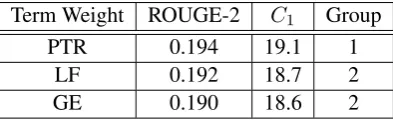
Table 2 gives a summary of the results. We ran a Wilcoxon test to check for statistical dis-tinguishability in the performance of the different term-weighting methods. Methods were placed in the same group if they produced results in cover-age (C1) that were indistinguishable. More
pre-cisely, we used the null hypothesis that the differ-ence between the vector of scores for two methods has median 0. If the p-value of two consecutive entries in the table was less than 0.05, the group label was increased and is shown in the last col-umn.
Log frequency (LF) and global entropy (GE) are correlated. For the DUC 2002 data they per-form comparably. Personalized term rank (PTR) weighting is statistically stronger than the other two approaches, as measured by the oracle term coverage score. For these data the definition of term for the purposes of the computation of the oracle coverage score is non-stop word stemmed (unigram) tokens.
3.2 Results for the Wikipedia Pilot at MultiLing 2013
This task involves single-document summariza-tion for 1200 Wikipedia feature articles: 30 uments in each of 40 languages. For each doc-ument, the organizers generated a baseline lead summary consisting of the first portion of the fea-ture article following the “hidden summary.” Sum-mary lengths were approximately 150 words for all non-ideograph languages and 500 characters for the ideograph languages. Sentences were
or-dered in the order selected by OCCAMS V. Thus, sentences covering the largest number of relevant terms, as measured by the term-weighting scheme, will appear first.
Results of this pilot study will be presented in detail in the overview workshop paper, but we note here that, as measured by ROUGE-1, in 19 of the 40 languages, at least one of our three submit-ted methods significantly outperformed the lead-summary baseline.
4 Dimensionality Reduction
The goal of dimensionality reduction is to iden-tify the major factors of the term-sentence ma-trixAand to throw away those factors which are “irrelevant” for summarization. Here we survey three algorithms: the well-known LSA, the more recent latent Dirichlet allocation (LDA), and the new interval-bounded nonnegative matrix factor-ization.
4.1 Latent Semantic Analysis
Davis et al. (2012) successfully used an approx-imation to A, computed using the singular value decomposition (SVD) A = U SVT. They used the first 200 columns U200 of the singular vector
matrixU and the corresponding part of the singu-lar value matrix S. They eliminated negative en-tries inU200 by taking absolute values. The term
weights were computed as the L1 norm (sum of
the entries) in the rows ofW =|U200|S200.
Our method is similar, except that we use 250 columns and form them in a slightly different way. Observe that in the SVD, if ui is a column of U andviT is a row ofV, then they can be replaced by −ui and −viT. This is true since if Dis any diagonal matrix with entries+1and−1, then
A=U SVT = (U D)S(DVT).
Therefore, we propose choosingDso that the sum of the positive entries in each column ofUis max-imized. Then we formUˆ by setting each negative entry ofU Dto zero and formW = ˆU250S250.
4.2 Latent Dirichlet Allocation
which each column represents a probability distri-bution over terms.
In this model, sentences are generated inde-pendently. We use the “pure-topic” LDA model and assume, for simplicity, that the length of the sentence is fixed a priori. First, a topic i ∈ {1, . . . , k}is chosen from the probability distribu-tionw. Then, terms are generated by sampling in-dependently from the distribution specified by the ith column of the matrixA.
We train this model using a recently-developed spectral algorithm based on third-order tensor de-compositions (Anandkumar et al., 2012a; Anand-kumar et al., 2012b). This algorithm is guaranteed to recover the parameters of the LDA model, pro-vided that the columns of the matrixAare linearly independent. For our experiments, we used a Mat-lab implementation from Hsu (2012).
4.3 Interval Bounded Nonnegative Matrix Factorization (IBNMF)
We also use a new method for dimensionality reduction, a nonnegative matrix factorization al-gorithm that handles uncertainty in a new way (O’Leary and et al., In preparation).
Since the term-sentence matrixAis not known with certainty, let’s suppose that we are given up-per and lower bound matrices U and L so that L ≤ A ≤ U. We compute a sparse nonnega-tive low-rank approximation toAof the formXY, where X is nonnegative (i.e., X ≥ 0) and has r columns and Y is nonnegative and hasr rows. This gives us an approximate nonnegative factor-ization ofAof rank at mostr.
We choose to measure closeness of two ma-trices using the Frobenius norm-squared, where
kZk2
F denotes the sum of the squares of the entries ofZ. SinceAis sparse, we also wantXandY to be sparse. We use the common trick of forcing this by minimizing the sum of the entries of the matri-ces, denoted by sum(X) +sum(Y). This leads us to determineXandY by choosing a weighting constantαand solving
min
X,Y,Z αkXY −Zk
2
F +sum(X) +sum(Y)
subject to the constraints
L≤ Z ≤U,
X ≥ 0, Y ≥ 0.
We simplify this problem by noting that for any W =XY, the entries of the optimalZare
zij =
`ij, wij ≤`ij, wij, `ij ≤wij ≤uij, uij, uij ≤wij.
We solve our minimization problem by an alter-nating algorithm, iterating by fixingXand deter-mining the optimalY and then fixing Y and de-termining the optimalX. Either non-negativity is imposed during the solution to the subproblems, making each step more expensive, or negative en-tries of the updated matrices are set to zero, ruin-ing theoretical convergence properties but yieldruin-ing a more practical algorithm. Each iteration reduces the distance to the term matrix, but setting nega-tive values to zero increases it again.
For our summarization system we choser= 50 andα = 1000. We scaled the rows of the matrix using global entropy weights and usedL = 0.9A andU = 1.1A.
4.4 Term Weighting and Dimension Choice for Multi-Document Summarization
A natural term weighting can be obtained by com-puting the row sums of the dimension-reduced approximation to the term-sentence matrix. For LSA, the resulting term weights are the sum of the entries in the rows of W = ˆU250S250. For
the LDA method the initial matrix is the matrix of counts. The model has three components similar to that of the SVD in LSA, and the term weights are computed analogously. For IBNMF, the term weights are the sum of the entries in the rows of the optimalXY.
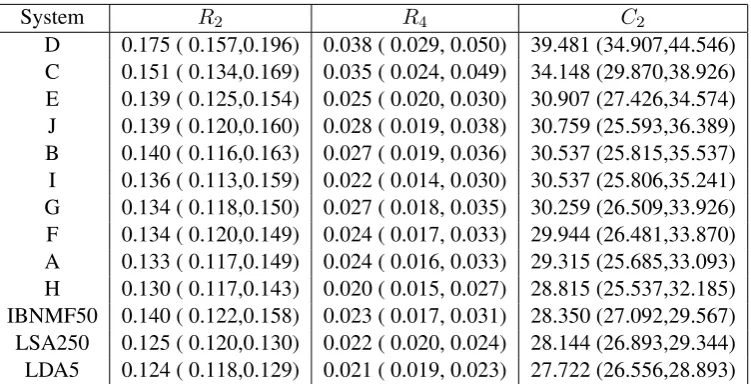
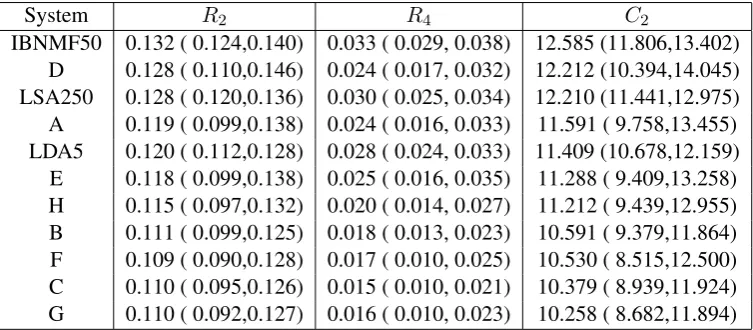
Each of the three dimensionality reduction methods require us to specify the dimension of the “topic space.” We explored this question using the DUC 2005-2007 and the TAC 2011 data. Tables 3, 4, 5, and 6 give the average 2, ROUGE-4, and bi-gram coverage scores, with confidence intervals, for the dimension that gave the best cov-erage. The optimal ranks were 250 for LSA, 5 for LDA, and 50 for IBNMF. We emphasize the these results are very strong despite the fact that no use of the topic descriptions or the guided summary aspects for the TAC 2010 and 2011 are used. Thus, we treat these data as if the task were to generate a generic summary, as is the case in the MultiLing 2013 task.2
2
ROUGE-System R2 R4 C2
[image:6.595.111.487.71.263.2]A 0.117 ( 0.106,0.129) 0.016 ( 0.011, 0.021) 26.333 (23.849,28.962) C 0.118 ( 0.105,0.131) 0.016 ( 0.012, 0.022) 25.882 (23.086,28.710) E 0.105 ( 0.092,0.120) 0.016 ( 0.010, 0.022) 23.625 (18.938,28.573) F 0.100 ( 0.089,0.111) 0.014 ( 0.010, 0.019) 23.500 (19.319,27.806) B 0.100 ( 0.086,0.115) 0.013 ( 0.008, 0.019) 23.118 (20.129,26.285) D 0.100 ( 0.089,0.113) 0.012 ( 0.007, 0.017) 22.957 (20.387,25.742) I 0.099 ( 0.085,0.116) 0.010 ( 0.007, 0.014) 21.806 (17.722,26.250) H 0.088 ( 0.077,0.101) 0.011 ( 0.007, 0.016) 20.972 (17.389,24.750) J 0.100 ( 0.090,0.111) 0.010 ( 0.007, 0.013) 20.472 (17.167,24.389) G 0.097 ( 0.085,0.108) 0.012 ( 0.008, 0.017) 20.111 (16.694,24.000) LSA250 0.085 ( 0.076,0.093) 0.008 ( 0.006, 0.009) 17.950 (17.072,18.838) IBNMF50 0.079 ( 0.068,0.089) 0.007 ( 0.005, 0.009) 17.730 (16.843,18.614) LDA5 0.077 ( 0.074,0.080) 0.008 ( 0.007, 0.009) 17.165 (16.320,18.024)
Table 3: DUC 2005
System R2 R4 C2
[image:6.595.111.491.301.496.2]C 0.133 ( 0.116,0.152) 0.025 ( 0.018, 0.033) 30.517 (26.750,34.908) D 0.124 ( 0.108,0.140) 0.017 ( 0.011, 0.023) 27.283 (23.567,31.050) B 0.118 ( 0.105,0.134) 0.015 ( 0.012, 0.020) 25.933 (23.333,29.033) G 0.113 ( 0.102,0.124) 0.016 ( 0.011, 0.022) 25.717 (23.342,28.017) H 0.108 ( 0.098,0.117) 0.013 ( 0.010, 0.016) 24.767 (22.433,27.067) F 0.109 ( 0.093,0.128) 0.016 ( 0.010, 0.023) 24.183 (20.650,28.292) I 0.106 ( 0.096,0.116) 0.012 ( 0.008, 0.015) 24.133 (22.133,26.283) J 0.107 ( 0.093,0.125) 0.015 ( 0.010, 0.022) 23.933 (20.908,27.233) A 0.104 ( 0.093,0.116) 0.015 ( 0.010, 0.022) 23.283 (20.483,26.283) E 0.104 ( 0.089,0.119) 0.014 ( 0.010, 0.020) 22.950 (19.833,26.450) LDA5 0.103 ( 0.099,0.107) 0.012 ( 0.011, 0.013) 22.620 (21.772,23.450) IBNMF50 0.095 ( 0.091,0.099) 0.010 ( 0.009, 0.011) 22.400 (21.615,23.177) LSA250 0.099 ( 0.096,0.103) 0.012 ( 0.011, 0.013) 22.335 (21.497,23.200)
Table 4: DUC 2006
System R2 R4 C2
D 0.175 ( 0.157,0.196) 0.038 ( 0.029, 0.050) 39.481 (34.907,44.546) C 0.151 ( 0.134,0.169) 0.035 ( 0.024, 0.049) 34.148 (29.870,38.926) E 0.139 ( 0.125,0.154) 0.025 ( 0.020, 0.030) 30.907 (27.426,34.574) J 0.139 ( 0.120,0.160) 0.028 ( 0.019, 0.038) 30.759 (25.593,36.389) B 0.140 ( 0.116,0.163) 0.027 ( 0.019, 0.036) 30.537 (25.815,35.537) I 0.136 ( 0.113,0.159) 0.022 ( 0.014, 0.030) 30.537 (25.806,35.241) G 0.134 ( 0.118,0.150) 0.027 ( 0.018, 0.035) 30.259 (26.509,33.926) F 0.134 ( 0.120,0.149) 0.024 ( 0.017, 0.033) 29.944 (26.481,33.870) A 0.133 ( 0.117,0.149) 0.024 ( 0.016, 0.033) 29.315 (25.685,33.093) H 0.130 ( 0.117,0.143) 0.020 ( 0.015, 0.027) 28.815 (25.537,32.185) IBNMF50 0.140 ( 0.122,0.158) 0.023 ( 0.017, 0.031) 28.350 (27.092,29.567) LSA250 0.125 ( 0.120,0.130) 0.022 ( 0.020, 0.024) 28.144 (26.893,29.344) LDA5 0.124 ( 0.118,0.129) 0.021 ( 0.019, 0.023) 27.722 (26.556,28.893)
[image:6.595.113.489.542.734.2]System R2 R4 C2
[image:7.595.111.488.64.229.2]IBNMF50 0.132 ( 0.124,0.140) 0.033 ( 0.029, 0.038) 12.585 (11.806,13.402) D 0.128 ( 0.110,0.146) 0.024 ( 0.017, 0.032) 12.212 (10.394,14.045) LSA250 0.128 ( 0.120,0.136) 0.030 ( 0.025, 0.034) 12.210 (11.441,12.975) A 0.119 ( 0.099,0.138) 0.024 ( 0.016, 0.033) 11.591 ( 9.758,13.455) LDA5 0.120 ( 0.112,0.128) 0.028 ( 0.024, 0.033) 11.409 (10.678,12.159) E 0.118 ( 0.099,0.138) 0.025 ( 0.016, 0.035) 11.288 ( 9.409,13.258) H 0.115 ( 0.097,0.132) 0.020 ( 0.014, 0.027) 11.212 ( 9.439,12.955) B 0.111 ( 0.099,0.125) 0.018 ( 0.013, 0.023) 10.591 ( 9.379,11.864) F 0.109 ( 0.090,0.128) 0.017 ( 0.010, 0.025) 10.530 ( 8.515,12.500) C 0.110 ( 0.095,0.126) 0.015 ( 0.010, 0.021) 10.379 ( 8.939,11.924) G 0.110 ( 0.092,0.127) 0.016 ( 0.010, 0.023) 10.258 ( 8.682,11.894)
Table 6: TAC 2011
5 Sentence Selection
Our sentence selection algorithm, OCCAMS V, is an extension of the one used in (Davis et al., 2012), which uses the(1−e−1/2)-approximation scheme for the Budgeted Maximal Coverage (BMC) problem and the Dynamic Programming based FPTAS for the knapsack problem.
AlgorithmOCCAMS V(T,D,W, c, L)
1.K1=Greedy BMC(T,D,W, c, L)
2.K2=Smax∪ Greedy BMC(T0,D0,W, c0, L0)),
whereSmax=argmax{Si∈D}
n P
tj∈Siw(tj)
o
andT0,D0,W, c0, L0represent quantities updated by deleting sentenceSmaxfrom the collection.
3.K3=KS(Greedy BMC(T,D,W, c,5L), L);
4.K4=KS(K40, L), where
K40 =Smax∪ Greedy BMC(T0,D0,W,C0,5L0));
5.K=argmaxk=1,2,3,4nP
T(Ki)w(ti) o
whereT(Ki)is the set of terms covered byKi.
This algorithm selects minimally overlapping sentences, thus reducing redundancy, while maxi-mizing term coverage. The algorithm guarantees a(1−e−1/2)approximation ratio for BMC.
We use the m terms T = {t1, . . . , tm} and their corresponding weightsW ={w1, . . . , wm}. We also use the nsentencesD = {S1, . . . , Sn}, where each Si is the set of terms in the ith sen-tence, so that Si ⊆ T. We define c to be a vec-tor whose components are the lengths of each sen-tence. Our algorithm, OCCAMS V, determines four candidate sets of summary sentences and then
2 scores reported in (Davis et al., 2012), where a rank 200 approximation and a large background corpus were used, are higher than the ones reported here, where a small self-background and a rank 250 approximation is used.
chooses the one with maximal coverage weight. The first three candidate sets were used in the OC-CAMS algorithm (Davis et al., 2012). The set K1 is determined using the Greedy BMC
heuris-tic of Khuller et al. (1999) to maximize the sum of weights corresponding to terms in the sum-mary sentences. The set K2 is determined the
same way, but the sentence that has the best sum of weights is forced to be included. The third candidate K3 is determined by applying a fully
polynomial-time approximation scheme (FPTAS) dynamic programming algorithm, denoted by KS, to the knapsack problem using sentences chosen by the Greedy BMC heuristic, asking for a length of5L. The fourth candidateK4is similar, but the
sentence with the best sum of weights is forced to be included in the input to KS.
OCCAMS V guarantees an approximation ratio of(1−e−1/2)for the result because the quality of
the solution chosen is no worse than the approxi-mation ratio achieved by the OCCAMS algorithm.
6 Coverage Results for MultiLing 2013
We defined a term oracle coverage score in Section 3.1, an automatic summarization evaluation score that computes the expected number of n-grams that a summary will have in common with a hu-man summary selected at random, assuming that humans select terms independently. As reported in (Davis et al., 2012), the 2-gram oracle cover-age correlates as well with human evaluations of English summaries as ROUGE-2 does for English newswire summaries.3 It is natural then to ask to what extent oracle coverage scores can predict a summary’s quality for other languages.
3
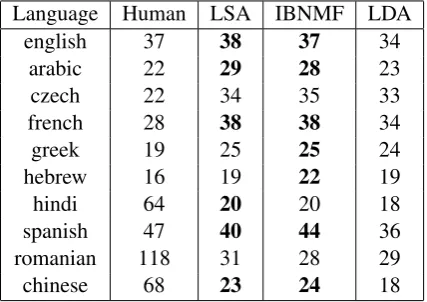
For each of the 10 MultiLing 2013 languages we can tokenize and generate bigrams (or charac-ter n-grams for Chinese) for the human-generated summaries and the machine-generated summaries. Table 7 gives the average oracle term (bi-gram) coverage score (C2) for the lowest-scoring human
and for each of the dimensionality reduction algo-rithms described in Section 4.
In all but four of the languages (Romanian, Hindi, Spanish, and Chinese), at least one of our methods scored higher than the lowest scoring hu-man. As with the DUC and TAC testing, the LDA method of term-weighting was the weakest of the three. In fact, in eight of the languages one or both of OCCAMS V(LSA) and OCCAMS V(IBNMF) (indicated in boldface in the table) scored signif-icantly higher than OCCAMS V(LDA) (p-value <0.05using a paired Wilcoxon test).
The human coverage scores for three of the lan-guages (Romanian, Hindi, and Chinese) are sur-prisingly high. Examining these data more closely indicates that a large number of the summaries are nearly identical. As an example, in one of the Ro-manian document sets, there were 266 bi-grams in the union of the three summaries, and the sum-mary length was 250. Document sets similar to this are the major cause of the anomalously high scores for humans in these languages.
Language Human LSA IBNMF LDA
english 37 38 37 34
arabic 22 29 28 23
czech 22 34 35 33
french 28 38 38 34
greek 19 25 25 24
hebrew 16 19 22 19
hindi 64 20 20 18
spanish 47 40 44 36
romanian 118 31 28 29
[image:8.595.75.289.475.626.2]chinese 68 23 24 18
Table 7: MultiLing 2013 Coverage Results
Human evaluation of the lingual multi-document summaries is currently under way. These evaluations will be extremely informative and will help measure to what extent ROUGE, coverage, and character n-gram based methods such as MeMoG (Giannakopoulos et al., 2010), are effective in predicting performance.
7 Conclusions and Future Work
In this paper we presented three term weight-ing approaches for sweight-ingle document multi-lweight-ingual summarization. These approaches were tested on the DUC 2002 data and on a submission to the MultiLing 2013 single document pilot task for all 40 languages. Automatic evaluation of these sum-maries with ROUGE-1 indicates that the strongest of the approaches significantly outperformed the lead baseline. The Wikipedia feature articles pose a challenge due to their variable summary size and genre. Further analysis of the results as well as hu-man evaluation of the submitted summaries would deepen our understanding.
A new nonnegative matrix factorization method, interval bounded nonnegative matrix factorization (IBNMF), was used. This method allows specifying interval bounds, which give an intuitive way to express uncertainty in the term-sentence matrix.
For MDS we presented a variation of a LSA term-weighting for OCCAMS V as well as novel use of both of the IBNMF and an LDA model.
Based on automatic evaluation using cover-age, it appears that the LSA method and the IBNMF term-weighting give rise to competitive summaries with term coverage scores approach-ing that of humans for 6 of the 10 languages. The automatic evaluation of these summaries, which should soon be finished, will be illuminating.
Note:Contributions to this article by NIST, an agency of the US government, are not subject to US copyright. Any men-tion of commercial products is for informamen-tion only, and does not imply recommendation or endorsement by NIST.
References
Anima Anandkumar, Dean P. Foster, Daniel Hsu, Sham
Kakade, and Yi-Kai Liu. 2012a. A spectral
al-gorithm for latent dirichlet allocation. In Peter L. Bartlett, Fernando C. N. Pereira, Christopher J. C. Burges, L´eon Bottou, and Kilian Q. Weinberger, ed-itors,NIPS, pages 926–934.
Anima Anandkumar, Rong Ge, Daniel Hsu, Sham M. Kakade, and Matus Telgarsky. 2012b. Tensor de-compositions for learning latent variable models. CoRR, abs/1210.7559.
David M. Blei, Andrew Y. Ng, and Michael I. Jordan.
2003. Latent dirichlet allocation. Journal of
John M. Conroy, Judith D. Schlesinger, and Dianne P.
O’Leary. 2006. Topic-focused multi-document
summarization using an approximate oracle score. InProceedings of the ACL’06/COLING’06 Confer-ences, pages 152–159, Sydney, Australia, July.
John M Conroy, Judith D Schlesinger, and Dianne P O’leary. 2009. Classy 2009: summarization and metrics.Proceedings of the text analysis conference (TAC).
John M Conroy, Judith D Schlesinger, Jeff Kubina, Pe-ter A Rankel, and Dianne P O’Leary. 2011. Classy 2011 at tac: Guided and multi-lingual summaries
and evaluation metrics. Proceedings of the Text
Analysis Conference.
Thomas M. Cover and Joy A. Thomas. 1991.
El-ements of information theory. Wiley-Interscience, New York, NY, USA.
Sashka T. Davis, John M. Conroy, and Judith D. Schlesinger. 2012. Occams - an optimal combina-torial covering algorithm for multi-document sum-marization. In Jilles Vreeken, Charles Ling, Mo-hammed Javeed Zaki, Arno Siebes, Jeffrey Xu Yu, Bart Goethals, Geoffrey I. Webb, and Xindong Wu,
editors, ICDM Workshops, pages 454–463. IEEE
Computer Society.
Susan T. Dumais. 1994. Latent semantic indexing
(lsi): Trec-3 report. InTREC, pages 105–115.
Ted Dunning. 1993. Accurate methods for the
statis-tics of surprise and coincidence. Computational
Linguistics, 19(1):61–74.
George Giannakopoulos, George A. Vouros, and
Van-gelis Karkaletsis. 2010. Mudos-ng:
Multi-document summaries using n-gram graphs (tech
re-port).CoRR, abs/1012.2042.
Daniel Hsu. 2012. Estimating a simple topic model.
http://cseweb.ucsd.edu/˜djhsu/
code/learn_topics.m.
Samir Khuller, Anna Moss, and Joseph Naor. 1999.
The Budgeted Maximum Coverage Problem. Inf.
Process. Lett., 70(1):39–45.
Chin-Yew Lin and Eduard Hovy. 2000. The automated acquisition of topic signatures for text summariza-tion. InProceedings of the 18th conference on Com-putational linguistics, pages 495–501, Morristown, NJ, USA. Association for Computational Linguis-tics.
Rada Mihalcea. 2005. Language independent
extrac-tive summarization. InProceedings of ACL 2005,
Ann Arbor, MI, USA.
Dianne P. O’Leary and et al. In preparation. An inter-val bounded nonnegative matrix factorization. Tech-nical report.
Lawrence Page, Sergey Brin, Rajeev Motwani, and Terry Winograd. 1999. The pagerank citation rank-ing: Bringing order to the web. Technical Report
1999-66, Stanford InfoLab, November. Previous
number = SIDL-WP-1999-0120.
Peter A. Rankel, John M. Conroy, and Judith D. Schlesinger. 2012. Better metrics to automatically
predict the quality of a text summary. Algorithms,
5(4):398–420.
Bob Rehder, Michael L. Littman, Susan T. Dumais, and Thomas K. Landauer. 1997. Automatic 3-language cross-language information retrieval with latent
se-mantic indexing. InTREC, pages 233–239.
Gerard Salton. 1991. The smart information retrieval system after 30 years - panel. In Abraham Book-stein, Yves Chiaramella, Gerard Salton, and Vijay V.
Raghavan, editors,SIGIR, pages 356–358. ACM.
Josef Steinberger and Karel Jezek. 2009. Update
summarization based on novel topic distribution. In ACM Symposium on Document Engineering, pages 205–213.
Lin Zhao, Lide Wu, and Xuanjing Huang. 2009. Using query expansion in graph-based approach for
query-focused multi-document summarization.