Multi-document Summarization Using Bipartite Graphs
Daraksha ParveenandMichael Strube Heidelberg Institute for Theoretical Studies gGmbH
Schloss-Wolfsbrunnenweg 35 69118 Heidelberg, Germany
(daraksha.parveen|michael.strube)@h-its.org
Abstract
In this paper, we introduce a novel graph based technique for topic based multi-document summarization. We transform documents into a bipartite graph where one set of nodes represents entities and the other set of nodes represents sentences. To obtain the summary we apply a ranking technique to the bipartite graph which is followed by an optimization step. We test the performance of our method on several DUC datasets and compare it to the state-of-the-art.
1 Introduction
Topic-based multi-document summarization aims to create a single summary from a set of given documents while considering the topic of inter-est. The input documents can be created by query-ing an information retrieval or search engine for a particular topic and retaining highly ranked docu-ments, or by clustering documents of a large col-lection and then using each cluster as a set of input documents (Galanis et al., 2012). Here, each clus-ter of the set of documents contains a representa-tive topic.
A summary extracted from a set of input doc-uments must be related to the topic of that set. If textual units (or sentences) extracted from different documents convey the same informa-tion, then those units are called redundant. Ide-ally, the multi-document summary should be non-redundant. Hence each textual unit in a summary should convey unique information. Still, all ex-tracted textual units should be related to the topic. They should also make up a coherent summary.
When building summaries from multiple docu-ments belonging to different sets, a system should attempt to optimize these three basic properties:
1. Relevance: A summary should contain only
those textual units which are relevant to the topic and provide useful information.
2. Non-redundancy: A summary should not contain the same information twice.
3. Readability: A summary should have good readability (syntactically well formed, no dangling pronouns, coherent, . . . ).
Generally, multi-document summarization sys-tems differ from each other on the basis of docu-ment representation, sentence selection method or on the requirements for the output summary. Pop-ular methods for document representation include graph-based representations (e.g.LexRank(Erkan and Radev, 2004) andTextRank(Mihalcea and Ta-rau, 2004)) and tf-idf vector-based representations (Luhn, 1958; Nenkova and Vanderwende, 2005; Goldstein et al., 2000). These document represen-tations act as input for the next phase and provide information about the importance of individual sentences. Sentence selection is the crucial phase of the summarizer where sentence redundancy must be handled in an efficient way. A widely used technique is the greedy approach introduced by Carbonell and Goldstein (1998) and Goldstein et al. (2000). They compute a relevance score for all sentences with regard to the topic, start by ex-tracting the most relevant sentence, and then itera-tively extract further sentences which are relevant to the topic and at the same time most dissimilar to already extracted sentences. Later more fun-damental optimization methods have been widely used in multi-document summarization, e.g. Inte-ger Linear Programming (ILP) (McDonald, 2007; Gillick et al., 2009; Nishikawa et al., 2010; Gala-nis et al., 2012). Unlike most other approaches (Galanis et al., 2012) has also taken into account the readability of the final summary.
In this work, we introduce an extractive topic based multi-document summarization sys-tem which represents documents graphically and
optimizes the importance of sentences and non-redundancy. The importance of sentences is ob-tained by means of applying the Hubs and Author-ities ranking algorithm (Kleinberg, 1999) on the unweighted bipartite graph whereas redundancy in the final summary is dealt with entities in a graph. In Section 2 we introduce the state-of-the-art in topic based multi-document summarizaton. Sec-tion 3 provides a detailed descripSec-tion of our ap-proach. Experiments are described in Section 4 where we also briefly describe the datasets used and the results. Section 5 discusses the results of our approach, and in Section 6 we finally give con-clusions.
2 Related work
A graph-based representation of documents for summarization is adopted by various approaches. For instance, TextRank by Mihalcea and Tarau (2004) applies thePageRankalgorithm (Brin and Page, 1998) to extract important sentences for sin-gle document summarization. This ranking algo-rithm proclaims the importance of a sentence by considering the global information which is com-puted recursively from the entire graph. Later, the graph is converted into a weighted graph in which the weights are calculated by measuring the similarity of sentences (Mihalcea, 2004). Simi-larly, in theLexRankapproach (Erkan and Radev, 2004), documents are represented as a similarity graph in which the sentences are nodes and these sentences are then ranked according to centrality measures. The three centrality measures used are degree, LexRank with threshold and continuous LexRank.LexRankis a measure to calculate ranks using the similarity graph of sentences. It is also known as lexical PageRank. The summarization approach developed by Gong and Liu (2001) is also based on ranking sentences where important sentences are selected using a relevance measure and latent semantic analysis.
Later, for better performance, sentences are classified according to their existence in their final summary in binary format i.e. 1 (belongs to sum-mary) and 0 (doesn’t belong to sumsum-mary) (Shen et al., 2007; Gong and Liu, 2001). Here, the sen-tences are projected as feature vectors and con-ditional random fields are used to classify them. During document processing, most informative sentences are selected by the summarizer (Shen et al., 2007). Fattah and Ren (2009) also
consid-ers summarization as two class classification prob-lem. They use a genetic algorithm and mathemati-cal regression to select appropriate weights for the features and used different classification technique for e.g. feed forward neural network, probablistic neural network and Gaussian mixture models.
In the summarization task, optimization of the three properties discussed in Section 1, relevance, non-redundancy and readability, is required. This is a global inference problem, which can be solved by two approaches. Firstly, relevance and redun-dancy can be optimized simultaneously. For in-stance, Goldstein et al. (2000) developed a met-ric named MMR-MD (influenced by the Max-imum Marginal Relevance (MMR) approach of Carbonell and Goldstein (1998)) and applied it to clusters of passages. Similarly, influenced by the SumBasic system (Nenkova and Vanderwende, 2005), Yih et al. (2007) developed a system which assigns a score to each term on the basis of po-sition and frequency information and selects the sentence having highest score. Other approaches are based on an estimate of word importance (e.g. Lin and Hovy (2000)) or the log likelihood ratio test which identifies the importance of words using a supervised model that considers a rich set of fea-tures (Hong and Nenkova, 2014). Finally, Barzi-lay and Elhadad (1999) extract sentences which are strongly connected by lexical chains for sum-marization. The second approach deals with rel-evance and redundancy seperately. For instance, McKeown et al. (1999) create clusters of similar sentences and pick the representative one from ev-ery cluster. The representative sentence of a clus-ter of sentences takes care of the requirement to extract relevant information whereas clustering re-duces the redundancy.
3 Our method
This section describes the technique, which we adopted for summarization. We start by discussing the graphical representation of the text followed by a description how to quantify the importance of sentences in the input texts. We then discuss the ILP technique which optimizes the importance of sentences and redundancy.
3.1 Graphical representation of text
The graphical representation of a text makes it more expressive than a traditionaltf-idf depiction for summarization. A graph can easily capture the essence of the whole text without leading to high computational complexity. Guinaudeau and Strube (2013) introduced a bipartite graph repre-sentation of text based on the entity grid (Barzilay and Lapata, 2008) representation of text. The pro-jection of this bipartite graph representation has been used for calculating the local coherence of a text (Guinaudeau and Strube, 2013). The basic intuition to use a bipartite graph for summariza-tion is that it contains entity transisummariza-tions similar to lexical chains (Barzilay and Elhadad, 1999). An appropriate measure to determine the importance of sentences by considering strong entity transi-tions indicates the information central to a text bet-ter than simply giving scores on the basis of most frequent words. The unweighted bipartite graph
G = (Vs, Ve, L) contains two sets of nodes, Vs
corresponding to the sentences from the input text and Ve corresonding to the entities, and a set of
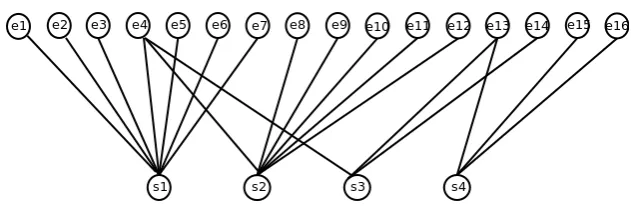
edges represented byL. Figure 1 shows a model summary from the DUC 2006 data, which is trans-formed into an entity grid in Figure 2 (Barzilay and Lapata, 2008; Elsner and Charniak, 2011). Here, cells are filled with the syntactic role a men-tion of an entity occupies in a sentence. Subjects are denoted byS, objects byOand all other roles by X. If an entity is not mentioned in a sentence then the corresponding cell contains “-”. In the corresponding bipartite graph (Figure 3), edges are created between a sentence and an entity only if the entity is mentioned in a sentence (the cell in entity grid is not “-”). Since this is a dyadic graph, there are no edges between nodes of the same set.
3.2 Ranking the importance of sentences
A graph based ranking algorithm is used to cal-culate the importance of a sentence represented as a node in the graph discussed above. In
con-trast to the local information specific to a ver-tex, graphical ranking algorithms take (graph-) global information to calculate the rank of a node. The Hyperlink-Induced Topic Search algorithm (HITS, also known as Hubs and Authorities) by Kleinberg (1999) is used to rank sentences in our method. This algorithm considers two types of nodes, hence it is well suited to rank sentences in our bipartite graph. Entities are considered as hub nodes, and sentences are considered as authority nodes. The importance of a sentence is calculated in two steps:
• Hub update rule: Update each node’s hub score to be equal to the sum of the author-ity scores of each node that it points to. It can be written as:
HubScore=A·AuthorityScore (1)
Here, A is an adjacency matrix which represents the connection between the nodes in a graph.
• Authority update rule: In this step, each au-thority node is updated by equating them to the sum of the hub scores of each node, which is pointing to that authority node. It can be written as:
AuthorityScore=AT ·HubScore (2)
Hence, the authority weight is high if it is pointed at by a hub having high weights.
Given some intial ranks to all nodes in a graph, the hub and authority update rules are applied un-til convergence. After applying this algorithm, the rank of every node is obtained. The rank is consid-ered as importance of the node within the graph. We normalize the ranks of sentences according to sentence length to avoid assigning high ranks to long sentences.
To incorporate important information from doc-uments, ranks of entities are incremented by
Rank+tfdoc·idfdocin every iteration, wheretfdoc
shows the importance of an entity in a document by calculating the frequency whereas idfdoc is an
inverse document frequency from the current clus-ter. Rank+tfdoc·idfdocis used in calculating the
S1 The treatment of osteoarthritis includes a number of non-steroidal anti-inflammatory drugs such as aspirin, acetaminophen, and ibuprofen.
S2 These drugs, however, cause liver damage and gastrointestinal bleeding and contribute to thousands of hospitalizations and deaths per year.
S3 New cox-2 inhibitor drugs are proven as effective against pain, with fewer gastrointestinal side effects.
[image:4.595.134.505.208.363.2]S4 The two together appeared to reduce knee pain after 8 weeks.
Figure 1: Model summary from DUC 2006
TREA TMENT
(e1)
OSTEO
ARTHRITIS (e2)
NUMBER (e3)
DRUGS (e4)
ASPIRIN (e5)
ACET
AMINOPHEN(e6) IBUPR
OFEN (e7)
DAMA GE(e8)
BLEEDING (e9)
THOUSANDS (e10)
DEA THS
(e11)
YEAR (e12)
PAIN (e13) EFFECTS
(e14)
TWO (e15) WEEKS
(e16)
S1 S X O X X X X - - -
-S2 - - - S - - - O O X X X - - -
-S3 - - - S - - - X X -
-S4 - - - O - S X
[image:4.595.140.456.416.519.2]Figure 2: Entity grid of the model summary from Figure 1
Figure 3: Bipartite graph derived from the entity grid from Figure 2
3.3 Optimization algorithm
In topic-based multi-document summarization, the final summary should be non-redundant. At the same time it should contain the important in-formation from the documents. To achieve these two conditions, we employ integer linear program-ming (ILP) to obtain an optimal solution. In ILP we maximize an objective function. Our objective function, given in Equation 3, has two parts: the importance of a summary and the non-redundancy of a summary. The values obtained after ranking by the HITS algorithm are used as the importance of sentences for ILP. Non-redundancy can not be calculated for a single sentence. Instead, it has to
be evaluated with respect to other sentences. We calculate non-redundancy by the number of un-shared entities, i.e. entities which are not un-shared by other sentences, after appending a sentence to a summary. The least redundant sentence will in-crease the number of entities in the final summary.
max(λ1
n X
i=1
(Rank(si) +topicsim(si))·xi
+λ2
m X
j=1
yj)
(3)
Topic Documents per topic Human Summaries Word limit in final summary
DUC 2005 50 25-50 4-9 250
DUC 2006 50 25 4 250
[image:5.595.83.516.64.119.2]DUC 2007 45 25 4 250
Table 1: Document Statistics
the number of entities in a document andnis the number of sentences in a document. xiandyj are
binary variables for sentences and entities respec-tively.λ1andλ2are tuning parameters.Rank(si)
is a rank of a sentencesi obtained by applying the
HITS algorithm. Since, we work on topic-based multi-document summarization, we include topic information by calculating topicsim(si), which
captures the cosine similarity of a sentencesiwith
the corresponding topic. If the topic contains more than one sentence then we take an average of co-sine similarity with a sentencesi. The constraints
on the variables are shown in Equations 4-6:
n X
i=1
Len(si)·xi≤Len(summary) (4)
Here, Len(si) and Len(summary) are the
number of words in a sentence si and in the
fi-nal summary, respectively. This constraint does not allow the length of final summary to exceed its maximum length. The maximum length varies de-pending on the datasets discussed in Section 4.1.
X
jEi
yj ≥Entities(si),fori= 1, . . . , n (5)
In constraint 5,Ei is a set of entities present in
a sentencesi. The number of entities present in a
sentence is represented asEntities(si). If a
sen-tence si is selected then the entities present in a
sentence are also selected(Pyj =Entities(si)).
Whereas, if a sentence si is not selected then
some of its entities can also be selected because they may appear in already selected sentences (Entities(si) = 0, ∴ Pyj ≥ 0). In both the
cases, constraint 5 is not violated.
X
iSj
xi ≥yj, forj= 1, . . . , m (6)
In constraint 6,Sjis a set of sentences
contain-ing entityyj. This constraint shows that, if an
en-tityyj is selected then at least one sentence is
se-lected which contains it (yj = 1,∴Pxi ≥1). If
an entityyj is not selected, then it is possible that
none of the sentences which contain it may not be selected (yj = 0,∴Pxi= 0). Also, constraint 4
holds in either of the cases.
4 Experiments
We perform experiments on various DUC datasets to compare the results with state-of-the-art sys-tems.
4.1 Datasets
Datasets used for our experiments are DUC2005 (Dang, 2005), DUC2006 (Dang, 2006) and DUC20071 . Each dataset contains group of re-lated documents. Each group of documents con-tains one related topic or a query consisting of a few sentences. In DUC, the final summary should respond to the corresponding topic. Also, the sum-mary cannot exceed the maximum allowed length. For instance, in DUC2005, 250 words are allowed in the final summary. Every document cluster has corresponding human summaries for evaluating system summaries on the basis of ROUGE scores (Lin, 2004). The sources of DUC datasets are Los Angeles Times, Financial Times of London, As-sociated Press, New York Times and Xinhua news agency. We employ ROUGE SU4 and ROUGE 2 as evaluation metrics. ROUGE returns recall, pcision and F-score of a system, but usually only re-call is used in for evaluating automatic summariza-tion systems, because the final summary does not contain many words. Hence, if the recall is high then the summarization system is working well. Document statistics is provided in Table 1.
4.2 Experimental setup
We use raw documents from the various DUC datasets as input for our system. We remove non-alphabetical characters from the documents. Then we obtain a clean sentence split by means of the Stanford parser (Klein and Manning, 2003) so that the sentences are compatible with the next steps.
1http://www-nlpir.nist.gov/projects/
ROUGE-2 ROUGE-SU4
λ1= 0.5&λ2 = 0.5 0.07950 0.14060
λ1= 0.6&λ2 = 0.4 0.07956 0.14071
λ1= 0.7&λ2 = 0.3 0.07975 0.14105
λ1= 0.8&λ2 = 0.2 0.07976 0.14106
[image:6.595.73.296.60.144.2]λ1= 0.9&λ2 = 0.1 0.07985 0.14107 Table 2: Results on differentλ’s on DUC 2005
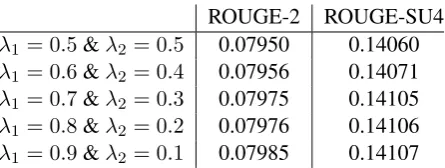
We use the Brown coherence toolkit (Elsner and Charniak, 2011) to convert the documents into the entity grid representation from which the bipar-tite graph is constructed (Guinaudeau and Strube, 2013). Entities in the graph correspond to head nouns of noun phrase mentioned in the sentences. The ranking algorithm from Section 3.2 is applied to this graph and returns the importance score of a sentence as required by the objective function given in Equation 3. Next optimization using ILP is performed as described in Section 3.3. We use GUROBI Optimizer2for performing ILP. ILP re-turns a binary value, i.e., if a sentence should be included in the summary it returns1, if not it re-turns 0. We set λ1 = 0.7 and λ2 = 0.3 for all datasets. We did not choose the optimal val-ues, but rather opted for ones which favor impor-tance over non-redundancy. We did not observe significant differences between different λvalues as long asλ1 > λ2(see Table 2). The sentences in the output summary are ordered according to their ranks. If the output summary contains pronouns, we perform pronoun resolution in the source doc-uments using the coreference resolution system by Martschat (2013). If pronoun and antecedent oc-cur in the same sentence, we leave the pronoun. If the antecedent occurs in an earlier sentence, we replace the pronoun in the summary by the first element of the coreference chain the pronoun be-longs to. Except for setting λ1 and λ2 on DUC 2005, our approach is unsupervised, as there is no traning data required. The recall (ROUGE) scores on different datasets are shown in Table 3.
Table 3 shows that our system would have per-formed very well in the DUC 2005 and DUC 2006 competitions with ranks in the top 3 and well in the DUC 2007 competition. Since the compe-titions date a while back, we compare in addi-tion to the current state-of-art in multi-document summarization. To our knowledge Galanis et al.
2Gurobi Optimization, Inc., http://www.gurobi.
com
Dataset ROUGE-2 ROUGE-SU4 DUC 2005 (32) 0.07975 (1) 0.14105 (1) DUC 2006 (35) 0.08969 (3) 0.15070 (2) DUC 2007 (32) 0.10928 (6) 0.16735 (5) Table 3: System performance (and rank) on the DUC 2005, 2006 and 2007 (main) data. The num-ber in parenthesis after the DUC year indicates the number of competing systems.
(2012) report the best results on DUC 2005 data. While their ROUGE-2 score is slightly better than ours, we outperform them in terms of ROUGE-SU4 (0.14105vs.0.13640), where, to our knowl-edge, our results are the highest reported so far. However, their results on DUC 2007 (ROUGE-2
0.12517and ROUGE-SU40.17603) are still quite a bit better than our results. On the DUC 2006 data we outperform the HIERSUM system by Haghighi and Vanderwende (2009) on ROUGE-2 (0.08969 vs. 0.086) as well as on ROUGE-SU4 (0.15070 vs. 0.143). On the DUC 2007 data, our results are worse than theirs on ROUGE-2 (0.10928 vs. 0.118) and on par on ROUGE-SU4 (0.16735vs.0.167). The system which won the DUC 2007 task, PYTHY by Toutanova et al. (2007), performs similar to HIERSUM and hence slightly better than our system on these data. The recent work by Suzuki and Fukumoto (2014) eval-uates also on DUC 2007 but reports only ROUGE-1 scores. We obtain a ROUGE-ROUGE-1 score of0.448on DUC 2007 which is better than Suzuki and Fuku-moto (2014) (0.438) as well as PYTHY (0.426). The best ROUGE-1 score reported to date has been reported by Celikyilmaz and Hakkani-T¨ur (2010) with 0.456. The difference between this score and our score of0.448is rather small.
5 Discussion
Several approaches have been proposed for topic based multi-document summarization on the DUC datasets we use for our experiments. The best re-sults to date have been obtained by supervised and semi-supervised systems. The results of our sys-tem are mostly on par with these syssys-tems though our system is unsupervised (as mentioned in Sec-tion 4 the values for λ1 and λ2 in the objective function (Equation 3) were not tuned for optimal ROUGE scores but rather set for favoring impor-tance over non-redundancy).
state-of-S1 What is being learned from the study of deep water, seabeds, and deep water life?
S2 What equipment and techniques are used?
S3 What are plans for future related activity?
Figure 4: Topic containing interrogative words from DUC 2007
S1 I’ve started to use irrigation hoses called “leaky pipe”.
S2 Soil’s usually best to water the target area a few days before I plan to dig.
S3 If I don’t place element in the root zone , element can’t be added later when the plants are growing.
S4 The new composts were much lighter and more suitable for container plants in garden centres and through these were rapidly introduced to gardeners.
Figure 5: Sentences containing dangling first person pronoun from DUC 2005
the-art systems, and our system is giving compet-itive results in both ROUGE-2 and ROUGE-SU4 scores. However, the ROUGE-2 score of Galanis et al. (2012) on DUC 2005 is slightly better than our score. This might be because they use bigram information for redundancy reduction. However, they need training data for sentence importance. Hence their system has to be classified as super-vised while ours is unsupersuper-vised.
We have also calculated the ROUGE-1 score on DUC 2007 and compared it with state-of-the-art approaches. HybHsum (Celikyilmaz and Hakkani-T¨ur, 2010) has obtained the top ROUGE-1 score on DUC 2007 with 0.456. However, HybHsum is a semi-supervised approach which requires a labeled training data. The difference between our ROUGE-1 score of0.448and HybH-sum ROUGE-1 score on DUC2007 is not signif-icant (to be fair, achieving signifsignif-icant improve-ments in ROUGE scores on DUC data is very dif-ficult). In contrast to HybHsum, our approach is unsupervised.
Our method computes importance on the basis of a bipartite graph. We believe that our bipartite graph captures more information than the general graphs used in earlier graph-based approaches to automatic summarization. Entity transition infor-mation present in the bipartite graph of a docu-ment, helps us in finding the salient sentences. Our approach works well if the graph is not sparse.
We observed a couple of problems in the out-put of our system which we plan to address in
future work. If topics contain interrogative pro-nouns as shown in Figure 4 the mapping between topic and sentences from the documents does not work well. We need to resolve which entities the interrogative pronouns refer to. Another problem occurs, because the coreference resolution system employed does not resolve first person pronouns. Hence, we end up with summaries containing dan-gling first person pronouns as shown in Figure 5. However, our system appears to work reasonably well in other cases where the summaries are co-herent and readable and also have a high ROUGE score as shown in the summary from DUC 2007 data in Figure 6.
6 Conclusions
In this paper, we have presented an unsuper-vised graph based approach for topic based multi-document summarization. Our graph based ap-proach provides state-of-the-art results on various datasets taken from DUC competitions. The graph based representation of a document makes com-putation very efficient and less complex. In future work, we incorporate the syntactic roles of enti-ties, to provide more information in the method.
Acknowledgments
The European Parliament , angered by Turkey ’s human rights record , voted Thursday to freeze hundreds of millions of US dollars in aid to Turkey for setting up a customs union with the EU. Since then , the EU has been trying to patch up the relationship , with several leaders of member countries insisting that Turkey ’s place is in the union. The special aid is part of the agreement between the European Union EU and Turkey on the establishment of a customs union between the two sides. “ The European Union , without renouncing its principles , ” will have to decide in December to allow Turkey to become a formal candidate for EU membership. ANKARA , February 27 Xinhua Turkey today welcomed the European Union ’s attitude toward its dispute with Greece and urged the EU to release financial assistance immediately despite Greek efforts to block it. After the decision in December to exclude Turkey from the first wave of enlargement talks , Turkey put its relations with the 15 member union on hold. During Solana stay here , Turkish leaders reiterated their position to link the expansion of the NATO with Turkey ’s entry into the European Union. The European Union , European Union Ankara wants to join , is pressing Turkey to find a peaceful solution to the war. The statement added that Greece , despite its attempts , was unable to get the support of the other 14 European Union members in getting a statement that would express solidarity with Greece and condemn Turkey. Both the European Union and the United States criticized Turkey for jailing Birdal.
Figure 6: Output summary from DUC 2007
Acknowledgments
This work has been funded by Klaus Tschira Foundation, Heidelberg, Germany. The first au-thor has been supported by a Heidelberg Institute for Theoretical Studies Ph.D. scholarship.
References
Regina Barzilay and Michael Elhadad. 1999. Us-ing lexical chains for text summarization. In
Inder-jeet Mani and Mark T. Maybury, editors,Advances
in Automatic Text Summarization, pages 111–121. Cambridge, Mass.: MIT Press.
Regina Barzilay and Mirella Lapata. 2008. Modeling
local coherence: An entity-based approach.
Compu-tational Linguistics, 34(1):1–34.
Taylor Berg-Kirkpatrick, Dan Gillick, and Dan Klein. 2011. Jointly learning to extract and compress. In
Proceedings of the 49th Annual Meeting of the As-sociation for Computational Linguistics, Portland, Oreg., 19–24 June 2011, pages 481–490.
Sergey Brin and Lawrence Page. 1998. The
anatomy of a large-scale hypertextual web search
engine. Computer Networks and ISDN Systems,
30(1–7):107–117.
Jaime G. Carbonell and Jade Goldstein. 1998. The use of MMR, diversity-based reranking for reordering
documents and producing summaries. In
Proceed-ings of the 21st Annual International ACM-SIGIR Conference on Research and Development in Infor-mation Retrieval,Melbourne, Australia, 24–28 Au-gust 1998, pages 335–336.
Asli Celikyilmaz and Dilek Hakkani-T¨ur. 2010. A hy-brid hierarchical model for multi-document
summa-rization. InProceedings of the 48th Annual
Meet-ing of the Association for Computational LMeet-inguis- Linguis-tics,Uppsala, Sweden, 11–16 July 2010, pages 815– 824.
Hoa Trang Dang. 2005. Overview of DUC 2005. In
Proceedings of the 2005 Document Understanding Conference held at the Human Language Technol-ogy Conference and Conference on Empirical Meth-ods in Natural Language Processing, Vancouver, B.C., Canada, 9–10 October 2005.
Hoa Trang Dang. 2006. Overview of DUC 2006. In
Proceedings of the 2006 Document Understanding Conference held at the Human Language Technol-ogy Conference of the North American Chapter of the Association for Computational Linguistics,New York, N.Y., 8–9 June 2006.
Micha Elsner and Eugene Charniak. 2011. Extending the entity grid with entity-specific features. In Pro-ceedings of the ACL 2011 Conference Short Papers,
Portland, Oreg., 19–24 June 2011, pages 125–129. G¨unes¸ Erkan and Dragomir R. Radev. 2004. LexRank:
Graph-based lexical centrality as salience in text
summarization. Journal of Artificial Intelligence
Research, 22:457–479.
Mohamed Abdel Fattah and Fuji Ren. 2009. GA, MR, FFNN, PNN and GMM based models for
au-tomatic text summarization. Computer Speech and
Language, 23(1):126–144.
Dimitrios Galanis, Gerasimos Lampouras, and Ion An-droutsopoulos. 2012. Extractive multi-document summarization with integer linear programming and
support vector regression. In Proceedings of the
Daniel Gillick, Korbinian Riedhammer, Benoit Favre, and Dilek Hakkani-T¨ur. 2009. A global
optimiza-tion framework for meeting summarizaoptimiza-tion. In
Pro-ceedings of the 2009 IEEE International Conference on Acoustics, Speech, and Signal Processing,Taipei, Taiwan, 19–24 June 2009, pages 4769–4772.
Jade Goldstein, Vibhu Mittal, Jaime Carbonell, and Mark Kantrowitz. 2000. Multi-document
sum-marization by sentence extraction. InProceedings
of the Workshop on Automatic Summarization at ANLP/NAACL 2000,Seattle, Wash., 30 April 2000, pages 40–48.
Yihong Gong and Xin Liu. 2001. Generic text summa-rization using relevance measure and latent semantic
analysis. InProceedings of the 24th Annual
Inter-national ACM SIGIR Conference on Research and Development in Information RetrievalNew Orleans, Louis., 9–12 September 2001, pages 19–25.
Camille Guinaudeau and Michael Strube. 2013.
Graph-based local coherence modeling. In
Proceed-ings of the 51st Annual Meeting of the Association for Computational Linguistics,Sofia, Bulgaria, 4–9 August 2013, pages 93–103.
Aria Haghighi and Lucy Vanderwende. 2009. Explor-ing content models for multi-document
summariza-tion. InProceedings of Human Language
Technolo-gies 2009: The Conference of the North American Chapter of the Association for Computational Lin-guistics,Boulder, Col., 31 May – 5 June 2009, pages 362–370.
Kai Hong and Ani Nenkova. 2014. Improving
the estimation of word importance for news
multi-document summarization. In Proceedings of the
14th Conference of the European Chapter of the Association for Computational Linguistics, Gothen-burg, Sweden, 26–30 April 2014, pages 712–721.
Dan Klein and Christopher D. Manning. 2003. Ac-curate unlexicalized parsing. InProceedings of the 41st Annual Meeting of the Association for Com-putational Linguistics, Sapporo, Japan, 7–12 July 2003, pages 423–430.
Jon M. Kleinberg. 1999. Authoritative sources in
a hyperlinked environment. Journal of the ACM,
46(5):604–632.
Chin-Yew Lin and Eduard Hovy. 2000. The auto-mated acquisition of topic signatures for automatic
summarization. In Proceedings of the 18th
Inter-national Conference on Computational Linguistics,
Saarbr¨ucken, Germany, 31 July – 4 August 2000, pages 495–501.
Chin-Yew Lin. 2004. ROUGE: A package for
auto-matic evaluation of summaries. InProceedings of
the Text Summarization Branches Out Workshop at ACL ’04,Barcelona, Spain, 25–26 July 2004, pages 74–81.
H.P. Luhn. 1958. The automatic creation of literature
abstracts. IBM Journal of Research and
Develop-ment, 2:159–165.
Sebastian Martschat. 2013. Multigraph clustering for
unsupervised coreference resolution. In
Proceed-ings of the Student Research Workshop at the 51st Annual Meeting of the Association for Computa-tional Linguistics,Sofia, Bulgaria, 5–7 August 2013, pages 81–88.
Ryan McDonald. 2007. A study of global inference
al-gorithms in multi-document summarization. In
Pro-ceedings of the European Conference on Informa-tion Retrieval,Rome, Italy, 2-5 April 2007.
Kathleen R. McKeown, Judith L. Klavans, Vassileios Hatzivassiloglou, Regina Barzilay, and Eleazar Es-kin. 1999. Towards multidocument summarization
by reformulation: Progress and prospects. In
Pro-ceedings of the 16th National Conference on Arti-ficial Intelligence, Orlando, Flo., 18–22 July 1999, pages 453–460.
Rada Mihalcea and Paul Tarau. 2004. TextRank:
Bringing order into texts. In Proceedings of the
2004 Conference on Empirical Methods in Natural Language Processing,Barcelona, Spain, 25–26 July 2004, pages 404–411.
Rada Mihalcea. 2004. Graph-based ranking algo-rithms for sentence extraction, applied to text
sum-marization. InCompanion Volume to the
Proceed-ings of the 42nd Annual Meeting of the Association for Computational Linguistics, Barcelona, Spain, 21–26 July 2004, pages 170–173.
Ani Nenkova and Lucy Vanderwende. 2005. The im-pact of frequency on summarization. Technical Re-port MSR-TR-2005-101, Microsoft Research. Hitoshi Nishikawa, Takaaki Hasegawa, Yoshihiro
Mat-suo, and Genichiro Kikui. 2010. Opinion summa-rization with integer linear programming
formula-tion for sentence extracformula-tion and ordering. In
Pro-ceedings of the 23rd International Conference on Computational Linguistics, Beijing, China, 23–27 August 2010, pages 910–918.
Dou Shen, Jian-Tao Sun, Hua Li, Qiang Yang, and Zheng Chen. 2007. Document summarization
us-ing conditional random fields. In Proceedings of
the 20th International Joint Conference on Artificial Intelligence,Hyderabad, India, 6–12 January 2007, pages 2862–2867.
Yoshimi Suzuki and Fumiyo Fukumoto. 2014. De-tection of topic and its extrinsic evaluation through
multi-document summarization. In Proceedings of
the ACL 2014 Conference Short Papers,Baltimore, Md., 22–27 June 2014, pages 241–246.
InProceedings of the 2007 Document Understand-ing Conference held at the Human Language Tech-nology Conference of the North American Chapter of the Association for Computational Linguistics,
Rochester, N.Y., 26–27 April 2007.
Kristian Woodsend and Mirella Lapata. 2012. Mul-tiple aspect summarization using integer linear
pro-gramming. InProceedings of the 2012 Conference
on Empirical Methods in Natural Language Pro-cessing and Natural Language Learning, Jeju Is-land, Korea, 12–14 July 2012, pages 233–242. Wen-tau Yih, Joshua Goodman, Lucy Vanderwende,