User Modeling by Using Bag-of-Behaviors for Building a Dialog System
Sensitive to the Interlocutor’s Internal State
Yuya Chiba, Takashi Nose, Akinori Ito Graduate School of Engineering,
Tohoku University, Japan
Masashi Ito Faculty of Engineering
Tohoku Institute of Technology, Japan
Abstract
When using spoken dialog systems in ac-tual environments, users sometimes aban-don the dialog without making any in-put utterance. To help these users before they give up, the system should know why they could not make an utterance. Thus, we have examined a method to estimate the state of a dialog user by capturing the user’s non-verbal behavior even when the user’s utterance is not observed. The pro-posed method is based on vector quan-tization of multi-modal features such as non-verbal speech, feature points of the face, and gaze. The histogram of the VQ code is used as a feature for determining the state. We call this feature “the Bag-of-Behaviors.” According to the experi-mental results, we prove that the proposed method surpassed the results of conven-tional approaches and discriminated the target user’s states with an accuracy of more than 70%.
1 Introduction
Spoken dialog systems have an advantage of be-ing a natural interface since speech commands are less subject to the physical constraints imposed by devices. On the other hand, if the system accepts only a limited expression, the user need to learn how to use the system. If the user is not familiar with the system, he/she cannot even make an in-put utterance. Not all users are motivated to con-verse with the system in actual environments, and sometimes a user will abandon the dialog with-out making any input utterance. When the user has difficulty to make the utterance, conventional systems just repeat the prompt at fixed interval (Yankelovich, 1996) or taking the initiative in the dialog to complete the task (Chung, 2004; Bo-hus and Rudnicky, 2009). However, we think that the system has to cope with the user’s implicit re-quests to help the user more adequately. To solve this problem, Chiba and Ito (2012) proposed a
method to estimate two “user’s states” by captur-ing their non-verbal cues. Here, the state A is when the user does not know what to input, and the state B is when the user is considering how to answer the system’s prompt. These states have not been distinguished by the conventional dialog sys-tems so far, but should be handled differently.
The researchers of spoken dialog systems have focused on the various internal states of users such as emotion (Forbes-Riley and Litman, 2011a; Metallinou et al., 2012), preference (Pargellis et al., 2004) and familiarity with the system (Jokinen and Kanto, 2004; Rosis et al., 2006) to build natu-ral dialog system. In particular, the user’s “uncer-tainty” is assumed to be the nearest user’s states that we wish to study. Forbes-Riley and Litman (2011b) and Pon-Barry et al. (2005) introduced a framework for estimating the user’s uncertainty to a tutor system.
The above-mentioned researches have a cer-tain result by employing linguistic information for the estimation, but it remains difficult to as-sist a user who does not make any input utter-ance. By contrast, the method by Chiba and Ito (2012) estimated the target user’s state by only using the user’s non-verbal information. In their work, the user’s multi-modal behaviors were de-fined empirically, and the labels of the behaviors were annotated manually. Based on this result, the present paper proposes the method that does not use manually-defined labels nor manual annota-tion. The multi-modal behaviors are determined automatically using the vector quantization, and the frequency distribution of the VQ code is used for estimation of the user’s state. Because this ap-proach expects to construct clusters of the speech events or behaviors of the user, we called it as Bag-of-Behaviors approach.
2 Data collection
The experimental data (video clips) were the same as those used in the experiment by Chiba et al. (Chiba and Ito, 2012; Chiba et al., 2012). The video clips contained the frontal image of the user
and their speech, which were recorded with a web camera and a lapel microphone, respectively. The task of the dialog was a question-and-answer task to ask users to answer common knowledge or a number they remembered in advance, such as “Please input your ID.” 16 users (14 males and 2 females) participated in the dialog collection.
Recorded clips were divided into sessions, where one session included one interchange of the system’s prompt and the user’s response. The total number of sessions was 792. Then we employed evaluators to label each video clip as either state A, B or C, where state A and B were that described in the previous section, and state C is the state where the user had no problem answering the system. We took the majority vote of the evaluators’ decisions to determine the final label of a clip. Fleiss’ κ
among the evaluators was 0.22 (fair agreement). Finally, we obtained 59, 195 and 538 sessions of state A, B and C, respectively.
3 Discrimination method by using Bag-of-Behaviors
In the work of Chiba et al. (2013), the user’s state was determined using the labels of the multi-modal events such as fillers or face orientation, which were estimated from the low-level acoustic and visual features.
Here, inventory of multi-modal events was de-termined empirically. There were, however, two problems with this method. The first one was that the optimality of the inventory was not guaran-teed. The second one is that it was difficult to esti-mate the events from the low-level features, which made the final decision more difficult. Therefore, we propose a new method for discriminating the user’s state using automatically-determined events obtained by the vector quantization.
First, a codebook of the low-level features (which will be described in detail in the next section) is created using k-means++ algorithm (Arthur and Vassilvitskii, 2007). Let a low-level feature vector at timetof sessionsof the training data be x(ts). Then we perform the clustering of the low-level feature vectors for all oftands, and create a codebook C = {c1, . . . ,cK}, where ck
denotes thek-th centroid of the codebook. Then the input feature vectors are quantized frame-by-frame using the codebook. When a ses-sion for evaluationsEis given, we quantize the
in-put low-level feature vectorsx(sE)
1 , . . . ,x(TsE)into q1, . . . , qT, where
qt=arg min
q ||x
(sE)
t −cq||. (1)
Then we calculate the histogram Q0(sE) =
(Q1, . . . , QK)where
Qk = T ∑
t=1
δ(k, qt) (2)
δ(x, y) =
{
1 x=y
0 x̸=y (3)
ThenQ(sE) = Q0(sE)/||Q0(sE)||is used as
the feature of the discrimination. The similar fea-tures based on the vector quantization were used for image detection and scene analysis (Csurka et al., 2004; Jiang et al., 2007; Natarajan et al., 2012) and called Features” or “Bag-of-Keypoints.” In our research, each cluster of the low-level features is expected to represent some kind of user’s behavior. Therefore, we call the pro-posed method the “Bag-of-Behaviors” approach.
After calculating the Bag-of-Behaviors, we em-ploy an appropriate classifier to determine the user’s state in the given session. In this research, the support vector machine (SVM) is used as a classifier.
4 The low-level features
In this section, we describe the acoustic and visual features employed as the low-level features.
The target user’s states are assumed to have sim-ilar aspects to emotion. Collignon et al. (2008) suggested that emotion has a multi-modality na-ture. For example, W¨ollmer et al. (2013) showed that the acoustic and visual features contributed to discriminate arousal and expectation, respectively. Several other researches also have reported that recognition accuracy of emotion was improved by combining multi-modal information (Lin et al., 2012; Wang and Venetsanopoulos, 2012; Paul-mann and Pell, 2011; Metallinou et al., 2012). Therefore, we employed similar features as those used in these previous works, such as the spectral features and intonation of the speech, and facial feature points, etc.
4.1 Audio features
(the current frame, the two previous frames and two following frames) were used to calculate the
∆and∆∆components of MFCC and∆ compo-nent of logF0.
4.2 Face feature
Face feature (Chiba et al., 2013) was extracted by the Constraint Local Model (CLM) (Saragih et al., 2011) frame by frame. The coordinates of the points relative to the center of the face were used as the face features. The scale of the feature points was normalized by the size of the facial region. The number of feature points was 66 and the di-mension of the feature was 132.
4.3 Gaze feature
The evaluators of the dialogs declared that move-ment of the user’s eyes seems to express their in-ternal state. The present paper used the Haar-like feature which has a fast calculation algo-rithm using the integral image to represent the brightness of the user’s eye regions. This feature was extracted by applying filters comprehensively changed the size and location to the image (eye regions in our case). The eye regions were de-tected by the facial feature points. Because this feature had large dimensions, the principal com-ponent analysis (PCA) was conducted to reduce the dimensionality. Finally, gaze feature had 34 di-mensions and the cumulative contribution rate was about 95%.
4.4 Feature synchronization
The audio features were calculated every 10 ms (see Table 1) while the visual features were ex-tracted every 33 ms. Therefore, the features were synchronized by copying the visual features of the previous frame in every 10 ms.
5 Discrimination examination 5.1 Conditions of the Bag-of-Behaviors
construction
We built the Bag-of-Behaviors under two condi-tions described below.
Letx(ats),xft(s) andx(ets) represent the audio fea-ture, face feature and gaze feature of the sessions
at timet, respectively.
Table 1: Conditions of audio feature extraction
MFCC logF0 ZC
[image:3.595.322.514.71.131.2]Frame width 25.0 ms 17.0 ms 10.0 ms Frame shift 10.0 ms 10.0 ms 10.0 ms
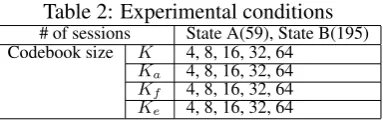
Table 2: Experimental conditions
# of sessions State A(59), State B(195) Codebook size K 4, 8, 16, 32, 64
Ka 4, 8, 16, 32, 64
Kf 4, 8, 16, 32, 64
Ke 4, 8, 16, 32, 64
In Condition (1), the three features are com-bined to single feature vectorx(ts):
x(ts)= (x(ats),x(fts),x(ets)) (4)
Then, the low-level feature vectors x(ts) are clus-tered to construct one codebook C with size K. When an input session sE is given, we calculate
the combined feature vector x(sE)
t , and generate
the Bag-of-Behaviors Q(sE). This method is a
kind of the feature-level fusion method.
In Condition (2), the three features are used sep-arately. First, we generate three codebooksCa,Cf
andCeusing the audio, face and gaze features,
re-spectively. Size of those codebooks wereKa, Kf
and Ke. When an input session sE is given,
we generate three Bag-of-Behaviors feature vec-torsQa(sE),Qf(sE)andQe(sE)using the three
codebooks. Finally, we combine those features as
Q(sE) = (Qa(sE),Qf(sE),Qe(sE)). (5)
5.2 Experimental condition
We employed the SVM with RBF-kernel as a clas-sifier. The experimental conditions are summa-rized in Table 2. The hyperparameters of the clas-sifier were decided by grid-searching. Since the session of state C and the other states (state A and state B) were clearly distinguished by the duration of the session, we used only the session of state A and state B for the experiments. Hence, each experiment was a two-class discrimination task.
As explained, the experimental data were un-balanced. Since it is desirable that the system can discriminate the user’s state without deviation, the harmonic meanHof the accuracy of the two states was used for measuring the performance. This is calculated by
H= C2CACB
A+CB, (6)
whereCAandCBrepresent the discrimination
4 8 16 32 64
Number of clusters K
30 40 50 60 70 80 90
Disc
rim
ina
tio
n r
esu
lt [
%]
State A(CA)
State B(CB)
[image:4.595.75.272.74.204.2]Harm.(H)
Figure 1: Discrimination results of condition (1)
0 20 40 Order of 60 80 100 120
H
50 55 60 65 70 75
Disc
rim
ina
tio
n r
esu
lt (
H
) [%
[image:4.595.76.271.255.381.2]] Harm.(H)
Figure 2: Discrimination results of condition (2) arranged in descending order
5.3 Experimental results
The results of condition (1) are shown in Figure 1. The figure shows the best H of each num-ber of clusters. In condition (1), the best result (H = 70.0%) was obtained when the number of clustersK was 64. Figure 2 shows the results of condition (2). In this figure, the results are shown in descending order of the harmonic mean for all combination of codebook size of the three code-books (there were53 = 125conditions). The best
H = 70.7%was obtained whenKa= 8, Kf = 8
andKe= 64.
The best results of the tested methods are sum-marized in Table 3. Here, “Baseline + NN” in the table denotes the result in Chiba et al. (2013), where the visual events and acoustic events were annotated manually, and the manual labels were
Table 3: Comparison of estimation methods
State A State B Harm.
Baseline + NN 52.5 65.1 58.2
Baseline + Gaze + NN 64.5 59.5 61.9 Condition (1) + RBF-SVM 67.9 72.3 70.0 Condition (2) + RBF-SVM 67.7 73.8 70.7 Condition (2) + MKL-SVM 68.0 76.4 72.0
used as input for a neural network for the classi-fication. The gaze feature was not used in “Base-line + NN.” We added the result when including the gaze feature, shown as “Baseline + Gaze + NN.” As shown in Table 3, the performance of the method proposed in this paper surpassed the base-line methods. Therefore, the proposed method could not only automatically determine the inven-tory of the audio-visual events, but also achieved better discrimination accuracy. One of the reasons of the improvement is VQ can construct the clus-ters in proper quantities.
Comparing the two conditions of feature combi-nation,Hof condition (2) (denoted as “Condition (2) + RBF-SVM”) was slightly higher than that of condition (1) (denoted as “Condition (1) + RBF-SVM”). This result was similar to Split-VQ (Pari-wal and Atal, 1991) where a single feature vec-tor split into subvecvec-tors and the input vecvec-tor was quantized subvector by subvector.
We conducted additional experiments for con-dition (2) by using SVM with combined kernel trained by Multiple Kernel Learning (MKL) (Son-nenburg et al., 2006). The combined kernel is rep-resented as a linear combination of several sub-kernels. The distinct kernel was employed for the speech, face feature and gaze feature, respec-tively. This paper used the RBF-kernel having the same width as the sub-kernels.The best result was
shown as “Condition (2) + MKL-SVM” in Table 3. As shown in the table, the MKL-SVM showed the highest performance of 72.0 %. The weights of the audio, face and gaze feature were 0.246, 0.005 and 0.749, respectively. This result suggested that the contribution of the face feature was weaker than the other features.
6 Conclusion
In this paper, we proposed a method to estimate the state of the user of the dialog system by us-ing non-verbal features. We proposed the Bag-of-Behaviors approach, in which the user’s mult-modal behavior was first classified by vector quan-tization, and then the histogram of the VQ code was used as a feature of the discrimination. We verified that the method could discriminate the tar-get user’s state with an accuracy of 70% or more.
References
David Arthur and Sergei Vassilvitskii. 2007. k-means++: The advantages of careful seeding. In Proc. the 18th annual ACM-SIAM symposium on Discrete algorithms, pages 1027–1035.
Dan Bohus and Alexander I. Rudnicky. 2009. The raven-claw dialog management framework: Architecture and systems.Computer Speech & Language, 23(3):332–361. Yuya Chiba and Akinori Ito. 2012. Estimating a
user’s internal state before the first input utterance.
Advances in Human-Computer Interaction, 2012:11, DOI:10.1155/2012/865362, 2012.
Yuya Chiba, Masashi Ito, and Akinori Ito. 2012. Effect of linguistic contents on human estimation of internal state of dialog system users. InProc. Feedback Behaviors in Dialog, pages 11–14.
Yuya Chiba, Masashi Ito, and Akinori Ito. 2013. Estima-tion of user’s state during a dialog turn with sequential multi-modal features. InHCI International 2013-Posters’ Extended Abstracts, pages 572–576.
Grace Chung. 2004. Developing a flexible spoken dialog system using simulation. InProc. the 42nd Annual Meet-ing on Association for Computational LMeet-inguistics, pages 63–70.
Olivier Collignon, Simon Girard, Frederic Gosselin, Syl-vain Roy, Dave Saint-Amour, Maryse Lassonde, and Lep-ore Franco. 2008. Audio-visual integration of emotion expression.Brain research, 1242:126–135.
Gabriella Csurka, Christopher Dance, Lixin Fan, Jutta Willamowski, and C´edric Bray. 2004. Visual categorization with bags of keypoints. InProc. workshop on statistical learning in computer vision, ECCV, pages 1–2.
Kate Forbes-Riley and Diane Litman. 2011a. Benefits and challenges of real-time uncertainty detection and adapta-tion in a spoken dialogue computer tutor.Speech Commu-nication, 53:1115–1136.
Kate Forbes-Riley and Diane Litman. 2011b. Designing and evaluating a wizarded uncertainty-adaptive spoken di-alogue tutoring system. Computer Speech & Language, 25(1):105–126.
Yu-Gang Jiang, Chong-Wah Ngo, and Jun Yang. 2007. To-wards optimal bag-of-features for object categorization and semantic video retrieval. In Proc. of the 6th ACM international conference on Image and video retrieval, pages 494–501.
Kristiina Jokinen and Kari Kanto. 2004. User expertise mod-elling and adaptivity in a speech-based e-mail system. In
Proc. the 42nd Annual Meeting on Association for Com-putational Linguistics, pages 88–95.
Jen-Chun Lin, Chung-Hsien Wu, and Wen-Li Wei. 2012. Error weighted semi-coupled hidden markov model for audio-visual emotion recognition. IEEE Trans. Multime-dia, 14(1):142–156.
Angeliki Metallinou, Martin W¨ollmer, Athanasios Kat-samanis, Florian Eyben, Bj¨orn Schuller, and Shrikanth Narayanan. 2012. Context-sensitive learning for enhanced audiovisual emotion classification. IEEE Trans. Affective Computing, 3(2):184–198.
Pradeep Natarajan, Shuang Wu, Shiv Vitaladevuni, Xiao-dan Zhuang, Stavros Tsakalidis, and Unsang Park, Ro-hit Prasad, and Premkumar Natarajan. 2012. Multimodal feature fusion for robust event detection in web videos. InProc. Computer Vision and Pattern Recognition, pages 1298–1305.
Andrew Pargellis, Hong-Kwang Jeff Kuo, and Chin-Hui Lee. 2004. An automatic dialogue generation platform for per-sonalized dialogue applications. Speech Communication, 42:329–351.
Kuldip Paliwal and Bishnu Atal. 1993. Efficient vector quan-tization of lpc parameters at 24 bits/frame. InIEEE Trans. Speech and Audio Processing, 1(1):3–14.
Silke Paulmann and Marc Pell. 2011. Is there an advantage for recognizing multi-modal emotional stimuli? Motiva-tion and EmoMotiva-tion, 35(2):192–201.
Heather Pon-Barry, Karl Schultz, Elizabeth Owen Bratt, Brady Clark, and Stanley Peters. 2005. Responding to student uncertainty in spoken tutorial dialogue systems.
Int. J. Artif. Intell. Edu., 16:171–194.
Fiorella Rosis, Nicole Novielli, Valeria Carofiglio, Addo-lorata Cavalluzzi, and Berardina Carolis. 2006. User modeling and adaptation in health promotion dialogs with an animated character. J. Biomedical Informatics, 39:514–531.
Jason Saragih, Simon Lucey, and Jeffrey Cohn. 2011. De-formable model fitting by regularized landmark mean-shift.Int. J. Computer Vision, 91(2):200–215.
Yongjin Wang and Anastasios Venetsanopoulos. 2012. Ker-nel cross-modal factor analysis for information fusion with application to bimodal emotion recognition. IEEE Trans. Multimedia, 14(3):597–607.
Martin W¨ollmer, Moritz Kaiser, Florian Eyben, Bj¨orn Schuller, and Gerhard Rigoll. 2013. Lstm-modeling of continuous emotions in an audiovisual affect recognition framework. Image and Vision Computing, 31(2):153–163.
Nicole Yankelovich. 1996. How do users know what to say?