DiscoTK: Using Discourse Structure for Machine Translation Evaluation
Shafiq Joty Francisco Guzm´an Llu´ıs M`arquez and Preslav Nakov ALT Research Group
Qatar Computing Research Institute — Qatar Foundation
{sjoty,fguzman,lmarquez,pnakov}@qf.org.qa
Abstract
We present novel automatic metrics for machine translation evaluation that use discourse structure and convolution ker-nels to compare the discourse tree of an automatic translation with that of the hu-man reference. We experiment with five transformations and augmentations of a base discourse tree representation based on the rhetorical structure theory, and we combine the kernel scores for each of them into a single score. Finally, we add other metrics from the ASIYA MT evaluation toolkit, and we tune the weights of the combination on actual human judgments. Experiments on the WMT12 and WMT13 metrics shared task datasets show corre-lation with human judgments that outper-forms what the best systems that partici-pated in these years achieved, both at the segment and at the system level.
1 Introduction
The rapid development of statistical machine translation (SMT) that we have seen in recent years would not have been possible without au-tomatic metrics for measuring SMT quality. In particular, the development of BLEU (Papineni et al., 2002) revolutionized the SMT field, al-lowing not only to compare two systems in a way that strongly correlates with human judg-ments, but it also enabled the rise of discrimina-tive log-linear models, which use optimizers such as MERT (Och, 2003), and later MIRA (Watanabe et al., 2007; Chiang et al., 2008) and PRO (Hop-kins and May, 2011), to optimize BLEU, or an ap-proximation thereof, directly. While over the years other strong metrics such as TER (Snover et al., 2006) and Meteor (Lavie and Denkowski, 2009) have emerged, BLEU remains the de-facto stan-dard, despite its simplicity.
Recently, there has been steady increase in BLEU scores for well-resourced language pairs such as Spanish-English and Arabic-English. However, it was also observed that BLEU-liken -gram matching metrics are unreliable for high-quality translation output (Doddington, 2002; Lavie and Agarwal, 2007). In fact, researchers al-ready worry that BLEU will soon be unable to dis-tinguish automatic from human translations.1This
is a problem for most present-day metrics, which cannot tell apart raw machine translation output from a fully fluent professionally post-edited ver-sion thereof (Denkowski and Lavie, 2012).
Another concern is that BLEU-like n-gram matching metrics tend to favor phrase-based SMT systems over rule-based systems and other SMT paradigms. In particular, they are unable to cap-ture the syntactic and semantic struccap-ture of sen-tences, and are thus insensitive to improvement in these aspects. Furthermore, it has been shown that lexical similarity is both insufficient and not strictly necessary for two sentences to convey the same meaning (Culy and Riehemann, 2003; Coughlin, 2003; Callison-Burch et al., 2006).
The above issues have motivated a large amount of work dedicated to design better evaluation met-rics. The Metrics task at the Workshop on Ma-chine Translation (WMT) has been instrumental in this quest. Below we present QCRI’s submission to the Metrics task of WMT14, which consists of the DiscoTK family of discourse-based metrics.
In particular, we experiment with five different transformations and augmentations of a discourse tree representation, and we combine the kernel scores for each of them into a single score which we call DISCOTKlight. Next, we add to the com-bination other metrics from the ASIYA MT eval-uation toolkit (Gim´enez and M`arquez, 2010), to produce the DISCOTKparty metric.
1This would not mean that computers have achieved
hu-man proficiency; it would rather show BLEU’s inadequacy.
Finally, we tune the relative weights of the met-rics in the combination using human judgments in a learning-to-rank framework. This proved to be quite beneficial: the tuned version of the DISCOTKparty metric was the best performing metric in the WMT14 Metrics shared task.
The rest of the paper is organized as follows: Section 2 introduces our basic discourse metrics and the tree representations they are based on. Section 3 describes our metric combinations. Sec-tion 4 presents our experiments and results on datasets from previous years. Finally, Section 5 concludes and suggests directions for future work.
2 Discourse-Based Metrics
In our recent work (Guzm´an et al., 2014), we used the information embedded in the discourse-trees (DTs) to compare the output of an MT system to a human reference. More specifically, we used a state-of-the-art sentence-level discourse parser (Joty et al., 2012) to generate discourse trees for the sentences in accordance with the Rhetorical Structure Theory (RST) of discourse (Mann and Thompson, 1988). Then, we computed the simi-larity between DTs of the human references and the system translations using a convolution tree kernel (Collins and Duffy, 2001), which efficiently computes the number of common subtrees. Note that this kernel was originally designed for syntac-tic parsing, and the subtrees are subject to the con-straint that their nodes are taken with all or none of their children, i.e., if we take a direct descen-dant of a given node, we must also take all siblings of that descendant. This imposes some limitations on the type of substructures that can be compared, and motivates the enriched tree representations ex-plained in subsections 2.1–2.4.
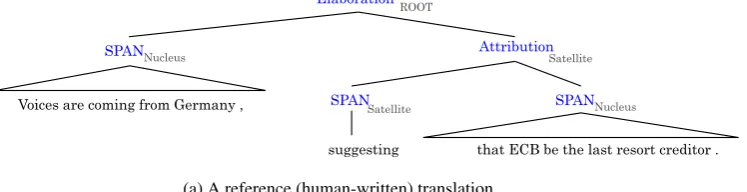
The motivation to compare discourse trees, is that translations should preserve the coherence re-lations. For example, consider the three discourse trees (DTs) shown in Figure 1. Notice that the
Attributionrelation in the reference translation is also realized in the system translation in (b) but not in (c), which makes (b) a better translation com-pared to (c), according to our hypothesis.
In (Guzm´an et al., 2014), we have shown that discourse structure provides additional informa-tion for MT evaluainforma-tion, which is not captured by existing metrics that use lexical, syntactic and se-mantic information; thus, discourse should be con-sidered when developing new rich metrics.
Here, we extend our previous work by devel-oping metrics that are based on new representa-tions of the DTs. In the remainder of this section, we will focus on the individual DT representations that we will experiment with; then, the following section will describe the metric combinations and tuning used to produce the DiscoTK metrics.
2.1 DR-LEX1
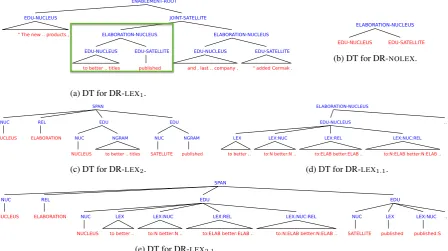
Figure 2a shows our first representation of the DT. The lexical items, i.e., words, constitute the leaves of the tree. The words in an Elementary Discourse Unit (EDU) are grouped under a predefined tag
EDU, to which the nuclearity status of the EDU is attached: nucleusvs. satellite. Coherence re-lations, such asAttribution,Elaboration, and En-ablement, between adjacent text spans constitute the internal nodes of the tree. Like the EDUs, the nuclearity statuses of the larger discourse units are attached to the relation labels. Notice that with this representation the tree kernel can easily be ex-tended to find subtree matches at the word level, i.e., by including an additional layer of dummy
leaves as was done in (Moschitti et al., 2007). We applied the same solution in our representations.
2.2 DR-NOLEX
Our second representation DR-NOLEX(Figure 2b) is a simple variation of DR-LEX1, where we
ex-clude the lexical items. This allows us to measure the similarity between two translations in terms of their discourse structures alone.
2.3 DR-LEX2
ElaborationROOT
SPANNucleus AttributionSatellite
Voices are coming from Germany , SPANSatellite SPANNucleus
suggesting that ECB be the last resort creditor .
(a) A reference (human-written) translation.
Attribution
ROOT
SPANSatellite SPANNucleus
In Germany voices , the ECB should be the lender of last resort .
(b) A higher quality (system-generated) translation.
SPANROOT
In Germany the ECB should be for the creditors of last resort .
[image:3.595.83.457.72.168.2](c) A lower quality (system-generated) translation.
Figure 1: Three discourse trees for the translations of a source sentence: (a) the reference, (b) a higher quality automatic translation, and (c) a lower quality automatic translation.
2.4 DR-LEX1.1and DR-LEX2.1
Although both DR-LEX1 and DR-LEX2 allow the tree kernel to find matches at the word level, the words are compared in a bag-of-words fashion, i.e., if the trees share a common word, the ker-nel will find a match regardless of its position in the tree. Therefore, a word that has occurred in an EDU with statusNucleusin one tree could be matched with the same word under aSatellite in the other tree. In other words, the kernel based on these representations is insensitive to the nu-clearity status and the relation labels under which the words are matched. DR-LEX1.1, an
exten-sion of DR-LEX1, and DR-LEX2.1, an extension of DR-LEX2, are sensitive to these variations at the lexical level. DR-LEX1.1 (Figure 2d) and
DR-LEX2.1 (Figure 2e) propagate the nuclearity sta-tuses and/or the relation labels to the lexical items by including three more subtrees at the EDU level.
3 Metric Combination and Tuning
In this section, we describe our Discourse Tree Kernel (DiscoTK) metrics. We have two main versions: DISCOTKlight, which combines the five DR-based metrics, and DISCOTKparty, which fur-ther adds the Asiya metrics.
3.1 DISCOTKlight
In the previous section, we have presented several discourse tree representations that can be used to compare the output of a machine translation sys-tem to a human reference. Each representation stresses a different aspect of the discourse tree.
In order to make our estimations more robust, we propose DISCOTKlight, a metric that takes ad-vantage of all the previous discourse representa-tions by linearly interpolating their scores. Here are the processing steps needed to compute this metric:
(i) Parsing: We parsed each sentence in order to produce discourse trees for the human references and for the outputs of the systems.
(ii) Tree enrichment/simplification: For each sentence-level discourse tree, we generated the five different tree representations: DR-NOLEX, DR-LEX1, DR-LEX1.1, DR-LEX2, DR-LEX2.1.
(iii) Estimation: We calculated the per-sentence similarity scores between tree representations of the system hypothesis and the human reference using the extended convolution tree kernel as de-scribed in the previous section. To compute the system-level similarity scores, we calculated the average sentence-level similarity; note that this en-sures that our metric is “the same” at the system and at the segment level.
(iv) Normalization: In order to make the scores of the different representations comparable, we per-formed amin–maxnormalization2 for each
met-ric and for each language pair.
(v) Combination: Finally, for each sentence, we computed DISCOTKlight as the average of the normalized similarity scores of the different repre-sentations. For system-level experiments, we per-formed linear interpolation of system-level scores.
(a) DT for DR-LEX1.
ELABORATION-NUCLEUS
EDU-NUCLEUS EDU-SATELLITE
(b) DT for DR-NOLEX.
SPAN
NUC REL EDU EDU
NUCLEUS ELABORATION NUC NGRAM NUC NGRAM
NUCLEUS to better .. titles SATELLITE published
(c) DT for DR-LEX2.
ELABORATION-NUCLEUS
EDU-NUCLEUS ..
LEX LEX:NUC LEX:REL LEX:NUC:REL
to better .. to:N better:N .. to:ELAB better:ELAB .. to:N:ELAB better:N:ELAB ..
(d) DT for DR-LEX1.1.
SPAN
NUC REL EDU EDU
NUCLEUS ELABORATION NUC LEX LEX:NUC LEX:REL LEX:NUC:REL NUC LEX LEX:NUC ..
NUCLEUS to better .. to:N better:N .. to:ELAB better:ELAB .. to:N:ELAB better:N:ELAB .. SATELLITE published published:S
[image:4.595.77.526.80.331.2](e) DT for DR-LEX2.1.
Figure 2: Five different representations of the discourse tree (DT) for the sentence “The new organisa-tional structure will also allow us to enter the market with a joint offer of advertising products, to better link the creation of content for all the titles published and, last but not least, to continue to streamline significantly the business management of the company,” added Cermak.Note that to avoid visual clutter, (b)–(e) show alternative representations only for the highlighted subtree in (a).
3.2 DISCOTKparty
One of the weaknesses of the above discourse-based metrics is that they use unigram lexical information, which does not capture reordering. Thus, in order to make more informed and ro-bust estimations, we extended DISCOTKlightwith the composing metrics of the ASIYA’s ULC met-ric (Gim´enez and M`arquez, 2010), which is a uni-form linear combination of twelve individual met-rics and was the best-performing metric at the sys-tem and at the segment levels at the WMT08 and WMT09 metrics tasks.
In order to compute the individual metrics from ULC, we used the ASIYA toolkit,3 but we de-parted from ASIYA’s ULC by replacing TER and Meteor with newer versions thereof that take into account synonymy lookup and paraphras-ing (‘TERp-A’ and ‘Meteor-pa’ in ASIYA’s ter-minology). We then combined the five compo-nents in DISCOTKlight and the twelve individ-ual metrics from ULC; we call this combination DISCOTKparty.
3http://nlp.lsi.upc.edu/asiya/
We combined the scores using linear interpola-tion in two different ways:
(i)Uniform combinationofmin-max normalized scores at the segment level. We obtained system-level scores by computing the average over the segment scores.
(ii) Trained interpolation at the sentence level. We determined the interpolation weights for the above-described combination of 5+12 = 17 met-rics using a pairwise learning-to-rank framework and classification with logistic regression, as we had done in (Guzm´an et al., 2014). We obtained the final test-time sentence-level scores by pass-ing the interpolated raw scores through a sigmoid function. In contrast, for the final system-level scores, we averaged the per-sentence interpolated raw scores.
3.3 Post-processing
Discourse-based metrics, especially DR-NOLEX, tend to produce many ties when there is not enough information to do complete discourse analysis. This contributes to lower τ scores for DISCOTKlight. To alleviate this issue, we used a simple tie-breaking strategy, in which ties between segment scores for different systems are resolved by using perturbations proportional to the global system-level scores produced by the same metric, i.e.,x0seg
sys=xsegsys+∗Psxssys. Here,is automati-cally chosen to avoid collisions with scores not in-volved in the tie. This post-processing is not part of the metric; it is only applied to our segment-level submission to the WMT’14 metrics task.
4 Experimental Evaluation
In this section, we present some of our experi-ments to decide on the best DiscoTK metric vari-ant and tuning set. For tuning, testing and compar-ison, we worked with some of the datasets avail-able from previous WMT metrics shared tasks, i.e., 2011, 2012 and 2013. From previous ex-periments (Guzm´an et al., 2014), we know that the tuned metrics perform very well on cross-validation for the same-year dataset. We further know that tuning can be performed by concatenat-ing data from all the into-English language pairs, which yields better results than training separately by language pair. For the WMT14 metrics task, we investigated in more depth whether the tuned metrics generalize well to new datasets. Addition-ally, we tested the effect of concatenating datasets from different years.
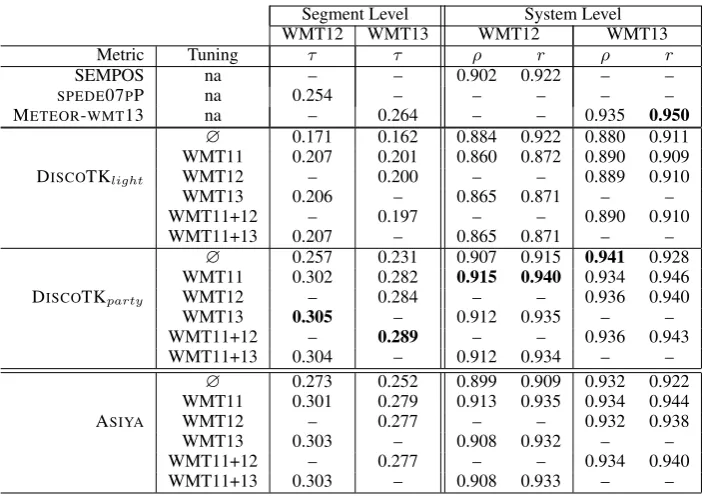
Table 1 shows the main results of our experi-ments with the DiscoTK metrics. We evaluated the performance of the metrics on the WMT12 and WMT13 datasets both at the segment and the system level, and we used WMT11 as an addi-tional tuning dataset. We measured the perfor-mance of the metrics in terms of correlation with human judgements. At the segment level, we eval-uated using Kendall’s Tau (τ), recalculated follow-ing the WMT14 official Kendall’s Tau implemen-tation. At the system level, we used Spearman’s rank correlation (ρ) and Pearson’s correlation co-efficient (r). In all cases, we averaged the results over all into-English language pairs. The symbol ‘∅’ represents the untuned versions of our metrics, i.e., applying a uniform linear combination of the individual metrics.
We trained the tuned versions of the DiscoTK measures using different datasets (WMT11, WMT12 and WMT13) in order to study across-corpora generalization and the effect of training dataset size. The symbol ‘+’ stands for concatena-tion of datasets. We trained the tuned versions at the segment level using Maximum Entropy clas-sifiers for pairwise ranking (cf. Section 3). For the sake of comparison, the first group of rows contains the results of the best-performing met-rics at the WMT12 and WMT13 metmet-rics shared tasks and the last group of rows contains the re-sults of the ASIYA combination of metrics, i.e., DISCOTKpartywithout the discourse components. Several conclusions can be drawn from Table 1. First, DISCOTKpartyis better than DISCOTKlight in all settings, indicating that the discourse-based metrics are very well complemented by the hetero-geneous metric set from ASIYA. DISCOTKlight achieves competitive scores at the system level (which would put the metric among the best par-ticipants in WMT12 and WMT13); however, as expected, it is not robust enough at the segment level. On the other hand, the tuned versions of DISCOTKparty are very competitive and improve over the already strong ASIYA in each configu-ration both at the segment- and the system-level. The improvements are small but consistent, show-ing that usshow-ing discourse increases the correlation with human judgments.
Focusing on the results at the segment level, it is clear that the tuned versions offer an advantage over the simple uniform linear combinations. In-terestingly, for the tuned variants, given a test set, the results are consistent across tuning sets, ruling out over-fitting; this shows that the generalization is very good. This result aligns well with what we observed in our previous studies (Guzm´an et al., 2014). Learning with more data (WMT11+12 or WMT12+13) does not seem to help much, but it does not hurt performance either. Overall, the τ correlation results obtained with the tuned DISCOTKparty metric are much better than the best results of any participant metrics at WMT12 and WMT13 (20.1% and 9.5% relative improve-ment, respectively).
Segment Level System Level
WMT12 WMT13 WMT12 WMT13
Metric Tuning τ τ ρ r ρ r
SEMPOS na – – 0.902 0.922 – –
SPEDE07PP na 0.254 – – – – –
METEOR-WMT13 na – 0.264 – – 0.935 0.950 ∅ 0.171 0.162 0.884 0.922 0.880 0.911 WMT11 0.207 0.201 0.860 0.872 0.890 0.909
DISCOTKlight WMT12 – 0.200 – – 0.889 0.910
WMT13 0.206 – 0.865 0.871 – –
WMT11+12 – 0.197 – – 0.890 0.910
WMT11+13 0.207 – 0.865 0.871 – –
∅ 0.257 0.231 0.907 0.915 0.941 0.928 WMT11 0.302 0.282 0.915 0.940 0.934 0.946
DISCOTKparty WMT12 – 0.284 – – 0.936 0.940
WMT13 0.305 – 0.912 0.935 – –
WMT11+12 – 0.289 – – 0.936 0.943
WMT11+13 0.304 – 0.912 0.934 – –
∅ 0.273 0.252 0.899 0.909 0.932 0.922 WMT11 0.301 0.279 0.913 0.935 0.934 0.944
ASIYA WMT12 – 0.277 – – 0.932 0.938
WMT13 0.303 – 0.908 0.932 – –
WMT11+12 – 0.277 – – 0.934 0.940
[image:6.595.123.475.60.308.2]WMT11+13 0.303 – 0.908 0.933 – –
Table 1: Evaluation results on WMT12 and WMT13 datasets at segment and system level for the main combined DiscoTK measures proposed in this paper.
The scores of our best metric are higher than those of the best participants in WMT12 and WMT13, according to Spearman’s ρ, which was the official metric in those years. Overall, our met-rics are comparable to the state-of-the-art at the system level. The differences between Spearman’s
ρ and Pearson’s r coefficients are not dramatic, withrvalues being always higher thanρ.
Given the above results, we submitted the fol-lowing runs to the WMT14 Metrics shared task: (i) DISCOTKparty tuned on the concatenation of datasets WMT11+12+13, as our primary run; (ii) Untuned DISCOTKparty, to verify that we are not over-fitting the training set; and (iii) Untuned DISCOTKlight, to see the performance of a metric using discourse structures and word unigrams.
The results for the WMT14 Metrics shared task have shown that our primary run, DISCOTKparty tuned, was thebest-performingmetric both at the segment- and at the system-level (Mach´aˇcek and Bojar, 2014). This metric yielded significantly better results than its untuned counterpart, con-firming the importance of weight tuning and the absence of over-fitting during tuning. Finally, the untuned DISCOTKlight achieved relatively com-petitive, albeit slightly worse results for all lan-guage pairs, except for Hindi-English, where sys-tem translations resembled a “word salad”, and were very hard to discourse-parse accurately.
5 Conclusion
We have presented experiments with novel auto-matic metrics for machine translation evaluation that take discourse structure into account. In par-ticular, we used RST-style discourse parse trees, which we compared using convolution kernels. We further combined these kernels with metrics from ASIYA, also tuning the weights. The re-sulting DISCOTKparty tuned metric was the best-performing at the segment- and system-level at the WMT14 metrics task.
In an internal evaluation on the WMT12 and WMT13 metrics datasets, this tuned combina-tion showed correlacombina-tion with human judgments that outperforms the best systems that participated in these shared tasks. The discourse-only met-ric ranked near the top at the system-level for WMT12 and WMT13; however, it is weak at the segment-level since it is sensitive to parsing errors, and most sentences have very little internal dis-course structure.
References
Chris Callison-Burch, Miles Osborne, and Philipp Koehn. 2006. Re-evaluating the role of BLEU in machine translation research. In Proceedings of the Eleventh Conference of the European Chapter of the Association for Computational Linguistics, EACL’06, pages 249–256, Trento, Italy.
David Chiang, Yuval Marton, and Philip Resnik. 2008. Online large-margin training of syntactic and struc-tural translation features. InProceedings of the Con-ference on Empirical Methods in Natural Language Processing, EMNLP’08, pages 224–233, Honolulu, Hawaii.
Michael Collins and Nigel Duffy. 2001. Convolution Kernels for Natural Language. InNeural Informa-tion Processing Systems, NIPS’01, pages 625–632, Vancouver, Canada.
Deborah Coughlin. 2003. Correlating automated and human assessments of machine translation quality. In Proceedings of the Machine Translation Summit IX, MT Summit’03, pages 23–27, New Orleans, LA, USA.
Christopher Culy and Susanne Riehemann. 2003. The limits of n-gram translation evaluation metrics. In Proceedings of the Machine Translation Summit IX, MT Summit’03, pages 1–8, New Orleans, LA, USA.
Michael Denkowski and Alon Lavie. 2012. Chal-lenges in predicting machine translation utility for human post-editors. In Proceedings of the Tenth Conference of the Association for Machine Trans-lation in the Americas, AMTA’12, pages 40–49, San Diego, CA, USA.
George Doddington. 2002. Automatic evaluation of machine translation quality using n-gram co-occurrence statistics. In Proceedings of the Sec-ond International Conference on Human Language Technology Research, HLT’02, pages 138–145, San Francisco, CA, USA.
Jes´us Gim´enez and Llu´ıs M`arquez. 2010. Linguistic Measures for Automatic Machine Translation Eval-uation. Machine Translation, 24(3–4):77–86.
Francisco Guzm´an, Shafiq Joty, Llu´ıs M`arquez, and Preslav Nakov. 2014. Using discourse structure improves machine translation evaluation. In Pro-ceedings of 52nd Annual Meeting of the Association for Computational Linguistics, ACL’14, Baltimore, MD, USA.
Mark Hopkins and Jonathan May. 2011. Tuning as ranking. In Proceedings of the Conference on Em-pirical Methods in Natural Language Processing, EMNLP’11, pages 1352–1362, Edinburgh, Scot-land, UK.
Shafiq Joty, Giuseppe Carenini, and Raymond Ng. 2012. A Novel Discriminative Framework for
Sentence-Level Discourse Analysis. In Proceed-ings of the Joint Conference on Empirical Methods in Natural Language Processing and Computational Natural Language Learning, EMNLP-CoNLL’12, pages 904–915, Jeju Island, Korea.
Alon Lavie and Abhaya Agarwal. 2007. METEOR: An automatic metric for MT evaluation with high levels of correlation with human judgments. In Proceedings of the Second Workshop on Statisti-cal Machine Translation, WMT’07, pages 228–231, Prague, Czech Republic.
Alon Lavie and Michael Denkowski. 2009. The ME-TEOR metric for automatic evaluation of machine translation.Machine Translation, 23(2-3):105–115. Matouˇs Mach´aˇcek and Ondˇrej Bojar. 2014. Results of the WMT14 Metrics Shared Task. InProceedings of the Ninth Workshop on Statistical Machine Transla-tion, WMT’14, Baltimore, MD, USA.
William Mann and Sandra Thompson. 1988. Rhetor-ical Structure Theory: Toward a Functional Theory of Text Organization. Text, 8(3):243–281.
Alessandro Moschitti, Silvia Quarteroni, Roberto Basili, and Suresh Manandhar. 2007. Exploiting syntactic and shallow semantic kernels for question answer classification. In Proceedings of the 45th Annual Meeting of the Association of Computational Linguistics, ACL’07, pages 776–783, Prague, Czech Republic.
Franz Josef Och. 2003. Minimum error rate training in statistical machine translation. InProceedings of the 41st Annual Meeting of the Association for Compu-tational Linguistics, ACL’03, pages 160–167, Sap-poro, Japan.
Kishore Papineni, Salim Roukos, Todd Ward, and Wei-Jing Zhu. 2002. BLEU: a method for auto-matic evaluation of machine translation. In Pro-ceedings of 40th Annual Meeting of the Association for Computational Linguistics, ACL’02, pages 311– 318, Philadelphia, PA, USA.
Matthew Snover, Bonnie Dorr, Richard Schwartz, Lin-nea Micciulla, and John Makhoul. 2006. A study of translation edit rate with targeted human annota-tion. In Proceedings of the Seventh Biennial Con-ference of the Association for Machine Translation in the Americas, AMTA’06, pages 223–231, Cam-bridge, MA, USA.