Semi-supervised Learning for Vietnamese Named Entity Recognition
using Online Conditional Random Fields
Quang H. Pham University of Science, Vietnam
Minh-Le Nguyen Japan Advanced Institute of
Science and Technology [email protected] Binh T. Nguyen
University of Science, Vietnam [email protected]
Nguyen Viet Cuong National University of Singapore
Abstract
We present preliminary results for the named entity recognition problem in the Vietnamese language. For this task, we build a system based on conditional ran-dom fields and address one of its chal-lenges: how to combine labeled and un-labeled data to create a stronger system. We propose a set of features that is useful for the task and conduct experiments with different settings to show that using boot-strapping with an online learning algo-rithm called Margin Infused Relaxed Al-gorithm increases the performance of the models.
1 Introduction
Named Entity Recognition (NER) is an impor-tant problem in natural language processing and has been investigated for many years (Tjong Kim Sang and De Meulder, 2003). There have been a lot of works on this task, especially for ma-jor languages such as English, Chinese, etc. (Mc-Callum and Li, 2003; Gao et al., 2005; Ritter et al., 2011). For the Vietnamese language, several authors have attempted to tackle the NER problem using both supervised and semi-supervised meth-ods (Tu et al., 2005; Tran et al., 2007; Nguyen et al., 2010; Pham et al., 2012; Le Trung et al., 2014). However, previous works for NER in the Vietnamese language mainly used offline super-vised learning methods, where all the training data are gathered before a model is trained.
In this paper, we report preliminary results for a Vietnamese NER system trained by using condi-tional random fields (CRFs) (Lafferty et al., 2001). Unlike previous works for NER in the Vietnamese language, we use an online learning algorithm,
the Margin Infused Relaxed Algorithm (MIRA) (Crammer and Singer, 2003), to train the CRFs. Furthermore, due to the fact that the number of la-beled data is small while that of unlala-beled data is very large, we treat this problem under the semi-supervised learning framework. In particular, we use the bootstrapping method on top of the CRF models to gradually increase the number of la-beled data. Using bootstrapping, a small number of new labeled training data are available after each round and then can be used to update the CRF model.
We demonstrate that using MIRA to learn CRFs instead of the traditional offline method would in-crease the performance of our system. We also propose a set of features that is useful for this task and gives competitive performance. In con-trast to previous works such as (Tran et al., 2007), we do not use features from outside sources, e.g. gazetteer features; so our feature set does not re-quire human effort to create such resources and therefore, is easy to build.
The rest of this paper is organized as follows. In Section 2, we review some previous works for the NER task, especially for the Vietnamese language. A brief introduction to CRF and MIRA is given in Section 3. This will be followed by a description of our feature set in Section 4. In Section 5, we de-scribe our semi-supervised learning approach for the Vietnamese NER problem. We show our ex-perimental setup and results in Section 6. In Sec-tion 7, we give some discussions about the prob-lem. Finally, we conclude our paper and discuss some future works in Section 8.
2 Related Works
NER is an important problem that was first intro-duced at the Sixth Message Understanding Confer-ence (MUC–6) (Grishman and Sundheim, 1996)
and since then has attracted many researchers to investigate the problem with new methods as well as different languages. Over the years, re-searchers have tried to solve the problem under su-pervised learning (McCallum and Li, 2003), semi-supervised learning (Ji and Grishman, 2006), and unsupervised learning (Etzioni et al., 2005) frameworks. One dominant approach for NER is supervised learning with conditional random fields (McCallum and Li, 2003). However, semi-supervised learning approaches are also attrac-tive for this task because it is expensive to get a large amount of labeled data. Notably, Riloff et al. (1999) introduced the mutual bootstrapping method that proved to be highly influential. Be-sides, using bootstrapping methods, Ji and Grish-man (2006) were able to improve the perforGrish-mance of existing NER systems.
For the Vietnamese language, using supervised learning, Tu et al. (2005) built an NER system with CRFs and reported 87.90%F1score as their
high-est performance. Using SVMs, Tran et al. (2007) achieved 87.75%F1 score for the task. For
semi-supervised learning, Pham et al. (2012) achieved 90.14%F1score using CRFs with the generalized
expectation criteria (Mann and McCallum, 2010), while Le Trung et al. (2014) reported an accu-racy of 95% for their system that uses bootstrap-ping and rule-based models.
3 Margin Infused Relaxed Algorithm for CRFs
3.1 Conditional Random Fields
Linear-chain conditional random field (CRF) is a sequence labeling model first introduced by Laf-ferty et al. (2001). This model allows us to define a rich set of features to capture complex depen-dencies between a structured observationxand its corresponding structured labely. Throughout this paper, we will use the term CRF to refer to linear-chain CRF, a widely used type of CRFs in which
xandyhave linear-chain structures.
Formally, let x = (x1, x2, . . . , xT) be the
in-put sequence, y = (y1, y2, . . . , yT) be the label
sequence, F = {fk(yt, yt−1,x)}Kk=1 be a set of
real-valued functions (features) over two consecu-tive labelsyt, yt−1 and the input sequencex, and Λ = {λk}Kk=1 be the set of parameters
associ-ated with the features that we want to learn. A linear-chain CRF defines the conditional
distribu-tionp(y|x)as:
p(y|x) = 1
Z(x)exp K
X
k=1 T
X
t=1
λkfk(yt, yt−1,x)
!
where
Z(x) =PyexpPKk=1PTt=1λkfk(yt, yt−1,x)
is the normalization constant, also called the par-tition function.
Normally, training a CRF is an iterative process where all the parameters are updated after each it-eration to maximize the conditional log-likelihood of the training data. During testing, the label se-quence for a new test instance is determined by a Viterbi-like algorithm, which returns the label se-quence with the highest probability according to the trained model (Sutton and McCallum, 2006).
3.2 Margin Infused Relaxed Algorithm
MIRA is an online learning algorithm developed by Crammer and Singer (2003). In this algorithm, at each round, the model receives a training exam-ple, makes a prediction on the examexam-ple, and suf-fers a loss. Then the training algorithm updates the weight vector so that the norm of the change to the weight vector is as small as possible while keeping a margin at least as large as the loss of the incorrect examples.
Details of the single-best MIRA (Crammer, 2004; McDonald et al., 2005) for the sequence la-beling task are given in Algorithm 1. In the update step at line 4 of the algorithm,s(x,y) is a scor-ing function and L(y,y0) is a loss function. The
difference between MIRA and offline training for CRFs is that MIRA processes one data example at a time while the offline algorithm processes all the data at each iteration. However, the features and the prediction algorithm are identical regardless of the learning algorithms.
4 Features for CRFs
We model NER as a sequence labeling task where each word in a sentence is associated with a tag to indicate which type of named entities it belongs to. There are 5 possible tags that we are interested in: person, organization, location, miscellaneous
(proper names), andnone. Thenonetag indicates that the corresponding word is not a part of any named entity. For instance, it may be a verb or an adjective.
Algorithm 1MIRA for Sequence Labeling
INPUT: Training dataD = {(xt,yt)}|D|t=1,
num-ber of iterationsN.
1: w0 ←0; v←0; i= 0;
2: forn= 1toN do 3: fort= 1to|D|do
4: wi+1←arg minwkw−wiksuch that
s(xt,yt)−s(xt,y)≥L(yt,y),∀y;
5: v←v+wi+1; 6: i←i+ 1;
7: end for
8: end for
9: returnv/(N×T);
in CRFs is a function over the observation xand two consecutive labelsyt andyt−1. In this paper,
we use as features the binary functions that can be fully defined based on the observation sequence.
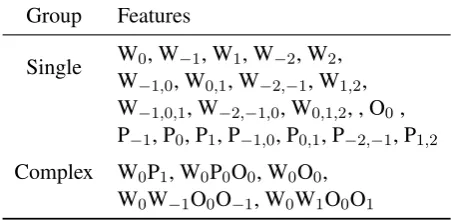
Particularly, the first type of features we use is the identity of words in a window of size 5 and their combinations. Besides, information about capitalization plays a notably important role for this task. For example, a person’s name always has its first letter capitalized, and an abbreviation of a company’s name or a place is all capitalized (e.g. Ho Chi Minh city is abbreviated as HCM). Thus, we add orthographic features to feed this informa-tion into the CRFs. This type of features describes whether a word is in lower case, whether it has the first letter capitalized, whether all of its letters are capitalized, and whether it contains numeric let-ters or not. For this type of features, we also take the orthographic information of words in a win-dow of size 5. Finally, we include as features the part-of-speech of the word and the combination of the word’s identity and its part-of-speech to better describe the context of the sentence.
We note that not all of the features described above are used since there are possibly redun-dant features that do not increase the performance. Therefore, we conduct a feature selection step for choosing which features to be utilized for later ex-periments. We first start with the current word’s identity and orthographic features. Then, we add several features, build an appropriate model, and measure its performance on a validation set, which contains 150 sentences extracted from the total training data. If the performance increases, we keep those features; otherwise, they are discarded. The process of adding and discarding features is
Group Features
Single WW0, W−1, W1, W−2, W2,
−1,0, W0,1, W−2,−1, W1,2,
W−1,0,1, W−2,−1,0, W0,1,2, , O0 ,
P−1, P0, P1, P−1,0, P0,1, P−2,−1, P1,2
Complex W0P1, W0P0O0, W0O0,
[image:3.595.306.532.65.175.2]W0W−1O0O−1, W0W1O0O1
Table 1: Features for training the CRFs. The sub-scripts indicate the position of the features rela-tively to the current position.
repeated until there is no more feature left to be added.
[image:3.595.76.292.74.247.2]In Table 1, we give the final set of our fea-tures. This set includes 2 groups: single and com-plex features. The first group contains features about word identity (W), part-of-speech (P), and orthographic information (O). Complex features are formed by combining the single features. From Table 1, possible word identity features such as W−1,1and W−2,2are not listed because they were
eliminated during the feature selection step.
5 Bootstrapping with CRFs
One main difficulty of the Vietnamese NER task is the lack of labeled data. Since texts from news, books, etc. naturally do not come with named en-tity labels, we have to manually label the data set. This is tedious and time consuming when the data size becomes very large. One way to address this problem is to gradually create more labeled data with just a small amount of labeled data via semi-supervised learning.
More specifically, we use the bootstrapping method in this paper. First, we build a model on a labeled corpus and use it to label the data from a data set that has not been labeled. After that, we select some newly labeled instances (sentences in our case), remove them from the unlabeled data set, and add them to the labeled data set. The crite-ria for choosing instances may vary and depend on the task. Then, the next model is trained on the new labeled set and it will also get an amount of new labeled data from the unlabeled data set. This pro-cess is repeated until we satisfy with the amount of labeled data that have been received.
Algorithm 2Bootstrapping with CRFs
INPUT: Labeled data set L, unlabeled data set
U, number of iterationsn, the amount of sen-tences per roundk.
1: fori= 0tondo
2: Train CRF modelMion data setL. 3: UseMito labelU.
4: Chooseklabeled sentencesX={xj}kj=1
with highest confidence fromU.
5: L←L∪X; U ←U \X. 6: end for
7: returnMn.
set is to choose the sentence whose best label se-quence got the highest probability assigned by the model.
6 Experimental Results
6.1 Setup
We build a corpus of 1,911 sentences from law news articles and manually tag their named en-tity labels. To build the unlabeled data set, we col-lect another 17,500 sentences, which also come from law articles .Both data sets are collected from online newspaper articles. The labeled data set is annotated using the IBO label format (Tjong Kim Sang and De Meulder, 2003) with the 5 la-bels mentioned in Section 4.
For the bootstrapping experiments, we split our corpus into two parts: the first part contains a fixed set of 411 sentences for testing, and the second part contains 1500 sentences for training. We train 3 initial models using 500, 1000, and 1500 sen-tences respectively from the second part and ap-ply the bootstrapping algorithm to each trained model, with the maximum number of iterationsn
being 15. In each iteration, the model selects the topk = 10highest confidence (i.e., highest value ofp(y|x,Λ)) sentences to add into its training set. Finally, we compare the results of these models af-ter 5, 10, and 15 rounds of bootstrapping with the initial models. To evaluate the performance of the models, we use the micro-averaged precision (P), recall (R), andF1score (F).
In our experiments, we use the CRF++ toolkit1
which comes with MIRA training option to build our models. Regarding the tasks of Vietnamese word segmentation and part-of-speech tagging, we
1The toolkit is available at: http://taku910. github.io/crfpp.
use a standard tool for Vietnamese language pro-cessing provided by Nguyen et al. (2005).
6.2 Results
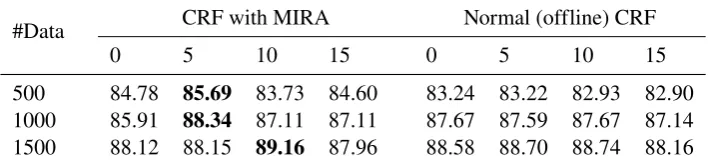
In Table 2, we depict the highestF1 score (in %)
of the models for every 5 rounds of bootstrap-ping. For all the initial training sizes, the best CRF trained using MIRA outperforms the best nor-mal CRF in the semi-supervised learning scenario. With 1000 initial training sentences, we achieve the highest increase inF1score (which is2.43%)
after 5 rounds of bootstrapping with MIRA com-pared to not using bootstrapping. Our highest per-formance is 89.16%, obtained by training with 1500 initial sentences and after 15 rounds of boot-strapping with MIRA.
It is interesting to note that the performance does not always increase after every round. From our error analysis, whenever a model makes a mis-take at a round, it affects all the following models and makes them more inaccurate. This leads to a decrease of F1 score for the later models on the
fixed test set.
7 Discussions
When inspecting the best model in Table 2 (CRF model using MIRA with 1500 training sentences and 10 rounds of bootstrapping), we find several cases that may be difficult for the model to pre-dict. In the examples below, every two consecutive words are separated by a white space, the syllables in each word are connected by underscores, and the bold phrases include one word and its wrongly predicted label. All words having thenonelabel or having been correctly classified are neither in bold nor followed by any label.
For the Vietnamese language, we find that the model may easily confuse a person name with a location name and vice versa. For instance, the model may mistake a person name for a location name as in the following sentence:
Họ nói rằng lượng hàng hoá họ nhận được có nguồn từ
Trần_Thế_Luân/location.
(They said that all the goods they received originated from Tran_The_Luan.)
#Data CRF with MIRA Normal (offline) CRF
0 5 10 15 0 5 10 15
[image:5.595.122.477.64.147.2]500 84.78 85.69 83.73 84.60 83.24 83.22 82.93 82.90 1000 85.91 88.34 87.11 87.11 87.67 87.59 87.67 87.14 1500 88.12 88.15 89.16 87.96 88.58 88.70 88.74 88.16
Table 2: Results of bootstrapping with different initial training sizes after 0, 5, 10, and 15 rounds of bootstrapping. The bold figures are the bestF1 scores with respect to a training size.
by the similar sentence structures when using a person name or a location name. For example, we can replace the word “Trần_Thế_Luân” in the sen-tence above by a location name and the sensen-tence is still correct. Furthermore, in Vietnamese, many person names are used to name the locations. This also makes it more difficult to distinguish these two labels.
Another source of mistakes is the confusion be-tween an organization name and a person name. For example, the following sentence was added during bootstrapping:
Trong_khi_đó,ACB/noneđang dư tiền nên đã chuyển choVietbank/personvà
Kienlongbank/person.
(In the meantime, ACB is having a lot of extra money, so they transfer some to both Vietbank and Kienlongbank.)
In this example, the model could not recognize “ACB” as an organization name, and it also mis-classified “Vietbank” and “Kienlongbank” as per-son names (ACB, Vietbank, and Kienlongbank are in fact three major banks in Vietnam). This is a dif-ficult case since the English word “bank” is con-catenated with the word “Viet” and “Kienlong”, and thus it is harder to classify these words without using an external dictionary. Moreover, the sen-tence structure also cannot help to distinguish the two labels in this case because we can replace the three words “ACB”, “Vietbank”, and “Kienlong-bank” by three person names and the sentence is still correct.
8 Conclusions and Future Works
We have presented preliminary results for a Viet-namese NER system trained using the CRF with MIRA and bootstrapping. We also proposed a set of useful features, which are easy to compute and do not need human work for processing unla-beled data. Our experiments showed that
combing CRFs trained by MIRA with bootstrappcombing in-creases our system’s performance.
For future works, we will focus on how to choose more meaningful sentences from the un-labeled data set and how to enhance the bootstrap-ping algorithm for the NER task. Since there are many algorithms to build our model, investigat-ing how to combine these models in the semi-supervised learning framework to achieve better results is also a promising direction.
Acknowledgments
This work was carried out when the first author participated in an internship program at the Japan Advanced Institute of Science and Technology.
References
Koby Crammer and Yoram Singer. 2003. Ultracon-servative online algorithms for multiclass problems.
Journal of Machine Learning Research, 3:951–991.
Yacov Shlomo Crammer. 2004. Online learning of
complex categorical problems. Ph.D. thesis, He-brew University of Jerusalem.
Oren Etzioni, Michael Cafarella, Doug Downey, Ana-Maria Popescu, Tal Shaked, Stephen Soderland, Daniel S. Weld, and Alexander Yates. 2005. Un-supervised named-entity extraction from the web:
An experimental study. Artificial intelligence,
165(1):91–134.
Jianfeng Gao, Mu Li, Andi Wu, and Chang-Ning Huang. 2005. Chinese word segmentation and named entity recognition: A pragmatic approach.
Computational Linguistics, 31(4):531–574.
Ralph Grishman and Beth Sundheim. 1996. Mes-sage Understanding Conference-6: A Brief History. InInternational Conference on Computational Lin-guistics (COLING), volume 96, pages 466–471. Heng Ji and Ralph Grishman. 2006. Data
John Lafferty, Andrew McCallum, and Fernando C.N. Pereira. 2001. Conditional random fields: Prob-abilistic models for segmenting and labeling
se-quence data. In International Conference on
Ma-chine Learning (ICML).
Hieu Le Trung, Vu Le Anh, and Kien Le Trung. 2014. Bootstrapping and rule-based model for recognizing
Vietnamese named entity. InAsian Conference on
Intelligent Information and Database Systems (ACI-IDS), pages 167–176.
Gideon S. Mann and Andrew McCallum. 2010.
Generalized expectation criteria for semi-supervised
learning with weakly labeled data. Jounral of
Ma-chine Learning Research, 11:955–984.
Andrew McCallum and Wei Li. 2003. Early results for named entity recognition with conditional ran-dom fields, feature induction and web-enhanced
lex-icons. InConference on Natural Language Learning
at HLT-NAACL (CoNLL), pages 188–191.
Ryan McDonald, Koby Crammer, and Fernando Pereira. 2005. Online large-margin training of
de-pendency parsers. InAnnual Meeting of the
Asso-ciation for Computational Linguistics (ACL), pages 91–98.
Cam-Tu Nguyen, Xuan-Hieu Phan, and Thu-Trang Nguyen. 2005. JVnTextPro: A tool to process Viet-namese texts.
Dat Ba Nguyen, Son Huu Hoang, Son Bao Pham, and Thai Phuong Nguyen. 2010. Named entity
recogni-tion for Vietnamese. InAsian Conference on
Intel-ligent Information and Database Systems (ACIIDS), pages 205–214.
Thi-Ngan Pham, Le Minh Nguyen, and Quang-Thuy Ha. 2012. Named entity recognition for Vietnamese documents using semi-supervised learning method of CRFs with generalized expectation criteria. In
International Conference on Asian Language Pro-cessing (IALP), pages 85–88.
Ellen Riloff, Rosie Jones, et al. 1999. Learning dictio-naries for information extraction by multi-level boot-strapping. InAAAI Conference on Artificial Intelli-gence, pages 474–479.
Alan Ritter, Sam Clark, Oren Etzioni, et al. 2011. Named entity recognition in tweets: an experimental
study. InConference on Empirical Methods in
Nat-ural Language Processing (EMNLP), pages 1524– 1534.
Charles Sutton and Andrew McCallum. 2006. An introduction to conditional random fields for
rela-tional learning. Introduction to Statistical
Rela-tional Learning, pages 93–128.
Erik F. Tjong Kim Sang and Fien De Meulder. 2003. Introduction to the CoNLL-2003 shared task: Language-independent named entity recognition. In
Conference on Natural Language Learning at HLT-NAACL (CoNLL), pages 142–147.
Q. Tri Tran, T.X. Thao Pham, Q. Hung Ngo, Dien Dinh, and Nigel Collier. 2007. Named entity recognition
in Vietnamese documents. Progress in Informatics,
5:14–17.
Nguyen Cam Tu, Tran Thi Oanh, Phan Xuan Hieu, and Ha Quang Thuy. 2005. Named entity recognition in Vietnamese free-text and web documents using
conditional random fields. InConference on Some