D S Sharma, R Sangal and J D Pawar. Proc. of the 11th Intl. Conference on Natural Language Processing, pages 89–94, Goa, India. December 2014. c2014 NLP Association of India (NLPAI)
How Sentiment Analysis Can Help Machine Translation
Santanu Pal
*, Braja Gopal Patra
†, Dipankar Das
†, Sudip Kumar Naskar
†,
Sivaji Bandyopadhyay
†and Josef van Genabith
* *Universität des Saarlandes, Saarbrücken, Germany†Jadavpur University, Kolkata, India
*{santanu.pal, josef.vangenabith}@uni-saarland.de †{brajagopal.cse, dipankar.dipnil2005}@gmail.com
†{sudip.naskar, sbandyopadhyay}@cse.jdvu.ac.in
Abstract
State-of-the-art Machine Translation (MT) does not perform well while translating senti-ment components from source to target lan-guage. The components such as the sentiment holders, sentiment expressions and their cor-responding objects and relations are not main-tained during translation. In this paper, we described, how sentiment analysis can im-prove the translation quality by incorporating the roles of such components. We also demonstrated how a simple baseline phrase-based statistical MT (PB-SMT) system phrase-based on the sentiment components can achieve 33.88% relative improvement in BLEU for the under-resourced language pair English-Bengali.
1
Introduction
The Statistical machine translation (SMT) systems are considered as one of the most popular ap-proaches to machine translation (MT). However, SMT can suffer from grammatically incorrect out-put with erroneous syntactic and semantic structure for the language pair on which it is being applied. It is observed that the grammatical errors not only weaken the fluency, but in some cases it may even completely change the meaning of a sentence. In morphologically rich languages, grammatical accu-racy is of particular importance, as the interpreta-tion of syntactic relainterpreta-tions depends heavily on the morphological agreement within sentences. Mor-phological errors create serious problems in con-text of translating the sentiment related components from source to target language. In this paper, we handle these errors by focusing on the roles of sentiment-holder, sentiment expression,
corresponding objects and their relations with each other at the clause level.
A common error that occurs during translation using SMT is the relations among the holders, as-sociated sentiment expressions and their corre-sponding objects in a sentence (in case of complex and compound sentences) may interchange. In the following example, the position of the sentiment expression has been changed in target language while translated. Similar instances are found if any interchange occurs in case of other sentiment com-ponents such as holder or object.
Example 1: Source: In 1905, <hold-er>Calcutta</holder> <expression_1>protested </expression_1> <object_1>the partition of Ben-gal</object_1> and <expression_2>boycotted </expression_2> <object_2>all the British Goods </object_2>.
Target: 1905 sale, <holder>Calcutta </holder> <object_1>bongo vongo-r</object_1> <expres-sion_2>boykot korechilo </expression_2 > ebong <object_2>ssmosto british samogri </object_2> <expression_1> protibad janiyechilo </expression_1>.
Thus, the entire semantics of the sentence has been changed even the sentence is considered as grammatically correct. Another major challenge is to develop a sentiment phrase aligned system be-tween a resource-rich language English and a re-source-constrained language Bengali.
The scarcity in state of the art sentiment aligned translation system motivates us to perform this task. To the best of our knowledge, no previous work has been done for the English-Bengali lan-guage pair translation by considering the senti-ment-aligned approach.
In our approach, sentiment expressions, senti-ment holder and the corresponding objects of the holders are used to improve the phrase alignment
of the SMT system during training stage. Senti-ment information is also used in the automatic post-editing of the SMT output after the decoding phase. SMT is based on a mathematical model, is most reliable and cost effective in many applica-tions. This is one of the main reasons to choose SMT for our English-Bengali translation task. For automatic post-editing, we marked the phrases that contain sentiment expression, holders and their corresponding object. After translating the marked-up sentences, we then restructure the restructure the output according to the sentiment relations be-tween the sentiment holder and the sentiment ex-pression. Our approach involves the following steps:
• We first identify phrases, which contain
sen-timent holder, sensen-timent expressions and their corresponding objects.
• We aligned these phrases using word
align-ment provided by GIZA++.
• The aligned phrases are incorporated with
the PB-SMT phrase table.
• Finally, the automatic post-editing has been
carried out using the positional information of sentiment components.
The rest of the paper is organized in the follow-ing manner. Section 2 briefly elaborates the related work. Section 3 provides an overview of the da-taset used in our experiments. The proposed sys-tem is described in Section 4 while Section 5 provides the system setup for the various experi-ments. Section 6 includes the experiments and re-sults obtained. Finally, Section 7 concludes and provides avenues for further work.
2
Related Work
SMT systems have undergone considerable im-provements over the years. Moreover, PB-SMT models (Koehn et al., 2003) outperform word-based models. The alignment template approach for PB-SMT (Och et al., 2004) allows many-to-many relations between words. A model that uses hierarchical phrases based on synchronous gram-mars is presented in (Chiang et al., 2005). To date there is little research on English-Bengali SMT: PB-SMT systems can be improved (Pal et al., 2011; 2013) by single tokenizing Multiword Ex-pressions (MWEs) on both sides of the parallel corpus. Researches on alignment were mostly de-veloped for MT tasks (Brown, 1991; Gale and
Church, 1993). A Maximum Entropy model based approach for English-Chinese NE alignment has been proposed in Feng et al. (2004), which signifi-cantly outperforms IBM Model 4 and HMM. Fung (1994) presented K-vec, an alternative alignment strategy that starts by estimating the lexicon.
Sentiment detection is the task of determining positive or negative sentiment of words, phrases, sentences and documents. The computational ap-proach to sentiment analysis in textual data re-quires annotated lexicons with polarity tags (Patra et al., 2013). Research has been carried out on building sentiment or emotional corpora in English (Strapparava and Valitutti, 2004; Baccianella et al., 2010; Patra et al., 2013) and Bengali (Das and Bandyopadhyay, 2010; Das and Bandyopadhyay, 2010a). Identifying the sentiment holder is another task closely related to subjectivity detection (Kim and Hovy, 2004). Several methods have been im-plemented to identify the sentiment holders such as rule based methods (using dependency infor-mation) (Kolya et al., 2012) and supervised ma-chine learning methods (Kim and Hovy, 2004; Kolya et al., 2012).
To the best of our knowledge, no prior work on improving SMT systems using aligned sentiment expressions, holders and their corresponding ob-jects have been developed yet. There is research on creating sentiment lexica and cross-lingual senti-ment identification. Automatic translation is a via-ble alternative for the construction of resources and tools for subjectivity or sentiment analysis in a new constrained language using a resource-rich language as a starting point (Banea et al., 2008). Banea et al., (2008) generated resources for subjectivity annotation in Spanish and Romanian using English corpora. In context of Indian lan-guages, Das et al., 2010 have developed a senti-ment lexicon for Bengali Languages using an English to Bengali MT system. Similarly, a Hindi sentiment corpus has been developed using English to Hindi MT system (Balamurali et al., 2010). Hi-roshi et al., (2004) developed a high-precision sen-timent analysis system with low development cost, by making use of an existing transfer-based MT engine.
3
Dataset
In our experiment, an English-Bengali parallel corpus containing 23,492 parallel sentences
prising of 488,026 word tokens from the travel and tourism domain has been used. We randomly se-lected 500 sentences each for the development set and the test set from the initial parallel corpus. The rest of the sentences were used as the training cor-pus. The training corpus was filtered with the max-imum allowable sentence length of 100 words and sentence length ratio of 1:2 (either way). The cor-pus has been collected from the “Development of English to Indian Languages Machine Translation (EILMT) System1” project.
4
System Description
Initially, we identify the sentiment expressions, holders and objects from English-Bengali parallel sentences. Sentiment phrase alignment model has been developed using our existing baseline table provided by GIZA++. These aligned sentiment phrases are integrated with the state-of-the-art PB-SMT system. Finally, an automatic post editing system has been developed to correct the transla-tion output using the textual clues identified from the sentiment components.
4.1 Sentiment expression, holder and object identification from Parallel corpus
Sentiment: Initially, sentiment expressions were not tagged with sentiment polarity. Therefore, we developed a bootstrapping method to tag the words with sentiment polarity. We have tagged the Eng-lish sentiment words using the SentiWordNet 3.0 (Baccianella et al., 2010). The raw English sen-tences were parsed and the stems of the words were extracted using the Stanford parser2. Senti-WordNet examines stemmed words along with their part of speech and provides a sentiment score for each stemmed word. The sentiment of the word is judged positive, negative or neutral according to its sentiment scores. We have manually created a stop word list of around 300 words that helps us to remove the stop words from the sentences. But the words ‘not’, ‘neither’ etc. are not removed as they are valence shifters and can change the sentiment of the whole sentence. We identified 76924 and
1 The EILMT project is funded by the Department of Electronics and Information Technology (DEITY), Min-istry of Communications and Information Technology (MCIT), Government of India.
2 http://nlp.stanford.edu/software/lex-parser.shtml
36125 number of positive and negative words re-spectively.
Holder (Subject Based): Sentiment analysis in-volves identifying its associated holder and the event or topic. A sentiment holder is the person or organization that expresses the positive or negative sentiment towards a specific event or topic. Eng-lish input sentences are parsed by the Stanford Par-ser to extract the dependency relations. The output is checked to identify the predicates (i.e., “nsubj” and “xsubj”), so that the subject related infor-mation in the “nsubj” and “xsubj” predicates are considered as probable candidates of sentiment holders.
We correlate our sentiment words with the hold-er using the dependency tree. For example, the sen-tence “I hate chocolate but he loves it.” has two sentiment expressions, “hate” and “love”. Here the root word and the sentiment expression is the same, i.e. “hate”. We identify that the sentiment expression, “hate” and subject “I” are related with “nsubj” relation. We conclude that “I” is the sen-timent holder of the word “hate”. Similarly, we identify that “he” is the sentiment holder of word “loves”.
Example 2: nsubj(hate-2, I-1), root(ROOT-0, hate-2), dobj(hate-2, chocolate-3), nsubj(loves-6, he-5), conj_but(hate-2, loves-6), dobj(loves-6, it -7).
We have identified only 22992 number of sen-timent holders, in comparison to a total of 113049 sentiment expressions.
Object: The parsed data were analyzed to identi-fy the object of a sentence. It is found that the rela-tions, “dobj” and “obj” are considered as the probable candidates for the object. The above ex-ample sentence along with parsed output and de-pendency relations (example 2), the “dobj” dependency relation includes the object. Here, “chocolate” and “it” are identified and tagged as the “object”.
4.2 Sentiment Phrase Alignment
In case of low-resource languages, chunking the parallel sentences (both source and target) adds more complexity in building any system. POS tag-gers or Chunkers might not be available for some low-resource languages. In such cases, the meth-odology we present below can help chunk sentenc-es. In this paper, we propose a simple but effective
chunking technique. The sentence fragments are very similar with grammatical phrases or chunks. We collected the stop word lists for English as well as Bengali to implement this method (Groves and Way, 2005). We chop a sentence into several fragments whenever a stop word is encountered.
Example 3:English sentence fragmentation “In 1905, <holder>Calcutta</holder> <ex-pression_1>protested</expression_1> the <ob-ject_1>partition</object_1> of Bengal and <expression_2>boycotted</expression_2> all the <object_2>British Goods</object_2>.”
1. (In 1905) (, Calcutta protested) 2. (the parti-tion) 3. (of Bengal) 4. (and boycotted) 5. (all) 6. (the British Goods)
[image:4.612.361.515.150.257.2]Sentiment relation Phrasal sentiment rela-tion
Figure 1 Figure 2
Bengali sentence fragmentation:
“1905 sale, Kolkata bongo vongo-r protibad janiyechilo ebong ssmosto british samogri boykot korechilo.”
Pre-processing: 1905 sale , Kolkata bongo von-go -r protibad janiyechilo ebong ssmosto british samogri boykot korechilo.
1. (1905 sale) 2. (, Kolkata bongo vongo) 3. (-r protibad janiyechilo) 4. (ebong ssmosto british samogri boykot korechilo.)
Initially, we built an English-Bengali word alignment model, which was trained with the same EILMT tourism domain parallel corpus of 22,492 sentences. Using this word alignment knowledge we aligned bilingual sentiment phrases. For estab-lishing the alignment, we use the same phrase alignment algorithm which is used in existing state-of-the-art PB-SMT system Moses. The rest of the processes, such as scoring and phrase table creation also follow the state-of-the-art system.
4.3 Automatic Post Editing using Sentiment Knowledge
Begin The decoding process is carried out with the Moses decoder and the PB-SMT model is
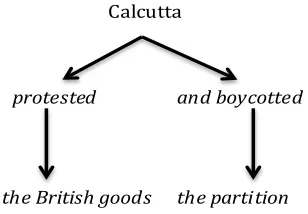
comput-ed with Moses. Recall our previous example, and that after translation, the sentiment relation may interchange, so that the semantic meaning of the sentence may be the opposite of what was stated in the source. For example:
!
Calcutta!
protested( and(boycotted(
the(British(goods( the(partition(
Figure 3
To correct this error in translation, we reposi-tioned the words using our source sentiment rela-tion knowledge obtained on the English side of the data. First, we marked the input source sentence with sentiment holder, sentiment word and their corresponding objects and measured the distance between them. The distance is then also measured on the translated sentence. If they maintained the similar distance, i.e. it ensures that they did not exchange their positions. Otherwise, we have to exchange the position of sentiment expression with their corresponding holder and object according to the distance measure. In this way, we automatical-ly post-edited the entire translated sentences, if required.
5
System Setup
The effectiveness of the present work is demon-strated by using the standard log-linear PB-SMT model as our baseline system. For building base-line system, we use the maximum phrase length of 7 and a 5-gram language model. The other experi-mental settings were: GIZA++ implementation of IBM word alignment model 4 with grow-diagonal-final-and heuristics for performing word alignment and phrase-extraction (Koehn et al., 2003). The reordering model was trained msd-bidirectional (i.e. using both forward and backward models) and conditioned on both source and target languages. The reordering model is built by calculating the probabilities of the phrase pair associated with the given orientation such as monotone (m), swap(s) and discontinuous (d). We use Minimum Error Rate Training (MERT) (Och, 2003) on a held-out
development set of 500 sentences, and a target lan-guage model with Kneser-Ney smoothing (Kneser and Ney, 1995) trained with SRILM (Stolcke, 2002).
6
Experiments and Results
Our experiments have been carried out in two di-rections. First we improved the baseline model using the aligned sentiment phrases. Then, we au-tomatically post-edited the translation output by using the sentiment knowledge of the source input test sentence.
The evaluation results are reported in Table 1. The evaluation was carried out using well-known automatic MT evaluation metrics: BLEU (Papineni et al., 2002, NIST (Doddington, 2002), METEOR (Banerjee and Lavie, 2005), and TER (Snover et al., 2006). In experiment 2, the extracted parallel sentiment phrase alignments are incorporated with the existing baseline phrase table and the resulting model performs better than the baseline system. Experiment 3 shows how post-editing the output of experiment 2 brings about further improvements.
7
Conclusions and Future Research
In this paper, we successfully illustrated how sen-timent analysis can improve the translation of an English-Bengali PB-SMT system. We have also shown how sentiment knowledge is useful for au-tomatic post-editing the MT output. In either case, we were able to improve the performance over the baseline system. Using sentiment phrase alignment we obtained a 25.73% relative improvement in BLEU over the baseline system. The automatic post-editing method results in a 33.88% relative improvement in BLEU over the baseline system. On manual inspection of the output translation we found that after incorporating sentiment phrase alignment with the baseline PB-SMT system, the output delivers better lexical selection. The post-editing method also ensures better word ordering to some extent. In the near future, we will extend the post-editing process and improve our sentiment
alignment strategies by using machine learning algorithms.
Acknowledgments
The research leading to these results has received funding from the EU FP7 Project EXPERT the People Programme (Marie Curie Actions) (Grant No. 317471) and the “Development of English to Indian Languages Machine Translation (EILMT) System - Phase II” project funded by Department of Information Technology, Government of India.
References
Aditya Joshi, A. R. Balamurali and Pushpak Bhattacharyya. 2010. A fall-back strategy for senti-ment analysis in Hindi: a case study. In Proceedings of the 8th International Conference on Natural Lan-guage Processing.
Amitava Das and Sivaji Bandyopadhyay. 2010. Senti-WordNet for Indian Languages. In Proceedings of the 8th Workshop on Asian Language Resources (ALR), August, pp. 56-63.
Andreas Stolcke. 2002. SRILM-An Extensible Lan-guage Modeling Toolkit. In Proceedings of the Intl. Conf. on Spoken Language Processing, pp. 901–904. Anup K. Kolya, Dipankar Das, Asif Ekbal and Sivaji
Bandyopadhyay. 2012. Roles of event actors and sen-timent holders in identifying event-sensen-timent associa-tion. In Proceedings of CICLing-2012, pp. 513-525. Arthur P. Dempster, Nan M. Laird and Donald B.
Ru-bin. 1977. Maximum Likelihood from Incomplete Data via the EM Algorithm. Journal of the Royal Statistical Society, 39 (1): 1–38.
Braja G. Patra, Hiroya Takamura, Dipankar Das, Mana-bu Okumura and Sivaji Bandyopadhyay. 2013. Con-struction of Emotional Lexicon Using Potts Model. In Proceedings of the6th IJCNLP-2013, Nagoya, Ja-pan, pp. 674-679.
Carlo Strapparava and Alessandro Valitutti. 2004. Wordnet-affect: an affective extension of wordnet. In
Proceedings of the 4th LRE, Lisbon, pp. 1083-1086. Carmen Banea, Rada Mihalcea, Janyce Wiebe and
Sa-mer Hassan. 2008. Multilingual subjectivity analysis using machine translation. In Proceedings of the EMNLP, pp. 127-135.
Exp. No. Experiments BLEU NIST METEOR TER
1 Baseline (B) 10.92 4.16 0.3073 75.34
2 B + Sentiment Phrase Alignment (SPA) 13.73 4.44 0.3307 72.93
3 B + SPA+ Post Editing 14.62 4.44 0.3416 71.83
Table 1: Evaluation Result
David Chiang. 2005. A Hierarchical Phrase-Based Model for Statistical Machine Translation. In Pro-ceedings of 43rd Annual Meeting on Association for Computational Linguistics, pp. 263-270.
Declan Groves and Andy Way. 2005. Hybrid data-driven models of machine translation. Machine Translation 19(3-4): 301-323.
Dipankar Das and Sivaji Bandyopadhyay. 2010. Devel-oping Bengali WordNet Affect for Analyzing Emo-tion. In International Conference on the Computer Processing of Oriental Languages, pp. 35-40. Donghui Feng, Yajuan Lü and Ming Zhou. 2004. A
New Approach for English-Chinese Named Entity Alignment. In Proc. of the EMNLP, pp. 372-379. Franz Josef Och and Hermann Ney. (2004). The
Align-ment Template Approach to Statistical Machine Translation. Computational linguistics 30(4): 417-449.
George Doddington. 2002. Automatic evaluation of machine translation quality using n-gram co-occurrence statistics. In Proc. of the 2nd Human Language Technology Research, pp. 138-145. Hua Wu, Haifeng Wang and Chengqing Zong. 2008.
Domain adaptation for statistical machine translation with domain dictionary and monolingual corpora. In
Proc. of the 22nd International Conference on Com-putational Linguistics (COLING 2008), Manchester, UK, pp. 993-1000.
Jaehyung Yang. 2004. Phrase chunking for efficient parsing in machine translation system. In MICAI 2004: Advances in Artificial Intelligence, pp. 478-487.
Kanayama Hiroshi, Nasukawa Tetsuya and Watanabe Hideo. 2004. Deeper sentiment analysis using ma-chine translation technology. In Proceedings of the 20th international conference on Computational Lin-guistics.
Kneser, Reinhard, and Hermann Ney. 1995. Improved backing-off for m-gram language modeling. In Proc. of the IEEE International Conference on Acoustics, Speech, and Signal Processing (ICASSP), pp. 181– 184.
Kishore Papineni, Salim Roukos, Todd Ward and Wei-Jing Zhu. 2002. BLEU: a method for automatic eval-uation of machine translation. In Proc. of the 40th Annual Meeting of the Association for Computational Linguistics, Philadelphia, PA, pp. 311-318.
Marine Carpuat and Mona Diab. 2010. Task-based Evaluation of Multiword Expressions: a Pilot Study in Statistical Machine Translation. In Proc. of HLT-NAACL, Los Angeles, CA, pp. 242-245.
Pascale Fung and Kenneth Ward Church. 1994. K-vec: A new approach for aligning parallel texts. In Pro-ceedings of the 15th Association for Computational linguistics.
Peter F. Brown, Vincent J. D. Pietra, Stephen A. D. Pietra and Robert L. Mercer. 1993. The mathematics of statistical machine translation: parameter estima-tion. Computational Linguistics, 19(2):263-311. Philipp Koehn, Franz Josef Och and Daniel Marcu.
2003. Statistical phrase-based translation. In Proc. of HLT-NAACL, Edmonton, Canada, pp. 48-54.
Philipp Koehn. 2004. Statistical significance tests for machine translation evaluation. In Proceedings of the EMNLP, pp. 388-395.
Philipp Koehn, Hieu Hoang, Alexandra Birch, Chris
Callison-Burch, Marcello Federico, Nicola Bertoldi,
Brooke Cowan, Wade Shen, Christine Mo- ran,
Richard Zens, Chris Dyer, Ondřej Bojar, Alexandra Constantin, and Evan Herbst. 2007. Moses: open source toolkit for statistical machine translation. In
Proc. of the 45th Annual meeting of the Association for Computational Linguistics (ACL 2007), pp. 177-180.
Santanu Pal, Sudip Kumar Naskar and Sivaji Bandyo-padhyay. 2013. MWE Alignment in Phrase Based Statistical Machine Translation. In Proceedings of the Machine Translation Summit XIV, Nice, France. pp. 61-68
Santanu Pal, Tanmoy Chkraborty and Sivaji Bandyo-padhyay. 2011. Handling Multiword Expressions in Phrase-Based Statistical Machine Translation. In
Proceedings of the Machine Translation Summit XIII, Xiamen, China. pp. 215-224.
Satanjeev Banerjee and Alon Lavie. 2005. An Automat-ic MetrAutomat-ic for MT Evaluation with Improved Correla-tion with Human Judgments. In proceedings of the ACL Workshop on Intrinsic and Extrinsic Evaluation Measures for MT and/or Summarization, pp. 65-72. Ann Arbor, Michigan.
Soo-Min Kim and Eduard Hovy. 2004. Determining the sentiment of opinions. In Proceedings of the 20th in-ternational conference on Computational Linguistics, pp. 1-8.
Soo-Min Kim and Eduard Hovy. 2006. Extracting opin-ions, opinion holders, and topics expressed in online news media text. In Proceedings of the Workshop on Sentiment and Subjectivity in Text. pp. 1-8. ACL. Stefano Baccianella, Andrea Esuli and Fabrizio
Sebas-tiani. 2010. Sentiwordnet 3.0: An enhanced lexical resource for sentiment analysis and opinion mining. In Proceedings of the 7th conference on International Language Resources and Evaluation (LREC’10),
Valletta, Malta.
Ted Dunning. 1993. Accurate methods for the statistics of surprise and coincidence. Computational Linguis-tics, 19:61–74.
William A. Gale and Kenneth W. Church. 1993. A pro-gram for aligning sentences in bilingual corpora.
Computational linguistics 19(1): 75-102.