A Poodle or a Dog? Evaluating Automatic Image Annotation Using
Human Descriptions at Different Levels of Granularity
Josiah K. Wang1 Fei Yan2 Ahmet Aker1 Robert Gaizauskas1
1Department of Computer Science, University of Sheffield, UK 2Centre for Vision, Speech and Signal Processing, University of Surrey, UK
{j.k.wang, ahmet.aker, r.gaizauskas}@sheffield.ac.uk [email protected]
Abstract
Different people may describe the same object in different ways, and at varied levels of granular-ity (“poodle”, “dog”, “pet” or “animal”?) In this paper, we propose the idea of ‘granulargranular-ity- ‘granularity-aware’ groupings where semantically related concepts are grouped across different levels of granularity to capture the variation in how different people describe the same image content. The idea is demonstrated in the task of automatic image annotation, where these semantic group-ings are used to alter the results of image annotation in a manner that affords different insights from its initial, category-independent rankings. The semantic groupings are also incorporated during evaluation against image descriptions written by humans. Our experiments show that se-mantic groupings result in image annotations that are more informative and flexible than without groupings, although being too flexible may result in image annotations that are less informative.
1 Introduction
Describing the content of an image is essential for various tasks such as image indexing and retrieval, and the organization and browsing of large image collections. Recent years have seen substantial progress in the field of visual object recognition, allowing systems to automatically annotate an image with a list of terms representing concepts depicted in the image. Fueled by advances in recognition algorithms and the availability of large scale datasets such as ImageNet (Deng et al., 2009), current systems are able to recognize thousands of object categories with reasonable accuracy, for example achieving an error rate of0.11in classifying1,000categories in the ImageNet Large Scale Visual Recognition Challenge 2013 (ILSVRC13) (Russakovsky et al., 2013).
However, the ILSVRC13 classification challenge assumes each image is annotated with only one correct label, although systems are allowed up to five guesses per image to make the correct prediction (or rather, to match the ground truth label). The problem with this is that it becomes difficult to guess what the ‘correct’ label is, especially when many other categories can equally be considered correct. For instance, should a system label an image containing an instance of a dog (and possibly some other objects like a ball and a couch) as “dog”, “poodle”, “puppy”, “pet”, “domestic dog”, “canine” or even “animal” (in addition to “ball”, “tennis ball”, “toy”, “couch”, “sofa”,etc.)? The problem becomes even harder when the number of possible ways to refer to the same object instance increases, but the number of prediction slots to fill remains limited. With so many options from which to choose, how do we know what the ‘correct’ annotation is supposed to be?
In this paper, we take ahuman-centricview of the problem, motivated by the observation that humans are likely to be the end-users or consumers of such linguistic image annotations. In particular, we investi-gate the effects of grouping semantically related concepts that may refer to the same object instance in an image. Our work is related to the idea ofbasic-levelcategories (Biederman, 1995) in Linguistics, where most people have a natural preference to classify certain object categories at a particular level of granu-larity,e.g.“bird” instead of “sparrow” or “animal”. However, we argue that what one person considers
This work is licensed under a Creative Commons Attribution 4.0 International Licence. Page numbers and proceedings footer are added by the organisers. Licence details:http://creativecommons.org/licenses/by/4.0/
‘basic-level’ may not necessarily be ‘basic-level’ to another, depending on the person’s knowledge, ex-pertise, interest, or the context of the task at hand. For example, Rorissa (2008) shows that users label groups of images and describe individual images differently with regards to the level of abstraction. The key idea behind our proposed ‘granularity-aware’ approach is to group semantically related categories acrossdifferent levels of granularity to account for how different people would describe content in an image differently.
We demonstrate the benefits of the ‘granularity-aware’ approach by producing a re-ranking of visual classifier outputs for groups of concept nodes, e.g.WordNet synsets. The concept nodes are grouped across different levels of specificity within a semantic hierarchy (Section 3.1). This models better the richness of the vocabulary and lexical semantic relations in natural language. In this sense these group-ings are used to alter the results of image annotation in a manner that affords different insights from its initial, category-independent rankings. For example, if the annotation mentions only “dog” but not “poodle”, a system ranking “poodle” at1and “dog” at20will have a lower overall score than a system ranking “dog” at1, although both are equally correct. Grouping (“poodle” or “dog”) however will allow a fairer evaluation and comparison where both systems are now considered equally good. The ‘granularity-aware’ groupings will also be used in evaluating these re-rankings using textual descriptions written by humans, rather than a keyword-based gold-standard annotation. The hypothesis is that by modeling the variation in granularity levels for different concepts, we can gain a more informative insight as to how the output of image annotation systems can relate to how a person describes what he or she perceives in an image, and consequently produce image annotation systems that are more human-centric.
Overview. The remainder of the paper is organized as follows: Section 2 discusses related work. Sec-tion 3 describes our proposed ‘granularity-aware’ approach to group related concepts across different levels of granularity. It also discusses how to apply the idea both in automatic image annotation, by re-ranking noisy visual classifier outputs in a ‘granularity-aware’ manner, and in evaluation of classi-fier outputs against human descriptions of images. The results of the proposed method are reported in Section 4. Finally, Section 5 offers conclusions and proposes possible future work.
2 Related work
Work on automatic image annotation traditionally relies heavily on image datasets annotated with a fixed set of labels as training data. For example, Duygulu et al. (2002) investigated learning from images annotated with a set of keywords, posing the problem as a machine translation task between image regions and textual labels. Gupta and Davis (2008) includes some semantic information by incorporating prepositions and comparative adjectives, which also requires manual annotation as no such data is readily available. Recent work has moved beyond learning image annotation from constrained text labels to learning from real world texts, for example from news captions (Feng and Lapata, 2008) and sports articles (Socher and Fei-Fei, 2010).
There is also recent interest in treating texts as richer sources of information than just simple bags of keywords, for example with the use of semantic hierarchies for object recognition (Marszałek and Schmid, 2008; Deng et al., 2012b) and the inclusion of attributes for a richer representation (Lampert et al., 2009; Farhadi et al., 2009). Another line of recent work uses textual descriptions of images for various vision tasks, for example for recognizing butterfly species from butterfly descriptions (Wang et al., 2009) and discovering attributes from item descriptions on fashion shopping websites (Berg et al., 2010). There has also been interest in recent years in producing systems that annotate images with full sentences rather than just a list of terms (Kulkarni et al., 2011; Yang et al., 2011). We consider our work to complement the work of generating full sentences, as it is important to filter and select the most suitable object instances from noisy visual output. The shift from treating texts as mere labels to utilizing them as human-centric, richer forms of annotations is important to gain a better understanding of the processes underlying image and text understanding or interpretation.
ours in that the semantic hierarchy is used from within the visual classifier to make a decision about its output, rather than for evaluating existing outputs. More directly related to our work is recent work by Ordonez et al. (2013), which incorporates the notion of basic-level categories by modeling word ‘naturalness’ from text corpora on the web. While their focus is on obtaining the most ‘natural’ basic-level categories for different encyclopedic concepts as well as for image annotation, our emphasis is on accommodating different levels of naturalness, not just a single basic level. We adapt their model directly to our work, details of which will be discussed in Section 3.1.
3 Granularity-aware approach to image annotation
The proposed ‘granularity-aware’ approach to image annotation consists of several components. We first define semantic groupings of concepts by considering hypernym/hyponym relations in WordNet (Fell-baum, 1998) and also how people describe image content (Section 3.1). The groupings are then used to re-rank the output of a set of category-specific visual classifiers (Section 3.2), and also used to produce a grouped ‘gold standard’ from image captions (Section 3.3). The re-ranked output is then evaluated against the ‘gold standard’, and the initial rankings and ‘granularity-aware’ re-rankings are compared to gain a different insight into the visual classifiers’ performance as human-centric image annotation systems.
3.1 Semantic grouping across different granularity levels
The goal of semantic grouping is to aggregate related concepts such that all members of the group refer to the same instance of an object, even across different specificity levels. In particular, we exploit the hypernym/hyponym hierarchy of WordNet (Fellbaum, 1998) for this task. WordNet is also the natural choice as it pairs well with our visual classifiers which are trained on ImageNet (Deng et al., 2009) categories, orsynsets.
The WordNet hypernym hierarchy alone is insufficient for semantic grouping as we still need a way to determine what constitutes a reasonable group,e.g.putting all categories into a single “entity” group is technically correct but uninformative. For this, we draw inspiration from previous work by Ordonez et al. (2013), where a ‘word naturalness’ measure is proposed to reflect how people typically describe image content. More specifically, we adapt for our purposes their proposed approach of mapping encyclopedic concepts to basic-level concepts (mapping “Grampus griseus” to the more ‘natural’ “dolphin”). In this approach, the task is defined as learning a translation functionτ(v, λ) :V 7→W that best maps a nodev to a hypernym nodewwhich optimizes a trade-off between the ‘naturalness’ ofw(how likely a person is to usewto describe something) and the distance betweenv andw(to constrain the translation from being too general,e.g.“entity”), with the parameterλcontrolling this trade-off between naturalness and specificity. Formally,τ(v, λ)is defined as:
τ(v, λ) = arg max
w∈Π(v) [λ φ(w)−(1−λ)ψ(w, v) ] (1)
whereΠ(v) is the set of hypernyms forv (including v),φ(w) is naturalness measure for nodew, and ψ(w, v)is the number of edges separating nodeswandvin the hypernym structure of WordNet.
For our work, all synsets that map to a common hypernymware clustered as a single semantic group Gλ
w:
Gλw={v:∀vτ(v, λ) =w} (2)
In this sense, the parameterλ∈ [0,1]essentially also controls the average size of the groups: λ= 0 results in no groupings, whileλ= 1results in synsets being grouped with their most ‘natural’ hypernym, giving the largest possible difference in the levels of granularity within each group.
describe image content. Thus, we explore a different corpus that (i) better reflects how humans describe image content; (ii) is sufficiently large for a reasonable estimate ofφ(w). The Yahoo! Webscope Yahoo Flickr Creative Commons 100M (YFCC-100M) dataset (Yahoo! Webscope, 2014) fits these criteria with 100 million images containing image captions written by users. Hence, we compute term occurrence statistics from the title, description, and user tags of images from this dataset. Following Ordonez et al., we measureφ(w)as the maximum log count of term occurrences for all terms appearing in synsetw.
Internal nodes. Unlike Ordonez et al. (2013), we do not constrain v to be a leaf node, but instead also allow for internal nodes to be translated to one of their hypernyms. We could choose to limit visual recognition to leaf nodes and estimate the visual content of internal nodes by aggregating the outputs from all its leaf nodes, as done by Ordonez et al. (2013). However, since the example images in ImageNet are obtained for internal nodes pretty much in the same way as leaf nodes (by querying “dog” rather than by combining images from “poodle”, “terrier” and “border collie”) (Deng et al., 2009), the visual models learnt from images at internal nodes may capture different kinds of patterns than from their hyponyms. For example, a model trained with ImageNet examples of “dog” might capture some higher-level information that may otherwise not be captured by merely accumulating the outputs of the leaf nodes under it, andvice versa.
3.2 Re-ranking of visual classifier output
The visual classifier used in our experiments (Section 4.2) outputs a Platt-scaled (Platt, 2000) confidence value for each synset estimating the probability of the synset being depicted in a given image. The classifier outputs are then ranked in descending order of these probability values, and are treated as image annotation labels.
As mentioned, these rankings do not take into consideration that some of these synsets are semantically related. Thus, we aggregate classifier outputs within our semantic groupings (Section 3.1), and then re-rank the scores of each grouped classifier. Formally, the new score of a classifier c, ρc(Gλw), for a
semantic groupGλ
w is defined as:
ρc(Gλw) = maxv∈Gλ w
pc(v) (3)
wherevis a synset from the semantic groupGλ
w, andpc(v)is the original probability estimate of classifier
cfor synsetv. I.e., the probability of the most probable synset in the group is taken as the probability of the group.
To enable comparison of the rankings against a gold standard keyword annotation, a word label is also generated for each semantic group. We assign as the semantic group’s label`(Gλ
w)the first term of
synsetw, the common hypernym node to which members of the group best translates. Note that the term merely acts a label for evaluation purposes and should not be treated as a word in a traditional sense. We also merge semantic groups with the same label to account for polysemes/homonyms, again taking the maximum ofρcamong the semantic groups as the new score.
The semantic grouping of synsets is performed independently of visual classifier output. As such, we only need to train each visual classifieroncefor each synset, without requiring re-training for different groupings since we only aggregate theoutputof the visual classifiers. This allows for more flexibility since the output for each semantic group is only aggregated atevaluation time.
3.3 Evaluation using human descriptions
λ
0.0 0.1 0.2 0.3 0.4 0.5 0.6 0.7 0.8 0.9 1.0
Semantic Grouping 0.3450 0.3450 0.3548 0.3735 0.4025 0.4417 0.4562 0.4702 0.4834 0.5059 0.5395
Random Grouping 0.3450 0.3450 0.3493 0.3529 0.3585 0.3689 0.3823 0.4067 0.4241 0.4359 0.4467
Number of groups 1294 1294 1237 1105 949 817 693 570 474 419 368
Table 1: Results of re-ranking with semantic groupings. The first two rows show the average NDCG scores for the proposed groupings and the random baseline groupings, for different groupings formed by varyingλ. The bottom row shows the number of semantic groups formed for different values ofλ.
For each image, each noun is assigned an individual relevance score, which is the number of captions that mentions the noun. This upweights important objects while downweighting less important objects (or errors from the annotator or the parser). The result is a list of nouns that humans use to describe objects present in the image, each weighted by its relevance score. We assume nouns that appear in the same WordNet synset (“bicycle” and “bike”) are synonyms and that they refer to the same object instance in the image. Hence, we group them as a single label-group, with the relevance score taken to be the maximum relevance score among the nouns in the group.
Since there are only five captions per image, the proposed approach will result in a sparseset of keywords. This mirrors the problem described in Section 1 where systems have to ‘guess’ the so-called ‘correct’ labels, thus allowing us to demonstrate the effectiveness of our ‘granularity-aware’ re-rankings. In order to compare the annotations against the re-rankings, we will need to map the keywords to the semantic groupings. This is done by matching the nouns to any of the terms in a semantic group, with a corresponding label`(Gλ
w)for each group (Section 3.2). Nouns assigned the same label are merged, with
the new relevance score being the maximum relevance score among the nouns. If a noun matches more than one semantic group (polyseme/homonym), we treat all groups as relevant and divide the relevance score uniformly among the groups. Evaluation is then performed by matching the semantic group labels against the image annotation output.
4 Experimental evaluation
Our proposed method is evaluated on the dataset and categories as will be described in Section 4.1, by re-ranking the output of the visual classifiers in Section 4.2. The effects of semantic groupings are explored using different settings ofλ(see Section 3.1).
Baseline. To ensure any improvements in scores are not purely as a result of having a shorter list of concepts to rank, we compare the results to a set of baseline groupings where synsets are grouped in a random manner. For a fair comparison the baselines contain the same number of groups and cluster size distributions as our semantic groupings.
4.1 Dataset and Object Categories
The Flickr8k dataset (Hodosh et al., 2013) is used in our image annotation experiments. The dataset contains 8,091 images, each annotated with five textual descriptions. To demonstrate the notion of gran-ularity in large-scale object hierarchies, we use as object categories synset nodes from WordNet (Fell-baum, 1998). Ideally, we would like to be able to train visual classifiers for all synset categories in ImageNet (Deng et al., 2009). However, we limit the categories to only synsets with terms occurring in the textual descriptions of the Flickr8k dataset to reduce computational complexity, and regard the use of more categories as future work. This results in a total of 1,372 synsets to be used in our experiments. The synsets include bothleaf nodesas well asinternal nodesin the WordNet hierarchy.
4.2 Visual classifier
(CNN) (Krizhevsky et al., 2012) in the ImageNet Large Scale Visual Recognition Challenge 2012 (ILSVRC12) (Deng et al., 2012a). Donahue et al. (2013) report that features extracted from the acti-vation of a deep CNN trained in a fully supervised fashion can also be re-purposed to novel generic tasks that differ significantly from the original task. Inspired by Donahue et al. (2013), we extract such acti-vation as feature for ImageNet images that correspond to the 1,372 synsets, and train binary classifiers to detect the presence of the synsets in the images of Flickr8k. More specifically, we use as our training set the 1,571,576 ImageNet images in the 1,372 synsets, where a random sample of 5,000 images serves as negative examples, and as our test set the 8,091 images in Flickr8k. For each image in both sets, we extracted activation of a pre-trained CNN model as its feature. The model is a reference implementation of the structure proposed in Krizhevsky et al. (2012) with minor modifications, and is made publicly available through the Caffe project (Jia, 2013). It is shown in Donahue et al. (2013) that the activation of layer 6 of the CNN performs the best for novel tasks. Our study on a toy example with 10 ImageNet synsets however suggests that the activation of layer 7 has a small edge. Once the 4,096 dimensional activation of layer 7 is extracted for both training and test sets, 1,372 binary classifiers are trained and applied using LIBSVM (Chang and Lin, 2011), which give probability estimates for the test images. For each image, the 1,372 classifiers are then ranked in order of their probability estimates.
4.3 Evaluation measure
The systems are evaluated using the Normalized Discounted Cumulative Gain (NDCG) (Wang et al., 2013) measure. This measure is commonly used in Information Retrieval (IR) to evaluate ranked retrieval results where each document is assigned a relevance score. This measure favours rankings where the most relevant items are ranked ahead of less relevant items, and does not penalize irrelevant items.
The NDCG at positionk,NDCGk, for a set of test imagesIis defined as:
NDCGk(I) = |I|1
|I| X
i=1
1 IDCGk(i)
k
X
p=1
2Rp−1
log2(1 +p) (4)
where Rp is the relevance score of the concept at position p, and IDCGk(i) is the ideal discounted
cumulative gain for a perfect ranking algorithm at positionk, which normalizes the overall measure to be between 0.0 to 1.0. This makes the scores comparable across rankings regardless of the number of synset groups involved. For each grouping, we report the results ofNDCGk for the largest possiblek
(i.e.the number of synset groups), which gives the overall performance of the rankings.
4.4 Results
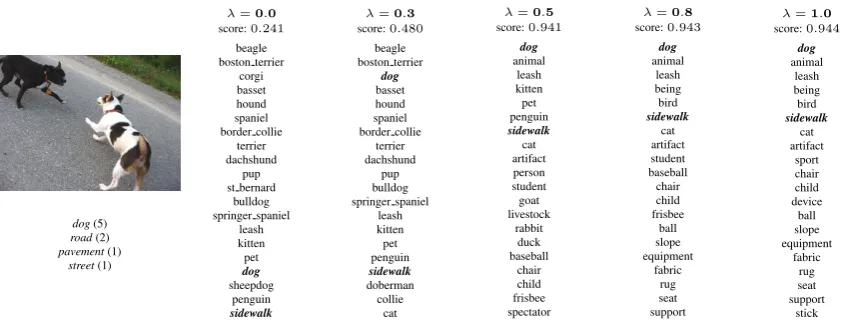
Table 1 shows the results of re-ranking the output of the visual classifiers (Section 4.2), with different semantic groupings formed by varyingλ. The effects of the proposed groupings is apparent when com-pared to the random baseline groupings. As we increase the value ofλ(allowing groups to have a larger range of granularity), the NDCG scores also consistently increase. However, higher NDCG scores do not necessarily equate to better groupings, as semantic groups with too much flexibility in granularity levels may end up being less informative, for example by annotating a “being” in an image. The in-formativeness of the groupings is a subjective issue depending on the context, and makes an interesting open question. To provide insight into the effects of our groupings, Figure 1 shows an example where at low levels ofλ(rigid flexibility), the various dog species are highly ranked but none of them is consid-ered relevant by the evaluation system. However, atλ = 0.5most dog species are grouped as a “dog” semantic group resulting in a highly relevant prediction, while at the same time allowing the “sidewalk” group to rise higher in the rankings. At higher levels ofλ, however, the semantic groupings become less informative when superordinate groups like “being”, “artifact” and “equipment” are formed, suggesting that higher flexibility with granularity levels may not always be more informative.
5 Conclusions and future work
dog(5) road(2) pavement(1)
street(1)
λ=0.0
score:0.241 beagle boston terrier corgi basset hound spaniel border collie terrier dachshund pup st bernard bulldog springer spaniel leash kitten pet dog sheepdog penguin sidewalk
λ=0.3
score:0.480 beagle boston terrier dog basset hound spaniel border collie terrier dachshund pup bulldog springer spaniel leash kitten pet penguin sidewalk doberman collie cat
λ=0.5
score:0.941 dog animal leash kitten pet penguin sidewalk cat artifact person student goat livestock rabbit duck baseball chair child frisbee spectator
λ=0.8
score:0.943 dog animal leash being bird sidewalk cat artifact student baseball chair child frisbee ball slope equipment fabric rug seat support
λ=1.0
[image:7.595.80.504.59.222.2]score:0.944 dog animal leash being bird sidewalk cat artifact sport chair child device ball slope equipment fabric rug seat support stick
Figure 1: Example re-ranking of our visual classifier by semantic groupings, for selected values of λ. Words directly below the image indicate the ‘gold standard’ nouns extracted automatically from its corresponding five captions. The number next to each noun indicate its relevance score. For each re-ranking, we show the labels representing the semantic groupings.Italicized labelsindicate a match with the (grouped) ‘gold standard’ nouns (see Section 3.3).
ways, and at varied levels of specificity. To gain insight into the effects of our semantic groupings on human-centric applications, the proposed idea was investigated in the context of re-ranking the output of visual classifiers, and was also incorporated during evaluation against human descriptions. We found that although the groupings help provide a more human-centric and flexible image annotation system, too much flexibility may result in an uninformative image annotation system. Future work could include (i) exploring different ways of grouping concepts; (ii) incorporating the output of visual classifiers to improve both groupings and rankings; (iii) using information from more textual sources to improve image annotation; (iv) taking the approach further to generate full sentence annotations. We believe that these steps are important to bridge the semantic gap between computer vision and natural language.
Acknowledgements
The authors would like to acknowledge funding from the EU CHIST-ERA D2K programme, EPSRC grant reference: EP/K01904X/1.
References
Tamara L. Berg, Alexander C. Berg, and Jonathan Shih. 2010. Automatic attribute discovery and characterization from noisy web data. InProceedings of ECCV, volume 1, pages 663–676.
Irving Biederman. 1995. Visual object recognition. In S. F. Kosslyn and D. N. Osherson, editors,An Invitation to Cognitive Science, 2nd edition, Volume 2, Visual Cognition, pages 121–165. MIT Press.
Thorsten Brants and Alex Franz. 2006. Web 1T 5-gram Version 1. InLinguistic Data Consortium.
Chih-Chung Chang and Chih-Jen Lin. 2011. LIBSVM: A library for support vector machines. ACM Transactions on Intelligent Systems and Technology, 2(3):1–27. http://www.csie.ntu.edu.tw/˜cjlin/libsvm. Jia Deng, Wei Dong, Richard Socher, Li-Jia Li, Kai Li, and Li Fei-Fei. 2009. ImageNet: A large-scale hierarchical
image database. InProceedings of CVPR.
Jia Deng, Alexander C. Berg, Sanjeev Satheesh, Hao Su, Aditya Khosla, and Li Fei-Fei. 2012a. ImageNet large scale visual recognition challenge (ILSVRC) 2012. http://image-net.org/challenges/LSVRC/2012/. Jia Deng, Jonathan Krause, Alexander C. Berg, and Li Fei-Fei. 2012b. Hedging your bets: Optimizing
accuracy-specificity trade-offs in large scale visual recognition. InProceedings of CVPR.
Pinar Duygulu, Kobus Barnard, Nando de Freitas, and David A. Forsyth. 2002. Object recognition as machine translation: Learning a lexicon for a fixed image vocabulary. InProceedings of ECCV, pages 97–112.
Ali Farhadi, Ian Endres, Derek Hoiem, and David A. Forsyth. 2009. Describing objects by their attributes. In
Proceedings of CVPR.
Christiane Fellbaum, editor. 1998.WordNet: An Electronic Lexical Database. MIT Press, Cambridge, MA. Yansong Feng and Mirella Lapata. 2008. Automatic image annotation using auxiliary text information. In
Pro-ceedings of the 46th Annual Meeting of the Association for Computational Linguistics: Human Language Tech-nologies, pages 272–280. Association for Computational Linguistics.
Abhinav Gupta and Larry S. Davis. 2008. Beyond nouns: Exploiting prepositions and comparative adjectives for learning visual classifiers. InProceedings of ECCV, pages 16–29.
Geoffrey E. Hinton and Ruslan R. Salakhutdinov. 2006. Reducing the dimensionality of data with neural networks.
Science, 313:504–507.
Micah Hodosh, Peter Young, and Julia Hockenmaier. 2013. Framing image description as a ranking task: Data, models and evaluation metrics. Journal of Artificial Intelligence Research, 47:853–899.
Yangqing Jia. 2013. Caffe: An open source convolutional architecture for fast feature embedding. http:// caffe.berkeleyvision.org.
Alex Krizhevsky, Ilya Sutskever, and Geoffrey Hinton. 2012. ImageNet classification with deep convolutional neural networks. InAdvances in Neural Information Processing Systems.
Girish Kulkarni, Visruth Premraj, Sagnik Dhar, Siming Li, Yejin Choi, Alexander C. Berg, and Tamara L. Berg. 2011. Baby talk: Understanding and generating simple image descriptions. InProceedings of CVPR.
Chris H. Lampert, Hannes Nickisch, and Stefan Harmeling. 2009. Learning to detect unseen object classes by between-class attribute transfer. InProceedings of CVPR.
Y. LeCun, B. Boser, J. Denker, D. Henerson, R. Howard, W. Hubbard, and L. Jackel. 1989. Backpropagation applied to handwritten zip code recognition. Neural Computation, 1(4):541–551.
Marcin Marszałek and Cordelia Schmid. 2008. Constructing category hierarchies for visual recognition. In David Forsyth, Philip Torr, and Andrew Zisserman, editors,Proceedings of ECCV, volume 5305 ofLecture Notes in Computer Science, pages 479–491. Springer Berlin Heidelberg.
Vicente Ordonez, Jia Deng, Yejin Choi, Alexander C. Berg, and Tamara L. Berg. 2013. From large scale image categorization to entry-level categories. InProceedings of ICCV.
Llu¨ıs Padr¨o and Evgeny Stanilovsky. 2012. Freeling 3.0: Towards wider multilinguality. InProceedings of the Language Resources and Evaluation Conference, LREC ’12, Istanbul, Turkey, May. ELRA.
John C. Platt. 2000. Probabilities for SV machines. Advances in Large-Margin Classifiers, pages 61–74.
Abebe Rorissa. 2008. User-generated descriptions of individual images versus labels of groups of images: A comparison using basic level theory. Information Processing and Management, 44(5):1741–1753.
Olga Russakovsky, Jia Deng, Jonathan Krause, Alexander C. Berg, and Li Fei-Fei. 2013. ImageNet large scale visual recognition challenge (ILSVRC) 2013. http://image-net.org/challenges/LSVRC/2013/ results.php.
Richard Socher and Li Fei-Fei. 2010. Connecting modalities: Semi-supervised segmentation and annotation of images using unaligned text corpora. InProceedings of CVPR, pages 966–973.
Josiah Wang, Katja Markert, and Mark Everingham. 2009. Learning models for object recognition from natural language descriptions. InProceedings of BMVC.
Yining Wang, Liwei Wang, Yuanzhi Li, Di He, Wei Chen, and Tie-Yan Liu. 2013. A theoretical analysis of NDCG ranking measures. InProceedings of the 26th Annual Conference on Learning Theory (COLT 2013).
Yahoo! Webscope. 2014. Yahoo! Webscope dataset YFCC-100M. http://labs.yahoo.com/Academic_ Relations.