DESIGN OF AN AUTOMATED ATTENDANCE SYSTEM USING FACE
RECOGNITION ALGORITHM
Muazzamu Ibrahim
1, Isiaka Shuaibu
2, Mulikatu Yakubu Ibrahim
3, Abdullahi Abdulkadir
41,2,4
computer Vision and Robotics Dept., Changchun University of Science and Technology, China
3computer Science Dept., Kano University of science and Technology, Nigeria
---***---
Abstract - As the population of the Nigerian universities is increasing rapidly, the paper-based attendance becomes highly difficult to manage by most of the Nigerian lecturers and also by the managements of the institutions. Most of the managements need to have the attendance records of all their students before the commencement of examination. However, Nigerian universities are facing a lot of problems with visiting lecturers, in view of this, the managements usually need to have the attendance records of the visiting lecturers and number of times they took lectures in each semester for the processing of their allowances. Mostly, Nigerian universities have policy that student most have 75% attendance in order to allow him sit for examination of that semester. The issue of paper-based attendance has caused a lot of problems in obtaining the accurate records. The aim of this paper is to provide an efficient way of taking attendance in Nigerian universities using face recognition. The use of face recognition in carrying out the attendance in Nigerian universities will provide solution to the major problems being faced during paper-based attendance in the classrooms. The algorithm works by using single scale Retinex with bi-histogram equalization to enhance the image captured. Viola-jone algorithm was used to detect the face and principal component analysis (PCA) to recognize the student face by comparing with template images stored in the database. The proposed system provided above 90% accuracy which is an improvement to the existing face recognition algorithms.
Key Words: single scale Retinex, bi-histogram equalization, face detection, face recognition, attendance.
1. INTRODUCTION
Attendance in any organization is very vital to know the frequency of members presence. University is a place where attendance plays a vital role for both students and staff. It has been proved that student’s performance has impact with classroom attendance [1]. Most of the Nigerian universities have policy of 75% attendance of the semester for students to be allowed to sit examination for that semester [16]. The manual attendance system adopted by Nigerian universities has a lot of problems such as time consuming, impersonation, and other difficulties being faced in managing it because of its manual nature.
Face recognition is one of the most important biometric technologies used for verification and identification of
individuals. Face recognition has taken advantage among other biometric technologies [15]. Most of the biometric technologies require the presence of the user. However, in face recognition, the system can capture multiple faces of students at the same time without presence of any user(admin) and the system is non-intrusive [14]. There are little papers published on attendance using face recognition in Nigerian Institutions. The previous papers studied have certain weakness in enhancing the quality of image [15]. The purpose of this study is to design an efficient face recognition algorithm that uniquely identify and mark attendance of the students in a particular course with accuracy. The algorithm can capture student face via webcam and use single scale Retinex with bi-histogram equalization algorithms to improve the quality of the image. Viola-jone was used to detect the face of the students, extract the features, and PCA is used to match student face against stored template images in the database and then mark the attendance. PCA is the most popular and simplest algorithm used in face recognition.
2. LITERATURE REVIEW
Viola-jone algorithm is one of the simplest and popular face detection algorithms in the computer vision field [13]. L. Sirovich and M. Kirby highlighted that any picture can be presented in economically manner by reducing the dimension which termed as eigen picture [2]. M. Sharkas and M.A. Elenien proposed that principal component analysis (PCA) is a dimensional reduction algorithm that produce a better result and is good for face recognition algorithm [3].
Soniya V. and et al (2017) highlighted the important of attendance using face recognition in India where they addressed the use of internet of things (IOT) as of one the widest technology used in the modern world. The system used Arduino to create and control tasks of checking absent, and automatically mark the attendance for the students. The Arduino microcontroller is responsible for comparing the captured image with the images stored in the database were all pattern images were already stored, if the pattern marched, then the attendance is marked for the student [14].
© 2019, IRJET | Impact Factor value: 7.34 | ISO 9001:2008 Certified Journal
| Page 1115
Their algorithm can detect the student face and mark their attendance but has some drawbacks in accuracy especially when there is light variation [15]. The Retinex theory was developed by Land and McCann to model how the human vision system perceive scene [5]. Retinex algorithm is the most image enhancement algorithm used in computer vision for color constancy and tonal rendition [4]. Retinex model can be described as ( ) ( ) ( ) where S is the input image, R is the reflectance and L is the illumination [4]. The algorithm is used to enhance the quality of the image. Many algorithms have been developed for image enhancement. Single scale Retinex with histogram equalization is one of the most widely used algorithms for improving the contrast, brightness and sharpness of an image through dynamic range compression [10].
3. METHODOLOGY
This section provides the method and techniques used in the proposed face recognition attendance system.
3.1 Retinex Algorithm.
In the proposed system, we first used single scale Retinex with bi-histogram equalization to enhance the quality of the face captured then later applied face recognition algorithm to detect and recognize the captured face by comparing with faces in the database. Below is the brief explanation of Retinex enhancement algorithm used in the proposed system. Note that, the enhanced image produced by single scale Retinex is the input to the face recognition algorithm.
Retinex algorithm is one of the image enhancement algorithms for improving the quality of images that provide color constancy and tonal rendition. This theory was first developed by Edwin Land in 1977, and later Jobson.et al proposed two most popular Retinex algorithm called Single Scale Retinex (SSR) and Multiple Scale Retinex (MSR) . The general model of Retinex algorithm is given by
( ) ( ) ( )
where 𝐼 is the input image on the color channel, R is the Retinex output on the color channel and L is the normalized surrounded function.
3.1.1 Single Scale Retinex
This is one of image enhancement algorithms whereby the output image is determined by the difference between the input image value and average of its neighborhood.
SSR for an image 𝐼 (𝑥, 𝑦) is defined by [7] as
( ) ( ) , ( ) ( )-
By using Gaussian surround function to F (x, y), the normalized surround function,
F (x, y) = *( ) ( ) +
where c is the Gaussian surround constant, that is referred to as the scale of the SSR, and K is selected such that
∬ ( )
3.1.2 Single Scale Retinex with Bi-Histogram Equalization
Histogram equalization is the traditional technique for improving the contrast of the image but has drawback that can change the mean brightness of an image [6].
Bi Histogram Equalization (BHE) is used for improving the histogram equalization (HE) method for contrast enhancement. BHE first finds average point in histogram of the image and then divides the histogram in to two segments based on this point. After that histogram equalization operation is applied on each segment [9].
Single Scale Retinex with bi-histogram equalization provided a better result for image recognition algorithm.
Figure 1 single scale Retinex with bi-histogram equalization
Once image captured, single scale Retinex is applied to the image then take the bi-equalization, the output image is the enhanced image which can be use as an input to the face recognition algorithm.
3.2.Face Recognition Algorithm
Viola-jone was used to detect single face or multiples faces. The algorithm used four processes which allow fast face detection [8][12]. They are Haar feature, integral image, AdaBoosting and cascading.
Input image
Single scale
Output image
Retinex
Haar feature selection: This provided rectangle to similar feature shared by human being in order to allow fast detection [8]. Integral image is a new representation which allow fast feature evaluation to determine whether the face is present or absent [11][12]. AdaBoost
algorithm is a process of selecting small efficient feature of an image from large potential features [11]. The final process is the cascade structure which directly focus on the promising parts of an image by using more complex classifiers in a cascade structure [12].
Figure 2 PCA Algorithm
3.2.1 Face Tracking
The face recognition is of two forms: face location and face tracking. The face location locates the specific place which is suitable for detection [14]. Face tracking works by tracking the length, breadth, size and pixels of the face as well as components such as eyebrows, eyes, nose, and mouth.
3.2.2 PCA Algorithm
Principal Component Analysis, or PCA, is a dimensionality-reduction method that is often used to reduce the dimensionality of large data sets, by transforming a large set of variables into smaller one that still contain most of the information in the large set. The face pattern can be detected and recognized using PCA algorithm. These steps used for PCA are:
I.
Standardization: This can be done by subtracting the mean and dividing by the standard deviation for each value of each variable. Once the standardization is done, all the variables will be transformed to the same scale.II.
Covariance matrix: The aim of this step is to understand how the variables of the input data set are varying from the mean with respect to each other and is calculate by C=AT A. The entries of the covariance matrix are symmetric with respect to the main diagonal, which means that the upper and the lower triangular portions are equal.III.
Compute the eigenvectors and eigenvalues of the covariance matrix C to identify the principal components which is done usingD=CV V-1
IV.
Feature Vector: The feature vector is simply a matrix that has as columns the eigenvectors of the components that we decide to keepV.
Recast the data along the principal component’s axes: The aim is to use the feature vector formed using the eigenvectors of the covariance matrix, to reorient the data from the original axes to the ones represented by the principal components (hence the name Principal Components Analysis). This can be done by multiplying the transpose of the original data set by the transpose of the feature vector as follows.FinalDataSet= FeatureT * StandardizedOriginalDataSetT.
3.3 Proposed System
Webcam was used as the input device for capturing the faces. Once the face is captured, single scale Retinex with bi-histogram equalization was used to enhance the sharpness of the image then face recognition algorithm is applied to the face captured. The algorithm can detect the face, extract features and recognize the face. The algorithm was implemented using MATLAB. Before the algorithm is used, the template images need to be stored in the database. Each person has 10 different faces patterns stored in the database. The database was designed to hold maximum number of 40 persons.
Most of the face recognition algorithms have light variation problem. The images trained in dark room is very difficult to recognize in a bright room. The application of single scale Retinex with bi-histogram equalization provided better result because the low illumination present in the image should be improve to have stable contrast to provided more accurate and efficient result.
© 2019, IRJET | Impact Factor value: 7.34 | ISO 9001:2008 Certified Journal
| Page 1117
[image:4.595.60.532.89.363.2]
Figure 3 proposed system flow chart
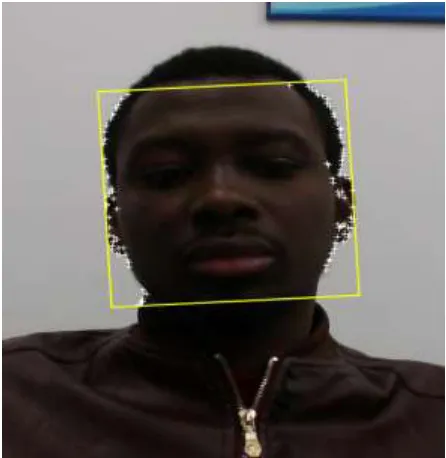
The student needs to be registered by storing his/her personal information in the database including face image. Figure 4 shows sample face capture. Once done, verification takes place by capturing student face with camera, single scale Retinex with bi-histogram equalization was used to improve the quality of the image. That is, it increases the contrast of the image if the surrounded environment has low illumination and provide almost real image. After that, Viola-jone detection and recognition algorithms detect, extract the features and recognize the face by comparing image captured result with the template images stored in the database. If matches are found, one (1) will be place in present column, and zero (0) in the absent column and saved with time. Student attendance is check by sorting attendance list based on the time range to determine student’s presence or absence in that particular time. At last, the percentage presence is calculated to determine the student’s overall percentage attendance for the course.
Figure 4 sample face capture
3.3.1 Use Case Diagram
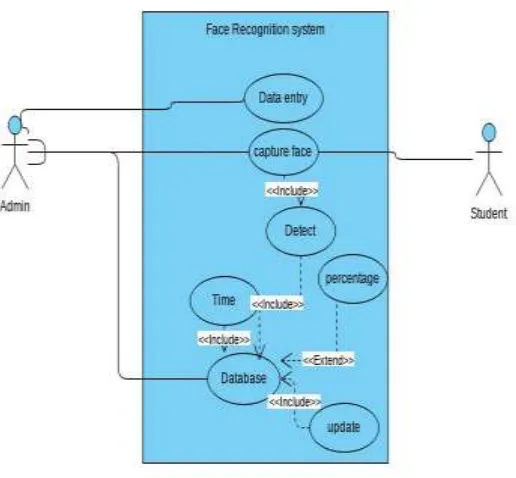
The use case diagram shows the interaction between the user and the system as shown diagrammatically in the figure 5. The admin is responsible of registering the students by entering students bio-data including the face captured and also setting the time range for the attendance while students can only scan their faces during attendance process. The use case can be seen as a blueprint of the proposed system.
start
Enhance the captured face by single
scale with bi-histogram equalization
face recognition algorithm
Put 1 and save the
time
Is pattern matches?
stop
update
[image:4.595.326.549.406.635.2]Figure 5 Use case diagram
3.3.2 Database
The database was designed to hold the information of 40 students. The information of forty students is stored under different column. The Table 1 shown some part of
the database. Each entry had provision for the storage of images, with maximum of ten images per person. The type of database used to implement this system was relational. The sample of face captured for testing the algorithm is shown in Figure 4.
4. RESULT
The faces of all the students need to be trained before we can start taking the attendance. During the attendance process, the student’s face is captured and compared with the trained faces stored in the database. If the face captured has matched at least 85% with any one of the trained faces the value 1 will be save to the database which marks attendance status for the corresponding student as presentotherwise, value zero (0) will be returned which marks attendance status for the corresponding student as absent.
The table 1 gives a description of a sample output from the system. As you can see a student with registration no UG11/coms/2012 has scanned his face late, then system marked him absent because the time was set in the range of 8:00 am to 10:00 am
Table 1 Sample Database record from the proposed system
5. CONCLUSION
The face recognition student’s attendance system works quite well. Results obtained in the proposed system showed clearly that the face recognition attendance system performs better in terms of accuracy. Absolutely, it can be improved for accommodating a better result especially by improving the feature extraction or recognition process. This improvement may help the recognition process become more robust. We need to keep in mind that a well-trained database plays a crucial role in face recognition. Therefore, to have a high percentage of face recognition rates, we need to train our database with as much variations as possible. The
success rate of the proposed system in recognizing facial images of the students who are seated in classroom is above 90%.
REFERENCES
1. D. Romer (1993). Do students go to class? Should they? The Journal of Economic Perspectives, 7, 167-174. http://dx.doi.org/10.1257/jep.7.3.167.
[image:5.595.69.494.473.600.2]© 2019, IRJET | Impact Factor value: 7.34 | ISO 9001:2008 Certified Journal
| Page 1119
3. M. Sharkas and M.A. Elenien, Eigenfaces vs. Fisherfaces vs. ica for face recognition: A comparative study, in: 9th International Conference on Signal Processing (ICSP), Beijing, China, (2008), 914–919
4. LI Xue-ming, Image Enhancement Algorithm Based on Retinex Theory emic, Application Research of Computers, 2005,25(2), pp. 235—237.
5. E. Land and J. McCann, Lightness and retinex theory, Journal of the Optical Society of America, 61 (1971),
pp. 1–11.
http://dx.doi.org/10.1364/JOSA.61.000001.
6. Paramjit Singh, Dr. Amandeepkaur, Contrast Enhancement of Color Images with BiHistogram, Journal of Engineering Research and Applications, Vol. 4, Issue 6(Version 2), June 2014, pp.26-29.
7. M. Prabhu, V. Sarumathi and C. Vaishnavi, Implementing Histogram Equalization and Retinex Algorithms for Image Contrast Enhancement,2014, Middle-East Journal of Scientific Research 22 (8)
8. I.S. Jacobs and C.P. Bean, “Fine particles, thin films and exchange anisotropy,” in Magnetism, vol. III, G.T. Rado and H. Suhl, Eds. New York: Academic, 1963, pp. 271-350. [9] Yeong-taekgi, M., 1997. Contrast enhancement using brightness preserving bi-histogram equalization, IEEE
9. M. Prabhu, S. Rajarajan and M. P. Karthikeyan, Implementing histogram equalization and retinex
algorithms for image contrast enhancement, International Journal of Applied Engineering Research ISSN 0973-4562 Volume 9, Number 20 (2014) pp. 7311-7318.
10. G. Eason, B. Noble, and I.N. Sneddon, “On certain integrals of Lipschitz-Hankel type involving products of Bessel functions,” Phil. Trans. Roy. Soc. London, vol. A247, pp. 529551, April 1955.
11. C. Papageorgiou, M. Oren and T. Poggio, A general frame- work for object detection, in: International Conference on Computer Vision, (1998).
12. P. Viola and M.J. Jones, Robust real time face detection, International Journal of Computer Vision 57(2) (2001), 137–154.
13. V. Soniya(2017), Attendance automation using face recognition biometric authentication,
14. 2017 International Conference on Power and Embedded Drive Control (ICPEDC) 978-15090-4679-9/17/ IEEE
15. k. okokpujie and et al (2017), A Face Recognition Attendance System with GSM Notification, International Conference on Electro-Technology for National Development (NIGERCON), 978-1-5090-6422-9/17IEEE