Performance Parameter of Spectrum Sensing MIMO- OFDM based LTE
Technique
Anjali Pachauri
1, Prof. Gurpreet Singh
21
Research scholar, Electronics & Communication Department, Trinity Institute of Technology & Research, Bhopal
2Professor, Electronics & Communication Department, Trinity Institute of Technology & Research, Bhopal
---***---Abstract - Orthogonal Frequency Division Multiple Access has been adopted in emerging broadband wireless access networks such as 3GPP UMTS/LTE and IEEE 802.16x (WiMAX) due to its inherent immunity to inter-symbol interference and scheduling flexibility in resource allocation. 3GPP LTE (Long Term Evolution) is the evolution of the UMTS which will make possible to deliver next generation high quality multimedia services according to the users expectations. For the LTE performance evaluation and Radio Resource Management in 4G, needs, system level simulations, different algorithms to simulate the LTE Downlink based on OFDM technology with Schedulers are presented in this thesis. These show that proportional fair and resource fair schedulers deliver a good trade-off between throughput and fairness.
Key Words: Long Term Evolution (LTE), OFDM, 4G, MIMO- OFDM
1. INTRODUCTION
Mobile communication of these days is inherently extra more complex than fixed factor communication. Consequently, the overall potential of radio communication is far being found out. In December 1947, Douglas H. Ring and W. Rae younger, Bell Labs engineers, proposed hexagonal cells for cellular phones in cars. In 1969 Amtrak geared up commuter trains alongside the 225-mile.
The big apple Washington course with special pay telephones that allowed passengers to vicinity telephone calls while they teach changed into moving. The gadget re-used six frequencies in the 450 MHZ band in 9 websites, a precursor of the idea later applied in mobile phones. On December 1971, AT&T submitted a suggestion for mobile carrier to the Federal Communications commission (FCC). In 1971’s they constructed the primary community in Chicago and had 1300 customers at the machine by the stop of 1978. After years of hearings, the FCC accepted the thought in 1982 for an advanced cell phone system (AMPS) and allotted frequencies in the 824–894 MHz band. Analog AMPS become subsequently superseded by way of virtual AMPS in 1990.
In 1979 cell communities (1G) become launched in Japan by using NTT. The subsequent 1G network to release became the Nordic mobile phone (NMT) system in Denmark, Finland, Norway and Sweden in 1981. NMT changed in the primary cellular smartphone network to characteristic worldwide roaming. With the creation of 1G phone, the mobile market confirmed the annual boom fee of 30 to 50 according to cent, rising to almost 20 million subscribers by means of 1990 [1]. The 2G systems designed in the Nineteen Eighties have been nevertheless used specifically for voice applications however have been based totally on virtual era, which includes virtual sign processing techniques [2]. 2G cellular systems include GSM, digital AMPS (D-AMPS), code-division a couple of get right of entry to (CDMA), and private virtual communication (percent). GSM is the maximum a hit own family of mobile requirements. It includes GSM900, GSM-railway (GSM-R), GSM1800, GSM1900, and GSM 400 [3].
3G mobile telecommunication is a technology of requirements for cell phones and cellular telecommunication offerings fulfilling the international mobile Telecommunications-2000 (IMT-2000) specs via the ITU. Utility services include huge- vicinity wireless voice phone, cellular internet access, video calls and mobile TV, all in a cell environment [4]. To fulfill the developing demands in network ability, charges required for high speed statistics switch and multimedia packages, 3G standards started evolving. The 3G era lets in video, audio, and pix applications. Over 3G phones, you'll be able to watch streaming video or have video telephony.
(OFDM), that is more spectrally green and can deliver greater bits per Hertz. LTE also brings subscribers a “proper” cell broadband that allows a excellent video to enjoy and media mobility. it is predicted that out of about 2 billion people, who may be having broadband via 2012, a few 1/3 can be mobile broadband customers and majority customers might be served with the aid of high pace Packet access (HSPA) and longtime Evolution (LTE). 3GPP LTE is the evolution of the 0.33-technology of mobile communications [8]. LTE is designed to growth records costs and mobile facet bit fees. Radio aid control draws outstanding attention while utilizing available resources to offer customers with better device throughput. Radio resources management consists of transmission strength management, mobility management, and scheduling of radio assets. A smart radio useful resource management is at the heart of LTE to make it a strong generation to satisfy the broadband mobility desires of upcoming years. This could schedule the to be had resource in a quality manner and offer to the customers with the enough transmission functionality to attain the decided QoS.
Fig -1: LTE Architecture
[image:2.595.179.412.310.471.2]While they move freely and will also make certain that these assigned sources could not intervene with already assigned resources. 3GPP advanced Packet gadget (EPS) framework consists of evolved Packet Cores (EPCs) and developed UMTS Terrestrial Radio access Networks (E-UTRAN) as shown in determine 1. EPCs talk with each different and with E-UTRANs. EPC incorporates a mobile control Entity (MME) and device architecture Evolution Gateway (SGW) together with a Packet facts network Gateway (PDN GW).
Table -1: LTE Performance metrics
LTE Performance Metrics
Peak Data Rate DL/UL: 100/50 Mbps for
20 MHz
Full Mobility Up to 500 km/h
Latency in Control/user plane < 100 ms (idle to active) /<5 MHz
Capacity 200 users per cell (5
MHz)
Cell Sizes 5-100 km
Spectrum 1.25, 2.5, 10, 15 and 20
MHz
[image:2.595.173.426.569.706.2]Fig -2: LTE downlink transmitter structure
Within the first step of the transmitter processing, the consumer facts is generated relying on the preceding Acknowledgement (ACK) signal. If the preceding consumer records delivery Block (TB) changed into now not mentioned, the stored TB is retransmitted the usage of a Hybrid computerized Repeat request (HARQ) scheme. Then a Cyclic Redundancy check (CRC) is calculated and appended to every user's TB. The records of every consumer is independently encoded the usage of a faster encoder. Every block of code bits is then interleaved and rate matched with a target rate depending on the obtained Channel pleasant Indicator (CQI) person comments. In addition to HSDPA, the fee-matching method in LTE already consists of the HARQ technique.
A. LTE Downlink Receiver
[image:3.595.62.520.52.345.2] [image:3.595.180.411.548.710.2]and the receivers, [8] called multiple-input multiple-output (MIMO) system, which could show a considerable increase in the channel capacity. In a multipath wireless channel environment, the deployment of MIMO systems which enhances the channel capacity enormously has led to the achievement of high rate data transmission without increasing the total transmission power or bandwidth. Using multiple antennas at both the source (transmitter (TX)) and the destination (receiver (RX)) is referred to as spatial multiplexing [15]. The use of MIMO in wireless systems has several advantages such as:-
o Significant increase in data throughput and spectral efficiency
o Reduced fading because of antenna diversity
o Increased user capacity
o Greater immunity to interference
MIMO combined with OFDM provides significant improvement in the performance of wireless LANs, enabling them to serve existing applications more cost-effectively, as well as making new and more demanding applications possible [9].
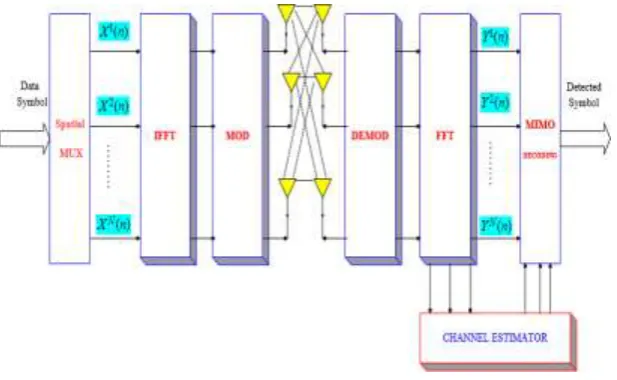
Fig -4: MIMO – OFDM Model
The spectral efficiency of MIMO is achieved by transmitting different symbols on different transmit antennas simultaneously as shown in Figure 4, in such a way that the information can be recovered from the parallel streams of data arriving at different antennas in the receiver under suitable channel conditions (i.e. Sufficiently rich multipath scattering). This requires of advanced signal processing algorithms, which also ensures adequate BER performance [10].
3. SIMULATION RESULTS
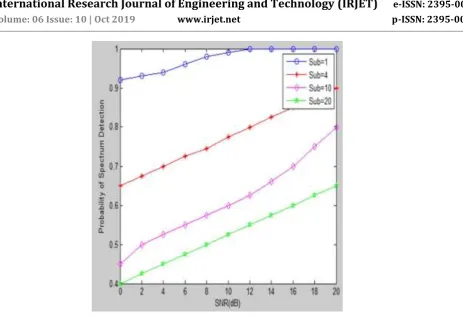
[image:4.595.138.447.362.552.2]Fig -5: Probability of spectrum detection versus different SNR in 2 × 2 MIMO system
Fig -6: Probability of relative mean square error versus different SNR in 2×2 MIMO system
In figure 6, show the graph of the relative mean squared error versus different SNR in 2×2 MIMO system with different number of active subcarriers. From the figure, we can see when less relative mean squared error is less number of subcarriers. The increase subcarriers are active in the system, the mean square error will increase.
[image:5.595.80.544.52.370.2] [image:5.595.171.425.396.575.2]Fig -7: Probability of bit error rate versus different SNR in 4×4 MIMO system
4. CONCLUSION
In this research work, we proposed an iterative receiver for MIMO-OFDM systems. Based on this receiver, solutions to two of the most important problems in OFDM systems have been provided, namely, inter carrier interference cancellation and inter symbol interference cancellation over long term evolution (LTE) transmitter and receiver system. Furthermore, the spectrum sensing algorithm introduced in this paper can efficiently estimate the spectrum usage but without the prior information of sparsity, which makes it suitable for the application in the real wireless environment.
REFERENCES
[1] Z. Han, T. Himsoon, W. P. Siriwongpairat, and K. J. R. Liu, “Resource allocation or multiuser cooperative OFDM networks:
Who helps whom and how to cooperate,”IEEE Transactions on Vehicular Technology, vol. 58, no. 5, pp. 2378–2391, 2009.
[2] P. Hasselbach1, A. Klein1, and I. Gaspard, “Self- organising radio resource management for cellular mobile radio networks
using power-bandwidth characteristics,” in Conference Proceedings, ICT- Mobile Summit, pp. 1–8, 2009.
[3] Theodoratos and G. Pavlidou, “A novel radio resource management scheme for maximizing uplink capacity in M-WiMAX,”
in Wireless Communications and Networking Conference (WCNC), Sydney, pp. 1–6, 2010.
[4] Dimitrakopoulos, P. Demestichas, A. Saatsakis, K. Tsagkaris, A. Galani, J. Gebert, and K. Nolte, “Management and control of
reconfigurable radio systems,” IEEE Vehicular Technology Magazine, 2009.
[5] S. Schwarz, C. Mehlfȕhrer, and M. Rupp, “Throughput maximizing multiuser scheduling with adjustable fairness,” in Proc.
IEEE International Conference on Communications, pp. 1–5, 2011.
[6] J. F. Monserrat, A. Saul, G. Auer, and T. Clessienne, “Advanced radio resource management for IMT- Advanced in the
framework of WINNER+ Project,” in Conference Proceedings, ICT-Mobile Summit, pp. 101–108, 2009.
[7] R. Kwan, C. Leung, and J. Zhang, “Resource allocation in an LTE cellular communication system,” in Proc. of IEEE
International Conference on Communications, pp. 3915–3919, 2009.
[8] D. Niyato, E. Hossain, D. I. Kim, and Z. Han, “Relay- centric radio resource management and network planning in ieee
802.16j mobile multi-hop relay networks,” IEEE Transactions on Wireless Communications, vol. 8, pp. 6115–6124, December 2009.
[9] S. Nonchev and M. Valkama, “Advanced radio resource management for multiantenna packet radio systems,” International
Journal of Wireless and Mobile Networks, vol. 2, no. 2, pp. 1–14, 2010.
[10] S. Schwarz, C. Mehlfȕhrer, and M. Rupp, “Low complexity approximate maximum throughput scheduling for LTE,” in 44th
Annual Asilomar Conference on Signals, Systems, and Computers, November 2010.
[11] C. Mehlfȕhrer, J. C. Ikuno, M. Simko, S. Schwarz, M. Wrulich, and M. Rupp, “The vienna LTE simulators - enabling
reproducibility in wireless communications research,” EURASIP Journal on Advances in Signal Processing, vol. 2011, pp. 1– 13, 2011.
[12] Shan Jin and Xi Zhang, “Compressive Spectrum Sensing for MIMO-OFDM Based Cognitive Radio Networks”, 2015 IEEE
[image:6.595.94.524.49.265.2]