Using the improved position specific scoring matrix
and ensemble learning method to predict
drug-binding residues from protein sequences
Juan Li1, Yongqing Zhang2, Wenli Qin1, Yanzhi Guo1*, Lezheng Yu1, Xuemei Pu1, Menglong Li1, Jing Sun1
1College of Chemistry, Sichuan University, Chengdu, China; *Corresponding Author: [email protected] 2College of Computer Science, Sichuan University, Chengdu, China
Received 10 March 2012; revised 15 April 2012; accepted 28 April 2012
ABSTRACT
Identification of the drug-binding residues on the surface of proteins is a vital step in drug dis- covery and it is important for understanding pro- tein function. Most previous researches are based on the structural information of proteins, but the structures of most proteins are not avail- able. So in this article, a sequence-based method was proposed by combining the support vector machine (SVM)-based ensemble learning and the improved position specific scoring matrix (PSSM). In order to take the local environment informa- tion of a drug-binding site into account, an im- proved PSSM profile scaled by the sliding win- dow and smoothing window was used to im- prove the prediction result. In addition, a new SVM-based ensemble learning method was de- veloped to deal with the imbalanced data classi- fication problem that commonly exists in the binding site predictions. When performed on the dataset of 985 drug-binding residues, the me- thod achieved a very promising prediction result with the area under the curve (AUC) of 0.9264. Furthermore, an independent dataset of 349 drug- binding residues was used to evaluate the pre- diction model and the prediction accuracy is 84.68%. These results suggest that our method is effective for predicting the drug-binding sites in proteins. The code and all datasets used in this article are freely available at
http://cic.scu.edu.cn/bioinformatics/Ensem_DB S.zip.
Keywords: Drug-Binding Site Prediction; Position Specific Scoring Matrix; Ensemble Learning; Support Vector Machine
1. INTRODUCTION
It’s known that the function of a protein is determined to a great extent by the binding sites on its interacting surface with other molecules. Identification of these binding sites is crucial for elucidating protein functions and further assisting drug design. However, there are still abundant potential binding sites that are not identified. In recent years, although various experimental techniques [1-4] have been developed, they are all time-consuming and expensive. So it is of great practical significance to develop the reliable computational methods to facilitate the identification of drug-binding sites.
based on sequence information only.
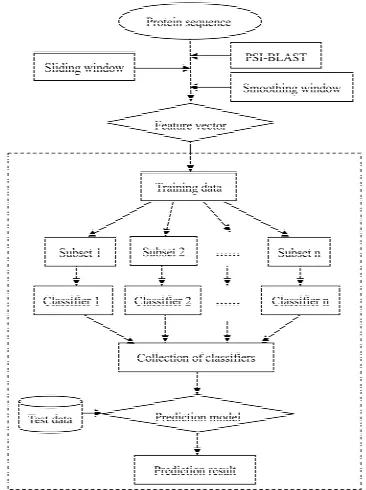
In this work, a sequence-based method based on the improved position specific scoring matrix (PSSM) and support vector machine (SVM)-based ensemble learning was firstly proposed. The improved PSSM profile ac- counts for the influence of the surrounding residues on the drug-binding sites by using a sliding window and a smoothing window. The amino acid residues were trans- lated into numerical values representing evolutionary information and their local environment information. At the same time, a new SVM-based ensemble learning me- thod was developed to deal with the imbalanced data classification problem. The entire flow chart of the pre- diction process is shown in Figure 1. The optimization experiment demonstrated that the local environment in- formation would contribute to characterize the drug- binding sites. The method yielded a high area under the curve (AUC) of 0.9264 using the dataset of 985 drug- binding sites. Moreover, the final prediction model was further evaluated by an independent dataset of 349 drug- binding sites and the prediction accuracy is 84.68%.
2. MATERIALS AND METHODS
2.1. Dataset
[image:2.595.77.260.462.707.2]The drug-binding protein chains used in this paper were from the work of Ghersi and Sanchez [10]. The 77 protein chains were extracted from the structures of drug- protein complexes determined by X-ray crystallography with a resolution better than 2.5 Å in protein data bank (PDB) [13]. To avoid redundancy, the 77 protein chains
Figure 1. The entire flow chart for the prediction of
drug-binding sites.
were aligned using position specific iterated-basic local alignment search tool (PSI-BLAST) [14]. In each cluster, the longest one was reserved [15]. And then, the mutual sequence identity of protein sequences in the dataset was less than 40%. At last, 69 drug-binding protein chains were remained. Here, only the residues that have PDB coordinators were used. A residue was designated as the drug-binding site if the backbone atoms of the residue have at least one atom within 6 Å of the heavy atoms of the drug molecule [10]. Otherwise, it is a non-binding residue. The final dataset contained 985 drug-binding residues and 21626 non drug-binding residues.
2.2. Feature Extraction and the Improved PSSM
A PSSM profile contains the evolutionary information of each residue in a protein which represents the log- likelihoods of the substitutions of 20 standard amino ac- ids. Therefore, PSSM is considered as a measure of resi- due conservation in a given location. It has been widely used to predict the functional sites [16-20] and received good results. Some researchers have shown that evolu- tionary information obtained from multiple sequence ali- gnment contains more comprehensive information than a single sequence [21,22]. In this study, the evolutionary information obtained from PSSM generated from PSI- BLAST was also employed to predict drug-binding resi- dues. A given protein sequence was searched against the Swiss-Prot database (version 54.4, released on 25 Oct. 2007) by using three iterations of PSI-BLAST for multi- ple sequence alignment, the original PSSM profile was created based on BLOSUM62 substitution matrix with E-value as 0.001. The size of the matrix of a protein is 20 × L, where L is the length of a protein sequence.
A residue ai in a protein sequence was encoded as a feature vector of dimension 20 using the ith row in the original PSSM profile. Considering the influence of sur- rounding residues on the drug-binding sites, a sliding window and a smoothing window were applied to re- encode the PSSM profiles to represent the local envi- ronment information. Therefore, for a residue ai in se- quence position i, a feature vector Hi of dimension 20 ×
w was used to represent it. w is an odd number and it is the size of sliding window.
12, ,
, , i 12i i w i a w
H h a h a h (1)
where h[ai] is the 20 feature vectors in the ith PSSM pro-file for the residue ai. If w extends beyond the sequence, (w – 1)/2 zero vectors of dimension 20 were appended on empty positions. The profile added a sliding window is defined as the standard PSSM profile [23].
PSSM profiles were encoded based on the sum of the evolution information of the neighbors to calculate a cen- tral residue’s evolutionary information [23,24]. A smooth- ing window was used to encode a smoothed PSSM pro- file. For the residue ai, the feature vector represented by
Hsm_i·ws is also an odd number.
2_ 1 2 i 1
sm i i ws i a ws
H H a H a H
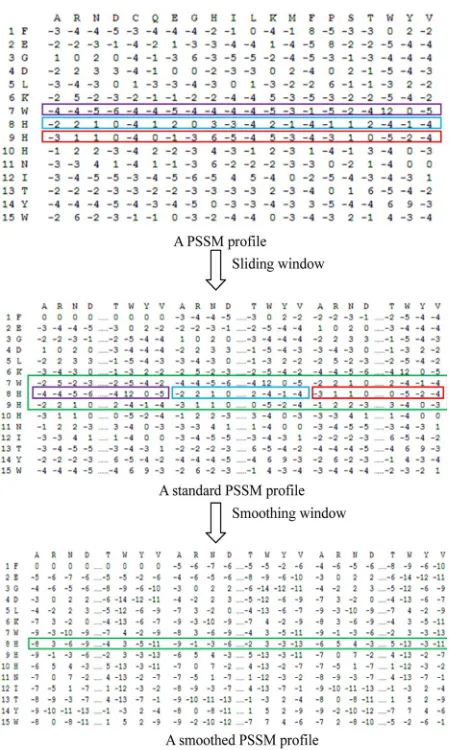
(2) For the first and the last residue of a protein, (w – 1)/2 zero vectors of dimension 20 were appended on the empty positions. Figure 2 illustrates an example of applying the sliding window and the smoothing window. Similar PSSM
Figure 2. Examples of the improved PSSM profile using a sli-
ding window and a smoothing window. The first profile is the evolutionary information obtained from PSSM generated by PSI-BLAST. For residue a8, the feature vector was represented
by [h7, h8, h9] when a sliding window size 3 was applied on the
original PSSM profile. The vector of dimension 20 × 3 was obtained in the standard profile. The corresponding value of amino acid “H” was represented by the sum of [(–2) + (–4) + (–2)] when a smoothing window size 3 was applied to reencode in smoothed profile.
approaches have been successfully used to enhance the prediction quality for various protein attributes [25-33].
2.3. Model Construction
Support vector machine (SVM) is a machine learning method based on statistical learning theory which has been proposed by Vapnik [34]. Chou and Cai [35] and Cai et al. [36,37]have given a detailed description about how to use SVM. Here, the software libsvm 2.91
(http://www.csie.ntu.edu.tw/~cjlin/libsvm/) was used to
construct the classification model. A radial basis function (RBF) was chosen as the kernel function. Two parame- ters, the regularization parameter C and the kernel width parameter γ were optimized using a grid search approach. Because the number of interacting residues is much smaller than that of non-interacting residues, the imbal- anced data classification problem commonly exists in binding site predictions. But the standard machine learn- ing methods without considering the class-imbalance problem tend to cause high false negative rate by pre- dicting the positive sample as the negative one. The cur- rent methods [38-41] have been tried to change the dis- tribution of positive and negative samples by randomly extracting a very small fraction of the negative samples as the training data, which will fail to use the most in- formation in the original data and lead to a biased esti- mate of the accuracy. To solve this imbalanced data clas- sification problem, a new SVM-based ensemble learning method [42,43] was employed to predict the drug-bind- ing sites. This method utilizes the information available in the non drug-binding sites as much as possible to con- struct the prediction model, so the prediction result is more objective. The ensemble learning method has been successfully used in predicting glycosylation sites [44] and lysine acetylation sites [45] and achieve the good prediction results.
The framework of the SVM-based ensemble learning method is shown in Figure 1. It is a collection of SVM classifiers and each one is trained on a subset of the training data. Note that the ratio of positive to negative examples in each subset is equal to that of the original dataset. The final prediction result was computed based on diverse ensembles in n classifiers combination. In our experiments, considering the ratio of positive to negative examples of the original data and the information in the negative samples, we used n = 30. For a residue in a query protein, it is misclassified by the ensemble if the majority of the SVM classifiers misclassify it.
[image:3.595.60.285.251.626.2]gram was used to re-sample the negative samples in the training set 30 times, and then combined with the posi- tive samples in the training set as the subsets. For the same test set, there are 30 sub-training sets. A SVM mo- del was constructed using the sub-training set and the performance of the model was evaluated by the test set. In order to test the robustness of the method, this process was repeated ten times with different combinations of training and testing datasets. The final result was given by averaging the prediction results of the ten test sets.
Three measures, sensitivity, specificity and accuracy were used to evaluate the performance of this method. They are defined as follows:
TP Sensitivity
TP FN
(3)
TN Specificity
TN FP
(4)
TP TN Accuracy
TP TN FP FN
(5) where TP, TN, FN, FP are the number of correctly pre- dicted positive ones, the number of correctly predicted negative ones, the number of positive ones incorrectly predicted as negative ones, and the number of negative ones incorrectly predicted as positive ones.
In addition, the receiver operating characteristic (ROC) curve [46] is one of the most rigorous measures for clas- sifier evaluation. So it was employed to further evaluate the performance of the method. The ROC curve was ob- tained by plotting sensitivity on the y-axis against the 1-specificity on the x-axis. The area under the ROC curve (AUC) [47] was used for model evaluation. The maximum value of AUC (1) represents the perfect pre- diction. The random guess achieves the AUC of 0.5.
3. RESULTS AND DISCUSSION
3.1. Window Size Optimization
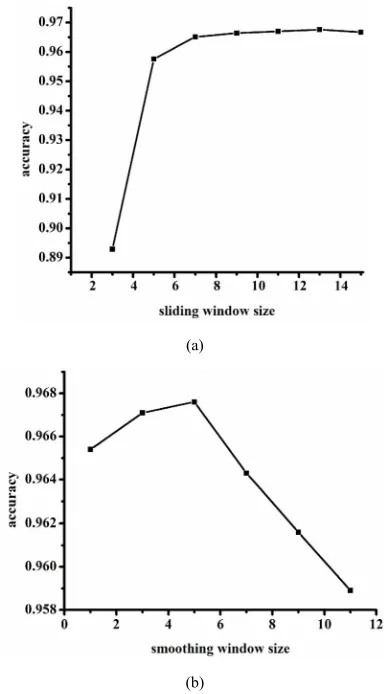
The improved PSSM profile used in this paper can in- corporate both the evolutionary information and the local environment information. A sliding window and a smoothing window were applied to re-encode the origi- nal PSSM profiles. It has been successfully used for pre- dicting RNA-binding sites in our group [24]. But the sli- ding window size and the smoothing window size were needed to be optimized. In this work, the optimal win- dow size was selected by the prediction accuracy and it was obtained by testing the performance of different slid- ing window sizes from 3 to 15 with the smoothing win- dow size of 5. The results of different sliding window sizes are shown in Figure 3(a). We can see that when the sliding window size is 13, the method achieves the best performance. At the same time, from Figure 3(b), the
(a)
[image:4.595.326.518.84.431.2](b)
Figure 3. The selection of the optimal window size. (a) The results of different sliding window sizes; (b) The results of different smoothing window sizes.
optimal smoothing window size is 5.
3.2. Comparison of SVM-Based Ensemble Learning and the Weighted SVM
Here, a weighted SVM was also used to identify the drug-binding sites and the performance of the model based on a weighted SVM classifier as compared with that of the model based on ensemble learning method.
[image:4.595.101.287.249.336.2]3.3. Comparing the Performance of the Improved PSSM with That of the Original PSSM
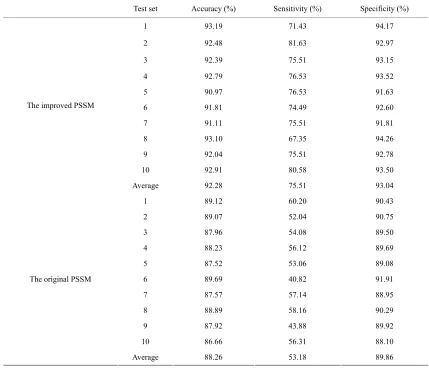
[image:5.595.65.283.82.300.2]Using the ensemble learning method, we also used the original PSSM profile to transform the protein sequences and compared the performance of the model based on the original PSSM profile with that of the model based on the improved PSSM profile. The prediction results are listed in Table 1. We can see that the model based on the improved PSSM profile gives better result with the sen- sitivity of 75.51% that is much higher than that of the original PSSM based model, only 53.18%. It proves that the local environment information is important for rep- resenting the drug-binding sites. On average, the sensi- tivity, specificity, accuracy and AUC of the improved PSSM profile based model are 75.51%, 93.04%, 92.28% and 0.9264, respectively. So using the whole dataset of 985 positive and 21626 negative samples, the final pre- diction model was built with the improved PSSM profile and the SVM-based ensemble learning.
Figure 4.The ROC curves of the ensemble learning of SVM
classifiers and the single SVM classifier for the prediction of drug-binding sites in proteins.
Table 1.The prediction results of the test sets using the SVM-based ensemble learning.
Test set Accuracy (%) Sensitivity (%) Specificity (%)
1 93.19 71.43 94.17
2 92.48 81.63 92.97
3 92.39 75.51 93.15
4 92.79 76.53 93.52
5 90.97 76.53 91.63
6 91.81 74.49 92.60
7 91.11 75.51 91.81
8 93.10 67.35 94.26
9 92.04 75.51 92.78
10 92.91 80.58 93.50
The improved PSSM
Average 92.28 75.51 93.04
1 89.12 60.20 90.43
2 89.07 52.04 90.75
3 87.96 54.08 89.50
4 88.23 56.12 89.69
5 87.52 53.06 89.08
6 89.69 40.82 91.91
7 87.57 57.14 88.95
8 88.89 58.16 90.29
9 87.92 43.88 89.92
10 86.66 56.31 88.10
The original PSSM
[image:5.595.82.511.368.737.2]3.4. Performance on the Independent Dataset
In statistical prediction, the following three cross- validation methods are often used to examine a predictor for its effectiveness in practical application: independent dataset test, subsampling test, and jackknife test [48]. However, as elaborated in [49], among the three cross- validation methods, the jackknife test is regarded as the least arbitrary or most objective that can always yield a unique result for a given benchmark dataset, and hence has been increasingly used and widely recognized by in- vestigators to examine the accuracy of various predictors [50-66]. However, to reduce the computational time, we adopted the 5-fold cross-validation in this study as done by many investigators with SVM as the prediction en- gine.
An independent dataset was selected from 100 protein complexes [9]. The mutual sequence identity in the in- dependent dataset and the sequence identity between the independent dataset and the training dataset are both less than 40%. The independent dataset contained 349 posi- tive samples and 6121 negative samples. Our method achieves a good performance and the sensitivity, speci- ficity and accuracy are 65.04%, 85.80% and 84.68%, respectively. The results suggest that our method has the good generalization ability in predicting drug-binding sites for novel proteins.
4. CONCLUSIONS
In this paper, we proposed a new method for predict- ing drug-binding sites only using the primary sequences of proteins. A PSSM profile was employed to represent the evolutionary information of each residue in a protein. Considering the influence of the surrounding residues on the drug-binding sites, the PSSM profile was improved by using a sliding window and a smoothing window. So the improved PSSM profile adequately takes the local sequence information of a drug-binding site into account. On the other hand, because the number of drug-binding sites is much smaller than that of non drug-binding sites, a new SVM-based ensemble learning method was used to solve this imbalanced data classification problem. This method fully utilizes the information available from the non drug-binding sites and the more objective prediction result was achieved. Our method gives a high AUC of 0.9264. It suggests that our method is feasible and valid. Meanwhile, the final prediction model was tested using the independent dataset of 349 drug-binding residues with a good performance. Overall, it indicates that our method can be a useful supplement to identify the un- known drug-binding sites.
Since user-friendly and publicly accessible web-servers represent the future direction for developing practically
more useful models, simulated methods, or predictors [67,68], we shall make efforts in our future work to pro- vide a web-server for the method presented in this paper.
5. ACKNOWLEDGEMENTS
This work was supported by the National Natural Science Founda- tion of China (Nos. 20905054, 20972103, 20973115) and the Specia- lized Research Fund for the Doctoral Program of Higher Education (No. 20090181120058) and National Basic Research Program of China (2007CB512602).
REFERENCES
[1] Riddall, D.R., Leach, M.J. and Garthwaite, J. (2006) A novel drug binding site on voltage-gated sodium channels in rat brain. Molecular Pharmacology, 69, 278-287.
doi:10.1124/mol.105.015966
[2] Zsila, F. and Iwao, Y. (2007) The drug binding site of human α1-acid glycoprotein: Insight from induced circu-lar dichroism and electronic absorption spectra. Bio-chimica et Biophysica Acta, General Subjects, 1770,
797-809. doi:10.1016/j.bbagen.2007.01.009
[3] Barasoain, I., Matesanz, R., Maccari, G., Trigili C., Mori, M., et al. (2010) Probing the pore drug binding site of Microtubules with fluorescent taxanes: Evidence of two binding poses. Chemistry & Biology, 17, 243-253.
doi:10.1016/j.chembiol.2010.02.006
[4] Messori, L., Piccioli, F., Gabrielli, S., Orioli, P., Angelo-nia, L. and Bugnob, C.D. (2002) The disaccharide an-thracycline MEN 10755 binds human serum albumin to a non-classical drug binding site. Bioorganic &Medicinal Chemistry, 10, 3425-3430.
doi:10.1016/S0968-0896(02)00265-1
[5] Chen, K., Huzil, J.T., Freedman, H., Ramachandran, P., Antoniou, A., Tuszynski, J.A., et al. (2008) Identification of tubulin drug binding sites and prediction of relative differences in binding affinities to tubulin isotypes using digital signal processing. Journal of Molecular Graphics &Modelling, 27, 497-505.
doi:10.1016/j.jmgm.2008.09.001
[6] Fuller, J.C., Burgoyne, N.J. and Jackson, R.M. (2009) Predicting druggable binding sites at the protein-protein interface. Drug Discovery Today, 14, 155-161.
doi:10.1016/j.drudis.2008.10.009
[7] Capra, J.A., Laskowski, R.A., Thornton, J.M., Singh, M. and Funkhouser, T.A. (2009) Predicting protein ligand binding sites by combining evolutionary sequence con-servation and 3D structure. Plos Computational Biology,
5, e1000585.doi:10.1371/journal.pcbi.1000585
[8] Nayal, M. and Honig, B. (2006) On the nature of cavities on protein surfaces: Application to the identification of drug-binding sites. Proteins: Structure, Function, and Bioinformatics, 63, 892-906. doi:10.1002/prot.20897
249. doi:10.1002/prot.20088
[10] Ghersi, D. and Sanchez, R. (2009) Improving accuracy and efficiency of blind protein-ligand docking by focus-ing on predicted bindfocus-ing sites. Proteins: Structure, Func-tion, and Bioinformatics, 74, 417-424.
doi:10.1002/prot.22154
[11] Thangudu, R.R., Tyagi, M., Shoemaker, B.A., Bryant, S.H., Panchenko, A.R. and Madej, T. (2010) Knowl-edge-based annotation of small molecule binding sites in proteins. BMC Bioinformatics, 11, 365.
doi:10.1186/1471-2105-11-365
[12] Laurie, A.T.R. and Jackson, R.M. (2006) Methods for the prediction of protein-ligand binding sites for struc-ture-based drug design and virtual ligand screening. Cur-rent Protein and Peptide Science, 7, 395-406.
doi:10.2174/138920306778559386
[13] Berman, H.M., Westbrook, J., Feng, Z.K., Gilliland, G., Bhat, T.N., Weissig, H., et al. (2000) The protein data bank. Nucleic Acids Research, 28, 235-242.
doi:10.1093/nar/28.1.235
[14] Altschul, S.F., Madden, T.L., A.A., J.H., Z. Zhang, Miller, W. and Lipman, D.J. (1997) Gapped BLAST and PSI- BLAST: A new generation of protein database search programs. Nucleic Acids Research, 25, 3389-3402.
doi:10.1093/nar/25.17.3389
[15] Wu, J.S., Liu, H.D., Duan, X.Y., Ding, Y., Wu, H.T., Bai, Y.F., et al. (2009) Prediction of DNA-binding residues in proteins from amino acid sequences using a random for-est model with a hybrid feature. Bioinformatics, 25, 30-35.
doi:10.1093/bioinformatics/btn583
[16] Wang Y., Xue, Z., Shen, G. and Xu, J. (2008) PRINTR: Prediction of RNA binding sites in proteins using SVM and profiles. Amino Acids, 35, 295-302.
doi:10.1007/s00726-007-0634-9
[17] Zhang T., Zhang, H., Chen, K., Shen, S.Y., Ruan, J.S. and Kurgan, L. (2008) Accurate sequence-based prediction of catalytic residues. Bioinformatics, 24, 2329-2338.
doi:10.1093/bioinformatics/btn433
[18] Kumar, M., Gromiha, M.M. and Raghava, G.P.S. (2008) Prediction of RNA binding sites in a protein using SVM and PSSM profile. Proteins: Structure, Function, and Bioinformatics, 71, 189-194. doi:10.1002/prot.21677
[19] Ahmad, S. and Sarai, A. (2005) PSSM-based prediction of DNA binding sites in proteins. BMC Bioinformatics, 6,
33. doi:10.1186/1471-2105-6-33
[20] Chauhan, J.S., Mishra, N.K. and Raghava, G.P.S. (2009) Identification of ATP binding residues of a protein from its primary sequence. BMC Bioinformatics, 10, 434.
doi:10.1186/1471-2105-10-434
[21] Kaur, H. and Raghava, G.P.S. (2003) Prediction of b-turns in proteins from multiple alignment using neural network.
Protein Science, 12, 627-634. doi:10.1110/ps.0228903
[22] Garg, A., Kaur, H. and Raghava, G.P.S. (2005) Real value prediction of solvent accessibility in proteins using mul-tiple sequence alignment and secondary structure. Pro-teins, 61, 318-324. doi:10.1002/prot.20630
[23] Cheng, C.W., Su, E.C., Hwang, J., Sung, T.Y. and Hsu, W.L. (2008) Predicting RNA-binding sites of proteins
using support vector machines and evolutionary informa-tion. BMC Bioinformatics, 9, S6.
doi:10.1186/1471-2105-9-S12-S6
[24] Wang, C.C., Fang, Y.P., Xiao, J.M. and Li, L.M. (2011) Identification of RNA-binding sites in proteins by inte-grating various sequence information. Amino Acids, 40,
239-248. doi:10.1007/s00726-010-0639-7
[25] Hayat, M. and Khan, A. (2012) MemHyb: Predicting membrane protein types by hybridizing SAAC and PSSM.
Journal of Theoretical Biology, 292, 93-102.
doi:10.1016/j.jtbi.2011.09.026
[26] Li, D., Jiang, Z., Yu, W. and Du, L. (2010) Predicting caspase substrate cleavage sites based on a hybrid SVM- PSSM method. Protein and Peptide Letters, 17, 1566-
1571.
[27] Mundra, P., Kumar, M., Kumar, K.K., Jayaraman, V.K. and Kulkarni, B.D. (2007) Using pseudo amino acid composition to predict protein subnuclear localization: Approached with PSSM. Pattern Recognition Letters, 28,
1610-1615. doi:10.1016/j.patrec.2007.04.001
[28] Shen, H.B. and Chou, K.C. (2007) Nuc-PLoc: A new web-server for predicting protein subnuclear localization by fusing PseAA composition and PsePSSM. Protein en-gineering. Design & Selection, 20, 561-567.
doi:10.1093/protein/gzm057
[29] Chou, K.C., Wu, Z.C. and Xiao, X. (2011) iLoc-Euk: A multi-label classifier for predicting the subcellular local-ization of singleplex and multiplex eukaryotic proteins.
PLoS ONE, 6, e18258. doi:10.1371/journal.pone.0018258
[30] Wu, Z.C., Xiao, X. and Chou, K.C. (2011) iLoc-plant: A multi-label classifier for predicting the subcellular local-ization of plant proteins with both single and multiple sites. Molecular Biosystems, 7, 3287-3297.
doi:10.1039/c1mb05232b
[31] Chou, K.C. and Shen, H.B. (2007) MemType-2L: A Web server for predicting membrane proteins and their types by incorporating evolution information through Pse- PSSM. Biochemical and Biophysical Research Commu-nications, 360, 339-345. doi:10.1016/j.bbrc.2007.06.027
[32] Wu, Z.C., Xiao, X. and Chou, K.C. (2012) iLoc-Gpos: A multi-layer classifier for predicting the subcellular local-ization of singleplex and multiplex gram-positive bacte-rial proteins. Protein & Peptide Letters, 19, 4-14.
[33] Chou, K.C., Wu, Z.C. and Xiao, X. (2012) iLoc-Hum: Using accumulation-label scale to predict subcellular lo-cations of human proteins with both single and multiple sites. Molecular Biosystems, 8, 629-641.
doi:10.1039/c1mb05420a
[34] Vapnik, V.N. (1998) Statistical learning theory. Wiley, New York.
[35] Chou, K.C. and Cai, Y.D. (2002) Using functional do-main composition and support vector machines for pre-diction of protein subcellular location. Journal of Bio-logical Chemistry, 277, 45765-45769.
doi:10.1074/jbc.M204161200
mistry, 23, 267-274. doi:10.1002/jcc.10017
[37] Cai, Y.D., Zhou, G.P. and Chou, K.C. (2003) Support vector machines for predicting membrane protein types by using functional domain composition. Biophysical Journal, 84, 3257-3263.
doi:10.1016/S0006-3495(03)70050-2
[38] Petrova, N.V. and Wu, C.H. (2006) Prediction of catalytic residues using support vector machine with selected pro-tein sequence and structural properties. BMC Bioinfor-matics, 7, 312. doi:10.1186/1471-2105-7-312
[39] Pugalenthi, G., Kumar, K.K., Suganthan, P.N. and Gangal, R. (2008) Identification of catalytic residues from protein structure using support vector machine with sequence and structural features. Biochemical and Biophysical Re-search Communications, 367, 630-634.
doi:10.1016/j.bbrc.2008.01.038
[40] Li, S.L., Li, H., Li, M.F., Shyr, Y., Xie, L. and Li, Y.X. (2009) Improved prediction of lysine acetylation by sup-port vector machines. Protein & Peptide Letters, 16, 977-
983. doi:10.2174/092986609788923338
[41] Li, Z.C., Zhou, X., Dai, Z. and Zou, X.Y. (2011) Identifi-cation of protein methylation sites by coupling improved ant colony optimization algorithm and support vector machine. Analytical Chimica Acta, 703, 163-171.
[42] Dietterich, T.G. (2000) Ensemble methods in machine learning. Lecture Notes in Computer Science, 1857, 1-15.
doi:10.1007/3-540-45014-9_1
[43] Kuncheva, L.I., Skurichina, M. and Duin, R.P.W. (2002) An experimental study on diversity for bagging and boosting with linear classifiers. Inform Fusion, 3, 245- 258. doi:10.1016/S1566-2535(02)00093-3
[44] Caragea, C., Sinapov, J., Silvescu, A., Dobbs, D. and Honavar, V. (2007) Glycosylation site prediction using ensembles of support vector machine classifiers. BMC Bioinformatics, 8, 438. doi:10.1186/1471-2105-8-438
[45] Xu Y., Wang, X.B., Ding, J., Wu, L.Y. and Deng, N.Y. (2010) Lysine acetylation sites prediction using an en-semble of support vector machine classifiers. Journal of Theoretical Biology, 264, 130-135.
doi:10.1016/j.jtbi.2010.01.013
[46] Swets, J.A. (1988) Measuring the accuracy of diagnostic systems. Science, 240, 1285-1293.
doi:10.1126/science.3287615
[47] Bradley, A.P. (1997) The use of the area under the ROC curve in the evaluation of machine learning algorithms.
Pattern Recognition, 30, 1145-1159.
doi:10.1016/S0031-3203(96)00142-2
[48] Chou, K.C. and Zhang, C.T. (1995) Review: Prediction of protein structural classes. Critical Reviews in Biochemis-try and Molecular Biology, 30, 275-349.
doi:10.3109/10409239509083488
[49] Chou, K.C. (2011) Some remarks on protein attribute prediction and pseudo amino acid composition (50th An-niversary Year Review). Journal of Theoretical Biology,
273, 236-247. doi:10.1016/j.jtbi.2010.12.024
[50] Chen, C., Chen, L., Zou, X. and Cai, P. (2009) Prediction of protein secondary structure content by using the con-cept of Chou’s pseudo amino acid composition and
sup-port vector machine. Protein & Peptide Letters, 16, 27-31.
doi:10.2174/092986609787049420
[51] Ding, H., Luo, L. and Lin, H. (2009) Prediction of cell wall lytic enzymes using Chou’s amphiphilic pseudo amino acid composition. Protein & Peptide Letters, 16,
351-355. doi:10.2174/092986609787848045
[52] Esmaeili, M., Mohabatkar, H. and Mohsenzadeh, S. (2010) Using the concept of Chou’s pseudo amino acid composi-tion for risk type prediccomposi-tion of human papillomaviruses.
Journal of Theoretical Biology, 263, 203-209.
doi:10.1016/j.jtbi.2009.11.016
[53] Georgiou, D.N., Karakasidis, T.E., Nieto, J.J. and Torres, A. (2009) Use of fuzzy clustering technique and matrices to classify amino acids and its impact to Chou’s pseudo amino acid composition. Journal of Theoretical Biology,
257, 17-26. doi:10.1016/j.jtbi.2008.11.003
[54] Gu, Q., Ding, Y.S. and Zhang, T.L. (2010) Prediction of G-protein-coupled receptor classes in low homology us-ing Chou’s pseudo amino acid composition with ap-proximate entropy and hydrophobicity patterns. Protein & Peptide Letters, 17, 559-567.
doi:10.2174/092986610791112693
[55] Guo, J., Rao, N., Liu, G., Yang, Y. and Wang, G. (2011) Predicting protein folding rates using the concept of Chou’s pseudo amino acid composition. Journal of Com- putational Chemistry, 32, 1612-1617.
doi:10.1002/jcc.21740
[56] Jiang, X., Wei, R., Zhang, T.L. and Gu, Q. (2008) Using the concept of Chou’s pseudo amino acid composition to predict apoptosis proteins subcellular location: An ap-proach by approximate entropy. Protein & Peptide Let-ters, 15, 392-396. doi:10.2174/092986608784246443
[57] Lin, H. (2008) The modified Mahalanobis discriminant for predicting outer membrane proteins by using Chou’s pseudo amino acid composition. Journal of Theoretical Biology, 252, 350-356. doi:10.1016/j.jtbi.2008.02.004
[58] Lin, J. and Wang, Y. (2011) Using a novel AdaBoost al-gorithm and Chou’s pseudo amino acid composition for predicting protein subcellular localization. Protein & Pe- ptide Letters, 18, 1219-1225.
doi:10.2174/092986611797642797
[59] Mei, S. (2012) Multi-kernel transfer learning based on Chou’s PseAAC formulation for protein submitochondria localization. Journal of Theoretical Biology, 293, 121-
130. doi:10.1016/j.jtbi.2011.10.015
[60] Mohabatkar, H. (2010) Prediction of cyclin proteins using Chou’s pseudo amino acid composition. Protein & Pep-tide Letters, 17, 1207-1214.
doi:10.2174/092986610792231564
[61] Mohabatkar, H., Mohammad Beigi, M. and Esmaeili, A. (2011) Prediction of GABA(A) receptor proteins using the concept of Chou’s pseudo-amino acid composition and support vector machine. Journal of Theoretical Biol-ogy, 281, 18-23. doi:10.1016/j.jtbi.2011.04.017
and Functional Genomics, 12, 191-197.
doi:10.1007/s10969-011-9120-4
[63] Nanni, L., Lumini, A., Gupta, D. and Garg, A. (2012) Identifying bacterial virulent proteins by fusing a set of classifiers based on variants of Chou’s pseudo amino acid composition and on evolutionary information. IEEE/ACM Transactions on Computational Biology and Bioinfor-matics, 9, 467-475.
[64] Qiu, J.D., Huang, J.H., Shi, S.P. and Liang, R.P. (2010) Using the concept of Chou’s pseudo amino acid composi-tion to predict enzyme family classes: An approach with support vector machine based on discrete wavelet trans-form. Protein & Peptide Letters, 17, 715-722.
doi:10.2174/092986610791190372
[65] Sahu, S.S. and Panda, G. (2010) A novel feature repre-sentation method based on Chou’s pseudo amino acid composition for protein structural class prediction.
Com-putational Biology and Chemistry, 34, 320-327.
doi:10.1016/j.compbiolchem.2010.09.002
[66] Zou, D., He, Z., He, J. and Xia, Y. (2011) Supersecondary structure prediction using Chou’s pseudo amino acid composition. Journal of Computational Chemistry, 32,
271-278. doi:10.1002/jcc.21616
[67] Chou, K.C. and Shen, H.B. (2009) Review: Recent ad-vances in developing web-servers for predicting protein attributes. Natural Science, 2, 63-92.
doi:10.4236/ns.2009.12011
[68] Chou, K.C. and Shen, H.B. (2008) Cell-PLoc: A package of Web servers for predicting subcellular localization of proteins in various organisms (updated version: Cell- PLoc 2.0: An improved package of web-servers for pre-dicting subcellular localization of proteins in various or-ganisms. Natural Science, 2, 1090-1103.