© 2019, IRJET | Impact Factor value: 7.34 | ISO 9001:2008 Certified Journal | Page 391
CHATBOT IN PYTHON
Akshay Kumar
1, Pankaj Kumar Meena
2, Debiprasanna Panda
3, Ms. Sangeetha
41,2,3
UG Student, Dept. of Information Technology, SRMIST, Chennai-600089
4
Assistant Professor, Dept. of Information Technology, SRMIST, Chennai-600089
---***---Abstract -
A chatbot is a computer software program thatconducts a conversation via auditory or textual methods. This software is used to perform tasks such as quickly responding to users, informing them, helping to purchase products and providing better service to customers. Chatbots are programs that work on Artificial Intelligence (AI) & Machine Learning Platform. Chatbot has become more popular in business groups right now as it can reduce customer service costs and handles multiple users at a time. But yet to accomplish many tasks there is a need to make chatbots as efficient as possible. In this project, we provide the design of a chatbot, which provides a genuine and accurate answer for any query using Artificial Intelligence Markup Language (AIML) and Latent Semantic Analysis (LSA) with python platform
.
Key Words: Artificial Intelligence Markup Language (AIML), Latent Semantic Analysis (LSA), Pattern Matching, Chatbot, Flask Web-Framework, HCI
1. INTRODUCTION
A chatbot is an automated software program that interacts with humans. A chatbot is merely a computer program that fundamentally simulates human conversations. A chatbot that functions through AI and machine learning has an artificial neural network inspired by the neural nodes of the human brain. Chatbots are programs that can do talk like human conversations very easily. For example, Facebook has a machine learning chatbot that creates a platform for companies to interact with their consumers through the Facebook Messenger application. In 2016, chatbots became too popular on Messenger. By the consequences is noted that 2016 was the entire year of chatbots. The software industry is mainly oriented on chatbots. Thousands of chatbots are invented on startups and used by the businesses to improve their customer service, keeping them hanging by a kind communication. According to research, nowadays chatbots are used to solve a number of business tasks across many industries like E-Commerce, Insurance, Banking, Healthcare, Finance, Legal, Telecom, Logistics, Retail, Auto, Leisure, Travel, Sports, Entertainment, Media and many others. Thus that was the moment to look at the chatbots as a new technology in the communication field. Nowadays various companies are using chatbots to answer quickly and efficiently some frequented asking questions from their own customers.
AIML and LSA are used for creating chatbots. Artificial Intelligence Markup Language (AIML) and Latent Semantic Analysis (LSA) are used for developing chatbots, which are
used to define general pattern-based queries. This pattern can also be used to give random responses for the same query in the chatbot. LSA is a Latent Semantic Analysis technology in python, which is utilized to discover likenesses between words as vector representation. So that the unanswered queries by AIML will be viewed as a reply by LSA.
2. RELATED WORK
Chatbots: Are They Really Useful?
Author: Bayan Abu Shawar, Eric Atwell
The paper is basically focused on an academic paper highlighting some case studies and including a brief history of chatbots that extends back to the earliest experiments such as ELIZA (c. 1966). The paper is based on making a chatbot using AIML patterns with ALICE.[1]
A Web-based Platform for Collection of Human
Chatbot Interactions
Author: Lue Lin, Luis Fdo. D’Haro, and Rafael Banchs
The paper presents a chatbot design which is work on the web-based framework. Lue Line, Luis Fernando D’Haro and Rafael E. Banchs in HAI 2016 proposed the Web Chat which was a crowd-sourced initiative that could collect and annotate human chatbot interactions. [12]
The anatomy of ALICE
Author: Wallace, Richard S.
In this paper, Dr. Richard S. Wallace proposed the technical presentation of Artificial Linguistic Internet Computer Entity (A.L.I.C.E.) as well as Artificial Intelligence Markup Language (A.I.M.L.), which are set in the background by philosophical and historical ruminations occurring on human consciousness. [13]
CHARLIE: An AIML-based Chatterbot as an Interface
in INES
Author: Mikic, Burguillo, Llamas, Rodr´ıguez, Rodr´ıguez
© 2019, IRJET | Impact Factor value: 7.34 | ISO 9001:2008 Certified Journal | Page 392
request questionnaires or free questions from the bot to testtheir knowledge.[10]
An e-business chatbot using AIML and LSA
Author: N. Thomas
In this paper, Thomas T provided the way by which the chatbot is planned in a manner that for a single template, it gives irregular responses. LSA based inquiries are giving the right reactions to random responses. [18]
3.
ARTIFICIAL INTELLIGENCE MARKUP LANGUAGE
Extensible Markup Language (XML) is the base for the derivation of Artificial Intelligence Markup Language (AIML). It has a class of data object called an AIML object that describes the behavior of computer programs. It consists of units or tag called topics and categories. In AIML, categories are basic units of knowledge. There each category consists of a pattern that contains input and template which contain the answer of chatbot based on queries. To build a Chatbot, mainly a flexible, easy to understand and universal language is needed which will be AIML. AIML, a derivative of XML, is one of the widely used approaches that satisfy the requirements based on general queries. AIML represents the knowledge put into Chatbots and is based on the software technology developed for A.L.I.C.E. (the Artificial Linguistic Internet Computer Entity). It has the ability to characterize the type of data object and describe partial conductance of the programs that it processes. These objects consist of two units: topics and categories. Thus the data contained in these categories are either parsed or unparsed.
The purpose of the AIML language is to simplify the job of conversational modeling, in a “stimulus-response” process. It is also a mark-up language based on XML and depends on tags which are the identifiers that make snippets of codes to send commands into the Chatbot. The data object class is defined in AIML as an AIML object, and the responsibility of these objects is modeling conversational patterns. Each AIML object is the language tag that associates with a language command using patterns. The general structure of AIML objects is put forward by List of parameters the most important object among the AIML objects is category, pattern, and template. The task of the category tag is defining the
various patterns and their answer based templates. The pattern tag identifies the input from the user and the task of template tag is to respond to the specific user input, these are the most frequent tags and the bases to design AIML Chatbots with an intelligent response to natural language speech conversations. Let’s see the structure of category, pattern, and template object which is shown below:
<category>
<pattern>User Input</pattern> <template>
Corresponding Response to input </template>
</category>
4. SYSTEM DESIGN
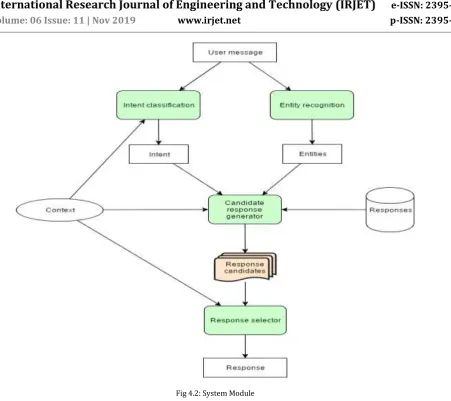
Systems design is the process of defining the architecture, components, modules, interfaces, and data for a given system to satisfy specified requirements. Systems design could be the application of various systems theory to product development. There is some overlap with the disciplines of systems analysis, systems architecture and system designing. A chatbot is a computer program, which is designed to simulate a conversation with human users using patterns, especially over the internet. They are our online assistants that offer different services through chatting over the internet. To build artificial intelligence chatbots through Python, you will require an AIML package (Artificial Intelligence Markup Language). First, we need to create a standard startup file without any pattern and load aiml b in the kernel. Add random response patterns that would make dialogue interesting.
[image:2.595.177.427.649.767.2]Now, to code your own AIML files, look for some files which are available beforehand. For example, browse all among files from the Alice Bot website. The startup file we will be creating will act as a separate entity. As a result of which, we will have more AIML files without a source code modification. The program will start running when there are enough AIML files for loading. This was an introduction to how to make AI chatbot using Python. Now, let’s proceed further and see which particular library can be implemented for building an AI Chatbot.
© 2019, IRJET | Impact Factor value: 7.34 | ISO 9001:2008 Certified Journal | Page 393
Fig 4.2: System Module
5. PROPOSED SYSTEM
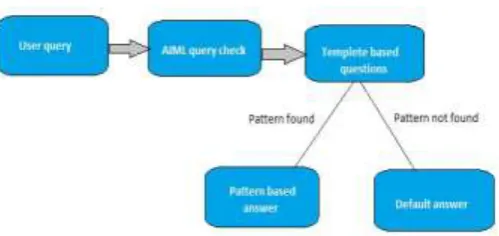
In this work, we have developed an interactive chatbot using the Flask framework in python, and the workflow of the proposed framework is shown in Fig-5.1. User discussion, as a rule, begins with the simple welcome or general questions. User inquiries are first taken care of by AIML check, to check whether the entered inquiry is AIML script or not. AIML is characterized by general inquiries, queries, and welcome which is replied by utilizing AIML formats.
Once the bot-user types in the query in the chatbot, the AIML developed chatbot will identify the category that contains the query pattern. Here the bot-user is expected to type in the query in a predefined pattern. Once the query pattern is matched, the template of the category that contains the response is sent back to the bot-user.
Fig 5.1: Proposed Model
6. IMPLEMENTATION
[image:3.595.329.549.453.702.2]© 2019, IRJET | Impact Factor value: 7.34 | ISO 9001:2008 Certified Journal | Page 394
[image:4.595.35.290.401.611.2]Fig 6.1: Implementation
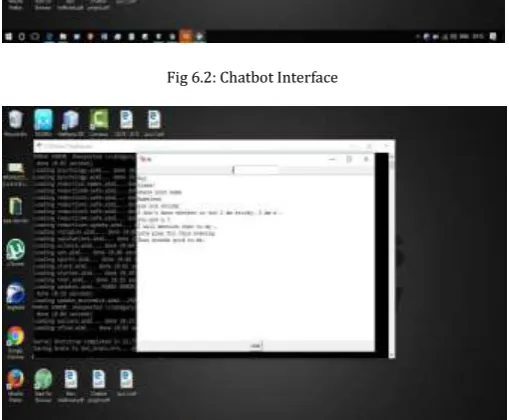
Fig 6.2: Chatbot Interface
Fig 6.3: Conversation
7. CONCLUSION
In this project, we have introduced a chatbot that is able to interact with users. This chatbot can answer queries in the textual user input. For this purpose, AIML with program-o has been used. The chatbot can answer only those questions which he has the answer in its AIML dataset. So, to increase the knowledge of the chatbot, we can add the APIs of Wikipedia, Weather Forecasting Department, Sports, News, Government and a lot more. In such cases, the user will be able to talk and interact with the chatbot in any kind
of domain. Using APIs like Weather, Sports, News and Government Services, the chatbot will be able to answer the questions outside of its dataset and which are currently happening in the real world.
The next step towards building chatbots involves helping people to facilitate their work and interact with computers using natural language or using their set of rules. Future Such chatbots, backed by machine-learning technology, will be able to remember past conversations and learn from them to answer new ones. The challenge would be conversing with the various multiple bot users and multiple users.
As future work, we can make a chatbot that is based on AIML and LSA. This technology will enable a client to interact with a chatbot in a more natural fashion. We can enhance the discussion by including and changing patterns and templates for general client queries using AIML and the right response are given more often than LSA.
REFERENCES
[1] Bayan Abu Shawar and Eric Atwell, 2007 “Chatbots: Are they Really Useful?”
[2] LDV Forum - GLDV Journal for Computational Linguistics and Language Technology.
[3] http://www.ldv-forum.org/2007_Heft1/Bayan_Abu-Shawar _and_Eric_Atwell.pdf
[4] Bringing chatbots into education: Towards natural language negotiation of open learner models. Know.-Based Syst. 20, 2 (Mar. 2007), 177-185.
[5] Intelligent Tutoring Systems: Prospects for Guided Practice and Efficient Learning. Whitepaper for the Army's Science of Learning Workshop, Hampton, VA. Aug 1-3, 2006.
[6] http://en.wikipedia.org/wiki/Chatterbot
[7] ALICE. 2002. A.L.I.C.E AI Foundation, http://www.alicebot.org/
[8] Kumar, M Naveen, PC Linga Chandar, A Venkatesh Prasad, and K Sumangali (2016). “Android based educational Chatbot for visually impaired people”. In: International Conference on Computational Intelligence and Computing Research (ICCIC), 2016 IEEE. IEEE, pp. 1–4.
© 2019, IRJET | Impact Factor value: 7.34 | ISO 9001:2008 Certified Journal | Page 395
[10] Mikic, Fernando A, Juan C Burguillo, Mart´ın Llamas,Daniel A Rodr´ıguez, and Eduardo Rodr´ıguez (2009). “Charlie: An aiml-based chatterbot which works as an interface among ines and humans”. In: EAEEIE Annual Conference, 2009. IEEE.
[11] Deryugina, OV (2010). “Chatterbots”. In: Scientific and Technical Information Processing 37.2, pp. 143–147.
[12] Lue Lin, Luis Fdo. D’Haro, and Rafael Banchs. A Web-based Platform for Collection of Human Chatbot Interactions, Paper accepted in HAI 2016 to appear in Oct. 2016.
[13] Wallace, Richard S. "The anatomy of ALICE." Parsing the Turing Test. Springer Netherlands, 2009. 181-210.
[14] Steven Bird, Ewan Klein, and Edward Loper – Natural Language Processing with Python, Published by: O’Reilly Media, Inc., June 2009
[15] Weizenbaum, Joseph (1966). “ELIZA—a computer program for the study of natural language communication between man and machine”. In: Communications of the ACM 9.1, pp. 36–45.
[16] Emanuela Haller and Traian Rebedea, “Designing a Chat-bot that Simulates an Historical Figure”, IEEE Conference Publications, July 2013.
[17] Maria das Graças Bruno Marietto, Rafael Varago de Aguiar, Gislene de Oliveira Barbosa, Wagner Tanaka Botelho, Edson Pimentel, Robson dos Santos França, and Vera Lúcia da Silva, “ARTIFICIAL INTELLIGENCE MARKUP LANGUAGE: A BRIEF TUTORIAL,” International Journal of Computer science and engineering Survey (IJCSES), July 2013.