Programmable Donations: Exploring Escrow-based
Conditional Giving
Chris Elsden
School of Design Northumbria University Newcastle upon Tyne, UK [email protected]
Ludwig Trotter
Lancaster University Lancaster, UK [email protected]
Mike Harding
Lancaster University Lancaster, UK [email protected]
Nigel Davies
Lancaster University Lancaster, UK [email protected]
Chris Speed
Design Informatics University of Edinburgh
Edinburgh, UK [email protected]
John Vines
School of Design Northumbria University Newcastle upon Tyne, UK [email protected]
ABSTRACT
This paper reports on a co-speculative interview study with charitable donors to explore the future of programmable, conditional and data-driven donations. Responding to the rapid emergence of blockchain-based and AI-supported fi-nancial technologies, we specifically examine the potential of automated, third-party ‘escrows’, where donations are held before they are released or returned based on speci-fied rules and conditions. To explore this we conducted pilot workshops with 9 participants and an interview study in which 14 further participants were asked about their ex-periences of donating money, and invited to co-speculate on a service for programmable giving. The study elicited how data-driven conditionality and automation could be leveraged to create novel donor experiences, however also illustrated the inherent tensions and challenges involved in giving programmatically. Reflecting on these findings, our paper contributes implications both for the design of pro-grammable aid platforms, and the design of escrow-based financial services in general.
CCS CONCEPTS
•Human-centered computing→User studies.
KEYWORDS
Charity, Blockchains, Automation, Conditionality,
Permission to make digital or hard copies of part or all of this work for personal or classroom use is granted without fee provided that copies are not made or distributed for profit or commercial advantage and that copies bear this notice and the full citation on the first page. Copyrights for third-party components of this work must be honored. For all other uses, contact the owner/author(s).
CHI 2019, May 4–9, 2019, Glasgow, Scotland UK
© 2019 Copyright held by the owner/author(s). ACM ISBN 978-1-4503-5970-2/19/05.
https://doi.org/10.1145/3290605.3300609
ACM Reference Format:
Chris Elsden, Ludwig Trotter, Mike Harding, Nigel Davies, Chris Speed, and John Vines. 2019. Programmable Donations: Exploring Escrow-based Conditional Giving. InCHI Conference on Human Factors in Computing Systems Proceedings (CHI 2019), May 4–9, 2019, Glasgow, Scotland UK.ACM, New York, NY, USA, 13 pages. https: //doi.org/10.1145/3290605.3300609
1 INTRODUCTION
From cryptocurrencies [16, 30] to mobile money applica-tions (e.g. [1, 24, 31], a key feature of many new financial technologies is the attachment of specific rules and condi-tions to the exchange of value, underpinned by data and enforced algorithmically. By making money ‘smart’ [27] in this way, it is envisioned to afford entirely new financial infrastructures, services and interactions. In this paper we extend the growing interest in financial technology (FinTech) in HCI, to the contested realm of philanthropic informatics [38], and explore the potential design space forconditional and ‘programmable’ money[11, 27] in the charitable sector. Rooted in an ongoing collaboration with a large UK-based international development charity, we explore with donors emerging forms of conditional charitable giving that support what we term ‘programmable donations’.
a beneficiary. The power of such escrows is the possibility to ‘program’ a donation to make it conditional and to only be disbursed according to pre-defined logics and data. Our particular interest is to explore the opportunities and impli-cations of such programmable donationsfor donors. Based on prior engagements with a partner NGO, we focus primarily on the‘first mile’of donations; that is, how funds are solicited and transferred from donors to charities, rather than how those funds ultimately deliver impact to eventual beneficia-ries over the‘last mile’. For example, donors could pledge to give to a charityif there is an earthquake; to give a small donation based on air pollution data reaching a threshold; or to giveeach timeone takes a flight.
To explore this, we conducted a study where we speculated about the potential value of programmable donations with donors. Drawing inspiration from speculative approaches to interrogate experiences of emerging technologies (e.g, [8, 15, 34, 41, 42] we report on two pilot workshops (with 9 participants) and an interview-based study with a further 14 charitable donors who were invited to participate and enact a speculative service. We investigated the range of conditions - from personal to world events — donors would consider attaching to a donation, and the actors they would trust to provide and validate information that triggered their donation.
Our analysis of how participants oriented to programmable donations and reflected on the speculative service contributed to the emerging HCI literature at the intersection of financial technologies, blockchain-based systems and philanthropic informatics. First, we discern the value and challenges of dif-ferent approaches to conditional giving based around pledg-ing support, dynamic and data-driven donations; and givpledg-ing related to personal activities. Second, we recognize the ways in which programmable donations, and the networks of ac-tors and relations they might support, offer radically new models of philanthropy. This extends existing work in the fields of philanthropic informatics and digital civics by high-lighting the ways in which emerging technologies can be seen as negatively impacting relational forms of trust and accountability in not-for-profit and charity contexts. Finally, we crystallize these insights to provide implications for the human-centered design of programmable aid platforms, and financial escrow-based platforms in general.
2 RELATED WORK
Here, we review literature on the multifaceted motivations donors have for giving; extant work about technologies for charitable giving in HCI; and the state of the art regarding programmable and escrow-based donation platforms.
Motivations for Giving
The study of charitable giving from the perspectives of donors has been examined in depth in the field of philanthropic stud-ies. Bekkers et al. [2] offer a framework of eight ‘mechanisms’ that drive charitable giving based on a review of more than 500 papers across multiple disciplines. Examples of these in-clude donors ‘awareness of need’; their belief in the ‘efficacy’ of giving to charity, ‘psychological benefits’, often described as the ‘joy of giving’; and the extent to which charities ex-press ‘values’ that a donor prizes. These mechanisms vary extensively across donors, can be experienced simultane-ously, take many different tangible and intangible forms, and involve various actors besides the donor themselves. Mejova et al. [32] indicate that many of these mechanisms hold when charitable giving is mediated by digital technologies, specifi-cally discussing examples of donation behavior responding to email solicitations.
In this study we do not aim to directly address why people donate to charity, however, these prior theories provide a useful framing for our exploration of conditional giving. In particular, we consider that conditionality may be appropri-ated by donors as a way to balance or prioritize particular motivations they have. For example, making a donation con-ditional on evidence of a disaster could appeal to those who give most when they are aware of a need. Alternatively, a condition to give related to one’s food consumption could appeal to those who give within a particular value system, such as environmentalism.
HCI Research on Philanthropic Technologies
for various stakeholders (not only donors). Further, Harmon et al. emphasize informal philanthropic work, looking be-yond specific charitable transactions, and instead supporting practices of ‘care work’ throughout everyday life [20].
It is important to recognize that as an explorative and speculative study, our work does not yet reckon with the pragmatic challenges of new philanthropic IT. However, by undertaking a speculative studywith donorsour ambition is that we might envision forms of conditionality and pro-grammability that produce alternative matters and meanings of data, oriented to diverse values and experiences, beyond al-gorithmic accounting and efficiency. Prior work has already considered features of specific giving platforms that fore-shadow the possibilities of programmable donations. Work by Lee et al. [25] and Voida et al. [40] points to the chal-lenge of reconciling competing views of fairness in design of data-driven philanthropic systems. Researchers have devel-oped systems to optimize the distribution of crowdfunding support [43] and the weighting of recommendations for a donation platform [33].
Notably, Beltran et al. discuss‘Codo’, a system to sup-port‘conditional donations’ to crowdfunding projects [3]. Their approach details a grammar to support the techni-cal implementation and resolution of conditional systems. The platform focuses primarily on regulating the value of one’s own donation based on the support from other specific donors. For example, donors can state:‘I will donate $10 if: another user/group donates x amount; or if the total donations are greater than x’. Through a brief user study they noted competing views of conditional giving. Some users found the system off-putting, seeing charitable giving as something entirely personal, while others were invigorated by realizing the potential for collective action (e.g. [9]).
Conditional and programmable giving as we envision in this paper differs from this work in some significant ways. First, we consider a far greater array of possible conditions related to any manner of real-world phenomena — from the occurrence of an earthquake, to a daily step count. Second, the data that can be used to inform and validate those condi-tions may be drawn from a network sources, from oneself, to third-parties and automated sensors. Thirdly, the major-ity of conditions envisioned are independent, rather than co-dependent on other donations.
Blockchains and Charitable Giving (State of the Art)
Under the moniker of ‘Blockchain for Good’ [23] several com-mercial start-ups are developing proposals for programmable donations and blockchain philanthropy, as the state of the art in the sector. Premised on making charitable giving more direct and accountable, the proposed platforms follow one of three broad premises. Cryptocurrencies themselves are viewed as a way to potentially support more direct forms of
peer-to-peer giving, to individual beneficiaries or community projects (e.g.BitGive1). Cryptocurrencies could potentially provide a solution to the expense and risk of international money transfer that all international charities face. However, the unstable value and the risk inherent in cryptocurrency ex-changes present risks for direct adoption. Instead,Disberse2 propose a ‘backbone’ service for the development finance supply-chain. Similarly, enterprises such asAidTech3 are targeting solutions for ‘end-to-end’ tracking of direct cash transfers, to ensure the delivery and receipt of donations.
Several groups seek not only to demonstrate that funds have been appropriately disbursed, but more ambitiously, that a charity can actually deliver impact. These ‘social im-pact networks’ — such asAlice4, andPromise5 claim to use programmable cryptocurrency tokens and reputation sys-tems to enforce a process where charities are required to demonstrate completion of project milestones, before sub-sequent funds are released. Such systems endeavor to in-centivize best practices and charitable reporting, although demonstrating the true impact of charity is notoriously chal-lenging [17].
Automated escrows are a fundamental feature of all of these platforms. These are used to hold and then disburse funds according to specified conditions and protocols. The secure and reliable function of these escrows is ensured through immutable smart contracts and ‘self-executing’ blockchain based transactions. To our knowledge there is no prior work that has investigated with donors their perception, under-standing and use of blockchain-based philanthropy or es-crows in general. These features, and the resulting programma-bility of charitable giving are central to our study.
3 CONCEPTUALIZING PROGRAMMABLE
DONATIONS
Our research is part of an ongoing collaborative project with a large UK international development NGO to investigate the potential role and design of blockchains in their sector. Through this work, we have recognized the considerable challenges of effective aid allocation, and the domain ex-pertise that many charities possess in identifying the most impactful and worthy causes. Through a series of prior iter-ative engagements with this charity, we chose to focus our inquiry on the‘first-mile’of donations — how donations are triggered and channeled to charities, rather than attempt-ing to determine aid impact. In particular, our partner NGO sought new approaches to fundraising that may appeal to what they described as‘globally engaged citizens’.
1https://www.bitgivefoundation.org/ 2http://www.disberse.com/ 3https://aid.technology/ 4https://alice.si/
We see escrow-based programmable donations as a mecha-nism or tool, within the wider aid and fundraising infrastruc-ture that could remediate relationships between donors and charities. We conceptualize the escrow as a potential mecha-nism to redress declining trust in charities [10], and create novel experiences of giving. Specifically, we envision condi-tions that can: a) act as a pledge, and make specific commit-ments; b) support donations that are variable and dynamic, depending on data-driven conditions; and c) automatically relate donations to personal activities and behaviors.
This approach is now the subject of an iterative technical development that we are exploring with charitable partners. The technical aspects and feasibility of such a system (and the use of blockchains in general) are not our key concern here. Instead, this simply provided the context for an exploratory study where we sought to investigate the premise and con-cept of such a service with donors. The basic premise of the service from which we began our inquiry was presented to donors as follows:
Using smart contracts, powered by blockchain technology, you can set up contracts to pledge a donation, if certain conditions are met. If the conditions are met, your donation is automatically released. However, if your contract expired before this, the donations can be returned to you, or reinvested in another project or contract.
1. Decide if you want to give a one-off amount, or a small amount often.
2. Create conditions for your donation. For example, your gift could be related to your own lifestyle, local and world events, or global measures and metrics.
3. Choose how your conditions will be validated and who you trust to do this.
Figure 1: Promotional descriptive text ‘Smart Donations’ ser-vice provided to participants.
We envisaged the use of escrows as a way for a donor to set up an individual‘smart donation’with a charity. Each donation would contain an‘offer’: the value of the donation, and how it is withdrawn; specific‘conditions’that trigger the release of a donation;‘validator(s)’who provide the data that informs the contract whether conditions are met. Lastly, do-nations would define abeneficiary— the individual, cause or account who would directly receive the funds once released — and an expiry date, at which point any unreleased funds would be returned to the donor. The escrow as a mechanism to hold and release money underpins the attachment of con-ditions and validation. The donation serves as a contract between donor and charity, which is immutable, but requires funds to be pledged up-front by the donor.
This conceptualization is clearly only one example of how programmable donations as a class of technologies could be implemented or presented to donors. Our concept is based
primarily on an abstraction of the system proposed by our technical team, but as we have seen, bears many features of other blockchain-based donation platforms. We adopted this as a basis both to inform our ongoing project, but also as a provocation that donors could engage with and ultimately shape.
4 RESEARCH APPROACH AND METHODS
With this conceptualization in mind, we designed a study that would generate empirical insights while providing an oppor-tunity to speculate with participants and explore the broader design space for programmable donations. We were inspired by recent approaches in HCI to undertake ‘co-speculation’ [41], and forms of enactments [15, 34] that invite participants to experience and reflect upon possible futures through en-gagements with various speculative artefacts and scenarios. Over the course of six months, we undertook a series of en-gagements with a total of 23 participants to co-speculate on a programmable donations service.
Pilot Workshops
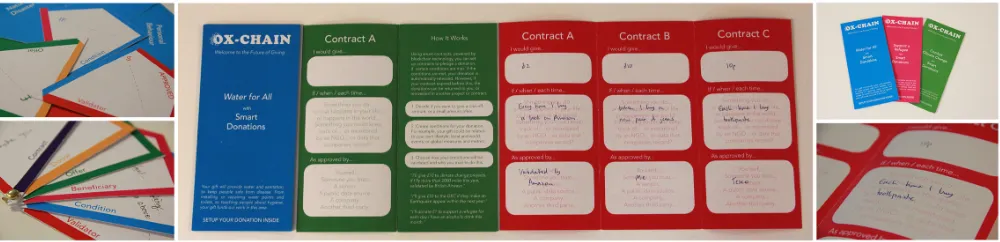
Our study commenced with running two pilot workshops, where we set out to co-create a catalogue of examples of pro-grammable donations with participants. For the workshops we developed card-based materials [Fig. 2] to support partic-ipants in ideating a range of offers, conditions and validators. In a hexagonal format, participants were invited to complete instructions for a programmable donation.“I WOULD GIVE [A], TO [B], IF [C], AS APPROVED BY [D])”. These imagined donations were tailored towards three different generic fic-tional causes, loosely based on existing projects promoted by our partner NGO, to: ‘combat climate change’, ‘support a refugee’, and ‘water for all’. Participants were provided with cards to exemplify different kinds of offers, conditions and data sources.
participants, who focused primarily on three factors: an of-fer, a condition, and the validating data source. We took the experience and insights from these pilots into our central study.
Donor Interviews
Following these workshops, we moved to an interview-based approach with individual charitable donors. Although group discussions supported the collaborative generation of dif-ferent donations, we wanted to gain greater depth on how different individuals own motivations and values towards charity (often quite private matters) related to programmable donations. We also wanted to give participants longer to re-flect upon the service. Therefore, we gave more thought as to how to present such a service to donors, as an introductory pack that could be sent ahead of an interview as a form of ‘sensitising’ probe [5, 25].
Recruitment.Focusing on personal motivations for giving
to charity, we sought to engage with a diverse range of charitable donors. In particular we advertised for and ap-proached: donors who gave monthly monetary donations to charity; people who donated to second hand charity shops; and people directly involved with volunteering and chari-table fundraising on a local level. In total, we recruited 14 UK-based participants (10F, 4M; Aged 24-70; Mean – 44.4 years old) None had any experience or specialist knowledge of financial or blockchain technologies. We viewed these donors as ‘experts’ in their own giving — however acknowl-edge future work should also engage non-donors.
Pre-Interview Materials.Participants who expressed an
inter-ested in the study were posted an introductory pack ahead of their interview. The introductory pack consisted of a cover letter, three glossy tri-fold leaflets [Fig. 2], and an informa-tion sheet and consent form that detailed the nature of the research. (The study received full ethical approval from our host institution and was of low-risk to participants). The leaflets were a considerable simplification of the prior card-based approach of the pilot workshops, but with the same core activity — to prepare instructions for a programmable donation. Each of the leaflets were identical, besides differ-ent titles, descriptive text and colours to denote the three different fictional causes. These leaflets were primarily in-tended to introduce and sensitize participants to a novel and challenging concept. We wanted participants, few of whom had any expertise with technology, to not only understand, but be able to extend and co-speculate this concept with us. The front cover of the leaflets presented a traditional char-ity appeal and invited donors to set up a donation. The inside pages of the leaflet provided space for participants to write out three programmable donations for each cause. As a sim-plification of the previous cards, the construction of these
donations was‘I WOULD GIVE [A]; IF / WHEN / EACH TIME [B]; AS APPROVED BY [C]’. In the space provided for an answer, semi-transparent text again provided examples of the categories of conditions and validators that a donation might take. The inside flap of the leaflets included the text to describe the service [Fig. 1], as well as three brief examples, which guided participants through the process of setting up a donation. The back page of the leaflets reiterated the key details of the research study. Participants were asked to spend some time with the leaflets before their interview, and generate at least one example for each cause.
Interview Protocol.Interviews were semi-structured, took
place in a meeting room on our University campus, and lasted between 30-70 minutes. The interview began by asking participants to describe the way they currently donated to and engaged with charity. The researcher then introduced the key features of the smart donations service (no technical details were discussed however), and confirmed participants understanding of the concept and the leaflets themselves. At this point participants were given more time to consider their donations if they wished. They were then invited to talk through each of their proposed donations, describing how they envisioned they would work, and their motivation for setting up such a donation. The remainder of the interview was then spent discussing each example, considering possible alternatives or extensions, as well as parallels to existing charitable interactions. To conclude, participants were asked to give their views on the service as a whole, and whether they could envisage themselves opting for a ‘smart donation’ if they were offered one by a charity. Participants were given a £20 shopping voucher in appreciation for their time.
Follow-Up Enactment.Finally, seven participants who were
Figure 2: Card-based Workshop Materials (left) and Pre-Interview Leaflets describing Smart Donations service.
Data Analysis
These varied activities produced a large corpus of qualita-tive data. Across all engagements a catalogue of 99 different programmable donations were proposed by participants. In addition, audio was recorded from both pilot workshops, 14 individual donor interviews, and the 7 follow up interviews. All of these recordings, except those from the initial pilot (with poor audio quality), were transcribed in full.
Our analysis of this data followed two threads. First, we wanted to understand how our participants had approached the construction of these donations, their diversity in style, and what made them compelling to donors. We collated a spreadsheet of all 99 proposed programmable donations, including the offer, condition, validator and cause for each. Using qualitative analysis software NVivo, we systematically coded each of these donations for their overall intention and purpose (e.g. as a tax; in response to need); the kind of offer (e.g. a microdonation; a one-off); and the nature of the valida-tor (e.g. a web-app; a sensor). Following Braun and Clarke [7], we then began thematically grouping these codes to develop a coherent overview of different kinds of programmable do-nations. A summary of this analysis is presented in the first section of our findings.
The second thread of our analysis focused on the donors interviews and was rooted in an Interpretive Phenomenolog-ical Analysis (IPA) [35], focused on idiographic reflections and speculation, and the way in which the novel features of escrow-based conditional giving intersected with existing motivations and practices for giving. Each transcript was highlighted and annotated to illuminate passages where par-ticipants reflected on their motivations for charitable giving, and passed comment on the ‘smart donations’ service as a whole. These annotations provided the basis to produce bio-graphical summaries for each participant, recognising their often idiosyncratic approaches to charitable giving, and core concerns regarding programmable giving. These summaries formed the basis of the reflections reported in Section 6,
to demonstrate a diversity of views related to engagement, temporality and conditionality itself.
5 APPROACHES TO PROGRAMMABLE
DONATIONS
In this section, we report how donors approached programmable donations, in terms of the choice of conditions; the offer or value of a donation; and the approval of conditions.
Conditions and Triggers
The character and intention behind each donation stemmed primarily from the choice of condition. The likelihood, fre-quency, and clarity of these conditions would then deter-mine an appropriate offer, and validator for each. While participants had diverse approaches, in general they drew upon their everyday routines and experience — news events, weather, bills and travel were especially common triggers for a condition.
Personal Conditions.The most significant distinction between
conditions was whether they were internal or external to the donor — in other words, whether the donor could control the condition through their personal activity. Several examples of such personal conditions concerned activities that donors perceived negatively, and hoped to change or avoid. For ex-ample: one donor pledged“50p each time they walked less than 10,000 steps over a year”; another participant proposed “£1.60 (the price of a bus ticket) each time they take the car”. Motivations for these kind of donations varied. Adding addi-tional costs to a bad habit could provide an extra incentive to avoid or overcome it; alternatively it might offset some of the guilt one experienced about the activity through a charitable donation.
not simply equate to and write-off one’s guilt over certain actions. Following the enactment of a donation to donate £1 for each plastic bottle he purchased, one participant summed it up as:“[The donation] didn’t reduce the feeling of guilt, but I felt slightly better that there was a positive action . . . It didn’t make me think less about it, I didn’t feel more carefree (P12).” Negative personal conditions were arguably more effective when framed by participants as a kind of ‘offset’ or personal ‘tax’, related to a necessary or unavoidable action like flying or driving a long distance. Setting up the donation did not aim to prevent or reduce the behavior, but by giving to a climate change cause, for example, it was a way to acknowledge and commit to proportionate action to address one’s own impact.
However, donations were also related to positive personal activities, especially those that participants felt privileged to enjoy. For example, two participants suggested a small donation to a water charity each time they visited a swim-ming baths.“I have the privilege of doing that, but I also need to be aware that some don’t. [P6]”Such donations could also act as a form of empathy. One donor imagined donating to a refugee charity every time she menstruated. Finally, pro-grammable donations could be envisioned as a kind of added reward or celebration for reaching milestones or doing good. In one enactment, a donor chose to donate as a reward and extra incentive for swimming 40 lengths — as if she were swimming for a cause.“I wanted it to be more of a . . . like everyone’s a winner, you know. I win because I’m like healthier and, you know, I want to get fitter but also my charity wins, you know. (P5).”As this quote shows, giving related to positive behavior is quite in contrast to the dissonance experienced when giving as a punishment.
Needs-Based Conditions.There were three other styles of
external conditions proposed by donors. The first of these related to providing evidence of needs, which the donation or charity would directly address. Several donations addressed drought, humanitarian crises, war or forced migration. Even for such significant events, part of the challenge of these conditions was to decide upon an appropriate indicator of this need. Some envisaged using a news application as a cipher, while others expected there to be other NGOs or appropriate trusted experts who could determine this.
Some needs were expressed more specifically than a gen-eral humanitarian crisis. One participant suggested:“I will donate £100 if a whale species that I choose, because I’m at-tached to that whale species, is reported extinct by the [World Wildlife Fund].”Such constructions indicate the possibility of much more personalized engagements with charitable giv-ing. Needs-based conditions also presented an opportunity to maintain accountability of charities, and a desire to sup-port their most urgent and imsup-portant work, without tracking ‘end-to-end’ the actual delivery of that aid. In essence, for
some, the very existence of such terrible events as drought and species extinction justified the charities themselves, re-gardless of how their particular donation was eventually spent.
Symbolic Conditions.A second set of external conditions
related to events that signified a wider issue that the donor hoped to address. For example, one participant proposed a climate change donation“each time today’s temperature exceeds the average on this day over the past 5 years”. For the donor, this measure indirectly but very concisely highlights the issue at hand. Symbolic conditions often related to the fre-quency of events, for example:“if a sustainable power/energy initiative is reported by the BBC.”Symbolic conditions were apt for issues of ongoing concern, like climate change, which may not have immediate moments of crisis or need, as with a humanitarian disaster that stimulate a large appeal. The trigger event could simply be a means to offer a conscious reminder; for example one participant proposed a donation every time she changed the filter of her water-bottle. This was a regular six-weekly event, but gave her a cue to give.
Activist Conditions.Finally, there were conditions that were
more political in their character, whose primary intention was to bring attention to a particular issue, or publicly sup-port a cause. For example:“I will give two pounds [. . . ] every time the UK’s arms sales to Saudi Arabia go up, as reported by the Department of International Commerce.”Other examples included monitoring speeches of prominent politicians for offensive remarks, and donating in spite of them. As such, these conditions would often depend upon news reports or public information as a source of data.
Another approach to activist conditions were those that were intended to demonstrate support for specific organisa-tions. One donor with experience of working in the charity sector suggested:“I would give one pound every time some-one signed up to their newsletter. (P13).”As such, by pledging donations for these kinds of conditions, donors are able to affirm and practically demonstrate their support for issues that matter.
Calibrating Offers
it:“Well [£5]’s like, it’s enough that it’s an amount, but it’s not enough to completely deter me from taking taxis . . . So, it is just like getting that balance [P6].”For more frequent conditions, especially those envisaged as a kind of personal tax, mi-crodonations of even a few pence were considered more ap-propriate. Another key factor was the extent to which donors felt in control of the condition, and how unpredictable it was. More predictable donations could be calibrated, towards an expected total donation over time. Most participants who took part in the enactment approached their donation in this fashion. Others felt it would be important to be able to calibrate and“tweak the amount as you go along, if you realize that you’ve set it a bit too high, or a bit too low (P5)”.
Recurrent offers were not always a fixed amount, but could be dynamic, varying according to conditions themselves, for example being equal to the cost of a meal or luxury, or dependent on oneâĂŹs extra available income. A number of other offer mechanics were generated by donors. A larger one-off donation could be made when specific thresholds for a condition were met. A round-up, based on transaction data, could be used to calculate small donations for regular events, such as refueling one’s car. Others proposed donations that would match the costs of specific items or donations. Indeed, billing and existing transactions were frequently envisaged as a site through which the precise value of a donation could be calibrated.
Evaluating and Validating Conditions
The most challenging aspect of the service for participants to consider was the evaluation and validation of their condi-tions. This required imagination about appropriate forms of data that related to the condition, and a reliable and trusted source for that data. Especially for personal conditions, par-ticipants reached first for themselves as an arbiter. In some cases, participants found it hard to imagine technology in their lives that would reliably recognize their activities, for example, if they used a takeaway cup. For some participants, familiar technologies they already used to monitor their ac-tivity, such as step tracking or commuting, were imagined as ways to inform their conditions. Still, in many cases, hav-ing at least a personal confirmation maintained a sense of control, and the possibility to flexibly interpret and approve the meaning of the contract in exceptional circumstances. Certainly, this makes the donation less automatic; but partic-ipants felt strongly that if prompted by such a system, they would be honest, seeing the donation as a sort of promise. On some occasions, donors also envisaged that trusted indi-viduals could be employed to help keep such promises.
Participants were able to envisage third-party enterprises as validators of conditions, especially where they were al-ready familiar with data that they collected (e.g. Google, UK Met Office). Several conditions entailed transactional data,
for example from a supermarket loyalty card, or even a bank transaction. For external conditions, concerning a need or world event, participants considered the role of specialists or those in trusted positions. In some cases, these included other NGO’s, with perceived authority in an area — for exam-ple, the World Wildlife Fund could report species extinction. However, with the exception of weather conditions, there were limited examples of specific metrics that people would expect to trigger a donation. This may indicate the need for charities to better communicate the key factors that deter-mine how they allocate aid.
6 CONTEMPLATING PROGRAMMABLE
DONATIONS
In this section we take a broader view of how donors re-flected on programmable donations as a service, and how they speculated about its position in relation to existing ap-proaches to charity. Clearly, individuals had mixed attitudes towards the service, related to their personal approaches to charitable giving and new technologies. The following anal-ysis is not an effort to summarize all of these attitudes, nor a general verdict on the service. Rather, we aim to highlight distinctive features that defined the service for donors, and use these as a basis for a discussion of the implications of these technologies.
Balancing Donor Engagement
An initial motivation for the service we had proposed was to support donors in becoming more actively and consciously engaged in giving to charity. However, several generous monthly donors were deliberately unengaged in their giving. “Once I’ve agreed to do it then I can, kind of, forget about it, you know” (P8). For these participants, they had made a decision to support certain causes, and giving through their bank account on a predictable, but unremarkable, basis supported this. Choosing to donate to charity can be joyful [2] but comes with an emotional responsibility. Greater engagement evidently demands significantly more of donors:“Yes, I like to see where my money’s going, but do I want to be thinking about it all the time? . . . there’s the emotional aspect of it.” (P7). Further, there is the risk that giving becomes donor-centric:“There are some things I feel strongly about I want to give to but I want it to be as simple and painless, and as unselfconscious as possible”(P4). Ultimately, this participant was wary of programmable donations. Although“it is nice to try and connect people’s giving” he was concerned that“that has a value in it that is about me as the giver, that’s the thing, [that] I need to feel good about my giving” (P4).
programmable donations, he envisioned something similar: “I need some way of having an idea when something might be triggered . . . because normally, when I was making an action, I could suddenly relate what action I was doing, to the giving bit” (P12). Routine and everyday actions, such as refueling one’s car, or walking 10,000 steps, could become acts of generosity. Especially as they related their conditions to specific causes, donors could construct their own stories and meaning to their donations:“The step thing was about how far, you know, refugees have to walk everywhere” (P9). Activist conditions especially highlight the way conditional donations could express a wider concern in order to foster engagement in an issue.
However, programmable donations also demand more of a donor. Several participants initially favored personal condi-tions because they felt a sense of control and accountability as to whether and when those conditions would be triggered. However, this can also“exert a lot of pressure on [you] to act in a certain way to get a certain outcome” (P6). Reflecting on her participation in an enactment, P6 continued:“I viewed it as Âč10 that would go to charity, but I would have to do some-thing. So I would have preferred to just give £10” (P6). When attached to a behavior that donors sought to change, the donation risked being even further donor-centric.“It became more about me having a short shower . . . but it seemed like sort of an obfuscating factor in terms of if you want to give to charity” (P10).External conditions were more out of a donors own hands, however, this would be something to“think quite hard about it in advance.” The proper configuration could require careful engagement to calibrate the donation appro-priately in the first place, but perhaps afterwards would be easier to manage — it could even be forgotten about. Clearly already there are donors who more actively engage in giving to and thinking about charity, as something“natural to actu-ally go and do it” (P2).Others take a more passive approach. A key challenge of programmable donations is to balance the donor’s engagement — to empower the donor, without over-burdening them.
Negotiating Temporality
Programmable donations presented an entirely different tem-porality to giving. Escrows are necessarily slow, and re-quire predicting and then waiting for conditions to be met. Whereas placing spare change into a bucket can be immedi-ately gratifying, this sensation is significantly delayed with a programmable donation:“I like giving things on a whim, you know. So, I gave the guy outside of Gregg’s today, a pound, because you know, I felt like he could use it, he looked like he needed something . . . And I like, if I have the money, I like doing that, instead of, I don’t know, instead of setting goals” (P9). Furthermore, escrows require upfront commitment, or cost to the donor, removed from this moment of gratification.
Indeed, it is possible that no donation will be made at all. As P9 outlines, this is a more rational and calculative way to approach charity. By contrast, P12 suggests a desire to expe-rience programmable donations as a form of membership:“I probably give where there’s a relationship.”And in the worst case“this might start to feel like a bill, or something, it’s just another thing” (P12).
When making personal conditions, participants clearly saw programmable donations as an opportunity to make a commitment. Anxiety about the potential cost and unpre-dictability of donations often related to a desire to keep to one’s commitments.“You can say, oh, well, £10 for this and £10 for that and then you feel as if you can’t keep the promise (P3).”
A core feature of escrows is their immutability, their ability to preserve present intentions into the future. Part of the challenge for donors is to ascertain with what certainties they can engage or affix their relationship with a charity, and when they wish to respond more dynamically.
The Value of Conditionality
Contemplating programmable donations requires consider-ing the value of conditionality itself. That the very act of giving could be so explicitly conditional is potentially chal-lenging:“It’s like if you give somebody money for a present, you can’t tell them how to use it; it’s up to them, I feel (P11).” For nearly all participants, the potential return of money they had donated seemed entirely alien: ‘‘I’ve never really even thought of actually getting money back, I’ve never thought of it that way, ever. To me once you donate it that’s it, you expect that money is going to a good cause” (P1).Therefore the mo-ment of giving is in committing to the donation:“Because once that money was in that escrow account, I don’t see it as mine anymore” (P6).Relatedly, few participants imagined spreading more money than they intended to donate into several contracts, with the expectation that some might be returned. When confronted with money that was returned to them, several donors insisted they would simply give it to another worthwhile cause or contract.
has agreed she should be taxed for taking her car, and the donation is programmed to calculate this.
Even where donors always intended to make their do-nation, conditionality could still serve a useful function in synchronizing a donation with an event.“I’m gonna see on the local news, that there’s something happening, so okay. Oh it’s terrible, oh I’m feeling better, I’ve just given a quid to it, you know (P12).” Predictable phenomena, such as menstru-ation (P9) or a water bill (P5), would almost guarantee a donation was made, but by attaching a condition to their donation donors are able to sync these events with charity, and transform them into generous acts. As such, the value of conditionality is not simply whether to give or not. Rather it could be a question of ‘how much’ to give; ‘when’ to give; or even ‘what’ to give to.
7 DISCUSSION
In this study, we presented participants with a challenging and provocative proposition — that they could start to attach rules and conditions to their charitable donations. Although our work is necessarily anticipatory, the concept of ‘Smart Donations’ that we presented to participants offers a lens on contemporary trends in philanthropic informatics [38] — in particular, the desire for greater accountability of charitable funding [28], and the opportunities to use data-driven tools to configure this accountability work [29]. Of course, the very idea of conditional giving could be considered trans-gressive, and should not be accepted uncritically. Through this discussion, we aim to constructively reflect on the op-portunities and benefits of programmable giving, as well as the challenges and risks, to consider how and when such technology might be employed.
The Value of Programmable Donations
Prior to the study, we speculated that allowing donors a way to tailor and ‘program’ their donations could help them to configure new relationships with charities that better addressed their own motivations for giving [2] — be that helping those most in need, supporting charities with certain values, or simply through a joy of giving. We saw the use of escrows and programmability as a means to make firm pledges to charity; to make one’s donations dynamic and data-driven by varying the total value and timing at which donations are released; and to relate charitable giving to the occurrence of personal activities or habits in daily life. We now reconsider these propositions.
Pledging support.In our findings, we saw that while donors
proposed conditional relationships in response to disasters or needs, this support was rarely truly conditional. Having de-cided to trust a charity, and set up a donation like this, donors did not expect their money back, and otherwise trusted the
charity to spend the money elsewhere as required. At best, pledging support in this way can achieve a sense of tim-ing, and an alternative model of commitment to a regular monthly donation. However, the gratification of knowing their donation has helped a cause can be delayed for the donor — they might even feel rebuffed if their donation is not ultimately put to good use.
The use of programmable donations as a form of pledge or firm commitment appeared to hold more promise as a tool for activism and vocal support of specific causes. Attaching or promising a donation to an activity raises awareness of its sig-nificance, especially if one can inspire others to do the same. For example, a crowd of supporters could act collectively to fund refugee charities every time high-profile politicians make statements contrary to that cause. An escrow-based pledge can be used to demonstrate collective commitment, and co-ordinate obligations between core networks of sup-porters.
Further, pledges could be used to explicitly drive chari-ties towards particular actions and democratize aspects of their governance — or for charities to seek funding for ac-tivities that might otherwise lack legitimacy. Programmable donations could be directed to political funds of a charity, or charities could be incentivized to act on a particular topical issue.
Dynamic and Data-Driven giving.Conditional and data-driven
giving presents donors with tools to program and calibrate the amount they want to give to a cause. However, it was clear from our study that giving an unpredictable amount can be challenging to come to terms with. This is especially the case for those on low incomes, for whom giving to char-ity is a defined part of their outgoings. In orienting to pro-grammable donations, many participants sought ways to maintain control over how much they would give. Offers were carefully calibrated, with efforts to try and assess the likelihood of their conditions. Donors felt the need to be able to tweak donations once set up. This requires the donor to have a good understanding of the condition, and the literacy to understand how such conditions could be defined by data-driven systems. In sum, this placed a demand on donors to engage and“work it out” [P9]; else it meant surrendering control and experiencing uncertainty as to how much they had actually committed to give.
to charity can be determined programmatically. Program-ming donations may come at cost to a sense of control, and stretch out the experience of giving compared to the simplic-ity of a one-off gift, or regular sustained support. However, further work could determine if there is a time, place and audience for dynamic giving, beyond the examples captured in our study.
Personal giving.Giving related to one’s own everyday life
offered participants the opportunity to construct their own narratives of living generously. Even predictable everyday events, such as visiting a swimming pool or having a take-away, became opportunities for empathy and gratefulness for one’s own good fortune.
However, conditions framed such that one is required to personally act, or avoid acting, in particular ways to trigger a donation to charity, can become emotionally demanding and burdensome to participants. At worst, one’s everyday life can get in the way of simply giving to charity. Motivations to change behavior and simultaneously give to charity can quickly become confused and in tension with each other. However, this could be alleviated somewhat, if reconfigured as a social or competitive activity, or as a sponsorship activity to raise funds from others (rather than releasing one’s own funds).
As such, we can see how the framing of personal condi-tions is crucial. Indeed, in some cases it was best to consider a programmable donation as a contract, between an individual and a charity, rather than a donation at all. Returning a gift can be offensive to a donor, but if the purpose of the dona-tion is simply to account for a cost, and the original contract is configured as a form of personal tax, insurance or social responsibility, then a dynamic and calculative approach can be more acceptable.
New Models of Philanthropy
We began our research on this project with a large UK in-ternational development NGO, and continue to envisage with them how a programmable donations platform could fit within their organization. Following this study, there are clearly conditions that could present a compelling new expe-rience for donors if they are supported in configuring their donations. However, under the surface of the study are po-tentially radical new models of philanthropy. If giving to charity means funding activist movements or taking out a contract to account for one’s carbon footprint is this really giving to charity as it is traditionally understood? In the UK context, the role of charities is already beginning to blur as they step into spaces of care and service provision left vacant by the retrenchment of local public services. Should charities begin to engage with their donors as ‘taxpayers’ or perform roles closer to an insurance company?
Such envisioning cuts to the core of political discussions of data-driven tools, and especially blockchains, as a class of technologies. It is clear that programmable donations, and the implementation of escrows in particular, provides a facil-ity for a donor or group of donors to enter into some kind of carefully defined exchange with a charity who are a form of service provider. Similarly, in an overview of blockchain technologies, Elsden et al. note a trend towards ‘transac-tionalization’ [16]. Yet, in their reflective study of ‘everyday philanthropy’ Harmon et al. [20] poignantly highlight“that philanthropic work is not just about transactions of money, goods, or services.”
While programmable donations could hold promise in harnessing crowds and ‘paying publics’ [26], by giving net-works of donors the ability to configure their own charitable infrastructure, does this simply represent the further ‘trans-actionalization’ of care work or even ‘charity as a service’? Donors also viewed charity as about values that go beyond the efficient transfer of economy from ‘haves’ to ‘have nots’. It’s also clear that some donors value an experience of mem-bership or a deeper relationship with charity, which is rein-forced by forms of exchange, for example receiving regular charity literature, or gaining preferential access to national landmarks and events.
We suggest that the conditionality, connectivity and au-tomation implied by programmable donations presents a challenge to traditional charities, but may also provide space for alternative forms of social and not-for-profit organisa-tions to co-ordinate around shared aims. The challenge will be to harness programmability as a commitment to shared values, rather than a reduction of charitable values to abstract economic exchange.
8 DESIGN CONSIDERATIONS
With these broad reflections in mind, we conclude with spe-cific design considerations for platforms incorporating ele-ments of programmable donations.
Conditional and Data-Driven Donation Platforms
(1) How programmable donations are framed may greatly inform their use and motive. They may not even be a ‘donation’ as commonly understood, nor a substitution for current fundraising channels. There is a need for charities to present compelling stories to donors, that relate networks of conditions, validators and benefi-ciaries.
(3) Seek to support conditionality and data that foster experiences of empathy, gratefulness and supporting others. These experiences may emerge through syn-chronizing donations with need, or creating opportu-nities for generosity through everyday routines.
Escrow-Based Services
(1) Escrows are slow technologies, which considerably elongate the experience of exchange, and run counter to decades of financial technology that have sought to make payment as fast and seamless as possible. We may explore how escrows can be designed to make a virtue of this slowness [18] and fixity [21].
(2) One approach to negotiating the unusual temporality of escrows may be to present them as an anchor for shared commitment and relationships, that express membership or possession of certain embedded values. (3) In an escrow, funds are held in a curious kind of stasis - between the charity and the donor. However, donors may still experience the cost of having already given those funds away. Therefore, there is a challenge to reflect this transitional rather than finalized state to users.
(4) Finally, escrows can hold assets that have uncertain futures and destinations. Therefore, there is a challenge to communicate this uncertainty and conditionality to users in a way such that they realize the ramifications and potential future value of the escrow.
9 CONCLUSIONS
In this study we explored with donors the emerging concept of conditional giving via escrow-based, programmable dona-tions. Based on a series of engagements and co-speculations with participants our study elicited both the values and chal-lenges of giving that is more conditional and data-driven. While donations envisioned by our participants hint at novel donor experiences and fundraising opportunities, we caution about a purely transactional approach to charity. In offering implications for the design of conditional giving platforms, and escrow-based services, we note the need for considered research to relate to deeper human values of empathy, care and membership through these technologies.
10 ACKNOWLEDGEMENTS
This research was funded by EPSRC grant EP/N028198/1 (Ox-Chain: Towards secure and trustworthy circular economies through distributed ledger technologies). We are grateful to our partner NGO, and all of our participants who gave their time to take part in this research. Data underpinning this publication is available from the authors upon request.
REFERENCES
[1] Amelia Acker and Dhiraj Murthy. 2018. Venmo: Understanding Mo-bile Payments As Social Media. Proceedings of the 9th International Conference on Social Media and Society, 5–12. https://doi.org/10.1145/
3217804.3217892
[2] René Bekkers and Pamala Wiepking. 2011. A Literature Review of Empirical Studies of Philanthropy: Eight Mechanisms That Drive Char-itable Giving.Nonprofit and Voluntary Sector Quarterly40, 5 (2011),
924–973. https://doi.org/10.1177/0899764010380927
[3] Juan Felipe Beltran, Aysha Siddique, Azza Abouzied, and Jay Chen. 2015. Codo: Fundraising with Conditional Donations.Proceedings of the 28th Annual ACM Symposium on User Interface Software & Technology,
213–222. https://doi.org/10.1145/2807442.2807509
[4] Lehn M. Benjamin, Amy Voida, and Chris Bopp. 2018. Policy fields, data systems, and the performance of nonprofit human service orga-nizations.Human Service Organizations: Management, Leadership & Governance42, 2 (2018), 185–204. https://doi.org/10.1080/23303131.
2017.1422072
[5] Kirsten Boehner, Janet Vertesi, Phoebe Sengers, and Paul Dourish. 2007. How HCI Interprets the Probes.Proceedings of the 2007 SIGCHI Conference on Human Factors in Computing Systems, 1077–1086. https:
//doi.org/10.1145/1240624.1240789
[6] Chris Bopp, Ellie Harmon, and Amy Voida. 2017. Disempowered by Data: Nonprofits, Social Enterprises, and the Consequences of Data-Driven Work.Proceedings of the 2017 CHI Conference on Human Factors in Computing Systems, 3608–3619. https://doi.org/10.1145/3025453.
3025694
[7] Virginia Braun and Victoria Clarke. 2006. Using thematic analysis in psychology.Qualitative research in psychology3, 2 (2006), 77–101.
[8] Stuart Candy and Jake Dunagan. 2017. Designing an experiential scenario: The People Who Vanished.Futures86 (2017), 136–153. https:
//doi.org/10.1016/j.futures.2016.05.006
[9] Justin Cheng and Michael Bernstein. 2014. Catalyst: Triggering Collec-tive Action with Thresholds.Proceedings of the 17th ACM Conference on Computer Supported Cooperative Work & Social Computing, 1211–1221.
https://doi.org/10.1145/2531602.2531635
[10] The Charity Commission. 2016. Public trust in charities has fallen, reports Charity Commission. https://www.gov.uk/government/news/ public-trust-in-charities-has-fallen-reports-charity-commission [11] Sinclair Davidson, Primavera De Filippi, and Jason Potts. 2016.
Disrupt-ing Governance: The New Institutional Economics of Distributed Ledger Technology. Technical Report. Rochester, NY. https://papers.ssrn.com/
abstract=2811995 [Online; accessed 2018-09-20].
[12] Rhodri Davies. 2015. Giving Unchained: Philanthropy and the Blockchain. Technical Report. https://www.
cafonline.org/docs/default-source/about-us-publications/ givingunchained-philanthropy-and-the-blockchain.pdf?sfvrsn=4 [13] Rhodri Davies. 2017. Losing the Middle but Keeping the
Heart: Blockchain, DAOs and the future decentralisation of char-ity. Technical Report.
https://www.cafonline.org/docs/default-source/about-us-policy-and-campaigns/ losing-the-middle-keeping-the-heart -blockchain-daos-and-future-of-charity.pdf.
[14] Andy Dow, John Vines, Rob Comber, and Rob Wilson. 2016. Thought-Cloud: Exploring the Role of Feedback Technologies in Care Organisa-tions.Proceedings of the 2016 CHI Conference on Human Factors in Com-puting Systems, 3625–3636. https://doi.org/10.1145/2858036.2858105
[15] Chris Elsden, David Chatting, Abigail C. Durrant, Andrew Garbett, Bettina Nissen, John Vines, and David S. Kirk. 2017. On Speculative En-actments. InProceedings of the 2017 CHI Conference on Human Factors in Computing Systems (CHI ’17). ACM, New York, NY, USA, 5386–5399.
[16] Chris Elsden, Arthi Manohar, Jo Briggs, Mike Harding, Chris Speed, and John Vines. 2018. Making Sense of Blockchain Applications: A Typology for HCI.Proceedings of the 2018 CHI Conference on Human Factors in Computing Systems, 458:1–458:14. https://doi.org/10.1145/
3173574.3174032
[17] Rosalind Eyben, Irene Guijt, Chris Roche, and Cathy Shutt. 2015.The politics of evidence and results in international development: playing the game to change the rules? Practical Action Publishing Rugby.
[18] Lars Hallnäs and Johan Redström. 2001. Slow Technology âĂŞ Design-ing for Reflection.Personal Ubiquitous Comput.5, 3 (2001), 201–212.
https://doi.org/10.1007/PL00000019
[19] Ellie Harmon, Chris Bopp, and Amy Voida. 2017. The Design Fictions of Philanthropic IT: Stuck Between an Imperfect Present and an Impos-sible Future.Proceedings of the 2017 CHI Conference on Human Factors in Computing Systems, 7015–7028. https://doi.org/10.1145/3025453.
3025650
[20] Ellie Harmon, Matthias Korn, and Amy Voida. 2017. Supporting Everyday Philanthropy: Care Work In Situ and at Scale. Proceed-ings of the 2017 ACM Conference on Computer Supported Coopera-tive Work and Social Computing - CSCW ’17, 1631–1645. https:
//doi.org/10.1145/2998181.2998330
[21] Richard Harper, Eryn Whitworth, and Ruth Page. 2012. Fixity: Identity, time and durée on Facebook.Selected Papers of Internet Research(2012).
[22] Danushka Jayasinghe, Sheila Cobourne, Konstantinos Markantonakis, Raja Naeem Akram, and Keith Mayes. 2018. Philanthropy on the Blockchain, Gerhard P. Hancke and Ernesto Damiani (Eds.). Informa-tion Security Theory and Practice, 25–38.
[23] Beth Kewell, Richard Adams, and Glenn Parry. 2017. Blockchain for good?Strategic Change26, 5 (2017), 429–437. https://doi.org/10.1002/
jsc.2143
[24] Yong Ming Kow, Xinning Gui, and Waikuen Cheng. 2017. Special Digital Monies: The Design of Alipay and WeChat Wallet for Mobile Payment Practices in China.Human-Computer Interaction – INTERACT 2017, 136–155. https://doi.org/10.1007/978-3-319-68059-0_9
[25] Min Kyung Lee, Ji Tae Kim, and Leah Lizarondo. 2017. A Human-Centered Approach to Algorithmic Services: Considerations for Fair and Motivating Smart Community Service Management That Allocates Donations to Non-Profit Organizations.Proceedings of the 2017 CHI Conference on Human Factors in Computing Systems, 3365–3376. https:
//doi.org/10.1145/3025453.3025884
[26] Ann Light and Jo Briggs. 2017. Crowdfunding Platforms and the Design of Paying Publics.Proceedings of the 2017 CHI Conference on Human Factors in Computing Systems, 797–809. https://doi.org/10.
1145/3025453.3025979
[27] Eric Lonergan. 2018. What if your money had a mind of its own?
Prospect Magazine (2018). https://www.prospectmagazine.co.uk/
magazine/what-if-your-money-had-a-mind-of-its-own
[28] Matthew Marshall, David S Kirk, and John Vines. 2016. Accountable: Exploring the inadequacies of transparent financial practice in the non-profit sector. InProceedings of the 2016 CHI Conference on Human Factors in Computing Systems. ACM, 1620–1631.
[29] Matthew Marshall, John Vines, Pete Wright, David S. Kirk, Toby Lowe, and Rob Wilson. 2018. Accountability Work: Examining the Values, Technologies and Work Practices That Facilitate Transparency in Char-ities.Proceedings of the 2018 CHI Conference on Human Factors in Com-puting Systems, 275:1–275:12. https://doi.org/10.1145/3173574.3173849
[30] Bill Maurer, Taylor C. Nelms, and Lana Swartz. 2013. “When perhaps the real problem is money itself!”: the practical materiality of Bitcoin.
Social Semiotics23, 2 (2013), 261–277. https://doi.org/10.1080/10350330.
2013.777594
[31] Isaac Mbiti and David N Weil. 2011.Mobile Banking: The Impact of M-Pesa in Kenya. Technical Report. http://www.nber.org/papers/w17129
DOI: 10.3386/w17129.
[32] Yelena Mejova, Venkata Rama Kiran Garimella, Ingmar Weber, and Michael C. Dougal. 2014. Giving is Caring: Understanding Donation Behavior Through Email.Proceedings of the 17th ACM Conference on Computer Supported Cooperative Work & Social Computing, 1297–1307.
https://doi.org/10.1145/2531602.2531611
[33] Tavi Nathanson, Ephrat Bitton, and Ken Goldberg. 2009. Donation Dashboard: A Recommender System for Donation Portfolios. Proceed-ings of the Third ACM Conference on Recommender Systems, 253–256.
https://doi.org/10.1145/1639714.1639761
[34] William Odom, John Zimmerman, Scott Davidoff, Jodi Forlizzi, Anind K. Dey, and Min Kyung Lee. 2012. A Fieldwork of the Fu-ture with User Enactments.Proceedings of the Designing Interactive Systems Conference, 338–347. https://doi.org/10.1145/2317956.2318008
[35] Jonathan A Smith and Mike Osborn. 2004. Interpretative phenomeno-logical analysis.Doing social psychology research(2004), 229–254.
[36] Katie G. Tanaka and Amy Voida. 2016. Legitimacy Work: Invisible Work in Philanthropic Crowdfunding. Proceedings of the 2016 CHI Conference on Human Factors in Computing Systems, 4550–4561. https:
//doi.org/10.1145/2858036.2858110
[37] Alex S. Taylor, Siân Lindley, Tim Regan, David Sweeney, Vasillis Vla-chokyriakos, Lillie Grainger, and Jessica Lingel. 2015. Data-in-Place: Thinking Through the Relations Between Data and Community. In
Proceedings of the 33rd Annual ACM Conference on Human Factors in Computing Systems (CHI ’15). ACM, New York, NY, USA, 2863–2872.
https://doi.org/10.1145/2702123.2702558
[38] Amy Voida. 2014. A Case for Philanthropic Informatics. In User-Centric Technology Design for Nonprofit and Civic Engagements, Saqib
Saeed (Ed.). Springer International Publishing, Cham, 3–13. https: //doi.org/1_1 DOI: 10.1007/978-3-319-05963-1_1.
[39] Amy Voida, Ellie Harmon, and Ban Al-Ani. 2012. Bridging Be-tween Organizations and the Public: Volunteer Coordinators’ Un-easy Relationship with Social Computing.Proceedings of the SIGCHI Conference on Human Factors in Computing Systems, 1967âĂŞ1976.
https://doi.org/10.1145/2207676.2208341 [Online; accessed 2018-09-21].
[40] Amy Voida, Ellie Harmon, Willa Weller, Aubrey Thornsbury, Ariana Casale, Samuel Vance, Forrest Adams, Zach Hoffman, Alex Schmidt, Kevin Grimley, Luke Cox, Aubrey Neeley, and Christopher Goodyear. 2017. Competing Currencies: Designing for Politics in Units of Measurement. Proceedings of the 2017 ACM Conference on Com-puter Supported Cooperative Work and Social Computing, 847–860.
https://doi.org/10.1145/2998181.2998209
[41] Ron Wakkary, Doenja Oogjes, Henry W. J. Lin, and Sabrina Hauser. 2018. Philosophers Living with the Tilting Bowl.Proceedings of the 2018 CHI Conference on Human Factors in Computing Systems, 94:1–94:12.
https://doi.org/10.1145/3173574.3173668
[42] Richmond Y. Wong, Ellen Van Wyk, and James Pierce. 2017. Real-Fictional Entanglements: Using Science Fiction and Design Fiction to Interrogate Sensing Technologies.Proceedings of the 2017 Conference on Designing Interactive Systems, 567–579. https://doi.org/10.1145/
3064663.3064682
[43] Chi-Hsien Yen, Yi-Chieh Lee, and Wai-Tat Fu. 2018. Visible Hearts, Visible Hands: A Smart Crowd Donation Platform.23rd International Conference on Intelligent User Interfaces, 385–395. https://doi.org/10.