ISSN Online: 1949-5005 ISSN Print: 1949-4998
DOI: 10.4236/health.2018.106055 Jun. 5, 2018 719 Health
Angle Effect to Dropping of Dew in Closed
Suction Catheters
Kazuto Doi
1, Mayumi Doi
2, Yukoh Yaegashi
3, Katsuhisa Imoto
3,
Masaru Ando
4, Junichi Kadota
41Department of Pathophysiology, Faculty of Medicine, Oita University, Oita, Japan
2Department of Clinical Pharmacology & Therapeutics, Faculty of Medicine, Oita University, Oita, Japan 3Department of Medical Engineering, Faculty of Health Sciences, Junshin Gakuen University, Fukuoka, Japan 4Department of Respiratory Medicine & Infectious diseases, Faculty of Medicine, Oita University, Oita, Japan
Abstract
Intratracheal aspiration in a patient on ventilation is generally performed us-ing a catheter. Of late, closed suction systems have been used more frequently than open systems. To remove tracheal secretions through the intratracheal tube, catheter suction is used, and the suction catheter may be of the closed- or open-type. The catheters are cleaned by flushing with sterile 0.9% saline, resulting in dropping of dew. This phenomenon is caused by some factors: in-fluence of flow, clogging of the suction tube, problem of manipulation of flushing and angle between the intubation tube and the connection port. But this dropping has not yet been investigated. In this study, we focused at this angle and we used the test lung which is simulated machine on behalf of pa-tient. We consider two situations adult and child, also two types of catheters Eco-Cath and Ty-care. In child case we consider elbow-type suction catheters and Y-connector type. The angle was set at 0˚, 20˚, 40˚, 60˚, and 90˚, and we observed the difference between Eco-Cath and Ty-care. In adults difference is significant (p
0.001), In 90˚ between Tracheal intubation and Tracheot-omy (p ≈ 0.26). In child difference is significant (p
0.001), In 90˚ between Tracheal intubation and Tracheotomy (p ≈ 0.15). In child case we observed dependency of angle on various conditions too. The relation of the angle and dew was clarified.Keywords
Catheters, Intratracheal, Intubation, Respiration, Suction, Tracheostomy, Ventilators
1. Introduction
Acute- and chronic-phase tracheal aspiration is widely practiced in the hospital How to cite this paper: Doi, K., Doi, M.,
Yaegashi, Y., Imoto, K., Ando, M. and Ka-dota, J. (2018) Angle Effect to Dropping of Dew in Closed Suction Catheters. Health, 10, 719-729.
https://doi.org/10.4236/health.2018.106055
Received: April 4, 2018 Accepted: June 2, 2018 Published: June 5, 2018
Copyright © 2018 by authors and Scientific Research Publishing Inc. This work is licensed under the Creative Commons Attribution International License (CC BY 4.0).
DOI: 10.4236/health.2018.106055 720 Health and home medical care settings by medical professionals as well as non-medical personnel [1][2]. The procedure and technique are relatively simple, and do not require elaborate equipment or complicated devices. In actual clinical situations, tracheal aspiration rarely poses any risk to the patient’s life [3]. However, in or-der to standardize the technique, the guidelines for tracheal aspiration in adults (during tracheal intubation, tracheostomy, etc.) were formulated in 2007 [2].
There are two types of suction methods: open- and closed-suction. In general, the use of open suction has been more prevalent. However, with the widespread use and adherence to the guidelines in recent years, there has been an increasing use of the closed suction systems for tracheal aspiration [4], because they have a number of advantages over open suction systems. For instance, at least six bene-fits of using the closed suction system have been reported [5]: it 1) avoids hy-poxic conditions by disconnecting the respiratory circuit, 2) avoids release of positive end-expiratory pressure (PEEP), 3) avoids splashing of secretions, 4) avoids the need for standard precautions for each aspiration, 5) reduces aspira-tion time, and 6) decreases the number of expendables for aspiraaspira-tion. In addi-tion, it has been reported that the closed suction system limits loss in lung vo-lume and oxygenation compared to the open suction system [6] [7]. For these and other reasons, the American Association for Respiratory Care (AARC) created and reported guidelines regarding suction methods in home-care pa-tients [8]. However, another set of guidelines generated by the Centers for Dis-ease Control and Prevention (CDC) does not specify any preference for the mul-tiuse closed system suction catheter or the single-use open system suction cathe-ter for the prevention of pneumonia [9]. Hence, considering the cost, the former (closed suction catheter) is generally used in medical facilities as well as in home-care patients.
There have been several reports on issues that need to be taken care of during tracheal aspiration, such as, an assessment to judge whether the patient adapts to tracheal aspiration, and postural drainage before tracheal aspiration. In addition, several complications associated with tracheal aspiration have been reported [10]
such as patient discomfort, elevation of intracranial pressure, and coronary ar-tery spasm. It may be possible that the dew dropping on flushing during tracheal aspiration causes those complications. However, so far, no study has investigated the effect of ventilation and structure of the catheter on the dropping of dew during tracheal aspiration. Therefore, in this study, we simulated a patient on ventilation and investigated the cause of dropping of dew in the closed-type as-piration catheter.
2. Methods
2.1. Materials
el-DOI: 10.4236/health.2018.106055 721 Health bow type 6 Fr for children (2.0 mm; for intubation and tracheostomy, Covidien, Japan), Eco-Cath Y connector type for children 6 Fr (2.0 mm; for intubation and tracheostomy, Covidien, Japan).
[image:3.595.214.537.393.689.2]2.2. Experimental Procedures
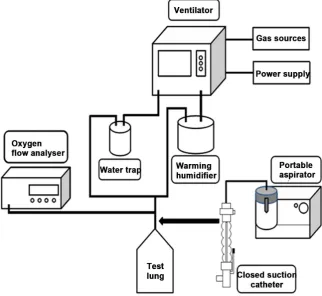
Figure 1 shows the circuit diagram of the procedure. Briefly, the test lung (adults: Siemens Maquet Adult 1 Liter Ventilator Test Lung 190 # 6006832; children: test bag R5, IMI, Japan) was placed vertically, and a ventilator (VELA, Care Fusion 207, America) was connected to simulate a patient on ventilation. The ventilation volume of the ventilator was measured using Flow analyzer PF-300 (imt medical, Switzerland). After aspiration with the closed-type suction catheter, the Eco-Cath or Ty-care, flush operation was carried out using syringe SS-10ESZ10 10 mL (Terumo, Japan) and DARTM Saline Vial 0.9% Sodium Chloride Solution for irrigation 15 ml (Covidien, Japan). A suction device Minic W-II (Shinei Industry Co. Ltd., Japan) was used for producing suction pressure. The state of the dropping was verified by visual observation, with the intubation tube making an angle of 0˚, 20˚, 40˚, 60˚, or 90˚ with the connection port of the test lung. The ventilator settings were as follows: volume control continuous
mandatory ventilation (VC-CMV), FiO2; 21%, breathing frequency; 15
breaths/min, inspiratory time; 1.4 s, PEEP; 0, 5, 7, and 10 cm H2O, and tidal
DOI: 10.4236/health.2018.106055 722 Health volume; 100 ml, 300 ml, and 500 ml. In positive control continuous mandatory ventilation (PC-CMV), the pressure support value was varied in the range of 13 - 38 cm H2O depending on the tidal volume.
A suction pressure of 20 kPa (150 mmHg) was applied, in accordance with the clinical guidelines followed in Japan.
2.3. Statistics
All statistical analyses were performed with R (The R Foundation for Statistical Computing, Vienna, Austria). The Chi-squared test was used to check depen-dence between the time of dropping and each factor. Additionally, Fisher’s exact test was used when the Chi-squared test could not be used. For each angle be-tween the intubation tube and the connection port of the test lung, Chi-squared or Fisher’s exact tests were conducted to investigate the relationship between “presence/absence of dropping” and “tidal volume”, “control method”, “type of catheter”, and “PEEP”. P < 0.01 was considered statistically significant.
3. Results
3.1. Adults
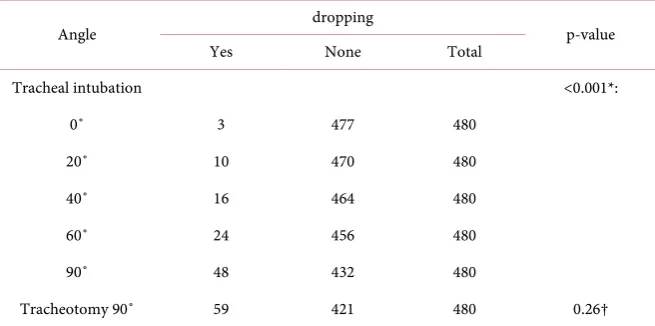
[image:4.595.210.538.536.699.2]In adults, dew droppings were observed in 67 of all 1440 times in VC-CMV and 93 of all 1440 times in PC-CMV; the dropping was more frequent in PC-CMV.
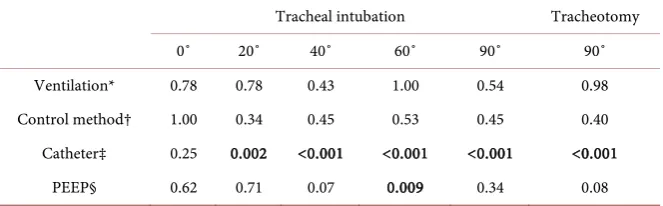
Table 1 shows the relationship between the dropping time and angle of intuba-tion relative to the connecintuba-tion port. Our results showed a significant relaintuba-tionship between the number of droppings and the angle between the intubation tube and the connection port of the test lung (P < 0.001, chi-squared test). The last two rows in Table 1 shows the result of chi-squared test between the dropping and angle for “tracheal intubation 90˚” and “tracheotomy 90˚”. The type of ca-theter and the number of dropping had a significant relationship at angles of 40˚ to 90˚ (Table 2). With regards to the structure of the catheter, droppings were
Table 1. The number of droppings at each angle (adults).
Angle dropping p-value
Yes None Total
Tracheal intubation <0.001*:
0˚ 3 477 480
20˚ 10 470 480
40˚ 16 464 480
60˚ 24 456 480
90˚ 48 432 480
Tracheotomy 90˚ 59 421 480 0.26†
*: Significance with the chi-squared test. †: Probability (by chi-square test) between tracheal intubation 90˚
DOI: 10.4236/health.2018.106055 723 Health Table 2. The p-value of each angle under different conditions (adults).
Tracheal intubation Tracheotomy
0˚ 20˚ 40˚ 60˚ 90˚ 90˚
Ventilation* 0.78 0.78 0.43 1.00 0.54 0.98
Control method† 1.00 0.34 0.45 0.53 0.45 0.40
Catheter‡ 0.25 0.002 <0.001 <0.001 <0.001 <0.001
PEEP§ 0.62 0.71 0.07 0.009 0.34 0.08
*: 100 ml vs. 300 ml vs. 500 ml; †: VC-CMV vs. PC-CMV; ‡: Eco-Cath vs. Ty-care; §: 0 cm H2O vs. 5 cm H2O vs. 7 cm H2O vs. 10 cm H2O.
observed 0 out of 1440 times in the Ty-care, and 160 out of 1440 times in the Eco-Cath; and this difference was statistically significant (P < 0.001).
3.2. Children
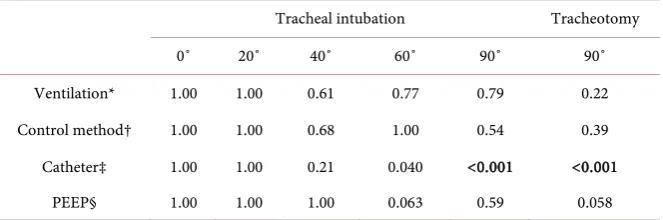
The droppings were observed 61 of 1080 times in VC-CMV and 66 of 1080 times in PC-CMV; and like the observation in adults, the difference was not signifi-cant. Additionally, as was observed in adults, there was a correlation between the number of dropping and the angle between the intubation tube and the connec-tion port of the test lung in the children (Table 3). There was a significant rela-tionship between the presence/absence of dropping and the angle between the intubation tube and the connection port of the lung (P < 0.001). At an angle of 90˚ (tracheal intubation and tracheostomy), there was a significant association between the type of the catheter placement and the number of droppings (Table 4). At all angles from 20˚ to 90˚, the dropping of dew was observed more fre-quently in the elbow-type suction catheter (98/1080) than in the Y-connector type catheter (29/1080).
4. Discussion
Approximately ten years have passed since Japan’s guidelines for tracheal aspira-tion (first ediaspira-tion) were introduced in 2007. In keeping with the medical situa-tion regarding the use of tracheal aspirasitua-tion, these guidelines were revised in 2013 [2]. The overall evidence level was reviewed and the recommendation level was represented by the grade classification [11]. Following a standardized pro-cedure according to the recommended guidelines has been shown to decrease the occurrence of complications, such as rise in blood pressure, increased heart rate, decreased oxygen saturation and carbon dioxide storage [12].Hence, the importance of standardized protocols to perform this procedure is well-known. In this study, tracheal aspiration was performed according to the established guidelines by the same operator so that all suction procedures were performed under identical conditions.
DOI: 10.4236/health.2018.106055 724 Health Table 3. The number of droppings at each angle (children).
Angle dropping p-value
Yes None Total
Tracheal intubation <0.001*:
0˚ 0 360 360
20˚ 1 359 360
40˚ 6 354 360
60˚ 12 348 360
90˚ 49 311 360
Tracheotomy 90˚ 59 301 360 0.15†
*: Significance with the chi-squared test. †: Probability (by chi-square test) between tracheal intubation 90˚
and tracheotomy 90˚.
Table 4. The p-value of each angle under different conditions (children).
Tracheal intubation Tracheotomy
0˚ 20˚ 40˚ 60˚ 90˚ 90˚
Ventilation* 1.00 1.00 0.61 0.77 0.79 0.22
Control method† 1.00 1.00 0.68 1.00 0.54 0.39
Catheter‡ 1.00 1.00 0.21 0.040 <0.001 <0.001
PEEP§ 1.00 1.00 1.00 0.063 0.59 0.058
*: 100 ml vs. 300 ml vs. 500 ml; †: VC-CMV vs. PC-CMV; ‡: Eco-Cath vs. Ty-care; §: 0 cm H2O vs. 5 cm
H2O vs. 7 cm H2O vs. 10 cm H2O.
on flushing at an angle of 0˚, the saline was pulled by suction pressure, so it hardly dripped (Figure 2), while at 90˚, because of gravity, all the saline was not pulled by suction pressure, hence, fell on to the side of the patient without being absorbed by the side groove (Figure 3). We have observed this phenomenon previously and presented it at the Chubu clinical engineering society in Nagoya, 2012. The Ty-care was not considerably influenced by the airflow during flush-ing. However, it does not imply absence of possibility of droppflush-ing. A disadvan-tage of the structure of the Ty-care is that the saline that cannot be sucked by the catheter during flushing accumulates under the rotary valve and may drop on to the side of the patient at the time of valve rotation. In this study, the experimen-ters were familiar with the drawbacks of Ty-care and the dropping did not hap-pen because they were careful to avoid it.
[image:6.595.208.540.307.417.2]DOI: 10.4236/health.2018.106055 725 Health Figure 2. The movement of the saline at an angle of 0˚ between the intubation tube and the connection port of the test lung. (a) Patient side; (b) Connection port of the respira-tory circuit. The part painted blue indicates saline and the red arrow indicates suction pressure. Presumably, on flushing at an angle of 0˚, saline is pulled by suction pressure, so it hardly drips.
Figure 3. The movement of the saline at an angle of 90˚ between the intubation tube and the connection port of the test lung. (a) Patient side. The part painted blue indicates sa-line. The red arrow indicates suction pressure and the black arrow shows gravity. At 90˚, because of gravity, the entire saline is not pulled by suction pressure, and hence, falls onto the patient’s side.
The Y connector type catheter was contained in a cylinder when flushed, and sa-line was sucked into the side groove. In contrast, the elbow-type catheter is structured to be exposed to flow because the catheter edge length was approx-imately 5 mm for adults and 3 mm for children, and hence was susceptible to flow (Figure 4).
[image:7.595.213.532.319.518.2]DOI: 10.4236/health.2018.106055 726 Health Figure 4. The structure of the Y-connector type catheter and the elbow-type catheter. The Y-connector type catheter is contained in a cylinder when flushed, and saline is sucked into the side groove. The elbow-type catheter is structured to be exposed to flow. Because the catheter edge length is approximately 5 mm for adults and 3 mm for children, and hence, is susceptible to flow.
flushed (Figure 5). There is no prior research report on this, to our knowledge. The numbers of the droppings in this study was less than that previously re-ported by Doi (the Chubu clinical engineering society 2012, Nagoya). The per-formance of the ventilator used in this study (VELA) was better than that of the ventilator (LTV 1200) used in previous studies for the chronic phase. For the flow and the ventilation, VELA was more accurate than other ventilators such as LTV1200. In this context, Banner et al have shown that the ventilator used in the acute phase was more precise and had a better function than the ventilator used in the chronic phase [13].
The second issue is “clogging of the suction tube”. As in the AARC guidelines, suction was usually performed within 10 s at 20 kPa (150 mmHg). However, as sputum remained in the catheter or the suction bottle became full, the suction power decreased and the flush operation may not be performed normally, re-sulting in dropping of the saline on to the side of the patient. This was also mentioned in the 24th report of the medical accident information gathering project [3], and is suggested as a risk of flushing caused by a decrease in suc-tion power.
The third issue is “problems related to the procedure”. According to the guideline, when cleaning the lumen of the catheter, 5 to 10 ml of saline needs to be injected from the washing solution injection port while applying negative pressure, but the injection speed of saline is not specified. It was thought that the number of dropping was small when injecting at about 1 ml per second. It is ex-pected that the risk of the dropping will increase as the amount of saline per second increases.
DOI: 10.4236/health.2018.106055 727 Health Figure 5. Influence of flow. The upward arrow indicates expiration by the patient and the left-pointing arrow indicates the inspiration from the ventilation. Saline was exposed to ventilation and it dropped onto the patient’s side when flushed.
is the possibility of potentially serious medical errors if the procedure is per-formed manually, and there is no solution other than adequate training of the medical staff. However, it is possible to alter the structure of the catheter so that events do not occur irreversibly. Compared with the Eco-Cath, this study found that the structure of the Ty-care can prevent factors of dropping, such as influ-ence of angle on flushing, influinflu-ence of airflow, clogging of the suction tube, and errors in the procedure by the operator.
This study has provided important information about tracheal aspiration, which is carried out in domestic clinical sites. However, it does have some limi-tations. First, the aspirator used in this study was not equipped, but a portable aspirator. Unlike the pressure of the piping used in hospital facilities, the suction pressure becomes unstable and the number of dropping may increase. The risks related to suction pressure will decrease if stable piping is used at hospital facili-ties. Second, the evaluation of dropping was subjective. It can be said that it is preferable to objectively evaluate the dropping using moving images or the like. Third, it cannot be denied that since this was a simulation study and was not performed on a real patient, some causes of dropping may not have been identi-fied. Performing this study under actual clinical conditions will increase our knowledge on preventing dropping. These considerations will constitute the ra-tionale for future studies.
5. Conclusion
DOI: 10.4236/health.2018.106055 728 Health phase, clogging of the suction tube, and problems related to the procedure. But in this research, we clarified relation of the angle and dew. Especially, between the intubation tube and the connection port of the test lung at the time of flush-ing. These results provide valuable information regarding the risk factors for dropping at the time of tracheal aspiration, and will be useful in guiding these procedures in clinical practice.
Acknowledgements
We would like to thank Editage (http://www.editage.jp) for English language editing.
References
[1] Ministry of Health, Labour and Welfare of Japan Website (2017). (In Japanese) http://www.mhlw.go.jp/stf2/shingi2/2r9852000000g3ig-att/2r9852000000iiut.pdf [2] Japanese Society of Respiratory Care Medicine Website (2017). (In Japanese)
http://square.umin.ac.jp/jrcm/pdf/kikanguideline2013.pdf
[3] Japan Council for Quality Health Care Website (2017). (In Japanese) http://www.med-safe.jp/pdf/report_24.pdf
[4] Shizuoka Hospital Association Website (2017). (In Japanese) http://shizuoka-bk.jp/advice/detail.php?N=68
[5] Michimata, Y. (2014) Shin Jinkou Kokyuu Kea No Subete Ga Wakaru Hon. [A Book That Shows All about Artificial Respiration.] Shorinsha, Japan.
[6] Corley, A., Sharpe, N., Caruana, L.R., Spooner, A.J. and Fraser, J.F. (2014) Lung Volume Changes during Cleaning of Closed Endotracheal Suction Catheters: A Randomized Crossover Study Using Electrical Impedance Tomography. Respiratory Care, 59, 497-503.https://doi.org/10.4187/respcare.02601
[7] Cereda, M., Villa, F., Colombo, E., Greco, G., Nacoti, M. and Pesenti, A. (2001) Closed System Endotracheal Suctioning Maintains Lung Volume during Vo-lume-Controlled Mechanical Ventilation. Intensive Care Medicine, 27, 648-654. https://doi.org/10.1007/s001340100897
[8] Guideline, A.C.P. (1999) Suctioning of the Patient in the Home. Respiratory Care, 44, 99-104.
[9] Tablan, O.C., Anderson, L.J., Besser, R., Bridges, C., Hajjeh, R. and CDC, Health-care Infection Control Practices Advisory Committee (2004) Guidelines for pre-venting Health-Care—Associated Pneumonia, 2003: Recommendations of CDC and the Healthcare Infection Control Practices Advisory Committee. MMWR Recommendations and Reports, 53, 1-36.
[10] Michimata, Y., Kozu, R. and Kotani, T. (2009) Jinkou Kokyuu Kanri Jissen Gaido. [Practice Guide for Artificial Respiration Management.] Shorinsha, Japan.
[11] Guyatt, G.H., Oxman, A.D., Vist, G.E., Kunz, R., Falck-Ytter, Y., Alonso-Coello, P.,
et al. (2008) GRADE: An Emerging Consensus on Rating Quality of Evidence and Strength of Recommendations. BMJ, 336, 924-926.
https://doi.org/10.1136/bmj.39489.470347.AD
DOI: 10.4236/health.2018.106055 729 Health
[13] Banner, M.J., Blanch, P.B. and Kirby, R.R. (1993) Imposed Work of Breathing and Methods of Triggering a Demand-Flow, Continuous Positive Airway Pressure Sys-tem. Critical Care Medicine, 21, 183-190.