© 2019, IRJET | Impact Factor value: 7.211 | ISO 9001:2008 Certified Journal | Page 1265
ATM Security using Machine Learning
1,2,3,4
B.Tech Student, Dept. of Information Technology, Dr. Akhilesh Das Gupta Institute of Technology and
Management, New Delhi, India
5
Mentor: Assistant Professor Ms. Arushi Gupta, Dept. of Information Technology, Dr. Akhilesh Das Gupta Institute of
Technology and Management, New Delhi, India
---***---
Abstract
-
Due to use of outdated technology and lack of basic security features ATM machines are becoming prime targets for thieves and hackers. Now a days there are lot of crimes occurring in the ATM sector. Thieves have come up with many different ways to trick ATMs, manipulating and forcing people into spitting out large amounts of cash. So we have come to the idea of making this project from our observations of life incidents happening in the world. This project ATM Security using Machine Learning provides some security measures for ATM transactions. In this project, various facial detection & emotion recognition features has been done using various algorithms like K-Nearest Neighbors Algorithm, Back Propagation Neural Networks. The machine will only work if the expressions and emotions are normal and there is no sign of forced usage or any other illicit activity. At first, we will check that if only single person is trying to access the ATM machine, if a person is entering in group then access will not be provided. The machine will also check if a person is wearing helmet or mask if yes the machine will not give access. After this process of facial detection it will recognize the emotions and expressions of a person using algorithms. If emotions and expressions are found to be tensed or nervous, then machine will stop the transaction and will send a SMS alert to the guard outside the ATM machine. This project will give the maximum level of accuracy and reliability for face detection and emotion recognition and will help to make ATM machines secure.Key words: ATM machines, ATM Security, Machine Learning, K-Nearest Neighbors Algorithm, Back Propagation Neural Networks, Face Detection, Emotion Recognition.
1.
INTRODUCTION
These days research is going in the field of crime avoidance and detection in ATM. But till now there is no good technology in the field of ATM that can avoid these crimes. So the idea of making this project has come from our observation of life incidents happening in the IT sector. So to provide some security measures for ATM transactions is what the purpose of the project is. In this project, we will analyze various facial & emotional features using various algorithms. The machine will only work if the expressions and emotions are normal and there is no sign of forced usage or any other illicit activity. Image processing technology concentrates on the development of data extraction techniques applied toward the statistical classification of visual imagery.
This project describes a number of artificial intelligence and digital image processing techniques which allow symbolic information to be exploited in conjunction with numerical data to improve object classification performance. At first, we will check that only single person is trying to access the ATM machine, if a person is entering in group or illicitly accessing ATM then access will not be provided, and then we will recognize the emotions and expressions of a person, if they are found to be tensed or nervous, then we will send a SMS alert to the guard outside the ATM machine.
2.
FACE DETECTION
Face detection involves separating image windows into two classes; one containing faces (turning the background (clutter). It is difficult because although commonalities exist between faces, they can vary considerably in terms of age, skin color and facial expression. The problem is further complicated by differing lighting conditions, image qualities and geometries, as well as the possibility of partial occlusion and disguise. An ideal face detector would therefore be able to detect the presence of any face under any set of lighting conditions, upon any background. The face detection task can be broken down into two steps. The first step is a classification task that takes some arbitrary image as input and outputs a binary value of yes or no, indicating whether there are any faces present in the image. The second step is the face localization task that aims to take an image as input and output the location.
© 2019, IRJET | Impact Factor value: 7.211 | ISO 9001:2008 Certified Journal | Page 1266
2.1 Face Detection in Image
Most face detection systems attempt to extract a fraction of the whole face, thereby eliminating most of the background and other areas of an individual's head such as hair that are not necessary for the face recognition task. With static images, this is often done by running a across the image. The face detection system then judges if a face is present inside the window (Brunelli and Poggio, 1993). Unfortunately, with static images there is a very large search space of possible locations of a face in an image. Most face detection systems use an example based learning approach to decide whether or not a face is present in the window at that given instant (Sung and Poggio,1994 and Sung,1995). A neural network or some other classifier is trained using supervised learning with 'face' and 'non-face' examples, thereby enabling it to classify an image (window in face detection system) as a 'face' or 'non-face'.. Unfortunately, while it is relatively easy to find face examples, how would one find a representative sample of images which represent non-faces (Rowley et al., 1996). Therefore, face detection systems using example based learning need thousands of 'face' and 'non-face' images for effective training. Rowley, Baluja, and Kanade (Rowley et al., 1996) used 1025 face images and 8000 non-face images (generated from 146,212,178 sub-images) for their training set.
2.2
Real-Time Face Detection
Real-time face detection involves detection of a face from a series of frames from a video-capturing device. While the hardware requirements for such a system are far more stringent, from a computer vision stand point, real-time face detection is actually a far simpler process than detecting a face in a static image. This is because unlike most of our surrounding environment, people are continually moving. We walk around, blink, fidget, wave our hands about, etc. Exact face locations can be easily identified by using a few simple rules, such as:
1.
The head is the small blob above a larger blob the body head motion must be reasonably slow and contiguous-heads won't jump around erratically (Turk and Pent land 1991a, 1991b).
2.
Real-time face detection has therefore become a relatively simple problem and is possible even in unstructuredand uncontrolled environments using these very simple image processing techniques and reasoning rules.
3.
FEATURE EXTRACTION
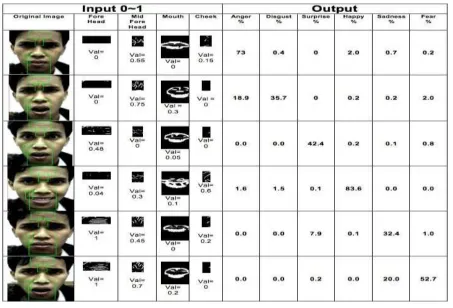
The face of a human has several features such as, mouth, eyes, nose, eyebrows, and forehead. Each of this features has a unique shape and a unique pattern, hence, many experiments have been reported in extracting facial feature for recognizing facial expression.
[image:2.612.184.431.560.699.2]We have used the locations of eyes as the visual features of face and have also used eyebrows, eyes, and mouth for facial expression labeling. In this paper, we extract four main features: forehead, mid forehead, cheek and mouth for facial expression labeling. We extract the features toward forehead wrinkle, mid forehead wrinkle, cheek wrinkle, and mouth length as seen in Figure 1.
© 2019, IRJET | Impact Factor value: 7.211 | ISO 9001:2008 Certified Journal | Page 1267
The K-Nearest Neighbor classifier is the most simple and easy to implement image classification algorithm/machine
[image:3.612.221.392.133.266.2]learning algorithm. This algorithm simply focus on the distance between the feature vectors. Here we have the labels associated with every image in such way that we can predict and return the actual category of the image.
Fig. 2:
KNN Classifier
4.
EMOTION RECOGNITION & CLASSIFICATION
We have used Back Propagation Neural Network algorithm to recognize of facial expression with feed forward
architecture. Back propagation neural networks are the most widely used network and are considered the work horse of artificial neural network. The training of a network by Back Propagation Neural Network involve three stages: the feed forward of the input training pattern, the calculation and back propagation of associated error, and the adjustment of the
weights
.
Classification using neural networks is the best classification technique. It is a kind of computational model thatworks same as neurons in the human brain. Here each neuron gets some input, and then it performs some operations on it and then passes the output to the next neuron. In order to classify human emotions, we first need to teach the machine various features of human behavior, how human facial expressions gets changed at different emotional activity. The more images machine sees, the better it gets in recognizing emotions. This technique is known as supervised learning. We can perform this task by labeling the images, then the machine will start recognizing patterns present in face and will start building its own cognition.
[image:3.612.92.526.464.675.2]© 2019, IRJET | Impact Factor value: 7.211 | ISO 9001:2008 Certified Journal | Page 1268
The extracted feature points are processed to obtain the inputs for the neural network. The neural network has being trained so that the emotions happiness, sadness, anger, disgust, surprise and fear are classified. Many images from Facial expressions and emotion database are taken to train the network. To classify emotions, we have used the naive bias classifier as an evaluation step.Table 1: Emotion Classifier Table
5. ATM SECURITY USING SUSPICIOUS ACTIVITY DETECTION
The proposed system is mainly connected with ATM software. The role of the system is divided into various categories: The first module is associated with the CCTV camera in the ATM which captures the images. The second module comprises of MOD (Multiple Object Detection) which mainly checks the presence of more than one person in the ATM site. If there are multiple objects or user then it will give a pop up error message to the user. Now, the third module is the activity and emotion recognition module. It basically recognizes human behavior and emotions. If the emotions and behavior of the person are normal then the transaction module enables ATM transactions run smoothly in normal fashion. If there are multiple objects or if behavior of a person is not normal then it will produce an alarm and will send a SMS alert to the guard outside the ATM.
6. CONCLUSION
© 2019, IRJET | Impact Factor value: 7.211 | ISO 9001:2008 Certified Journal | Page 1269
7. FUTURE SCOPE
In future, we can improve the accuracy of our project by real time training of the machine via deep learning. Also, we can provide an android app to security guard with SOS features which will be connected to ATM software and police helpline services.
REFERENCES
[1] Emotion Recognition with Image Processing and Neural Networks- W.N. Widanagamaachchi & A.T. Dharmaratne , University of Colombo School of Computing, Sri Lanka.
[2] Facial Expression Recognition Using Back propagation- Graduate School of System Design Tokyo Metropolitan University, [email protected].
[3] Detection and Classification of Facial Expressions using Artificial Neural Network- Department of Computer Science, National University of Computer and Emerging Sciences Lahore, Pakistan
[4] http://www.ux.uis.no/~tranden/brodatz.html