Applying Extrasentential Context To M a x i m u m Entropy Based
Tagging With A Large Semantic And Syntactic Tagset
E z r a B l a c k a n d A n d r e w F i n c h a n d R u i g i a n g Z h a n g A T R I n t e r p r e t i n g T e l e c o m m u n i c a t i o n s L a b o r a t o r i e s
2-2 Hikaridai Seika-cho, S o r a k u - g u n Kyoto, J a p a n 619-02
b l a c k © i t I. atr. co. jp f i n c h © i t l , atr. co. jp r z h a n g © i t l , atr. co. jp
A b s t r a c t
Experiments are presented which measure the perplexity reduction derived from incor- porating into the predictive model utilised in a standard t a g - n - g r a m part-of-speech tagger, contextual information from previous sentences of a document. The tagset employed is the roughly-3000-tag ATR General English Tagset, whose tags are both syntactic and semantic in nature. The kind of extrasentential informa- tion provided to the tagger is semantic, and consists in the occurrence or non-occurrence, within the past 6 sentences of the document being tagged, of words tagged with particular tags from the tagset, and of boolean combina- tions of such conditions. In some cases, these conditions are combined with the requirement that the word being tagged belong to a partic- ular set of words thought most likely to ben- efit from the extrasentential information they are being conjoined with. The baseline model utilized is a m a x i m u m entropy-based t a g - n - gram tagging model, embodying a standard t a g - n - g r a m approach to tagging: i.e. con- straints for tag trigrams, bigrams, a n d and the word-tag occurrence frequency of the specific word being tagged, form the basis of prediction. Added into to this baseline tagging model is the extrasentential semantic information just indi- cated. The performance of the tagging model with and without the added contextual knowl- edge is contrasted, training from the 850,000- word A T R General English Treebank, and test- ing on the accompanying 53,000-word test tree- bank. Results are that a significant reduction in testset perplexity is achieved via the added se- mantic extrasentential information of the richer model. The model with both long-range tag triggers and more complex linguistic constraints achieved a perplexity reduction of 21.4%.
1 I n t r o d u c t i o n
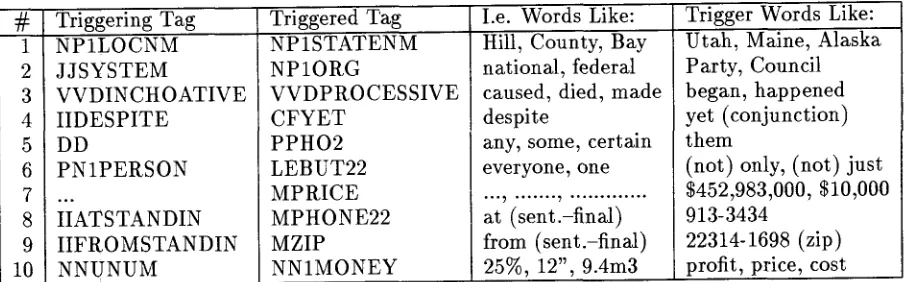
It appears intuitively that information from earlier sentences in a document ought to help reduce uncertMnty as to a word's correct p a r t - of-speech tag. This is especially so for a large semantic and syntactic tagset such as the roughly-3000-tag A T R General English Tagset (Black et al., 1996; Black et al., 1998). And in fact, (Black et al., 1998) demonstrate a signif- icant "tag trigger-pair" effect. T h a t is, given that certain "triggering" tags have already oc- curred in a document, the probability of oc- currence of specific "triggered" tags is raised significantly--with respect to the unigram tag probability model. Table 1, taken from (Black et al., 1998), provides examples of the tag trigger-pair effect.
Yet, it is one thing to show that extrasenten- tial context yields a gain in information with respect to a unigram tag probability model. But it is another thing to demonstrate that extrasentential context supports an improve- ment in perplexity vis-a-vis a part-of-speech tagging model which employs s t a t e - o f - t h e - a r t t e c h n i q u e s : such as, for instance, the tag- ging model of a m a x i m u m entropy t a g - n - g r a m - based tagger.
The present paper undertakes just such a demonstration. Both the model underlying a standard tag-n-gram-based tagger, and the same model augmented with extrasentential contextual information, are trMned on the 850,000-word ATR General English Treebank (Black et al., 1996), and then tested on the ac- companying 53,000-word test treebank. Perfor- mance differences are measured, with the result that semantic information from previous sen- tences within a document is shown to help sig- nificantly in improving the perplexity of tagging
Triggering Tag Triggered Tag I.e. Words Like: Trigger Words Like: Utah, Maine, Alaska
#
1 N P i L O C N M 2 J J S Y S T E M
3 V V D I N C H O A T I V E 4 I I D E S P I T E
5 DD
6 P N 1 P E R S O N
. , .
8 IIATSTANDIN 9 I I F R O M S T A N D I N 10 N N U N U M
N P I S T A T E N M N P 1 O R G
V V D P R O C E S S I V E C F Y E T
P P H O 2 LEBUT22 M P R I C E M P H O N E 2 2 MZIP
N N I M O N E Y
Hill, County, Bay national, federal caused, died, m a d e despite
any, some, certain everyone, one
at (sent.-final) from (sent.-final) 25%, 12", 9.4m3
Party, Council began, h a p p e n e d yet (conjunction) t h e m
(not) only, (not) just $452,983,000, $10,000 913-3434
22314-1698 (zip) profit, price, cost Table 1: Selected Tag Trigger-Pairs, A T R General-English Treebank
with the indicated tagset.
In what follows, Section 2 provides a basic overview of the tagging approach used (a max- i m u m entropy tagging model employing con- straints equivalent to those of the s t a n d a r d hid- den Markov model). Section 3 discusses and offers examples of the sorts of extrasententially- based semantic constraints that were added to the basic tagging model. Section 4 describes the experiments we performed. Section 5 details our experimental results. Section 6 glances at pro- jected future research, and concludes.
2 T a g g i n g M o d e l 2.1 M E M o d e l
Our tagging model is a m a x i m u m entropy (ME) model of the following form:
K
P(tlh) = 7 I ~ ~ k(h't)p° (1) k=0
w h e r e :
- t is tag we are predicting;
- h is the history (all prior words and tags) of t;
- 7 is a normalization coefficient that en- ~ L r-TK ]k(h,t)
sures: ~t=oTllk=o ak P0 = 1; L is the number of tags in our tag set; - ak is the weight of trigger fk;
fk are trigger functions and f~e{0, 1};
- P0 is the default tagging model (in our case, the uniform distribution, since all of the in- formation in the model is specified using ME constraints).
The model we use is similar to that of (Rat- naparkhi, 1996). Our baseline model shares the following features with this tagging model; we will call this set of features the basic n-gram tagger constraints:
1. w = X & t = T
2. t _ l = X & t = T
3. t - 2 t - 1 = X Y ~: t = T
where:
- w is word whose tag we are predicting; - t is tag we are predicting;
- t-1 is tag to the left of tag t;
- t-2 is tag to the left of tag t - l ;
Our baseline model differs from Ratna- parkhi's in that it does not use any informa- tion about the occurrence of words in the his- tory or their properties (other than in con- straint 1). Our model exploits the same kind of t a g - n - g r a m information that forms the core of m a n y successful tagging models, for exam- ple, (Kupiec, 1992), (Merialdo, 1994), (Ratna- parkhi, 1996). We refer to this type of tagger as a t a g - n - g r a m tagger.
2.2 T r i g g e r s e l e c t i o n
[image:2.612.94.546.58.199.2](Rosenfeld, 1996)). That is, we use the follow- ing formula to gauge a feature's usefulness to 1-he model:
MI( , t)
where:
= P(,s,t)'tog -?~P(tl~)
+ P(s,t)"
~og p(~)P(tls)
+ P ( ~ , t ) l o g + P ( ~ , / ) l o ~ c~ p([)P(tl~)
- t is the tag we are predicting;
- s can be any kind of triggering feature. For each of our trigger predictors, s is defined below:
B i g r a m a n d t r i g r a m t r i g g e r s : s is the presence of a particular tag as the first tag in the bigram pair, or the presence of two particular tags (in a particular order) as the first two tags of a trigram triple. In this case, t is the presence of a particular tag in the final position in the n-gram.
Extrasentential tag t r i g g e r s : 8 is the pres- ence of a particular tag in the extrasenten- tial history.
Q u e s t i o n t r i g g e r s : s is the boolean answer to a question.
This m e t h o d has the advantage of finding good candidates quickly, and the disadvantage of ignoring any duplication of information in the features it selects. A more principled approach is to select features by actually adding them one-by-one into the ME model (Della Pietra et al., 1997); however, using this approach is very time-consuming and we decided on the MI ap- proach for the sake of speed.
3 T h e C o n s t r a i n t s
To understand what extrasentential semantic constraints were added to the base tagging model in the current experiments, one needs some familiarity with the A T R General En- glish Tagset. For detailed presentations, see (Black et al., 1998; Black et al., 1996). An apercu can be gained, however, from Figure 1, which shows two sample sentences from
the ATR Treebank (and originally from a Chinese take-out food flier), tagged with respect to the ATR GenerM English Tagset. Each verb, noun, adjective and adverb in the A T R tagset includes a semantic label, chosen from 42 noun/adjective/adverb categories and 29 verb/verbal categories, some overlap existing between these category sets. Proper nouns, plus certain adjectives and certain numerical expressions, are further categorized via an additional 35 "proper-noun" categories. These semantic categories are intended for any "Standard-American-English" text, in any domain. Sample categories include: "phys- ical.attribute" (nouns/adjectives/adverbs), "alter" (verbs/verbals), "interpersonal.act" (nouns/adjectives/adverbs/verbs/verbals), "orgname" (proper nouns), and "zipcode" (numericals). They were developed by the ATR grammarian and then proven and refined via d a y - i n - d a y - o u t tagging for six months at A T R by two h u m a n "treebankers', then via four months of tagset-testing-only work at Lancaster University (UK) by five treebankers, with daily interactions among treebankers, and between the treebankers and the A T R grammarian. The semantic categorization is, of course, in addition to an extensive syn- tactic classification, involving some 165 basic syntactic tags.
Starting with a basic t a g - n - g r a m tagger trained to tag raw text with respect to the A T R General English Tagset, then, we added con- straints defined in terms of "tag families". A tag family is the set of all tags sharing a given semantic category. For instance, the tag fam- ily "MONEY" contains common nouns, proper nouns, adjectives, and adverbs, the semantic component of whose tags within the A T R Gen- eral English Tagset, is "money": 500-stock, De- posit, T O L L - F R E E , inexpensively, etc.
One class of constraints consisted of the pres- ence, within the 6 sentences (from the same doc- ument) 1 preceding the current sentence, of one or more instances of a given tag family. This type of constraint came in two varieties: ei- ther including, or excluding, the words within the sentence of the word being tagged. Where these intrasentential words were included, they 1 (Black et al., 1998) d e t e r m i n e d a 6-sentence window to be o p t i m a l for this task.
(_( Please_RRCONCESSIVE Mention_VVIVERBAL-ACT this_DDl coupon_NNIDOCUMENT when_CSWHEN ordering_VVGINTER-ACT
0R_CCOR 0NE_MCIWORD FREE_JJMONEY FANTAIL_NNiANIMAL SHRIMPS_NNiF00D
Figure h Two A T R Treebank Sentences from Chinese T a k e - O u t Food Flier (Tagged Only - i.e. Parses Not Displayed)
consisted of the set of words preceding the word being tagged, within its sentence.
A second class of constraints added to the re- quirements of the first class the representation, within the past 6 sentences, of related tag fam- ilies. Boolean combinations of such events de- fined this group of constraints. An example is as follows: (a) an instance either of the tag fam- ily "person" or of the tag family "personal at- tribute"(or both) occurs within the 6 sentences preceding the current one; or else (b) an in- stance of t h e tag family "person" occurs in the current sentence, to the left of the word being tagged; or, finally, both (a) and (b) occur.
A third class of constraints had to do with the specific word being tagged. In particular, the word being classified is required to belong to a set of words which have been tagged at least once, in the training treebank, with some tag from a particular tag family; and which, fur- ther, always shared the same basic syntax in the training data. For instance, consider the words "currency" and "options". Not only have they both been tagged at least once in the train- ing set w i t h some m e m b e r of the tag family "MONEY" (as well, it happens, as with tags from other tag families); but in addition they both occur in the training set only as nouns. Therefore these two words would occur on a list named " M O N E Y nouns", and when an instance of either of these words is being tagged, the con- straint " M O N E Y nouns" is satisfied.
A fourth and final class of constraints com- bines the first or the second class, above, with the third class. E.g. it is both the case that some avatar of the tag family "MONEY" has occurred within the last 6 sentences to the left; and that the word being tagged satisfies the constraint " M O N E Y nouns". The advantage of this sort Of composite constraint is that it is focused, a n d likely to be'helpful when it does occur. The d[isadvantage is that it is unlikely to
occur extremely often. On the other hand, con- straints of the first, second, and third classes, above, are more likely to occur, but less focused and therefore less obviously helpful.
4 T h e E x p e r i m e n t s
4.1 T h e F o u r M o d e l s
To evaluate the utility of long-range seman- tic context we performed four separate exper- iments. All of the models in the experiments include the basic ME t a g - n - g r a m tagger con- straints listed in section 2. The models used in our experiments are as follows:
(1) The first model is a model consisting ONLY of these basic ME t a g - n - g r a m tagger con- straints. This model represents the base- line model.
(2) The second model consists of the baseline model together with constraints represent- ing extrasentential tag triggers. This ex- periment measures the effect of employing the triggers specified in (Black et al., 1998) --i.e. the presence (or absence) in the pre- vious 6 sentences of each tag in the tagset, in t u r n - - to assist a real tagger, as opposed to simply measuring their m u t u a l informa- tion. In other words, we are measuring the contribution of this long-range information over and above a model which uses local t a g - n - g r a m s as context, rather than mea- suring the gain over a naive model which does not take context into account, as was the case with the m u t u a l information ex- periments in (Black et al., 1998).
(3) The third model consists of the baseline model together with the four classes of more sophisticated question-based triggers defined in the previous section.
tag trigger constraints and the question- based trigger constraints.
\\:(~ chose the model underlying a standard la< n-gram tagger as the baseline because it represents a respectable tagging model which most readers will be familiar with. The ME framework was used to build the models since il provides a principled manner in which to inte- grate the diverse sources of information needed for these experiments.
4.2 E x p e r i m e n t a l P r o c e d u r e
The performance of each the tagging models is measured on a 53,000-word test treebank hand- labelled to an accuracy of over 97% (Black et al., 1996; Black et al., 1998). We measure the model performance in terms of the perplexity of the tag being predicted. This measurement gives an indication of how useful the features we supply could be to an n - g r a m tagger when it consults its model to obtain a probablity dis- tribution over the tagset for a particular word. Since our intention is to gauge the usefulness of long-range context, we measure the perfor- mance improvement with respect to correctly (very accurately) labelled context. We chose to do this to isolate the effect of the correct markup of the history on tagging performance (i.e. to measure the performance gain in the ab- sence of noise from the tagging process itself). Earlier experiments using predicted tags in the history showed that at current levels of tagging accuracy for this tagset, these predicted tags yielded very little benefit to a tagging model. However, removing the noise from these tags showed clearly that improvement was possible from this information. As a consequence, we chose to investigate in the absence of noise, so that we could see the utility of exploiting the history when labelled with s y n t a c t i c / s e m a n t i c tags.
The resulting measure is an idealization of a component of a real tagging process, and is a measure of the usefulness of knowing the tags in the history. In order to make the comparisons between models fair, we use correctly-labelled history in the n-gram components of our mod- els as well as for the long-range triggers. As a consequence of this, no search is nescessary.
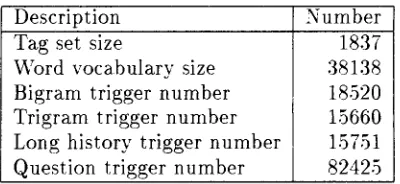
The number of possible triggers is obviously very large and needs to be limited for reasons of
Description N u m b e r
Tag set size
Word vocabulary size Bigram trigger number Trigram trigger number Long history trigger number Question trigger number
1837 38138 18520 15660 15751 82425 Table 2: Vocabulary sizes and number of trig- gers used
practicability. The number of triggers used for these experiments is shown in Table 2. [;sing these limits we were able to build each model in around one week on a 600MHz DEC-alpha. The constraints were selected by m u t u a l infor- mation. Thus, as an example, the 82425 ques- tion trigger constraints shown in Table 2 repre- sent the 82425 question trigger constraints with the highest m u t u a l information.
The improved iterative scaling technique (Della Pietra et al., 1997) was used to train the parameters in the ME model.
5 T h e R e s u l t s
Table 4 shows the perplexity of each of the four models on the testset.
The maximum entropy framework adopted for these experiments virtually guarantees that models which utilize more information will per- form as well as or b e t t e r than models which do not include this extra information. Therefore, it comes as no surprise that all models improve upon the baseline model, since every model ef- fectively includes the baseline model as a com- ponent.
However, despite promising results when measuring m u t u a l information gain (Black et M., 1998), the baseline model combined only with extrasentential tag triggers reduced per- plexity by just a modest 7.6% . The explana- tion for this is that the information these trig- gers provide is already present to some degree in the n - g r a m s of the tagger and is therefore redundant.
In spite of this, when long-range information is captured using more sophisticated, linguisti- cally meaningful questions generated by an ex- pert grammarian (as in experiment 3), the per- plexity reduction is a more substantial 19.4%.
[image:5.612.333.533.62.154.2]i
Question Description MI (bits)
#
1 Person or personal attribute word in full history
2 Word being tagged has taken NN1PERSON in training set 3 Person or personal attribute word in remote history
4 Person or personal attribute or other related tags in full history 5 Person or personal attribute or other related tags in remote history
0.024410 0.024355 0.024294 0.020777 0.020156 Table 3: The 5 triggers for tag NNIPERSON with the highest MI
Model Perplexity Perplexity Reduction
Baseline n-gram model 2.99 0.0%
Baseline + long-range tag triggers 2.76 7.6% Baseline + question-based triggers 2.41 19.4%
Baseline + all triggers 2.35 21.4%
Table 4: Perplexity of the four models
#
1 2 3 4
The explanation for this lies in the fact that these question-based triggers are much more specific. The simple tag-based triggers will be active much more frequently and often inap- propriately. The more sophisticated question- based triggers are less of a blunt instrument. As an example, constraints from the fourth class (described in the constraints section of this pa- per) are likely to only be active for words able to take the particular tag the constraint was designed to apply to. In effect, tuning the ME constraints has recovered much ground lost to the n-grams in the model.
The final experiment shows that using all.the triggers reduces perplexity by 21.4%. This is a modest improvement over the results obtained in experiment 3. This suggests that even though this long-range trigger information is less useful, it is still providing some additional information to the more sophisticated question-based trig- gers.
Table 3 shows the five constraints with the highest mutual information for the tag NN1PERSON (singular common noun of per- son, e.g. lawyer, friend, niece). All five of these constraints happen to fall within the twenty-five constraints of any type with the highest mutual information with their predicted tags. Within Table 3, "full history" refers to the previous 6 sentences as well as the previous words in the current sentence, while "remote history" indi- cates only the previous 6 sentences. A "per- son word" is any word in the tag family
"per-
son", hence adjectives, adverbs, and both com- mon and proper nouns of person. Similarly, a "personal attribute word" is any word in the tag family "personal attribute", e.g. left-wing, liberty, courageously.
6 C o n c l u s i o n
[image:6.612.121.499.180.248.2]go much further in the direction of querying the historical tag structure. For example, we can, in effect, exploit grammatical relations within pre- vious sentences with an eye to predicting the tags of similarly related words in the current sentence. It is also possible to go even further and exploit the structure of full parses in the history.
R e f e r e n c e s
E. Black, A. Finch, H. Kashioka. 1998. Trigger- Pair Predictors in Parsing and Tagging. In
Proceedings, 36th Annual Meeting of the As- sociation for Computational Linguistics, 17th Annual Conference on Computational Lin- guistics, pages 131-137, Montreal.
E. Black, S. Eubank, H. Kashioka, J. Saia. 1998. Reinventing Part-of-Speech Tagging.
Journal of .Natural Language Processing (Japan), 5:1.
E. Black, S. Eubank, H. Kashioka, R. Garside, G. Leech, and D. Magerman. 1996. Beyond skeleton parsing: producing a comprehensive large-scale general-English treebank with full grammatical analysis. In Proceedings of the 16th Annual Conference on Computational Linguistics, pages 107-112, Copenhagen. S. Della Pietra, V. Della Pietra, J. Lafferty.
1997. Inducing features of random fields.
IEEE Transactions on Pattern Analysis and Machine Intelligence, 19(4):380-393.
J. Kupiec. 1992. Robust part-of-speech tagging using a hidden Markov model. In Computer Speech and Language, 6:225-242.
R. Lau, R. Rosenfeld, S. Roukos. 1993. Trigger- based language models: a maximum entropy approach. Proceedings of the International Conference on Acoustics, Speech and Signal Processing, Ih45-48.
B. Merialdo 1994. Tagging English text with a probabilistic model. In Computational Lin- guistics, 20(2):155-!72_
A. Ratnaparkhi. 1996. A Maximum Entropy Part-Of-Speech Tagger. In Proceedings of the Empirical Methods in Natural Language Pro- cessing Conference, University of Pennsylva-
nia.
R. Rosenfeld. 1996. A maximum entropy approach to adaptive statistical language modelling. Computer Speech and Language,
10:187-228.