Isolating neural indices of continuous
speech processing from multivariate
neural data
Giovanni M. Di Liberto, B.E., M.E.
Under the supervision of Dr. Edmund C. Lalor
A dissertation submitted to the
University of Dublin, Trinity College
In fulfilment of the requirements for the degree of
Doctor of Philosophy
August, 2017
Declaration
I, Giovanni Di Liberto, confirm that this thesis has not been submitted as an exercise for
a degree at this or any other university and is entirely my own work.
I agree to deposit this thesis in the University's open access institutional repository or
allow the Library to do so on my behalf, subject to Irish Copyright Legislation and Trinity
College Library conditions of use and acknowledgement.
Signed,
____________________
Giovanni M. Di Liberto
iii
Summary
The human ability to understand speech is underpinned by a hierarchical auditory system
whose successive stages process increasingly complex attributes of the auditory input. To
produce categorical speech perception, it has been suggested that this system must elicit
consistent neural responses to speech tokens (e.g., syllables, phonemes) despite variations
in their acoustics. This is an intermediate stage of the speech processing hierarchy,
followed by lexical and semantical analyses which allow the extraction of concepts from
speech sounds.
Although speech is a very important and unique aspect of humans, the cortical
mechanisms that allow its efficient processing remain unclear. One of the issues is
methodological, with research in auditory neuroscience often constrained to utilising
artificial speech stimuli such as isolated syllables or words. Also, important aspects such
as the temporal cortical dynamics have been ignored by studies that use technologies such
as functional MRI. This thesis investigates the neural underpinnings of speech perception
using scalp electro- and magneto-encephalography (EEG, MEG), with the aim of
developing methodologies capable of isolating neural activity at different stages of the
speech processing hierarchy by analysing spatio-temporal cortical dynamics in response
to different features of speech.
Previous research revealed that cortical activity is entrained to the low frequency
amplitude fluctuations of speech in time (i.e., amplitude envelope). However, the neural
underpinnings of this phenomenon remain unclear. Here, further insights on this topic are
revealed by studying the responses to continuous natural speech. In the first study
(Chapter 3), participants were presented with natural speech from an audio-book while
non-invasive EEG signals were recorded. This chapter demonstrates that EEG signals are
sensitive to the temporal tracking of categorical phonological features of speech and
provides a novel analysis framework to quantitatively investigate this phenomenon.
The study in Chapter 4 aimed to further assess this framework and, specifically, its
ability to isolate cortical responses to phonetic features from the ones in response to
speech acoustics. This involved implementing a perceptual pop-out paradigm that, by
providing or not providing prior predictive knowledge on the upcoming stimuli, allowed
for the comparison between two conditions consisting of the same stimulus but different
phoneme-iv
level speech processing that is modulated by the perceived clarity of the incoming stimuli.
The effects of prior predictive knowledge on the cortical responses to speech are further
investigated in Chapter 5, in which a similar pop-out paradigm and source-space MEG
signals were used to provide new insights on the neural substrates of these effects and,
specifically, on the interactions between and within selected cortical sites in temporal and
frontal areas.
The other important question of this thesis regards the applicability of the novel
framework in Chapter 3 in the study of language development and specific speech and
language impairments. This kind of research can involve working with particular cohorts
(e.g., clinical populations, infants), which may be unable to undertake long EEG
experiments, and one issue relating to the framework described in the previous chapters
is whether it would work with small amounts of data. Chapter 6 aims to address this by
introducing an extension of the original approach that allows the reduction of the
recording time down to 10 minutes. Finally, this improved approach is applied to
investigate speech perception in children with dyslexia (Chapter 7) and the results support
theories stating that this developmental deficit, whose symptoms involve mainly a
person’s reading skills, is related with language processing and, in particular, with the
v
Acknowledgements
This thesis is the result of four fantastic years of work and would not have been possible
without the support of several people. Therefore, I would like to thank:
Ed, for his constant and thoughtful encouragement and trust. Your incredible
mentorship represents a great role model both in research and life. Thank you for giving
me the opportunity to travel so much, which allowed me to grow, build my research
network, and make new friends. Thanks for teaching me that great ideas can arise while
having a good time or a nice conversation. Also, thanks for the humiliating games of pool,
Street Fighter, football, and bowling!
Richard, for his time, advice, and encouragement during these years.
John Butler, for his help at the start of my PhD and for his advice when I most
needed it.
Mick, James, and Ger, who supported me greatly at the start of my PhD. Thanks
Mick for the many hours of productive conversation and for his friendship, I hope we will
continue collaborating on new cool studies in the future!
The current members of the LalorLab, ReillyLab, and the “tissue guys”. The
constant craic in the lab and on the third floor made these years very memorable.
T-Dogg Terence for his friendship, his help with figures and as a participant for my
EEG experiments, and for all the trips to Il Capo!
Adam, for the hilarious and pitiless comments on papers and thesis, for the many
outdoor adventures, and for his friendship.
Emily, Aisling, Michael, and Nate for the invaluable help with the thesis and for
the enjoyable time exploring ideas. I look forward for more of this in the future!
Fiona, who assisted me with data collection for the study in Chapter 4.
Everybody who generously volunteered their time to participate in these studies.
Rebecca, for the fruitful collaboration and for her time while visiting York.
Varghese, Marina, and Denis, for the great opportunity to apply my work on the
study of dyslexia.
The neuroscience crowd at Trinity College, for reminding me that not all
vi
Shihab, Alain, Yves, and the ENS crowd, KC, Majid, and Brad at UW, for being so
welcoming during my time in Paris and Seattle and for the inspiring conversations.
Alejandro, for his invaluable friendship, for the many hours of conversation about
the future, for introducing me to so many friends, and for finding me a room in a fantastic
house. On this note, thanks to all my former housemates at 42 Percy Place, for making
me feel at home while being on the posh side of Dublin!
My friends, for reminding me who I am and where I come from.
I miei genitori Teresa e Domenico, per il loro supporto ed incoraggiamento in questi
anni trascorsi lontano da casa.
My brother Giancarlo, for being an endless source of inspiration and energy.
Pat and Ann, for being so welcoming and for making me feel part of the family.
My beautiful girlfriend Claire. For her unconditional support, for proof reading, for
listening to all my waffle, and most of all for her love.
This research was kindly supported by the Irish Research Council (IRC) through a
Government of Ireland Postgraduate Scholarship.
G
IOVANNID
IL
IBERTO Trinity College Dublinvii
Table of Contents
Acknowledgements ... v
Publications Arising from this Thesis ... xi
Glossary of Acronyms ... xv
List of Figures and Tables ... xvi
Chapter 1. Introduction ... 1
1.1 Background ... 3
1.2 Research Goals and Collaborations ... 6
1.3 Thesis outline ... 6
Chapter 2. The neurophysiology of speech perception ... 9
2.1 The functional anatomy of speech perception ... 9
2.1.1 The auditory system ... 10
2.1.2 Hierarchical organisation of the auditory system in the human cortex .... 13
2.1.3 Phoneme-level processing in human auditory cortex ... 17
2.2 The integration of prior and cross-modal information in speech processing ... 19
2.2.1 Principal factors contributing to speech perception ... 19
2.2.2 Sharpening vs Predictive coding theories ... 22
2.3 Measuring the cortical dynamics of speech perception ... 26
2.3.1 Non-invasive electroencephalography ... 27
2.3.2 Magnetoencephalography ... 28
2.3.3 Event-Related framework ... 29
2.3.4 Modelling the response to continuous speech ... 31
2.3.5 Temporal response function (TRF) ... 33
Chapter 3. Low frequency cortical entrainment to speech reflects phonemic level processing….. ... 37
3.1 Introduction ... 37
3.2 Methods ... 38
3.2.1 Subjects ... 38
3.2.2 Stimuli and Experimental Procedure ... 38
3.2.3 Data Acquisition and Preprocessing ... 39
3.2.4 TRF computation ... 40
3.2.5 Speech Representations ... 41
3.2.6 Model Evaluation ... 43
viii
3.2.8 Time-lag Selection ... 43
3.2.9 Multi-Dimensional Scaling ... 44
3.2.10 F-Scores ... 44
3.2.11 Statistical Analyses ... 45
3.3 Results ... 45
3.3.1 Neural evidence for phonetic processing ... 46
3.3.2 Phonetic processing across different EEG frequency bands ... 49
3.3.3 Sensitivity of EEG to phonetic features as a function of latency ... 52
3.4 Discussion ... 55
3.4.1 EEG measures of cortical entrainment reflect speech-specific processing ... 56
3.4.2 A novel approach for studying natural speech perception: Further requirements and potential impact ... 57
3.5 Summary ... 58
Chapter 4. Isolating neural indices of continuous speech processing at the phonetic level………… ... 59
4.1 Introduction ... 59
4.2 Methods ... 61
4.2.1 Subjects and Data Acquisition ... 61
4.2.2 Stimuli and Experimental Procedure ... 61
4.2.3 Stimulus Representations ... 62
4.2.4 EEG Data Analysis ... 64
4.2.5 Statistical Analysis ... 65
4.3 Results ... 66
4.3.1 Prior knowledge enhances perceived speech clarity ... 66
4.3.2 Dual effect of prior knowledge on the cortical entrainment to speech features ... 67
4.3.3 Differential effects of prior knowledge on distinct phonetic features ... 71
4.4 Discussion ... 73
4.4.1 A novel isolated index of speech-specific processing ... 73
4.4.2 Neural basis for the counteracting effects of prior knowledge ... 74
4.5 Summary ... 76
Chapter 5. Causal cortical dynamics of a predictive enhancement of speech intelligibility.. ... 77
5.1 Introduction ... 77
5.2 Methods ... 79
5.2.1 Participants ... 79
ix
5.2.3 Experimental paradigm ... 80
5.2.4 MEG recordings ... 82
5.2.5 Coregistration ... 82
5.2.6 Beamformer-based analyses ... 83
5.2.7 Locations of interest ... 83
5.2.8 Frequency bands of interest ... 84
5.2.9 Event-related power analyses ... 84
5.2.10 Cortical entrainment analyses ... 85
5.2.11 Network effective connectivity analysis ... 86
5.2.12 Statistical analysis ... 87
5.3 Results ... 88
5.3.1 Behavioural intelligibility ratings ... 88
5.3.2 Distinct effects of perceptual pop-out on neurophysiological power ... 88
5.3.3 Prior knowledge modulates top-down and bottom-up envelope entrainment ... 90
5.3.4 Effects of prior knowledge on cortico-cortical dynamics ... 93
5.4 Discussion ... 96
5.4.1 Low-frequency envelope entrainment reflects perceived speech intelligibility ... 96
5.4.2 Top-down and bottom-up effects of prior knowledge during speech perception ... 98
5.5 Summary ... 100
Chapter 6. Indexing cortical entrainment to natural speech at the phonemic level: Methodological considerations for applied research ... 101
6.1 Introduction ... 101
6.2 Material and methods ... 103
6.2.1 Data Preprocessing ... 103
6.2.2 Speech Representations ... 103
6.2.3 Model Evaluation ... 103
6.2.4 Multi-Dimensional Scaling analysis ... 104
6.2.5 Statistical Analyses ... 104
6.3 Results ... 105
6.3.1 Neural evidence for phonetic processing in generic models ... 105
6.3.2 Generic models index phonetic processing for limited experimental time ... 107
6.3.3 Sensitivity of EEG to phonetic features for limited recording time ... 109
6.4 Discussion ... 110
x
6.4.2 Challenges and guidelines for real-world application ... 112
6.5 Summary ... 114
Chapter 7. Deficits in right hemisphere encoding of natural speech correlate with psychometric measures of dyslexia ... 115
7.1 Introduction ... 115
7.2 Material and methods ... 117
7.2.1 Subjects ... 117
7.2.2 Behavioural measurements ... 118
7.2.3 EEG Experimental Procedure ... 120
7.2.4 EEG Data Preprocessing ... 120
7.2.5 Model Evaluation ... 121
7.2.6 Statistical Analyses ... 124
7.3 Results ... 124
7.3.1 Reduced EEG predictability in dyslexia ... 124
7.3.2 Cortical entrainment to speech correlates with linguistic skills ... 126
7.3.3 Topographic specificity of the effects of dyslexia ... 127
7.4 Discussion ... 131
7.4.1 Impaired phase-locking to speech features in dyslexia ... 131
7.4.2 Atypical phonological processing in right hemisphere in dyslexia ... 132
7.4.3 Neural correlates of reduced working memory and reading level in dyslexia ... 133
7.5 Summary ... 134
Chapter 8. General Discussion ... 135
8.1 A novel approach to study natural speech perception ... 136
8.2 Heterogeneous roles of low-frequency cortical rhythms ... 138
8.3 The role of prior predictive knowledge in speech comprehension ... 139
8.4 Ongoing and Future Work ... 142
8.5 Summary and Conclusions ... 144
xi
Publications Arising from this Thesis
Journal Publications
• Giovanni M. Di Liberto, O’Sullivan JA, Lalor EC, “Low frequency cortical
entrainment to speech reflects phonemic level processing”, Current Biology,
2015, 25: 2457-2465.
• Giovanni M. Di Liberto, Lalor EC, “Indexing cortical entrainment to natural
speech at the phonemic level: Methodological considerations for applied
research”, Hearing Research, 2017, http://doi.org/10.1016/j.heares.2017.02.015
• Giovanni M. Di Liberto, Michael J. Crosse, Edmund C. Lalor, “Cortical
measures of phoneme-level speech encoding correlate with the perceived clarity
of natural speech”, in review.
• Giovanni M. Di Liberto, Edmund C. Lalor, Rebecca E. Millman, “Causal
cortical dynamics of a predictive enhancement of speech intelligibility”, in review.
• Giovanni M. Di Liberto, Varghese Peter, Marina Kalashnikova, Denis Burnham,
Edmund C. Lalor, “Deficits in right hemisphere encoding of natural speech
correlate with psychometric measures of dyslexia”, in preparation.
Conference Publications
• Giovanni M. Di Liberto, Edmund C. Lalor, Isolating neural indices of
continuous speech processing at the phonetic level. Advances in Experimental
Medicine and Biology, 2016, 894: 337-345.
Other Related Journal Publications
• Michael J. Crosse, Giovanni M. Di Liberto, Edmund C. Lalor, “Eye Can Hear
Clearly Now: Mechanisms Underlying Multisensory Integration in
xii
• Michael J. Crosse, Giovanni M. Di Liberto, Adam Bednar, Edmund C. Lalor,
“The multivariate temporal response function (mTRF) toolbox: a MATLAB
toolbox for relating neural signals to continuous stimuli”, Frontiers in Human
Neuroscience, 2016, 10:604.
• Aisling E. O’Sullivan, Michael J. Crosse, Giovanni M. Di Liberto, Edmund C.
Lalor, “Visual Cortical Entrainment to Motion and Categorical Speech Features
during Silent Lipreading”, Frontiers in Human Neuroscience, 2016,10:679.
• Mark Hasegawa-Johnson, Adrian KC Lee, Edmund C. Lalor, Preethi Jyothi, Dan
McCloy, Majid Mirbagheri, Giovanni M. Di Liberto, Amit Das, Brad Ekin,
Chunxi Liu, Vimal Manohar, Hao Tang, Nancy Chen, Paul Hager, Tyler Kekona,
and Rose Sloan, “ASR for Under-Resourced Languages from Probabilistic
Transcription”, IEEE/ACM Transactions on Audio, Speech, and Language
Processing, 2017,25 (1), 50-63.
• Marina Kalashnikova, Varghese Peter, Giovanni M. Di Liberto, Edmund C.
Lalor, Denis Burnham, “Infant directed speech facilitates neural entrainment to
speech in seven-month- old infants”, in preparation
Poster and Oral presentations
• Poster presentation, Neuroscience, SfN's 46th annual meeting, San Diego, USA,
November 2016, “Investigating the effect of perceptual enhancement on the
cortical representation of speech using source space analysis with MEG”
• Poster presentation, Advances and Perspectives in Auditory Neuroscience
(APAN), San Diego, USA, November 2016, “Investigating the cortical encoding
xiii
• Oral presentation, Synaesthesia and Cross-Modal Perception, Dublin, April
2016, “Modelling the cortical representation of auditory and visual speech
features in low frequency EEG”
• Poster presentation, Computational and System Neuroscience (Cosyne), Salt
Lake City, USA, February 2016, “A model-based EEG approach for investigating
the hierarchical nature of continuous speech processing”
• Oral presentation, Cognitive Science Arena, Brixen, Italy, February 2016,
“Isolating neural indices of continuous speech processing at the phonetic level”
• Poster presentation, Workshop on Auditory Neuroscience, Cognition and
Modelling, QMUL, London, UK, February 2016, “A model-based EEG approach
for investigating the hierarchical nature of continuous speech processing”
• Poster presentation, Neuroscience, SfN's 45th annual meeting, Chicago, USA,
October 2015, “Isolating neural indices of continuous speech processing at the
phonetic level”
• Poster presentation, Advances and Perspectives in Auditory Neuroscience
(APAN), Chicago, USA, October 2015, “Isolating neural indices of continuous
speech processing at the phonetic level”
• Oral presentation, 17th International Symposium on Hearing, Groningen,
Netherlands, June 2015, “Isolating neural indices of continuous speech processing
at the phonetic level”
• Poster presentation, The Auditory Model Workshop, Oldenburg, June 2015,
“Indexing neural responses to continuous speech at the phonetic level”
• Oral presentation, École Normale Supérieure, Paris, France, May 2015
• Poster presentation, 3rd Annual Trinity Centre for Bioengineering Symposium,
xiv
• Poster presentation, Auditory Cortex, Magdeburg, Germany, September 2014,
“Pushing beyond the envelope”
• Poster presentation, Young Neuroscientists Symposium, Dublin, Ireland,
xv
Glossary of Acronyms
ABR Auditory Brainstem Response
AEP/F Auditory Evoked Potential/Field
AESPA Auditory Evoked Spread Spectrum Analysis
BA Brodmann Areas
BCI Brain-Computer Interface
BOLD Blood Oxygenation Level Dependent signal
CA Age matched Control group
CN Cochlear Nucleus
DX Dyslexia
ECoG ElectroCorticoGraphy
EEG ElectroEncephaloGraphy
EMG ElectroMyoGraphy
EOG ElectroOculoGraphy
ERP/F Event-Related Potentials/Field
FDR False Discovery Rate
fMRI functional Magnetic Resonance Imaging
HG Heschl's gyrus
IC Inferior Colliculus
IFG Inferior Frontal Gyrus
ITS Inferior Temporal Sulcus
LLR Long Latency Response
LTI Linear Time-Invariant
MDS Multi-Dimensional Scaling
MEG MagnetoEncephaloGraphy
MGN Medial Geniculate Nucleus
MLR Middle Latency Response
MRI Magnetic Resonance Imaging
MTG Middle Temporal Gyrus
mTRF multivariate Temporal Response Function
PP Planum Polare
PT Planum Temporale
RL Reading-Level matched control group
SF Sylvian Fissure
SI System Identification
SLI Specific Language Impairment
SNR Signal-to-Noise Ratio
SOC Superior Olivary Complex
STG Superior Temporal Gyrus
STRF Spectro-Temporal Response Function
STS Superior Temporal Sulcus
xvi
List of Figures and Tables
Figure 1.1: The challenge of speech perception. ... 4
Figure 2.1: The ascending auditory pathway. ... 10
Figure 2.2: The peripheral auditory system. ... 11
Figure 2.3: Anatomical details of the auditory processing network in the human cortex. ... 14
Figure 2.4: The dual-stream model of the functional anatomy of language. ... 16
Figure 2.5: Schematic representations of information flow in models of speech perception. ... 20
Figure 2.6: Computational variables involved in perceptual inference. ... 24
Figure 2.7: Predictive coding account for the speech processing network. ... 25
Figure 2.8: Electroencephalographic recording setup. ... 28
Figure 2.9: A canonical auditory evoked potential (AEP). ... 30
Figure 2.10: Average rate of linguistic units. ... 31
Figure 3.1: Assessing the encoding of speech features in EEG. ... 42
Figure 3.2: EEG responses to forward speech, but not time-reversed speech, are best predicted when speech is represented as a combination of spectro-temporal features and phonetic feature labels. ... 48
Figure 3.3: EEG response prediction for different EEG frequency bands. ... 50
Figure 3.4: mTRF models for natural speech reflect sensitivity to different speech features. ... 51
Figure 3.5: mTRF models for time-reversed speech. ... 52
Figure 3.6: The sensitivity of EEG to speech features increases with response latency. 54 Figure 3.7: Discriminability of speech features in EEG for time-reversed speech. ... 55
Figure 4.1: A pop-out experiment to modulate speech perception. ... 63
Figure 4.2: A behavioural measure of speech clarity reflects the effect of prior knowledge. ... 67
Figure 4.3: The effect of prior knowledge on EEG predictability. ... 70
Figure 4.4. The effect of prior knowledge on the temporal response functions. ... 72
Figure 5.1: A pop-out experiment to isolate predictive perceptual enhancement of speech. ... 81
Figure 5.2: Schematic of the cortical locations of interest. ... 84
Figure 5.3: Perceptual pop-out determines changes in source-space MEG power. ... 89
Figure 5.4: Prior information induces top-down dynamics of delta-band entrainment to the speech envelope. ... 92
Figure 6.1: Sensitivity of generic models to the encoding of speech features. ... 106
Figure 6.2: Generic models are effective for short recording times. ... 108
Figure 6.3: Sensitivity of EEG to phonetic features for limited recording time. ... 110
Figure 7.1: Assessing the encoding of speech features in EEG. ... 123
Figure 7.2: Right biased reduction of cortical entrainment to natural speech in dyslexia. ... 125
Figure 7.3: Topographic specificity to language skills of the effects of dyslexia. ... 128
Figure 7.4: A further look at the psychometric measures. ... 129
Figure 7.5: Topographic specificity to language skills of the effects of dyslexia. ... 130
Table 2.1: Table of phonemes and phonetic features...18
1
Chapter 1.
Introduction
Spoken language is the form of communication that most markedly distinguishes humans
from other species. Humans are able to understand speech in real-time despite challenges
such as noisy environments, competing speakers, co-articulation effects, and the
variability of speaker accents and voices. The seeming ease of this process makes us
oblivious of the incredibly complex neural operations required to parse real-world
acoustic signals into their corresponding meanings (Naatanen and Winkler, 1999).
While the precise neurophysiological mechanisms and neuroanatomic infrastructure
underpinning this ability are not well understood (Poeppel, 2014), robust speech
perception has been proposed to be the product of a hierarchical auditory processing
system whose successive stages process increasingly complex attributes of the audio
input (Chang et al., 2010; Okada et al., 2010; Peelle et al., 2010). In this context, it has
been suggested that, while earlier areas of the auditory system undoubtedly respond to
acoustic differences in speech tokens, later areas must exhibit consistent neural responses
to those tokens in order to produce a categorical perception of speech sounds and words.
This framework, in which potentially discriminable speech sounds are assigned to
functionally equivalent classes, suggests that speech is “special” to our brains as it is
processed differently from other non-speech sounds (Liberman et al., 1967; Liberman,
1970; Stevens and House, 1972; Nourski, 2017). In particular, research in the field of
speech perception has focused on the categorical perception of the smallest linguistic
units that can change the meaning of a speech message, called phonemes (e.g., /c/ and /f/
as in car vs far) (Chomsky and Miller, 1968; Casserly and Pisoni, 2010). The mapping
of acoustic sounds into phonemes is considered an essential step for speech
comprehension. However, unveiling the cortical mechanisms that underpin such a neural
2
The human brain is composed of about 100 billion neurons interconnected with
over 100 trillion synapses (Williams and Herrup, 1988; Herculano-Houzel, 2009).
Today’s technology is far from being able to capture such an incredible level of
complexity. Specifically, there is no machine capable of measuring brain dynamics
non-invasively with both high temporal and spatial resolution. For this reason, different fields
in neuroscience have specialised in the study of brain mechanisms at distinct levels of
detail. In the context of speech, functional magnetic resonance imaging (fMRI) (Obleser
et al., 2007; DeWitt and Rauschecker, 2012), non-human primate electrophysiology
(Rauschecker and Scott, 2009), and electrocorticography (ECoG) (Chang et al., 2010;
Zion Golumbic et al., 2013b; Mesgarani et al., 2014; Nourski, 2017) have all made
important contributions to our understanding of hierarchical speech encoding in the brain.
However, all of these methods have their shortcomings: fMRI has relatively poor
temporal resolution, which is a strong limitation given that speech has very fast dynamics;
studies based on primates have to deal with fundamental differences with humans (e.g.,
primates do not speak); ECoG studies are limited to patient groups with severe cases of
epilepsy.
Recent developments in electro- and magneto-encephalography (EEG/MEG)
techniques may offer important opportunities for further progress. These approaches
allow for the macroscopic, non-invasive study of brain patterns with high temporal
resolution and have been used for years to study the processing of speech units such as
discrete syllables (i.e., syllables presented in isolation) (Salmelin, 2007). Furthermore, it
has been shown that both EEG and MEG index the cortical tracking of the low frequency
amplitude envelope of natural speech (Aiken and Picton, 2008b; Lalor and Foxe, 2010;
Ding and Simon, 2012a). This has proved useful for investigating the mechanisms
underlying speech processing (Luo and Poeppel, 2007), how such processing is affected
by attention (Kerlin et al., 2010; Ding and Simon, 2012a; Power et al., 2012), and how
audio and visual speech interact (Luo et al., 2010; Zion Golumbic et al., 2013a). However,
it has not yet been established to what extent these EEG/MEG indices reflect higher-level
speech-specific processing versus lower-level processing of the
spectro-temporal/acoustic stimulus dynamics (Ding and Simon, 2014).
The main goal of this thesis is the identification of an experimental and analytic
approach to isolate quantitative indices of phonological processing based on measures of
cortical entrainment to natural speech features using non-invasive technologies. The work
3
from a core of engineering methodologies, provides new insights in neighbouring fields
such as neuroscience, linguistics, psychology, and clinical research.
1.1
Background
The human brain allows for effortless, robust, and real-time processing of speech. As
mentioned above, speech comprehension is a hard task that requires a very complex
neural network. One example that may help the reader to appreciate the importance and
complexity of this task can be found in the context of speech recognition software, in the
field of computer science and engineering. While we may consider speech comprehension
as a straightforward process that does not require out-of-the-ordinary intelligence, that
same process is one which the leading companies in the information technology field are
striving to emulate in the form of speech recognition software and represents a
multi-billion dollar industry. Yet, the performances of such software remain far from being
comparable to human-level speech recognition.
Successful speech comprehension feels so natural and easy to do that it can be
readily taken for granted. In fact, before the availability of modern signal processing
technology, researchers believed that the corresponding neural processes were fairly
uncomplicated and straightforward (Casserly and Pisoni, 2010). Of course, this is not the
case, which is the reason for the present research work. A brilliant analogy of the modern
challenges of research in speech perception was proposed by Prof. Nima Mesgarani
during a talk at the 20th Jelinek Workshop in Speech and Language Technology (Seattle,
USA, 2015, here readapted to the domain of neurophysiology). Let us consider a lake
populated with fish that swim in various directions (Figure 1.1A) and that we want to
study the movements of these fish. Now, all we have are measurements of wave height at
different locations of the lake. In neurophysiology, measurements provided by EEG,
MEG, or ECoG can be thought of as the time-series of such height values, while the fish
movement corresponds to the neural activity. This type of measurement will allow the
study of shoals of fish, however the movement of a single fish cannot be detected. This
problem, which already seems very hard, is further complicated by various types of noise
that is often larger than the signal of interest, e.g., the wave movement induced by a
speed-boat (Figure 1.1B). The sections to follow will extensively address traditional and novel
4
A B
[image:20.595.94.493.78.398.2]
Figure 1.1: The challenge of research in speech perception.
If we think of a brain as a lake, where each neuron is a fish, neurophysiological measurements (e.g., EEG) can be thought of as the wave heights at various locations. Such measurements can be used to tell us something about the movement of shoals of fish, while deriving dynamics of each single fish is an ill-posed problem.
Despite these challenges, it is important to pursue this type of research because of
the major role that successful speech comprehension plays in education and social
development. This role becomes indisputable when considering the negative effects of
impairments in speech and language functions, which range from the substantially higher
rates of depression and anxiety, school dropout, delinquency, to a lower chance of future
employment (Sabornie, 1994; Wiener and Schneider, 2002; McNulty, 2003; Daniel et al.,
2006; Baker and Ireland, 2007; Brooks, 2014). Indeed, the causes and symptoms are of
various types and our inability to investigate the brain dynamics of this process in
sufficient detail makes it very difficult to fully understand and diagnose such deficits.
Impairment in speech and language functions can involve difficulties in
comprehension and/or use of spoken, written and/or other symbolic systems. These
deficits can be grouped into (American Speech-Language-Hearing Association 1993):
5
of sounds. Individuals with hearing impairment can be deaf (they cannot hear
sounds) or hard of hearing (their primary sensory input for communication is
still auditory, although sound perception is impaired).
• Language disorders involve the form of language (phonology, morphology, syntax), the semantic content of language, or the function of language
(functional and socially appropriate communication);
• Speech disorders refer to a deficit in the articulation of speech sounds
(mistakes, omissions, or additions), fluency (e.g., a disrupted flow of speaking,
repetitions, atypical rate), or voice (atypical vocal loudness, pitch, duration,
and more generally vocal quality).
Deficits in speech perception that cannot be attributed to any of these groups can be
classified as central auditory processing disorders, which may involve, for example,
difficult hearing in noisy environments, lack of attention during listening, or lack of
auditory memory. It is important to highlight that this grouping is not clear-cut. In fact,
the presence of one type of impairment does not exclude other symptoms. The ability to
quantify speech processing at specific levels of the cortical hierarchy may be crucial to
better understand the neural causes of these disorders, providing a means to better
distinguish different deficits and to provide potential biomarkers for diagnosis.
Furthermore, such neural indices could provide new insights on the cortical mechanisms
of speech perception in healthy people, as well as their development from infancy to
adulthood, and their decline from adult to old age.
This thesis is centred on speech perception, however this field of research is
intertwined with non-verbal receptive communication. In fact, higher levels of the speech
and language processing hierarchy are thought to process modality-independent
information, which may be reached and shared by different pathways originating from
distinct sensory inputs (Poeppel, 2006; Simanova et al., 2014; Handjaras et al., 2016). For
example, one can consider the case of developmental dyslexia, a learning disorder that
affects 5-10% of school aged children whose symptoms and impact persist into adulthood
(Vellutino et al., 2004). Dyslexia is defined by difficulties in acquiring reading despite
otherwise normal sensory and intellectual functioning. However, current theories suggest
that the root causes of dyslexia are related to a deficit in the processing of phonological
units (Goswami, 2011; Richlan, 2012; Goswami and Leong, 2013; Lehongre et al., 2013;
Clark et al., 2014; Goswami, 2015). In fact, this processing stage is not exclusive to verbal
6
movements (visemes) with sounds. The ability to investigate speech perception at the
level of phonemes could provide a new view into deficits in phonological processing for
both verbal and non-verbal receptive (and expressive) communication.
1.2
Research Goals and Collaborations
The overarching goal of this thesis is to identify a novel methodology to extract
quantitative indices of the cortical processing of speech at the level of phonemes using
non-invasive EEG. Firstly, such a methodology is described and used to test the
hypothesis that the cortical tracking of speech measured with EEG reflects speech
processing at both the acoustic and phonological levels. Secondly, this thesis takes a new
look at the neural underpinnings of speech perception, with a focus on the mechanism of
integration of prior information and sensory input. In particular, the ability to investigate
phonological processing with high temporal resolution provides an opportunity to clarify
the precise dynamics and interactions between distinct hierarchical levels during speech
perception. Finally, the present research work aims to define a framework to isolate
indices of speech processing at the acoustic and phonological levels that is applicable in
clinical and other cohorts of interest as a research tool and potentially as a diagnostic
biomarker.
This research work involved international collaborations that complemented the
existing infrastructure at Trinity College. Firstly, the collaboration with Dr. Rebecca E.
Millman (University of York, now at University of Manchester) provided an opportunity
to investigate the cortical dynamics of speech perception with high spatial and temporal
resolution using MEG, a technology that is currently unavailable in the Republic of
Ireland (Chapter 5). Furthermore, the interaction with Dr. Varghese Peter and Prof. Denis
Burnham (MARCS institute for brain, behavior, and development; Western Sydney
University) allowed for the first clinical application of this methodology in cohorts with
developmental dyslexia (Chapter 7).
1.3
Thesis outline
In Chapter 2, the neural anatomy of speech processing is described, with a particular
focus on the functional organisation in the human cortex. The cortical mechanisms that
7
into the perception of speech are discussed. As this topic remains hotly debated, two
chapters of this thesis are focused on such neural mechanisms (Chapters 4 and 5). The
subsequent section describes non-invasive technologies to investigate speech perception
in humans. Given the importance of time-domain analysis in speech perception, a
particular focus is given to electro- and magnetoencephalography (EEG and MEG
respectively), which provide direct non-invasive measures of brain activity with high
temporal resolution. Finally, this section includes a description of recent analysis
approaches that allow the investigation of speech processing using naturalistic stimuli
such as continuous speech.
Chapter 3 introduces a novel analysis framework that enables the isolation of
cortical responses to speech at the level of phonemes using non-invasive EEG and an
experiment with natural speech. This study provides the first evidence that EEG is
sensitive to the temporal tracking of categorical phonological features of natural speech
and shows sensitivity to distinct features at the level of phonemes e.g., vowels and
consonants, nasal and fricative.
The availability of such a framework enables the study of a variety of questions.
Chapter 4 investigates how quantitative measures of cortical tracking of acoustic and
phonetic speech features are affected by intelligibility and prior knowledge. This study
demonstrates that indices of phoneme-level speech processing increase in magnitude with
perceived intelligibility. Also, these measures are sensitive to the effect of prior
knowledge, which is discussed in the context of current theories.
Chapter 5 builds on Chapter 4 by examining the cortical mechanisms that allow
the integration of prior knowledge with sensory input using technology with higher spatial
resolution. In particular, MEG (co-registered with MRI) was used to further investigate
these mechanisms of integration in source-space by using source reconstruction of MEG
signals in cortical locations of interest.
Another research question of this thesis is whether the novel framework
introduced in Chapter 3 could find applicability in the study of speech perception in
particular cohorts, e.g., clinical populations, infants. One issue is the long experimental
time required for this analysis (> 1 hour). For instance, clinical assessment may involve
a long battery of tests, which imposes strict time constraints on the duration of each
specific test. Chapter 6 provides a solution to this issue by introducing an extension of
the analysis framework. This improved approach enables the extraction of indices of
8
Chapter 7 describes the first application of this analysis framework in the study
of speech perception in particular cohorts. Specifically, measures of cortical tracking of
acoustic and phonetic features are used to investigate speech perception in developmental
dyslexia in children aged between 6 and 12 years. This study reveals causal effects of
dyslexia that support theories stating that this developmental deficit is related with
language processing and, specifically, with the low frequency cortical tracking of
phonological speech features.
Finally, Chapter 8 presents a discussion of the main findings of the research
carried out in this thesis and outlines other current and future work that builds upon the
9
Chapter 2.
The neurophysiology of speech
perception
This chapter provides a review of the literature relevant to this thesis and is divided into
three sections. The first section describes speech and summarises the current
understanding of the functional neuroanatomy of speech comprehension, with a focus on
phoneme-level processing. The following section focuses on current views on the
mechanisms that allow the active integration of prior information to facilitate speech
comprehension. The third section presents an overview of the methodologies to study
sound and speech perception, with a focus on non-invasive technologies and continuous
acoustic stimuli.
2.1
The functional anatomy of speech perception
Speech is the verbal means of communicating and consists of articulation, voice, and
fluency. It can be decomposed into smaller units such as sentences, phrases, words, and
syllables. In phonology, the most basic unit of sound is called ‘phoneme’ and it can be
described as the smallest contrastive linguistic unit which may differentiate one word
from another. Separately, language refers to the socially shared rules that allow speech to
be an efficient communication method. For instance, it defines the meaning of words,
how to build new words by combining different suffixes or prefixes, and how to put words
together. The combination of sensory organs and neuronal structures that allow us to
perceive and localise sounds, and to interpret speech sounds into meaningful messages is
called the human auditory system. This dissertation presents research on the
10
2.1.1
The auditory system
In its physical form, speech is a pressure waveform that travels from a speaking person
to one or more listeners. This vibration is mechanically transformed into electrical signals
by the human peripheral auditory system. The signal from the two ears are combined in
the central auditory system, which is thought to be crucial in the extraction of early
acoustic features, such as binaural cues for sound localisation and pitch. The resulting
electrical signal is then transported to the auditory cortex which, in the context of speech
comprehension, is responsible for the identification of auditory stimuli such as speech,
rather than any other sound, and for the extraction of its corresponding meaning. The
mechanisms that characterise the ascending auditory pathway, its evolution from animals
to humans, and its impairment in case of trauma or disease have been topics of intense
[image:26.595.123.442.370.641.2]investigation (Salmelin, 2007; Rauschecker and Scott, 2009; Ding and Simon, 2014)
(Figure 2.1).
Figure 2.1: The ascending auditory pathway.
Illustration from Purves et al. (2008).
Peripheral auditory system
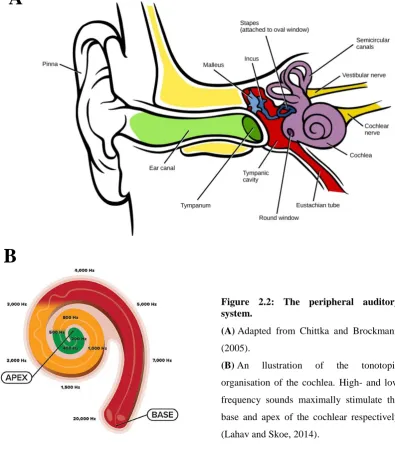
Sound waves arrive at the outer ear, propagate through the ear canal, and hit the tympanic
membrane (i.e., ear drum), causing it to vibrate. This thin and conical component marks
11
ossicles (malleus, incus, and stapes). Because of this structure, vibrations of the tympanic
membrane propagate through the middle ear and reach the inner ear, which represents a
direct interface with the nervous system (Figure 2.2A). These vibrations reach the
cochlea, a small coiled cavity with tonotopic organisation (frequency-to-place mapping),
which performs frequency analysis of the incoming sound wave by splitting it up into
multiple frequency-bands (Yang et al., 1992).
The section cochlea contains tiny mechanosensory cells, known as hair cells. The
vibration that reaches the cochlea induces the movement to these hair cells, which are
connected to spiral ganglion neurons from the auditory nerve. Therefore, that movement
of hair cells is transformed into electrical signals which, on a broader picture, allows for
the transformation of an incoming sound wave into electrical signals.
A
B
Figure 2.2: The peripheral auditory system.
(A) Adapted from Chittka and Brockmann (2005).
[image:27.595.124.520.313.765.2]12
The tonotopy of the cochlea constitutes the first stage of sound processing, which results
in the filtering of the auditory signal into logarithmically spaced frequency bands (Figure
2.2B). This tonotopic structure is then preserved through the central auditory system and
primary auditory cortex.
Central auditory system
The structures that transport and process auditory information to the human cortex after
its transformation into electrical signals are collectively called the central auditory
system. The inner ear communicates with the central auditory system via the auditory
nerve. The cochlear nucleus (CN) is a structure situated in the brainstem that extracts
information on the firing rate of the auditory nerve fibres and performs nonlinear spectral
and spatial analysis (Purves et al., 2008). Auditory information is then transferred
laterally to the superior olivary complex (SOC) where, for the first time, information from
both ears converge and binaural cues can be derived. As a result, sound localisation in the
azimuthal plane (left vs right) can be performed at this stage.
The following stage of the auditory pathway is the inferior colliculus (IC), which is
considered to be involved in, among the other things, the integration and routing of
multi-modal sensory perception and in the processing of amplitude modulation features crucial
for pitch detection (Joris et al., 2004). Furthermore, it is thought to play a central role in
the extraction of sound features that are critical for sound perception (Ehret and Romand,
1997). Finally, the signals propagate through the medial geniculate nucleus (MGN) of the
thalamus, which connects IC and the primary auditory cortex. Please refer to the books
by Schnupp et al. (2011) and by Clark (2006) for further reading on the structures of the
auditory system described above.
Auditory cortex
The signal processed in MGN is transmitted to the auditory cortex, an area located
bilaterally on the supratemporal plane that comprises the superior two-thirds of the
superior temporal gyrus (STG) (Celesia, 1976; Galaburda and Sanides, 1980; Rivier and
Clarke, 1997). To date, because of both technical and neuroscientific limitations, there is
no dominant anatomical parcellation scheme of human auditory cortical areas that is
generally accepted and routinely used across laboratories (Moerel et al., 2014). Similar to
the monkey (which can be studied in more detail with invasive studies), the human
13
auditory areas that receive ascending signals from the thalamus, and is surrounded by
non-primary regions named belt and parabelt (Hackett et al., 1998; Morosan et al., 2001).
However, at the finer level of area definition, there is large variability among the various
reports. For this reason, the following analysis is limited to a macroscopic scale.
In the anterior to posterior direction, the human auditory cortex can be divided into
three regions (Kim et al., 2000): Planum polare (PP), transverse temporal gyrus or
Heschl’s gyrus (HG), and planum temporale (PT). HG, which is hidden in the depth of
the Sylvian fissure (SF), is thought to be evolutionary new as it was found only in a subset
of chimpanzee brains (Hackett et al., 2001), but not in the macaque monkey (however,
see Baumann et al., 2013). Interpretations vary for a placement of the human auditory
core along HG, across HG, and everything in between (Baumann et al., 2013). Despite
this debate, it is commonly agreed that the core is located in a tonotopic area of the
auditory cortex with frequency selectivity organised in a high-low-high gradient
(Baumann et al., 2013; Saenz and Langers, 2014). Please refer to Moerel, De Martino,
and Formisano (2014) for a more in-depth discussion on the structures and functions of
the human auditory cortex.
The brain network responsible for the processing of complex sounds, such as
speech, involves areas beyond the STG. In particular, other cortical sites of interest are
placed in superior temporal sulcus (STS), middle temporal gyrus (MTG), and inferior
temporal sulcus (ITS), and extend to areas of other cortical lobes, such as the inferior
frontal gyrus (IFG). The following section describes the current views on the functional
structure, roles, and interactions within such a network.
2.1.2
Hierarchical organisation of the auditory system in the human cortex
The neural organisation of speech perception in the human cortex has been surprisingly
difficult to characterise, even in gross anatomical terms (Hickok and Poeppel, 2007). The
hypotheses on this topic before the introduction of modern neuroimaging techniques were
mainly based on observations of patients with speech disorders due to lesions in parts of
the cortex. For instance, patients with speech comprehension disorders were typically
affected by lesions in the left superior temporal gyrus (STG) (Hickok and Small, 2015).
Therefore, this area was thought to be critical for speech perception. However, later
14
not in speech comprehension, which confirmed that multiple regions participate in the
[image:30.595.72.493.130.475.2]speech comprehension process (Damasio and Damasio, 1980).
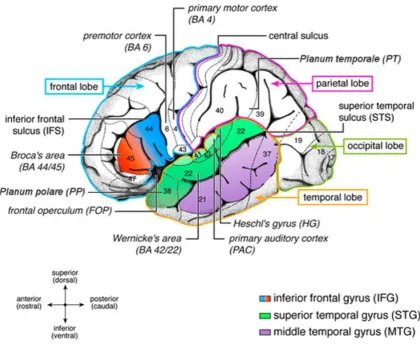
Figure 2.3: Anatomical details of the auditory processing network in the human cortex.
Original illustration from Friederici (2011). The different lobes (frontal, temporal, parietal, occipital) are marked by coloured borders. Major speech language relevant gyri (IFG, STG, MTG) are colour coded. Numbers indicate language relevant Brodmann Areas (BA; Brodmann, 1909). Broca’s area consists of the
pars opercularis (BA 44) and the pars triangularis (BA 45). The premotor cortex is located in BA 6.
Wernicke’s area is defined as BA 42 and BA 22. The primary auditory cortex (PAC) and Heschl’s gyrus (HG) are located in a lateral to medial orientation.
Modern neuroimaging technologies such as magnetic resonance imaging (MRI),
fMRI, EEG, MEG, and ECoG have been shown to be valuable tools for the investigation
of speech processing. Recent work with these methods provided further insights into this
phenomenon and revealed speech perception as a complex process that involves both left
and right hemispheres and that is not limited to the temporal areas of the cortex (Figure
2.3) (Hagoort, 2005; Shalom and Poeppel, 2008; Friederici, 2011; Friederici, 2012;
Hickok and Small, 2015). Furthermore, the interaction between speech comprehension
and speech production, which involves also parietal regions of the cortex, was shown to
15
A growing body of literature supports the hypothesis that speech perception is
underpinned by a hierarchical system which processes features of speech at progressively
higher levels of abstraction, from purely acoustic features of the speech sound to
categorical units of speech (phonemes and syllables), words, and semantics (Hickok and
Poeppel, 2004; Okada et al., 2010). However, there remains considerable controversy as
to whether this analytic process proceeds strictly “left-to-right” in a feedforward manner,
from smaller units (e.g., phonemes) to larger units (e.g., syllables; Chait et al., 2015). A
growing body of research indicates that the human cortex is characterised by a massive
amount of anatomical feedback versus feedforward connections (Gazzaniga, 2009).
Although this seems to suggest a crucial role of top-down modulation in speech
processing, the precise role of feedback is still hotly debated and will be discussed more
fully in the next section.
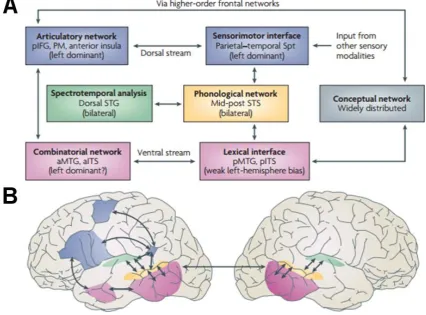
Among the several models proposed to explain the cortical organisation of speech
processing (e.g., Hickok and Poeppel, 2007; see Figure 2.4), some agreement is found in
the hypothesis that there exists specialisation at the sound-word interface. In this sense,
lower-level areas are the ones involved in the processing of the raw sound signal and the
extraction of acoustical patterns from a speech sound, while higher-level areas are
specialised in the processing of speech at the phonological, morphological, syntactical
and lexical stages. One prominent model of the speech comprehension network was
suggested by Hickok and Poeppel (2007), which macroscopically localised
spectro-temporal analysis in dorsal STG and phonological level analysis in mid-posterior STS.
Subsequently, this model suggests a divergence of this network into a ventral stream,
which is involved in extracting and processing lexical components of speech and localises
in MTG and ITS, and a dorsal stream, which maps speech onto articulatory motor
representations (area Sylvian parietal temporal, between parietal and temporal lobes) and
to more abstract and linguistic decision processes (IFG).
The cortical processing of speech has historically been attributed to the left or
‘dominant’ hemisphere. Although this is still hotly debated, recent research shed some
light on this issue by supporting the conjecture that temporal processing at different
timescales is associated with hemispherically asymmetric activation (Boemio et al., 2005;
Jamison et al., 2006; Giraud et al., 2007; Obleser et al., 2008; Telkemeyer et al., 2009;
Morillon et al., 2010; Giraud and Poeppel, 2012). One view proposes that right and left
auditory areas are primarily suited to processing spectral and temporal changes
16
2003; Schonwiesner et al., 2005). Higher order areas such as STS have been suggested to
exhibit a right hemispheric bias during the processing of sounds at the syllabic rate
(200-300 ms; Boemio et al., 2005), whereas faster rates (25-50 ms) are thought to induce left
lateralised responses (Poeppel, 2003; Zatorre and Salimpoor, 2013). In the context of
speech, the emerging consensus is that cortical processing becomes progressively more
left lateralised as signals become more speech-like, suggesting that laterality effects are
more driven by higher order linguistic processing demands than by speech analysis per
se (Binder et al., 2000; McGettigan et al., 2012; Peelle, 2012; Cogan et al., 2014; Overath
[image:32.595.68.495.276.591.2]et al., 2015).
Figure 2.4: The dual-stream model of the functional anatomy of language.
17
2.1.3
Phoneme-level processing in human auditory cortex
Speech perception is the process that allows vocal communication and it consists of the
transformation of a speech sound into its underlying meaning. An essential characteristic
of this process is its robustness. In fact, it remains effective despite considerable natural
variability across speakers and distortions in noisy and reverberant environments.
Consequently, there is reason to believe that linguistic analysis cannot proceed directly
from the sound waveform itself, but requires a processing stage that maps the variable
speech sounds into invariant representations of speech units, such as phonemes and
syllables (Liberman et al., 1967; Mesgarani et al., 2008; Overath et al., 2015).
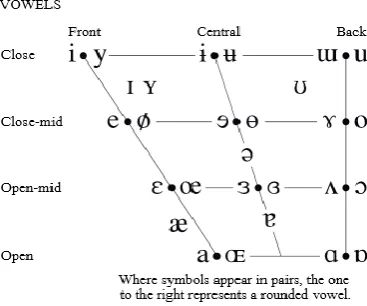
In the field of linguistics, speech can be represented as a set of categorical
phonological features that describe how a sound is articulated by humans (Chomsky and
Halle, 1968; Jakobson et al., 1969). These features include properties of consonants, such
as place of articulation (i.e., the location in the mouth where the constriction and
obstruction of air occurs), manner of articulation (i.e., configuration and interaction of
speech organs, such as tongue, lips, and palate), and glottal state of sounds (e.g., vibration,
aspiration), as well as properties of vowels (e.g., back, high, and rounded vowels). Such
properties can provide a “universal” feature set, i.e., language independent. Another way
to represent speech is through a language-specific set of phonemes. Importantly, each
phoneme maps to a unique configuration of phonetic features (Table 2.1).
Studies on small mammals showed that primary auditory areas encode
spectro-temporal patterns that can discriminate features of speech such as the manner of
articulation and voicing (Mesgarani et al., 2008), suggesting that humans and animals
may build upon similar general acoustical structures to recognise and discriminate
sounds. Crucially, there is evidence of the categorical encoding of such phonetic features
in the STG, which may constitute a crucial step in the processing of a stimulus as speech
rather than any other sound (Mesgarani et al., 2014; Leonard et al., 2016). The
identification of categorical phonetic features allows for phoneme detection and, although
it is unclear whether phonemes are explicitly encoded in the human cortex or by means
of its constituent features, the processing leading to their categorical identification
engages an extended cortical network that reaches from the auditory cortex to frontal and
parietal regions (Scott and Johnsrude, 2003; Liebenthal et al., 2005; Turkeltaub and
18
As expected by a hierarchical system, higher-level cortical areas in humans have
been shown to be progressively more sensitive to more abstract features of speech and
less susceptible to acoustic variation (DeWitt and Rauschecker, 2012; Overath et al.,
2015). In particular, the region of STS (especially posterior regions) has been shown to
be more sensitive to higher order intelligibility features and less to acoustic variations
compared to auditory core regions (Okada et al., 2010). Also, STS has been suggested to
be a possible area of speech-specific processing and encoding of linguistic features
ranging from single phonemes to pairs of syllables (Hickok and Poeppel, 2007; Overath
et al., 2015). However, there remains considerable uncertainty about its specific roles in
[image:34.595.75.259.501.654.2]the categorical perception and its integration in the speech comprehension network.
Table 2.1: Table of phonemes and phonetic features.
19
2.2
The integration of prior and cross-modal information
in speech processing
Conversational speech is characterised by fast dynamics and large spectro-temporal
variability. Humans can rapidly adapt to different voices and accents, and developed the
remarkable ability to successfully perform speech comprehension despite the challenges
of real world environments, such as noise, speech degradation, and competing speakers.
In this context, there is widespread agreement that the perception does not only depend
on the processing of sensory input, but that it benefits from the integration of information
from different modalities and from prior knowledge. This section provides some insights
on the current theories that explain such mechanisms of integration.
2.2.1
Principal factors contributing to speech perception
The previous section described the auditory system and presented current views on its
functional organisation. In particular, the human cortex has been suggested to be
organised in hierarchical stages that identify and process, from lower- to higher-levels,
progressively more abstract elements of speech (Hickok and Poeppel, 2004; Okada et al.,
2010; Peelle, 2012) (Section 2.1.2). In the simplest scenario, such a system could be
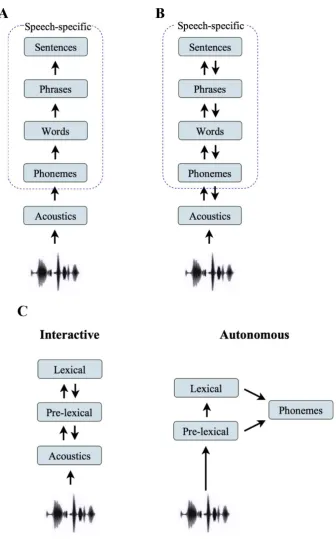
represented as a unidirectional hierarchical network with a bottom-up information flow
reflecting progressively more refined representation of speech extracted purely from
sensory information (Figure 2.5A). This serial process would elicit cortical responses
with precise temporal order, thus facilitating the isolation of neural indices at specific
hierarchical levels along the time dimension. Although this pattern of cortical activation
can be observed in response to simple isolated speech sounds (Salmelin, 2007), this basic
model cannot account for several fundamental mechanisms required for natural speech
comprehension, and thus it is not a good representation of our auditory system. For
instance, lexically ambiguous words have multiple meanings, and the selection of the
intended one may require prior knowledge or even information that has yet to be heard
(Mason and Just, 2007). In the latter case, the listener (or reader) would have to wait for
the following part of the speech to resolve such ambiguity, as is the case with the word
ball in the following sentence:
This time the ball was moved outside
20 Figure 2.5: Schematic representations of information flow in models of speech perception.
21
Similarly, the influence of semantic context on phonemic perception was studied in
the context of phonemic ambiguity (Ganong effect, Ganong, 1980) and also when
selected phonemes were replaced by a cough or noise (phonemic restoration effect,
Warren, 1970). Studies based on these effects found that perception of the ambiguous
segments is biased towards word sounds (rather than non-word ones) and toward words
consistent with the prior semantic context (Connine and Clifton, 1987; Pitt and Samuel,
1993). These are examples of why the acoustic-phonetic encoding cannot be understood
solely in terms of the mapping between an acoustic (or gestural) event and a phonetic
percept. In this context, the most influential models of speech processing vary in the way
that they incorporate sensory input with other sources of information, which is a crucial
ability given that speech is usually heard under less-than-optimal listening conditions.
Speech comprehension benefits from various linguistic and acoustic properties that
involve some types of past experience, for example about speaker, specific language,
accent, listening conditions, or the semantic context. Past experience may come in the
form of accurate prior knowledge or expectation, which provide sudden and dramatic
changes in subjective perception (Ludmer et al., 2011; Sohoglu and Davis, 2016). For
instance, strong perceptual enhancement of heavily distorted speech occurs when the
listener has prior knowledge of the content, either exact words or semantic context
(perceptual pop-out effect). Alternatively, past experience could entail a more gradual
and incremental perceptual learning of regularities of the language, acoustic noise, or
degradation over a timescale of minutes or longer (Sohoglu and Davis, 2016). For
example, perception of speech that was degraded using noise-vocoding was shown to
improve with experience (Goldstone, 1998; Ahissar and Hochstein, 2004; Davis et al.,
2005). Although both perceptual learning and perceptual pop-out are based on prior
experience, their very different effects may suggest that they originate from different
brain mechanisms (Rubin et al., 1997; Norris et al., 2003). In particular, perceptual
learning was linked to offline synaptic changes in low-level sensory processing, while
prior knowledge and expectation were suggested to influence perception through activity
at hierarchically late stages of processing.
One view of speech comprehension proposed autonomous models of speech that
attribute most lexical effects to post-perceptual decisions and do not require feedback
connections (Massaro, 1989; Norris et al., 2000). One model in particular, the Merge
model, suggests the processing of phonemic codes and lexical analysis through two