Sequence-to-Sequence Learning
as Beam-Search Optimization
Sam Wiseman and Alexander M. Rush School of Engineering and Applied Sciences
Harvard University Cambridge, MA, USA
{swiseman,srush}@seas.harvard.edu
Abstract
Sequence-to-Sequence (seq2seq) modeling has rapidly become an important general-purpose NLP tool that has proven effective for many text-generation and sequence-labeling tasks. Seq2seq builds on deep neural language modeling and inherits its remarkable accuracy in estimating local, next-word distributions. In this work, we introduce a model and beam-search training scheme, based on the work of Daum´e III and Marcu (2005), that extends seq2seq to learn global sequence scores. This structured approach avoids classical biases as-sociated with local training and unifies the training loss with the test-time usage, while preserving the proven model architecture of seq2seq and its efficient training approach. We show that our system outperforms a highly-optimized attention-based seq2seq system and other baselines on three different sequence to sequence tasks: word ordering, parsing, and machine translation.
1 Introduction
Sequence-to-Sequence learning with deep neural networks (herein, seq2seq) (Sutskever et al., 2011; Sutskever et al., 2014) has rapidly become a very useful and surprisingly general-purpose tool for nat-ural language processing. In addition to demon-strating impressive results for machine translation (Bahdanau et al., 2015), roughly the same model and training have also proven to be useful for sen-tence compression (Filippova et al., 2015), parsing (Vinyals et al., 2015), and dialogue systems (Ser-ban et al., 2016), and they additionally underlie other
text generation applications, such as image or video captioning (Venugopalan et al., 2015; Xu et al., 2015).
The dominant approach to training a seq2seq sys-tem is as a conditional language model, with training maximizing the likelihood of each successive tar-get word conditioned on the input sequence and the
gold history of target words. Thus, training uses a strictly word-level loss, usually cross-entropy over the target vocabulary. This approach has proven to be very effective and efficient for training neural lan-guage models, and seq2seq models similarly obtain impressive perplexities for word-generation tasks.
Notably, however, seq2seq models are not used as conditional language models at test-time; they must instead generate fully-formed word sequences. In practice, generation is accomplished by searching over output sequences greedily or with beam search. In this context, Ranzato et al. (2016) note that the combination of the training and generation scheme just described leads to at least two major issues:
1. Exposure Bias: the model is never exposed to its own errors during training, and so the in-ferred histories at test-time do not resemble the gold training histories.
2. Loss-Evaluation Mismatch: training uses a word-level loss, while at test-time we target improving sequence-level evaluation metrics, such as BLEU (Papineni et al., 2002).
We might additionally add the concern of label bias (Lafferty et al., 2001) to the list, since word-probabilities at each time-step are locally normal-ized, guaranteeing that successors of incorrect
tories receive the same mass as do the successors of the true history.
In this work we develop a non-probabilistic vari-ant of the seq2seq model that can assign a score to any possible target sequence, and we propose a training procedure, inspired by the learning as search optimization (LaSO) framework of Daum´e III and Marcu (2005), that defines a loss function in terms of errors made during beam search. Fur-thermore, we provide an efficient algorithm to back-propagate through the beam-search procedure dur-ing seq2seq traindur-ing.
This approach offers a possible solution to each of the three aforementioned issues, while largely maintaining the model architecture and training ef-ficiency of standard seq2seq learning. Moreover, by scoring sequences rather than words, our ap-proach also allows for enforcing hard-constraints on sequence generationat training time. To test out the effectiveness of the proposed approach, we develop a general-purpose seq2seq system with beam search optimization. We run experiments on three very dif-ferent problems: word ordering, syntactic parsing, and machine translation, and compare to a highly-tuned seq2seq system with attention (Luong et al., 2015). The version with beam search optimization shows significant improvements on all three tasks, and particular improvements on tasks that require difficult search.
2 Related Work
The issues of exposure bias and label bias have re-ceived much attention from authors in the structured prediction community, and we briefly review some of this work here. One prominent approach to com-bating exposure bias is that of SEARN (Daum´e III et al., 2009), a meta-training algorithm that learns a search policy in the form of a cost-sensitive classifier trained on examples generated from an interpolation of an oracle policy and the model’s current (learned) policy. Thus, SEARN explicitly targets the mis-match between oracular training and non-oracular (often greedy) test-time inference by training on the output of the model’s own policy. DAgger (Ross et al., 2011) is a similar approach, which differs in terms of how training examples are generated and aggregated, and there have additionally been
impor-tant refinements to this style of training over the past several years (Chang et al., 2015). When it comes to training RNNs, SEARN/DAgger has been applied under the name “scheduled sampling” (Bengio et al., 2015), which involves training an RNN to generate thet+ 1’st token in a target sequence after consum-ing either the truet’th token, or, with probability that increases throughout training, the predictedt’th to-ken.
Though technically possible, it is uncom-mon to use beam search when training with SEARN/DAgger. The early-update (Collins and Roark, 2004) and LaSO (Daum´e III and Marcu, 2005) training strategies, however, explicitly ac-count for beam search, and describe strategies for updating parameters when the gold structure be-comes unreachable during search. Early update and LaSO differ primarily in that the former discards a training example after the first search error, whereas LaSO resumes searching after an error from a state that includes the gold partial structure. In the con-text of feed-forward neural network training, early update training has been recently explored in a feed-forward setting by Zhou et al. (2015) and Andor et al. (2016). Our work differs in that we adopt a LaSO-like paradigm (with some minor modifica-tions), and apply it to the training of seq2seq RNNs (rather than feed-forward networks). We also note that Watanabe and Sumita (2015) apply maximum-violation training (Huang et al., 2012), which is sim-ilar to early-update, to a parsing model with recur-rent components, and that Yazdani and Henderson (2015) use beam-search in training a discriminative, locally normalized dependency parser with recurrent components.
sampling) to address the issues of exposure bias and loss-evaluation mismatch for seq2seq MT, and show impressive performance gains.
Whereas exposure bias results from training in a certain way, label bias results from properties of the model itself. In particular, label bias is likely to affect structured models that make sub-structure predictions using locally-normalized scores. Be-cause the neural and non-neural literature on this point has recently been reviewed by Andor et al. (2016), we simply note here that RNN models are typically locally normalized, and we are unaware of any specifically seq2seq work with RNNs that does
not use locally-normalized scores. The model we introduce here, however, is not locally normalized, and so should not suffer from label bias. We also note that there are some (non-seq2seq) exceptions to the trend of locally normalized RNNs, such as the work of Sak et al. (2014) and Voigtlaender et al. (2015), who train LSTMs in the context of HMMs for speech recognition using sequence-level objec-tives; their work does not consider search, however.
3 Background and Notation
In the simplest seq2seq scenario, we are given a col-lection of source-target sequence pairs and tasked with learning to generate target sequences from source sequences. For instance, we might view ma-chine translation in this way, where in particular we attempt to generate English sentences from (corre-sponding) French sentences. Seq2seq models are part of the broader class of “encoder-decoder” mod-els (Cho et al., 2014), which first use an encoding model to transform a source object into an encoded representation x. Many different sequential (and non-sequential) encoders have proven to be effec-tive for different source domains. In this work we are agnostic to the form of the encoding model, and simply assume an abstract source representationx.
Once the input sequence is encoded, seq2seq models generate a target sequence using adecoder. The decoder is tasked with generating a target se-quence of words from a target vocabulary V. In
particular, words are generated sequentially by con-ditioning on the input representation xand on the previously generated words orhistory. We use the notationw1:T to refer to an arbitrary word sequence
of lengthT, and the notationy1:T to refer to thegold
(i.e., correct) target word sequence for an inputx. Most seq2seq systems utilize a recurrent neural network (RNN) for the decoder model. Formally, a recurrent neural network is a parameterized non-linear function RNN that recursively maps a se-quence of vectors to a sese-quence of hidden states. Let m1, . . . ,mT be a sequence ofT vectors, and leth0
be some initial state vector. Applying an RNN to any such sequence yields hidden states ht at each
time-stept, as follows:
ht←RNN(mt,ht−1;θ),
whereθ is the set of model parameters, which are shared over time. In this work, the vectors mt
will always correspond to the embeddings of a tar-get word sequencew1:T, and so we will also write
ht ← RNN(wt,ht−1;θ), withwtstanding in for
its embedding.
RNN decoders are typically trained to act as con-ditional language models. That is, one attempts to model the probability of the t’th target word con-ditioned on x and the target history by stipulating thatp(wt|w1:t−1,x) =g(wt,ht−1,x), for some
pa-rameterized function g typically computed with an affine layer followed by a softmax. In computing these probabilities, the stateht−1represents the
tar-get history, andh0 is typically set to be some
func-tion ofx. The complete model (including encoder) is trained, analogously to a neural language model, to minimize the cross-entropy loss at each time-step while conditioning on the gold history in the train-ing data. That is, the model is trained to minimize
−lnQTt=1p(yt|y1:t−1,x).
Once the decoder is trained, discrete se-quence generation can be performed by approx-imately maximizing the probability of the tar-get sequence under the conditional distribution, ˆ
y1:T= argbeamw1:T QT
t=1p(wt|w1:t−1,x), where
is-sues of exposure bias and label bias, which moti-vates the work of this paper.
4 Beam Search Optimization
We begin by making one small change to the seq2seq modeling framework. Instead of predicting the probability of the next word, we instead learn to produce (non-probabilistic) scores for ranking se-quences. Define the score of a sequence consisting of history w1:t−1 followed by a single word wt as f(wt,ht−1,x), wheref is a parameterized function
examining the current hidden-state of the relevant RNN at timet−1 as well as the input representa-tion x. In experiments, ourf will have an identi-cal form togbutwithoutthe final softmax transfor-mation (which transforms unnormalized scores into probabilities), thereby allowing the model to avoid issues associated with the label bias problem.
More importantly, we also modify how this model is trained. Ideally we would train by comparing the gold sequence to the highest-scoring complete sequence. However, because finding the argmax sequence according to this model is intractable, we propose to adopt a LaSO-like (Daum´e III and Marcu, 2005) scheme to train, which we will re-fer to as beam search optimization (BSO). In par-ticular, we define a loss that penalizes the gold se-quence falling off the beam during training.1 The proposed training approach is a simple way to ex-pose the model to incorrect histories and to match the training procedure to test generation. Further-more we show that it can be implemented efficiently without changing the asymptotic run-time of train-ing, beyond a factor of the beam sizeK.
4.1 Search-Based Loss
We now formalize this notion of a search-based loss for RNN training. Assume we have a set St ofK
candidate sequences of lengtht. We can calculate a score for each sequence inStusing a scoring
func-tionfparameterized with an RNN, as above, and we define the sequenceyˆ1:(Kt)∈Stto be theK’th ranked
1Using a non-probabilistic model further allows us to incur no loss (and thus require no update to parameters) when the gold sequenceison the beam; this contrasts with models based on a CRF loss, such as those of Andor et al. (2016) and Zhou et al. (2015), though in training those models are simply not updated when the gold sequence remains on the beam.
sequence in St according to f. That is, assuming
distinct scores,
|{yˆ(k)1:t∈St|f(ˆy(k)t ,hˆ (k)
t−1)> f(ˆy (K) t ,hˆ
(K)
t−1)}|=K−1,
whereyˆ(tk)is thet’th token inyˆ1:(kt),hˆ(tk−)1is the RNN state corresponding to itst−1’st step, and where we have omitted thexargument tof for brevity.
We now define a loss function that gives loss each time the score of the gold prefixy1:tdoes not exceed
that ofyˆ1:(Kt)by a margin:
L(f) =
T X
t=1
∆(ˆy1:(Kt))h1−f(yt,ht−1) +f(ˆy(tK),hˆ
(K)
t−1)
i .
Above, the∆(ˆy(1:Kt))term denotes a mistake-specific cost-function, which allows us to scale the loss de-pending on the severity of erroneously predicting ˆ
y(1:Kt); it is assumed to return 0 when the margin re-quirement is satisfied, and a positive number other-wise. It is this term that allows us to use sequence-rather than word-level costs in training (addressing the 2nd issue in the introduction). For instance, when training a seq2seq model for machine trans-lation, it may be desirable to have∆(ˆy(1:Kt)) be in-versely related to the partial sentence-level BLEU score ofyˆ1:(Kt) with y1:t; we experiment along these
lines in Section 5.3.
Finally, because we want the full gold sequence to be at the top of the beam at the end of search, when t=Twe modify the loss to require the score ofy1:T
to exceed the score of thehighest ranked incorrect prediction by a margin.
We can optimize the lossLusing a two-step
pro-cess: (1) in a forward pass, we compute candidate setsStand record margin violations (sequences with
non-zero loss); (2) in a backward pass, we back-propagate the errors through the seq2seq RNNs. Un-like standard seq2seq training, the first-step requires running search (in our case beam search) to find margin violations. The second step can be done by adapting back-propagation through time (BPTT). We next discuss the details of this process.
4.2 Forward: Find Violations
at each time step t so that we find margin viola-tions. We follow LaSO (rather than early-update2; see Section 2) and build candidates in a recursive manner. If there was no margin violation at t−1, thenStis constructed using a standard beam search
update. If there was a margin violation, St is
con-structed as theK best sequences assuming the gold historyy1:t−1through time-stept−1.
Formally, assume the function succ maps a se-quence w1:t−1∈ Vt−1 to the set of all valid
se-quences of lengthtthat can be formed by appending to it a valid word w∈ V. In the simplest, uncon-strained case, we will have
succ(w1:t−1) ={w1:t−1, w|w∈ V}.
As an important aside, note that for some prob-lems it may be preferable to define a succ func-tion which imposes hard constraints on successor sequences. For instance, if we would like to use seq2seq models for parsing (by emitting a con-stituency or dependency structure encoded into a se-quence in some way), we will have hard constraints on the sequences the model can output, namely, that they represent valid parses. While hard constraints such as these would be difficult to add to standard seq2seq at training time, in our framework they can naturally be added to thesuccfunction, allowing us totrainwith hard constraints; we experiment along these lines in Section 5.3, where we refer to a model trained with constrained beam search as ConBSO.
Having defined an appropriatesuccfunction, we specify the candidate set as:
St= topK (
succ(y1:t−1) violation att−1
SK
k=1succ(ˆy (k)
1:t−1) otherwise,
where we have a margin violation at t−1 iff f(yt−1,ht−2) < f(ˆyt(−K1),hˆ
(K)
t−2) + 1, and where
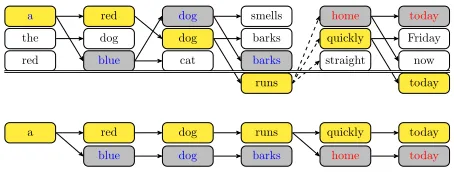
topK considers the scores given byf. This search procedure is illustrated in the top portion of Figure 1. In the forward pass of our training algorithm, shown as the first part of Algorithm 1, we run this version of beam search and collect all sequences and their hidden states that lead to losses.
2We found that training with early-update rather than (de-layed) LaSO did not work well, even after pre-training. Given the success of early-update in many NLP tasks this was some-what surprising. We leave this question to future work.
a red dog smells home today
the dog dog barks quickly Friday
red blue cat barks straight now
runs today
a red dog runs quickly today
[image:5.612.313.540.57.143.2]blue dog barks home today
Figure 1: Top: possible yˆ(k)1:t formed in training with a beam of size K= 3 and with gold sequence y1:6 = “a
red dog runs quickly today”. The gold sequence is high-lighted in yellow, and the predicted prefixes involved in margin violations (att= 4andt= 6) are in gray. Note that time-stepT= 6uses a different loss criterion. Bot-tom: prefixes that actually participate in the loss, ar-ranged to illustrate the back-propagation process.
4.3 Backward: Merge Sequences
Once we have collected margin violations we can run backpropagation to compute parameter updates. Assume a margin violation occurs at time-stept be-tween the predicted history yˆ(1:Kt) and the gold his-tory y1:t. As in standard seq2seq training we must
back-propagate this error through the gold history; however, unlike seq2seq we also have a gradient for the wrongly predicted history.
Recall that to back-propagate errors through an RNN we run a recursive backward procedure — denoted below by BRNN — at each time-step t, which accumulates the gradients of next-step and fu-ture losses with respect toht. We have:
∇htL ←BRNN(∇htLt+1,∇ht+1L),
where Lt+1 is the loss at step t+ 1, deriving, for
instance, from the scoref(yt+1,ht). Running this
BRNNprocedure fromt=T−1tot= 0is known as back-propagation through time (BPTT).
In determining the total computational cost of back-propagation here, first note that in the worst case there is one violation at each time-step, which leads toT independent, incorrect sequences. Since we need to call BRNN O(T) times for each se-quence, a naive strategy of running BPTT for each incorrect sequence would lead to an O(T2) back-ward pass, rather than the O(T) time required for the standard seq2seq approach.
Fortunately, our combination of search-strategy and loss make it possible to efficiently share
naturally from the LaSO update, which resets the beam in a convenient way.
We informally illustrate the process in Figure 1. The top of the diagram shows a possible sequence ofyˆ(1:kt) formed during search with a beam of size 3 for the target sequencey =“a red dog runs quickly today.” When the gold sequence falls off the beam att= 4, search resumes withS5= succ(y1:4), and
so all subsequent predicted sequences havey1:4as a
prefix and are thus functions ofh4. Moreover,
be-cause our loss function only involves the scores of the gold prefix and the violating prefix, we end up with the relatively simple computation tree shown at the bottom of Figure 1. It is evident that we can backpropagate in a single pass, accumulating gradi-ents from sequences that diverge from the gold at the time-step that precedes their divergence. The second half of Algorithm 1 shows this explicitly for a single sequence, though it is straightforward to extend the algorithm to operate in batch.3
5 Data and Methods
We run experiments on three different tasks, com-paring our approach to the seq2seq baseline, and to other relevant baselines.
5.1 Model
While the method we describe applies to seq2seq RNNs in general, for all experiments we use the global attention model of Luong et al. (2015) — which consists of an LSTM (Hochreiter and Schmidhuber, 1997) encoder and an LSTM decoder with a global attention model — as both the base-line seq2seq model (i.e., as the model that computes theg in Section 3) and as the model that computes our sequence-scores f(wt,ht−1,x). As in Luong
et al. (2015), we also use “input feeding,” which involves feeding the attention distribution from the previous time-step into the decoder at the current step. This model architecture has been found to be highly performant for neural machine translation and other seq2seq tasks.
3We also note that because we do not update the parameters until after theT’th search step, our training procedure differs slightly from LaSO (which is online), and in this aspect is essen-tially equivalent to the “delayed LaSO update” of Bj¨orkelund and Kuhn (2014).
Algorithm 1 Seq2seq Beam-Search Optimization 1: procedureBSO(x, Ktr,succ)
2: /*FORWARD*/
3: Init empty storageyˆ1:T andhˆ1:T; initS1
4: r←0;violations← {0}
5: fort= 1, . . . , T do
6: K=Ktrift6=Telse arg max
k:ˆy1:(kt)6=y1:t
f(ˆy(tk),hˆ(tk−)1)
7: iff(yt,ht−1)< f(ˆyt(K),hˆ (K)
t−1) + 1then
8: hˆr:t−1←hˆ(K)
r:t−1
9: yˆr+1:t←yˆr+1:t(K)
10: Addttoviolations
11: r←t
12: St+1←topK(succ(y1:t))
13: else
14: St+1←topK(SKk=1succ(ˆy (k) 1:t))
15: /*BACKWARD*/
16: gradhT ←0;gradhbT ←0
17: fort=T −1, . . . ,1do
18: gradht←BRNN(∇htLt+1, gradht+1)
19: gradhbt←BRNN(∇hbtLt+1, gradhbt+1)
20: ift−1∈violationsthen
21: gradht←gradht+gradhbt
22: gradhbt←0
To distinguish the models we refer to our system as BSO (beam search optimization) and to the base-line as seq2seq. When we apply constrained training (as discussed in Section 4.2), we refer to the model as ConBSO. In providing results we also distinguish between the beam size Ktr with which the model
is trained, and the beam sizeKte which is used at
test-time. In general, if we plan on evaluating with a beam of sizeKteit makes sense to train with a beam
of sizeKtr = Kte+ 1, since our objective requires
the gold sequence to be scored higher than thelast
sequence on the beam.
5.2 Methodology
Here we detail additional techniques we found nec-essary to ensure the model learned effectively. First, we found that the model failed to learn when trained from a random initialization.4 We therefore found it necessary to pre-train the model using a standard, word-level cross-entropy loss as described in
tion 3. The necessity of pre-training in this instance is consistent with the findings of other authors who train non-local neural models (Kingsbury, 2009; Sak et al., 2014; Andor et al., 2016; Ranzato et al., 2016).5
Similarly, it is clear that the smaller the beam used in training is, the less room the model has to make erroneous predictions without running afoul of the margin loss. Accordingly, we also found it use-ful to use a “curriculum beam” strategy in training, whereby the size of the beam is increased gradually during training. In particular, given a desired train-ing beam sizeKtr, we began training with a beam
of size 2, and increased it by 1 every 2 epochs until reachingKtr.
Finally, it has been established thatdropout (Sri-vastava et al., 2014) regularization improves the per-formance of LSTMs (Pham et al., 2014; Zaremba et al., 2014), and in our experiments we run beam search under dropout.6
For all experiments, we trained both seq2seq and BSO models with mini-batch Adagrad (Duchi et al., 2011) (using batches of size 64), and we renormal-ized all gradients so they did not exceed 5 before updating parameters. We did not extensively tune learning-rates, but we found initial rates of 0.02 for the encoder and decoder LSTMs, and a rate of 0.1 or 0.2 for the final linear layer (i.e., the layer tasked with making word-predictions at each time-step) to work well across all the tasks we consid-ered. Code implementing the experiments described below can be found at https://github.com/ harvardnlp/BSO.7
5.3 Tasks and Results
Our experiments are primarily intended to evaluate the effectiveness of beam search optimization over standard seq2seq training. As such, we run exper-iments with the same model across three very dif-5Andor et al. (2016) found, however, that pre-training only increased convergence-speed, but was not necessary for obtain-ing good results.
6However, it is important to ensure that the same mask ap-plied at each time-step of the forward search is also apap-plied at the corresponding step of the backward pass. We accomplish this by pre-computing masks for each time-step, and sharing them between the partial sequence LSTMs.
7Our code is based on Yoon Kim’s seq2seq code,https:
//github.com/harvardnlp/seq2seq-attn.
ferent problems: word ordering, dependency pars-ing, and machine translation. While we do not in-clude all the features and extensions necessary to reach state-of-the-art performance, even the baseline seq2seq model is generally quite performant.
Word Ordering The task of correctly ordering the words in a shuffled sentence has recently gained some attention as a way to test the (syntactic) capa-bilities of text-generation systems (Zhang and Clark, 2011; Zhang and Clark, 2015; Liu et al., 2015; Schmaltz et al., 2016). We cast this task as seq2seq problem by viewing a shuffled sentence as a source sentence, and the correctly ordered sentence as the target. While word ordering is a somewhat synthetic task, it has two interesting properties for our pur-poses. First, it is a task which plausibly requires search (due to the exponentially many possible or-derings), and, second, there is a clear hard constraint on output sequences, namely, that they be a permu-tation of the source sequence. For both the baseline and BSO models we enforce this constraint at test-time. However, we also experiment with constrain-ing the BSO model durconstrain-ing trainconstrain-ing, as described in Section 4.2, by defining thesuccfunction to only al-low successor sequences containing un-used words in the source sentence.
For experiments, we use the same PTB dataset (with the standard training, development, and test splits) and evaluation procedure as in Zhang and Clark (2015) and later work, with performance re-ported in terms of BLEU score with the correctly or-dered sentences. For all word-ordering experiments we use 2-layer encoder and decoder LSTMs, each with 256 hidden units, and dropout with a rate of 0.2 between LSTM layers. We use simple 0/1 costs in defining the∆function.
We show our test-set results in Table 1. We see that on this task there is a large improvement at each beam size from switching to BSO, and a further im-provement from using the constrained model.
Inspired by a similar analysis in Daum´e III and Marcu (2005), we further examine the relationship betweenKtr andKte when training with ConBSO
in Table 2. We see that larger Ktr hurt greedy
in-ference, but that results continue to improve, at least initially, when using aKtethat is (somewhat) bigger
Word Ordering (BLEU) Kte= 1 Kte = 5 Kte= 10
seq2seq 25.2 29.8 31.0
BSO 28.0 33.2 34.3
ConBSO 28.6 34.3 34.5
[image:8.612.312.544.59.159.2]LSTM-LM 15.4 - 26.8
Table 1: Word ordering. BLEU Scores of seq2seq, BSO, constrained BSO, and a vanilla LSTM language model (from Schmaltz et al, 2016). All experiments above have
Ktr= 6.
Word Ordering Beam Size (BLEU) Kte= 1 Kte = 5 Kte= 10
Ktr= 2 30.59 31.23 30.26
Ktr= 6 28.20 34.22 34.67
Ktr= 11 26.88 34.42 34.88
seq2seq 26.11 30.20 31.04
Table 2: Beam-size experiments on word ordering devel-opment set. All numbers reflect training with constraints (ConBSO).
Dependency Parsing We next apply our model to dependency parsing, which also has hard con-straints and plausibly benefits from search. We treat dependency parsing with arc-standard transi-tions as a seq2seq task by attempting to map from a source sentence to a target sequence of source sentence words interleaved with the arc-standard, reduce-actions in its parse. For example, we attempt to map the source sentence
But it was the Quotron problems that ...
to the target sequence
But it was @L SBJ @L DEP the Quotron problems @L NMOD @L NMOD that ...
We use the standard Penn Treebank dataset splits with Stanford dependency labels, and the standard UAS/LAS evaluation metric (excluding punctua-tion) following Chen and Manning (2014). All models thus see only the words in the source and, when decoding, the actions it has emitted so far; no other features are used. We use 2-layer encoder and decoder LSTMs with 300 hidden units per layer
Dependency Parsing (UAS/LAS) Kte= 1 Kte= 5 Kte= 10
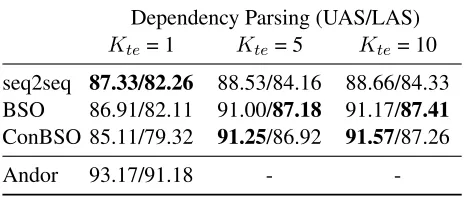
seq2seq 87.33/82.26 88.53/84.16 88.66/84.33 BSO 86.91/82.11 91.00/87.18 91.17/87.41 ConBSO 85.11/79.32 91.25/86.92 91.57/87.26
Andor 93.17/91.18 -
-Table 3: Dependency parsing. UAS/LAS of seq2seq, BSO, ConBSO and baselines on PTB test set. Andor is the current state-of-the-art model for this data set (Andor et al. 2016), and we note that with a beam of size 32 they obtain 94.41/92.55. All experiments above haveKtr= 6.
and dropout with a rate of 0.3 between LSTM lay-ers. We replace singleton words in the training set with an UNK token, normalize digits to a single symbol, and initialize word embeddings for both source and target words from the publicly available word2vec(Mikolov et al., 2013) embeddings. We use simple 0/1 costs in defining the∆function.
As in the word-ordering case, we also experiment with modifying the succ function in order to train under hard constraints, namely, that the emitted tar-get sequence be a valid parse. In particular, we con-strain the output at each time-step to obey the stack constraint, and we ensure words in the source are emitted in order.
We show results on the test-set in Table 3. BSO and ConBSO both show significant improvements over seq2seq, with ConBSO improving most on UAS, and BSO improving most on LAS. We achieve a reasonable final score of 91.57 UAS, which lags behind the state-of-the-art, but is promising for a general-purpose, word-only model.
[image:8.612.81.290.59.156.2]Machine Translation (BLEU) Kte = 1 Kte= 5 Kte= 10
seq2seq 22.53 24.03 23.87
BSO, SB-∆ 23.83 26.36 25.48
XENT 17.74 20.10 20.28
DAD 20.12 22.25 22.40
[image:9.612.81.290.58.168.2]MIXER 20.73 21.81 21.83
Table 4: Machine translation experiments on test set; re-sults below middle line are from MIXER model of Ran-zato et al. (2016). SB-∆indicates sentence BLEU costs are used in defining∆. XENT is similar to our seq2seq model but with a convolutional encoder and simpler at-tention. DAD trains seq2seq with scheduled sampling (Bengio et al., 2015). BSO, SB-∆ experiments above haveKtr= 6.
al. (2016), and like them we also use a single-layer LSTM decoder with 256 units. We also use dropout with a rate of 0.2 between each LSTM layer. We em-phasize, however, that while our decoder LSTM is of the same size as that of Ranzato et al. (2016), our re-sults are not directly comparable, because we use an LSTM encoder (rather than a convolutional encoder as they do), a slightly different attention mechanism, and input feeding (Luong et al., 2015).
For our main MT results, we set ∆(ˆy1:(kt)) to 1−SB(ˆyr(K+1:)t, yr+1:t), where r is the last margin
violation and SBdenotes smoothed, sentence-level BLEU (Chen and Cherry, 2014). This setting of∆ should act to penalize erroneous predictions with a relatively low sentence-level BLEU score more than those with a relatively high sentence-level BLEU score. In Table 4 we show our final results and those from Ranzato et al. (2016).8 While we start with an improved baseline, we see similarly large increases in accuracy as those obtained by DAD and MIXER, in particular whenKte >1.
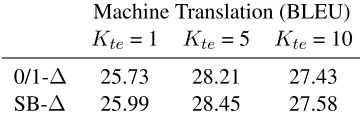
We further investigate the utility of these sequence-level costs in Table 5, which compares us-ing sentence-level BLEU costs in definus-ing ∆with using 0/1 costs. We see that the more sophisti-cated sequence-level costs have a moderate effect on BLEU score.
8Some results from personal communication.
Machine Translation (BLEU) Kte= 1 Kte = 5 Kte= 10
0/1-∆ 25.73 28.21 27.43
SB-∆ 25.99 28.45 27.58
Table 5: BLEU scores obtained on the machine trans-lation development data when training with∆(ˆy(k)1:t) = 1
(top) and∆(ˆy(k)1:t) = 1−SB(ˆy (K)
r+1:t, yr+1:t)(bottom), and
Ktr= 6.
Timing Given Algorithm 1, we would expect training time to increase linearly with the size of the beam. On the above MT task, our highly tuned seq2seq baseline processes an average of 13,038 kens/second (including both source and target to-kens) on a GTX 970 GPU. For beams of size Ktr
= 2, 3, 4, 5, and 6, our implementation processes on average 1,985, 1,768, 1,709, 1,521, and 1,458 to-kens/second, respectively. Thus, we appear to pay an initial constant factor of≈ 3.3due to the more complicated forward and backward passes, and then training scales with the size of the beam. Because we batch beam predictions on a GPU, however, we find that in practice training time scales sub-linearly with the beam-size.
6 Conclusion
We have introduced a variant of seq2seq and an as-sociated beam search training scheme, which ad-dresses exposure bias as well as label bias, and moreover allows for both training with sequence-level cost functions as well as with hard constraints. Future work will examine scaling this approach to much larger datasets.
Acknowledgments
We thank Yoon Kim for helpful discussions and for providing the initial seq2seq code on which our im-plementations are based. We thank Allen Schmaltz for help with the word ordering experiments. We also gratefully acknowledge the support of a Google Research Award.
References
[image:9.612.335.515.62.123.2]Petrov, and Michael Collins. 2016. Globally normal-ized transition-based neural networks. ACL.
Dzmitry Bahdanau, Kyunghyun Cho, and Yoshua Ben-gio. 2015. Neural machine translation by jointly learning to align and translate. InICLR.
Samy Bengio, Oriol Vinyals, Navdeep Jaitly, and Noam Shazeer. 2015. Scheduled sampling for sequence pre-diction with recurrent neural networks. InAdvances in Neural Information Processing Systems, pages 1171– 1179.
Anders Bj¨orkelund and Jonas Kuhn. 2014. Learning structured perceptrons for coreference Resolution with Latent Antecedents and Non-local Features. ACL, Baltimore, MD, USA, June.
Mauro Cettolo, Jan Niehues, Sebastian St¨uker, Luisa Bentivogli, and Marcello Federico. 2014. Report on the 11th iwslt evaluation campaign. InProceedings of IWSLT, 20014.
Kai-Wei Chang, Hal Daum´e III, John Langford, and Stephane Ross. 2015. Efficient programmable learn-ing to search. InArxiv.
Boxing Chen and Colin Cherry. 2014. A system-atic comparison of smoothing techniques for sentence-level bleu.ACL 2014, page 362.
Danqi Chen and Christopher D Manning. 2014. A fast and accurate dependency parser using neural net-works. InEMNLP, pages 740–750.
KyungHyun Cho, Bart van Merrienboer, Dzmitry Bah-danau, and Yoshua Bengio. 2014. On the properties of neural machine translation: Encoder-decoder ap-proaches. Eighth Workshop on Syntax, Semantics and Structure in Statistical Translation.
Michael Collins and Brian Roark. 2004. Incremental parsing with the perceptron algorithm. In Proceed-ings of the 42nd Annual Meeting on Association for Computational Linguistics, page 111. Association for Computational Linguistics.
Hal Daum´e III and Daniel Marcu. 2005. Learning as search optimization: approximate large margin meth-ods for structured prediction. In Proceedings of the Twenty-Second International Conference on Machine Learning (ICML 2005), pages 169–176.
Hal Daum´e III, John Langford, and Daniel Marcu. 2009. Search-based structured prediction. Machine Learn-ing, 75(3):297–325.
John Duchi, Elad Hazan, and Yoram Singer. 2011. Adaptive Subgradient Methods for Online Learning and Stochastic Optimization. The Journal of Machine Learning Research, 12:2121–2159.
Katja Filippova, Enrique Alfonseca, Carlos A Col-menares, Lukasz Kaiser, and Oriol Vinyals. 2015. Sentence compression by deletion with lstms. In Pro-ceedings of the 2015 Conference on Empirical Meth-ods in Natural Language Processing, pages 360–368.
Sepp Hochreiter and J¨urgen Schmidhuber. 1997. Long short-term memory.Neural Comput., 9:1735–1780. Liang Huang, Suphan Fayong, and Yang Guo. 2012.
Structured perceptron with inexact search. In Proceed-ings of the 2012 Conference of the North American Chapter of the Association for Computational Linguis-tics: Human Language Technologies, pages 142–151. Association for Computational Linguistics.
Brian Kingsbury. 2009. Lattice-based optimization of sequence classification criteria for neural-network acoustic modeling. In Acoustics, Speech and Signal Processing, 2009. ICASSP 2009. IEEE International Conference on, pages 3761–3764. IEEE.
John D. Lafferty, Andrew McCallum, and Fernando C. N. Pereira. 2001. Conditional random fields: Probabilis-tic models for segmenting and labeling sequence data. InProceedings of the Eighteenth International Confer-ence on Machine Learning (ICML 2001), pages 282– 289.
Yijia Liu, Yue Zhang, Wanxiang Che, and Bing Qin. 2015. Transition-based syntactic linearization. In
Proceedings of NAACL.
Thang Luong, Hieu Pham, and Christopher D. Manning. 2015. Effective approaches to attention-based neural machine translation. InProceedings of the 2015 Con-ference on Empirical Methods in Natural Language Processing, EMNLP 2015, pages 1412–1421.
Tomas Mikolov, Ilya Sutskever, Kai Chen, Greg S Cor-rado, and Jeff Dean. 2013. Distributed representa-tions of words and phrases and their compositionality. InAdvances in neural information processing systems, pages 3111–3119.
Kishore Papineni, Salim Roukos, Todd Ward, and Wei-Jing Zhu. 2002. Bleu: a method for automatic eval-uation of machine translation. InProceedings of the 40th annual meeting on association for computational linguistics, pages 311–318. Association for Computa-tional Linguistics.
Vu Pham, Th´eodore Bluche, Christopher Kermorvant, and J´erˆome Louradour. 2014. Dropout improves re-current neural networks for handwriting recognition. In Frontiers in Handwriting Recognition (ICFHR), 2014 14th International Conference on, pages 285– 290. IEEE.
Marc’Aurelio Ranzato, Sumit Chopra, Michael Auli, and Wojciech Zaremba. 2016. Sequence level training with recurrent neural networks. ICLR.
St´ephane Ross, Geoffrey J. Gordon, and Drew Bagnell. 2011. A reduction of imitation learning and structured prediction to no-regret online learning. InProceedings of the Fourteenth International Conference on Artifi-cial Intelligence and Statistics, pages 627–635. Hasim Sak, Oriol Vinyals, Georg Heigold, Andrew W.
Mao. 2014. Sequence discriminative distributed train-ing of long short-term memory recurrent neural net-works. InINTERSPEECH 2014, pages 1209–1213. Allen Schmaltz, Alexander M Rush, and Stuart M
Shieber. 2016. Word ordering without syntax. arXiv preprint arXiv:1604.08633.
Iulian Vlad Serban, Alessandro Sordoni, Yoshua Bengio, Aaron C. Courville, and Joelle Pineau. 2016. Build-ing end-to-end dialogue systems usBuild-ing generative hier-archical neural network models. InProceedings of the Thirtieth AAAI Conference on Artificial Intelligence, pages 3776–3784.
Shiqi Shen, Yong Cheng, Zhongjun He, Wei He, Hua Wu, Maosong Sun, and Yang Liu. 2016. Minimum risk training for neural machine translation. In Proceed-ings of the 54th Annual Meeting of the Association for Computational Linguistics, ACL 2016.
Nitish Srivastava, Geoffrey Hinton, Alex Krizhevsky, Ilya Sutskever, and Ruslan Salakhutdinov. 2014. Dropout: A simple way to prevent neural networks from overfitting. The Journal of Machine Learning Research, 15(1):1929–1958.
Ilya Sutskever, James Martens, and Geoffrey E Hinton. 2011. Generating text with recurrent neural networks. In Proceedings of the 28th International Conference on Machine Learning (ICML), pages 1017–1024. Ilya Sutskever, Oriol Vinyals, and Quoc VV Le. 2014.
Sequence to sequence learning with neural networks. In Advances in Neural Information Processing Sys-tems (NIPS), pages 3104–3112.
Subhashini Venugopalan, Marcus Rohrbach, Jeffrey Donahue, Raymond J. Mooney, Trevor Darrell, and Kate Saenko. 2015. Sequence to sequence - video to text. InICCV, pages 4534–4542.
Oriol Vinyals, Łukasz Kaiser, Terry Koo, Slav Petrov, Ilya Sutskever, and Geoffrey Hinton. 2015. Grammar as a foreign language. InAdvances in Neural Informa-tion Processing Systems, pages 2755–2763.
Paul Voigtlaender, Patrick Doetsch, Simon Wiesler, Ralf Schluter, and Hermann Ney. 2015. Sequence-discriminative training of recurrent neural networks. InAcoustics, Speech and Signal Processing (ICASSP), 2015 IEEE International Conference on, pages 2100– 2104. IEEE.
Taro Watanabe and Eiichiro Sumita. 2015. Transition-based neural constituent parsing. Proceedings of ACL-IJCNLP.
Kelvin Xu, Jimmy Ba, Ryan Kiros, Kyunghyun Cho, Aaron C. Courville, Ruslan Salakhutdinov, Richard S. Zemel, and Yoshua Bengio. 2015. Show, attend and tell: Neural image caption generation with visual at-tention. InICML, pages 2048–2057.
Majid Yazdani and James Henderson. 2015. Incremen-tal recurrent neural network dependency parser with
search-based discriminative training. InProceedings of the 19th Conference on Computational Natural Lan-guage Learning, (CoNLL 2015), pages 142–152. Wojciech Zaremba, Ilya Sutskever, and Oriol Vinyals.
2014. Recurrent neural network regularization.
CoRR, abs/1409.2329.
Yue Zhang and Stephen Clark. 2011. Syntax-based grammaticality improvement using ccg and guided search. InProceedings of the Conference on Empir-ical Methods in Natural Language Processing, pages 1147–1157. Association for Computational Linguis-tics.
Yue Zhang and Stephen Clark. 2015. Discriminative syntax-based word ordering for text generation. Com-putational Linguistics, 41(3):503–538.