Review Article
Association between IRF6 rs642961 polymorphism
and non-syndromic cleft lip with or without a cleft
palate: a systematic review and meta-analysis
Tzu-Hui Lee1*, Tsung-Ta Liu2*, Chih-Wei Sung3,4*, Ju-Chi Ou5, Jui-Ju Yeh6, Yung-Ting Kuo1,7, Yuan-Hung Wang8,9
Departments of 1Pediatrics, 5Emergency Medicine, 6Family Medicine, 8Medical Research, Shuang Ho Hospital,
Taipei Medical University, New Taipei City 23561, Taiwan; 2Graduate Institute of Medical Sciences, College of
Medicine, Taipei Medical University, Taipei, Taiwan; 3Department of Emergency Medicine, National Taiwan
Univer-sity Hospital Hsin-Chu Branch, Hsinchu, Taiwan; 4Department of Emergency Medicine, National Taiwan University
Hospital, Taipei, Taiwan; 7Department of Pediatrics, School of Medicine, College of Medicine, Taipei Medical
University, Taipei 11031, Taiwan; 9Graduate Institute of Clinical Medicine, College of Medicine, Taipei Medical
University, Taipei 11031, Taiwan. *Equal contributors.
Received October 2, 2017; Accepted January 29, 2018; Epub April 15, 2018; Published April 30, 2018
Abstract: Non-syndromic cleft lip with or without a cleft palate (NSCL/P) is one of the most common newborn malformations. sPrevious studies have reported that genetic variations of interferon regulatory factor 6 (IRF6) poly-morphisms are associated with NSCL/P. However, the effect sizes of individual studies still vary. Our present study is a meta-analysis to investigate the association of IRF6 rs642961 polymorphism with NSCL/P. A literature search in PubMed was performed to select eligible literatures including observational studies which evaluated association between IRF6 polymorphisms and NSCL/P. We conducted a systematic review and a meta-analysis on all qualified eight case-control studies that included 1,899 cases and 3,458 controls to investigate the association between NSCL/P and IRF6 rs642961 polymorphism. We found that the A allele had a higher risk of NSCL/P (odds ratio (OR)=1.64, 95% confidence interval (CI)=1.37-1.97) in comparison to the G allele of IRF6 rs642961 polymorphism. The rs642961 A allele in the Asian population had an increased risk of NSCL/P (OR=2.12, 95% CI=1.66-2.71). Un-der various genetic models, the A allele of IRF6 rs642961 polymorphism in Asian population showed a significantly increased risk of NSCL/P under the dominant model (OR=2.19, 95% CI=1.64-2.91), recessive model (OR=4.49, 95% CI=2.26-8.92), homozygous model (OR=5.86, 95% CI=2.90-11.8), and heterozygous model (OR=1.91, 95% CI=1.42-2.57). Our major findings suggest that association of IRF6 rs642961 polymorphism andNSCL/P is pre-dominant in an Asian population rather than non-Asian populations, which might be useful in clinical diagnoses and treatment of patients with NSCL/P.
Keywords: IRF6, meta-analysis, non-syndromic cleft lip and palate, polymorphism
Introduction
Non-syndromic cleft lip with or without a cleft palate (NSCL/P) is characterized by an incom-plete separation between the nasal and oral cavities. It is a birth craniofacial abnormality, the incidence of which varies with geographic origin and ethnicity [1-3]. Prevalence of NSCL/P in Asian and Amerindian populations appear to have the highest frequencies (~2 in 1000 live births), with European populations being intermediate (~1 in 1000 live births), and African populations the lowest (~0.4 in 1000
live births). In Taiwan, the annual rate of in- cidence of CL/P was approximately 1.48 in 1000 live births with a 2.9% annual decline in the rate [4]. Patients with NSCL/P are vulnera-ble to speech and communication provulnera-blems which result in delayed development, low
self-confidence, and a poor quality of life
repre-senting challenges to clinical care. The etiology of NSCL/P is multifactorial and includes both genetic and environmental components [5]. Ex- posure to smoking, drugs, infections, and/or
-tions may also play a role in the development of
NSCL/P. Several studies have identified specif -ic genes associated with NSCL/P, wh-ich may shed light on the etiology of the condition and facilitate efforts to prevent this disease [7, 8]. The interferon regulatory factor-6 (IRF6) gene, located on chromosome 1q32.3-q41, encodes a protein that plays an important role in de- velopment of the maxillofacial region. IRF6
mutations may produce a nonfunctional
pro-tein leading to haplo-insufficiency, affecting
the DNA-binding domain, causing a dominant negative effect, and resulting in severe phe- notypes [9]. In animal models, IRF6-knockout mice exhibited abnormal skin, limb, and cranio-facial development due to defects in the kerati-nocyte proliferation-differentiation switch [10]. The IRF6 gene is involved in the proliferation-differentiation of keratinocytes [11]. In humans, mutations in IRF6 gene were first identified as
an etiologic factor in the autosomal-dominant Van der Woude’s syndrome (VWS), which in- cludes NSCL/P along with dental anomalies
as well as lip fistulas [12]. Association of
NSCL/P with the single-nucleotide polymor-phism (SNP) rs642961 in the IRF6 gene
locat-ed in chromosomal region 1q32 was confirmlocat-ed
in candidate genes and genome-wide
associa-tion studies (GWAS) [13, 14].
Several studies have investigated the effects of polymorphisms in the IRF6 gene (at rs22-
35371 (G>A) and rs642961 (G>A)) and the 8q24 region (at rs987525 (C>A)) on NSCL/P.
The risky A allele disrupts the binding site of
the AP-2-α transcription factor and an expres -sion analysis of the mouse localized the en- hancer activity to craniofacial and limb struc-tures [15]. Currently, the biological mecha-
nisms of newly identified SNPs of IRF6 gene
remain unclear. Grant et al. conducted a GWAS and identified a locus for non-syndromic cleft
lip with or without cleft palate on 8q24 [16].
Beaty et al. replicated the GWAS in Asian popu -lation and found that rs987525 polymorphism
was another significant SNP [17]. Shi investi
-gated two identified SNPs of IRF6 gene and three transcription factor AP-2a tag SNPs and
observed a significant correlation between the
IRF6 rs642961 polymorphism and NSCL/P [18]. Kousa found that of the several SNPs located within the IRF6 gene, rs2235371 and rs642961 variants existed in over 30% of the world’s population and contributed to the risk
for NSCL/P [19]. Those findings were then fur -ther pooled by meta-analyses [20, 21]. How- ever, meta-analyses pooled only allele effects rather than genetic model analyses. There are more pooled studies targeting the IRF6
rs2235371 polymorphism than those targeting the rs642961 polymorphism. Therefore, we conducted an updated meta-analysis of the association between IRF6 rs642961 polymor-phism and the risk of NSCL/P, aiming to as- sess both variant effects and possible genetic models.
Methods
The methodology and reporting of the present meta-analysis were based on the recommen-dations of the Cochrane Collaboration, the Pre- ferred Reporting Items for Systematic Reviews and Meta-Analyses (PRISMA) statement, and the Moose group [22-24]. A systematic search was performed of PubMed, Web of Science, EMBASE, and the Cochrane Libraries to iden- tify all eligible studies. References of all rele-vant articles were also searched for additional studies. The search strategy included the fol-lowing key words: “interferon regulatory factor 6 gene”, “IRF-6”, “polymorphism”, “rs642961”, “SNP”, “NSCL/P”, “non-syndromic cleft”, “cleft lip”, and “cleft palate only (CPO)”. Two authors (C.W. Sung and T.H. Lee) performed the litera-ture review and searched independently. The search included papers published by Decem- ber 2014. Any human population-based asso-ciation study published in English was included if it also met the following criteria: 1) the out-come of interest was NSCL/P or CPO; and 2) the studied polymorphisms included IRF6 rs-
642961 with sufficient data for analysis
in-cluding the allele/genotype frequency between cases and controls.
Two independent authors extracted the data of eligible studies using a standardized data extraction form. The following terms were ex-
tracted: the first author, country of study, eth -nicity, source, and number of cases and con-trols, frequencies of IRF6 rs642961 genotyp-ing, and year of publication. Ethnic descent was categorized into Asian and non-Asian sub-groups. Our study focused on NSCL/P as the outcome of interest, which was diagnosed in accordance with the original studies. The SNP of interest was a polymorphism within the IRF6
-ized by two independent authors (T.H. Lee and M.C. Chang) and compared to identify disa- greement. Discrepancies were further resolved by discussion with the senior author (Y.H. Wang). The quality of studies was independent-ly assessed using a risk of bias assessment for genetic association studies [25].
Odds ratios (ORs) and 95% confidence intervals
(CIs) were used as summary statistics and to indicate the strength of association. The follow-ing models were adopted and evaluated: an
allele model (A vs. G), homozygote model (A/ A+G/A vs. G/G), recessive model (A/A vs. G/ A+G/G), homozygous model (A/A vs. G/G), and heterozygous model (G/A vs. G/G).
Heteroge-neity was assessed by Cochran’s Q test. Sta- tistical heterogeneity was calculated with the
I2 statistic which quantifies the percentage of
variation in study results due to heterogeneity rather than to chance.
Pooled ORs and 95% CIs between the IRF6
rs642961 polymorphism and NSCL/P stratified
by ethnicity and disease types were calculated. We adopted the Der Simonian and Laird ran-dom effects model. Potential publication bias was examined by Begg’s funnel plot, in which the standard error of the OR was plotted against
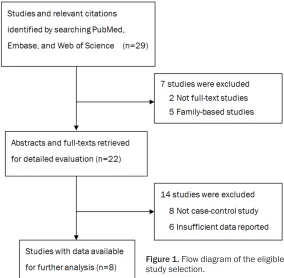
of them were excluded because of no full text (two studies) or being family-based studies
(five studies). The abstract and full text of the
remaining 22 studies were retrieved for sec-ondary evaluation. In total, 14 studies were further excluded (eight studies were not
case-control and six studies had insufficient data).
Reasons for ineligibility are provided in Figure 1. Ultimately, the study involved eight case-control studies with totals of 1,899 cases and 3,458 controls. Basic characteristics of eligi- ble studies [14, 15, 18 , 27-31] are listed in Table 1. The ethnic groups examined by these studies included Caucasian (three studies), Asian (three studies), American (one study), and
mixed (one study). Further stratified by dise-ase subtype, five of the studies examined cleft
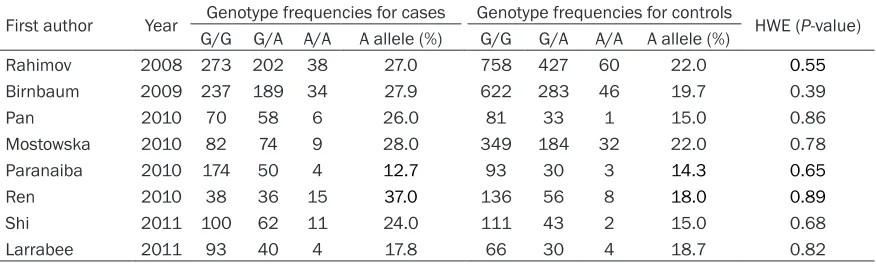
lips with or without a cleft palate (CL/P) while the others examined CL/P and CPO. The po- lymerase chain reaction-restriction fragment length polymorphism (PCR-RFLP) method was applied for genotyping in all studies. The dis- tribution of IRF6 rs642961 polymorphism in each study is shown in Table 2. Genotype fre
-quencies (G/G, G/A, A/A, and A allele (%)) for
both cases and controls are presented. Hardy-Weinberg Equilibrium (HWE) of the controls
[image:3.612.91.375.72.350.2]was confirmed in all studies (p>0.05).
Figure 1. Flow diagram of the eligible study selection.
the OR of the selected out-comes and Egger’s test [26]. An asymmetrical funnel plot and a p value of <0.05 sug-gested possible publication bias. Some of the included studies presented several re- sults using different adjust-ments for covariates and de- sign elements. We also per-formed a sensitivity analysis to explore the effects of using differently adjusted results for these studies. All statistical analyses were performed us- ing Software R version 3.2.2 (The R Foundation for Sta- tistical Computing).
Results
Forest plots shown in Figure 2 illustrate the association between IRF6 rs642961 polymor-phism and NSCL/P. Notably, two studies (Paranaiba et al., 2010 and Larrabee et al., 2011) were removed from the following analy-sis because of the ethnicity involved. American
or mixed populations are difficult to categorize
into Asian or Caucasian subgroups. Additionally, results of the two studies presented different
orientations from the others (OR>1 vs. OR<1),
therefore the results could not be pooled. To avoid potential interference, the two studies were excluded. The IR6 rs642961
polymor-phism was significantly related to an increased risk of NSCL/P in the A allele versus G allele
model (OR=1.64, 95% CI=1.37-1.97, p heterogene-ity=0.02), dominant model (A/A+G/A vs. G/G) (OR=1.74, 95% CI=1.45-2.10, pheterogeneity=0.11),
and recessive model (A/A vs. G/A+G/G) (OR=
1.74, 95% CI=1.26-2.97, pheterogeneity=0.08). Ta- ble 3 summarizes pooled ORs and 95% CIs between the IRF6 rs642961 polymorphism
and NSCL/P after stratification by ethnicity and
disease types. The risk of NSCL/P in Asians
was significantly higher than that in non-Asian
populations especially in the recessive model (OR=4.49, 95% CI=2.26-8.92, pheterogeneity=0.98)
and homozygous model (A/A vs. G/G) (OR=
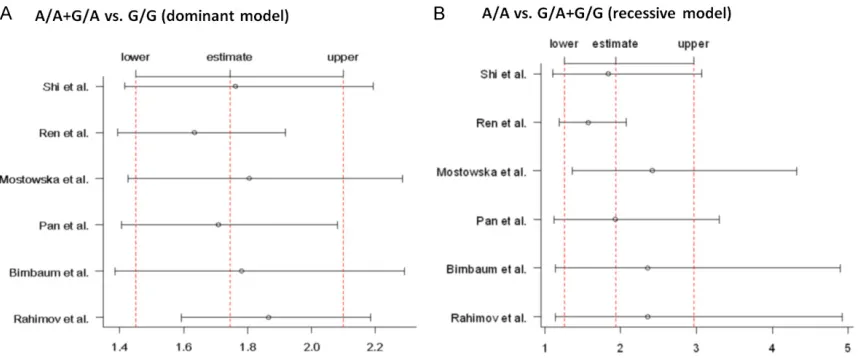
5.86, 95% CI=2.90-11.8, pheterogeneity=0.95). Af- ter stratifying by disease types, we also found that the risk of NSCLP in CL/P was higher than that in CL/P and CPO in individual models. Publication bias was evaluated by Begg’s fun-nel plot and Egger’s test. There was a slight asymmetry in the funnel plot (Figure 3) in the dominant model and potential risk of pub- lication bias was assessed via Egger’s test (p=0.037). A sensitivity analysis showed that the outcomes did not differ from the main analysis and there was consistency in both the direction and magnitude of the estimates (Figure 4). No individual study significantly
affected the pooled ORs in either the dominant or recessive model.
Discussion
[image:4.612.91.522.85.215.2]This meta-analysis was undertaken to update information on genetic effects of the rs642961 Table 1. Basic characteristics of studies included in the present meta-analysis
First author Year Country Ethnicity (case/control)Sample size subtypesDisease # Genotyping method
Rahimov 2008 Denmark and Norway Caucasian 513/1245 CL/P and CPO PCR-RFLP Birnbaum 2009 Germany and other countries Caucasian 460/951 CL/P PCR-RFLP
Pan 2010 China Asian 134/115 CL/P and CPO PCR-RFLP
Mostowska 2010 Poland Caucasian 165/565 CL/P PCR-RFLP
Paranaiba 2010 Brazil Mixed 228/126 CL/P and CPO PCR-RFLP
Ren 2010 China Asian 89/200 CL/P PCR-RFLP
Shi 2011 China Asian 173/156 CL/P PCR-RFLP
Larrabee 2011 Honduran American 137/100 CL/P PCR-RFLP
#CL/P: cleft lip with or without cleft palate; CPO: cleft palate only.
Table 2. The distribution of IRF6 rs642961 polymorphism among studies included in the meta-analysis First author Year Genotype frequencies for cases Genotype frequencies for controls HWE (P-value)
G/G G/A A/A A allele (%) G/G G/A A/A A allele (%)
Rahimov 2008 273 202 38 27.0 758 427 60 22.0 0.55
Birnbaum 2009 237 189 34 27.9 622 283 46 19.7 0.39
Pan 2010 70 58 6 26.0 81 33 1 15.0 0.86
Mostowska 2010 82 74 9 28.0 349 184 32 22.0 0.78
Paranaiba 2010 174 50 4 12.7 93 30 3 14.3 0.65
Ren 2010 38 36 15 37.0 136 56 8 18.0 0.89
Shi 2011 100 62 11 24.0 111 43 2 15.0 0.68
[image:4.612.88.526.263.395.2]Figure 2. Forest plots illustrate the association between IRF6 rs642961 polymorphism and nonsyndromic cleft lip with or without cleft palate (NSCLP).
Table 3. The pooled ORs and 95% CI between IRF6 rs642961 polymorphism and NSCLP stratified by
ethnicity and disease types
Subgroups A allele vs. G allele
A/A+G/A vs. G/G
(dominant model) (recessive model)A/A vs. G/A+G/G (homozygous model)A/A vs. G/G (heterozygous model)G/A vs. G/G OR (95% CI) Phb OR (95% CI) Phb OR (95% CI) Phb OR (95% CI) Phb OR (95% CI) Phb
Overall (n=6) 1.64 (1.37-1.97) 0.02 1.74 (1.45-2.10) 0.11 1.93 (1.26-2.97) 0.08 2.39 (1.50-3.78) 0.05 1.63 (1.39-1.90) 0.28 Ethnicity
Asian (n=3) 2.12 (1.66-2.71) 0.34 2.19 (1.64-2.91) 0.43 4.49 (2.26-8.92) 0.98 5.86 (2.90-11.8) 0.95 1.91 (1.42-2.57) 0.59 Non-Asian (n=3) 1.42 (1.27-1.60) 0.36 1.57 (1.32-1.86) 0.24 1.48 (1.11-1.96) 0.53 1.74 (1.30-2.33) 0.05 1.55 (1.27-1.90) 0.17 Disease typesa
polymorphism in IRF6 gene on NSCL/P. In total, eight studies were included in the pooling for the IRF6 rs642961 polymorphism. The A allele of the IRF6 rs642961 polymorphism showed
a significantly increased risk of NSCL/P under
the dominant model, recessive model,
homozy-gous model, and heterozyhomozy-gous model. Our find
-ings suggest that the IRF6 rs642961 poly-
morphism is more significantly associated with
NSCL/P in Asian population than in non-Asian populations.
Our findings are consistent with previous hu-man GWASs [14, 17, 32-36] and animal studies
[10, 11]. Evidence from animal studies also supports the role of IRF6 in NSCL/P and
con-firms the association of abnormalities of epi -thelial differentiation in mice with a mutation in IRF6. This supports a role of IRF6 in the forma-tion and maintenance of the periderm and spa-tiotemporal regulation of appropriate palatal adhesion. Also, mice with a mutation of IRF6 showed abnormal skin, limb, and craniofacial development which implied a role of IRF6 in keratinocyte proliferation and differentiation of
the face and limbs [11]. Additionally, our find -ings are also consistent with previous meta-analyses of genetic association studies regard-ing IRF6 rs642961 polymorphisms [20, 21]. We
confirmed the previous findings and provide
[image:6.612.90.525.72.264.2]updated information by both expanding the analyses to various models and stratifying the
Figure 3. Funnel plot for the examination of the publication bias in the present meta-analysis. Each point represents an eligible study. Log [OR], the natural logarithm of OR. Horizontal line, mean magnitude of effect size.
[image:6.612.93.522.313.492.2]results by ethnicity and disease types. Alth- ough the IRF6 rs642961 polymorphism was considered in previous meta-analyses for ge- netic association studies, this analysis was
used to further confirm the GWAS. The pres -ence of the A allele at the IRF6 rs642961 poly-morphism site, which alters the binding site of the AP-2a transcription factor, is the true poly-morphic allele associated with NSCL/P. The A allele effects were estimated and also pooled genotype effects by ethnicity and disease ty- pes were additionally provided from previous evidence.
Paranaiba et al. (2010) and Larrabee et al. (2011) were not included in the pooled analy-ses because of their inappropriate handling of various populations. Paranaiba et al. sug-gested an association between NSCL/P and
IRF6 rs642961 polymorphisms in an examin- ed Brazilian population (or mixed population), demonstrating that their presence might not play an important role in the etiology of NSCL/P. Larrabee et al. suggested that rs22- 35371 showed an association with CLP, imply-ing a functional role of this polymorphism in a Honduran population (non-Caucasian). As for the rs642961 polymorphism, it was previously reported to have an effect in other populations, suggesting that different populations may be
affected. Because of our stratification by Asian
and non-Asian populations, these two studies
were not included in the final pooled analyses.
NSCL/P is a common birth defect with a com-plex etiology. Although genetic and environ-mental factors have been discovered to cause syndromic CLP, the pathogenesis of the more common non-syndromic (isolated) forms re- mains poorly characterized. Birnbaum and
col-leagues revealed the first GWAS of NSCL/P in
Caucasians and showed that rs987525 was a susceptibility locus [14]. Based on data from prevalence screening, more than 60% of families with VWS had a mutation in IRF6
gene [37]. IRF6 mutations are risks
contribut-ing to the incidence of oral cleft in German,
Swedish, Brazilian, African-American, Cauca- sian, European, and Asian populations [38] and IRF6 is a marker of CLP severity [39].
Notably, in our major findings, we first found
that Asian individuals with the IRF6 rs642961
A allele had a significantly higher risk compared
to those in non-Asian populations.
Our study has some strengths. We attempted to pool various effects on NSCL/P separately by ethnicity and disease types, if data were available. We also adopted several combina-tions as genetic models to estimate the asso-ciation between IRF6 rs642961 polymorphism and NSCL/P. Admittedly, our study also had some limitations. First, given that we worked
with summary data, the lack of sufficient and
original data from the reviewed studies
con-fined our further evaluation of potential
cor-relations. Interactions, including gene versus gene, gene versus the environment, and gene versus ethnicity may have modulated the risk of NSCL/P. Second, we could not control con-founding effects, although the major source of confounding for genetic studies is population
stratification, and we summarized results by
ethnic group. Third, in sensitivity analysis by ethnicity and source of control, the sample size was relatively small which may have led
to insufficient power to detect actual
correla-tions.
In conclusion, our findings suggest that the A
allele of IRF6 rs642961 polymorphism shows
a significantly increased risk of NSCL/P under
various genetic models. Among Asian popula-tions, the risk of NSCL/P is more predominant. The association of IRF6 rs642961 polymor-phism within NSCL/P in Asian populations suggests potential genetic heterogeneity of NSCL/P at this locus, which may be a criti- cal phenomenon of different linkage patterns of this polymorphism among different ethnic groups. Clinically, information on genetic poly-morphisms in patients with NSCL/P might be useful in diagnosis and treatment. Moreover, there are still polymorphisms other than IRF6
rs642961 that may affect the risk. The effects of these polymorphisms should be investigated in further studies.
Acknowledgements
This study was supported by Taipei Medical
University Shuang Ho Hospital (Grant no.
106HCP-08). The authors would like to thank Dr. Ping-Hsiao Shih for professional consulta-tion in publishing this work.
Disclosure of conflict of interest
Address correspondence to: Dr. Yuan-Hung Wang, Graduate Institute of Clinical Medicine, College of Medicine Taipei Medical University, 250 Wu-Hsing Street, Taipei 11031, Taiwan. Tel: +886-2-27361661 Ext. 3232; E-mail: [email protected]; Dr. Yung-Ting Kuo, Department of Pediatrics, Shuang Ho Hospital, Taipei Medical University, 291 Jhong- jheng Rd., Jhonghe Dist., New Taipei City 23561, Taiwan. Tel: 22490088; Fax: +886-2-22490088 Ext. 2507; E-mail: [email protected]. tw
References
[1] Carinci F, Scapoli L, Palmieri A, Zollino I and Pezzetti F. Human genetic factors in non-syn-dromic cleft lip and palate: an update. Int J Pe-diatr Otorhinolaryngol 2007; 71: 1509-1519. [2] Huang YQ. Progress in studies on the genetic
risk factors for non-syndromic cleft lip or palate in China. Zhonghua Kou Qiang Yi Xue Za Zhi 2017; 52: 223-228.
[3] Bender PL. Genetics of cleft lip and palate. J Pediatr Nurs 2000; 15: 242-249.
[4] Chang WJ, See LC and Lo LJ. Time trend of in-cidence rates of cleft lip/palate in Taiwan from 1994 to 2013. Biomed J 2016; 39: 150-154. [5] Li D, Liu T, Meng X, Guo Q, Shi J, Hao Y, Jiao X,
Lv K and Song T. Polymorphic variants in VAX1 and the risk of non-syndromic cleft lip with or without cleft palate in a population from northern China. Medicine (Baltimore) 2017; 96: e6550.
[6] Dixon MJ, Marazita ML, Beaty TH, Murray JC. Cleft lip and palate: understanding genetic and environmental influences. Nat Rev Genet 2011; 12: 167-178.
[7] Mangold E, Ludwig KU, Nöthen MM. Break-throughs in the genetics of orofacial clefting. Trends Mol Med 2011; 17: 725-733.
[8] Stuppia L, Capogreco M, Marzo G, La Rovere D, Antonucci I, Gatta V, Palka G, Mortellaro C, Tetè S. Genetics of syndromic and non-syn-dromic cleft lip and palate. J Craniofac Surg 2011; 22: 1722-1726.
[9] Houdayer C, Bonaiti-Pellie C, Erguy C, Soupre V, Dondon MG, Burglen L, Cougoureux E, Coud-erc R, Vazquez MP and Bahuau M. Possible relationship between the van der Woude syn-drome (vWS) locus and non-syndromic cleft lip with or without cleft palate (NSCL/P). Am J Med Genet 2001; 104: 86-92.
[10] Ingraham CR, Kinoshita A, Kondo S, Yang B, Sajan S, Trout KJ, Malik MI, Dunnwald M, Goudy SL, Lovett M, Murray JC and Schutte BC. Abnormal skin, limb and craniofacial morpho-genesis in mice deficient for interferon regula-tory factor 6 (Irf6). Nat Genet 2006; 38: 1335-1340.
[11] Richardson RJ, Dixon J, Jiang R and Dixon MJ. Integration of IRF6 and Jagged2 signalling is essential for controlling palatal adhesion and fusion competence. Hum Mol Genet 2009; 18: 2632-2642.
[12] Kondo S, Schutte BC, Richardson RJ, Bjork BC, Knight AS, Watanabe Y, Howard E, de Lima RL, Daack-Hirsch S, Sander A, McDonald-McGinn DM, Zackai EH, Lammer EJ, Aylsworth AS, dinger HH, Lidral AC, Pober BR, Moreno L, Ar-cos-Burgos M, Valencia C, Houdayer C, Bahuau M, Moretti-Ferreira D, Richieri-Costa A, Dixon MJ and Murray JC. Mutations in IRF6 cause Van der Woude and popliteal pterygium syn-dromes. Nat Genet 2002; 32: 285-289. [13] Salagovic J, Klimcakova L, Zabavnikova M,
Behunova J, Hudakova T, Fedeles J, Molnarova A and Podracka L. Polymorphisms at 1q32, 8q24, and 17q22 loci are associated with non-syndromic cleft lip with or without cleft palate risk in the Slovak population. Biomed Pap Med Fac Univ Palacky Olomouc Czech Repub 2017; 161: 152-157.
[14] Birnbaum S, Ludwig KU, Reutter H, Herms S, de Assis NA, Diaz-Lacava A, Barth S, Lauster C, Schmidt G, Scheer M, Saffar M, Martini M, Reich RH, Schiefke F, Hemprich A, Potzsch S, Potzsch B, Wienker TF, Hoffmann P, Knapp M, Kramer FJ, Nothen MM and Mangold E. IRF6 gene variants in Central European patients with non-syndromic cleft lip with or without cleft palate. Eur J Oral Sci 2009; 117: 766-769. [15] Rahimov F, Marazita ML, Visel A, Cooper ME,
Hitchler MJ, Rubini M, Domann FE, Govil M, Christensen K, Bille C, Melbye M, Jugessur A, Lie RT, Wilcox AJ, Fitzpatrick DR, Green ED, Mossey PA, Little J, Steegers-Theunissen RP, Pennacchio LA, Schutte BC and Murray JC. Disruption of an AP-2alpha binding site in an IRF6 enhancer is associated with cleft lip. Nat Genet 2008; 40: 1341-1347.
[16] Grant SF, Wang K, Zhang H, Glaberson W, An-naiah K, Kim CE, Bradfield JP, Glessner JT, Thomas KA, Garris M, Frackelton EC, Otieno FG, Chiavacci RM, Nah HD, Kirschner RE and Hakonarson H. A genome-wide association study identifies a locus for non-syndromic cleft lip with or without cleft palate on 8q24. J Pedi-atr 2009; 155: 909-913.
Mills JL, Molloy AM, Kirke PN, Scott JM, Arcos-Burgos M and Scott AF. A genome-wide asso-ciation study of cleft lip with and without cleft palate identifies risk variants near MAFB and ABCA4. Nat Genet 2010; 42: 525-529. [18] Shi J, Song T, Jiao X, Qin C and Zhou J.
Single-nucleotide polymorphisms (SNPs) of the IRF6 and TFAP2A in non-syndromic cleft lip with or without cleft palate (NSCLP) in a northern Chi-nese population. Biochem Biophys Res Com-mun 2011; 410: 732-736.
[19] Kousa YA and Schutte BC. Toward an orofacial gene regulatory network. Dev Dyn 2016; 245: 220-232.
[20] Wang M, Pan Y, Zhang Z and Wang L. Three polymorphisms in IRF6 and 8q24 are associ-ated with non-syndromic cleft lip with or with-out cleft palate: evidence from 20 studies. Am J Med Genet A 2012; 158A: 3080-3086. [21] Wattanawong K, Rattanasiri S, McEvoy M, Attia
J and Thakkinstian A. Association between IRF6 and 8q24 polymorphisms and non-syn-dromic cleft lip with or without cleft palate: systematic review and meta-analysis. Birth De-fects Res A Clin Mol Teratol 2016; 106: 773-788.
[22] Stroup DF, Berlin JA, Morton SC, Olkin I, Wil-liamson GD, Rennie D, Moher D, Becker BJ, Sipe TA and Thacker SB. Meta-analysis of ob-servational studies in epidemiology: a propos-al for reporting. Meta-anpropos-alysis Of Observation-al Studies in Epidemiology (MOOSE) group. JAMA 2000; 283: 2008-2012.
[23] Moher D, Liberati A, Tetzlaff J, Altman DG and Group P. Preferred reporting items for system-atic reviews and meta-analyses: the PRISMA statement. Ann Intern Med 2009; 151: 264-269.
[24] Navarese EP, Kozinski M, Pafundi T, Andreotti F, Buffon A, Servi SD and Kubica J. Practical and updated guidelines on performing meta-analyses of non-randomized studies in inter-ventional cardiology. Cardiol J 2011; 18: 3-7. [25] Thakkinstian A, McKay GJ, McEvoy M,
Chakra-varthy U, Chakrabarti S, Silvestri G, Kaur I, Li X and Attia J. Systematic review and meta-analy-sis of the association between complement component 3 and age-related macular degen-eration: a HuGE review and meta-analysis. Am J Epidemiol 2011; 173: 1365-1379.
[26] Egger M, Davey Smith G, Schneider M and Minder C. Bias in meta-analysis detected by a simple, graphical test. BMJ 1997; 315: 629-634.
[27] Paranaiba LM, Bufalino A, Martelli-Junior H, de Barros LM, Graner E and Coletta RD. Lack of association between IRF6 polymorphisms (rs2235371 and rs642961) and non-syndrom-ic cleft lip and/or palate in a Brazilian popula-tion. Oral Dis 2010; 16: 193-197.
[28] Pan Y, Ma J, Zhang W, Du Y, Niu Y, Wang M, Zhang Z and Wang L. IRF6 polymorphisms are associated with non-syndromic orofacial clefts in a Chinese Han population. Am J Med Genet A 2010; 152A: 2505-2511.
[29] Mostowska A, Hozyasz KK, Wojcicki P, Biedziak B, Paradowska P and Jagodzinski PP. Associa-tion between genetic variants of reported can-didate genes or regions and risk of cleft lip with or without cleft palate in the polish popu-lation. Birth Defects Res A Clin Mol Teratol 2010; 88: 538-545.
[30] Larrabee YC, Birkeland AC, Kent DT, Flores C, Su GH, Lee JH and Haddad J Jr. Association of common variants, not rare mutations, in IRF6 with non-syndromic clefts in a Honduran population. Laryngoscope 2011; 121: 1756-1759.
[31] Ren HW, Zhao GZ, Huang YQ, Ma M, Ma J, Sun YB, Gao J and Shi B. Association between interferon regulatory factor 6 gene polymor-phism and non-syndromic oral clefting. Hua Xi Kou Qiang Yi Xue Za Zhi 2010; 28: 352-355. [32] Pegelow M, Koillinen H, Magnusson M,
Frans-son I, Unneberg P, Kere J, Karsten A and Peyrard-Janvid M. Association and mutation analyses of the IRF6 gene in families with non-syndromic and non-syndromic cleft Lip and/or cleft palate. Cleft Palate Craniofac J 2014; 51: 49-55.
[33] Lu Y, Liu Q, Xu W, Li Z, Jiang M, Li X, Zhao N, Liu W, Sui Y, Ma C, Feng W, Han W and Li J. TGFA and IRF6 contribute to the risk of non- syndromic cleft lip with or without cleft pa- late in northeast China. PLoS One 2013; 8: e70754.
[34] Velazquez-Aragon JA, Alcantara-Ortigoza MA, Estandia-Ortega B, Reyna- Fabian ME, Cruz-Fuentes C, Villagomez S and Gonzalez-del An-gel A. Association of interactions among the IRF6 gene, the 8q24 region, and maternal folic acid intake with non-syndromic cleft lip/ palate in Mexican Mestizos. Am J Med Genet A 2012; 158A: 3207-3210.
[35] Li MJ, Zhu WL, Wang Y, Guo JZ, Li SQ and Li Y. Association between polymorphism of IRF6 rs2235371 locus and non-syndromic cleft lip with or without cleft palate. Zhonghua Yi Xue Yi Chuan Xue Za Zhi 2012; 29: 149-154. [36] Ludwig KU, Mangold E, Herms S, Nowak S,
cleft lip with or without cleft palate identify six new risk loci. Nat Genet 2012; 44: 968-971. [37] de Lima RL, Hoper SA, Ghassibe M, Cooper
ME, Rorick NK, Kondo S, Katz L, Marazita ML, Compton J, Bale S, Hehr U, Dixon MJ, Daack-Hirsch S, Boute O, Bayet B, Revencu N, Verel-len-Dumoulin C, Vikkula M, Richieri-Costa A, Moretti-Ferreira D, Murray JC and Schutte BC. Prevalence and nonrandom distribution of ex-onic mutations in interferon regulatory factor 6 in 307 families with Van der Woude syndrome and 37 families with popliteal pterygium syn-drome. Genet Med 2009; 11: 241-247.
[38] Salahshourifar I, Wan Sulaiman WA, Halim AS and Zilfalil BA. Mutation screening of IRF6 among families with non-syndromic oral clefts and identification of two novel variants: review of the literature. Eur J Med Genet 2012; 55: 389-393.