Importance sampling for unbiased on-demand evaluation of knowledge
base population
Arun Tejasvi Chaganty∗ and Ashwin Pradeep Paranjape∗and Percy Liang Computer Science Department
Stanford University
{chaganty,ashiwnp,pliang}@cs.stanford.edu Christopher D. Manning
Computer Science Department Stanford University
{manning}@cs.stanford.edu Abstract
Knowledge base population (KBP) sys-tems take in a large document corpus and extract entities and their relations. Thus far, KBP evaluation has relied on judge-ments on the pooled predictions of exist-ing systems. We show that this evalua-tion is problematic: when a new system predicts a previously unseen relation, it is penalized even if it is correct. This leads to significant bias against new systems, which counterproductively discourages in-novation in the field. Our first contribu-tion is a new importance-sampling based evaluation which corrects for this bias by annotating a new system’s predictions on-demand via crowdsourcing. We show this eliminates bias and reduces variance using data from the 2015 TAC KBP task. Our second contribution is an implementation of our method made publicly available as an online KBP evaluation service. We pi-lot the service by testing diverse state-of-the-art systems on the TAC KBP 2016 cor-pus and obtain accurate scores in a cost ef-fective manner.
1 Introduction
Harnessing the wealth of information present in unstructured text online has been a long stand-ing goal for the natural language processstand-ing com-munity. In particular, knowledge base popula-tion seeks to automatically construct a knowl-edge base consisting of relations between entities from a document corpus. Knowledge bases have found many applications including question an-swering (Berant et al., 2013; Fader et al., 2014;
∗ Authors contributed equally.
Fisher’s mother, entertainer Debbie Reynolds, said on
Twitter on Sunday that her daughter was stabilizing.
Debbie Reynolds , title, entertainer
Debbie Reynolds, per:parents, Fisher
Fisher
Debbie Reynolds
daughter her
Relation instances
Linked Entities
Knowledge Base
title entertainer
[image:1.595.315.517.221.390.2]child of
+
Figure 1: An example describing entities and re-lations in knowledge base population.
Reddy et al.,2014), automated reasoning (Kalyan-pur et al.,2012) and dialogue (Han et al.,2015).
Evaluating these systems remains a challenge as it is not economically feasible to exhaustively annotate every possible candidate relation from a sufficiently large corpus. As a result, a pooling-based methodology is used in practice to construct datasets, similar to them methodology used in in-formation retrieval (Jones and Rijsbergen, 1975; Harman,1993). For instance, at the annual NIST TAC KBP evaluation, all relations predicted by participating systems are pooled together, anno-tated and released as a dataset for researchers to develop and evaluate their systems on. However, during development, if a new system predicts a previously unseen relation it is considered to be wrong even if it is correct. The discrepancy be-tween a system’s true score and the score on the pooled dataset is calledpooling bias and is typi-cally assumed to be insignificant in practice (Zo-bel,1998).
actu-ally significant, and it penalizes newly developed systems by 2%F1 on average (Section3). Novel improvements, which typically increase scores by less than 1% F1 on existing datasets, are there-fore likely to be clouded by pooling bias during development. Worse, the bias is larger for a sys-tem which predicts qualitatively different relations systematically missing from the pool. Of course, systems participating in the TAC KBP evaluation do not suffer from pooling bias, but this requires researchers to wait a year to get credible feedback on new ideas.
This bias is particularly counterproductive for machine learning methods as they are trained as-suming the pool is the complete set of positives. Predicting unseen relations and learning novel pat-terns is penalized. The net effect is that researchers are discouraged from developing innovative ap-proaches, in particular from applying machine learning, thereby slowing progress on the task.
Our second contribution, described in Sec-tion 4, addresses this bias through a new evalua-tion methodology, on-demand evaluation, which avoids pooling bias by querying crowdworkers, while minimizing cost by leveraging previous sys-tems’ predictions when possible. We then com-pute the new system’s score based on the predic-tions of past systems using importance weighting. As more systems are evaluated, the marginal cost of evaluating a new system decreases. We show how the on-demand evaluation methodology can be applied to knowledge base population in Sec-tion 5. Through a simulated experiment on eval-uation data released through the TAC KBP 2015 Slot Validation track, we show that we are able to obtain unbiased estimates of a new systems score’s while significantly reducing variance.
Finally, our third contribution is an implementa-tion of our framework as a publicly available eval-uation service athttps://kbpo.stanford. edu, where researchers can have their own KBP systems evaluated. The data collected through the evaluation process could even be valuable for rela-tion extracrela-tion, entity linking and coreference, and will also be made publicly available through the website. We evaluate three systems on the 2016 TAC KBP corpus for about $150 each (a fraction of the cost of official evaluation). We believe the public availability of this service will speed the pace of progress in developing KBP systems.
Humans
System A
System B
System C
i1: (s1, r, o1, p1)
i2: (s1, r, o2, p2)
i3: (s1, r, o3, p3)
i4: (s1, r, o2, p4)
i5: (s1, r, o3, p5)
i6: (s1, r, o4, p6)
[image:2.595.321.513.69.179.2]X X X X × X
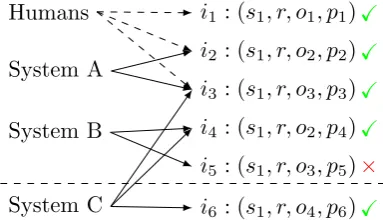
Figure 2: In pooled evaluation, an evaluation dataset is constructed by labeling relation in-stances collected from the pooled systems (A and B) and from a team of human annotators (Hu-mans). However, when a new system (C) is evalu-ated on this dataset, some of its predictions (i6) are missing and can not be fairly evaluated. Here, the precision and recall for C should be 3
3 and 34 re-spectively, but its evaluation scores are estimated to be 2
3 and23. The discrepancy between these two scores is calledpooling bias.
2 Background
In knowledge base population, each relation is a triple (SUBJECT, PREDICATE, OBJECT) where SUBJECT and OBJECT are some globally unique entity identifiers (e.g. Wikipedia page titles) and PREDICATE belongm to a specified schema.1 A KBP system returns an output in the form of
re-lation instances(SUBJECT,PREDICATE, OBJECT,
PROVENANCE), wherePROVENANCEis a descrip-tion of where exactly in the document corpus the relation was found. In the example shown in Fig-ure1, CARRIEFISHER and DEBBIE REYNOLDS are identified as the subject and object, respec-tively, of the predicate CHILD OF, and the whole sentence is provided as provenance. The prove-nance also identifies that CARRIE FISHER is ref-erenced byFisherwithin the sentence. Note that the same relation can be expressed in multiple sen-tences across the document corpus; each of these is a different relation instance.
Pooled evaluation. The primary source of
eval-uation data for KBP comes from the annual TAC KBP competition organized by NIST (Ji et al.,
1The TAC KBP guidelines specify a total of 65
predicates (including inverses) such as per:title or
2011). LetE be a held-out set ofevaluation en-tities. There are two steps performed in parallel: First, each participating system is run on the docu-ment corpus to produce a set of relation instances; those whose subjects are inEare labeled as either positive or negative by annotators. Second, a team of annotators identify and label correct relation in-stances for the evaluation entitiesE by manually searching the document corpus within a time bud-get (Ellis et al.,2012). These labeled relation in-stances from the two steps are combined and re-leased as the evaluation dataset. In the example in Figure2, systems A and B were used in construct-ing the poolconstruct-ing dataset, and there are 3 distinct re-lations in the dataset, betweens1ando1,o2,o3.
A system is evaluated on the precision of its predicted relation instances for the evaluation en-titiesEand on the recall of the corresponding pre-dictedrelations(not instances) for the same enti-ties (see Figure 2for a worked example). When using the evaluation data during system develop-ment, it is common practice to use the more le-nientanydoc score that ignores the provenance when checking if a relation instance is true. Un-der this metric, predicting the relation (CARRIE FISHER, CHILD OF, DEBBIE REYNOLDS) from an ambiguous provenance like “Carrie Fisherand
Debbie Reynolds arrived together at the awards
show” would be considered correct even though it would be marked wrong under the official metric.
3 Measuring pooling bias
The example in Figure 2 makes it apparent that pooling-based evaluation can introduce a system-atic bias against unpooled systems. However, it has been assumed that the bias is insignificant in practice given the large number of systems pooled in the TAC KBP evaluation. We will now show that the assumption is not valid using data from the TAC KBP 2015 evaluation.2
Measuring bias. In total, there are 70 system
submissions from 18 teams for 317 evaluation en-tities (E) and the evaluation set consists of 11,008 labeled relation instances.3 The original
evalua-2Our results are not qualitatively different on data from
previous years of the shared task.
3The evaluation set is actually constructed from
composi-tional queries like, “what does Carrie Fisher’s parents do?”: these queries select relation instances that answer the ques-tion “who are Carrie Fisher’s parents?”, and then use those answers (e.g. “Debbie Reynolds”) to select relation instances that answer “what does Debbie Reynolds do?”. We only
con-Median bias
Precision Recall MacroF1 Official 17.93% 17.00% 15.51%
anydoc 2.34% 1.93% 2.05%
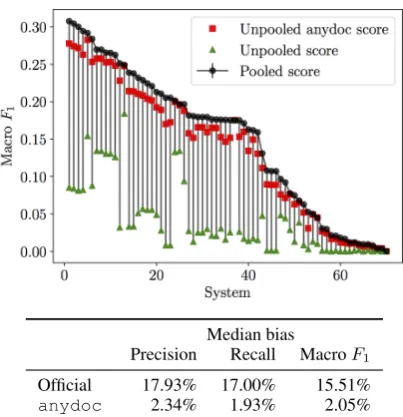
Figure 3: Median pooling bias (difference be-tween pooled and unpooled scores) on the top 40 systems of TAC KBP 2015 evaluation using the official and anydoc scores. The bias is much smaller for the lenientanydoc metric, but even so, it is larger than the largest difference between adjacent systems (1.5%F1) and typical system im-provements (around 1%F1).
tion dataset gives us a good measure of the true scores for the participating systems. Similar to Zo-bel(1998), which studied pooling bias in informa-tion retrieval, we simulate the condiinforma-tion of a team not being part of the pooling process by removing any predictions that are unique to its systems from the evaluation dataset. The pooling bias is then the difference between the true and unpooled scores.
Results. Figure 3 shows the results of
measur-ing poolmeasur-ing bias on the TAC KBP 2015 eval-uation on the F1 metric using the official and anydoc scores.45 We observe that even with le-nientanydoc heuristic, the median bias (2.05% F1) is much larger than largest difference between adjacently ranked systems (1.5% F1). This ex-periment shows that pooling evaluation is signif-icantly and systematically biased against systems that make novel predictions!
sider instances selected in the first part of this process.
4We note thatanydoc scores are on average 0.88%F
1 larger than the official scores.
5 The outlier at rank 36 corresponds to a University of
[image:3.595.314.516.68.277.2]4 On-demand evaluation with importance sampling
Pooling bias is fundamentally a sampling bias problem where relation instances from new sys-tems are underrepresented in the evaluation dataset. We could of course sidestep the prob-lem by exhaustively annotating the entire docu-ment corpus, by annotating all docu-mentions of en-tities and checking relations between all pairs of mentions. However, that would be a laborious and prohibitively expensive task: using the interfaces we’ve developed (Section6), it costs about $15 to annotate a single document by non-expert crowd-workers, resulting in an estimated cost of at least $1,350,000 for a reasonably large corpus of 90,000 documents (Dang, 2016). The annotation effort would cost significantly more with expert annota-tors. In contrast, labelingrelation instances from system predictions can be an order of magnitude cheaper than finding them in documents: using our interfaces, it costs only about $0.18 to verify each relation instance compared to $1.60 per instance extracted through exhaustive annotations.
We propose a new paradigm called on-demand evaluation which takes a lazy approach to dataset construction by annotating predictions from
sys-tems only when they are underrepresented, thus
correcting for pooling bias as it arises. In this sec-tion, we’ll formalize the problem solved by on-demand evaluation independent of KBP and de-scribe a cost-effective solution that allows us to accurately estimate evaluation scores without bias using importance sampling. We’ll then instantiate the framework for KBP in Section5.
4.1 Problem statement
LetX be the universe of (relation) instances,Y ⊆ X be the unknown subset of correct instances,
X1, . . . Xm ⊆ X be the predictions for m
sys-tems, and let Yi = Xi ∩ Y. LetX = Smi=1Xi and Y = Smi=1Yi. Let f(x) def= I[x ∈ Y] and gi(x) = I[x ∈ Xi], then the precision, πi, and recall,ri, of the set of predictionsXiis
πidef= Ex∼pi[f(x)] ri
def
= Ex∼p0[gi(x)],
wherepi is a distribution overXi andp0 is a dis-tribution overY. We assume thatpiis known, e.g. the uniform distribution overXiand that we know p0 up to normalization constant and can sample from it.
In on-demand evaluation, we can query f(x)
(e.g. labeling an instance) or draw a sample fromp0; typically, querying f(x) is significantly cheaper than sampling fromp0. We obtain predic-tion setsX1, . . . , Xm sequentially as the systems are submitted for evaluation. Our goal is to esti-mateπiandri for each systemi= 1, . . . , m.
4.2 Simple estimators
We can estimate eachπiandriindependently with simple Monte Carlo integration. LetXˆ1, . . . ,Xˆm
be multi-sets of n1, . . . , nj i.i.d. samples from
X1, . . . , Xm respectively, and let Yˆ0 be a
multi-set ofn0samples drawn fromY. Then, the simple estimators for precision and recall are:
ˆ
πi(simple)= 1
ni
X
x∈Xˆi
f(x) ˆr(simple)i = 1
n0
X
x∈Yˆ0
gi(x).
4.3 Joint estimators6
The simple estimators are unbiased but have wastefully large variance because evaluating a new system does not leverage labels acquired for pre-vious systems.
On-demand evaluation with the joint estimator works as follows: First Yˆ0 is randomly sampled
from Y once when the evaluation framework is launched. For every new set of predictions Xm submitted for evaluation, the minimum number of samplesnm required to accurately evaluateXmis calculated based on the current evaluation data,Yˆ0
andXˆ1, . . . ,Xˆm
−1. Then, the setXˆm is added to the evaluation data by evaluatingf(x)onnm sam-ples drawn fromXm. Finally, estimatesπi andri are updated for each systemi = 1, . . . , musing the joint estimators that will be defined next. In the rest of this section, we will answer the follow-ing three questions:
1. How can we use all the samplesXˆ1, . . .Xˆm
when estimating the precisionπiof systemi? 2. How can we use all the samplesXˆ1, . . . ,Xˆm
withYˆ0 when estimating recallri?
3. Finally, to form Xˆm, how many samples
should we draw fromXmgiven existing sam-ples andXˆ1, . . . ,Xˆm−1andYˆ0?
Estimating precision jointly. Intuitively, if two
systems have very similar predictionsXi andXj,
6Proofs for claims made in this section can be found in
we should be able to use samples from one to es-timate precision on the other. However, it might also be the case thatXi andXj only overlap on a small region, in which case the samples fromXj do not accurately represent instances in Xi and could lead to a biased estimate. We address this problem by using importance sampling (Owen, 2013), a standard statistical technique for estimat-ing properties of one distribution usestimat-ing samples from another distribution.
In importance sampling, ifXiˆ is sampled from
qi, then 1
ni
P
x∈Xˆi qpii((xx))f(x) is an unbiased esti-mate ofπi. We would like the proposal distribu-tion qi to both leverage samples from all m sys-tems and be tailored towards system i. To this end, we first define a distribution over systemsj, represented by probabilitieswij. Then, defineqi as sampling a j and drawing x ∼ pj; formally
qi(x) =Pmj=1wijpj(x).
We note thatqi(x)not only significantly differs between systems, but also changes as new systems are added to the evaluation pool. Unfortunately, the standard importance sampling procedure re-quires us to draw and use samples from each dis-tributionqi(x)independently and thus can not ef-fectively reuse samples drawn from different dis-tributions. To this end, we introduce a practical refinement to the importance sampling procedure: we independently draw nj samples according to pj(x)from each of them systems independently and then numerically integrate over these samples using the weightswij to “mix” them appropriately to produce and unbiased estimate of πi while re-ducing variance. Formally, we define thejoint pre-cision estimator:
ˆ
π(joint)i def=
m
X
j=1
wij
nj
X
x∈Xˆj
pi(x)f(x)
qi(x)
,
where eachXjˆ consists ofnji.i.d. samples drawn
frompj.
It is a hard problem to determine what the op-timal mixing weights wij should be. However, we can formally verify that ifXi andXj are dis-joint, then wij = 0 minimizes the variance of
πi, and if Xi = Xj, then wij ∝ nj is
opti-mal. This motivates the following heuristic choice which interpolates between these two extremes:
wij ∝njPx∈Xpj(x)pi(x).
Estimating recall jointly. The recall of system
ican be expressed can be expressed as a product
ri = θνi, whereθis therecall of the pool, which measures the fraction of all positive instances pre-dicted by the pool (any system), and νi is the pooled recall of systemi, which measures the frac-tion of the pool’s positive instances predicted by systemi. Letting g(x) def= I[x ∈ X], we can
de-fine these as:
νidef= Ex∼p0[gi(x)|x∈X] θ
def
= Ex∼p0[g(x)].
We can estimateθanalogous to the simple recall estimator rˆi, except we use the pool g instead a systemgi. Forνi, the key is to leverage the work from estimating precision. We already evaluated
f(x)onXi, so we can computeˆ Yiˆ def= ˆXi∩ Yand
form the subsetYˆ = Sm
i=1Yˆi. Yˆ is an approx-imation of Y whose bias we can correct through importance reweighting. We then define estima-tors as follows:
ˆ
νidef=
Pm
j=1 wij
nj
P
x∈Yˆj
p0(x)gi(x)
qi(x)
Pm
j=1 wij
nj
P
x∈Yˆj
p0(x) qi(x)
ˆ
ri(joint)def= ˆθνˆi θˆdef=
1
n0
X
x∈Yˆ0
g(x).
whereqiandwij are the same as before.
Adaptively choosing the number of samples. Finally, a desired property for on-demand evalu-ation is to label new instances only when the cur-rent evaluation data is insufficient, e.g. when a new set of predictionsXmcontains many instances not covered by other systems. We can measure how well the current evaluation set covers the predic-tionsXm by using a conservative estimate of the variance of πˆ(joint)m .7 In particular, the variance of ˆπ(joint)m is a monotonically decreasing function in nm, the number of samples drawn from Xm. We can easily solve for the minimum number of samples required to estimateπˆm(joint)within a con-fidence interval by using the bisection method (Burden and Faires,1985).
5 On-demand evaluation for KBP
Applying the on-demand evaluation framework to a task requires us to answer three questions:
1. What is the desired distribution over system predictionspi?
7Further details can be found in AppendixBof the
2. How do we label an instancex, i.e. check if
x∈ Y?
3. How do we sample from the unknown set of true instancesx∼p0?
In this section, we present practical implementa-tions for knowledge base population.
5.1 Sampling from system predictions
Both the official TAC-KBP evaluation and the on-demand evaluation we propose use micro-averaged precision and recall as metrics. However, in the official evaluation, these metrics are com-puted over a fixed set of evaluation entities chosen by LDC annotators, resulting in two problems: (a) defining evaluation entities requires human inter-vention and (b) typically a large source of vari-ability in evaluation scores comes from not hav-ing enough evaluation entities (see e.g. (Webber, 2010)). In our methodology, we replace manu-ally chosen evaluation entities by sampling entities from each system’s output accordingpi. In effect, pimakes explicit the decision process of the anno-tator who chooses evaluation entities.
Identifying a reasonable distributionpiis an im-portant implementation decision that depends on what one wishes to evaluate. Our goal for the on-demand evaluation service we have implemented is to ensure that KBP systems are fairly evalu-ated on diverse subjects and predicates, while at the same time, ensuring that entities with multiple relations are represented to measure completeness of knowledge base entries. As a result, we propose a distribution that is inversely proportional to the frequency of the subject and predicate and is pro-portional to the number of unique relations iden-tified for an entity (to measure knowledge base completeness). See AppendixAin the supplemen-tary material for an analysis of this distribution and a study of other potential choices.
5.2 Labeling predicted instances
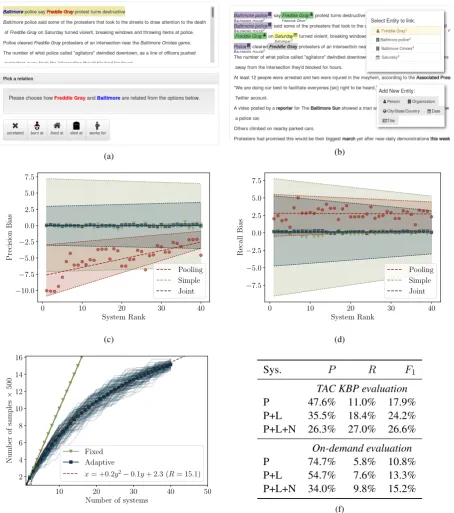
We label predicted relation instances by present-ing the instance’s provenance to crowdworkers and asking them to identify if a relation holds be-tween the identified subject and object mentions (Figure4a). Crowdworkers are also asked to link the subject and object mentions to their canoni-cal mentions within the document and to pages on Wikipedia, if possible, for entity linking. On av-erage, we find that crowdworkers are able to per-form this task in about 20 seconds,
correspond-ing to about $0.05 per instance. We requested 5 crowdworkers to annotate a small set of 200 rela-tion instances from the 2015 TAC-KBP corpus and measured a substantial inter-annotator agreement with a Fleiss’ kappa of 0.61 with 3 crowdworkers and 0.62 with 5. Consequently, we take a majority vote over 3 workers in subsequent experiments.
5.3 Sampling true instances
Sampling from the set of true instancesY is diffi-cult because we can’t even enumerate the elements of Y. As a proxy, we assume that relations are identically distributed across documents and have crowdworkers annotate a random subset of doc-uments for relations using an interface we devel-oped (Figure4b). Crowdworkers begin by iden-tifying every mention span in a document. For each mention, they are asked to identify its type, canonical mention within the document and asso-ciated Wikipedia page if possible. They are then presented with a separate interface to label predi-cates between pairs of mentions within a sentence that were identified earlier.
We compare crowdsourced annotations against those of expert annotators using data from the TAC KBP 2015 EDL task on 10 randomly chosen docu-ments. We find that 3 crowdworkers together iden-tify 92% of the entity spans identified by expert annotators, while 7 crowdworkers together iden-tify 96%. When using a token-level majority vote to identify entities, 3 crowdworkers identify about 78% of the entity spans; this number does not change significantly with additional crowdwork-ers. We also measure substantial token-level inter-annotator agreement using Fleiss’ kappa for iden-tifying typed mention spans (κ= 0.83), canonical
mentions (κ = 0.75) and entity links (κ = 0.75)
with just three workers. Based on this analysis, we use token-level majority over 3 workers in subse-quent experiments.
(a) (b)
0 10 20 30 40
System Rank
−10.0
−7.5
−5.0
−2.5 0.0 2.5 5.0 7.5
Precision
Bias
Pooling Simple Joint
(c)
0 10 20 30 40
System Rank
−7.5
−5.0
−2.5 0.0 2.5 5.0 7.5
Recall
Bias
Pooling Simple Joint
(d)
10 20 30 40 50
Number of systems 2
4 6 8 10 12 14 16
Num
b
er
of
samples
×
500
Fixed Adaptive
x= +0.2y2−0.1y+ 2.3 (R= 15.1)
(e)
Sys. P R F1
TAC KBP evaluation
P 47.6% 11.0% 17.9%
P+L 35.5% 18.4% 24.2%
P+L+N 26.3% 27.0% 26.6% On-demand evaluation
P 74.7% 5.8% 10.8%
P+L 54.7% 7.6% 13.3%
P+L+N 34.0% 9.8% 15.2%
[image:7.595.74.529.68.582.2](f)
9.2 relations, resulting in a cost of about $1.61 per relation instance. We note that this is about ten times as much as labeling a relation instance.
We defer details regarding how documents themselves should be weighted to capture diverse entities that span documents to AppendixA.
6 Evaluation
Let us now see how well on-demand evaluation works in practice. We begin by empirically study-ing the bias and variance of the joint estimator pro-posed in Section4and find it is able to correct for pooling bias while significantly reducing variance in comparison with the simple estimator. We then demonstrate that on-demand evaluation can serve as a practical replacement for the TAC KBP eval-uations by piloting a new evaluation service we have developed to evaluate three distinct systems on TAC KBP 2016 document corpus.
6.1 Bias and variance of the on-demand evaluation.
Once again, we use the labeled system predictions from the TAC KBP 2015 evaluation and treat them as an exhaustively annotated dataset. To evaluate the pooling methodology we construct an evalua-tion dataset using instances found by human an-notators and labeled instances pooled from 9 ran-domly chosen teams (i.e. half the total number of participating teams), and use this dataset to evaluate the remaining 9 teams. On average, the pooled evaluation dataset contains between 5,000 and 6,000 labeled instances and evaluates 34 dif-ferent systems (since each team may have submit-ted multiple systems). Next, we evaluasubmit-ted sets of 9 randomly chosen teams with our proposed simple and joint estimators using a total of 5,000 samples: about 150 of these samples are drawn fromY, i.e. the full TAC KBP 2015 evaluation data, and 150 samples from each of the systems being evaluated. We repeat the above simulated experiment 500 times and compare the estimated precision and recall with their true values (Figure 4). The simulations once again highlights that the pooled methodology is biased, while the simple and joint estimators are not. Furthermore, the joint estima-tors significantly reduce variance relative to the simple estimators: the median 90% confidence intervals reduce from 0.14 to 0.06 precision and from 0.14 to 0.08 for recall.
6.2 Number of samples required by on-demand evaluation
Separately, we evaluate the efficacy of the adaptive sample selection method described in Section4.3 through another simulated experiment. In each trial of this experiment, we evaluate the top 40 systems in random order. As each subsequent sys-tem is evaluated, the number of samples to pick from the system is chosen to meet a target variance and added to the current pool of labeled instances. To make the experiment more interpretable, we choose the target variance to correspond with the estimated variance of having 500 samples. Fig-ure 4 plots the results of the experiment. The number of samples required to estimate systems quickly drops off from the benchmark of 500 sam-ples as the pool of labeled instances covers more systems. This experiment shows that on-demand evaluation using joint estimation can scale up to an order of magnitude more submissions than a simple estimator for the same cost.
6.3 A mock evaluation for TAC KBP 2016 We have implemented the on-demand evaluation framework described here as an evaluation service to which researchers can submit their own system predictions. As a pilot of the service, we evaluated three relation extraction systems that also partici-pated in the official 2016 TAC KBP competition. Each system uses Stanford CoreNLP (Manning et al.,2014) to identify entities, the Illinois Wiki-fier (Ratinov et al.,2011) to perform entity linking and a combination of a rule-based system (P), a logistic classifier (L), and a neural network classi-fier (N) for relation extraction. We used 15,000 Newswire documents from the 2016 TAC KBP evaluation as our document corpus. In total, 100 documents were exhaustively annotated for about $2,000 and 500 instances from each system were labeled for about $150 each. Evaluating all three system only took about 2 hours.
to an externally defined set of evaluation entities. Likewise, recall is measured using exhaustive an-notations of relations within the corpus instead of annotations from pooled output in the official eval-uation.
7 Related work
The subject of pooling bias has been extensively studied in the information retrieval (IR) commu-nity starting with Zobel (1998), which examined the effects of pooling bias on the TREC AdHoc task, but concluded that pooling bias was not a significant problem. However, when the topic was later revisited,Buckley et al.(2007) identified that the reason for the small bias was because the sub-missions to the task were too similar; upon repeat-ing the experiment usrepeat-ing a novel system as part of the TREC Robust track, they identified a 23% point drop in average precision scores!8
Many solutions to the pooling bias problem have been proposed in the context of information retrieval, e.g. adaptively constructing the pool to collect relevant data more cost-effectively (Zobel, 1998;Cormack et al.,1998;Aslam et al.,2006), or modifying the scoring metrics to be less sen-sitive to unassessed data (Buckley and Voorhees, 2004;Sakai and Kando,2008;Aslam et al.,2006). Many of these ideas exploit the ranking of docu-ments in IR which does not apply to KBP. While bothAslam et al.(2006) andYilmaz et al.(2008) estimate evaluation metrics by using importance sampling estimators, the techniques they propose require knowing the set of all submissions before-hand. In contrast, our on-demand methodology can produce unbiased evaluation scores for new development systems as well.
There have been several approaches taken to crowdsource data pertinent to knowledge base population (Vannella et al., 2014; Angeli et al., 2014;He et al.,2015;Liu et al.,2016). The most extensive annotation effort is probably Pavlick et al. (2016), which crowdsources a knowledge base for gun-violence related events. In contrast to previous work, our focus is onevaluating systems, not collecting a dataset. Furthermore, our main contribution is not a large dataset, but an evalua-tion service that allows anyone to use crowdsourc-ing predictions made by their system.
8For the interested reader,Webber(2010) presents an
ex-cellent survey of the literature on pooling bias.
8 Discussion
Over the last ten years of the TAC KBP task, the gap between human and system performance has barely narrowed despite the community’s best ef-forts: top automated systems score less than 36% F1 while human annotators score more than 60%. In this paper, we’ve shown that the current eval-uation methodology may be a contributing factor because of its bias against novel system improve-ments. The new on-demand framework proposed in this work addresses this problem by obtaining human assessments of new system output through crowdsourcing. The framework is made economi-cally feasible by carefully sampling output to be assessed and correcting for sample bias through importance sampling.
Of course, simply providing better evaluation scores is only part of the solution and it is clear that better datasets are also necessary. However, the very same difficulties in scale that make eval-uating KBP difficult also make it hard to collect a high quality dataset for the task. As a result, existing datasets (Angeli et al.,2014;Adel et al., 2016) have relied on the output of existing sys-tems, making it likely that they exhibit the same biases against novel systems that we’ve discussed in this paper. We believe that providing a fair and standardized evaluation platform as a service al-lows researchers to exploit such datasets and while still being able to accurately measure their perfor-mance on the knowledge base population task.
There are many other tasks in NLP that are even harder to evaluate than KBP. Existing evaluation metrics for tasks with a generation component— such as summarization or dialogue—leave much to be desired. We believe that adapting the ideas of this paper to those tasks is a fruitful direction, as progress of a research community is strongly tied to the fidelity of evaluation.
Acknowledgments
References
H. Adel, B. Roth, and H. Sch¨utze. 2016. Comparing convolutional neural networks to traditional models for slot filling. InHuman Language Technology and North American Association for Computational Lin-guistics (HLT/NAACL).
G. Angeli, J. Tibshirani, J. Y. Wu, and C. D. Manning. 2014. Combining distant and partial supervision for relation extraction. InEmpirical Methods in Natural Language Processing (EMNLP).
J. A. Aslam, V. Pavlu, and E. Yilmaz. 2006. A statis-tical method for system evaluation using incomplete judgments. InACM Special Interest Group on Infor-mation Retreival (SIGIR), pages 541–548.
J. Berant, A. Chou, R. Frostig, and P. Liang. 2013. Se-mantic parsing on Freebase from question-answer pairs. InEmpirical Methods in Natural Language Processing (EMNLP).
C. Buckley, D. Dimmick, I. Soboroff, and E. Voorhees. 2007. Bias and the limits of pooling for large col-lections. In ACM Special Interest Group on Infor-mation Retreival (SIGIR).
C. Buckley and E. M. Voorhees. 2004. Retrieval eval-uation with incomplete information. In ACM Spe-cial Interest Group on Information Retreival (SI-GIR), pages 25–32.
R. L. Burden and J. D. Faires. 1985. Numerical Analy-sis (3rd ed.). PWS Publishers.
G. V. Cormack, C. R. Palmer, and C. L. A. Clarke. 1998. Efficient construction of large test collections. In ACM Special Interest Group on Information Re-treival (SIGIR).
H. T. Dang. 2016. Cold start knowledge base popula-tion at TAC KBP 2016.Text Analytics Conference.
J. Ellis, X. Li, K. Griffitt, and S. M. Strassel. 2012. Linguistic resources for 2012 knowledge base pop-ulation evaluations. Text Analytics Conference.
A. Fader, L. Zettlemoyer, and O. Etzioni. 2014. Open question answering over curated and extracted knowledge bases. In International Conference on Knowledge Discovery and Data Mining (KDD), pages 1156–1165.
S. Han, J. Bang, S. Ryu, and G. G. Lee. 2015. Exploit-ing knowledge base to generate responses for natural language dialog listening agents. 16th Annual Meet-ing of the Special Interest Group on Discourse and Dialogue, pages 129–133.
D. K. Harman. 1993. The first text retrieval conference (trec-1) rockville, md, u.s.a., 4-6 november, 1992.
Information Processing and Management, 29:411– 414.
L. He, M. Lewis, and L. Zettlemoyer. 2015. Question-answer driven semantic role labeling: Using natu-ral language to annotate natunatu-ral language. In Em-pirical Methods in Natural Language Processing (EMNLP).
H. Ji, R. Grishman, and H. Trang Dang. 2011. Overview of the TAC 2011 knowledge base popu-lation track. InText Analytics Conference.
K. S. Jones and C. V. Rijsbergen. 1975. Report on the need for and provision of an “ideal test collection.
Information Retrieval Test Collection.
A. Kalyanpur, B. K. Boguraev, S. Patwardhan, J. W. Murdock, A. Lally, C. A. Welty, J. M. Prager, B. Coppola, A. Fokoue-Nkoutche, L. Zhang, Y. Pan, and Z. M. Qui. 2012. Structured data and inference in deepqa. IBM Journal of Research and Develop-ment, 56:351–364.
A. Liu, S. Soderland, J. Bragg, C. H. Lin, X. Ling, and D. S. Weld. 2016. Effective crowd annotation for relation extraction. InNorth American Association for Computational Linguistics (NAACL), pages 897– 906.
C. D. Manning, M. Surdeanu, J. Bauer, J. Finkel, S. J. Bethard, and D. McClosky. 2014. The stanford coreNLP natural language processing toolkit. In
ACL system demonstrations.
A. B. Owen. 2013. Monte Carlo theory, methods and examples.
E. Pavlick, H. Ji, X. Pan, and C. Callison-Burch. 2016. The gun violence database: A new task and data set for NLP. InEmpirical Methods in Natural Lan-guage Processing (EMNLP), pages 1018–1024.
L. Ratinov, D. Roth, D. Downey, and M. Anderson. 2011. Local and global algorithms for disambigua-tion to Wikipedia. InAssociation for Computational Linguistics (ACL).
S. Reddy, M. Lapata, and M. Steedman. 2014. Large-scale semantic parsing without question-answer pairs. Transactions of the Association for Compu-tational Linguistics (TACL), 2(10):377–392.
T. Sakai and N. Kando. 2008. On information retrieval metrics designed for evaluation with incomplete rel-evance assessments. InACM Special Interest Group on Information Retreival (SIGIR), pages 447–470.
D. Vannella, D. Jurgens, D. Scarfini, D. Toscani, and R. Navigli. 2014. Validating and extending semantic knowledge bases using video games with a purpose. InAssociation for Computational Linguistics (ACL), pages 1294–1304.
E. Yilmaz, E. Kanoulas, and J. A. Aslam. 2008. A sim-ple and efficient sampling method for estimating AP and NDCG. InACM Special Interest Group on In-formation Retreival (SIGIR), pages 603–610.