Leveraging Linguistic Structures for Named Entity Recognition with
Bidirectional Recursive Neural Networks
Peng-Hsuan Li National Taiwan University No. 1, Sec. 4, Roosevelt Rd.
Taipei 10617, Taiwan
Ruo-Ping Dong
National Tsing Hua University No. 101, Sec. 2, Kuang-Fu Rd.
Hsinchu 30013, Taiwan [email protected]
Yu-Siang Wang National Taiwan University No. 1, Sec. 4, Roosevelt Rd.
Taipei 10617, Taiwan [email protected]
Ju-Chieh Chou National Taiwan University No. 1, Sec. 4, Roosevelt Rd.
Taipei 10617, Taiwan [email protected]
Wei-Yun Ma Academia Sinica
No. 128, Sec. 2, Academia Rd. Taipei 11529, Taiwan [email protected]
Abstract
In this paper, we utilize the linguistic structures of texts to improve named en-tity recognition by BRNN-CNN, a spe-cial bidirectional recursive network at-tached with a convolutional network. Mo-tivated by the observation that named en-tities are highly related to linguistic con-stituents, we propose a constituent-based BRNN-CNN for named entity recogni-tion. In contrast to classical sequential la-beling methods, the system first identifies which text chunks are possible named en-tities by whether they are linguistic con-stituents. Then it classifies these chunks with a constituency tree structure by recur-sively propagating syntactic and semantic information to each constituent node. This method surpasses current state-of-the-art on OntoNotes 5.0 with automatically gen-erated parses.
1 Introduction
Named Entity Recognition (NER) can be seen as a combined task of locating named entity chunks of texts and classifying which named entity cat-egory a chunk falls into. Traditional approaches label each token in texts as a part of a named en-tity chunk, e.g. “person begin”, and achieve high
performances in several benchmark datasets ( Rati-nov and Roth,2009;Passos et al.,2014;Chiu and Nichols,2016).
Being formulated as a sequential labeling prob-lem, NER systems could be naturally imple-mented by recurrent neural networks. These net-works process a token at a time, taking, for each token, the hidden features of its previous token as well as its raw features to compute its own hidden features. Then they classify each token by these hidden features. With both forward and backward directions, networks learn how to prop-agate the information of a token sequence to each token. Chiu and Nichols (2016) utilize a varia-tion of recurrent networks, bidirecvaria-tional LSTM, attached with a CNN, which learns character-level features instead of handcrafting. They accom-plish state-of-the-art results on both CoNLL-2003 (Tjong Kim Sang and De Meulder, 2003) and OntoNotes 5.0 (Hovy et al.,2006;Pradhan et al.,
2013) datasets.
Classical sequential labeling approaches take little information about phrase structures of sen-tences. However, according to our analysis, most named entity chunks are actually linguistic con-stituents, e.g. noun phrases. This motivates us to focus on a constituent-based approach for NER where the NER problem is transformed into a named entity classification task on every node of a
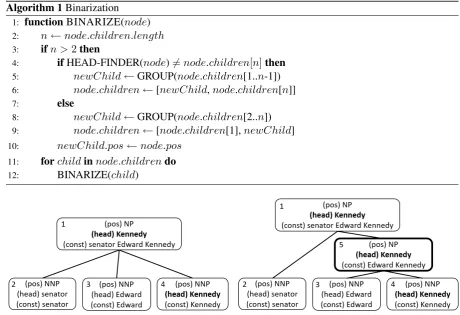
Algorithm 1Binarization
1: functionBINARIZE(node) 2: n←node.children.length
3: ifn >2then
4: ifHEAD-FINDER(node)6=node.children[n]then 5: newChild←GROUP(node.children[1..n-1])
6: node.children←[newChild,node.children[n]]
7: else
8: newChild←GROUP(node.children[2..n])
9: node.children←[node.children[1],newChild] 10: newChild.pos←node.pos
[image:2.595.66.527.62.377.2]11: forchildinnode.childrendo 12: BINARIZE(child)
Figure 1: Applying Algorithm1to the parse ofsenator Edward Kennedy.
constituency structure.
To classify constituents and take into account their structures, we propose BRNN-CNN, a spe-cial bidirectional recursive neural network at-tached with a convolutional network. For each sentence, a constituency parse where every node represents a meaningful chunk of the sentence, i.e. a constituent, is first generated. Then BRNN-CNN recursively computes hidden state features of ev-ery node and classifies each node by these hidden features. To capture structural linguistic informa-tion, bidirectional passes are applied so that each constituent sees what it is composed of as well as what is containing it, both in a near-to-far fashion. Our main contribution is the introduction of a novel constituent-based BRNN-CNN for named entity recognition, which successfully utilizes the linguistic structures of texts by recursive neural networks. We show that it achieves better scores than current state-of-the-art on OntoNotes 5.0, where good parses can be automatically gener-ated. Additionally, we analyze the effects of only considering constituents and the effects of con-stituency parses.
2 Related Work
Collobert et al. (2011) achieved near state-of-the-art performance on CoNLL-2003 NER with an end-to-end neural network which had minimal feature engineering and external data. Chiu and Nichols (2016) achieved the current state-of-the-art on both CoNLL-2003 and OntoNotes 5.0 NER with a sequential bidirectional LSTM-CNN. They also did extensive studies of additional features such as character type, capitalization, and Senna and DBpedia lexicons.
Finkel and Manning (2009) explored training a parser for an NER-suffixed grammar, jointly tack-ling parsing and NER. They achieved competitive results on OntoNotes with a CRF-CFG parser.
Recursive neural networks have been success-fully applied for parsing and sentiment analysis on Stanford sentiment treebank (Socher et al.,
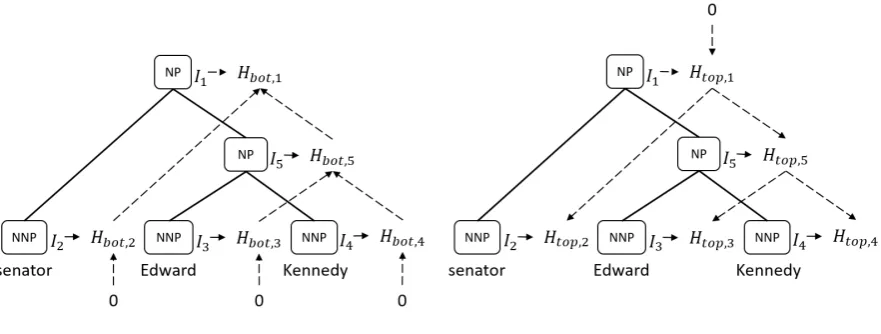
Figure 2: The bottom-up and top-down hidden layers applied to the binarized tree in Figure1.
3 Method
For each input sentence, our constituent-based BRNN-CNN first extracts features from its con-stituency parse, then recursively classifies each constituent, and finally resolves conflicting predic-tions.
3.1 Preparing Constituency Structures For a sentence and its associated constituency parse, our system first sets three features for each node: a POS, a word, and a head. While con-stituency tags and words should come readily, se-mantic head words are determined by a rule-based head finder (Collins,1999). Additionally, a fourth feature vector is added to each node to utilize lex-icon knowledge. The 3-bit vector records if the constituent of a node matches some phrases in each of the three SENNA (Collobert et al.,2011) lexicons of persons, organizations, and locations.
The system then tries to generate more plausible constituents while preserving linguistic structures by applying a binarization process which groups excessive child nodes around the head children. The heuristic is that a head constituent is usually modified by its siblings in a near to far fashion. Algorithm1shows the recursive procedure called for the root node of a parse. Figure 1shows the application of the algorithm to the parse ofsenator Edward Kennedy. With the heuristic thatEdward modifies the head node Kennedybefore senator. The binarization process successfully adds a new nodeEdward Kennedy that corresponds to a per-son name.
3.2 Computing Word Embeddings
For each word, our network retrieves one embed-ding from a trainable lookup table initialized by GloVe (Pennington et al.,2014). However, to cap-ture the morphology information of a word and help dealing with unseen words, the network com-putes another character-level embedding. Inspired by Kim et al. (2016), the network passes one-hot character vectors through a series of convolu-tional and highway layers to generate the embed-ding. These two embeddings are concatenated as the final embedding of a word.
3.3 Computing Hidden Features
Given a constituency parse tree, where every node represents a constituent, our network recursively computes two hidden state features for every node. First, for each nodeiwith left siblingland right siblingr, the raw feature vector Ii is formed by
concatenating the one-hot POS vectors of i, l, r, the head embeddings of i, l, r, the word embed-ding ofi, the lexicon vector ofi, and the mean of word embeddings in the sentence. Then, with the the set of child nodesCand the parent nodep, the hidden feature vectorsHbot,i andHtop,i are
com-puted by 2 hidden layers:
Hbot,i=ReLU((Iik X
c∈C
Hbot,c)Wbot+bbot) (1)
Htop,i=ReLU((IikHtop,p)Wtop+btop) (2)
whereWs are weight matrices,bs are bias vectors, andReLU(x) =max(0, x). In cases when some needed neighboring nodes do not exist, or wheni
Validation Test
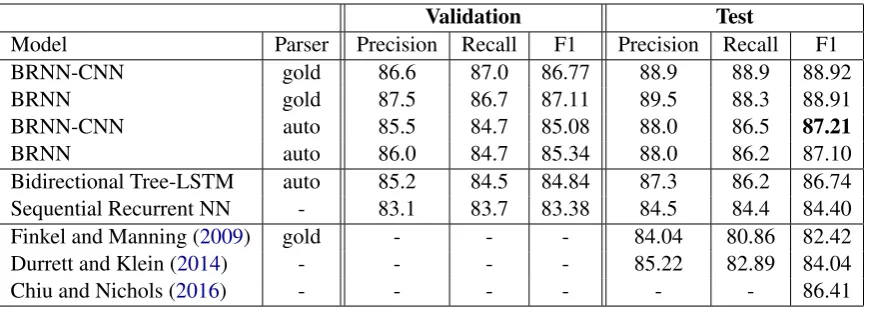
Model Parser Precision Recall F1 Precision Recall F1 BRNN-CNN gold 86.6 87.0 86.77 88.9 88.9 88.92
BRNN gold 87.5 86.7 87.11 89.5 88.3 88.91
BRNN-CNN auto 85.5 84.7 85.08 88.0 86.5 87.21
BRNN auto 86.0 84.7 85.34 88.0 86.2 87.10
Bidirectional Tree-LSTM auto 85.2 84.5 84.84 87.3 86.2 86.74 Sequential Recurrent NN - 83.1 83.7 83.38 84.5 84.4 84.40 Finkel and Manning (2009) gold - - - 84.04 80.86 82.42 Durrett and Klein (2014) - - - - 85.22 82.89 84.04
[image:4.595.83.518.61.217.2]Chiu and Nichols (2016) - - - 86.41
Table 1: Experiment results on whole dataset. BRNN is BRNN-CNN deprived of character-level em-beddings. Human-labeled parses and automatically generated parses are indicated by gold and auto respectively. Finkel and Manning used gold parses in training a joint model for parsing and NER.
Model BC BN MZ NW TC WB
Test set size (# tokens) 32488 23209 17875 49235 10976 18945 Test set size (# entities) 1697 2184 1163 4696 380 1137 Finkel and Manning (2009) 78.66 87.29 82.45 85.50 67.27 72.56 Durrett and Klein (2014) 78.88 87.39 82.46 87.60 72.68 76.17 Chiu and Nichols (2016) 85.23 89.93 84.45 88.39 72.39 78.38 BRNN-CNN-auto 85.98 90.96 84.93 89.18 73.18 80.39
Table 2: F1 scores on different data sources. From left to right: broadcast conversation, broadcast news, magazine, newswire, telephone conversation, and blogs & newsgroups.
vectors are used as the missing parts of raw or hid-den features.
Figure2shows the applications of the equations to the binarized tree in Figure 1. The computa-tions are done recursively in two direccomputa-tions. The bottom-up direction computes the semantic com-position of the subtree of each node, and the top-down counterpart propagates to that node the lin-guistic structures which contain the subtree. To-gether, hidden features of a constituent capture its structural linguistic information.
In addition, each hidden layer can be extended to a deep hidden network. For example, a 2-layer top-down hidden network is given by
Htα,i=ReLU((IikHtα,p)Wtα+btα)
Htβ,i =ReLU((Htα,ikHtβ,p)Wtβ+btβ)
where tα represents the first top-down hidden layer and tβ represents the second. Our best model is tuned to have 3 layers for both directions. 3.4 Forming Consistent Predictions
Given hidden features for every node, our network computes a probability distribution of named
en-tity classes plus a special non-enen-tity class by an output layer. For each node i with left siblingl
and right siblingr, the probability distributionOi
is computed by an output layer:
Oi=σ((HikHlkHr)Wout+bout) (3)
whereHx = Hbot,x+Htop,x, x ∈ {i, l, r}, and
σ(x) = (1 +e−x)−1. If a sibling does not exist, zero vectors are used as its hidden states. Should deep hidden layers be deployed, the last hidden layer is used.
Finally, the system makes predictions for a sen-tence by collecting the constituents whose most probable classes are named entity classes. How-ever, nodes whose ancestors are already predicted as named entities are ignored to prevent predicting overlapping named entities.
4 Evaluation
Split Token NE Constituent Train 1,088,503 81,828 93.3→97.3 Validate 147,724 11,066 92.8→97.0 Test 152,728 11,257 92.9→97.2
Table 3: Dataset statistics for OntoNotes 5.0.
4.1 Training and Tuning
To train the model, we minimize the cross entropy loss of the softmax class probabilities in Equation
3by the Adam optimizer (Kingma and Ba,2014). Other details such as hyperparameters are docu-mented in the supplemental materials as well as the public repository.
4.2 OntoNotes 5.0 NER
OntoNotes 5.0 annotates 18 types of named enti-ties for diverse sources of texts. Like other pre-vious work (Durrett and Klein, 2014; Chiu and Nichols, 2016), we use the format and the train-validate-test split provided by CoNLL-2012. In addition, both gold and auto parses are available.
Table 3 shows the dataset statistics. The last column shows the percentages of named entities that correspond to constituents of auto parses be-fore and after binarization.
Table 1 and Table 2 compare our results with others on the whole dataset and different sources respectively. The sample mean, standard devia-tion, and sample count of BRNN-auto and Chiu and Nichols’ model are 87.10, 0.14, 3 and 86.41, 0.22, 10 respectively. By one-tailed Welch’s T-test, the former significantly surpasses the latter with 99% confidence level (0.000489 p-value).
4.3 Analysis of the Approach
The training and validation sets contain 1,236,227 tokens and 92,894 named entities, of which 90,371 correspond to some constituents of binarized auto parses. This backs our motivation that more than 97% named entities are linguistic constituents, and 52,729 of them are noun phrases.
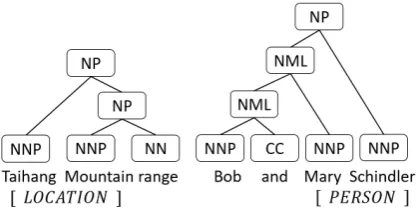
Essentially, the constituent-based approach fil-ters out the other 3% named entities that cross constituent boundaries (Figure 3), i.e. 3% loss of recall. We dig into this problem by analyzing a sequential labeling recurrent network (the sixth model in Table 1). The simple model performs reasonably well, but its non-constituent predic-tions are mostly false positive. In fact, it slightly improves if all non-constituent predictions are
re-Figure 3: Two sample named entities that cross different branches of syntax parses.
moved in post-processing, i.e., the precision gain of focusing on constituents is more significant than the recall loss. This is one advantage of our system over other sequential models, which try to learn and predict non-constituent named entities but do not perform well.
In addition, to analyze the effects of con-stituency structures, we test our models with dif-ferent qualities of parses (gold vs. auto in Table1). The significant F1 differences suggest that struc-tural linguistic information is crucial and can be learned by our model.
5 Conclusion
We have demonstrated a novel constituent-based BRNN-CNN for named entity recognition which successfully utilizes constituency struc-tures and surpasses the current state-of-the-art on OntoNotes 5.0 NER. Instead of propagating infor-mation by word orders as normal recurrent net-works, the model is able to recursively propa-gate structural linguistic information to every con-stituent. Experiments show that when a good parser is available, the approach will be a good alternative to traditional sequential labeling token-based NER.
Named entities that cross constituent bound-aries are analyzed and we find out that a na¨ıve sequential labeling model has difficulty predict-ing them without too many false positives. While avoiding them is one of the strengths of our model, generating more consistent parses to reduce this kind of named entities would be one possible di-rection for future research.
Acknowledgments
[image:5.595.312.521.63.175.2]References
Jason P.C. Chiu and Eric Nichols. 2016. Named entity recognition with bidirectional LSTM-CNNs. Trans-actions of the Association for Computational Lin-guistics, 4:357–370.
Michael Collins. 1999. Head-Driven Statistical Mod-els for Natural Language Parsing. Ph.D. thesis, University of Pennsylvania.
Ronan Collobert, Jason Weston, L´eon Bottou, Michael Karlen, Koray Kavukcuoglu, and Pavel Kuksa. 2011. Natural language processing (almost) from scratch. Journal of Machine Learning Research, 12(Aug):2493–2537.
Greg Durrett and Dan Klein. 2014. A joint model for entity analysis: Coreference, typing, and linking.
Transactions of the Association for Computational Linguistics, 2:477–490.
Jenny Rose Finkel and Christopher D. Manning. 2009. Joint parsing and named entity recognition. In Pro-ceedings of Human Language Technologies: The 2009 Annual Conference of the North American Chapter of the Association for Computational Lin-guistics, pages 326–334. Association for Computa-tional Linguistics.
Eduard Hovy, Mitchell Marcus, Martha Palmer, Lance Ramshaw, and Ralph Weischedel. 2006. Ontonotes: The 90% solution. In Proceedings of the Human Language Technology Conference of the NAACL, Companion Volume: Short Papers, pages 57–60. Association for Computational Linguistics.
Yoon Kim, Yacine Jernite, David Sontag, and Alexan-der M. Rush. 2016. Character-aware neural lan-guage models. InThirtieth AAAI Conference on Ar-tificial Intelligence.
Diederik Kingma and Jimmy Ba. 2014. Adam: A method for stochastic optimization.
arXiv:1412.6980 [cs.LG].
Alexandre Passos, Vineet Kumar, and Andrew Mc-Callum. 2014. Lexicon infused phrase embeddings for named entity resolution. InProceedings of the Eighteenth Conference on Computational Language Learning, pages 78–86.
Jeffrey Pennington, Richard Socher, and Christo-pher D. Manning. 2014. Glove: Global vectors for word representation. InEMNLP, volume 14, pages 1532–1543.
Sameer Pradhan, Alessandro Moschitti, Nianwen Xue, Hwee Tou Ng, Anders Bj¨orkelund, Olga Uryupina, Yuchen Zhang, and Zhi Zhong. 2013. Towards ro-bust linguistic analysis using ontonotes. In Proceed-ings of the Seventeenth Conference on Computa-tional Natural Language Learning, pages 143–152. Lev Ratinov and Dan Roth. 2009. Design challenges
and misconceptions in named entity recognition. In
Proceedings of the Thirteenth Conference on Com-putational Natural Language Learning, CoNLL ’09, pages 147–155, Stroudsburg, PA, USA. Association for Computational Linguistics.
Richard Socher, John Bauer, Christopher D Manning, and Andrew Y Ng. 2013a. Parsing with composi-tional vector grammars. InProceedings of the ACL conference.
Richard Socher, Christopher D. Manning, and An-drew Y. Ng. 2010. Learning continuous phrase representations and syntactic parsing with recursive neural networks. InProceedings of the NIPS-2010 Deep Learning and Unsupervised Feature Learning Workshop.
Richard Socher, Alex Perelygin, Jean Y Wu, Jason Chuang, Christopher D Manning, Andrew Y Ng, and Christopher Potts. 2013b. Recursive deep mod-els for semantic compositionality over a sentiment treebank. InProceedings of the Conference on Em-pirical Methods in Natural Language Processing, pages 1631–1642.
Kai Sheng Tai, Richard Socher, and Christopher D. Manning. 2015. Improved semantic representations from tree-structured long short-term memory net-works. In Proceedings of the 53rd Annual Meet-ing of the Association for Computational LMeet-inguistics and the 7th International Joint Conference on Natu-ral Language Processingg, pages 1556–1566. Erik F Tjong Kim Sang and Fien De Meulder.
2003. Introduction to the conll-2003 shared task: Language-independent named entity recognition. In