Proceedings of the 3rd Workshop on Neural Generation and Translation (WNGT 2019), pages 32–43 32
Generating a Common Question from Multiple Documents using
Multi-source Encoder-Decoder Models
Woon Sang Cho3 Yizhe Zhang† Sudha Rao† Chris Brockett† Sungjin Lee§∗
3Princeton University
†
Microsoft Research AI §
Amazon Alexa AI
3{woonsang}@princeton.edu,§{sungjinl}@amazon.com
†{yizzhang,sudhra,chrisbkt}@microsoft.com
Abstract
Ambiguous user queries in search engines re-sult in the retrieval of documents that often span multiple topics. One potential solution is for the search engine to generate multiple re-fined queries, each of which relates to a subset of the documents spanning the same topic. A preliminary step towards this goal is to gener-ate a question that captures common concepts of multiple documents. We propose a new task of generating common question from multiple documents and present simple variant of an existing multi-source encoder-decoder frame-work, called the Multi-Source Question Gen-erator (MSQG). We first train an RNN-based single encoder-decoder generator from (sin-gle document, question) pairs. At test time, given multiple documents, theDistributestep of our MSQG model predicts target word dis-tributions for each document using the trained model. TheAggregatestep aggregates these distributions to generate a common question. This simple yet effective strategy significantly outperforms several existing baseline models applied to the new task when evaluated using automated metrics and human judgments on the MS-MARCO-QA dataset.
1 Introduction
Search engines return a list of results in response to a user query. In the case of ambiguous queries, retrieved results often span multiple topics and might benefit from further clarification from the user. One approach to disambiguate such queries is to first partition the retrieved results by topic and then ask the user to choose from queries refined for each partition.
For example, a query ‘how good is apple?’
could retrieve documents some of which relate to apple the fruit, and some of which relate to Apple
∗
Work was done when affiliated with Microsoft Re-search AI
the company. In such a scenario, if the search en-gine generates two refinement queries‘how good is apple the fruit?’and‘how good is the company apple?’, the user could then choose one of it as a way to clarify her initial query.
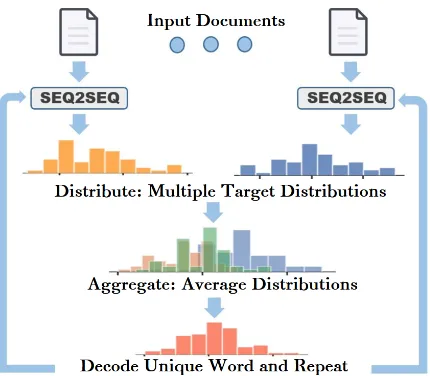
In this work, we take a step towards this aim by proposing a model that generates a common question that is relevant to a set of documents. At training time, we train a standard sequence-to-sequence model (Sutskever et al., 2014) with a large number of (single document, question) pairs to generate a relevant question given a sin-gle document. At test time, given multiple (N) input documents, we use our model, called the Multi-Source Question Generator (MSQG), to al-low document-specific decoders to collaboratively generate a common question. We first encode the N input documents separately using the trained encoder. Then, we perform an iterative procedure to i) (Distribute step) compute predictive word dis-tributions from each document-specific decoder based on previous context and generation ii) (Ag-gregate step) ag(Ag-gregate predictive word distribu-tions by voting and generate a single shared word for all decoders. These two steps are repeated until an end-of-sentence token is generated. We train and test our model on the MS-MARCO-QA dataset and evaluate it by assessing whether the original passages can be retrieved from the gen-erated question, as well as human judgments for fluency, relevancy, and answerability. Our model significantly outperforms multiple baselines. Our main contributions are:
i) a new task of generating a common question from multiple documents, where a common question target is doesnotexist, unlike multi-lingual sources to common language transla-tion tasks.
our simple variant model for generating a common question.
iii) an empirical evaluation framework based on automated metrics and human judgments on answerability, relevancy, and fluency to extensively evaluate our proposed MSQG model against the baselines.
2 Related Work
The use of neural networks to generate natural language questions has mostly focused on ques-tion answering (Labutov et al.,2015;Serban et al.,
2016;Rothe et al.,2016;Song et al.,2017;Duan et al., 2017; Du et al., 2017; Buck et al., 2017;
Song et al.,2018;Harrison and Walker,2018;Sun et al.,2018). A number of works process multiple passages by concatenating, adding, or attention-weight-summing among passage features into a single feature, and use it for downstream tasks (Zoph and Knight, 2016; Garmash and Monz,
2016; Libovick´y and Helcl, 2017; Wang et al.,
2018;Yan et al.,2018;Lebanoff et al.,2018; Ce-likyilmaz et al.,2018;Nishimura et al.,2018; Li-bovick´y et al.,2018;Li et al.,2018b;Nishida et al.,
2019). Our processing mechanisms are similar to
Garmash and Monz(2016),Firat et al. (2016), and
Dong and Smith(2018). The information retrieval literature is primarily concerned with reformulat-ing queries, by either selectreformulat-ing expansion terms from candidates as in pseudo-relevance feedback (Salton, 1971; Zhai and Lafferty, 2001; Xu and Croft,1996;Metzler and Croft, 2007;Cao et al.,
2008;Bernhard, 2010;Nogueira and Cho, 2017;
Li et al., 2018a). Our task differs because there is no supervision unlike multi-lingual translation tasks where a single target translation is available given sources from multiple languages.
3 Method
3.1 Multi-Source Question Generator
Our Multi-Source Question Generator (MSQG) model introduces a mechanism to generate a com-mon question given multiple documents. At
training time, it employs a standard sequence-to-sequence (S2S) model using a large number of (single document, question) pairs. Attesttime, it generates a common question given multiple doc-uments, similar toGarmash and Monz(2016) and
Firat et al.(2016). Specifically, our MSQG model iterates over two interleaved steps, until an end-of-sentence (EOS) token is generated:
Distribute Step During the Distribute step, we take an instance of the trained S2S model, and per-form inference withN different input documents. Each document is then encoded using one copy of the model to generate a unique target vocabulary distribution Pdec
i,t (for document i, at time t) for the next word. Note that source information comes from not only encoded latent representation from a source document, but also the cross-attention be-tween source and generation.
Aggregate Step During the Aggregate step, we aggregate theN different target distributions into one distribution by averaging them as below:
˜
Pdec
t =
1
N(β1P
dec
1,t +β2P2dec,t +· · ·+βNPN,tdec)
where P˜dec
t is the final decoding distribution at time t, and ΣNi βi = N. In our experiments, we weight all the decoding distributions equally (βi= 1) to smooth out features that are distinct in each documenti, wherei∈ {1, . . . , N}.
Note that the average Aggregate can be per-ceived as a majority voting scheme, in that each document-specific decoder will vote over the vo-cabulary and the final decision is made in a collab-orative manner. We also experimented with dif-ferent Aggregate functions: (i) MSQGmult mul-tiplies the distributions, which is analogous to a
unanimous voting scheme. However, it led to sub-optimal results since one unfavorable distri-bution can discourage decoding of certain com-mon words. (ii) MSQGmax takes the maximum probability of each word across N distributions and normalizes them into a single distribution, but it could not generate sensible questions so we ex-cluded from our pool of baselines.
3.2 Model Variants
Avoiding repetitive generation We observed
that naively averaging the target distributions at every decoding time continually emphasized the common topic, thereby decoding repetitive topic words. To increase the diversity of generated to-kens, we mask those tokens that have already been decoded in subsequent decoding steps. This strat-egy is reasonable for our task since questions gen-erally tend to be short and rarely have repeated words. This mechanism can be viewed as a hard counterpart of the coverage models developed in
Figure 1: Multi-Source Question Generator (MSQG) model at test time. The simple architecture signifi-cantly outperforms the baselines for generating com-mon questions, based on a number of metrics.
Shared encoder feature To initialize multiple decoders with the common meaning of the doc-uments in a partition, we broadcast the mean of encoded latent representation to each decoder and denote this variant by the subscriptsharedh. Note that the source document can affect the generated target vocabulary distribution Pdec
i,t at Distribute step through source-generation cross-attention.
4 Results
4.1 Experimental setup
Our training method uses the standard LSTM-based (Hochreiter and Schmidhuber, 1997) S2S with bi-linear attention (Luong et al.,2015). An input to our encoder is a concatenation of 100-dim GloVe (Pennington et al., 2014) vector, 100-dim predicate location vector, and 1024-dim ELMo (Peters et al.,2018) vector. Targets are embedded into 100-dim vectors. The S2S is bi-directional with a 256-dim bi-linear attention in each direction with ReLU (Nair and Hinton,2010). Our encoder has two layers and we use an Adam (Kingma and Ba,2014) with a learning rate of2×10−5.
4.2 Baselines
S2S We compare our model with a standard S2S baseline where weconcatenatetheN documents into a single document to generate a question. We provide detailed discussions about the effect of document order in supplementary material (SM). Two variants are considered (S2S and S2Srmrep). Beam size is set to 5.
MESD We also compare our model with the multi-encoder single-decoder (MESD) baseline where documents are encoded individually into {vi}Ni=1. The single decoder’s initial hidden state
is initialized by the mean of {vi}N
i=1, following
(Dong and Smith,2018).
4.3 Dataset
We use the Microsoft MAchine Reading COm-prehension Question-Answering Dataset (MS-MARCO-QA) (Nguyen et al., 2016), where a single data instance consists of an anonymized Bing search queryqand top-10 retrieved passages. Among the 10 passages, a passage is labelled is-selected:Trueif annotators used it, if any, to con-struct answers, and most instances contain one or two selected passages. For training S2S, we use a single selected passagep∗ ∈ {p1, p2, . . . , p10} as
input, and the queryqas target output.
4.4 Constructing Evaluation Sets
For automatic evaluation, we follow the standard evaluation method from the MS-MARCO Re-Ranking task. For each generated questionq, we˜
construct an evaluation set that contains 100 pas-sages in total.1
First, using the 10-passage sets from the MS-MARCO-QA development dataset as inputs, we generate common questions with the baselines and our MSQG models, decoded for a maximum length of 25 words. A sample generation is pro-vided in the SM. Secondly, we evaluate the gener-ations by using the pre-trained BERT-based MS-MARCO passage re-ranker R, which is publicly available and state-of-the-art as of April 1, 2019 (Nogueira and Cho, 2019). We assess whether the 10-passage set used to generate the question ranks higher than 90 other passages drawn from a pool of∼8.8 million MS-MARCO passages us-ing the generated question. These 90 passages are retrieved via a different criterion: BM25 ( Robert-son and Zaragoza,2009) using Lucene2. Note that there are multiple 10-passage sets that generate the same question q. For each of these 10-passage˜
sets, we construct a 100-passage evaluation set us-ing the same 90 passages retrieved via the BM25 criterion.
1
A small number of evaluation sets had less than 100 pas-sages because of duplicates between the source 10-passage set and the 90 passages retrieved via BM25.
Fluency Relevancy Answerability
MSQG S2S Human MSQG S2S Human MSQG S2S Human
Completely grammatical 81.37% 71.28% 82.48% Completely relevant 84.00% 71.00% 86.40% Completely answered 71.89% 48.45% 72.79% Comprehensible 16.58% 21.81% 16.35% Somewhat relevant 7.06% 7.56% 6.69% Somewhat answered 7.28% 5.83% 6.83% Not comprehensible 2.05% 6.91% 1.17% Not relevant 8.94% 21.44% 6.91% Not answered 20.83% 45.72% 20.38%
Human judges preferred: Human judges preferred: Human judges preferred:
Our Method Neutral Comparison Our Method Neutral Comparison Our Method Neutral Comparison
MSQG 75.77% 9.74% 14.49% S2S MSQG 79.22% 8.06% 12.72% S2S MSQG 78.50% 9.09% 12.40% S2S
[image:4.595.74.526.63.145.2]MSQG 42.11% 10.66% 47.24% Human MSQG 40.81% 9.67% 49.52% Human MSQG 40.66% 10.26% 49.08% Human
Table 1: Human evaluation of fluency, relevancy, and answerability. We used the top-ranked 30% of judges provided by a crowdsourcing service. Three judges performed each hit. Spammers were blocked at runtime. Agreement with most common was 81% overall. MSQG refers to MSQGsharedh,rmrep. The upper table shows evaluations of individual models and the lower shows pairwise comparisons: (Human ↔ MSQGsharedh,rmrep) and(MSQGsharedh,rmrep↔S2S). Comparison results are significant atp <0.00001.
Retrieval Statistics Model MRR nDCG MRR@10
Uniqueq˜ %dev.
S2S 0.0520 0.2147 0.0266 70.6
S2Srmrep 0.0540 0.2152 0.0284 80.4
MESD 0.0509 0.2141 0.0248 68.6
MEMDmult 0.0513 0.2142 0.0256 61.4
MEMD 0.0560 0.2209 0.0287 66.9
MSQGsharedh 0.0569 0.2220 0.0298 67.0
[image:4.595.72.290.233.323.2]MSQGsharedh,rmrep 0.0704 0.2337 0.0441 70.3
Table 2: Our proposed model MSQGsharedh,rmrep sig-nificantly outperforms baselines, based on the auto-mated retrieval statistics. Discussion of the proportion of unique questions is dealt in supplementary material.
4.5 Evaluation Metrics
MRR, MRR@10, nDCG An input to the
re-rankerRis a concatenation of the generated ques-tion and one passage i.e. [˜q, p]. For each pair, it returns a score∈ (0,1)where 1 denotes that the input passage is the most suitable forq. We score˜
all 100 pairs in an evaluation set. For the source 10-passage set, we average the 10 scores into one score as one combined document and obtain the retrieval statistics MRR, MRR@10 (Voorhees,
2001;Radev et al.,2002), and nDCG (J¨arvelin and Kek¨al¨ainen,2002) (see the SM for details).
Human Judgments We also conduct human
evaluation where we compare questions generated by MSQGsharedh,rmrepand the S2S baseline, and the reference question using three criteria: flu-ency,relevancy, andanswerabilityto the original 10 passages. We randomly select 200 (10-passage, reference question) sets from which we generate questions, yielding 2,000 (passage, question) eval-uation pairs for our model, baseline, and reference, respectively (see the SM for details).
4.6 Results
Table 3 shows the mean retrieval statistics and their proportion of unique generated questions
from 55,065 10-passage instances. Notice that our proposed MSQG models are more effective in terms of retrieving the source 10-passage sets. Particularly, MSQGsharedh,rmrepoutperforms the baselines in all metrics, indicating that broadcast-ing the mean of the document vectors to initial-ize the decoders (sharedh), and increasing the cov-erage of vocabulary (rmrep) are effective mecha-nisms for generating common questions.
Overall, the retrieval statistics are relatively low. Most 100 passages in the evaluation sets have high pair-wise cosine similarities. We computed simi-larities of passage pairs for a significant portion of the dataset until convergence. A random set of 10 passages has an average pair-wise similar-ity of 0.80, whereas the top-10 re-ranked passages have an average of 0.85 based on BERT (Devlin et al.,2018) embeddings. Given the small similar-ity margin, the retrieval task is challenging. De-spite of low statistics, we obtained statistical sig-nificance based on MRR with p < 0.00001 be-tweenallmodel pairs (see the SM for details).
Human evaluation results are shown in Table
1. In the comparison tasks, our proposed model significantly outperforms the strong baseline by a large margin. Nevertheless, judges preferred the reference over our model on all three aspects. The individual tasks corroborate our observations.
5 Conclusion
References
Mohammad Aliannejadi, Hamed Zamani, Fabio Crestani, and Bruce Croft. 2019. Asking clarifying questions in open-domain information-seeking con-versations. InSIGIR ’19.
Dzmitry Bahdanau, Kyunghyun Cho, and Yoshua Bengio. 2014. Neural machine translation by jointly learning to align and translate. CoRR, abs/1409.0473.
Delphine Bernhard. 2010. Query expansion based on pseudo relevance feedback from definition clus-ters. InColing 2010: Posters, pages 54–62, Beijing, China. Coling 2010 Organizing Committee.
Christian Buck, Jannis Bulian, Massimiliano Cia-ramita, Wojciech Gajewski, Andrea Gesmundo, Neil Houlsby, and Wei Wang. 2017. Ask the right ques-tions: Active question reformulation with reinforce-ment learning.
Guihong Cao, Jian-Yun Nie, Jianfeng Gao, and Stephen Robertson. 2008. Selecting good expansion terms for pseudo-relevance feedback. In Proceed-ings of the 31st Annual International ACM SIGIR Conference on Research and Development in Infor-mation Retrieval, SIGIR ’08, pages 243–250, New York, NY, USA. ACM.
Asli Celikyilmaz, Antoine Bosselut, Xiaodong He, and Yejin Choi. 2018. Deep communicating agents for abstractive summarization. In Proceedings of the 2018 Conference of the North American Chapter of the Association for Computational Linguistics: Hu-man Language Technologies, Volume 1 (Long Pa-pers), pages 1662–1675, New Orleans, Louisiana. Association for Computational Linguistics.
Eric Chu and Peter J. Liu. 2018. Unsupervised neural multi-document abstractive summarization. CoRR, abs/1810.05739.
Jacob Devlin, Ming-Wei Chang, Kenton Lee, and Kristina Toutanova. 2018. BERT: pre-training of deep bidirectional transformers for language under-standing.CoRR, abs/1810.04805.
Rui Dong and David Smith. 2018. Multi-input atten-tion for unsupervised OCR correcatten-tion. In Proceed-ings of the 56th Annual Meeting of the Association for Computational Linguistics (Volume 1: Long Pa-pers), pages 2363–2372, Melbourne, Australia. As-sociation for Computational Linguistics.
Xinya Du, Junru Shao, and Claire Cardie. 2017. Learn-ing to ask: Neural question generation for readLearn-ing comprehension. In Proceedings of the 55th An-nual Meeting of the Association for Computational Linguistics (Volume 1: Long Papers), pages 1342– 1352, Vancouver, Canada. Association for Compu-tational Linguistics.
Nan Duan, Duyu Tang, Peng Chen, and Ming Zhou. 2017. Question generation for question answering.
In Proceedings of the 2017 Conference on Empiri-cal Methods in Natural Language Processing, pages 866–874, Copenhagen, Denmark. Association for Computational Linguistics.
Orhan Firat, Baskaran Sankaran, Yaser Al-Onaizan, Fatos T. Yarman-Vural, and Kyunghyun Cho. 2016. Zero-resource translation with multi-lingual neural machine translation.CoRR, abs/1606.04164.
Jianfeng Gao, Michel Galley, and Lihong Li. 2018. Neural approaches to conversational AI. arXiv preprint arXiv:1809.08267.
Ekaterina Garmash and Christof Monz. 2016. Ensem-ble learning for multi-source neural machine transla-tion. InProceedings of COLING 2016, the 26th In-ternational Conference on Computational Linguis-tics: Technical Papers, pages 1409–1418, Osaka, Japan. The COLING 2016 Organizing Committee.
Vrindavan Harrison and Marilyn Walker. 2018. Neural generation of diverse questions using answer focus, contextual and linguistic features.
Sepp Hochreiter and J¨urgen Schmidhuber. 1997. Long short-term memory. Neural Comput., 9(8):1735– 1780.
Kalervo J¨arvelin and Jaana Kek¨al¨ainen. 2002. Cumu-lated gain-based evaluation of ir techniques. ACM Trans. Inf. Syst., 20(4):422–446.
Diederik P. Kingma and Jimmy Ba. 2014. Adam: A method for stochastic optimization. CoRR, abs/1412.6980.
Igor Labutov, Sumit Basu, and Lucy Vanderwende. 2015. Deep questions without deep understanding. In Proceedings of the 53rd Annual Meeting of the Association for Computational Linguistics and the 7th International Joint Conference on Natural Lan-guage Processing (Volume 1: Long Papers), pages 889–898, Beijing, China. Association for Computa-tional Linguistics.
Logan Lebanoff, Kaiqiang Song, and Fei Liu. 2018. Adapting the neural encoder-decoder framework from single to multi-document summarization. In
Proceedings of the 2018 Conference on Empirical Methods in Natural Language Processing, pages 4131–4141, Brussels, Belgium. Association for Computational Linguistics.
Ruizhi Li, Xiaofei Wang, Sri Harish Reddy Mallidi, Takaaki Hori, Shinji Watanabe, and Hynek Herman-sky. 2018b. Multi-encoder multi-resolution frame-work for end-to-end speech recognition. CoRR, abs/1811.04897.
Jindˇrich Libovick´y and Jindˇrich Helcl. 2017. Attention strategies for multi-source sequence-to-sequence learning. InProceedings of the 55th Annual Meet-ing of the Association for Computational LMeet-inguis- Linguis-tics (Volume 2: Short Papers), pages 196–202, Van-couver, Canada. Association for Computational Lin-guistics.
Jindˇrich Libovick´y, Jindˇrich Helcl, and David Mareˇcek. 2018. Input combination strategies for multi-source transformer decoder. InProceedings of the Third Conference on Machine Translation: Research Papers, pages 253–260, Belgium, Brus-sels. Association for Computational Linguistics.
Yi Luan, Yangfeng Ji, Hannaneh Hajishirzi, and Boyang Li. 2016. Multiplicative representations for unsupervised semantic role induction. InACL.
Thang Luong, Hieu Pham, and Christopher D. Man-ning. 2015. Effective approaches to attention-based neural machine translation. InProceedings of the 2015 Conference on Empirical Methods in Natu-ral Language Processing, pages 1412–1421, Lis-bon, Portugal. Association for Computational Lin-guistics.
Donald Metzler and W. Bruce Croft. 2007.Latent con-cept expansion using markov random fields. In Pro-ceedings of the 30th Annual International ACM SI-GIR Conference on Research and Development in Information Retrieval, SIGIR ’07, pages 311–318, New York, NY, USA. ACM.
Nasrin Mostafazadeh, Chris Brockett, Bill Dolan, Michel Galley, Jianfeng Gao, Georgios Sp-ithourakis, and Lucy Vanderwende. 2017. Image-grounded conversations: Multimodal context for natural question and response generation. In Pro-ceedings of the Eighth International Joint Confer-ence on Natural Language Processing (Volume 1: Long Papers), pages 462–472, Taipei, Taiwan. Asian Federation of Natural Language Processing.
Vinod Nair and Geoffrey E. Hinton. 2010. Rectified linear units improve restricted boltzmann machines. InProceedings of the 27th International Conference on International Conference on Machine Learning, ICML’10, pages 807–814, USA. Omnipress.
Tri Nguyen, Mir Rosenberg, Xia Song, Jianfeng Gao, Saurabh Tiwary, Rangan Majumder, and Li Deng. 2016. MS MARCO: A human generated machine reading comprehension dataset. In Proceedings of the Workshop on Cognitive Computation: Inte-grating neural and symbolic approaches 2016 co-located with the 30th Annual Conference on Neu-ral Information Processing Systems (NIPS 2016), Barcelona, Spain, December 9, 2016.
Kyosuke Nishida, Itsumi Saito, Kosuke Nishida, Kazu-toshi Shinoda, Atsushi Otsuka, Hisako Asano, and Junji Tomita. 2019. Multi-style generative reading comprehension.CoRR, abs/1901.02262.
Yuta Nishimura, Katsuhito Sudoh, Graham Neubig, and Satoshi Nakamura. 2018. Multi-source neural machine translation with missing data. In Proceed-ings of the 2nd Workshop on Neural Machine Trans-lation and Generation, pages 92–99, Melbourne, Australia. Association for Computational Linguis-tics.
Rodrigo Nogueira and Kyunghyun Cho. 2017. Task-oriented query reformulation with reinforcement learning. InProceedings of the 2017 Conference on Empirical Methods in Natural Language Process-ing, pages 574–583, Copenhagen, Denmark. Asso-ciation for Computational Linguistics.
Rodrigo Nogueira and Kyunghyun Cho. 2019.Passage re-ranking with BERT.CoRR, abs/1901.04085.
Jeffrey Pennington, Richard Socher, and Christo-pher D. Manning. 2014. GloVe: Global vectors for word representation. In Proceedings of the 2014 Conference on Empirical Methods in Natural Lan-guage Processing, pages 1532–1543.
Matthew E. Peters, Mark Neumann, Mohit Iyyer, Matt Gardner, Christopher Clark, Kenton Lee, and Luke Zettlemoyer. 2018. Deep contextualized word rep-resentations. InProc. of NAACL.
Dragomir R. Radev, Hong Qi, Harris Wu, and Weiguo Fan. 2002. Evaluating web-based question answer-ing systems. InProceedings of the Third Interna-tional Conference on Language Resources and Eval-uation (LREC’02), Las Palmas, Canary Islands -Spain. European Language Resources Association (ELRA).
Stephen Robertson and Hugo Zaragoza. 2009. The probabilistic relevance framework: Bm25 and be-yond.Found. Trends Inf. Retr., 3(4):333–389.
A Rothe, Brenden Lake, and Todd Gureckis. 2016. Asking and evaluating natural language questions. InProceedings of the 38th Annual Conference of the Cognitive Science Society.
G. Salton. 1971. The SMART Retrieval System— Experiments in Automatic Document Processing. Prentice-Hall, Inc., Upper Saddle River, NJ, USA.
Abigail See, Peter J. Liu, and Christopher D. Manning. 2017.Get to the point: Summarization with pointer-generator networks. InProceedings of the 55th An-nual Meeting of the Association for Computational Linguistics (Volume 1: Long Papers), pages 1073– 1083, Vancouver, Canada. Association for Compu-tational Linguistics.
factoid questions with recurrent neural networks: The 30M factoid question-answer corpus. In Pro-ceedings of the 54th Annual Meeting of the Associa-tion for ComputaAssocia-tional Linguistics (Volume 1: Long Papers), pages 588–598, Berlin, Germany. Associa-tion for ComputaAssocia-tional Linguistics.
Linfeng Song, Zhiguo Wang, and Wael Hamza. 2017. A unified query-based generative model for question generation and question answering.
Linfeng Song, Zhiguo Wang, Wael Hamza, Yue Zhang, and Daniel Gildea. 2018. Leveraging context in-formation for natural question generation. In Pro-ceedings of the 2018 Conference of the North Amer-ican Chapter of the Association for Computational Linguistics: Human Language Technologies, Vol-ume 2 (Short Papers), pages 569–574, New Orleans, Louisiana. Association for Computational Linguis-tics.
Xingwu Sun, Jing Liu, Yajuan Lyu, Wei He, Yan-jun Ma, and Shi Wang. 2018. Answer-focused and position-aware neural question generation. In Pro-ceedings of the 2018 Conference on Empirical Meth-ods in Natural Language Processing, pages 3930– 3939, Brussels, Belgium. Association for Computa-tional Linguistics.
Ilya Sutskever, Oriol Vinyals, and Quoc V Le. 2014. Sequence to sequence learning with neural net-works. InNIPS.
Zhaopeng Tu, Zhengdong Lu, Yang Liu, Xiaohua Liu, and Hang Li. 2016. Modeling coverage for neural machine translation. InProceedings of the 54th An-nual Meeting of the Association for Computational Linguistics (Volume 1: Long Papers), pages 76– 85, Berlin, Germany. Association for Computational Linguistics.
Ellen M. Voorhees. 2001.The trec question answering track.Nat. Lang. Eng., 7(4):361–378.
Yizhong Wang, Kai Liu, Jing Liu, Wei He, Yajuan Lyu, Hua Wu, Sujian Li, and Haifeng Wang. 2018. Multi-passage machine reading comprehension with cross-passage answer verification. InProceedings of the 56th Annual Meeting of the Association for Compu-tational Linguistics (Volume 1: Long Papers), pages 1918–1927, Melbourne, Australia. Association for Computational Linguistics.
Jinxi Xu and W. Bruce Croft. 1996. Query expansion using local and global document analysis. In Pro-ceedings of the 19th Annual International ACM SI-GIR Conference on Research and Development in Information Retrieval, SIGIR ’96, pages 4–11, New York, NY, USA. ACM.
Ming Yan, Jiangnan Xia, Chen Wu, Bin Bi, Zhongzhou Zhao, Ji Zhang, Luo Si, Rui Wang, Wei Wang, and Haiqing Chen. 2018. A deep cascade model for multi-document reading comprehension. CoRR, abs/1811.11374.
Chengxiang Zhai and John Lafferty. 2001. Model-based feedback in the language modeling approach to information retrieval. In Proceedings of the Tenth International Conference on Information and Knowledge Management, CIKM ’01, pages 403– 410, New York, NY, USA. ACM.
Retrieval Statistics Model MRR nDCG MRR@10
Uniqueq˜ %dev.
S2S-M256 0.0368 0.1943 0.0147 66.3
S2S-M512 0.0393 0.1980 0.0165 71.1
S2S 0.0520 0.2147 0.0266 70.6
S2Srmrep 0.0540 0.2152 0.0284 80.4
MESD-M512 0.0367 0.1941 0.0147 72.6
MESD 0.0509 0.2141 0.0248 68.6
MSQG-M512 0.0450 0.2056 0.0210 72.0
MSQGmult 0.0513 0.2142 0.0256 61.4
MSQG 0.0560 0.2209 0.0287 66.9
MSQGsharedh 0.0569 0.2220 0.0298 67.0
[image:8.595.309.527.61.173.2]MSQGsharedh,rmrep 0.0704 0.2337 0.0441 70.3
Table 3: Full results, comparing models constructed withM256,M512, and Mattn
256. M512 has the most number of parameters among the three considered.
Supplementary Material
A Full Experiment Results
Table3 shows the retrieval results on a larger set of baselines and MSQG models. Mattn
256 is an
attention-based encoder-decoder with hidden size 256 for both encoder and decoder. M256 and M512 are non-attention encoder-decoders with hidden sizes 256 and 512. S2S denotes Mattn
256,
as in the main paper. It shows that models con-structed using Mattn
256 are more effective as
op-posed to models usingM512 which has more
pa-rameters. Furthermore, we see that the averag-ing scheme in theReductionstep, broadcasting the same encoder mean, and increasing coverage of vocabulary tokens are important features to gener-ating common questions using MSQG models.
B Effect of Document Order on S2S
To examine if the order of multiple input docu-ments are critical for S2S, we obtain the attention weights at each decoding time, gathered across the development dataset. Next, we perform a simple ordinary least squares regression, where the pre-dictors are indexed word positions in a concate-nated input, and responses are assumed noisy at-tention weights over the development dataset for each word position.
The slope coefficient fell within the 95% confidence interval that includes the null:
−2.75×10−5,3.03×10−5
and a statistically significant intercept value of 0.0021. The result also validates that an average 10-passage string is approximately 476 (≈ 1
0.0021) words long. Thus,
[image:8.595.74.291.62.193.2]we conclude that the attention weights are evenly distributed across multiple document at test time, and the document ordering is not critical to the
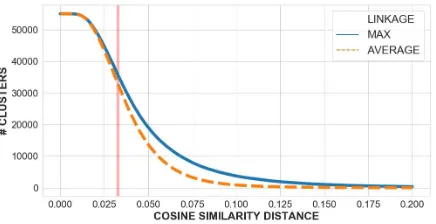
Figure 2: Agglomerative Clustering of 55,065 source 10-passage sets. Each set is represented by the mean of 10 BERT embeddings. Both max and average linkages yield the same inflection point at 0.0326, corresponding to 35,928 and 32,871 clusters. This method implies that the target proportion of unique generations should be at least 65% or 60%, which all models but MSQGmult achieve.
performance of S2S.
C Clustering Duplicate 10-passage Sets
In the MS-MARCO-QA dataset, there are many highly similar 10-passage sets retrieved from se-mantically close MS-MARCO queries. Exam-ples of semantically close MS-MARCO queries include [“symptoms blood sugar is low”, “low blood sugar symptoms”, “symptoms of low blood sugar levels” ,“signs and symptoms of low blood sugar”, “what symptoms from low blood sugar”, ... ], from which we expect duplicate generated questions, thus in sum, less than 55,065 different questions.
Therefore, to estimate the target proportion of unique generations, we examine the number of semantically similar 10-passage sets through ag-glomerative clustering. Figure2shows cluster re-sults with varying degrees of affinity thresholds, and observe that the effective models should gen-erate at least 65% unique questions from the de-velopment dataset. This, together with the low re-trieval statistics of MSQGmult, implies that mul-tiplying the distributions is not an appropriate Re-ductionstep.
D Statistical Significance Tests
Retrieval evaluation on ∼55K evaluation sets us-ing the re-ranker R is compute-intensive. Thus, for each model, we randomly sample and obtain retrieval statistics for 15K evaluation sets which are enough to mimic the true evaluation set distri-bution.
Then, to assess statistical significance, we use a non-parametric two-sample test, such as Mann-Whitney (MW) or Kolmogorov-Smirnov statistic, and test whether any pair of 15K retrieval sets be-tween two models come from the same distribu-tion. In our task, both tests reached the same con-clusion. MW two-sample tests on MRR results showed statistical significance atp <0.00001for
allmodel pairs dealt in the main paper, in spite of the relatively low retrieval statistics.
E Human Evaluation Templates
UHRS comparison and individual task instruc-tions and shown in the next pages.
F Generated Questions Sample
Passage 1: cucumbers and zucchini look similar but have nutritional differences . photo credit martin poole / digital vision / getty images . do n’t let the similarities between cucumbers and zucchini confuse you . even though both cylindrical vegetables are dark green with white flesh , they are distinctively different species . both cucumbers and zucchini belong to the curcurbit family , which also counts gourds , melons , pump-kins and squash among its members . cucumbers and zucchini differ both in how people commonly eat them and in their nutritional values . people almost always eat cukes raw , while zucchini is more often cooked .
Passage 2: cucumber and squash seedlings
both have elongated foliage for the first set of leaves after they emerge from the soil . the second set of leaves on a seedling varies . cucumber leaves are in the shape of a triangle and are flat in the center and rough to the touch . squash plants vary in shape as to the particular variety , but have three to five lobes and are larger than cucumber leaves . zucchini squash has elongated serrated leaves .
Passage 3: zucchini vs cucumber . zucchini
and cucumber are two vegetables that look mightily similar and hard to distinguish from each other . but in close inspection , they are actually very different . so read on . zucchini . zucchini is defined to be the kind of vegetable that is long , green colored and has many seeds .
Passage 4: as a general rule , we prefer cu-cumbers raw and zucchini cooked . while you ca n’t replace one with the other , zucchinis and cucumbers do complement one another . slice two cucumbers , two zucchinis and one sweet onion , and soak them all in rice vinegar for at least an hour in the refrigerator .
Passage 5: cucumber and zucchini are
pop-ular vegetables that are similar in appearance and botanical classification . but they differ signif-icantly in taste , texture and culinary application . zucchini and cucumber are both members of the botanical family cucurbitaceae , which includes melons , squashes and gourds .
Passage 6: melon vs. squash . the
cucum-ber is not particularly sweet , but it shares a genus with the cantaloupe and is botanically classified as a melon . the zucchini is a variety of summer squash and is of the same species as crookneck squash .
Passage 7: cucumber vs. zucchini . side by
side , they might fool you : cucumbers and zucchinis share the same dark green skin , pale seedy flesh , and long cylindrical shape . to the touch , however , these near - twins are not the same : cucumbers are cold and waxy , while zucchinis are rough and dry . the two vegetables also perform very differently when cooked .
Passage 8: the second set of squash leaves
grow much quicker and larger than cucumber leaves in the same time . squash leaves may be up to four times as large as a cucumber leaf when they are the same age .
Passage 10: zucchini ’s flowers are edible ; cucumber ’s flowers are not . zucchini is generally considered as a vegetable ; cucumber is classified as both a fruit and a vegetable . yes , they can fool the eye because of their similar look but as you go deeper , they are very different in so many ways .
Question generated by MSQGsharedh,rmrep:
what are the difference between cucumber and zucchini
Question generated by S2S:
different types of zucchini
Reference question: