Enhancing Medical Named Entity Recognition
with Features Derived from Unsupervised Methods
Maria Skeppstedt
Dept. of Computer and Systems Sciences (DSV) Stockholm University, Forum 100, 164 40 Kista, Sweden
Abstract
A study of the usefulness of features ex-tracted from unsupervised methods is pro-posed. The usefulness of these features will be studied on the task of performing named entity recognition within one clin-ical sub-domain as well as on the task of adapting a named entity recognition model to a new clinical sub-domain. Four named entity types, all very relevant for clini-cal information extraction, will be studied: Disorder, Finding, Pharmaceutical Drug and Body Structure. The named entity recognition will be performed using con-ditional random fields. As unsupervised features, a clustering of the semantic rep-resentation of words obtained from a ran-dom indexing word space will be used.
1 Introduction
Creating the annotated corpus needed for training a NER (named entity recognition) model is costly. This is particularly the case for texts in specialised domains, for which expert annotators are often re-quired. In addition, the need for expert annotators also limits the possibilities of using crowdsourcing approaches (e.g. Amazon Mechanical Turk). Fea-tures from unsupervised machine-learning meth-ods, for which no labelled training data is required, have, however, been shown to improve the per-formance of NER systems (Jonnalagadda et al., 2012). It is therefore likely that by incorporating features from unsupervised methods, it is possible to reduce the amount of training data needed to achieve a fixed level of performance.
Due to differences in the use of language, an NLP system developed for, or trained on, text from one sub-domain often shows a drop in per-formance when applied on texts from another sub-domain (Martinez et al., 2013). This has the
ef-fect that when performing NER on a new domain, annotated text from this new targeted sub-domain might be required, even when there are annotated corpora from other domains. It would, however, be preferable to be able to apply a NER model trained on text from one sub-domain on an-other sub-domain, with only a minimum of addi-tional data from this other targeted sub-domain. Incorporating features from unsupervised meth-ods might limit the amount of additional annotated data needed for adapting a NER model to a new sub-domain.
The proposed study aims at investigating the usefulness of unsupervised features, both for NER within one sub-domain and for domain adaptation of a NER model. The study has two hypotheses.
• Within one subdomain:
For reaching the same level of performance when training a NER model, less training data is required when unsupervised features are used.
• For adapting a model trained on one
subdo-main to a new targeted subdosubdo-main:
For reaching the same level of performance when adapting a NER model to a new subdo-main, less additional training data is required in the new targeted subdomain when unsu-pervised features are used.
For both hypotheses, the level of performance is defined in terms of F-score.
The proposed study will be carried out on dif-ferent sub-domains within the specialised text do-main ofclinical text.
2 Related research
There are a number of previous studies on named entity recognition in clinical text. For instance, a corpus annotated for the entities Condition,
Drug/Device and Locus was used for training a support vector machine with uneven margins (Roberts et al., 2008) and a corpus annotated for the entities Finding, Substance and Body was used for training a conditional random fields (CRF) sys-tem (Wang, 2009) as well as for training an en-semble of different classifiers (Wang and Patrick, 2009). Most studies have, however, been
con-ducted on the i2b2 medication challenge corpus
and the i2b2 challenge on concepts, assertions,
and relations corpus. Conditional random fields (Patrick and Li, 2010) as well as an ensemble clas-sifier (Doan et al., 2012) has for instance been used for extracting the entity Medication names from themedication challengecorpus, while all but the best among the top-performing systems used CRF for extracting the entities Medical Problem, Test
and Treatment from the i2b2 challenge on
con-cepts, assertions, and relationscorpus (Uzuner et al., 2011). The best system (de Bruijn et al., 2011) used semi-Markov HMM, and in addition to the features used by most of the other systems (e.g. tokens/lemmas/stems, orthographics, affixes, part-of-speech, output of terminology matching), this system also used features extracted from hierarchi-cal word clusters on un-annotated text. For con-structing the clusters, they used Brown clustering, and represented the feature as a 7-bit showing to what cluster a word belonged.
Outside of the biomedical domain, there are many studies on English corpora, which have shown that using features extracted from clusters constructed on unlabelled corpora improves per-formance of NER models, especially when using a smaller amount of training data (Miller et al., 2004; Freitag, 2004). This approach has also been shown to be successful for named entity recogni-tion in other languages, e.g. German, Dutch and Spanish (T¨ackstr¨om et al., 2012), as well as on related NLP tasks (Biemann et al., 2007), and there are NER tools that automatically incorpo-rate features extracted from unsupervised methods (Stanford, 2012). There are a number of addi-tional studies within the biomedical domain, e.g. using features from Brown and other clustering approaches (Stenetorp et al., 2012) or from k-means clustered vectors from a neural networks-based word space implementation (Pyysalo et al., 2014). Jonnalagadda et al. (2012) also present a study in which unsupervised features are used for
training a model on the i2b2 challenge on
con-cepts, assertions, and relations corpus. As un-annotated corpus, they used a corpus created by extracting Medline abstracts that are indexed with the publication type ”clinical trials”. They then built a semantic representation of this corpus in the form of a random indexing-based word space. This representation was then used for extracting a
number of similar words to each word in thei2b2
challenge on concepts, assertions, and relations
corpus, which were used as features when training a CRF system. The parameters of the random in-dexing model were selected by letting the nearest neighbours of a word vote for one of the UMLS categories Medical Problem, Treatment and Test according to the category of the neighbour, and by comparing the category winning the vote to the ac-tual category of the word. The authors motivate their choice of using random indexing for creat-ing features with that this method is scalable to very large corpora without requiring large compu-tational resources.
The method proposed here is similar to the method used by Jonnalagadda et al. (2012). How-ever, the focus of the proposed study is to explore to what extent unsupervised features can help a machine learning system trained only on very lit-tle data. It is therefore not feasible to use the large number of features that would be generated by using neighbouring words, as that would require a large training data set to ensure that there are enough training examples for each generated fea-ture. Therefore, the proposed method instead fur-ther processes the word space model by construct-ing clusters of semantically related words, thereby reducing the number of generated features, similar to the approach by Pyysalo et al. (2014).
3 Materials and previous results
Texts from three different clinical sub-domains:
cardiac ICU(intensive care unit),orthopaedic ER
(emergency room), andinternal medicine ERhave
been annotated (Tables 1-3).1All texts are written
in Swedish, and they all share the characteristics of text types written under time pressure; all of them containing many abbreviations and incom-plete sentences. There are, however, also differ-ences in e.g. what abbreviations are used and what
1Research on these texts aiming at extracting
Data set: All
Entity category # entities (Unique)
Disorder 1088 (533)
Finding 1798 (1295)
Pharmaceuticals 1048 (497)
[image:3.595.71.260.61.146.2]Body structure 461 (252)
Table 1: Annotated data, Cardiac ICU
Data set: All
Entity category # entities (Unique)
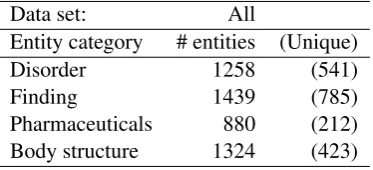
Disorder 1258 (541)
Finding 1439 (785)
Pharmaceuticals 880 (212)
Body structure 1324 (423)
Table 2: Annotated data, Orthopaedic ER
entities that are frequently mentioned.
The texts from cardiac ICU and orthopaedic ER will be treated as existing annotations in a cur-rent domain, whereas internal medicine ER will be treated as the new target domain. Approxi-mately a third of the texts from internal medicine ER have been doubly annotated, and an evaluation set has been created by manually resolving differ-ences between the two annotators (Skeppstedt et al., 2014). This evaluation subset will be used as held-out data for evaluating the NER task.
The following four entity categories have been annotated (Skeppstedt et al., 2014): (1) Disorder (a disease or abnormal condition that is not mo-mentary and that has an underlying pathological process), (2) Finding (a symptom reported by the patient, an observation made by the physician or the result of a medical examination of the patient), (3) Pharmaceutical Drug (not limited to generic name or trade name, but includes also e.g. drugs expressed by their effect, such as painkiller or sleeping pill). (4) Body Structure (an anatomically defined body part).
These three annotated corpora will be used in the proposed study, together with a large corpus of un-annotated text from which unsupervised fea-tures will be extracted. This large corpus will be a subset of the Stockholm EPR corpus (Dalianis et al., 2009), which is a large corpus of clinical text written in Swedish.
Named entity recognition on the internal medicine ER part of the annotated corpus has al-ready been studied, and results on the evaluation set were an F-score of 0.81 for the entity
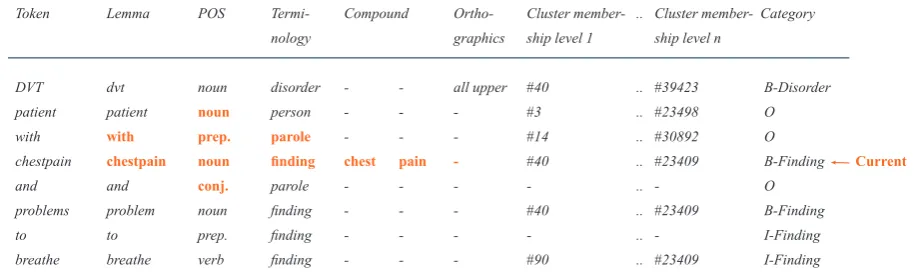
Dis-order, 0.69 for Finding, 0.88 for Pharmaceutical Drug, 0.85 for Body Structure and 0.78 for the combined category Disorder + Finding (Skeppst-edt et al., 2014). Features used for training the model on the development/training part of the in-ternal medicine ER corpus were the lemma forms of the words, their part of speech, their semantic category in used vocabulary lists, their word con-stituents (if the words were compounds) as well as the orthographics of the words. A narrow con-text window was used, as shown by the entries marked in boldface in Figure 1. As terminologies,
the Swedish versions of SNOMED CT2, MeSH3,
ICD-104, the Swedish medical list FASS5 were
used, as well as a vocabulary list of non-medical words, compiled from the Swedish Parole corpus (Gellerstam et al., 2000).
4 Methodological background
The proposed method consists of using the traiing data first for parameter setttraiing (through n-fold cross-validation) and thereafter for training a model using the best parameters. This model is then to be evaluated on held-out data. A number of rounds with parameter setting and training will be carried out, where each new round will make use of an increasingly larger subset of the training data. Two versions of parameter setting and model training will be carried out for each round; one using features obtained from unsupervised meth-ods on un-annotated text and one in which such features are not used. The results of the two ver-sions are then to be compared, with the hypothesis that the model incorporating unsupervised meth-ods will perform better, at least for small training data sizes.
To accomplish this, the proposed method makes use of four main components: (1) A system for training a NER model given features extracted from an annotated corpus. As this component, a conditional random fields (CRF) system will be used. (2) A system for automatic parameter set-ting. As a large number of models are to be con-structed on different sizes of the training data, for which optimal parameters are likely to differ, pa-rameters for each set of training data has to be determined automatically for it to be feasible to
2www.ihtsdo.org 3mesh.kib.ki.se
[image:3.595.73.260.178.263.2]Data set: Development Final evaluation
Entity category # entities (Unique) # entities
Disorder 1,317 (607) 681
Finding 2,540 (1,353) 1282
Pharmaceuticals 959 (350) 580
Body structure 497 (197) 253
[image:4.595.155.446.61.160.2]Tokens in corpus 45,482 25,370
Table 3: Annotated entities, internal medicine ER
Token Lemma POS Termi- Compound Ortho- Cluster member- .. Cluster member- Category nology graphics ship level 1 ship level n
DVT dvt noun disorder - - all upper #40 .. #39423 B-Disorder patient patient noun person - - - #3 .. #23498 O with with prep. parole - - - #14 .. #30892 O
chestpain chestpain noun finding chest pain - #40 .. #23409 B-Finding Current
and and conj. parole - - - - .. - O problems problem noun finding - - - #40 .. #23409 B-Finding to to prep. finding - - - - .. - I-Finding breathe breathe verb finding - - - #90 .. #23409 I-Finding
Figure 1: A hypothetical example sentence, with hypothetical features for training a machine learning model. Features used in a previous medical named entity recognition study (Skeppstedt et al., 2014) on this corpus are shown in boldface. The last column contains the entity category according to the manual annotation.
carry out the experiments. (3) A system for rep-resenting semantic similarity of the words in the un-annotated corpus. As this component, a ran-dom indexing based word space model will used. (4) A system for turning the semantic representa-tion of the word space model into features to use for the NER model. As this component, clustering will be used.
To give a methodological background, the theo-retical foundation for the four components will be described.
4.1 Conditional random fields
Conditional random fields (CRF or CRFs), intro-duced by Lafferty et al. (2001), is a machine learn-ing method suitable for segmentlearn-ing and labelllearn-ing sequential data and therefore often used for e.g. named entity recognition. As described in the re-lated research section, CRFs have been used in a number of studies for extracting entities from clin-ical text. In contrast to many other types of data, observed data points for sequential data, such as text, are dependent on other observed data points. Such dependences between data points are prac-tical to describe within the framework of
graphi-cal models (Bishop, 2006, p. 359), to which CRF belongs (Sutton and McCallum, 2006, p. 1). In the special, but frequently used, case of linear chain CRF, the output variables are linked in a chain. Apart from being dependent on the input variables, each output variable is then condition-ally independent on all other output variables, ex-cept on the previous and following output variable, given these two neighbouring output variables. In a named entity recognition task, the output vari-ables are the named entity classes that are to be predicted and the observed input variables are ob-served features of the text, such as the tokens or their part-of-speech.
[image:4.595.68.526.199.339.2]feature set (Sutton and McCallum, 2006, p. 1). For named entity recognition, the IOB-encoding is typically used for IOB-encoding the out-put variables. Tokens not annotated as an entity are then encoded with the labelO, whereas labels for annotated tokens are prefixed with a B, if it is the first token in the annotated chunk, and an
I otherwise (Jurafsky and Martin, 2008, pp. 763–
764). An example of this encoding is shown in the last column in Figure 1. In this case, where there are four types of entities, the model thus learns to classify in 8+1 different classes: B-Disorder, I-Disorder, B-Finding, I-Finding, B-Drug, I-Drug,
B-BodyStructure, I-BodyStructure andO.
The dependencies are defined by a large number of (typically binary) feature functions of input and output variables. E.g. is all of the following true?
• Output: The output at the current position is I-Disorder
• Output: The output at the previous position is B-Disorder
• Input: The token at the current position is chest-pain
• Input: The token at the previous position is experiences
A feature function in a linear chain CRF can only include the values of the output variable in current position and in the immediate previous po-sition, whereas it can include, and thereby show a dependence on, input variables from any position. The CRF model is trained through setting weights for the feature functions, which is carried
out by penalised maximum likelihood. Penalised
means that regularisation is used, and regularisa-tion is performed by adding a penalty term, which prevents the weights from reaching too large val-ues, and thereby prevents over-fitting (Bishop, 2006, p. 10). The L1-norm and the L2-norm are frequently used for regularisation (Tsuruoka et al.,
2009), and a variable C governs the importance
of the regularisation. Using the L1-norm also re-sults in that if C is large enough, some of the weights are driven to zero, resulting in a sparse model and thereby the feature functions that those weights control will not play any role in the model. Thereby, complex models can be trained also on data sets with a limited size, without being over-fitted. However, a suitable value of C must still be determined (Bishop, 2006, p. 145).
The plan for the proposed study is to use the
CRF package CRF++6, which has been used in a
number of previous NER studies, also in the med-ical domain. The CRF++ package automatmed-ically generates feature functions from user-defined tem-plates. When using CRF++ as a linear chain CRF, it generates one binary feature function for each combination of output class, previous output class and unique string in the training data that is ex-panded by a template. This means that L * L * M feature functions are generated for each tem-plate, where L = the number of output classes and M = the number of unique expanded strings. If only the current token were to be used as a fea-ture, the number of feature functions would be 9∗9∗|unique tokens in the corpus|. In practice, a lot of other features are, however, used. Most of these features will be of no use to the classifier, which means that it is important to use an infer-ence method that sets the weights of the feature functions with irrelevant features to zero, thus an inference method that promotes sparsity.
4.2 Parameter setting
As previously explained, a large number of mod-els are to be constructed, which requires a simple and efficient method for parameter setting. An ad-vantage with using the L1-norm is that only one parameter, the C-value, has to be optimised, as the weights for feature functions are driven to zero for feature functions that are not useful. The L1-norm will therefore be used in the proposed study. A very large feature set can then be used, without running the risk of over-fitting the model. Features will include those that have been used in previous clinical NER studies (Jonnalagadda et al., 2012; de Bruijn et al., 2011; Skeppstedt et al., 2014), with a context window of four previous and four following tokens.
When maximising the conditional log likeli-hood of the parameters, the CRF++ program will set parameters that are optimal for training the model for the best micro-averaged results for the four classes Disorder, Finding, Pharmaceutical drug and Body structure. A hill climbing search (Marsland, 2009, pp. 262–264) for finding a good C-value will be used, starting with a value very close to zero and thereafter changing it in a direc-tion that improves the NER results. A decreas-ingly smaller step size will be used for changing
Lemmatised and stop word filtered with a window size of 2 (1+1):
complain dermatitis eczema itch patient
complain: [0 0 0 2 2]
dermatitis: [0 0 0 1 0]
eczema: [0 0 0 1 0]
itch: [2 1 1 0 0]
[image:6.595.315.501.63.158.2]patient: [2 0 0 0 0]
Figure 2: Term-by-term co-occurrence matrix for the small corpus ”Patient complains of itching der-matitis. Patient complains of itching eczema.”
the C-value, until only small changes in the results can be observed.
4.3 Random indexing
Random indexing is one version of the word space model, and as all word space models it is a method for representing distributional semantics. The ran-dom indexing method was originally devised by Kanerva et al. (2000), to deal with the performance problems (in terms of memory and computation time) that were associated with the LSA/LSI im-plementations at that time. Due to its computa-tional efficiency, random indexing remains to be a popular method when building distributional se-mantics models on very large corpora, e.g. large web corpora (Sahlgren and Karlgren, 2009) or Medline abstracts (Jonnalagadda et al., 2012).
Distributional semantics is built on the distribu-tional hypothesis, which states that ”Words with similar meanings tend to occur in similar
con-texts”. If dermatitis and eczema often occur in
similar contexts, e.g. ”Patient complains of itch-ingdermatitis” and ”Patient complains of itching
eczema”, it is likely that dermatitis and eczema
have a similar meaning. One possible method of representing word co-occurrence information is to construct a term-by-term co-occurrence matrix, i.e. a matrix of dimensionalityw×w, in whichw
is the number of terms (unique semantic units, e.g. words) in the corpus. The elements of the matrix then contain the number of times each semantic unit occurs in the context of each other semantic unit (figure 2).
The context vectorsof two semantic units can then be compared as a measure of semantic sim-ilarity between units, e.g. using the the euclid-ian distance between normalised context vectors or the cosine similarity.
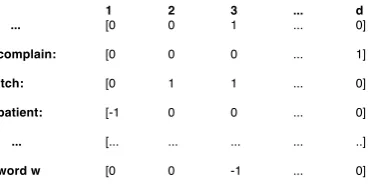
1 2 3 ... d
... [0 0 1 ... 0]
complain: [0 0 0 ... 1]
itch: [0 1 1 ... 0]
patient: [-1 0 0 ... 0]
... [... ... ... ... ..]
word w [0 0 -1 ... 0]
Figure 3: Index vectors.
The large dimension of a term-by-term ma-trix leads, however, to scalability problems, and the typical solution to this is to apply dimen-sionality reduction on the matrix. In a semantic space created by latent semantic analysis, for in-stance, dimensionality reduction is performed by applying the linear algebra matrix operation sin-gular value decomposition (Landauer and Dutnais,
1997). Random indexing is another solution, in
which a matrix with a smaller dimension is created from start, using the following method (Sahlgren et al., 2008):
Each term in the data is assigned a unique rep-resentation, called anindex vector. The index vec-tors all have the dimensionalityd(whered≥1000
butw). Most of the elements of the index
vec-tors are set to 0, but a few, randomly selected, el-ements are set to either +1 or -1. (Usually around 1-2% of the elements.) Instead of having orthogo-nal vectors, as is the case for the term-by-term ma-trix, the index vectors are nearly orthogonal. (See Figure 3.)
Each term in the data is also assigned acontext vector, also of the dimensionalityd. Initially, all elements in the context vectors are set to 0. The context vector of each term is then updated by, for every occurrence of the term in the corpus, adding the index vectors of the neighboring words. The
neighboring words are called thecontext window,
and this can be both narrow or wide, depending on what semantic relations the word space model is intended to capture. The size of the context win-dow can have large impact on the results (Sahlgren et al., 2008), and for detecting paradigmatic re-lations (i.e. words that occur in similar contexts, rather than words that occur together) a fairly nar-row context window has been shown to be most effective.
The resulting context vectors form a matrix of
dimensionw×d. This matrix is an approximation
[image:6.595.85.263.90.173.2]similar-Index vectors (never change)
1 2 3 ... d ...
itching: [0 1 1 ... 0] patient: [-1 0 0 ... 0] ...
___________________________________________________________ Context vectors
1 2 3 ... d ...
[image:7.595.78.267.69.152.2]complain: [-1 1 1 ... 0] ...
Figure 4: The updated context vectors.
0
Known term from an other entity category Known term from one entity category
Unknown term 0
θ dermatitis
eczema
Measure similarity between two terms by e.g. cosine θ
C1 C2
C3
C4
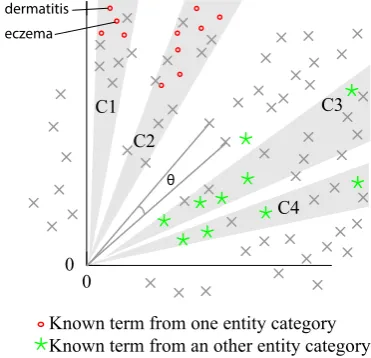
Figure 5: Context vectors for terms in a hypothet-ical word space withd=2. The context vectors for
the semantically similar words eczema and
der-matitisare close in the word space, in which close-ness is measured as the cosine of the angle be-tween the vectors. Four hypothetical clusters (C1-C4) of context vectors are also shown; clusters that contain a large proportion of known terms.
ity measures can be applied.
A hypothetical word space withd=2 is shown in Figure 5.
4.4 Clustering
As mentioned earlier, for the word space informa-tion to be useful for training a CRF model on a small data set, it must be represented as a feature that can only take a limited number of different values. The proposed methods for achieving this is to cluster the context vectors of the word space model, similar to what has been done in previous research (Pyysalo et al., 2014). Also similar to previous research, cluster membership for a word in the NER training and test data will be used as a
feature. Four named hypothetical clusters of con-text vectors are shown in the word space model in Figure 5 to illustrate the general idea, and an example of how to use cluster membership as a feature is shown Figure 1.
Different clustering techniques will be evalu-ated, for the quality of the created clusters, as well as for their computational efficiency. Having hi-erarchical clusters might be preferable, as clus-ter membership to clusclus-ters of different granular-ity then can be offered as features for training the CRF model. Which granularity that is most suit-able might vary depending on the entity type and also depending on the size of the training data. However, e.g. performing hierarchical agglomera-tive clustering (Jurafsky and Martin, 2008, p. 700) on the entire unlabelled corpus might be computa-tionally intractable (thereby defeating the purpose of using random indexing), as it requires pairwise comparisons between the words in the corpus. The pairwise comparison is a part of the agglomera-tive clustering algorithm, in which each word is first assigned its own cluster and then each pair of clusters is compared for similarity, resulting in a merge of the most similar clusters. This process is thereafter iteratively repeated, having the dis-tance between the centroids of the clusters as sim-ilarity measure. An alternative, which requires a less efficient clustering algorithm, would be to not create clusters of all the words in the corpus, but to limit initially created clusters to include those words that occur in available terminologies. Clus-ter membership of unknown words in the corpus could then be determined by measuring similarity to the centroids of these initially created clusters.
Regardless of what clustering technique that is chosen, the parameters of the random indexing models, as well as of the clustering, will be deter-mined by evaluating to what extent words that be-long to one of the studied semantic categories (ac-cording to available terminologies) are clustered
together. This will be measured usingpurity and
inverse purity (Amig´o et al., 2009). However, if clusters are to be created from all words in the cor-pus, the true semantic category will only be known for a very small subset of clustered words. In that case, the two measures have to be defined aspurity
[image:7.595.74.260.208.387.2]5 Proposed experiments
The first phase of the experiments will consist of finding the best parameters for the random index-ing model and the clusterindex-ing, as described above.
The second phase will consist of evaluating the usefulness of the clustered data for the NER task. Three main experiments will be carried out in this phase (I, II and III), using data set(s) from the fol-lowing sources:
I: Internal medicine ER
II: Internal medicine ER + Cardiac ICU
III: Internal medicine ER + Orthopaedic ER
In each experiment, the following will be car-ried out:
1. Divide internal medicine ER training data into 5 partitions (into a random division, to better simulate the situation when not all data is available, using the same random division for all experiments).
2. Run step 3-5 in 5 rounds. Each new round uses one additional internal medicine ER par-tition: (Experiments II and III always use the entire data set from the other domain). In each round, two versions of step 3-5 will be carried out:
(a) With unsupervised features. (b) Without unsupervised features.
3. Use training data for determining C-value (by n-fold cross-validation).
4. Use training data for training a model with this C-value.
5. Evaluate the model on the held-out internal medicine ICU data.
6 Open issues
What clustering technique to use has previously been mentioned as one important open issue. The following are examples of other open issues:
• Could the information obtained from random
indexing be used in some other way than as transformed to cluster membership features? Jonnalagadda et al. (2012) used the terms closest in the semantic space as a feature. Could this method be adapted in some way
to models constructed with a small amount of training data? For instance by restricting what terms are allowed to be used as such a feature, and thereby limiting the number of possible values this feature can take.
• Would it be better to use other approaches (or compare different approaches) for obtaining features from unlabelled data? A possibil-ity could be to use a more standard cluster-ing approach, such as Brown clustercluster-ing used in previous clinical NER studies (de Bruijn et al., 2011). Another possibility could be to keep the idea of creating clusters from vec-tors in a word space model, but to use other methods than random indexing for construct-ing the word space; e.g. the previously men-tioned latent semantic analysis (Landauer and Dutnais, 1997), or a neural networks-based word space implementation (Pyysalo et al., 2014).
• Many relevant terms within the medical
do-main are multi-word terms (e.g. of the type
diabetes mellitus), and there are studies on how to construct semantic spaces with such multiword terms as the smallest semantic unit (Henriksson et al., 2013). Should the whitespace segmented token be treated as the smallest semantic unit in the proposed study, or should the use of larger semantic units be considered?
Acknowledgements
Many thanks to Aron Henriksson, Alyaa Alfalahi, Maria Kvist, Gunnar Nilsson and Hercules Dalia-nis for taking a very active part in the planing of the proposed study, as well as to the three anony-mous reviewers for their constructive and detailed comments.
References
Enrique Amig´o, Julio Gonzalo, Javier Artiles, and Fe-lisa Verdejo. 2009. A comparison of extrinsic clustering evaluation metrics based on formal con-straints. Inf. Retr., 12(4):461–486, aug.
Chris Biemann, Claudio Giuliano, and Alfio Gliozzo. 2007. Unsupervised part of speech tagging support-ing supervised methods. InRANLP.
Hercules Dalianis, Martin Hassel, and Sumithra Velupillai. 2009. The Stockholm EPR Corpus -Characteristics and Some Initial Findings. In Pro-ceedings of ISHIMR 2009, Evaluation and imple-mentation of e-health and health information initia-tives: international perspectives. 14th International Symposium for Health Information Management Re-search, Kalmar, Sweden, pages 243–249.
Berry de Bruijn, Colin Cherry, Svetlana Kiritchenko, Joel D. Martin, and Xiaodan Zhu. 2011. Machine-learned solutions for three stages of clinical infor-mation extraction: the state of the art at i2b2 2010.
J Am Med Inform Assoc, 18(5):557–562.
Son Doan, Nigel Collier, Hua Xu, Hoang Duy Pham, and Minh Phuong Tu. 2012. Recognition of medi-cation information from discharge summaries using ensembles of classifiers. BMC Med Inform Decis Mak, 12:36.
Dayne Freitag. 2004. Trained named entity recogni-tion using distriburecogni-tional clusters. InEMNLP, pages 262–269.
M Gellerstam, Y Cederholm, and T Rasmark. 2000. The bank of Swedish. InLREC 2000. The 2nd In-ternational Conference on Language Resources and Evaluation, pages 329–333, Athens, Greece. Aron Henriksson, Mike Conway, Martin Duneld, and
Wendy W. Chapman. 2013. Identifying syn-onymy between SNOMED clinical terms of vary-ing length usvary-ing distributional analysis of electronic health records. InProceedings of the Annual Sym-posium of the American Medical Informatics Asso-ciation (AMIA 2013), Washington DC, USA. Siddhartha Jonnalagadda, Trevor Cohen, Stephen Wu,
and Graciela Gonzalez. 2012. Enhancing clinical concept extraction with distributional semantics. J Biomed Inform, 45(1):129–40, Feb.
Daniel Jurafsky and James H. Martin. 2008. Speech and Language Processing: An Introduction to Nat-ural Language Processing, Computational Linguis-tics and Speech Recognition. Prentice Hall, second edition, February.
Pentti Kanerva, Jan Kristoferson, and Anders Holst. 2000. Random indexing of text samples for latent semantic analysis. In L. R. Gleitman and A. K. Joshi, editors,Proceedings of the 22nd Annual Con-ference of the Cognitive Science Society, Mahwah, NJ.
John Lafferty, Andrew McCallum, and Fernando Pereira. 2001. Conditional random fields: Prob-abilistic models for segmenting and labeling se-quence data. In Proc. 18th International Conf. on Machine Learning, pages 282–289. Morgan Kauf-mann, San Francisco, CA.
Thomas K Landauer and Susan T. Dutnais. 1997. A solution to Plato’s problem: The latent semantic
analysis theory of acquisition, induction, and rep-resentation of knowledge. Psychological review, pages 211–240.
Stephen Marsland. 2009. Machine learning : an algo-rithmic perspective. Chapman & Hall/CRC, Boca Raton, FL.
David Martinez, Lawrence Cavedon, and Graham Pit-son. 2013. Stability of text mining techniques for identifying cancer staging. InProceedings of the 4th International Louhi Workshop on Health Document Text Mining and Information Analysis - Louhi 2013, Sydney, Australia, February.
Scott Miller, Jethran Guinness, and Alex Zamanian. 2004. Name tagging with word clusters and dis-criminative training. InProceedings of HLT, pages 337–342.
Jon Patrick and Min Li. 2010. High accuracy infor-mation extraction of medication inforinfor-mation from clinical notes: 2009 i2b2 medication extraction chal-lenge. J Am Med Inform Assoc, 17(5):524–527, Sep-Oct.
Sampo Pyysalo, Filip Ginter, Hans Moen, Tapio Salakoski, and Sophia Ananiadou. 2014. Distribu-tional semantics resources for biomedical text pro-cessing. In Proceedings of Languages in Biology and Medicine.
Angus Roberts, Robert Gaizasukas, Mark Hepple, and Yikun Guo. 2008. Combining terminology re-sources and statistical methods for entity recogni-tion: an evaluation. In Proceedings of the Sixth International Conference on Language Resources and Evaluation (LREC’08), pages 2974–2979, Mar-rakech, Morocco, may. European Language Re-sources Association (ELRA). http://www.lrec-conf.org/proceedings/lrec2008/.
Magnus Sahlgren and Jussi Karlgren. 2009. Termi-nology mining in social media. InProceedings of the 18th ACM conference on Information and knowl-edge management, CIKM ’09.
Magnus Sahlgren, Anders Holst, and Pentti Kanerva. 2008. Permutations as a means to encode order in word space. In Proceedings of the 30th An-nual Meeting of the Cognitive Science Society, pages 1300–1305.
Maria Skeppstedt, Maria Kvist, Gunnar H Nilsson, and Hercules Dalianis. 2014. Automatic recognition of disorders, findings, pharmaceuticals and body struc-tures from clinical text: An annotation and machine learning study. J Biomed Inform, Feb (in press).
Pontus Stenetorp, Hubert Soyer, Sampo Pyysalo, Sophia Ananiadou, and Takashi Chikayama. 2012. Size (and domain) matters: Evaluating semantic word space representations for biomedical text. In
Proceedings of the 5th International Symposium on Semantic Mining in Biomedicine.
Charles. Sutton and Andrew McCallum. 2006. An in-troduction to conditional random fields for relational learning. In Lise Getoor and Ben Taskar, editors,
Introduction to Statistical Relational Learning. MIT Press.
Oscar T¨ackstr¨om, Ryan McDonald, and Jakob Uszko-reit. 2012. Cross-lingual Word Clusters for Direct Transfer of Linguistic Structure. InProceedings of the 2012 Conference of the North American Chap-ter of the Association for Computational Linguis-tics: Human Language Technologies, pages 477– 487, Montr´eal, Canada, June. Association for Com-putational Linguistics.
Yoshimasa Tsuruoka, Jun’ichi Tsujii, and Sophia Ana-niadou. 2009. Fast full parsing by linear-chain con-ditional random fields. In Proceedings of the 12th Conference of the European Chapter of the Asso-ciation for Computational Linguistics, EACL ’09, pages 790–798, Stroudsburg, PA, USA. Association for Computational Linguistics.
¨Ozlem. Uzuner, Brett R. South, Shuying Shen, and Scott L. DuVall. 2011. 2010 i2b2/va challenge on concepts, assertions, and relations in clinical text. J Am Med Inform Assoc, 18(5):552–556.
Yefeng Wang and Jon Patrick. 2009. Cascading clas-sifiers for named entity recognition in clinical notes. In Proceedings of the Workshop on Biomedical In-formation Extraction, pages 42–49.