Structured and Unstructured Cache Models for SMT Domain Adaptation
Annie Louis
School of Informatics University of Edinburgh
10 Crichton Street Edinburgh EH8 9AB [email protected]
Bonnie Webber
School of Informatics University of Edinburgh
10 Crichton Street Edinburgh EH8 9AB [email protected]
Abstract
We present a French to English transla-tion system for Wikipedia biography ar-ticles. We use training data from out-of-domain corpora and adapt the system for biographies. We propose two forms of domain adaptation. The first biases the system towards words likely in biogra-phies and encourages repetition of words across the document. Since biographies in Wikipedia follow a regular structure, our second model exploits this structure as a sequence of topic segments, where each segment discusses a narrower subtopic of the biography domain. In this structured model, the system is encouraged to use words likely in the current segment’s topic rather than in biographies as a whole. We implement both systems using cache-based translation techniques. We show that a system trained on Europarl and news can be adapted for biographies with 0.5 BLEU score improvement using our mod-els. Further the structure-aware model out-performs the system which treats the entire document as a single segment.
1 Introduction
This paper explores domain adaptation of statisti-cal machine translation (SMT) systems to contexts where the target documents have predictable reg-ularity in topic and document structure. Regular-ities can take the form of high rates of word rep-etition across documents, similarities in sentence syntax, similar subtopics and discourse organiza-tion. Domain adaptation for such documents can exploit these similarities. In this paper we focus on topic (lexical) regularities in a domain. We present a system that translates Wikipedia biogra-phies from French to English by adapting a system
trained on Europarl and news commentaries. This task is interesting for the following two reasons.
Many techniques for SMT domain adaption have focused on rather diverse domains such as us-ing systems trained on Europarl or news to trans-late medical articles (Tiedemann, 2010a), blogs (Su et al., 2012) and transcribed lectures (Federico et al., 2012). The main challenge for such systems is translating out-of-vocabulary words (Carpuat et al., 2012). In contrast, words in biographies are closer to a training corpus of news commentaries and parlimentary proceedings and allow us to ex-amine how well domain adaptation techniques can disambiguate lexical choices. Such an analysis is harder to do on very divergent domains.
In addition, biographies have a fairly regu-lar discourse structure: a central entity (person who is the topic of the biography), recurring subtopics such as ‘childhood’, ‘schooling’, ‘ca-reer’ and ‘later life’, and a likely chronological order to these topics. These regularities become more predictable in documents from sources such as Wikipedia. This setting allows us to explore the utility of models which make translation decisions depending on the discourse structure. Translation methods for structured documents have only re-cently been explored in Foster et al. (2010). How-ever, their system was developed for parlimentary proceedings and translations were adapted using separate language models based upon the identity of the speaker, text type (questions, debate, etc.) and the year when the proceedings took place. Biographies constitute a more realistic discourse context to develop structured models.
This paper introduces a new corpus consisting of paired French-English translations of biography articles from Wikipedia.1 We translate this cor-pus by developing cache-based domain adaptation methods, a technique recently proposed by
Tiede-1Corpus available athttp://homepages.inf.ed. ac.uk/alouis/wikiBio.html.
mann (2010a). In such methods, cache(s) can be filled with relevant items for translation and trans-lation hypotheses that match a greater number of cache items are scored higher. These cache scores are used as additional features during decoding. We use two types of cache—one which encour-ages the use of words more indicative of the biog-raphy domain and another which encourages word repetition in the same document.
We also show how cache models allow for straightforward implementation of structured translation by refreshing the cache in response to topic segment boundaries. We fill caches with words relevant to the topic of the current segment which is being translated. The cache contents are obtained from an unsupervised topic model which induces clusters of words that are likely to ap-pear in the same topic segment. Evaluation re-sults show that cache-based models give upto 0.5 BLEU score improvements over an out-of-domain system. In addition, models that take topical struc-ture into account score 0.3 BLEU points higher than those which ignore discourse structure.
2 Related work
The study that is closest to our work is that of Tiedemann (2010a), which proposed cache mod-els to adapt a Europarl-trained system to medical documents. The system used caching in two ways: a cache-based language model (stores target lan-guage words from translations of preceding sen-tences in the same document) and a cache-based translation model (stores phrase pairs from pre-ceding sentence translations). These caches en-couraged the system to imitate the ‘consistency’ aspect of domain-specific texts i.e., the property that words or phrases are likely to be repeated in a domain and within the same document.
Cache models developed in later work, Tiede-mann (2010b) and Gong et al. (2011), were ap-plied for translating in-domain documents. Gong et al. (2011) introduced additional caches to store
(i) words and phrase pairs from training docu-ments most similar to a current source article, and(ii)words from topical clusters created on the training set. However, a central issue in these sys-tems is that caches become noisy over time, since they ignore topic shifts in the documents. This pa-per presents cache models which not only take ad-vantage of likely words in the domain and consis-tency, but which also adapt to topic shifts.
A different line of work very relevant to our study is the creation of topic-specific translations by either inferring a topic for the source document as a whole, or at the other extreme, finer topics for individual sentences (Su et al., 2012; Eidelman et al., 2012). Neither of these granularities seem in-tuitive in natural discourse. In this work, we pro-pose that tailoring translations to topics associated with discourse segments in the article is likely to be beneficial for two reasons: a) subtopics of such granularity can be assumed with reasonable con-fidence to re-occur in documents from the same domain and b) we can hypothesize that a domain will have a small number of segment-level topics.
3 System adaptation for biographies
We introduce two types of translation systems adapted for biographies:
General domain models (domain-) that use in-formation about biographies but treat the docu-ment as a whole.
Structured models (struct-)that are sensitive to topic segment boundaries and the specific topic of the segment currently being translated.
We implement both models using caches. Since we do not have parallel corpora for the biography domain, our caches contain items in the target lan-guage only. We use two types of caches:
Topic cache stores target language words (uni-grams) likely in a particular topic. Each unigram has an associated score.
Consistency cachefavours repetition of words in the sentences from the same document. It stores target language words (unigrams) from the 1-best translations of previous sentences in the same doc-ument. Each word is associated with an age value and a score. Age indicates when a word entered the cache and introduces a ‘decay effect’. Words used in immediately previous sentences have a low age value while higher age values indicate words from sentences much prior in the document. Scores are inversely proportional to age.
Both the types of caches are present in both the general domain and structured models, but the cache words and scores are computed differently.
3.1 A general domain model
This system seeks to bias translations towards words which occur often in biography articles.
com-pared to general news documents. We compare the words from 1,475 English Wikipedia biogra-phies articles to those in a large collection (64,875 articles) of New York Times (NYT) news articles (taken from the NYT Annotated Corpus (Sand-haus, 2008)). We use a log-likelihood ratio test (Lin and Hovy, 2000) to identify words which oc-cur with significantly higher probability in biogra-phies compared to NYT. We collect only words indicated with 0.0001 significance by the test to be more likely in biographies. We rank this set of 18,597 words in decreasing order of frequency in the biography article set and assign to each word a score equal to1/rank of the word. These words with their associated scores form the contents of the topic cache. In the general domain model, these same words are assumed to be useful for the full document and so the cache contents remain constant during translation of the full document.
The consistency cache stores words from the translations of preceding sentences of the same document. After each sentence is translated, we collect the words from the 1-best translation and filter out punctuation marks and out of vocabu-lary words. The remaining words are assigned an age of 1. Words already present in the cache have their age incremented by one. The new words with age 1 are added to the cache2 and the scores for all cache words are recomputed as e1/age. The age therefore gets incremented as each sentence’s words are inserted into the cache creating a decay. The cache is cleared at the end of each document. During decoding, a candidate phrase is split into unigrams and checked against each cache. Scores for matching unigrams are summed up to obtain a score for the phrase. Separate scores are computed for matches with the topic and consistency caches.
3.2 A structured model
Here we consider topic and consistency at a nar-rower level—within topic segments of the article.
The topic cache is filled with words likely in individual topic segments of an article. To do this, we need to identify the topic of smaller segments of the article and also store a set of most probable words for each topic. The topics should also have bilingual mappings which will allow us to infer for every French document segment, words that are likely in such a segment in the English language.
We designed and implemented an unsupervised
2If the word already exists in the cache, it is first removed.
topic model based on Latent Dirichlet Allocation (LDA) (Blei et al., 2003) to induce such word clus-ters. In a first step, we induce subtopics from monolingual articles in English and French sep-arately. The topics are subsequently aligned be-tween the languages as explained below.
In the first step, we learn a topic model which incorporates two main ideas a) adds sensitivity to topic boundaries by assigning a single topic per topic segment b) allows for additional flex-ibility by not only drawing the words of a seg-ment from the segseg-ment-level topic, but also al-lows some words to be either specific to the doc-ument (such as named entities) or stop words. To address idea b), we have a “switching variable” to switch between document-specific word, stop-word or domain-stop-words.
The generative story to create a monolingual dataset of biographies is as follows:
• Draw a distributionηfor the proportion of the three word types in the full corpus (domain subtopic, document-specific, stopwords) ∼
Dirichlet(γ)
• For each domain subtopic φl, 1 ≤ l ≤ T, draw a distribution over word vocabulary ∼
Dirichlet(β)
• Draw a distributionψover word vocabulary for stopwords∼Dirichlet()
• For each documentDi:
– Draw a distribution πi over vocab-ulary for document-specific words ∼
Dirichlet(µ)
– Draw a distribution θi giving the mix-ture of domain subtopics for this docu-ment∼Dirichlet(α)
– For each topic segmentMij inDi:
∗ Draw a domain subtopic zij ∼ Multinomial(θi)
∗ For each wordwijkin segmentMij:
· Draw a word type sijk ∼ Multinomial(η)
· Depending on the chosen switch value sijk, draw the word from the subtopic of the segment φzij
or document-specific vocabulary
πi, or stopwordsψ
for the vocabulary distributions associated with domain subtopics, document-specific words and stopwords. The concentration parameters are set to 0.001 to encourage sparsity. The distribution
θi for per-document subtopics is also drawn from a symmetric Dirichlet distribution with concentra-tion parameter 0.01. We use asymmetric Dirich-let priors for η set to (5, 3, 2) for (domain topic, document-specific, stopwords). The hyperparam-eter values were minimally tuned so that the differ-ent vocabulary distributions behaved as intended.
We perform inference using collapsed Gibbs sampling where we integrate out many multinomi-als. The sampler chooses a topiczij for every seg-ment and then samples a word typesijk for each word in the segment. We initialize these variables randomly and the assignment after 1000 Gibbs it-erations are taken as the final ones. We create these models separately for English and French, in each case obtainingT domain subtopics.
The second step creates an alignment between the source and target topics using a bilingual dic-tionary3. For each French topic, we find the top matching English topic by scoring the number of dictionary matches. It is unlikely for every French topic to have a closely corresponding En-glish topic. Based on observations about the qual-ity of topic alignment, we select the top 60% (out ofT) pairs of French-English aligned topics only. Note that our method uses two steps to learn bilingual topics in contrast to some multilingual topic models which learn aligned topics directly from parallel or comparable corpora (Zhao and Xing, 2006; Boyd-Graber and Blei, 2009; Jagar-lamudi and Daum´e III, 2010). These methods in-duce topic-specific translations of words. Rather we choose a less restrictive pairing of word clus-ters by topic since (i) we have monolingual bi-ographies in the two languages which could be quite heterogenous in the types of personalities discussed, (ii) we seek to identify words likely in a topic segment for example ‘career-related’ words rather than specific translations for source words.
During translation, for each topic segment in the source document, we infer the French topic most likely to have produced the segment and find the corresponding English-side topic. The most prob-able words for that English topic are then loaded into the topic cache. The score for a word is its probability in that topic. When a topic segment
3A filtered set of 13,400 entries fromwww.dict.cc
boundary is reached, the topic cache is cleared and the topic words for the new segment are filled.
The consistency cache’s contents are computed similarly to the general domain case. However, the cache gets cleared at segment boundaries.
4 Training and test data
We distinguish two resources for data. The out-of-domain system is trained using the WMT’12 datasets comprising Europarl and news commen-tary texts. It has 2,144,820 parallel French-English sentence pairs. The language model is trained using the English side of the training cor-pus. The tuning set has 2,489 sentence pairs.
Our test set is a corpus of French to En-glish translations of biographies compiled from Wikipedia. To create the biography corpus, we collect articles which are marked with a “Trans-lation template” in Wikipedia metadata. These markings indicate a page which is translated from a corresponding page in a different language and also contains a link to the source article. (Note that these article pairs are not those written on the same topic separately in the two languages.) We collect pairs of French-English pages with this template and filter those which do not belong to the Biography topic (using Wikipedia metadata).
Note, however, that these article pairs are not very close translations. During translation an edi-tor may omit or add information and also reorga-nize parts of the article. So we filter out the paired documents which differ significantly in length. We use LFAligner4 to create sentence alignments for the remaining document pairs. We constrain the alignments to be within documents but since sec-tion headings were not maintained in translasec-tions, we did not further constrain alignments within sec-tions. We manually corrected the resulting align-ments and keep only docualign-ments which have good alignments and have manually marked topic seg-ments (Wikipedia section headings). Unaligned sentences were filtered out. Table 1 shows a sum-mary of this data and the split for tuning and test. The articles are 12 to 87 sentences long and con-tain 5 topic segments on average.
We also collect a larger set of monolingual French and English Wikipedia biographies to cre-ate the domain subtopics. We select only articles that have at least 10 segments (sections) to ensure
Tuning Test
No. of article pairs 15 30
Total sentences pairs 430 1008
Min. article size (in sentences) 13 12 Max. article size (in sentences) 59 85 Average no. of segments per article 4.7 5.3
Table 1: Summary of Wikipedia biographies data that they are comprehensive ones. This collection contains 1000 French and 1000 English articles.
5 Experimental settings
We use the Moses phrase-based translation system (Koehn et al., 2007) to implement our models. 5.1 Out-of-domain model
This baseline model is trained on the WMT 2012 training sets described in the previous section and uses the six standard features from Koehn et al. (2003). We build a 5-gram language model us-ing SRILM. The features were tuned usus-ing MERT (Och, 2003) on the WMT 2012 tuning sets. This system does not use any data about biographies.
5.2 Biography-adapted models
First we perform experiments using the manually marked sections in Wikipedia as topic segments. We also report results with automatic segmenta-tion in Secsegmenta-tion 7.
The domain and structured models have two ex-tra features ‘topic cache’ and ‘consistency cache’. For the structured model, topic segment bound-aries and inferred topic is passed as XML markup on the source documents. For the consistency cache, we use a wrapper which passes the 1-best translation (also using XML markup) of the preceding sentence and updates the cache before translating every next sentence.
[image:5.595.308.523.58.230.2]We tune the weights for these new cache tures as follows. The weights for the baseline fea-tures from the out-of-domain model are kept con-stant. The weights for the new cache features are set using a grid search. This tuning uses the bi-ographies documents listed in Table 1 as tuning data. We run the decoding using the baseline fea-ture weights and a weight for a cache feafea-ture and compute the (case-insensitive) BLEU (Papineni et al., 2002) scores of each tuning document. The weight for the cache feature which maximizes the average BLEU value over the tuning documents is chosen. We have not tuned the features us-ing MERT in this study since a grid search al-lowed us to quantify the influence of increasing
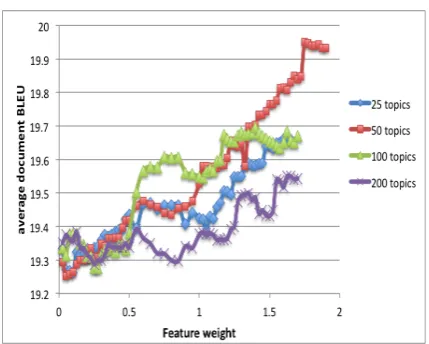
Figure 1: Effect of feature weights and number of topics on accuracy for structured topic cache weights on the new features directly. Previous work has noted that MERT fails to find good set-tings for cache models (Tiedemann, 2010b). In future work, we will explore how successful op-timization of baseline and cache feature weights could be done jointly. We present the findings from our grid search below.
The struct-topic cache has two parameters, the number of topicsT and the number of most prob-able words from each topic which get loaded into the cache. We ran the tuning for T = 25, 50, 100 and 200 topics (note that 60% of the topics will be kept after bilingual alignment, see Section 3.2). We also varied the number of topic words chosen—50, 100, 250 and 500.
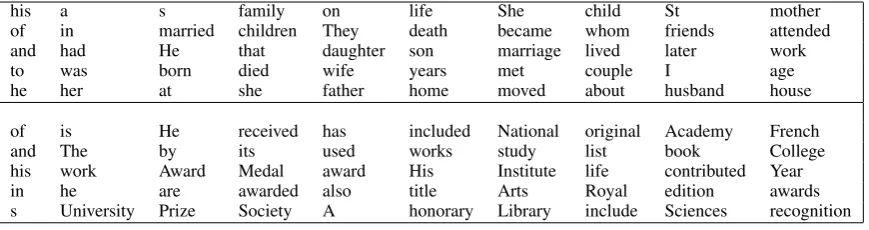
The performance did not vary with the number of topic words used and 50 words gave the same performance as 500 words for topic models with any number of topics. This interesting result sug-gests that only the most likely and basic words from each topic are useful. The top 50 words from two topics (one capturing early life and the other an academic career) taken from the 50-topic model on English biographies are shown in Table 2.
In Figure 1, we show the performance of sys-tems using different number of topics. In each case, the same number of topic words (50) was added to the cache. We find that 50 topics model performs best confirming our hypothesis that only a small number of domain subtopics is plausible. We choose the 50 topic model with top 50 words for each topic for the structured topic cache.
his a s family on life She child St mother
of in married children They death became whom friends attended
and had He that daughter son marriage lived later work
to was born died wife years met couple I age
he her at she father home moved about husband house
of is He received has included National original Academy French
and The by its used works study list book College
his work Award Medal award His Institute life contributed Year
in he are awarded also title Arts Royal edition awards
[image:6.595.82.517.62.177.2]s University Prize Society A honorary Library include Sciences recognition
Table 2: Top 50 words from 2 topics of theT = 50topic model
Cache type weight BLEU-doc
Domain-topic 0.075 19.79
Domain-consistency 0.05 19.70
Domain-topic + consis. 0.05, 0.05 19.80
Struct-topic (50 topics) 1.75 19.94
Struct-consistency 0.125 19.70
Struct-topic + consis. 0.4, 0.1 19.84 Domain-consis. + struct-topic 0.1, 0.25 19.86
Out-of-domain 19.33
Table 3: Best weights for cache features and BLEU scores (averaged for tuning documents).
out-of-domain model are shown on the last line. Note that these scores are overall on a lower scale for a French-English system due to out-of-domain differences and because the reference translations from Wikipedia are not very close ones.
These numbers show that cache models have the potential to provide better translations compared to an out-of-domain baseline. The structured topic model system is the best system outperforming the out-of-domain system and also the domain-topic system. Hence, treating documents as composed of topical segments is a useful setting for auto-matic translation.
The domain and structured versions of the con-sistency cache however, show no difference. This result could arise due to the decay factor incor-porated in the consistency cache. Higher scores are given to words from immediately previous sentences compared to those far off. This decay implicitly gives lower scores to words from ear-lier topic segments than those from recent ones. Explicitly refreshing the cache in the structured model does not give additional benefits.
When consistency and topic caches are used to-gether in both general domain and structured set-tings, the combination is not better than individual caches. We also tried a setting where the consis-tency cache is document-range and the topic cache works at segment level (domain-consis. + struct-topic). This combination also does not outperform using the structured topic cache alone.
Model BLEU-doc BLEU-sent
Domain-topic 17.63 17.61
Domain-consistency 17.70 17.75
Domain-topic+consis. 17.63 17.63
Struct-topic (50 topics) 17.76 17.84
Struct-consistency 17.33 17.34
Struct-topic+consis. 17.47 17.51
Struct-topic+dom-consis. 17.29 17.25
Out-of-domain 17.37 17.43
Table 4: BLEU scores on the test set. ‘doc’ in-dicates BLEU scores averaged over documents, ‘sent’ indicates sentence-level BLEU
6 Results on the test corpus
The best weights chosen on the tuning corpus are used to decode the biographies test corpus (sum-marized in Table 1). Table 4 reports the av-erage BLEU of documents as well as sentence level BLEU scores of the corpus. We used the paired bootstrap resampling method (Koehn 2004) to compute significance.
The struct-topic model gives the highest im-provement of 0.4 sentence level BLEU over the out-of-domain model. Struct-topic is also 0.23 BLEU points better compared to the domain-topic model confirming the usefulness of model-ing structure regularities. These improvements at significant at 95% confidence level.
cache leading to low performance of the ‘struc-tured’ version. In our current model, we do not distinguish between words making up the consis-tency cache. In future, we plan to experiment with consistency caches of different ranges and which hold different types of words. This ap-proach would require identifying named entities and parts of speech on the automatic translations of previous sentences, which is likely to be error-prone and so require methods for associating a confidence measure with the cache words.
7 Understanding factors that influence structured cache models
The documents in our test corpus have varying lengths, number of segments and segment sizes. This section explores the behavior of structured models on these different document types. For this analysis, we compare the BLEU scores from thedomainand thestructuredversions of the two caches. We do not consider the out-of-domain sys-tem here since we are interested in quantifying gains from using document structure.
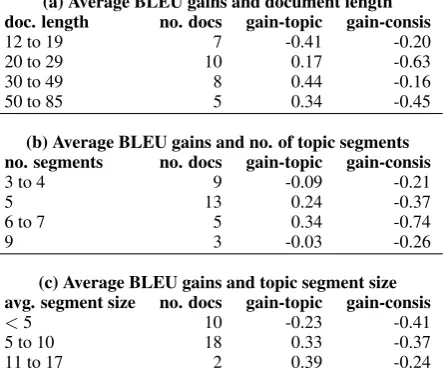
For each document in our test corpus, we com-pute (i) the difference between the BLEU scores of struct-topic and domain-topic systems ( BLEU-gain-topic), and (ii) the difference in BLEU scores between the struct-consistency and domain-consistency systems (BLEU-gain-consis). Table 5 reports the average BLEU gains binned by a) the document length (in sentences) b) number of topic segments in the document and c) the average size of topic segments in a document (in sentences).
The numbers clearly indicate that performance is not uniform across different types of docu-ments. The struct-topic cache performs much bet-ter on longer documents of over 30 sentences giv-ing 0.3 to 0.4 BLEU points increase compared to the general domain model. On the other hand, the performance worsens when the structured cache is applied on documents with less than 20 sen-tences. Similarly, the struct-topic cache is benefi-cial for documents where the average segment size is larger than 5 sentences and when the number of topic segments is around 5 to 7.
The struct-consistency cache generally per-forms worse than the unstructured version and there does not appear to be a niche set according to any of the properties—document length, num-ber of segments and segment size.
Given these findings, it is possible that the struct-topic cache can benefit by modifying the
(a) Average BLEU gains and document length
doc. length no. docs gain-topic gain-consis
12 to 19 7 -0.41 -0.20
20 to 29 10 0.17 -0.63
30 to 49 8 0.44 -0.16
50 to 85 5 0.34 -0.45
(b) Average BLEU gains and no. of topic segments
no. segments no. docs gain-topic gain-consis
3 to 4 9 -0.09 -0.21
5 13 0.24 -0.37
6 to 7 5 0.34 -0.74
9 3 -0.03 -0.26
(c) Average BLEU gains and topic segment size
avg. segment size no. docs gain-topic gain-consis
<5 10 -0.23 -0.41
5 to 10 18 0.33 -0.37
[image:7.595.311.533.66.258.2]11 to 17 2 0.39 -0.24
Table 5: Average BLEU score gains from a struc-tured cache (compared to domain caches) split by different properties of documents in the test set document structure to match that handled better by the structured model. We test this hypothe-sis by segmenting all test documents with an ideal segment size. The model seems to perform better when each segment has around 5 to 10 sentences (longer segments are also preferred but we have few very long documents in our corpus), so we try to re-segment the articles to contain approxi-mately 7 sentences in each segment. We use an automatic topic segmentation method (Eisenstein and Barzilay, 2008) to segment the source arti-cles in our test corpus. For each article we request (document length)/7segments to be created.5
We then run the structured topic and consis-tency models on the automatically segmented cor-pus using the same feature weights as before. The results are shown in Table 6.
Model BLEU (doc) BLEU (sent)
Struct-topic 17.94 17.94
Struct-consistency 17.51 17.46
Table 6: Translation performance on automati-cally segmented test corpus
The struct-topic cache now reaches our best re-sult of 0.5 BLEU improvement over the out-of-domain model and 0.3 improvement over the un-structured domain model. The consistency cache is also slightly better using the automatic segmen-tation than the manual sections. Choosing the right granularity appears to be important for struc-tured caches and coarse section headers may not be ideal. This result also shows automatic
of (42) he (36) his (36) the (22) to (11) in (9) was (7) one (6) a (3) at (3) head (3) that (3) construction (3) empire office french bases reconstruction only such
all ban marseille main charged have well researchers openness retreat
an two mechanical events army iron class surrender order thirty
and black objectives factory disciple largest close budget part time
as who ceremony figure majority level even sentence project trained
[image:8.595.81.521.62.134.2]on seat diplomatic wheat working winner life archaeological 9 during
Table 7: Impact words computed on the test corpus. The number of times each word was found in the impact list is indicated within parentheses. Words listed without parentheses appeared once in the list.
(1) (S)Pendant la Premi`ere Guerre mondiale, mobilis´e dans les troupes de marine, il combat dans les Balkans et les Dardanelles.
(R)During the First World War, conscripted into the navy,hefought in the Balkans and the Dardanelles. (B)During World War I, mobilized in troops navy, it fight in the Balkans and Dardanelles.
(C)During World War I, mobilized troops in the navy,hefight in the Balkans and the Dardanelles. (2) (S) `A l’ˆage de 15 ans, elle a ´et´e choisie par la troupe d’op´era de l’arm´ee chinoise pour ˆetre form´ee au chant.
(R)At the age of 15, she was selected by the Chinese Armys Operatic troupe to betrainedas a singer. (B)In the age of 15 years, she was chosen by the pool of opera of the Chinese military to be formed the call. (C)In the age of 15 years, she was chosen by the pool of opera of the Chinese military to betrainedto call. (3) (S)La figure de la Corriveau n’a cess´e, depuis, d’inspirer romans, chansons et pi`eces de th´eˆatre et d’alimenter les
controverses.
(R)Thefigureof Corriveau still inspires novels, songs and plays and is the subject of argument.
(B)The perceived the Corriveau has stopped, since, inspire novels, songs and parts of theater and fuel controversies.
(C)Thefigureof the Corriveau has stopped, since, inspire novels, songs and parts of theater and fuel controversies.
Table 8: Three examples of impact words in test translations. Abbreviations: S source sentence, R -reference translation, B - baseline translation, C - structured topic cache translation
tation can be successfully used in these models.
8 Changes made by the cache models
Here we examine the kinds of changes made by the cache models which have lead to the im-proved BLEU scores. We focus on the the topic cache since its changes are straightforward to compute compared to consistency. We analyze the struct-topic cache translations on automati-cally segmented documents as that provided the best performance overall.
To do this analysis, we define the notion of an
impact word. Animpact word is one which satis-fies three conditions: (i) the wordis not presentin the out-of-domain translation of a sentence, (ii) it is presentin the translation produced by the topic cache model (iii) the wordmatches the reference translation for the sentence.
These impact words provide a simple (albeit ap-proximate) way to analyze useful changes made by the topic cache over the out-of-domain system. On the test corpus (30 documents), 231 impact word tokens were found and they come from 70 unique word types. So topic cache model signif-icantly affects translation decisions and over 200 useful word changes were made in the 30 doc-uments. The impact word types and counts are shown in Table 7. Several of these changes relate
to function words and pronouns. For example, the pronoun ‘he’ and the past tense verb ‘was’ were correctly introduced in several sentences such as Example (1) in Table 8. A content word change is indicated in examples (2) and (3). These changes appear to be appropriate for biographies.
9 Conclusions
We have introduced a new corpus of biography translations which we propose as suitable for ex-amining discourse-motivated SMT methods. We showed that cache-based techniques which also take the topic organization into account, make more appropriate lexical choices for the domain. In future work, we plan to explore how other do-main similarities such as sentence syntax and en-tity reference, for example biographies have a cen-tral entity (person), can be used to improve transla-tion performance. We also plan to take advantage of recent methods to do document level decoding (Hardmeier et al., 2012).
Acknowledgements
References
David M. Blei, Andrew Y. Ng, and Michael I. Jordan. 2003. Latent dirichlet allocation. the Journal of ma-chine Learning research, 3:993–1022.
Jordan Boyd-Graber and David M. Blei. 2009. Multi-lingual topic models for unaligned text. In Proceed-ings of UAI, pages 75–82.
Marine Carpuat, Hal Daum´e III, Alexander Fraser, Chris Quirk, Fabienne Braune, Ann Clifton, Ann Irvine, Jagadeesh Jagarlamudi, John Morgan, Ma-jid Razmara, Aleˇs Tamchyna, Katharine Henry, and Rachel Rudinger. 2012. Domain adaptation in ma-chine translation: Final report. In2012 Johns Hop-kins Summer Workshop Final Report.
Vladimir Eidelman, Jordan Boyd-Graber, and Philip Resnik. 2012. Topic models for dynamic translation model adaptation. In Proceedings of ACL, pages 115–119.
Jacob Eisenstein and Regina Barzilay. 2008. Bayesian unsupervised topic segmentation. InProceedings of EMNLP, pages 334–343.
Marcello Federico, Mauro Cettolo, Luisa Bentivogli, Michael Paul, and Sebastian Stueker. 2012. Overview of the IWSLT 2012 evaluation campaign. Proceedings of IWSLT.
George Foster, Pierre Isabelle, and Roland Kuhn. 2010. Translating structured documents. In Pro-ceedings of AMTA.
Zhengxian Gong, Min Zhang, and Guodong Zhou. 2011. Cache-based document-level statistical ma-chine translation. InProceedings of EMNLP, pages 909–919.
Christian Hardmeier, Joakim Nivre, and J¨org Tiede-mann. 2012. Document-wide decoding for phrase-based statistical machine translation. In Proceed-ings of the EMNLP-CoNLL, pages 1179–1190.
Jagadeesh Jagarlamudi and Hal Daum´e III. 2010. Ex-tracting multilingual topics from unaligned compa-rable corpora. InAdvances in Information Retrieval, Lecture Notes in Computer Science, pages 444–456. Springer Berlin Heidelberg.
Philipp Koehn, Franz Josef Och, and Daniel Marcu. 2003. Statistical phrase-based translation. In Pro-ceedings of NAACL-HLT, pages 48–54.
Philipp Koehn, Hieu Hoang, Alexandra Birch, Chris Callison-Burch, Marcello Federico, Nicola Bertoldi, Brooke Cowan, Wade Shen, Christine Moran, Richard Zens, Chris Dyer, Ondˇrej Bojar, Alexan-dra Constantin, and Evan Herbst. 2007. Moses: open source toolkit for statistical machine transla-tion. InProceedings of the ACL meeting on Interac-tive Poster and Demonstration Sessions, pages 177– 180.
Chin-Yew Lin and Eduard Hovy. 2000. The automated acquisition of topic signatures for text summariza-tion. InProceedings of COLING, pages 495–501. Franz Josef Och. 2003. Minimum error rate training
in statistical machine translation. InProceedings of ACL, pages 160–167.
Kishore Papineni, Salim Roukos, Todd Ward, and Wei-Jing Zhu. 2002. Bleu: A method for automatic evaluation of machine translation. In Proceedings of ACL, pages 311–318.
Evan Sandhaus. 2008. The New York Times Anno-tated Corpus. Corpus number LDC2008T19, Lin-guistic Data Consortium, Philadelphia.
Jinsong Su, Hua Wu, Haifeng Wang, Yidong Chen, Xiaodong Shi, Huailin Dong, and Qun Liu. 2012. Translation model adaptation for statistical machine translation with monolingual topic information. In Proceedings of ACL, pages 459–468.
J¨org Tiedemann. 2010a. Context adaptation in statisti-cal machine translation using models with exponen-tially decaying cache. In Proceedings of the 2010 Workshop on Domain Adaptation for Natural Lan-guage Processing.
J¨org Tiedemann. 2010b. To cache or not to cache?: experiments with adaptive models in statistical ma-chine translation. InProceedings of the Joint Fifth Workshop on Statistical Machine Translation and MetricsMATR, pages 189–194.