Abstract— In-vehicle multimedia components and applications are becoming complex artifacts due to advancement in technology and increased competition. There is a growing need for software platform to enable efficient deployment of ad hoc multimedia services in automotive environment. A primary challenge in ad hoc multimedia scenario is the dynamic differentiation of provided levels of performance attributes depending on application characteristics and current resource availability.
This paper presents a bluetooth based multimedia network in a car and the roles of the nodes in the network. It further models and evaluates the performance of the network which is supporting point-to-multipoint audio and data communication in a piconet. The performance has been evaluated using simulations when multiple ACL data connections are present in the piconet.
Index Terms— Bluetooth, Ad Hoc Network, In Vehicle Multimedia.
I. INTRODUCTION
During the last years, the evolutionary development of in-car electronic systems has led to a significant increase of the number of connecting cables within a car. To reduce the amount of cabling and to simplify the networking of dedicated devices, currently appropriate wired bus systems are being considered. These systems are related with high costs and effort regarding the installation of cables and accessory components. Thus, wireless systems are a flexible and very advanced alterative to wired connections. However, the realization of a fully wireless car bus system is still far away. Though, cost-effective wireless subsystems which could extend or partly replace wired bus systems are already nowadays conceivable. A promising technology in this context is specified by the latest Bluetooth standard [1].
In the wireless networks, Bluetooth is one of the communication technologies emerging as the de facto standard for “last-meter” connectivity to the traditional fixed network infrastructure [2]. Bluetooth-enabled portable devices can interconnect to form a Kamal Kumar Sharma is Ph. D. student with Devi Ahilya University, Indore,
INDIA. ( e-mail: kamal.sharma74@rediffmail).
Hemant Sharma is Software Architect at Delphi Delco Electronics Europe
GmbH, Bad Salzdetfurth, Germany. (e-mail: hemant.sharma @ delphi.com).
A. K. Ramani, is Professor at School of Computer Science, Devi Ahilya
University, Indore, INDIA. (e-mail: [email protected]).
particular incarnation of Personal Area Networks (PAN) called piconet, which consists of one master and up to 7 slaves. The master device has direct visibility of all slaves in its piconet and can handle three types of communication services, which in Bluetooth terminology are called logical transports: unicast packet-oriented Asynchronous Connection-oriented Logical
transports (ACL), broadcast packet-oriented Active Slave Broadcast (ASB), and circuit-oriented Synchronous Connection Oriented (SCO). Bluetooth logical transports have
very different quality characteristics, e.g., in terms of reliability and maximum throughput. It is also vital to predict actual performance of Bluetooth systems so that it can be applied to the design of a system.
The use of Bluetooth has been restricted to (safety) uncritical applications in and around the car, e.g. communication and infotainment applications or applications regarding the exchange of pure car-specific information (e.g. control and status data of the body electronics). Inside a car, Bluetooth allows the wireless connection of a variety of car-embedded electronic devices such as control panels, small displays or headsets with other electronic in-car systems. But beyond replacing wires between in-car devices, the scope of the application of Bluetooth in automotive environments is to ensure wireless interoperability between mobile devices (e.g. PDA, notebook, mobile phone) and car-embedded devices (e.g. navigation system, car radio, car-embedded phone). The main principle behind is to allow devices to co-operate and share resources, and to control mobile devices by using the car embedded user interface, or the other way round, to access car-embedded systems by mobile devices. In this way, the functionality of an in-car electronics environment can be greatly extended, and beyond that, the personalization of the car and its services can be realized.
The provisioning of multimedia streaming applications using wireless network, inside the vehicle, requires managing differentiated performance levels depending on application/user/device requirements in order to properly allocate network bandwidth, especially the limited one available in the wireless last-meter [3]. In particular, the Bluetooth specification offers limited support to performance differentiation, by allowing to choose which of the three kind of logical transports to exploit and to statically configure performance requirements for ACL ones.
Performance Analysis of Ad Hoc Multimedia
Services in Automotive Environment
Figure 1: Ad Hoc In -car Multimedia Network.
In addition, current implementations of the Bluetooth software stack do not allow applications to exploit the limited performance functions included in the specification in a portable way. The result is that the development of Bluetooth operations in multimedia ad hoc applications currently depends on specific implementation details of the target Bluetooth hardware/software platform. This relevantly complicates service design and implementation, limits the portability of developed applications, and calls for the adequate modeling of performance parameters corresponding to potential ad hoc applications and services.
This paper discusses the model and analysis for common ad hoc network performance attributes for pervasive in vehicle multimedia services for packet based data communication. The rest of the paper is organized as follows: Section 2 provides the description of system and potential application scenarios. In section 3, the performance models have been described. Section 4 evaluates the performance of the system. Section 5 provides an overview of related research and section 6 concludes the paper.
II. SYSTEM DESCRIPTION
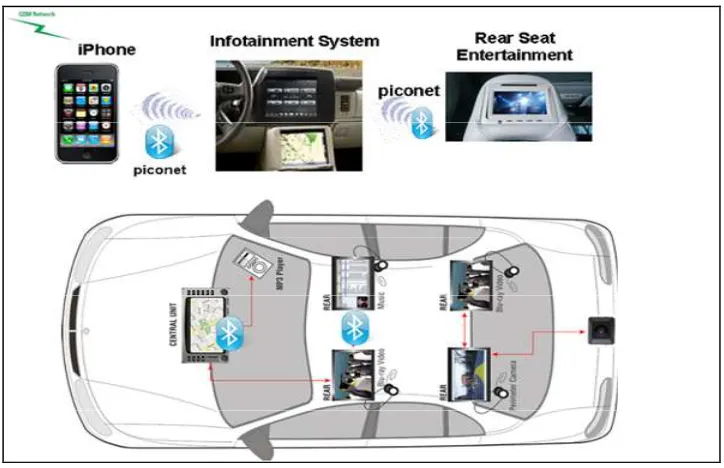
An ad hoc multimedia network in a car and participating devices are shown in figure 1. The diagram presents an ah hoc network containing a smart phone, an infotainment system, and rear seat entertainment system. The devices are equipped with Bluetooth module and are capable of establishing a Bluetooth connection. A piconet can be established between Infotainment system and iPhone when the driver or any other occupant of the vehicle
pairs the phone. Similarly a piconet could be established between Infotainment system and rear seat entertainment system. The piconet shall enable sharing of iPhone contents or access to contents from internet, if appropriate application framework is available at infotainment system.
A. The Multimedia PAN
[image:2.595.117.479.100.334.2]Bluetooth technology is based on a master-slave concept where the master device controls data transmissions through a polling procedure. The master is defined as the device that initiates the connection. A collection of slave devices associated with a single master device is referred to as a piconet.
The master dictates packet transmissions within a piconet according to a time-slot process. The channel is divided into time slots that are numbered according to an internal clock running on the master. A time division duplex (TDD) scheme is used where the master and slaves alternatively transmit packets, where even numbered time slots are reserved for master-slave transmissions, while odd numbered time slots are reserved for slave-master transmissions.
Figure 2 provides an overview of the multimedia PAN inside the car with the role of different nodes. The piconet here consists of a master, the infotainment device, and two slaves, the smart phone (iPhone) and rear-seat entertainment device. As soon as the infotainment system is up and running, its Bluetooth module is ready to pair with other available device. Pairing with iPhone or with rear-seat entertainment unit or with both establishes the network.
B. Application Scenarios
The ad hoc multimedia network consisting of Infotainment system and the slave devices shall provide following services:
Access to audio contents from iPhone to Infotainment system that could be played and hearable on the vehicle’s sound system.
Access to video contents from iPhone to rear- seat entertainment unit via the piconet master.
Access to internet from rear-seat unit using iPhone via the piconet master.
Applications based on Information contents received by the iPhone to help safe driving, such as weather information or traffic information.
III. PERFORMANCE MODELING
The main parameters that can influence the performance of the network described in previous section are, basically,
The number of application channels,
The offered traffic per application, and
The application profile, defined by the objective parameters (thresholds) and weights.
The performance indicators that should be considered for this network are: the packet delay, the packet error rate, the latency, and the throughput.
Packet transmission and reception are synchronized by the system clock (625 per sec slot interval). This paper focuses on throughput and delay performance in this point-to-multipoint communication environment. We try to simplify and abstract the system as much as possible while preserving the essence of
the network which affects the actual performance of the system.
A. Packet Delay Model
In order to model the delay, we consider one to five ad hoc multimedia applications with ACL connections in the piconet. In this scenario, packet types are adaptively selected among DM 1, DM3 and DM5 according to the amount of data waiting for transmission in buffers. We consider only DM packets assuming that data packets are vulnerable to bit errors due to error-prone wireless channel characteristics. To ensure reliable data transmission, FEC (Forward Error Correction) and ARQ (Automatic Repeat Request) [1] are employed. We simulated simple wireless channel model, where BER (Bit Error Rate) is constant in a Simulation.
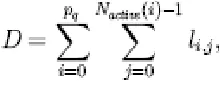
The evaluation of the probability of the queuing delay exceeding a threshold Dth , the delay threshold, starts from the
expression of the delay
where pq denotes the number of packets in the queue of the
desired application, Nactive (i) is the number of active applications during the transmission of packet i, and lij is the
length of the packet transmitted by application j during the ith round.
The limiting effect to the delay, for very high values, is determined by the control imposed to the incoming traffic when the buffer occupancy gets close to its limits.
B. Throughput Model
Taking into account that the main purpose of this ad hoc network is to provide access to multimedia contents, the throughput model has to reflect the characteristics of the network traffic. Throughput performance is evaluated when there are one or more slave device applications, for which an ACL or SCO connection is established. It is assumed that packets are always transmitted and received in the corresponding slots. In other words, the master device polls a slave device with an ACL connection in a round-robin fashion and it transmits a packet to the polled slave. When the slave device is polled by the master, the slave sends a packet to the master in the consecutive TX slot of the reception of the packet
transmitted if at least one ACL connection is present in a piconet. In order to see the maximum possible performance, asymmetric TX is considered, where different packet types are
used for down (master to slave) and up (slave to master) stream traffic.
A buffer analysis can be conducted for the network throughput resorting to the classical queuing theory [2] since the arrival process is modelled by an Interrupted Poisson Process (IPP). The number of packets in the queue is well approximated by a geometric random variable with parameter (1 - ρ), where ρ is the
activity coefficient [3] given by the ratio between the arrival rate, given by the sum of the arrival rates of the Nactive active
applications in the piconet and the service rate µ:
To take into account the effects of a finite buffer, a feedback is considered, blocking the incoming traffic whenever the buffer occupancy exceeds 90 percent of its capacity. In the simulations, the buffer capacity is considered at 256 Kbyte.
IV. PERFORMANCE EVALUATION
The performance of network has been evaluated when the applications on piconet nodes and transferring audio or data packets. We present here the analysis based on data packets.
A. Simulation Setup
The number of applications in the modelled network is relatively small and they are assumed to transfer data traffic between the nodes in the piconet. For the data traffic, this combination is expected to result in burst traffic streams in the network. The voice traffic was simulated using a measured trace of PCM audio stream, but not considered here.
Transmitted packets may be lost due to bit errors and is modeled with a constant loss probability. All lost ACL packets are resent according to the Bluetooth ARQ scheme. In all the simulations presented herein, the packet loss probability was set to 10-3.
B. Delay Analysis
Average packet delay, time between arrival of a new packet (data) into a buffer for transmission and reception of the packet at a receiver, is measured for each of traffic load as the number of ACL connections changes.
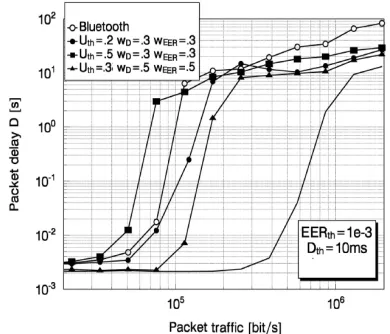
Figure 3 presents the packet latency as a function of the offered traffic per application for the network, where the number of applications is limited to 50, the objective thresholds are packet error ERRth = 10-3 and delay threshold Dth = 10 ms, and the
average duration of the vertical handover procedure is assumed to be 100 ms. The weights reflect the relative importance of each objective, according to the type of service. The objective values are used as threshold to determine a performance
[image:4.595.328.523.121.288.2]dissatisfaction value U on the basis of the weights assigned to the profile parameters.
Figure 3: Packet Delay as function of buffered packet traffic.
For low traffic and a profile where packet error EER has higher priority, the delay can even exceed that of the abstract Bluetooth system; otherwise, the delay lies between the performance of the ad hoc network and abstract Bluetooth network.
C. Throughput Analysis
The throughput performance of the system is considered without SCO connections as the number of ACL connections increases. In terms of throughput, in figure 4, the available bandwidth is shown as a function of the offered traffic per application, comparing the three scenarios, with packet EERth =
10-3 and Dth =10 ms. Again, the number of applications in the
[image:4.595.321.522.531.722.2]network is considered to be around 5 and other parameters have the same values as that for packet delay measurement.
Figure 4 above indicates an improvement in the throughput can be obtained by choosing a high weight for the packet error EER, thus forcing a control on the reliability of the transmission. On the other hand, if the focus is on the delay, the performance in terms of available throughput drops to low values in correspondence to a high offered traffic load. Moreover, note that, in this case, a control on the packet error rate and delay is performed.
V. RELATED RESEARCH
Bluetooth is a low-cost technology initially designed for cable replacement [4] but more generally intended for all kinds of Personal Area Network (PAN) applications [5]. It is probable that, in the very near future, Bluetooth will be embedded in almost every mobile device. These features coupled with the interoperability characteristic provided by Bluetooth specifications [1], make this wireless technology very appealing for applications in automotive environments [10]. As an example, Bluetooth headsets are very popular as wireless audio link to a mobile phone, also for vehicular use. These reasons make Bluetooth the most suited technology for the design of the low power Wireless Communication Network (WCN). The issue of performance management for multimedia distribution network has been faced at different levels of abstraction. At lower layers of the OSI protocol stack, several important research activities have introduced QoS-aware protocols for resource reservation, service differentiation, traffic engineering, and constraint-based routing [6, 7]. At a higher layer of abstraction, a wide spectrum of research activities, from both industry and academia, has investigated middleware solutions for multimedia performance management. For instance, content distribution networks exploit statically installed or self-organizing decentralized infrastructures to cache traversing flows and to transparently balance the request load by considering client locations [8, 9]. Bluetooth network performance can be evaluated from a number of viewpoints using various measures of performance (MOPs). The relevance of each MOP is dependent upon the specific network requirements. The data-rate on air is inevitably variable, due to mobility and interference in the Bluetooth wireless environment. Moreover, losses due to retransmission, interference in signalling with data flow, and the capabilities of the device at the far end of the Bluetooth link would also affect the data-rate [11]–[14].
VI. CONCLUSION
In the paper, we have modelled and evaluated the performance of the multimedia piconet in Bluetooth supporting point-to-multipoint communications. Our performance models provide a performance metric when ACL slave applications are
supported. An approximation for the packet error probabilities has been used and the influence of the main parameters on the network performance has been studied. In order to guarantee low delay requirements, the number of application running simultaneously may need to be limited.
These results can serve as valuable inputs to the optimal design of Bluetooth based multimedia network with throughput and delay requirements.
We anticipate two main directions for the future work:
Develop analytical models for relevant measures of performance for the described ad hoc network.
Performance analysis of multimedia protocol for different multimedia resources and performance attributes.
REFERENCES
[1] Bluetooth Special Interest Group., “Core Specification of the Bluetooth System v 3.0”. Apr. 2009.
[2] L. Kleinrock, Queuing Systems. Wiley, 1975.
[3] G. Lin, G. Noubir, and R. Rajaraman, “Mobility Models for Ad Hoc Network Simulation,” Proc. IEEE INFOCOM Conf., pp. 454-463, Mar. 2004.
[4] J.C. Haartsen, “The Bluetooth Radio System,” IEEE Personal Comm., vol. 7, no. 1, pp. 28-36, Feb. 2000.
[5] P. Johansson, M. Kazantzidis, R. Kapoor, and M. Gerla, “Bluetooth: An Enabler for Personal Area Networking,” IEEE Network, vol. 15, no. 5, pp. 28-37, Sept.-Oct. 2001.
[6] X. Masip-Bruin, M. Yannuzzi, J. Domingo-Pascual, A. Fonte, M. Curado, E. Monteiro, F. Kuipers, P. Van Mieghem, S. Avallone, G. Ventre, P. Aranda-Guti´errez, M. Hollick, R. Steinmetz, L. Iannone, K. Salamatian, Research challenges in QoS routing, Computer Communications 29 (2006) 563–581.
[7] X. Zhou, J. Wei, C.-Z. Xu, Quality-of-service differentiation on the internet: A taxonomy, Journal of Network and Computer Applications 30 (1) (2007) 354–383.
[8] G. Peng, CDN: Content distribution network, Technical Report TR-125, Department of Computer Science, State University of New York, Stony Brook, 2003, available from: http://citeseer.ist.psu.edu/peng03cdn.html. [9] A. Vakali, G. Pallis, Content delivery networks: Status and trends, IEEE
Internet Computing 7 (6) (2003) 68–74.
[10] R. Nüsser, R. Pelz, “Bluetooth-based Wireless Connectivity in an Automotive Environment”, Proc. of the IEEE Vehicular Technology Conference, Fall 2000, vol. 4, pp.1935-1942.
[11] S. Khurana, A. Kahol, and A. P. Jayasumana, “Effect of hidden terminals on the performance of IEEE 802.11 MAC protocol,” in Proc. 23rd Conf. Local Computer Networks, Boston, MA, Oct.1998, pp. 12–20. [12] Y. J. Lim, J. Kim, S. L. Min, and J. S. Ma, “Performance evaluation of the
bluetooth-based public internet access point,” in Proc. 15th Int. Conf. Information Networking (ICOIN’01), Beppu City, Oita, Japan, Jan./Feb. 2001, pp. 643–648.
[13] B. Kraimeche and C. Mantelis, “Analysis of interference in a wireless link with frequency hopping,” in Proc. 10th IEEE Int. Symp. Modeling, Analysis, and Simulation of Computer and Telecommunications Systems (MASCOTS’02), Fort Worth, TX, Oct.2002, pp. 303–312.