Proceedings of the 2019 Conference on Empirical Methods in Natural Language Processing 1361
Recurrent Positional Embedding for Neural Machine Translation
Kehai Chen, Rui Wang∗, Masao Utiyama, and Eiichiro Sumita
National Institute of Information and Communications Technology (NICT), Kyoto, Japan
{khchen, wangrui, mutiyama, eiichiro.sumita}@nict.go.jp
Abstract
In the Transformer network architecture, positional embeddings are used to encode order dependencies into the input representa-tion. However, this input representation only involves static order dependencies based on discrete numerical information, that is, are independent of word content. To address this issue, this work proposes a recurrent positional embedding approach based on word vector. In this approach, these recurrent positional embeddings are learned by a recurrent neural network, encoding word content-based order dependencies into the input representation. They are then integrated into the existing multi-head self-attention model as independent heads or part of each head. The experimental results revealed that the proposed approach improved translation performance over that of the state-of-the-art Transformer baseline in WMT’14 English-to-German and NIST Chinese-to-English translation tasks.
1 Introduction
Transformer translation systems (Vaswani et al., 2017), without recurrent and convolutional neural networks, rely on a positional embedding (PE) approach to encode order information into the input representation. PE is typically learned based on the position index of each word and is added to corresponding word embedding. This allows the Transformer to encode order dependencies between words in addition to the words themselves. Finally, the Transformer uses these combined vectors as the input to self-attention networks (SANs), achieving state-of-the-art translation performance with several language pairs (Vaswani et al., 2017; Dou et al., 2018; Zhang et al.,2018a;Marie et al.,2018,2019).
∗
Corresponding author
In spite of their success, the input representation only involves static order dependencies based on discrete numerical information. That is, any word in the entire vocabulary has the same PE on the same position index. As a result, the dependencies encoded by the original PEs are independent of word content, which may further hinder the improvement of translation capacity. Recently, Chen et al.(2018) andHao et al.(2019) introduced the additional source representation learned by an RNN-based encoder into Transformer to alleviate this issue, and reported improvements on the WMT’14 English-to-German translation task.
Inspired by their works (Chen et al.,2018;Hao et al., 2019), we propose an simple and efficient recurrent positional embedding approach to capture order dependencies based on word content in a sentence, thus learning a more effective sentence representation for the Transformer. In addition, we designed two simple multi-head self-attentions to introduce these learned RPEs and original input representation into the existing Transformer model for enhancing the sentence representation of Transformer. Experimental results on WMT’14 English-to-German and NIST Chinese-to-English translation tasks show that our models significantly improved translation performance over a strong Transformer baseline.
2 Background
2.1 Input Representation
In the Transformer network architecture (Vaswani et al., 2017), given a sentence of length J, the positional embedding of each word is firstly computed based on its position:
pe(j,2i)=sin(j/100002i/dmodel),
wherejis the word’s numerical position index in the sentence and i is the dimension of position index. The word embeddingxj is then added with
pej to get a combined embeddingvj:
vj =xj+pej. (2)
As a result, there is a sequence of vectors{v1,· · ·, vJ}as the input to the encoder or decoder of the
Transformer to learn the source or target sentence representations.
2.2 Self-Attention Mechanism
Following the input layer, the self-attention layer is used to learn the sentence representation for the Transformer (Vaswani et al., 2017). These combined vectors {v1, · · ·, vJ} are then packed
into a query matrix Q, their keys and values matricesKandV. The output of the self-attention layer can be computed by Eq.(3):
Att(Q,K,V) =softmax( QK
T √
dmodel
)V. (3)
Moreover, self-attention can be further refined as multi-head self-attention to jointly attend to the information from different representation sub-spaces at different positions. Specifically, Q,
K, and V are linearly projected H times with different, learned linear projections to dk and dv dimensions, respectively. On each of these projected versions of queries, keys, and values, the attention function is performed in parallel, yielding dv-dimensional output values. Take a single head as an example, the output of theh-th headOhis computed by Eq.(4):
Oh=Att(QWQh,KWKh,VWVh), (4)
where the parameter matrices are
WQh∈Rdmodel×dk, WK
h ∈Rdmodel
×dk, and
WVh∈Rdmodel×dv. For example, if there are H=8 heads anddmodel is 512, dk=dv=512/8=64. Finally, the outputs ofH heads are concatenated to serve as the sentence representationS:
S=Concat(O1,· · ·,OH−1,OH)WO, (5)
whereWO∈RHdv×dmodel is a parameter matrix.
3 Recurrent Positional Embedding
We propose a recurrent positional embedding approach based on part of word embedding
instead of numerical indices of words to capture order dependencies between words in a sentence. Specifically, the embedding of each word xj
is divided into two parts xpj and xrj, and their dimensions are dp and dr (dmodel=dp+dr), respectively. As a result, the sequence of word vectors {x1, · · ·, xJ} are spited into {xp1, · · ·, xpJ} and {x1r, · · ·, xrJ}. An RNN with an non-linear projection layer is then designed to learn its recurrent staterjfor each word over{xr1,· · ·,xrJ}:
rj =Tanh(fRNN(xrj,rj−1)Wr+br), (6)
whereWr∈Rdr×dr is a parameter matrix andbr ∈Rdr is a bias item.1 Note that thexr
j is derived
from part of the word embeddingxj. Finally, there
is a sequenceR={r1,· · ·,rJ}, called as recurrent
positional embeddings (RPEs). In this work, a bidirectional RNN and a forward RNN (Bahdanau et al., 2015) are used to learn source RPEs and target RPEs, respectively. Noth that the RNN is also replaced by other neural networks for learning order dependency information, such as GRU (Cho et al.,2014), and SRU (Li et al.,2018a).
In addition, other sub-sequence {xp1, · · ·, xpJ}
is used to gain the reduced dimension input representation P={p1, · · ·, pJ} according to the Section 2.1. Both of R and P will be together as the input to the encoder (or decoder) to learn a more effective source (or target) representation for the Transformer.
4 Neural Machine Translation with RPE
To make use of these learned RPEs, we propose two simple methods: RPE head (RPEHead) self-attention and mixed positional representation head (MPRHead) self-attention. Both of RPEHead and MPRHead can utilize RPEs to learn sentence representation for the Transformer.
4.1 RPEHead Self-Attention
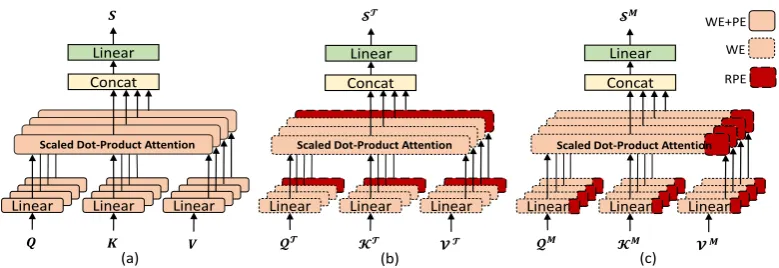
For the RPEHead self-Attention, these learned RPEs are integrated into multi-head self-attention (Fig1(a)) as several independent heads to learn the sentence representation, as shown in Fig1(b).
First, we concatenate P={p1, · · ·, pJ} and
R ={r1, · · ·, rJ} as a new combined input
representation T. To perform the attention function in Eq.(3) over the combined input representationT,dranddpare set to t*dmodel/H
1Ther
Linear Linear
𝓚𝑴
Linear
𝓢𝑴
𝓠𝑴
𝓥𝑴 Scaled Dot-Product Attention
RPE WE WE+PE
(c)
Linear Linear
𝓚𝓣
Linear
𝓢𝓣
𝓠𝓣
𝓥𝓣 Scaled Dot-Product Attention
(b)
Linear Linear
𝑲
Linear
𝑺
𝑸 𝑽
Scaled Dot-Product Attention
(a)
Linear
Concat Linear
Concat
Linear
Concat
Figure 1: (a) Multi-Head Self-Attention; (b) RPEHead Self-Attention; (c) MPRHead Self-Attention.
and dmodel-dr in the process of learning RPEs,
respectively. This guarantees that there are two types of heads: one type of head only contains RPE and other type of head only contains the original reduced dimension input representation. Second, the T is mapped to a new query matrix
QT, and their keys and values matricesKT and
VT. According to Eq.(4), the output of each head is computed by Eq.(7):
OTh =Att(QTWQh ,KTWKh,VTWVh). (7)
Therefore, the final sentence representationST is formally represented as:
ST =Concat(OT1 ,· · · ,OTH−1,OTH)WO. (8)
4.2 MPRHead Self-Attention
Compared with the RPEHead model, the
MPRHead model applies the multi-head
mechanism to the RPEs. In other words, RPEs are encoded into the sentence representation from different vector sub-spaces, as shown in Fig1(c).
To this end, each vector ofPis divided into the
H heads {p1j, · · ·, pHj }. Similarly, each vector of R is divided into the H heads {rj1, · · ·, rHj }. The corresponding heads for pj and rj are then
concatenated as a combined sequenceprj, in turn:
prj ={p1j :r1j,· · ·,pHj :rHj }, (9)
where “:” is the concatenation operation. All heads in prj are further concatenated as a mixed embedding mj ∈ Rdmodel in turn. As a result,
there is a new sequence of mixed embeddings:
M={m1,· · · ,mJ}. (10)
The M is mapped to a query matrix QM, and their keys and values matrices KM and VM.
According to Eq.(4) and Eq.(5), the final sentence representationSMis represented as:
OMh =Att(QMWQh,KMWKh,VMWVh),
SM=Concat(OM1,· · ·,OMH−1,OMH)WO. (11)
Note that for both RPEHead and MPRHead models, the RPEs will be jointly learned with the existing Transformer architecture.
5 Experiments
5.1 Experimental Setup
The proposed methods were evaluated on the WMT’14 English to German (EN-DE) and NIST Chinese-to-English (ZH-EN) translation tasks. The ZH-EN training set includes 1.28 million bilingual sentence pairs from the LDC corpora, where the NIST06 and the NIST02/NIST03/NIST04 data sets were used as the development and test sets, respectively. The EN-DE training set includes4.43million bilingual sentence pairs of the WMT’14 corpora, where the newstest2013 and newstest2014 data sets were used as the development and test sets, respectively. The BPE (Sennrich et al., 2016) was adopted and the vocabulary size was set as 32K. The dimension of all input and output layers was set to 512, and that of the inner feedforward neural network layer was set to 2048. The total heads of all multi-head modules were set to 8 in both encoder and decoder layers. In each training batch, there was a set of sentence pairs containing approximately4096*4source tokens and4096*4 target tokens. For the other setting not mentioned, we followed the setting inVaswani et al.(2017).
[image:3.595.104.494.59.193.2]System Architecture newstest2014 #Param Existing NMT systems
Vaswani et al.(2017) Transformer (base) 27.3 65M
Transformer (big) 28.4 213M
Chen et al.(2018) RNMT+SAN 28.49 378.9M
Hao et al.(2019) Transformer (base)+BiARN 28.21 97.4M Transformer (big)+BiARN 28.98 323.5M
Our NMT systems
This work
Transformer (base) 27.25 97.35M
+Relative PE 27.60 97.42M
+DiSAN 27.66 97.39M
[image:4.595.147.454.62.242.2]+RPEHead 28.11* 97.84M +MPRHead 28.35* 97.72M Transformer (big) 28.22 272.6M +MPRHead 29.11* 289.1M
Table 1: Results for EN-DE translation task. The mark “*” after scores indicates that the model was significantly better than the baseline Transformer (base or big) at the significance levelp <0.01 (Collins et al.,2005).
0 64 128 192 256 320 384 448 512 27.5
28
dr
BLEU
Transformer (base) +RPEHead +MPRHead
Figure 2: The BLEU scores on the differentdr.
et al., 2018). Besides, we reported results of the existing works (Vaswani et al., 2017; Chen et al., 2018;Shaw et al., 2018;Hao et al., 2019; Liu et al., 2019; Chen et al., 2019). We re-implemented the baseline Transformer, Relative PEs, and DiSAN models on the OpenNMT toolkit (Klein et al., 2017). All the models were trained for 200k batches and evaluated on a single V100 GPU. The multi-bleu.perl was used as the evaluation metric to obtain the case-sensitive 4-gram BLEU score of EN-DE and ZH-EN tasks.
5.2 Effect of RPEs
In this work, we extracteddr dimensions of each
word vector to learn recurrent embeddings. To explore the relation between dr and translation performance, Figure 2 shows the translation performance on the different dr. For +RPEHead
(or +MPRHead), with the increasing in the dimension of dr, BLEU scores are gradually
increasing, but BLEU scores begin to decrease when dr is more than 320 (or 256). In particular, +RPEHead and +MPRHead achieve
the highest BLEU scores atdr=320anddr=256,
respectively. This means that the original partial input representation and our RPE can complement each other to improve translation performance.
5.3 Main Results
According to the results of Fig2,dr of RPEHead is set to320anddrof MPRHead is set to256. The
main translation results are shown in Table1. 1) For the proposed methods, both RPEHead (base) and MPRHead (base) outperformed Trans-former (base), especially are better than +RPE and +DiSAN. This indicates that the learned RPEs are beneficial for the Transformer system.
2) Moreover, +MPRHead (base) performed better than RPEHead/RPE (base). The reason may be that adding RPEs into variant heads can encode order dependencies based word vectors from variant vector sub-spaces, which is one of the advantages of the multi-head mechanism. In particular, +MPRHead (base/big) is slightly better than Transformer (base/big)+BiARN. This denotes that the RPEs can more effective improve the performance of Transformer.
3) MPRHead (big) was superior to Transformer (big) significantly. MPRHead (base) achieved a comparable performance compared to Trans-former (big) which contains approximately three times parameters, indicating that the proposed RPE is efficient.
[image:4.595.78.285.297.412.2]System Architecture NIST02 NIST03 NIST04 #Param Existing NMT systems
Liu et al.(2019) Share-private Embeddings 43.73 41.99 44.53 N/A
Chen et al.(2019) Reordering Embeddings 47.54 46.56 47.27 78.3M Our NMT systems
This work
Transformer (base) 46.62 45.90 45.95 77.94M +Relative PEs (Shaw et al.,2018) 46.91 46.47 45.96 77.01M
+RPEHead 47.06 46.21 46.32 78.04M
+MPRHead 47.69* 47.27* 47.31* 78.04M
Transformer (big) 47.88 47.58 47.37 243.7M
[image:5.595.82.285.380.513.2]+MPRHead 48.73* 48.61* 48.21* 245.5M
Table 2: Results for ZH-EN translation Task. The mark “*” after scores indicates that the model was significantly better than the baseline Transformer (base or big) at the significance levelp <0.01 (Collins et al.,2005).
approach is a universal method for improving the translation of other language pairs.
5.4 Ablation Experiments
To further explore the effect of position informa-tion, PEs and RPEs were applied on the encoder (Enc) and decoder (Dec) side, respectively. Table3shows the results of ablation experiments on the EN-DE newstest2014 test set:
newstest2014 #Speed Transformer (base) 27.25 11.7K
- PE of Dec 26.73 11.7K
- PE of Enc 10.71 11.7K
RPEHead (base) 28.11 10.5K - RPE&PE of Dec 27.54 11.2K - RPE&PE of Enc 11.16 10.7K MPRHead (base) 28.35 9.9K - RPE&PE of Dec 27.74 11.2K - RPE/PE of Enc 10.89 10.7K - RPE&PE of Enc&Dec 10.43 11.7K
Table 3: Ablation experiments of position information. “#Speed” denotes the training speed (tokens/second).
1) For Enc/Dec/Enc&Dec, the proposed RPE-Head/MPRHead outperformed the Transformer in corresponding ablation settings, indicating that our methods worked well on both the encoder and decoder.
2) For PE/RPEs, performance became slightly lower when PE was removed from the decoder. However, when PE was removed from the encoder, the translation performance drastically decreased. We think that the source sentence representation is more sensitive to position infor-mation than the target sentence representation. It is possible that each hidden state in the decoder takes the previous hidden state into consideration, which would be somewhat similar to the proposed
RPEs. In contrast, the encoder would not be expected to contain this mechanism. Therefore, the position information would be more important in the encoder than the decoder.
3) The training speeds of the proposed RPEHead (base) and MPRHead (base) were just slightly slower than those of the vanilla Transformer (base), because we nearly did not introduce additional (less than 2%) parameters.
6 Conclusion and Future Work
In this paper, we presented a recurrent embedding to capture the order dependencies in a sentence. Empirical results show that this method can improve the performance of NMT efficiently. In future work, we plan to extend this method to unsupervised NMT (Sun et al., 2019) and other natural language processing tasks, such as dependency parsing (Li et al.,2018b) and reading comprehension (Zhang et al.,2018b).
Acknowledgments
References
Dzmitry Bahdanau, Kyunghyun Cho, and Yoshua Bengio. 2015. Neural machine translation by jointly
learning to align and translate. In Proceedings
of the 3rd International Conference on Learning Representations, San Diego, CA.
Kehai Chen, Rui Wang, Masao Utiyama, and
Eiichiro Sumita. 2019. Neural machine translation
with reordering embeddings. In Proceedings
of the 57th Annual Meeting of the Association for Computational Linguistics, pages 1787–1799, Florence, Italy. Association for Computational Linguistics.
Mia Xu Chen, Orhan Firat, Ankur Bapna, Melvin Johnson, Wolfgang Macherey, George Foster, Llion Jones, Mike Schuster, Noam Shazeer, Niki Parmar, Ashish Vaswani, Jakob Uszkoreit, Lukasz Kaiser, Zhifeng Chen, Yonghui Wu, and Macduff Hughes. 2018. The best of both worlds: Combining
recent advances in neural machine translation. In
Proceedings of the 56th Annual Meeting of the As-sociation for Computational Linguistics (Volume 1: Long Papers), pages 76–86, Melbourne, Australia. Association for Computational Linguistics.
Kyunghyun Cho, Bart van Merrienboer, Caglar Gul-cehre, Dzmitry Bahdanau, Fethi Bougares, Holger Schwenk, and Yoshua Bengio. 2014. Learning phrase representations using rnn encoder–decoder for statistical machine translation. InProceedings of the 2014 Conference on Empirical Methods in Nat-ural Language Processing (EMNLP), pages 1724– 1734, Doha, Qatar. Association for Computational Linguistics.
Michael Collins, Philipp Koehn, and Ivona Kucerova. 2005. Clause restructuring for statistical machine
translation. In Proceedings of the 43rd Annual
Meeting of the Association for Computational Linguistics (ACL’05), pages 531–540, Ann Arbor, Michigan. Association for Computational Linguis-tics.
Zi-Yi Dou, Zhaopeng Tu, Xing Wang, Shuming Shi, and Tong Zhang. 2018. Exploiting deep representations for neural machine translation. In
Proceedings of the 2018 Conference on Empirical Methods in Natural Language Processing, pages 4253–4262, Brussels, Belgium. Association for Computational Linguistics.
Jie Hao, Xing Wang, Baosong Yang, Longyue Wang, Jinfeng Zhang, and Zhaopeng Tu. 2019. Modeling
recurrence for transformer. In Proceedings of the
2019 Conference of the North American Chapter of the Association for Computational Linguistics: Human Language Technologies, Volume 1 (Long and Short Papers), pages 1198–1207, Minneapolis, Minnesota. Association for Computational Linguis-tics.
Guillaume Klein, Yoon Kim, Yuntian Deng, Jean Senellart, and Alexander Rush. 2017. Opennmt:
Open-source toolkit for neural machine translation. In Proceedings of ACL 2017, System Demonstra-tions, pages 67–72, Vancouver, Canada. Association for Computational Linguistics.
Jian Li, Zhaopeng Tu, Baosong Yang, Michael R. Lyu, and Tong Zhang. 2018a. Multi-head attention with disagreement regularization. InProceedings of the 2018 Conferenctemporale on Empirical Methods in Natural Language Processing, pages 2897–2903, Brussels, Belgium. Association for Computational Linguistics.
Zuchao Li, Jiaxun Cai, Shexia He, and Hai Zhao.
2018b. Seq2seq dependency parsing. In
Proceedings of the 27th International Conference on Computational Linguistics, pages 3203–3214, Santa Fe, New Mexico, USA.
Xuebo Liu, Derek F. Wong, Yang Liu, Lidia S. Chao, Tong Xiao, and Jingbo Zhu. 2019. Shared-private bilingual word embeddings for neural machine
translation. In Proceedings of the 57th Annual
Meeting of the Association for Computational Linguistics, pages 3613–3622, Florence, Italy. Association for Computational Linguistics.
Benjamin Marie, Haipeng Sun, Rui Wang, Kehai Chen, Atsushi Fujita, Masao Utiyama, and Eiichiro Sumita. 2019. NICT’s unsupervised neural and statistical machine translation systems for the
WMT19 news translation task. In Proceedings
of the Fourth Conference on Machine Translation (Volume 2: Shared Task Papers, Day 1), pages 294– 301, Florence, Italy. Association for Computational Linguistics.
Benjamin Marie, Rui Wang, Atsushi Fujita, Masao Utiyama, and Eiichiro Sumita. 2018. NICT’s neural and statistical machine translation systems
for the WMT18 news translation task. In
Proceedings of the Third Conference on Machine Translation: Shared Task Papers, pages 449–455, Belgium, Brussels. Association for Computational Linguistics.
Rico Sennrich, Barry Haddow, and Alexandra Birch. 2016.Neural machine translation of rare words with
subword units. InProceedings of the 54th Annual
Meeting of the Association for Computational Linguistics (Volume 1: Long Papers), pages 1715–1725, Berlin, Germany. Association for Computational Linguistics.
Peter Shaw, Jakob Uszkoreit, and Ashish Vaswani. 2018. Self-attention with relative position
repre-sentations. InProceedings of the 2018 Conference
of the North American Chapter of the Association for Computational Linguistics: Human Language Technologies, Volume 2 (Short Papers), pages 464– 468, New Orleans, Louisiana. Association for Computational Linguistics.
Directional self-attention network for rnn/cnn-free
language understanding. In AAAI Conference on
Artificial Intelligence.
Haipeng Sun, Rui Wang, Kehai Chen, Masao
Utiyama, Eiichiro Sumita, and Tiejun Zhao. 2019.
Unsupervised bilingual word embedding agreement
for unsupervised neural machine translation. In
Proceedings of the 57th Annual Meeting of the Association for Computational Linguistics, pages 1235–1245, Florence, Italy. Association for Computational Linguistics.
Ashish Vaswani, Noam Shazeer, Niki Parmar, Jakob Uszkoreit, Llion Jones, Aidan N Gomez, Ł ukasz Kaiser, and Illia Polosukhin. 2017. Attention is all
you need. In I. Guyon, U. V. Luxburg, S. Bengio,
H. Wallach, R. Fergus, S. Vishwanathan, and R. Garnett, editors,Advances in Neural Information Processing Systems 30, pages 5998–6008. Curran Associates, Inc.
Biao Zhang, Deyi Xiong, and Jinsong Su. 2018a.
Accelerating neural transformer via an average
attention network. In Proceedings of the 56th
Annual Meeting of the Association for Computa-tional Linguistics (Volume 1: Long Papers), pages 1789–1798, Melbourne, Australia. Association for Computational Linguistics.
Zhuosheng Zhang, Yafang Huang, and Hai Zhao. 2018b. Subword-augmented embedding for cloze
reading comprehension. In Proceedings of the