Proceedings of the 2019 Conference on Empirical Methods in Natural Language Processing 1297
Zero-shot Cross-lingual Dialogue Systems with
Transferable Latent Variables
Zihan Liu, Jamin Shin, Yan Xu, Genta Indra Winata, Peng Xu, Andrea Madotto, Pascale Fung Center for Artificial Intelligence Research (CAiRE) Department of Electronic and Computer Engineering
The Hong Kong University of Science and Technology, Clear Water Bay, Hong Kong
{zliucr,jay.shin,yxucb,giwinata,pxuab}@connect.ust.hk,
Abstract
Despite the surging demands for multilin-gual task-oriented dialog systems (e.g., Alexa, Google Home), there has been less research done in multilingual or cross-lingual scenar-ios. Hence, we propose a zero-shot adapta-tion of task-oriented dialogue system to low-resource languages. To tackle this challenge, we first use a set of very few parallel word pairs to refine the aligned cross-lingual word-level representations. We then employ a latent variable model to cope with the variance of similar sentences across different languages, which is induced by imperfect cross-lingual alignments and inherent differences in lan-guages. Finally, the experimental results show that even though we utilize much less external resources, our model achieves better adapta-tion performance for natural language under-standing task (i.e., the intent detection and slot filling) compared to the current state-of-the-art model in the zero-shot scenario.
1 Introduction
Task-oriented dialogue systems have been widely adopted in the industry (e.g., Amazon Alexa, Google Home, Apple Siri, Microsoft Cortana) as a virtual agent to tend to the needs of the users. However, these agents have mostly been trained with the monolingual dataset that is often expen-sive to build or acquire. In order to cope with the scarcity of low-resource language dialogue data, we are motivated to look into cross-lingual dia-logue systems which can adapt with very little or no training data in the target language.
This task of zero-shot adaptation of dialogue systems to different languages is relatively new and has not been explored thoroughly enough yet. The main approach of previous work (Upadhyay et al., 2018; Chen et al., 2018; Schuster et al.,
2019) in this task is using aligned cross-lingual
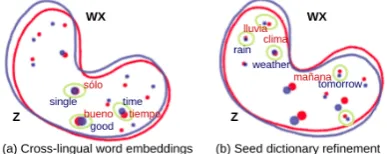
Figure 1: (a) The aligned word embeddings. (b) Re-fined mapping W with seed dictionary; green circle represents close words in different languages.
word embeddings between source and target lan-guages. However, this method suffers from im-perfect alignments between the source and target language embeddings. This can be attributed not only to the noise in aligning two different em-beddings, but also to the inherent discrepancies in different languages such as Thai and English which come from entirely different roots. To ad-dress such variance in the alignment, we turn to probabilistic modeling with latent variables as it has been successfully used in several recent task-oriented dialogue systems (Wen et al.,2017;Zhao et al., 2017, 2018;Zhao and Eskenazi, 2018;Le et al.,2018).
However, we notice that naively using latent variables does not help the model improve much in slot filling and intent prediction. We hypoth-esize that the variance of the cross-lingual word embeddings is too large for the model to learn any meaningful latent variables. Hence, we propose to first refine the cross-lingual embeddings with∼10 seed word-pairs related to the dialogue domains. We then add Gaussian noise (Zheng et al.,2016) to further compensate the imperfect alignment of cross-lingual embeddings.
[image:1.595.319.513.228.305.2]cross-.... ....
Refined Cross-lingual
Embeddings
....
BiLSTM Attention Layer
Latent Variable Model Predicted
Slots and Intent s1 ....
Input Utterance
Gaussian Noise μ1 σ1 .... μt σt μI σI
Intent
w1 w2 wt−1 wt
[image:2.595.78.284.59.239.2]s2 st−1 st
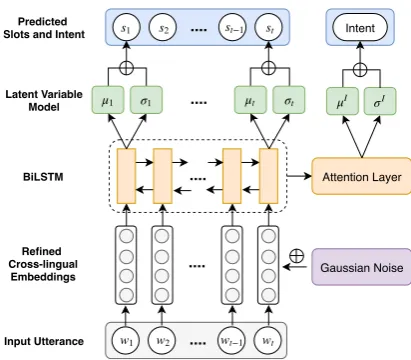
Figure 2: The structure of our proposed model.
lingual word embeddings. This enables our model to capture the variance of semantically similar sentences across different languages, and achieve state-of-the-art results in zero-shot adaptation of English to Spanish and Thai for the natural lan-guage understanding task (i.e., the intent predic-tion and slot filling) on the dataset proposed by
Schuster et al.(2019), even though we use much less external resources (i.e.,∼10 seed word-pairs) while others utilize a large amount of bilingual corpus. We further visualize the learned latent variables to confirm that same-meaning words and sentences have similar distributions.
2 Related Work
Cross-lingual transfer learning which acts as one of the low-resource topics (Gu et al., 2018; Lee et al., 2019; Liu et al., 2019; Xu et al., 2018) has attracted more and more people recently, fol-lowed by the rapid development of cross-lingual word embeddings. Artetxe et al.(2017) proposed a self-learning framework and utilized a small size of word dictionary to learn the mapping between source and target word embeddings. Conneau et al.(2018) leveraged adversarial training to learn a linear mapping from a source to a target space without using parallel data.Joulin et al.(2018) uti-lized Relaxed CSLS loss to optimize this mapping problem.Winata et al.(2019) introduced a method to leverage cross-lingual meta-representations for code-switching name entity recognition by com-bining multiple monolingual word embeddings.
Chen et al. (2018) proposed a teacher-student framework leveraging bilingual data for cross-lingual transfer learning in dialogue state
track-ing. Upadhyay et al.(2018) leveraged joint train-ing and cross-ltrain-ingual embeddtrain-ings to do zero-shot and almost zero-shot transfer learning in intent prediction and slot filling. Finally,Schuster et al.
(2019) utilizes Multilingual CoVe embeddings ob-tained from training Machine Translation systems as in (McCann et al.,2017). The main difference of our work with previous work is that our model does not leverage any external bilingual data other than 11 word pairs for embeddings refinement.
3 Methodology
Our model consists of a refined cross-lingual em-bedding layer followed by a BiLSTM (Hochreiter and Schmidhuber,1997) which parameterizes the Latent Variable Model, as illustrated in Figure2. We jointly train our model to predict both slots and user intents. We denote w = [w1, . . . , wT]
as the input words and e = [e1, . . . , eT] as the
word embeddings ofw. The slot at time-steptis
st, while the intent for each sentencewis denoted
asI. Note that only matrices are bold-faced.
3.1 Cross-lingual Embeddings Refinement
To further refine the cross-lingual alignments to our task, we draw from the hypothesis that domain-related words are more important than others. Hence, as shown in Figure1, we propose to refine the cross-lingual word embeddings (Joulin et al., 2018)1 using very few parallel word pairs, which is obtained by selecting 11 English words related to dialogue domains (weather, alarm, and reminder) and translate them using bilingual lexi-cons. We refine the embeddings by leveraging the framework proposed inArtetxe et al.(2017).
LetXandZbe the aligned cross-lingual word embeddings between two languages. Xi∗andZj∗
are the embeddings for theithsource word andjth
target word. We denote a binary dictionary ma-trixD: Dij = 1if theith source language word
is aligned with the jth target language word and Dij = 0otherwise. The goal is to find the optimal mapping matrixW∗by minimizing:
W∗ = arg min
W X
i,j
Dij||Xi∗W−Zj∗||2. (1)
Following Artetxe et al.(2016), with orthogonal constraints, mean centering, and length
tion, we can maximize the following instead:
W∗= arg max
W Tr(XWZ
TDT). (2)
We iteratively optimize Equation2until distances between domain-related seed words are closer than a certain threshold after refinement. Fig-ure 1 illustrates better alignment for domain-related words after refinement.
3.2 Gaussian Noise Injection
To cope with the noise in alignments, we inject Gaussian noise to English embeddings, so the trained model will be more robust to variance. This is a regularization method to improve the generalization ability to the unseen inputs in ferent languages, particularly languages from dif-ferent roots such as Thai and Spanish. The final embeddings are e∗ = [e1 +N1, . . . , eT +NT],
whereN∼ N(0,0.1I).
3.3 Latent Variable Model (LVM)
Given a near-perfect cross-lingual embedding, there is still noise caused by the inherent discrep-ancies between source and target languages. This noise amplifies when combined with imperfect alignment, and makes point estimation vulnerable to the small, but not negligible differences across languages. Instead, using latent variables will al-low us to model the distribution that captures the variance of semantically similar sentences across different languages. The whole training process is defined as follows:
[h1...ht...hT] =BiLSTM(e∗), (3)
mt=htwa, at= PTexp(mt) j=1exp(mj)
, v= T
X
t=1
atht,
(4)
µSt log σS
t)2
=WSrht,
µI log σI)2
=WIrv,
(5)
zSt ∼qSt(z|ht), zI∼qI(z|v), (6)
pSt(st|zSt) =Softmax(WSgztS), (7)
pI(I|zI) =Softmax(WIgzI), (8)
where attention vector (v) is obtained by follow-ing Felbo et al. (2017) and wa is the weight
matrix for the attention layer, W{{S,Ir,g}} are train-able parameters, superscripts S and I refer to slot prediction and intent detection respectively, sub-script “r” refers to “recognition” for obtaining the
mean and variance vectors while subscript “g” refers to “generation” for predicting the slots and intents, and qSt ∼ N(µSt,(σtS)2I) and qI ∼ N(µI,(σI)2I) are the posterior approximations which we sample our latent vectors ztS and zI
from. Finally, pSt and pI are the predictions for the slot of thet-thtoken and the intent of the utter-ance respectively. The objective functions for slot filling and intent prediction are:
LI =EzI[logpI(I|zI)], (9)
LSt =EzS t[logp
S
t(st|zSt)], (10)
LS =
T
X
t=1
LSt, (11)
hence, the final objective function to minimize is,
L=LS+LI. (12)
The model prediction is not deterministic since the latent variables ztS and zI are sampled from the Gaussian distributions. Therefore, in the inference time, we use the true meanµSt andµI to replace
zSt andzIrespectively to make the prediction de-terministic.
4 Experiments
4.1 Dataset
We conduct our experiments under the zero-shot scenario of multilingual task-oriented dialogue dataset presented by Schuster et al. (2019). Our model is trained only with the English data and then do a zero-shot test on Spanish and Thai test set. We delexicalize words by replacing the tokens which represent numbers, time (such as am, pm), and duration (such as 30min) with special tokens
<number>,<time>, and<last>respectively.
4.2 Training Details
Spanish Thai
Model Intent acc. Slot F1 Intent acc. Slot F1
LVM CRF LVM CRF LVM CRF LVM CRF
Vanilla BiLSTM 46.36 44.13 15.64 11.32 35.12 33.57 5.82 5.24
+noise (N) 72.97 66.95 46.56 20.27 40.37 37.53 10.66 6.51
+refinement (R) 87.69 88.23 61.63 42.62 59.40 59.28 21.84 16.53
+noise & refinement 89.21 88.79 64.04 43.98 70.81 64.48 29.54 17.46 +N & R & delexicalization 90.20 89.98 65.79 47.70 73.43 69.62 32.24 23.11
Zero-shot SLU‡ 46.64 15.41 35.64 12.11
Multi. CoVe w/ auto 53.89 19.25 70.70 35.62
[image:4.595.79.524.62.217.2]Translate Train† 85.39 72.87 95.85 55.43
Table 1: Results on different models including baseline models, where N refers to the Gaussian noise injection and R refers to the cross-lingual embeddings refinement. ‡ We implementedUpadhyay et al.(2018) model and evaluated with our test set. † Schuster et al.(2019) translated English data to Spanish and Thai with a trained supervised machine translation system and it is considered as ourupper boundresult.
BIO structure to calculate the F1 score for evalu-ating the performance of slot filling. In the zero-shot cross-lingual adaptation, we simply replace the training language (i.e., English) word embed-dings with the cross-lingual target language (i.e., Spanish or Thai) word embeddings. Note that we never use any target language evaluation data to select the model for zero-shot cross-lingual adap-tation, instead, we utilize the English validation set and early stop strategy according to the slot F1 score.
4.3 Word Pairs
We choose the number of word pairs based on the vocabulary size of the corpus. Intuitively, the larger the vocabulary size is, the more words we need to align across languages, and the more word pairs we need to achieve good performance. We select 11 domain-related words which frequently exist in the English training set. The number of words we select is around 0.25% of the vocabu-lary size for the English training set. The concrete information of the 11 word pairs is as follows:
The English seed words we selected are weather, forecast, temperature, rain, hot, cold, re-mind, forget, alarm, cancel, tomorrow, which are related to the three dialogue domains (weather, alarm, and reminder). We translate them by lever-aging bilingual dictionaries2. The correspond-ing translations in Spanish and Thai are clima, pron´ostico, temperatura, lluvia, caliente, fr´ıo, recordar, olvidar, alarma, cancelar, ma˜nana and
อากาศ, พยากรณ์, อุณหภูมิ, ฝน, ร้อน, หนาว,
2https://github.com/facebookresearch/MUSE
Model Spanish Thai
Intent Slot Intent Slot
Our model 90.20 65.79 73.43 32.24
- LVM 85.85 61.86 66.01 25.22
- LVM + MLP 86.02 62.34 66.56 28.35
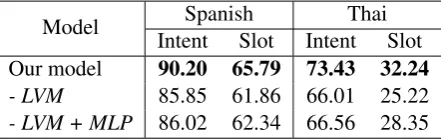
Table 2: Ablation Study on LVM models. {- LVM}
means removing LVM and{- LVM + MLP}means re-placing LVM with a Multi-Layer Perceptron which has the same size as the LVM.
เตือน, ลืม, เตือน, ยกเลิก, พรุ่ง respectively.
4.4 Evaluation
We implement and evaluate the following models:
Zero-shot SLU Upadhyay et al. (2018) used cross-lingual embeddings (Bojanowski et al.,
2017) to do zero-shot transfer learning.
Conditional Random Fields (CRF) We repro-duce the baseline model inSchuster et al. (2019), and also add embedding noise, cross-lingual re-finement, and delexicalization.
Latent Variable Model (LVM) - Ours We re-place the CRF module with latent variables and also apply it to intent prediction.
Besides, we directly compare with the baseline models illustrated inSchuster et al.(2019):
[image:4.595.309.530.294.364.2]English Spanish Thai
เ น
evening
noche
อากาศ
clima
weather
English Spanish Thai
What will the weather be like this evening
[image:5.595.91.519.61.206.2]Cancel tuesday alarm clock
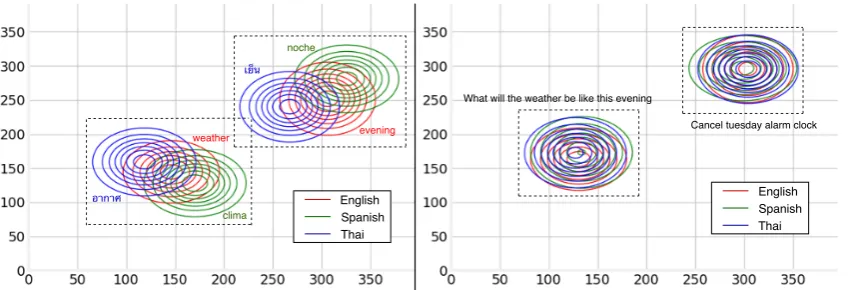
Figure 3: Visualization of latent variables on words(left)and sentences(right).Left:We choose
“weather-clima-อากาศ” and “evening-noche-เย็น”from parallel sentences.English: “What will the weather be like this evening”, Spanish: “C´omo ser´a el clima esta noche”,Thai:“ตอน เย็น นี้ อากาศ จะ เป็น อย่างไร”.Right:We choose two English sentences and show their distributions and those of the corresponding Spanish and Thai translations.
Translate Train They trained a supervised ma-chine translation system to translate English data into the target language and then trained the CRF model on this translated dataset.
5 Results & Discussion
From Table1, in general, LVM outperforms CRF models. This is because for semantically same words (e.g., weather and clima) LVM considers such close enough points as the same distribution, but CRF is more likely to classify them differently. This can be shown very clearly from Figure3, in which the latent variables demonstrate similar dis-tributions for semantically similar sentences and words. In addition, we can see that adding only Gaussian noise to the Vanilla BiLSTM improves our prediction performance significantly, which implies that the robustness of our model towards the noisy signals which come from the target em-bedding inputs.
Furthermore, it is clearly visible that cross-lingual embeddings refinement is more effective in Spanish than Thai. This is attributed to the qual-ity of alignments in the two languages. Spanish is much more lexically and grammatically similar to English than Thai, so word-level embedding re-finement is reasonably good. Jointly incorporating all three methods (Gaussian noise injection, cross-lingual embeddings refinement, and delexicaliza-tion) further reduces the noise in the inputs as well as makes the model more robust to noise, which help LVM to more easily approximate the distri-bution.
Finally, in Table2, we ablate the usage of LVM to see whether the boost of performance comes
simply from the increase of parameter size. By re-moving or replacing LVM with MLP, we can see the clear performance gains by using LVM.
6 Conclusion
In this paper, we propose a transferable latent variable that focuses on improving the zero-shot cross-lingual adaptation of natural language un-derstanding task to low-resource languages. We show that a combination of 1) cross-lingual em-beddings refinement, 2) Gaussian noise injection, and 3) latent variables are effective in coping with the variance of semantically similar sentences across different languages, and the visualizations of the latent variables confirm such. We leverage very few resources (i.e., 11 seed word pairs) and achieve state-of-the-art performance for English-to-Spanish and English-to-Thai in the zero-shot cross-lingual scenario.
Acknowledgments
This work has been partially funded by ITF/319/16FP and MRP/055/18 of the Inno-vation Technology Commission, the Hong Kong SAR Government.
References
Mikel Artetxe, Gorka Labaka, and Eneko Agirre. 2017. Learning bilingual word embeddings with (almost) no bilingual data. InProceedings of the 55th Annual Meeting of the Association for Computational Lin-guistics (Volume 1: Long Papers), pages 451–462.
Piotr Bojanowski, Edouard Grave, Armand Joulin, and Tomas Mikolov. 2017. Enriching word vectors with subword information. Transactions of the Associa-tion for ComputaAssocia-tional Linguistics, 5:135–146.
Wenhu Chen, Jianshu Chen, Yu Su, Xin Wang, Dong Yu, Xifeng Yan, and William Yang Wang. 2018. Xl-nbt: A cross-lingual neural belief tracking frame-work. In Proceedings of the 2018 Conference on Empirical Methods in Natural Language Process-ing, pages 414–424.
Alexis Conneau, Guillaume Lample, Marc’Aurelio Ranzato, Ludovic Denoyer, and Herv´e J´egou. 2018. Word translation without parallel data. In Inter-national Conference on Learning Representations (ICLR).
Bjarke Felbo, Alan Mislove, Anders Søgaard, Iyad Rahwan, and Sune Lehmann. 2017. Using millions of emoji occurrences to learn any-domain represen-tations for detecting sentiment, emotion and sar-casm. In Proceedings of the 2017 Conference on Empirical Methods in Natural Language Process-ing, pages 1615–1625.
Jiatao Gu, Hany Hassan, Jacob Devlin, and Victor OK Li. 2018. Universal neural machine translation for extremely low resource languages. In Proceed-ings of the 2018 Conference of the North American Chapter of the Association for Computational Lin-guistics: Human Language Technologies, Volume 1 (Long Papers), pages 344–354.
Sepp Hochreiter and J¨urgen Schmidhuber. 1997. Long short-term memory. Neural computation, 9(8):1735–1780.
Armand Joulin, Piotr Bojanowski, Tomas Mikolov, Herv´e J´egou, and Edouard Grave. 2018. Loss in translation: Learning bilingual word mapping with a retrieval criterion. InProceedings of the 2018 Con-ference on Empirical Methods in Natural Language Processing, pages 2979–2984.
Hung Le, Truyen Tran, Thin Nguyen, and Svetha Venkatesh. 2018. Variational memory encoder-decoder. In Advances in Neural Information Pro-cessing Systems, pages 1508–1518.
Nayeon Lee, Zihan Liu, and Pascale Fung. 2019. Team yeon-zi at semeval-2019 task 4: Hyperpartisan news detection by de-noising weakly-labeled data. In Proceedings of the 13th International Workshop on Semantic Evaluation, pages 1052–1056.
Zihan Liu, Yan Xu, Genta Indra Winata, and Pascale Fung. 2019. Incorporating word and subword units in unsupervised machine translation using language
model rescoring. InProceedings of the Fourth Con-ference on Machine Translation (Volume 2: Shared Task Papers, Day 1), pages 275–282.
Bryan McCann, James Bradbury, Caiming Xiong, and Richard Socher. 2017. Learned in translation: Con-textualized word vectors. InAdvances in Neural In-formation Processing Systems, pages 6294–6305.
Sebastian Schuster, Sonal Gupta, Rushin Shah, and Mike Lewis. 2019. Cross-lingual transfer learning for multilingual task oriented dialog. In Proceed-ings of the 2019 Conference of the North American Chapter of the Association for Computational Lin-guistics: Human Language Technologies, Volume 1 (Long and Short Papers), pages 3795–3805.
Shyam Upadhyay, Manaal Faruqui, Gokhan T¨ur, Hakkani-T¨ur Dilek, and Larry Heck. 2018. (almost) zero-shot cross-lingual spoken language understand-ing. In 2018 IEEE International Conference on Acoustics, Speech and Signal Processing (ICASSP), pages 6034–6038. IEEE.
Tsung-Hsien Wen, Yishu Miao, Phil Blunsom, and Steve Young. 2017. Latent intention dialogue mod-els. InInternational Conference on Machine Learn-ing, pages 3732–3741.
Genta Indra Winata, Zhaojiang Lin, and Pascale Fung. 2019. Learning multilingual meta-embeddings for code-switching named entity recognition. In Pro-ceedings of the 4th Workshop on Representation Learning for NLP (RepL4NLP-2019), pages 181– 186.
Peng Xu, Andrea Madotto, Chien-Sheng Wu, Ji Ho Park, and Pascale Fung. 2018. Emo2vec: Learn-ing generalized emotion representation by multi-task training. In Proceedings of the 9th Workshop on Computational Approaches to Subjectivity, Senti-ment and Social Media Analysis, pages 292–298.
Katherine Yu, Haoran Li, and Barlas Oguz. 2018. Multilingual seq2seq training with similarity loss for cross-lingual document classification. In Pro-ceedings of The Third Workshop on Representation Learning for NLP, pages 175–179.
Tiancheng Zhao and Maxine Eskenazi. 2018. Zero-shot dialog generation with cross-domain latent ac-tions. In Proceedings of the 19th Annual SIGdial Meeting on Discourse and Dialogue, pages 1–10.
Tiancheng Zhao, Kyusong Lee, and Maxine Eskenazi. 2018. Unsupervised discrete sentence representa-tion learning for interpretable neural dialog gener-ation. InProceedings of the 56th Annual Meeting of the Association for Computational Linguistics (Vol-ume 1: Long Papers), pages 1098–1107.