Proceedings of the Third Conference on Machine Translation (WMT), Volume 2: Shared Task Papers, pages 759–764
Keep It or Not: Word Level Quality Estimation for Post-Editing
Prasenjit Basu1, Santanu Pal2,3, Sudip Kumar Naskar4 1Future Institute of Engineering and Management, India
2Saarland University, Germany,
3German Research Center for Artificial Intelligence (DFKI), Saarbr¨ucken, Germany 4Jadavpur University, India
[email protected], [email protected], [email protected]
Abstract
The paper presents our participation in the WMT 2018 shared task on word level quality estimation (QE) of machine translated (MT) text, i.e., to predict whether a word in MT output for a given source context is correctly translated and hence should be retained in the post-edited translation (PE), or not. To per-form the QE task, we measure the similar-ity of the source context of the target MT word with the context for which the word is retained in PE in the training data. This is achieved in two different ways, using Bag-of-Words(BoW) model and Document-to-Vector
(Doc2Vec) model. In theBoWmodel, we com-pute the cosine similarity while in theDoc2Vec
model we consider the Doc2Vec similarity. By applying the Kneedle algorithm on the F1-mult vs. similarity score plot, we derive the threshold based on which OK/BAD decisions are taken for the MT words. Experimental results revealed that the Doc2Vec model per-forms better than the BoW model on the word level QE task.
1 Introduction
Evaluating and estimating quality of a machine translation (MT) system without referring the ac-tual translation is now one of the key research ar-eas in MT domain (Blatz et al.,2004;Specia et al., 2009). In a machine translated document quality estimation can be performed at various granulari-ties like word level, phrase level or sentence level (Specia et al., 2010,2013). Scarton et al. (2016) produced their task in WMT16 in document level quality estimation with winning result in two dif-ferent models (Bojar et al.,2016). One model used discourse features and SVR and another model employed word embedding feature and Gaussian Process for quality estimation. (Bic¸ici, 2017) predicted translation performance with referential translation machines at word level, sentence level
and at phrase level. (Blain et al., 2017) submit-ted task on bi-lexical word embedding in WMT17 QE shared task, which produced promising results in sentence level Quality Estimation. Some stud-ies (Fiederer and OBrien,2009;Koehn,2009; De-Palma and Kelly,2011;Zampieri and Vela,2014) show that the quality of MT output along with PE can produce better result than human editor in cer-tain situations.
In our work we mainly focus on word level quality estimation. The distributional structure of words was first described by (Harris, 1954). (Turian et al., 2010) illustrated representations of words in semi-supervised learning. Bengio et al. (2003) proposed neural probabilistic lan-guage model by using a distributed representa-tion of words. Collobert and Weston(2008), de-scribed how a convolutional neural network archi-tecture could be used to make different language processing predictions, such as semantically sim-ilar words, etc. Mnih and Hinton (2008) pro-posed a fast hierarchical language model along with a feature based algorithm which automati-cally builds word trees from data. Mikolov et al. (2013b) proposed vector representation of words with the help of negative sampling (instead of softmax function) that improves both word vec-tor quality and training speed. Their work showed prediction of a word from a context by adding two word vectors from the same context. (Mikolov et al.,2013a) proposed a novel approach to repre-sent words as fixed length vectors, widely known as word2vec model and they reported state-of-the-art performance on word similarity task. (Le and Mikolov,2014) extend their model to vector rep-resentation of a document known as Paragraph Vector model or commonly Document-to-Vector (Doc2Vec) model.
This paper reports our submission in the WMT 2018 Shared Task on Word-Level Quality
tion (QE task-2) on English–German (IT domain) SMT data. The proposed model has been devel-oped in two ways - one using the standard Bag-of-Words model and another using the Doc2Vec model. The motivation behind the use of Doc2Vec model is to achieve more accurate semantic simi-larity compared to the simple cosine simisimi-larity on Bag-of-Words model. The Doc2Vec model cap-tures semantic similarity which the Bag-of-Words model can not. Our word level error estimation is mainly based on Translation Error Rate (Snover et al.,2006) between MT and PE.
2 Proposed Approach
Our system highlights the retention of a word in MT translation and thus it helps human post-editors to increase their productivity with less ef-fort. Our QE system is built over the Translation Error Rate (TER) (Snover et al.,2006) alignment between MT output and the corresponding PE out-put in the training data. TER alignment shows whether words from MT data (hypothesis in TER) will be continued, deleted or substituted with re-spect to the PE data (reference in TER). Based on the TER alignment, we build binary classifi-cation models that suggestsOK for continuation
andBADfor deletion or substitution.
Our QE system follows two models: Bag-of-Words Model and Document-to-Vector based model as described in the following subsections.
2.1 Bag-of-Words Model
MT words that are retained in PE are identified through TER alignment. In the Bag-of-words (BoW) model, for each word (wi) in MT that is
retained in PE in the training set, we find the cor-responding source texts (src∗wi). A BoW (Bwi) is
then formed from thesrc∗wi for each suchwi that
are present in both MT and the corresponding PE in the training set. Algorithm1presents the BoW creation method. Bwi contains more repetition of
the source words which actually bear the meaning ofwi.
On the development set, we also establish TER alignment between the MT text (M Tdev) and the
PE text (P Edev). For each word (say, wj)
ap-pearing in each sentence in M Tdev, we consider
the correspondingsrcas the source context (say, srcwj) and keep track of the post-editing operation
required on the word (through TER alignment), i.e., whether the word is retained (OK) in PE or
Input:src–mt–peparallel training data and TER
alignments betweenmtandpe
Output: source BoW (Bdict) for each target word
begin
Vlist←N U LL
Bdict←N U LL
foreachsentence mti∈mtdo foreachTi,j∈mtido
ifTi,jis retained inpeithen ifTi,j ∈/Vlistthen
Vlist.add(Ti,j) end
Blist←N U LL forallSi,k∈srcido
Blist.add(Si,k) end
Bdict[Ti,j].add(Blist) end
end end returnBdict end
Algorithm 1:Creation of source BoW;Ti,jis the
jthword of theithmtsentence andSi,kis thekth
word ofithsrcsentence.
not (BAD). Then we compute the cosine
similar-ity betweensrcwjandBwj.
The similarity scores range between 0 and 1 with varying distribution. We aim to arrive at a threshold on the similarity score above which the system takes theOK decision, otherwise the BAD decision. This threshold is trained on the development set. However, the datasets, both training and development, are highly imbalanced; 85.66% and 83% of the mt tokens are retained (i.e.,OK) inpein the training set and the
devel-opment set respectively, and the rest are discarded or changed (i.e., BAD), which indicates that the mt data was generated by a strong MT system.
Such imbalance in the dataset proves to be a major hurdle in automatic QE or post-editing. The im-balance in the dataset leads to the fact that a very simple baseline of setting the threshold to 0 results in 85% F1-score on the development set (we con-sider only the non-stop words), which is very dif-ficult to defeat.
The similarity scores obtained for the develop-ment set MT words are divided into a number of segments (or ranges) for equal distribution such that there are roughly equal number of instances in each range (cf. Table3). The upper bound of each segment corresponds to a threshold.
We computeF1-mult1for each of the segments
1F
1-multis the multiplication ofF1scores for theOK
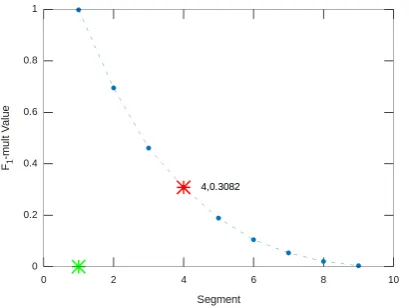
and produce the F1-multcurve. Figure1 shows
theF1-multcurve on the development set which
does not lead to any peak or intermediate thresh-old. We use the Kneedle algorithm (Satopaa et al., 2011) to find a knee point on theF1-multcurve
which serves as the threshold for our model and based on this threshold we take theOK/BAD
de-cision.
For each test set M T word (say wk), we
gen-erate the similarity score between Bwk and the
current source srcwk. If the score is above the
[image:3.595.74.279.250.404.2]threshold, the word is predicted asOK, otherwise BAD.
Figure 1: Segment vs. F1-multplot on the develop-ment set for theBoW model. Red Mark denotes the (segment, F1-mult) co-ordinate value for knee point and green Mark describes segment starting position.
2.2 Document-to-Vector based Model
In the Document-to-Vector (Doc2Vec) model for QE, for an MT wordwi, we also compute
similar-ity betweensrcwiandBwi. However, here instead
of the considering them as BoW, we treat them as documents and measure their Doc2Vec similar-ity score (SimD2V). For this, we prepare
docu-ment vector for each srcwi and Bwi using
gen-sim (Rehurek and Sojka, 2010). Gensim has its own implementation of document embedding via distributed memory or distributed Bag-of-Words model. In its model each document is represented as a fixed length vector. It is a generalization of and derived from the word2vec model. The QE decision is taken based on whether the SimD2V
for the word is above or below the threshold which is trained on the development set, as in the case of the BoW model. To train our Doc2Vec model we remove all stop words from the training data. For obtaining the threshold, the Doc2Vec
similar-ity scores are divided into a number of segments of equal distribution. Like the BoW model, we gen-erate theF1-multcurve on those similarity scores
and use the Kneedle algorithm to find the thresh-old.
3 Experiments
We used the WMT-2018 English–German (EN– DE) word level QE dataset for our experiments. Table3 presents the statistics of the training, de-velopment and test sets. Stop words generally oc-cur very frequently and their number of ococ-cur- occur-rences across BoW could easily mislead word-level QE. Therefore we process the training data by removing stop words for both German2and
En-glish from all the data sets, i.e., neither we con-sider them while building our context bags, nor we consider their QE.
Senten-ces src Tokensmt pe
Train 26,299 389,070 393,000 400,058 Dev 1000 14,600 14,773 14,970 Test 1926 28,312 28,785
-Table 1: Statistics of the the WMT-2018 Word Level QE Shared Task Data Set.
We considered 9 thresholds for the BoW model. Table3shows the segments and the corresponding thresholds.
Seg. No Threshold 1 0.075 2 0.15
3 0.2
4 0.25 5 0.31 6 0.38 7 0.47 8 0.58
9 1
Table 2: Segment versus Threshold values for the BOW model
Table 3shows word specific assignment of bi-nary scores to each threshold. For a word with QE decisionOK, a word–threshold cell is assigned to
1 if the similarity score for the corresponding word is higher than the corresponding threshold, and
[image:3.595.310.534.322.395.2]Token PE Decision Score 0.075 0.15 0.2 0.25 0.31 0.38 0.47 0.58 1Threshold
hinzugefgt OK 0.32 1 1 1 1 1 0 0 0 0
verhalten OK 0.26 1 1 1 1 0 0 0 0 0
zustzliche BAD 0.23 0 0 0 1 1 1 1 1 1
verknpfen OK 0.23 1 1 1 0 0 0 0 0 0
wird OK 0.32 1 1 1 1 1 0 0 0 0
verborgene OK 0.37 1 1 1 1 1 0 0 0 0
enthlt BAD 0.03 0 1 1 1 1 1 1 1 1
balken OK 0.21 1 1 1 0 0 0 0 0 0
fenster OK 0.17 1 1 0 0 0 0 0 0 0
[image:4.595.83.513.61.232.2]sol BAD 0.5 0 0 0 0 0 0 0 0 1
Table 3: A snapshot of the intermediate table showing word–threshold pair assignment
[image:4.595.129.233.270.355.2]Seg No Th. Value 1 0.001 2 0.12 3 0.21 4 0.4 5 0.1
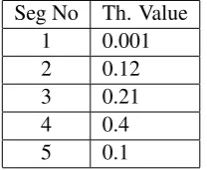
Table 4: Segment vs. threshold values for the Doc2Vec model
0 otherwise. For words with PE decision BAD,
scores are assigned the other way round. It is to be noted that our model can only predict the QE deci-sion for words that are already seen in the training set. Words that are not present in the training set (including stop words) are simply retained.
Kneedle algorithm on the Segments vs. F1
-mult plot on the development set (cf. Figure 1)
leads to the segment 4 as the knee point and the corresponding similarity score of 0.25 (cf. Table 3) serves as the threshold, which produces the op-timalF1-multfor the BoW model.
For the Doc2Vec based experiment, gensim creates models using distributed Bag-of-Words. Doc2Vec similarity is measured between the vec-tor representation of the Bag-of-Words and the source context for each target word from training data. The scores were distributed among 5 seg-ments (cf. Table3). Figure 2 shows the Segments vs. F1-multplot for the Doc2Vec model. From
the plot we take the knee value of the graph, i.e. segment 3 and the corresponding similarity score 0.21 (cf. Table 3) is considered as the threshold for the Doc2Vec model.
According to the WMT18 published results for the word level quality estimation task (Task 2), the
Figure 2: Segments versusF1-multplot on training set of Doc2Vec model. Red Mark denotes the (segment, F1-mult) co-ordinate value for knee point and green Mark describes segment starting position.
results of our two models along with baseline are shown in Table3. The evaluation results suggest that the Doc2Vec based word level QE model per-forms better than the Bag-of-Words based model for both theOKclass and theBAD class on the
WMT18 testset.
[image:4.595.311.511.273.424.2]Participant Model F1-BAD F1-OK F1-mult
[image:5.595.161.440.62.119.2]fblain BASELINE 0.4115 0.8821 0.3630 basuprasen Doc2Vec 0.2889 0.7547 0.2180 basuprasen BagOfWords 0.2784 0.7335 0.2042
Table 5: Evaluation Results on the WMT18 Word level Quality Estimation (Task 2)
4 Conclusions and Future Work
The paper reports our participation in the WMT 2018 shared task on word level quality estimation (QE task2) on English–German SMT data. The task of word level QE is treated as a binary clas-sification problem — i.e., decision is taken about whether a word under consideration is to be re-tained or not. The prediction is performed by mea-suring the similarity of the source context of the target word with the context for which the word is retained. This is achieved in two ways, us-ing BoW model and Doc2Vec. Experimental re-sults suggest that the Doc2Vec model can model this much more effectively than the Bag-of-Words model. An obvious extension of this work would be to extend our model to phrase-level QE and determining missing words and source words that lead to errors.
Acknowledgments
Santanu Pal is partly funded by the German re-search foundation (DFG) under grant number GE 2819/2-1 (project MMPE). Sudip Kumar Naskar is supported by Digital India Corporation (formerly Media Lab Asia), MeitY, Government of India, under the Young Faculty Research Fellowship of the Visvesvaraya PhD Scheme for Electronics & IT. We also want to thank the reviewers for their valuable input, and the organizers of the shared task.
References
Paul Azunre, Craig Corcoran, David Sullivan, Gar-rett Honke, Rebecca Ruppel, Sandeep Verma, and Jonathon Morgan. 2018. Abstractive tabular dataset summarization via knowledge basesemantic embed-dings. arXiv preprint arXiv:1804.01503.
Yoshua Bengio, R´ejean Ducharme, Pascal Vincent, and Christian Janvin. 2003. A neural probabilistic lan-guage model.J. Mach. Learn. Res., 3:1137–1155. Ergun Bic¸ici. 2017. Predicting translation performance
with referential translation machines. In Proceed-ings of the Second Conference on Machine Transla-tion, pages 540–544.
Fr´ed´eric Blain, Carolina Scarton, and Lucia Specia. 2017. Bilexical embeddings for quality estimation.
In Proceedings of the Second Conference on
Ma-chine Translation, pages 545–550.
John Blatz, Erin Fitzgerald, George Foster, Simona Gandrabur, Cyril Goutte, Alex Kulesza, Alberto Sanchis, and Nicola Ueffing. 2004. Confidence es-timation for machine translation. In Proceedings of the 20th international conference on Computa-tional Linguistics, page 315. Association for Com-putational Linguistics.
Ondrej Bojar, Rajen Chatterjee, Christian Federmann, Yvette Graham, Barry Haddow, Matthias Huck, An-tonio Jimeno Yepes, Philipp Koehn, Varvara Lo-gacheva, Christof Monz, et al. 2016. Findings of the 2016 conference on machine translation. In
ACL 2016 FIRST CONFERENCE ON MACHINE
TRANSLATION (WMT16), pages 131–198. The
As-sociation for Computational Linguistics.
Ronan Collobert and Jason Weston. 2008. A unified architecture for natural language processing: Deep neural networks with multitask learning. In Pro-ceedings of the 25th International Conference on Machine Learning, ICML ’08, pages 160–167, New York, NY, USA. ACM.
Donald A. DePalma and Nataly Kelly. 2011. Project management for crowdsourced translation: How user-translated content projects work in real life.
Translation and Localization Project Management: The art of the possible, XVI:379–408.
Rebecca Fiederer and Sharon OBrien. 2009. Quality and machine translation: A realistic objective. The Journal of Specialised Translation, 11:52–74.
Zellig S. Harris. 1954. Distributional structure.
WORD, 10(2-3):146–162.
Philipp Koehn. 2009. A process study of computer-aided translation. Machine Translation, 23:241– 263.
Quoc Le and Tomas Mikolov. 2014. Distributed repre-sentations of sentences and documents. In Proceed-ings of the 31st International Conference on Ma-chine Learning (ICML-14), pages 1188–1196.
Tomas Mikolov, Ilya Sutskever, Kai Chen, Greg S Cor-rado, and Jeff Dean. 2013b. Distributed representa-tions of words and phrases and their compositional-ity. InAdvances in neural information processing systems, pages 3111–3119.
Andriy Mnih and Geoffrey Hinton. 2008. A scalable hierarchical distributed language model. In Pro-ceedings of the 21st International Conference on Neural Information Processing Systems, NIPS’08, pages 1081–1088, USA. Curran Associates Inc. Radim Rehurek and Petr Sojka. 2010. Software
frame-work for topic modelling with large corpora. InIn Proceedings of the LREC 2010 Workshop on New Challenges for NLP Frameworks. Citeseer.
Ville Satopaa, Jeannie Albrecht, David Irwin, and Barath Raghavan. 2011. Finding a ”kneedle” in a haystack: Detecting knee points in system behavior. InProceedings of the 2011 31st International Con-ference on Distributed Computing Systems
Work-shops, ICDCSW ’11, pages 166–171, Washington,
DC, USA. IEEE Computer Society.
Carolina Scarton, Daniel Beck, Kashif Shah, Karin Sim Smith, and Lucia Specia. 2016. Word embeddings and discourse information for quality estimation. In
Proceedings of the First Conference on Machine Translation: Volume 2, Shared Task Papers, vol-ume 2, pages 831–837.
Matthew Snover, Bonnie Dorr, Richard Schwartz, Lin-nea Micciulla, and John Makhoul. 2006. A study of translation edit rate with targeted human annotation. In Proceedings of association for machine transla-tion in the Americas, volume 200.
Lucia Specia, Dhwaj Raj, and Marco Turchi. 2010. Machine translation evaluation versus quality esti-mation. Machine translation, 24(1):39–50.
Lucia Specia, Kashif Shah, Jose GC Souza, and Trevor Cohn. 2013. Quest-a translation quality estimation framework. InProceedings of the 51st Annual Meet-ing of the Association for Computational LMeet-inguis- Linguis-tics: System Demonstrations, pages 79–84.
Lucia Specia, Marco Turchi, Nicola Cancedda, Marc Dymetman, and Nello Cristianini. 2009. Estimat-ing the sentence-level quality of machine translation systems. In13th Conference of the European Asso-ciation for Machine Translation, pages 28–37. Joseph Turian, Lev Ratinov, and Yoshua Bengio. 2010.
Word representations: A simple and general method for semi-supervised learning. InProceedings of the 48th Annual Meeting of the Association for Com-putational Linguistics, ACL ’10, pages 384–394, Stroudsburg, PA, USA. Association for Computa-tional Linguistics.
Marcos Zampieri and Mihaela Vela. 2014. Quantify-ing the influence of mt output in the translators’ per-formance: A case study in technical translation. In