Proceedings of the 2019 Conference on Empirical Methods in Natural Language Processing
579
Select and Attend: Towards Controllable Content Selection in Text
Generation
Xiaoyu Shen1,2∗, Jun Suzuki3,4, Kentaro Inui3,4, Hui Su5 Dietrich Klakow1 and Satoshi Sekine4
1Spoken Language Systems (LSV), Saarland University, Germany 2Max Planck Institute for Informatics, Saarland Informatics Campus, Germany
3Tohoku University 4RIKEN AIP, Japan
5Pattern Recognition Center, Wechat AI, Tencent Inc, China
Abstract
Many text generation tasks naturally contain two steps: content selection and surface real-ization. Current neural encoder-decoder mod-els conflate both steps into a black-box archi-tecture. As a result, the content to be de-scribed in the text cannot be explicitly con-trolled. This paper tackles this problem by de-coupling content selection from the decoder. The decoupled content selection is human in-terpretable, whose value can be manually ma-nipulated to control the content of generated text. The model can be trained end-to-end without human annotations by maximizing a lower bound of the marginal likelihood. We further propose an effective way to trade-off between performance and controllability with a single adjustable hyperparameter. In both data-to-text and headline generation tasks, our model achieves promising results, paving the way for controllable content selection in text generation.1
1 Introduction
Many text generation tasks, e.g., data-to-text, sum-marization and image captioning, can be naturally divided into two steps: content selection and sur-face realization. The generations are supposed to have two levels of diversity: (1) content-level di-versity reflecting multiple possibilities of content selection (what to say) and (2) surface-level di-versity reflecting the linguistic variations of ver-balizing the selected contents (how to say) ( Re-iter and Dale, 2000;Nema et al., 2017). Recent neural network models handle these tasks with the encoder-decoder (Enc-Dec) framework (Sutskever et al.,2014;Bahdanau et al.,2015), which simul-taneously performs selecting and verbalizing in a
∗
Work mostly done while at RIKEN AIP. Correspon-dence [email protected]
1The source code is available onhttps://github.
com/chin-gyou/controllable-selection
Source Sentence: Thesri lankangovernment on Wednes-dayannouncedtheclosureof governmentschoolswith im-mediate effect as amilitary campaignagainst tamil sepa-ratists escalated in the north of the country.
Selected : sri lankan,closure,schools
Text: sri lanka closes schools.
Selected : sri lankan,Wednesday,closure,schools
Text: sri lanka closes schoolsonWednesday.
Selected : sri lankan,closure,schools,military campaign Text: sri lanka shuts down schoolsamidwarfears.
Selected : sri lankan,announced,closure,schools
Text: sri lankadeclaresclosureofschools.
Table 1: Headline generation examples from our model. We can generate text describing various con-tents by sampling different content selections. The se-lected source word and its corresponding realizations in the text are highlighted with the same color.
black-box way. Therefore, both levels of diver-sity are entangled within the generation. This en-tanglement, however, sacrifices the controllability and interpretability, making it diffifcult to specify the content to be conveyed in the generated text (Qin et al.,2018;Wiseman et al.,2018).
With this in mind, this paper proposes decou-pling content selection from the Enc-Dec frame-work to allow finer-grained control over the gen-eration. Table1shows an example. We can easily modify the content selection to generate text with various focuses, or sample multiple paraphrases by fixing the content selection.
Though there has been much work dealing with content selection for the Enc-Dec, none of them is able to address the above concerns properly. Cur-rent methods can be categorized into the following three classes and have different limits:
discrepancy when integrating them together.
2. Soft-select: Learn a soft mask to filter use-less information (Mei et al.,2016;Zhou et al.,
2017). However, the mask is deterministic
without any probabilistic variations, making it hard to model the content-level diversity.
3. Reinforce-select: Train the selector with reinforcement learning (Chen and Bansal,
2018), which has high training variance and low diversity on content selection.
In this paper, we treat the content selection as la-tent variables and train with amortized variational inference (Kingma and Welling,2014;Mnih and Gregor,2014). This provides a lower training vari-ance than Reinforce-select. The selector and gen-erator are co-trained within the same objective, the generations are thus more faithful to the selected contents than Bottom-up methods. Our model is task-agnostic, end-to-end trainable and can be seamlessly inserted into any encoder-decoder ar-chitecture. On both the data-to-text and head-line generation task, we show our model outper-forms others regarding content-level diversity and controllability while maintaining comparable per-formance. The performance/controllability trade-off can be effectively adjusted by adjusting a sin-gle hyperparameter in the training stage, which constrains an upper bound of the conditional mu-tual information (CMI) between the selector and generated text (Alemi et al., 2018; Zhao et al.,
2018). A higher CMI leads to stronger control-lability with a bit more risk of text disfluency.
In summary, our contributions are(1) systemat-ically studying the problem of controllable content selection for Enc-Dec text generation,(2) propos-ing a task-agnostic trainpropos-ing framework achievpropos-ing promising results and(3)introducing an effective way to achieve the trade-off between performance and controllability.
2 Background and Notation
LetX, Y denote a source-target pair. X is a se-quence ofx1, x2, . . . , xn and can be either some structured data or unstructured text/image depend-ing on the task. Y corresponds to y1, y2, . . . , ym
which is a text description ofX. The goal of text generation is to learn a distributionp(Y|X)to au-tomatically generate proper text.
The Enc-Dec architecture handles this task with an encode-attend-decode process (Bahdanau et al.,
2015;Xu et al.,2015). The encoder first encodes each xi into a vector hi. At each time step, the decoder pays attentions to some source embed-dings and outputs the probability of the next token by p(yt|y1:t−1, Ct). Ct is a weighted average of source embeddings:
Ct=X
i αt,ihi
αt,i = e f(hi,dt)
P
jef(hj,dt)
(1)
dt is the hidden state of the decoder at time step
t. f is a score function to compute the similarity betweenhianddt(Luong et al.,2015).
3 Content Selection
Our goal is to decouple the content selection from the decoder by introducing an extra con-tent selector. We hope the concon-tent-level diversity can be fully captured by the content selector for a more interpretable and controllable generation process. Following Gehrmann et al. (2018); Yu et al.(2018), we define content selection as a se-quence labeling task. Letβ1, β2, . . . , βn denote a sequence of binary selection masks. βi = 1ifhi
is selected and 0 otherwise. βi is assumed to be independent from each other and is sampled from a bernoulli distributionB(γi)2. γi is the bernoulli
parameter, which we estimate using a two-layer feedforward network on top of the source encoder. Text are generated by first samplingβ fromB(γ)
to decide which content to cover, then decode with the conditional distributionpθ(Y|X, β). The text
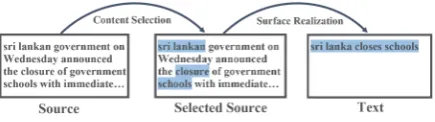
is expected to faithfully convey all selected con-tents and drop unselected ones. Fig. 1 depicts this generation process. Note that the selection is based on the token-levelcontext-aware embed-dings h and will maintain information from the surrounding contexts. It encourages the decoder to stay faithful to the original information instead of simply fabricating random sentences by con-necting the selected tokens. For each source-target pair, the ground-truth selection mask is unknown, so training is challenging. In the following ses-sion, we discuss several training possibilities and introduce the proposed model in detail.
2
Figure 1: Model will select contents based onB(γ), then decode with pθ(Y|X, β). Source-text pairs are available for training, but the ground-truth content se-lection for each pair is unknown.
3.1 Bottom-up
The most intuitive way is training the content se-lector to target some heuristically extracted con-tents. For example, we can train the selector to se-lect overlapped words between the source and tar-get (Gehrmann et al.,2018), sentences with higher tf-idf scores (Li et al., 2018) or identified image objects that appear in the caption (Wang et al.,
2017). A standard encoder-decoder model is in-dependently trained. In the testing stage, the pre-diction of the content selector is used to hard-mask the attention vector to guide the text generation in a bottom-up way. Though easy to train, Bottom-up generation has the following two problems:
(1) The heuristically extracted contents might be coarse and cannot reflect the variety of human lan-guages and(2)The selector and decoder are inde-pendently trained towards different objectives thus might not adapt to each other well.
β as Latent Variable: Another way is to treat
βas a latent variable and co-train selector and gen-erator by maximizing the marginal data likelihood. By doing so, the selector has the potential to auto-matically explore optimal selecting strategies best fit for the corresponding generator component.
With this in mind. We design pθ(Y|X, β) by changing the original decoder in the following way: (1) We initialize hidden states of the decoder from a mean pooling over selected contents to in-form the decoder which contents to cover and (2) Unselected contents will be prohibited from being attended to:
d0 =MLP
1 n
n
X
i βihi
αt,i =
ef(hi,dt)β
i
P
jef(hj,dt)βj
(2)
d0is the initial decoder hidden state and MLP de-notes multi-layer-perceptron.
Since computing the exact marginal likeli-hood logEβ∼B(γ)pθ(Y|X, β) requires enumerat-ing over all possible combinations ofβ (complex-ityO(2n)), we need some way to efficiently esti-mate the likelihood.
3.2 Soft-Select
Soft-select falls back on adeterministicnetwork to output the likelihood function’s first-order Taylor series approximation expanded atEβ∼B(γ)β:
logEβ∼B(γ)pθ(Y|X, β)
≈log[pθ(Y|X, γ) +Eβ∼B(γ)(β−γ)p0θ(Y|X, γ)]
= logpθ(Y|X, γ)
By moving the expectation into the decoding func-tion, we can deterministically compute the like-lihood by setting βi = γi, reducing complex-ity to O(1). Each attention weight will first be “soft-masked” by γ before being passed to the decoder. soft-select is fully differentiable and can be easily trained by gradient descent. How-ever, this soft-approximation is normally inaccu-rate, especially when B(γ) has a high entropy, which is common in one-to-many text generation tasks. The gap between logEβ∼B(γ)pθ(Y|X, β)
andlogpθ(Y|X,Eβ∼B(γ))will be large (Ma et al.,
2017;Deng et al., 2018). In practice, this would lead to unrealistic generations when sampling β
from the deterministically trained distribution.
3.3 Reinforce-Select
Reinforce-select (RS) (Ling and Rush,2017;Chen and Bansal,2018) utilizes reinforcement learning to approximate the marginal likelihood. Specifi-cally, it is trained to maximize a lower bound of the likelihood by applying the Jensen inequalily:
logEβ∼B(γ)pθ(Y|X, β)≥Eβ∼B(γ)logpθ(Y|X, β)
The gradient toγ is approximated with Monte-Carlo sampling by applying the REINFORCE al-gorithm (Williams,1992;Glynn,1990). To speed up convergence, we pre-train the selector by some distant supervision, which is a common practice in reinforcement learning. REINFORCE is unbiased but has a high variance. Many research have pro-posed sophisticated techniques for variance reduc-tion (Mnih and Gregor,2014;Tucker et al.,2017;
issue is its tendency to avoid stochasticity (Raiko et al.,2015), which we will show in Sec5.2that it results in low content-level diversity.
3.4 Variational Reinforce-Select
We propose Variational Reinforce-Select (VRS) which applies variational inference (Kingma and Welling, 2014) for variance reduction. Instead of directly integrating over B(γ), it imposes a proposal distributionqφfor importance sampling.
The marginal likelihood is lower bounded by:
logEβ∼B(γ)pθ(Y|X, β)
= logEβ∼qφ
pθ(Y, β|X) qφ(β)
≥Eβ∼qφlog
pθ(Y, β|X) qφ(β)
=Eβ∼qφlogpθ(Y|X, β)−KL(qφ||B(γ)) (3)
By choosing a proper qφ, the bound will be
im-proved and the variance can be largely reduced compared with REINFORCE. If qφ equals the
posterior distribution pθ(β|X, Y), the bound is
tight and the variance would be zero (Mnih and Rezende,2016). We defineqφ(β|X, Y)as a
mean-field distribution parameterized by a set of global parametersφto approach the true posterior distri-bution. φ, θandγ are simultaneously trained by minimizing the last tine of Eq.3.qφ(β|X, Y)also
allows us to further perform posterior inference: Given an arbitrary textY for a sourceX, we can infer which source contents are included inY (An example is given in AppendixC).
In Eq.3, the KL divergence term can be com-puted analytically. As for the independence as-sumption, it can be summed over each individual
βi. The likelihood term is differentiable to θ but not toφ, we estimate the gradient toφin Eq3by applying the REINFORCE estimator:
∇φEβ∼qφlogpθ(Y|X, β) =
Eβ∼qφ∇φlogqφ(β|X, Y)(logpθ(Y|X, β)−B)
Bis the control variate (Williams,1992). The op-timalBwould be (Weaver and Tao,2001):
B∗ =Eβ∼qφlogpθ(Y|X, β)
which we set as a soft-select approximation:
B= logpθ(Y|X,Eβ∼qφβ)
We estimate Eq.3.4with a single sample fromqφ
for efficiency. Though multiple-sample could po-tentially further tighten the bound and reduce the
variance (Burda et al.,2016;Lawson et al.,2018;
Tucker et al.,2019), it brings significant computa-tional overhead, especially in text generation tasks where the whole sentence needs to be decoded.
3.5 Degree of Controllability
In practice, when treating content selection as la-tent variables, the model tends to end up with a trivial solution of always selecting all source to-kens (Shen et al.,2018a;Ke et al.,2018). This be-havior is understandable since Eq.2strictly masks unselected tokens. Wrongly unselecting one to-ken will largely deteriorate the likelihood. Un-der the maximum likelihood (MLE) objective, this high risk pushes the selector to take a conserva-tive strategy of always keeping all tokens, then the whole model degenerates to the standard Enc-Dec and the selection mask loses effects on the gener-ation. Usually people apply a penalty term to the selecting ratio when optimizing the likelihood:
L+λ(¯γ−α)
(4)
L is the MLE loss function, γ¯ is the mean of γ
andαis the target selecting ratio. This forces the selector to select the most importantα tokens for each source input instead of keeping all of them.
In our VRS model, we can easily adjust the de-gree of controllability by limiting an upper bound of the conditional mutual information (CMI)
I(β, Y|X) (Zhao et al., 2018). Specifically, we can change our objective into:
max
φ,θ,γEβ∼qφlogpθ(Y|X, β) −λKL(qφ||B(γ))−)
(5)
λ is a fixed lagrangian multiplier. Eq. 5 can be proved equal to maximum likelihood with the con-straint I(β, Y|X) = given proper λ (Alemi et al.,2018). A higherindicatesβ has more in-fluences toY (higher controllability) while always safely selecting all tokens will leadI(β, Y|X) = 0.3 It is preferred over Eq.4because (a) CMI di-rectly considers the dependency between the se-lection and multiple-possible text while limiting the ratio aims at finding the single most salient parts for each source. (b) Unlike CMI, limiting the ratio is coarse. It considers only the total selected size and ignores its internal distribution.
3
Algorithm 1Variational Reinforce-Select (VRS)
Parameters: θ, φ, γ pretrain←TRUE
repeat
Sample X,Y from the corpus; Encode X into(h1, h2, . . . , hn); ifpretrainthen
Updateφwith distant supervision; Updateθ, γby∇θ,γEq.3;
else
Updateθ, γ, φby∇θ,γ,φEq.5; end if
pretrain←FALSE if Eq.3degrades
untilconvergence andpretrainis False
In practice, we can set to adjust the degree of controllability we want. Later we will show it leads to a trade-off with performance. The final algorithm is detailed in Algorithm1. To keep fair-ness, we trian RS and VRS with the same control variate and pre-training strategy.4
4 Related Work
Most content selection models train the selector with heuristic rules (Hsu et al., 2018; Li et al.,
2018;Yu et al.,2018;Gehrmann et al.,2018;Yao et al., 2019; Moryossef et al., 2019), which fail to fully capture the relation between selection and generation. Mei et al.(2016);Zhou et al.(2017);
Lin et al. (2018); Li et al. (2018) “soft-select” word or sentence embeddings based on a gating function. The output score from the gate is a de-terministic vector without any probabilistic varia-tions, so controlling the selection to generate di-verse text is impossible. Very few works explic-itly define a bernoulli distribution for the selector, then train with the REINFORCE algorithm (Ling and Rush,2017;Chen and Bansal,2018), but the selection targets at a high recall regardless of the low precision, so the controllability over generated text is weak. Fan et al. (2018) control the gen-eration by manually concatenating entity embed-dings, while our model is much more flexible by explicitly defining the selection probability over all source tokens.
Our work is closely related with learning discrete representations with variational
infer-4The only extra parameter of VRS isφwhich is a sim-ple MLP structure. The actual training comsim-plexity is similar to RS because they both use the REINFORCE algorithm for gradient estimation.
ence (Wen et al.,2017;van den Oord et al.,2017;
Kaiser et al., 2018;Lawson et al., 2018), where we treat content selection as the latent represen-tation. Limiting the KL-term is a common tech-nique to deal with the “posterior collapse” prob-lem (Kingma et al.,2016;Yang et al.,2017;Shen et al., 2018b). We adopt a similar approach and use it to further control the selecting strategy.
5 Experiments
For the experiments, we focus on compar-ing (1) Bottom-up generation (Bo.Up.), (2) soft-select (SS), (3) Reinforce-select (RS) and (4) Variational-Reinforce-select (VRS) regarding their performance on content selection. SS and RS are trained with the selecting ratio constraint in Eq.4. For the SS model, we further add a reg-ularization term to encourage the maximum value ofγto be close to 1 as inMei et al.(2016). We first briefly introduce the tasks and important setup, then present the evaluation results.
5.1 Tasks and Setup
We test content-selection models on the headline and data-to-text generation task. Both tasks share the same framework with the only difference of source-side encoders.
Headline Generation: We use English Giga-word preprocessed by Rush et al. (2015), which pairs first sentences of news articles with their headlines. We keep most settings same as inZhou et al. (2017), but use a vocabulary built by byte-pair-encoding (Sennrich et al.,2016). We find it speeds up training with superior performance.
Data-to-Text Generation: We use the Wik-ibio dataset (Lebret et al.,2016). The source is a Wikipedia infobox and the target is a one-sentence biography description. Most settings are the same as inLiu et al.(2018), but we use a bi-LSTM en-coder for better performance.
Heuristically extracted content: This is used to train the selector for bottom up models and pre-train the RS and VRS model. For wikibio, we sim-ply extract overlapped words between the source and target. In Gigaword, as the headline is more abstractive, we select the closest source word for each target word in the embedding space. Stop words and punctuations are prohibited from being selected.
Gigaword Oracle upper bound of % unique % unique %Effect of Entropy of
ROUGE-1 ROUGE-2 ROUGE-L Generation Mask Selector Selector
Bo.Up. 42.61 22.32 38.37 84.28 95.87 87.91 0.360
SS 33.15 14.63 30.68 82.06 96.23 85.27 0.392
RS 36.62 18.34 34.60 3.01 6.23 48.31 0.018
VRS 54.73 33.28 51.62 89.23 92.51 96.45 0.288
Wikibio ROUGE-4 BLEU-4 NIST Generation Mask Selector Selector
Bo.Up. 47.28 49.95 11.06 31.57 77.42 40.78 0.177
SS 41.73 43.94 9.82 63.09 89.42 70.55 0.355
RS 44.07 46.89 10.31 4.55 43.83 10.38 0.105
[image:6.595.86.512.64.211.2]VRS 52.41 55.03 11.89 57.62 77.83 74.03 0.181
Table 2: Diversity of content selection. The % effect of selector is defined as the ratio of unique generation and mask, which reflects the rate that changing the selector will lead to corresponding changes of the generated text.
VRS.αcorresponds to the selecting ratio. We set them as α = 0.35 for Wikibio and 0.25 for Gi-gaword. The value is decided by running a human evaluation to get the empirical estimation. To keep comparison fairness, we tuneto make VRS select similar amount of tokens with RS. The values we get are = 0.15nfor Wikibio and= 0.25nfor Gigaword.nis the number of source tokens.5
5.2 Results and Analysis
Ideally we would expect the learned content selec-tor to (1) have reasonable diversity so that text with various contents can be easily sampled, (2) prop-erly control the contents described in the generated text and (3) not hurt performance. The following section will evaluate these three points in order.
Diversity: We first look into the diversity of content selection learned by different models. For each test data, 50 selection masks are randomly sampled from the model’s learned distribution. Greedy decoding is run to generate the text for each mask. We measure the entropy of the se-lector, proportion of unique selection masks and generated text in the 50 samples. We further de-fine the “effect” of the selector as the ratio of sam-pled unique text and mask. This indicates how often changing the selection mask will also lead to a change in the generated text. The results are averaged over all test data. Following Rush et al.(2015) andLebret et al.(2016), we measure the quality of generated text with ROUGE-1, 2, L F-score for Gigaword and ROUGE-4, BLEU-4, NIST for Wikibio. As there is only one ref-erence text for each source, we report an oracle
5 corresponds to the KL divergence of the selection mask, which scales linearly with the number of source to-kens, so we set it proportinally w.r.t.n.
upper bound of these scores by assuming an “or-acle” that can choose the best text among all the candidates (Mao et al.,2015;Wang et al.,2017). Namely, out of each 50 sampled text, we pick the one with the maximum metric score. The final metric score is evaluated on these “oracle” picked samples. The intuition is that if the content selec-tor is properly trained, at least one out of the 50 samples should describe similar contents with the reference text, the metric score between it and the reference text should be high. Table2lists the re-sults. We can have the following observations:
• RS model completely fails to capture the content-level diversity. Its selector is largely deterministic, with a lowest entropy value among all models. In contrast, the selector from SS, VRS and Bo.Up. have reasonable diversity, with over90%and75%unique se-lection masks for Gigaword and Wikibio re-spectively.
• The selector from VRS has the strongest ef-fect to the generator, especially on the Giga-word data where modifying the content selec-tion changes the corresponding text in more than 95% of the cases. RS has the lowest ef-fect value, which indicates that even with the selecting ratio constraint, its generator still ignores the selection mask to a large extent.
soft approximation and the real distribution, as mentioned before, indeed results in a large drop of performance.
In short, compared with others, the content selec-tor of VRS is(1) diverse, (2) has stronger effect on the text generation and (3) with a larger potential of producing an expected text.
Controllability: We have shown the content se-lector of VRS is diverse and has strong effect on the text generation. This section aims at examin-ing whether such effect is desirable, i.e., whether the selector is able to properly control the contents described in the text. We measure it based on the self-bleu metric and a human evaluation.
The self-bleu metric measures the controllabil-ity by evaluating the “intra-selection” similarcontrollabil-ity of generated text. Intuitively, by fixing the selec-tion mask, multiple text sampled from the decoder are expected to describe the same contents and thereby should be highly similar to each other. The decoder should only model surface-level diversity without further modifying the selected contents. With this in mind, for each test data, we randomly sample a selection mask from the selector’s dis-tribution, then fix the mask and run the decoder to sample 10 different text. The self-BLEU-1 score (Zhu et al.,2018) on the sampled text is re-ported, which is the average BLEU score between each text pair. A higher self-BLEU score indi-cates the sampled text are more similar with each other. The results are shown in Table3. We can see generations from VRS have a clearly higher intra-selection similarity. SS performs even worse than RS, despite having a high effect score in Ta-ble2. The selector from SS affects the generation in an undesirable way, which also explain why SS has a lowest oracle metric score though with a high score on content diversity and effect.
Method Bo.Up. SS RS VRS
Gigaword 46.58 37.20 48.13 61.14
[image:7.595.310.523.66.170.2]Wikibio 38.30 13.92 25.99 43.81
Table 3: Self-Bleu score by fixing selection mask. Higher means better controllability of content selection
We further run a human evaluation to mea-sure the text-content consistency among differ-ent models. 100 source text are randomly sam-pled from the human-written DUC 2004 data for task 1&2 (Over et al., 2007). Bo.Up, SS, RS
Method Fluency intra-consistency inter-diversity
Reference 0.96 -
-Enc-Dec 0.83 -
-Bo.Up. 0.46 0.48 0.61
SS 0.27 0.41 0.54
RS 0.78 0.39 0.47
VRS 0.74 0.72 0.87
Table 4: Human evaluation on fluency, intra-consistency and inter-diversity of content selection on DUC 2004.
and VRS are applied to generate the target text by first sampling a selection mask, then run beam search decoding with beam size 10. We are inter-ested in seeing (1) if multiple generations from the same selection mask are paraphrases to each other (intra-consistent) and (2) if generations from dif-ferent selection masks do differ in the content they described (inter-diverse). The results in Table 4
show that VRS significantly outperforms the other two in both intra-consistency and inter-diversity. RS has the lowest score on both because the se-lector has very weak effects on the generation as measured in the last section. Bo.Up and SS lay between them. Overall VRS is able to maintain the highest content-text consistencyamong them.
Method R-1 R-2 R-L %Word
Zhou et al.(2017) 36.15 17.54 33.63 100
Enc-Dec 35.92 17.43 33.42 100
SS 20.35 4.78 16.53 24.82
Bo.Up 28.17 10.32 26.68 24.54
RS 35.45 16.38 32.71 25.12
VRS(= 0)-pri 36.42 17.81 33.86 78.63
VRS(= 0.25)-pri 34.26 15.11 31.69 24.36
VRS(= 0)-post 37.14 18.03 34.26 78.66
VRS(= 0.25)-post 56.72 33.24 51.88 24.53
Table 5: Gigaword best-select results. Larger leads to more controllable selector with a bit degrade of per-formance. (-post) means selecting from the posterior
qφ(β|X, Y), (-pri) is from the priorB(γi).
Method R-4 B-4 NIST %Word
Liu et al.(2018) 41.65 44.71 100
Enc-Dec 42.07 44.80 9.82 100
SS 5.10 5.73 0.24 35.12
Bo.Up 8.07 9.52 0.42 38.79
RS 42.64 45.08 10.01 34.53
VRS(= 0)-pri 43.01 46.01 10.24 84.56
VRS(= 0.15)-pri 42.13 44.51 9.84 34.04
VRS(= 0)-post 43.84 46.60 10.27 85.34
[image:8.595.316.507.281.421.2]VRS(= 0.15)-post 49.68 52.26 11.48 34.57
Table 6: Wikibio best-select results.
a content selector always affects the fluency a bit. The main reason is that when the controllability is strong, the change of selection will directly affect the text realization so that a tiny error of content selection might lead to unrealistic text. If the se-lector is not perfectly trained, the fluency will in-evitably be influenced. When the controllability is weaker, like in RS, the fluency is more stable because it will not be affected much by the selec-tion mask. For SS and Bo.Up, the drop of fluency is significant because of the gap of soft approx-imation and the independent training procedure. In general, VRS does properly decouple content selection from the enc-dec architecture, with only tiny degrade on the fluency.
Table5/6 further measure the metric scores on Gigaword/Wikibio by decoding text from the best selection mask based on the selector’s distribution (set βi = 1 if B(γi) > 0.5 and 0 otherwise). We include results from VRS model with = 0, which puts no constraint on the mutual informa-tion. We further report the score by generating the best selection mask from the learned posterior dis-tribution qφ(β|X, Y) for VRS model. Two cur-rent SOTA results fromZhou et al.(2017) andLiu et al.(2018) and the proportion of selected source words for each model are also included. We have the following observations:
• As the value ofdecreases, the performance of VRS improves, but the selector loses more controllability because the model tends to over-select contents (over75%source words selected). The text-content consistency will become low.
• Increasingsacrifices a bit performance, but still comparable with SOTA. Especially on
Wikibio where the performance drop is mi-nor. The reason should be that Wikibio is relatively easier to predict the selection but Gigaword has more uncertainty.
• Increasing improves the accuracy of the posterior selection. This would be useful when we want to perform posterior inference for some source-target pair.
• Setting= 0can actually outperform SOTA seq2seq which keeps all tokens, suggesting it is still beneficial to use the VRS model even if we do not care about the controllability.
Figure 2: Negative log likelihood (NLL), selection entropy and self-BLEU as changes. NLL and self-bleu on Wikibio are added by 1 for better vi-sualization. Lower NLL suggests higher perfor-mance. Higher entropy/self-BLEU means higher di-versity/controllability.
Figure2visualizes how changing the value of
affects the negative log likelihood (NLL), entropy of the selector and self-bleu score, which roughly correlates with performance, diversity and con-trollability. NLL is evaluated based on the lower bound in Eq3(Sohn et al.,2015). We can see as
increases, the performance decreases gradually but the content selection gains more diversity and controllability. In practice we can tune thevalue to achieve a trade-off.
Source: indian prime minister p.v. narasimha rao ’s promise of more autonomy for troubledkashmir and his plea for early state elections hassparkedaviolent reaction from provincial moslem and opposition parties .
Samples from SS:
t1:indian indian calls for end to violence in kashmir .
t2:indian pm calls for end to violence in afghanistan .
t3:indian pm calls for boycott of pakistan ’s ruling party .
Samples from Bo.Up:
t1:india promises more autonomous more autonomy .
t2:indian pm promises autonomy for kashmir autonomy .
t3:indian pm ’s promise sparks violent reaction .
Samples from RS:
t1:indian pm ’s kashmir promises sparks violent reaction.
t2:indian pm ’s promise sparks violent reaction .
t3:kashmir parties blast pm ’s promise .
Samples from VRS:
t1:indian pm ’s promise on kashmir sparks uproar .
t2:indian pm ’s promise on kashmir sparks protests .
t3:indian pm ’s promise for kashmir sparks controversy .
Source: factory orders for manufactured goodsrose #.# percent in september, the commerce department said here thursday .
Samples from SS:
t1:u.s. consumer confidence down in january in january.
t2:u.s. wholesale prices up #.# percent in october .
t3:u.s. jobless rate rises to #.# percent in march .
Samples from Bo.Up.:
t1:september u.s. factory orders up #.# percent .
t2:september u.s. factory orders increase .
t3:factory orders up in september .
Samples from RS:
t1:u.s. factory orders up #.# percent in september .
t2:factory orders for manufactured goods rise .
t3:factory orders up in september from the year .
Samples from VRS:
t1:september factory orders up #.# percent .
t2:september factory orders rise #.# percent .
t3:september factory orders increase #.# pct .
Figure 3: Text generation examples from Gigaword.
Highlightedwords are selected. t1-3 are sampled from the decoder based on the selected content. Generations from VRS are more faithful to selected contents.
contents and also the way of saying. SS and Bo.Up also suffer more from the text disfluency. The gen-erations from them are largely uncertain.
6 Conclusion
In this paper, we tackle the unaddressed problem of controllable content selection in text genera-tion. We propose a general framework based on variational inference that can be potentiall applied to arbitrary tasks. On both the headline genera-tion and data-to-text tasks, our model outperforms state-of-the-art models regarding the diversity and controllability of content selection. We further introduce an effective way to achieve a perfor-mance/controllability trade-off, which can be eas-ily tuned to meet specific requirement.
Acknowledgments
We thank anonymous reviewers for valuable com-ments, thank Aditya Mogadala, Shun Kiyono, Thomas Mclachlan and other members of the LIAT team at RIKEN AIP for useful discussions. Xiaoyu Shen is supported by IMPRS-CS fellow-ship. The work of J. Suzuki was partly supported by JSPS KAKENHI Grant Number JP19104418 and AIRPF Grant Number 30AI036-8. This work is also partially funded by DFG collaborative re-search center SFB 1102.
References
Alexander Alemi, Ben Poole, Ian Fischer, Joshua Dil-lon, Rif A. Saurous, and Kevin Murphy. 2018. Fix-ing a broken ELBO. InProceedings of the 35th In-ternational Conference on Machine Learning, vol-ume 80 of Proceedings of Machine Learning Re-search, pages 159–168, Stockholmsmssan, Stock-holm Sweden. PMLR.
Dzmitry Bahdanau, Kyunghyun Cho, and Yoshua Ben-gio. 2015. Neural machine translation by jointly learning to align and translate. InInternational Con-ference on Learning Representations.
Yuri Burda, Roger Grosse, and Ruslan Salakhutdinov. 2016. Importance weighted autoencoders. In Inter-national Conference on Learning Representations.
Yen-Chun Chen and Mohit Bansal. 2018. Fast abstrac-tive summarization with reinforce-selected sentence rewriting. InProceedings of the 56th Annual Meet-ing of the Association for Computational LMeet-inguistics (Volume 1: Long Papers), pages 675–686. Associa-tion for ComputaAssocia-tional Linguistics.
Marcella Cornia, Lorenzo Baraldi, and Rita Cucchiara. 2018. Show, control and tell: A framework for gen-erating controllable and grounded captions. arXiv preprint arXiv:1811.10652.
Yuntian Deng, Yoon Kim, Justin Chiu, Demi Guo, and Alexander M Rush. 2018. Latent alignment and variational attention. Nips.
Jacob Devlin, Ming-Wei Chang, Kenton Lee, and Kristina Toutanova. 2019. Bert: Pre-training of deep bidirectional transformers for language understand-ing.NAACL.
Angela Fan, David Grangier, and Michael Auli. 2018. Controllable abstractive summarization. In Pro-ceedings of the 2nd Workshop on Neural Machine Translation and Generation, pages 45–54. Associa-tion for ComputaAssocia-tional Linguistics.
Peter W. Glynn. 1990. Likelihood ratio gradient es-timation for stochastic systems. Commun. ACM, 33(10):75–84.
Will Grathwohl, Dami Choi, Yuhuai Wu, Geoff Roeder, and David Duvenaud. 2018. Backpropaga-tion through the void: Optimizing control variates for black-box gradient estimation. In International Conference on Learning Representations.
Anne-Claire Haury, Pierre Gestraud, and Jean-Philippe Vert. 2011. The influence of feature selection meth-ods on accuracy, stability and interpretability of molecular signatures. PloS one, 6(12):e28210.
Wan-Ting Hsu, Chieh-Kai Lin, Ming-Ying Lee, Kerui Min, Jing Tang, and Min Sun. 2018. A unified model for extractive and abstractive summarization using inconsistency loss. InProceedings of the 56th Annual Meeting of the Association for Computa-tional Linguistics (Volume 1: Long Papers), pages 132–141. Association for Computational Linguis-tics.
Peter Jackson. 1998. Introduction to expert systems. Addison-Wesley Longman Publishing Co., Inc.
Lukasz Kaiser, Samy Bengio, Aurko Roy, Ashish Vaswani, Niki Parmar, Jakob Uszkoreit, and Noam Shazeer. 2018. Fast decoding in sequence models using discrete latent variables. InProceedings of the 35th International Conference on Machine Learn-ing, volume 80 of Proceedings of Machine Learn-ing Research, pages 2390–2399, Stockholmsmssan, Stockholm Sweden. PMLR.
Nan Rosemary Ke, Konrad ˙Zołna, Alessandro Sor-doni, Zhouhan Lin, Adam Trischler, Yoshua Ben-gio, Joelle Pineau, Laurent Charlin, and Christopher Pal. 2018. Focused hierarchical RNNs for condi-tional sequence processing. In Proceedings of the 35th International Conference on Machine Learn-ing, volume 80 of Proceedings of Machine Learn-ing Research, pages 2554–2563, Stockholmsmssan, Stockholm Sweden. PMLR.
Diederik P Kingma, Tim Salimans, Rafal Jozefowicz, Xi Chen, Ilya Sutskever, and Max Welling. 2016. Improved variational inference with inverse autore-gressive flow. In Advances in Neural Information Processing Systems, pages 4743–4751.
Diederik P Kingma and Max Welling. 2014. Auto-encoding variational bayes. In International Con-ference on Learning Representations.
Dieterich Lawson, Chung-Cheng Chiu, George Tucker, Colin Raffel, Kevin Swersky, and Navdeep Jaitly. 2018. Learning hard alignments with variational in-ference. In2018 IEEE International Conference on Acoustics, Speech and Signal Processing (ICASSP), pages 5799–5803. IEEE.
R´emi Lebret, David Grangier, and Michael Auli. 2016. Neural text generation from structured data with ap-plication to the biography domain. In Proceed-ings of the 2016 Conference on Empirical Methods
in Natural Language Processing, pages 1203–1213. Association for Computational Linguistics.
Tao Lei, Regina Barzilay, and Tommi Jaakkola. 2016. Rationalizing neural predictions. InProceedings of the 2016 Conference on Empirical Methods in Nat-ural Language Processing, pages 107–117.
Wei Li, Xinyan Xiao, Yajuan Lyu, and Yuanzhuo Wang. 2018. Improving neural abstractive docu-ment summarization with explicit information selec-tion modeling. EMNLP.
Junyang Lin, Xu SUN, Shuming Ma, and Qi Su. 2018. Global encoding for abstractive summariza-tion. InProceedings of the 56th Annual Meeting of the Association for Computational Linguistics (Vol-ume 2: Short Papers), pages 163–169. Association for Computational Linguistics.
Jeffrey Ling and Alexander Rush. 2017. Coarse-to-fine attention models for document summarization. In Proceedings of the Workshop on New Frontiers in Summarization, pages 33–42.
Tianyu Liu, Kexiang Wang, Lei Sha, Baobao Chang, and Zhifang Sui. 2018. Building end-to-end di-alogue systems using generative hierarchical neu-ral network models. InProceedings of the Thirty-Second AAAI Conference on Artificial Intelligence, pages 4881–4888. AAAI Press.
Thang Luong, Hieu Pham, and Christopher D. Man-ning. 2015. Effective approaches to attention-based neural machine translation. In Proceedings of the 2015 Conference on Empirical Methods in Natural Language Processing, pages 1412–1421. Associa-tion for ComputaAssocia-tional Linguistics.
Xuezhe Ma, Yingkai Gao, Zhiting Hu, Yaoliang Yu, Yuntian Deng, and Eduard Hovy. 2017. Dropout with expectation-linear regularization. In Interna-tional Conference on Learning Representations.
Junhua Mao, Wei Xu, Yi Yang, Jiang Wang, Zhiheng Huang, and Alan Yuille. 2015. Deep captioning with multimodal recurrent neural networks (m-rnn). ICLR.
Hongyuan Mei, TTI UChicago, Mohit Bansal, and Matthew R Walter. 2016. What to talk about and how? selective generation using lstms with coarse-to-fine alignment. InProceedings of NAACL-HLT, pages 720–730.
Andriy Mnih and Karol Gregor. 2014. Neural vari-ational inference and learning in belief networks. InProceedings of the 31st International Conference on International Conference on Machine Learn-ing - Volume 32, ICML’14, pages II–1791–II–1799. JMLR.org.
Amit Moryossef, Yoav Goldberg, and Ido Dagan. 2019. Step-by-step: Separating planning from realization in neural data-to-text generation.NAACL.
Ramesh Nallapati, Feifei Zhai, and Bowen Zhou. 2017. Summarunner: A recurrent neural network based se-quence model for extractive summarization of docu-ments. InAAAI.
Preksha Nema, Mitesh M Khapra, Anirban Laha, and Balaraman Ravindran. 2017. Diversity driven atten-tion model for query-based abstractive summariza-tion. InProceedings of the 55th Annual Meeting of the Association for Computational Linguistics (Vol-ume 1: Long Papers), vol(Vol-ume 1, pages 1063–1072.
Aaron van den Oord, Oriol Vinyals, and koray kavukcuoglu. 2017. Neural discrete representation learning. In I. Guyon, U. V. Luxburg, S. Bengio, H. Wallach, R. Fergus, S. Vishwanathan, and R. Gar-nett, editors, Advances in Neural Information Pro-cessing Systems 30, pages 6306–6315. Curran As-sociates, Inc.
Paul Over, Hoa Dang, and Donna Harman. 2007. Duc in context. Information Processing & Management, 43(6):1506–1520.
Jeffrey Pennington, Richard Socher, and Christopher Manning. 2014. Glove: Global vectors for word representation. InProceedings of the 2014 confer-ence on empirical methods in natural language pro-cessing (EMNLP), pages 1532–1543.
Shrimai Prabhumoye, Chris Quirk, and Michel Galley. 2019. Towards content transfer through grounded text generation.NAACL.
Guanghui Qin, Jin-Ge Yao, Xuening Wang, Jinpeng Wang, and Chin-Yew Lin. 2018. Learning latent se-mantic annotations for grounding natural language to structured data. InProceedings of the 2018 Con-ference on Empirical Methods in Natural Language Processing, pages 3761–3771.
Tapani Raiko, Mathias Berglund, Guillaume Alain, and Laurent Dinh. 2015. Techniques for learning binary stochastic feedforward neural networks.ICLR.
Ehud Reiter and Robert Dale. 2000. Building natural language generation systems. Cambridge university press.
Alexander M. Rush, Sumit Chopra, and Jason Weston. 2015. A neural attention model for abstractive sen-tence summarization. In Proceedings of the 2015 Conference on Empirical Methods in Natural Lan-guage Processing, pages 379–389. Association for Computational Linguistics.
Rico Sennrich, Barry Haddow, and Alexandra Birch. 2016. Neural machine translation of rare words with subword units. InProceedings of the 54th Annual Meeting of the Association for Computational Lin-guistics (Volume 1: Long Papers), volume 1, pages 1715–1725.
Tao Shen, Tianyi Zhou, Guodong Long, Jing Jiang, Sen Wang, and Chengqi Zhang. 2018a. Reinforced self-attention network: a hybrid of hard and soft atten-tion for sequence modeling. InProceedings of the Twenty-Seventh International Joint Conference on Artificial Intelligence, IJCAI-18, pages 4345–4352. International Joint Conferences on Artificial Intelli-gence Organization.
Xiaoyu Shen, Hui Su, Shuzi Niu, and Vera Demberg. 2018b. Improving variational encoder-decoders in dialogue generation. In Thirty-Second AAAI Con-ference on Artificial Intelligence.
Kihyuk Sohn, Honglak Lee, and Xinchen Yan. 2015. Learning structured output representation using deep conditional generative models. InAdvances in neural information processing systems, pages 3483– 3491.
Amanda Stent, Rashmi Prasad, and Marilyn Walker. 2004. Trainable sentence planning for complex in-formation presentation in spoken dialog systems. In Proceedings of the 42nd annual meeting on associa-tion for computaassocia-tional linguistics, page 79. Associ-ation for ComputAssoci-ational Linguistics.
Ilya Sutskever, Oriol Vinyals, and Quoc V Le. 2014. Sequence to sequence learning with neural net-works. In Z. Ghahramani, M. Welling, C. Cortes, N. D. Lawrence, and K. Q. Weinberger, editors, Ad-vances in Neural Information Processing Systems 27, pages 3104–3112. Curran Associates, Inc.
George Tucker, Dieterich Lawson, Shixiang Gu, and Chris J Maddison. 2019. Doubly reparameterized gradient estimators for monte carlo objectives. In International Conference on Learning Representa-tions.
George Tucker, Andriy Mnih, Chris J Maddison, John Lawson, and Jascha Sohl-Dickstein. 2017. Rebar: Low-variance, unbiased gradient estimates for dis-crete latent variable models. In I. Guyon, U. V. Luxburg, S. Bengio, H. Wallach, R. Fergus, S. Vish-wanathan, and R. Garnett, editors,Advances in Neu-ral Information Processing Systems 30, pages 2627– 2636. Curran Associates, Inc.
Liwei Wang, Alexander Schwing, and Svetlana Lazeb-nik. 2017. Diverse and accurate image description using a variational auto-encoder with an additive gaussian encoding space. InAdvances in Neural In-formation Processing Systems, pages 5756–5766.
Wentao Wang, Zhiting Hu, Zichao Yang, Haoran Shi, Frank Xu, and Eric Xing. 2019. Toward unsu-pervised text content manipulation. arXiv preprint arXiv:1901.09501.
Tsung-Hsien Wen, Milica Gasic, Nikola Mrkˇsi´c, Pei-Hao Su, David Vandyke, and Steve Young. 2015. Semantically conditioned lstm-based natural lan-guage generation for spoken dialogue systems. In Proceedings of the 2015 Conference on Empirical Methods in Natural Language Processing, pages 1711–1721.
Tsung-Hsien Wen, Yishu Miao, Phil Blunsom, and Steve Young. 2017. Latent intention dialogue models. In Proceedings of the 34th International Conference on Machine Learning, volume 70 of Proceedings of Machine Learning Research, pages 3732–3741, International Convention Centre, Syd-ney, Australia. PMLR.
Ronald J. Williams. 1992. Simple statistical gradient-following algorithms for connectionist reinforce-ment learning. Machine Learning, 8(3):229–256.
Sam Wiseman, Stuart M Shieber, and Alexander M Rush. 2018. Learning neural templates for text gen-eration. EMNLP.
Kelvin Xu, Jimmy Ba, Ryan Kiros, Kyunghyun Cho, Aaron Courville, Ruslan Salakhudinov, Rich Zemel, and Yoshua Bengio. 2015. Show, attend and tell: Neural image caption generation with visual atten-tion. InInternational conference on machine learn-ing, pages 2048–2057.
Zichao Yang, Zhiting Hu, Ruslan Salakhutdinov, and Taylor Berg-Kirkpatrick. 2017. Improved varia-tional autoencoders for text modeling using dilated convolutions. ICML.
Lili Yao, Nanyun Peng, Weischedel Ralph, Kevin Knight, Dongyan Zhao, and Rui Yan. 2019. Plan-and-write: Towards better automatic storytelling. AAAI.
Naitong Yu, Jie Zhang, Minlie Huang, and Xiaoyan Zhu. 2018. An operation network for abstractive sentence compression. In Proceedings of the 27th International Conference on Computational Lin-guistics, pages 1065–1076. Association for Compu-tational Linguistics.
Shengjia Zhao, Jiaming Song, and Stefano Ermon. 2018. The information autoencoding family: A la-grangian perspective on latent variable generative models. UAI.
Qingyu Zhou, Nan Yang, Furu Wei, and Ming Zhou. 2017. Selective encoding for abstractive sentence summarization. In Proceedings of the 55th An-nual Meeting of the Association for Computational Linguistics (Volume 1: Long Papers), pages 1095– 1104. Association for Computational Linguistics.