Proceedings of the 2019 Conference on Empirical Methods in Natural Language Processing 1051
CM-Net: A Novel Collaborative Memory Network for
Spoken Language Understanding
Yijin Liu1∗, Fandong Meng2, Jinchao Zhang2, Jie Zhou2, Yufeng Chen1and Jinan Xu1† 1Beijing Jiaotong University, China
2Pattern Recognition Center, WeChat AI, Tencent Inc, China [email protected]
{fandongmeng, dayerzhang, withtomzhou}@tencent.com {chenyf, jaxu}@bjtu.edu.cn
Abstract
Spoken Language Understanding (SLU) mainly involves two tasks, intent detection and slot filling, which are generally modeled jointly in existing works. However, most existing models fail to fully utilize co-occurrence relations between slots and intents, which restricts their potential performance. To address this issue, in this paper we propose a novel Collaborative Memory Network (CM-Net) based on the well-designed block, named CM-block. The CM-block firstly cap-tures slot-specific and intent-specific feacap-tures from memories in a collaborative manner, and then uses these enriched features to enhance local context representations, based on which the sequential information flow leads to more specific (slot and intent) global utterance representations. Through stacking multiple CM-blocks, our CM-Net is able to alternately perform information exchange among specific memories, local contexts and the global utterance, and thus incrementally enriches each other. We evaluate the CM-Net on two standard benchmarks (ATIS and SNIPS) and a self-collected corpus (CAIS). Experimental results show that the CM-Net achieves the state-of-the-art results on the ATIS and SNIPS in most of criteria, and significantly outperforms the baseline models on the CAIS. Additionally, we make the CAIS dataset publicly available for the research community1.
1 Introduction
Spoken Language Understanding (SLU) is a core component in dialogue systems. It typically aims to identify the intent and semantic constituents
∗
This work was done when Yijin Liu was interning at Pattern Recognition Center, WeChat AI, Tencent Inc, China
†
Jinan Xu is the corresponding author of the paper.
1Code is available at:
https://github.com/Adaxry/CM-Net.
playlist_owner
artist playlist
music_item
sort
served_dish
time_range
temperature
AddToPlaylist
PlayMusic
BookRestaurant
[image:1.595.317.514.226.393.2]GetWeather
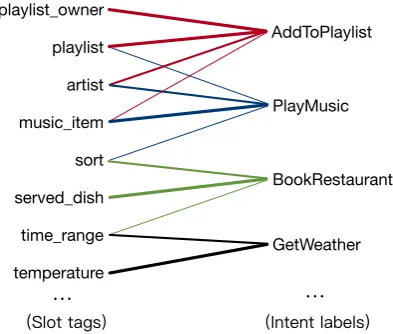
Figure 1: Statistical association of slot tags (on the left) and intent labels (on the right) in the SNIPS, where col-ors indicate different intents and thicknesses of lines indicate proportions.
# Utterance Slot tag Intent
1 play Roy Orbison tunes now artist PlayMusic
[image:2.595.97.504.62.134.2]2 add this Roy Orbison song onto Women of Comedy artist AddToPlaylist 3 book a spot for seven at a bar with chicken french served dish BookRestaurant 4 book french food for me and angeline at a restaurant cuisine BookRestaurant
Table 1: Examples in SNIPS with annotations of intent label for the utterance and slot tags for partial words.
unidirectionally with the guidance from intent rep-resentations via gating mechanisms (Goo et al., 2018;Li et al.,2018), while the predictions of in-tents lack the guidance from slots. Moreover, the capsule network with dynamic routing algorithms (Zhang et al., 2018a) is proposed to perform in-teractions in both directions. However, there are still two limitations in this model. The one is that the information flows from words to slots, slots to intents and intents to words in a pipeline manner, which is to some extent limited in capturing com-plicated correlations among words, slots and in-tents. The other is that the local context informa-tion which has been shown highly useful for the slot filling (Mesnil et al., 2014), is not explicitly modeled.
In this paper, we try to address these issues, and thus propose a novelCollaborativeMemory Network, named CM-Net. The main idea is to directly capture semantic relationships among words, slots and intents, which is conducted si-multaneously at each word position in a collabora-tive manner. Specifically, we alternately perform information exchange among the task-specific fea-tures referred from memories, local context rep-resentations and global sequential information via the well-designed block, named CM-block, which consists of three computational components:
• Deliberate Attention: Obtaining slot-specific and intent-slot-specific representations from memories in a collaborative manner.
• Local Calculation: Updating local context representations with the guidances of the re-ferred slot and intent representations in the previousDeliberate Attention.
• Global Recurrence: Generating specific (slot and intent) global sequential represen-tations based on local context represenrepresen-tations from the previousLocal Calculation.
Above components in each CM-block are con-ducted consecutively, which are responsible for
encoding information from different perspectives. Finally, multiple CM-blocks are stacked together, and construct our CM-Net.
We firstly conduct experiments on two popu-lar benchmarks, SNIPS (Coucke et al.,2018) and ATIS (Hemphill et al.,1990;Tur et al.,2010). Ex-perimental results show that the CM-Net achieves the state-of-the-art results in 3 of 4 criteria (e.g., intent detection accuracy on ATIS) on both bench-marks. Additionally, trials on our self-collected dataset, named CAIS, demonstrate the effective-ness and generalizability of the CM-Net.
Our main contributions are as follows:
• We propose a novel CM-Net for SLU, which explicitly captures semantic correla-tions among words, slots and intents in a collaborative manner, and incrementally en-riches the specific features, local context rep-resentations and global sequential represen-tations through stacked CM-blocks.
• Our CM-Net achieves the state-of-the-art re-sults on two major SLU benchmarks (ATIS and SNIPS) in most of criteria.
• We contribute a new corpus CAIS with man-ual annotations of slot tags and intent labels to the research community.
2 Background
In principle, the slot filling is treated as a sequence labeling task, and the intent detection is a clas-sification problem. Formally, given an utterance
X={x1, x2,· · · , xN}withN words and its cor-responding slot tags Yslot = {y1, y2,· · · , yN}, the slot filling task aims to learn a parameterized mapping functionfθ :X → Y from input words to slot tags. For the intent detection, it is designed to predict the intent labelyˆintfor the entire utter-anceXfrom the predefined label setSint.
{x1,x2,· · ·,xN} by character-aware and pre-trained word embeddings. Afterwards, the follow-ing bidirectional RNNs are applied to encode the embeddings X into context-sensitive representa-tionsH = {h1,h2,· · · ,hN}. An external CRF (Lafferty et al., 2001) layer is widely utilized to calculate conditional probabilities of slot tags:
p(yslot|H) = e
F(H,yslot)
P
e
yslot∈Y
xe
F(H,ey
slot) (1)
Here Yx is the set of all possible sequences of tags, andF(·)is the score function calculated by:
F(h,y) =
N
X
i=1
Ayi,yi+1+
N
X
i=1
Pi,yi (2)
whereAis the transition matrix thatAi,jindicates the score of a transition fromitoj, and Pis the score matrix output by RNNs. Pi,j indicates the score of thejth tag of the ith word in a sentence (Lample et al.,2016).
When testing, the Viterbi algorithm (Forney, 1973) is used to search the sequence of slot tags with maximum score:
ˆ
yslot= arg max
e
yslot∈Y x
F(H,ye
slot)
(3)
As to the prediction of intent, the word-level hidden states H are firstly summarized into a utterance-level representationvintvia mean pool-ing (or max poolpool-ing or self-attention,etc.):
vint= 1
N N
X
i=1
ht (4)
The most probable intent labelyˆintis predicted by softmax normalization over the intent label set:
ˆ
yint= arg max
e
y∈Sint
P(ye|vint)
P(ey=j|vint) =sof tmax(vint)[j] (5)
Generally, both tasks are trained jointly to min-imize the sum of cross entropy from each individ-ual task. Formally, the loss function of the join model is computed as follows:
L= (1−λ)·Lslot+λ·Lint
Lint=−
|Sint|
X
i=1
ˆ
yinti log(yinti )
Lslot=−
N
X
j=1
|Sslot|
X
i=1
ˆ
yi,jslotlog(yi,jslot)
(6)
CM-block ···
Slot Memory Inference Layer Intent Memory
# 2
# 1 # L
Embedding Layer CM-block
x1 ··· ··· CM-block
y1 y2 ··· yt ··· yN
yint slots
[image:3.595.308.526.63.221.2]x2 xt xN
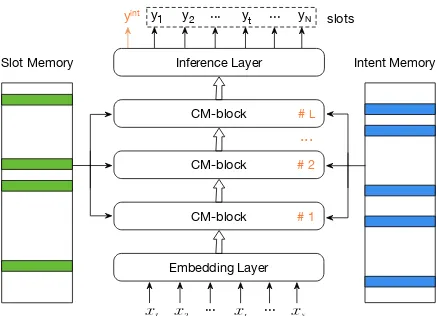
Figure 2: Overview of our proposed CM-Net. The in-put utterance is firstly encoded with the Embedding Layer (bottom), and then is transformed by multiple CM-blocks with the assistance of both slot and intent memories (on both sides). Finally we make predictions of slots and the intent in the Inference Layer (top).
whereyiintandyi,jslotare golden labels, andλis hy-perparameter, and|Sint|is the size of intent label set, and similarly for|Sslot|.
3 CM-Net
3.1 Overview
In this section, we start with a brief overview of our CM-Net and then proceed to introduce each module. As shown in Figure2, the input utterance is firstly encoded with the Embedding Layer, and then is transformed by multiple CM-blocks with the assistance of slot and intent memories, and fi-nally make predictions in the Inference Layer.
3.2 Embedding Layers
Pre-trained Word Embedding The pre-trained word embeddings has been indicated as a de-facto standard of neural network architectures for vari-ous NLP tasks. We adapt the cased, 300d Glove2 (Pennington et al.,2014) to initialize word embed-dings, and keep them frozen.
Character-aware Word Embedding It has been demonstrated that character level informa-tion (e.g. capitalization and prefix) (Collobert et al.,2011) is crucial for sequence labeling. We use one layer of CNN followed by max pooling to generate character-aware word embeddings.
3.3 CM-block
The CM-block is the core module of our CM-Net, which is designed with three computational
ponents: Deliberate Attention, Local Calculation andGlobal Recurrencerespectively.
Deliberate Attention
To fully model semantic relations between slots and intents, we build the slot memoryMslot and intent memoryMint, and further devise a collab-orative retrieval approach. For the slot memory, it keeps|Sslot|slot cells which are randomly ini-tialized and updated as model parameters. Simi-larly for the intent memory. At each word position, we take the hidden state ht as query, and obtain slot featurehslott and intent featurehintt from both memories by the deliberate attention mechanism, which will be illustrated in the following.
Specifically for the slot featurehslott , we firstly get a rough intent representationheintt by the
word-aware attention with hidden state ht over the in-tent memory Mint, and then obtain the final slot feature hslott by the intent-aware attention over the slot memoryMslot with the intent-enhanced representation [ht;ehintt ]. Formally, the
above-mentioned procedures are computed as follows:
e
hintt =AT T(ht,Mint)
htslot=AT T([ht;heintt ],Mslot)
(7)
whereAT T(·)is the query function calculated by the weighted sum of all cellsmxi in memoryMx (x∈ {slot, int}) :
AT T(ht,Mx) =X
i
αimxi
αi =
exp(u>si)
P
jexp(u>sj)
si =h>t Wmxi
(8)
Hereu andW are model parameters. We name the above calculations of two-round attentions (Equation7) as “deliberate attention”.
The intent representation hintt is computed by the deliberate attention as well:
e
hslott =AT T(ht,Mslot)
htint=AT T([ht;heslott ],Mint)
(9)
These two deliberate attentions are conducted simultaneously at each word position in such collaborative manner, which guarantees adequate knowledge diffusions between slots and intents. The retrieved slot features Hslot
t and intent fea-turesHintt are utilized to provide guidances for the next local calculation layer.
···
Hidden states
Slot features
Intent features
··· ht-1 ht ht+1 ···
··· ht-1slot htslot ht+1slot ···
ht-1int h
tint ht+1int ···
Embeddings ··· xt-1 xt xt+1 ···
Bi-LSTM
Slot Memory Intent Memory
Global Recurrence
Deliberate Attention Local Calculation
[image:4.595.314.513.61.264.2]Output states
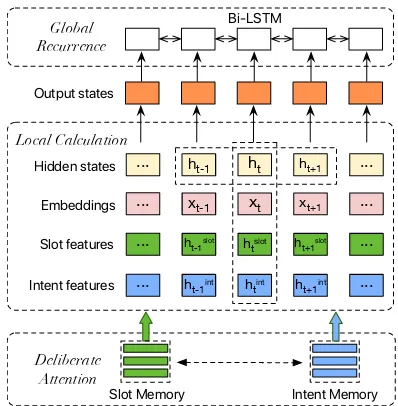
Figure 3: The internal structure of our CM-Block, which is composed of deliberate attention, local cal-culationandglobal recurrentrespectively.
Local Calculation
Local context information is highly useful for se-quence modeling (Kurata et al.,2016;Wang et al., 2016b).Zhang et al.(2018b) propose the S-LSTM to encode both local and sentence-level informa-tion simultaneously, and it has been shown more powerful for text representation when compared with the conventional BiLSTMs. We extend the S-LSTM with slot-specific featuresHslott and intent-specific featuresHslott retrieved from memories.
Specifically, at each input positiont, we take the local window contextξt, word embeddingxt, slot feature hslott and intent featurehintt as inputs to conduct combinatorial calculation simultaneously. Formally, in the lth layer, the hidden state ht is
updated as follows:
ξtl−1= [hlt−−11,hlt−1,hlt−+11] ˆil
t=σ(Wi1ξtl−1+W2ixt+W3ihslott +Wi4hintt )
ˆ
olt=σ(Wo1ξlt−1+W2oxt+Wo3htslot+Wo4hintt )
ˆ
ftl =σ(Wf1ξtl−1+W2fxt+Wf3hslott +W f
4h
int t )
ˆll
t=σ(Wl1ξl
−1
t +W2lxt+W3lhslott +Wl4hintt )
ˆ
rlt=σ(Wr1ξtl−1+W2rxt+Wr3htslot+Wr4hintt )
ult= tanh(Wu1ξlt−1+Wu2xt+Wu3hslott
+Wu4hintt )
ilt,ftl,llt,rlt=sof tmax(ˆilt,ˆftl,ˆllt,ˆrlt)
ctl =ftlctl−1+lltclt−−11+rltclt−+11
+iltult−1
hlt=olttanhclt
where ξlt is the concatenation of hidden states in a local window, and ilt, ftl, olt, llt and rlt are gates to control information flows, andWnx (x ∈ {i, o, f, l, r, u}, n ∈ {1,2,3,4}) are model pa-rameters. More details about the state transition can be referred in (Zhang et al., 2018b). In the first CM-block, the hidden state ht is initialized with the corresponding word embedding. In other CM-blocks, thehtis inherited from the output of the adjacent lower CM-block.
At each word position of above procedures, the hidden state is updated with abundant information from different perspectives, namely word embed-dings, local contexts, slots and intents represen-tations. The local calculation layer in each CM-block has been shown highly useful for both tasks, and especially for the slot filling task, which will be validated in our experiments in Section5.2.
Global Recurrence
Bi-directional RNNs, especially the BiLSTMs (Hochreiter and Schmidhuber,1997) are regarded to encode both past and future information of a sentence, which have become a dominant method in various sequence modeling tasks (Hammerton, 2003;Sundermeyer et al.,2012). The inherent na-ture of BiLSTMs is able to supplement global se-quential information, which is insufficiently mod-eled in the previous local calculation layer. Thus we apply an additional BiLSTMs layer upon the local calculation layer in each CM-block. By tak-ing the slot- and intent-specific local context rep-resentations as inputs, we can obtain more spe-cific global sequential representations. Formally, it takes the hidden state hlt−1 inherited from the local calculation layer as input, and conduct recur-rent steps as follows:
hlt= [
− → hlt;←h−tl]
− →
htl =−−−−→LSTM(htl−1,−→hlt−1; − →
θ)
←−
hlt=←−−−−LSTM(hlt−1,←−hlt+1;←−θ)
(11)
The output “states” of the BiLSTMs are taken as “states” input of the local calculation in next CM-block. The global sequential information encoded by the BiLSTMs is shown necessary and effective for both tasks in our experiments in Section5.2.
3.4 Inference Layer
After multiple rounds of interactions among lo-cal context representations, global sequential in-formation, slot and intent features, we conduct
Dataset SNIPS ATIS CAIS
Vocab Size 11241 722 2146 Average Length 9.15 11.28 8.65
# Intents 7 18 11
# Slots 72 128 75
# Train Set 13084 4478 7995 # Validation Set 700 500 994
[image:5.595.328.508.62.163.2]# Test Set 700 893 1012
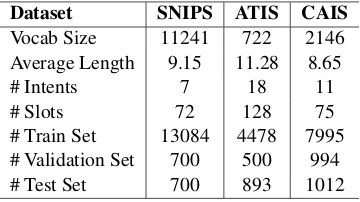
Table 2: Dataset statistics.
predictions upon the final CM-block. For the pre-dictions of slots, we take the hidden statesHalong with the retrieved slotHslotrepresentations (both are from the final CM-block) as input features, and then conduct predictions of slots similarly with the Equation (3) in Section2:
ˆ
yslot= arg max
e
yslot∈Y x
F([H;Hslot],ey
slot)
(12)
For the prediction of intent label, we firstly aggre-gate the hidden state ht and the retrieved intent representation hintt at each word position (from the final CM-block as well) via mean pooling:
vint= 1
N N
X
t
[ht;hintt ] (13)
and then take the summarized vectorvintas input feature to conduct prediction of intent consistently with the Equation (5) in Section2.
4 Experiments
4.1 Datasets and Metrics
We evaluate our proposed CM-Net on three real-word datasets, and statistics are listed in Table2.
ATIS The Airline Travel Information Systems (ATIS) corpus (Hemphill et al.,1990) is the most widely used benchmark for the SLU research. Please note that, there are extra named entity fea-tures in the ATIS, which almost determine slot tags. These hand-crafted features are not gener-ally available in open domains (Zhang and Wang, 2016;Guo et al., 2014b), therefore we train our model purely on the training set without additional hand-crafted features.
SNIPS SNIPS Natural Language Understanding benchmark3(Coucke et al.,2018) is collected in a crowsourced fashion by Snips. The intents of this
3
Models SNIPS ATIS
Slot (F1) Intent (Acc) Slot (F1) Intent (Acc)
Joint GRU (Zhang and Wang,2016) – – 95.49 98.10
Self-Attention, Intent Gate(Li et al.,2018) – – 96.52 98.77
Bi-model (Wang et al.,2018) – – 96.89 98.99
Attention Bi-RNN (Liu and Lane,2016) * 87.80 96.70 95.98 98.21 Joint Seq2Seq (Hakkani-T¨ur et al.,2016) * 87.30 96.90 94.20 92.60 Slot-Gated (Intent Atten.) (Goo et al.,2018) 88.30 96.80 95.20 94.10 Slot-Gated (Full Atten.) (Goo et al.,2018) 88.80 97.00 94.80 93.60 CAPSULE-NLU(Zhang et al.,2018a) 91.80 97.70 95.20 95.00 Dilated CNN, Label-Recurrent (Gupta et al.,2019) 93.11 98.29 95.54 98.10 Sentence-State LSTM (Zhang et al.,2018b)† 95.80 98.30 95.65 98.21 BiLSTMs + EMLoL (Siddhant et al.,2018) 93.29 98.83 95.62 97.42 BiLSTMs + EMLo (Siddhant et al.,2018) 93.90 99.29 95.42 97.30
Joint BERT (Chen et al.,2019) 97.00 98.60 96.10 97.50
[image:6.595.87.513.60.261.2]CM-Net (Ours) 97.15 99.29 96.20 99.10
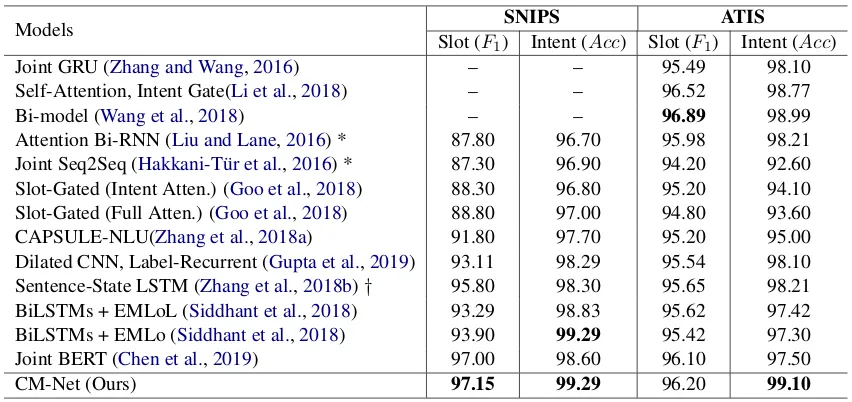
Table 3: Results on test sets of the SNIPS and ATIS, where our CM-Net achieves state-of-the-art performances in most cases. “*” indicates that results are retrieved from Slot-Gated (Goo et al.,2018), and “†” indicates our implementation.
dataset are more balanced when compared with the ATIS. We split another 700 utterances for val-idation set following previous works (Goo et al., 2018;Zhang et al.,2018a).
CAIS We collect utterances from the Chinese Artificial IntelligenceSpeakers (CAIS), and an-notate them with slot tags and intent labels. The training, validation and test sets are split by the distribution of intents, where detailed statistics are provided in the supplementary material. Since the utterances are collected from speaker systems in the real world, intent labels are partial to the PlayMusic option. We adopt the BIOES tag-ging scheme for slots instead of the BIO2 used in the ATIS, since previous studies have highlighted meaningful improvements with this scheme ( Rati-nov and Roth,2009) in the sequence labeling field.
Metrics Slot filling is typically treated as a se-quence labeling problem, and thus we take the conlleval 4 as the token-level F1 metric. The in-tent detection is evaluated with the classification accuracy. Specially, several utterances in the ATIS are tagged with more than one labels. Following previous works (Tur et al.,2010;Zhang and Wang, 2016), we count an utterrance as a correct classifi-cation if any ground truth label is predicted.
4https://www.clips.uantwerpen.be/conll2000/chunking/
conlleval.txt
4.2 Implementation Details
All trainable parameters in our model are initial-ized by the method described inGlorot and Ben-gio (2010). We apply dropout (Srivastava et al., 2014) to the embedding layer and hidden states with a rate of 0.5. All models are optimized by the Adam optimizer (Kingma and Ba,2014) with gradient clipping of 3 (Pascanu et al.,2013). The initial learning rateαis set to 0.001, and decrease with the growth of training steps. We monitor the training process on the validation set and report the final result on the test set. One layer CNN with a filter of size 3 and max pooling are utilized to generate 100d word embeddings. The cased 300d Glove is adapted to initialize word embeddings, and kept fixed when training. In auxiliary experi-ments, the output hidden states of BERT are taken as additional word embeddings and kept fixed as well. We share parameters of both memories with the parameter matrices in the corresponding soft-max layers, which can be taken as introducing su-pervised signals into the memories to some extent. We conduct hyper-parameters tuning for layer size (finally set to 3) and loss weightλ(finally set to 0.5), and empirically set other parameters to the values listed in the supplementary material.
4.3 Main Results
Figure 4: Investigations of the collaborative retrieval approach on slot filling (on the left) and intent detection (on the right), where “no slot2int” indicates removing slow-aware attention for the intent representation, and similarly for “no int2slot” and “neither”.
# Models SNIPS
Slot (F1) Intent (Acc)
0 CM-Net 97.15 99.29
1 – slot memory 96.64 99.14 2 – intent memory 96.95 98.84 3 – local calculation 96.73 99.00 4 – global recurrence 96.80 98.57
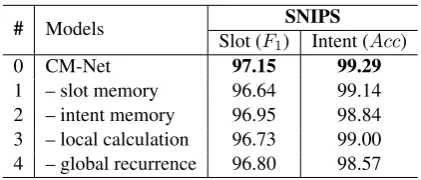
Table 4: Ablation experiments on the SNIPS to in-vestigate the impacts of various components, where “- slot memory” indicates removing the slot memory and its interactions with other components correspond-ingly. Similarly for the other options.
accuracy, except for the F1 score on the ATIS. We conjecture that the named entity feature in the ATIS has a great impact on the slot filling result as illustrated in Section4.1. Since the SNIPS is col-lected from multiple domains with more balanced labels when compared with the ATIS, the slot fill-ingF1 score on the SNIPS is able to demonstrate the superiority of our CM-Net.
It is noteworthy that the CM-Net achieves comparable results when compared with models that exploit additional language models (Siddhant et al.,2018;Chen et al.,2019). We conduct aux-iliary experiments by leveraging the well-known BERT (Devlin et al.,2018) as an external resource for a relatively fair comparison with those models, and report details in Section5.3.
5 Analysis
Since the SNIPS corpus is collected from multiple domains and its label distributions are more bal-anced when compared with the ATIS, we choose the SNIPS to elucidate properties of our CM-Net and conduct several additional experiments.
5.1 Whether Memories Promote Each Other?
In the CM-Net, the deliberate attention mecha-nism is proposed in a collaborative manner to per-form inper-formation exchange between slots and in-tents. We conduct experiments to verify whether such kind of knowledge diffusion in both memo-ries can promote each other. More specifically, we remove one unidirectional diffusion (e.g.from slot to intent) or both in each experimental setup. The results are illustrated in Figure4.
We can observe obvious drops on both tasks when both directional knowledge diffusions are removed (CM-Netvs. neither). For the slot filling task (left part in Figure4), theF1 scores decrease slightly when the knowledge from slot to intent is blocked (CM-Net vs. “no slot2int”), and a more evident drop occurs when the knowledge from in-tent to slot is blocked (CM-Netvs.“no int2slot”). Similar observations can be found for the intent detection task (right part in Figure4).
In conclusion, the bidirectional knowledge dif-fusion between slots and intents are necessary and effective to promote each other.
5.2 Ablation Experiments
We conduct ablation experiments to investigate the impacts of various components in our CM-Net. In particular, we remove one component among slot memory, intent memory, local calculation and global recurrence. Results of different combina-tions are presented in Table4.
Once the slot memory and its corresponding interactions with other components are removed, scores on both tasks decrease to some extent, and a more obvious decline occurs for the slot filling (row 1 vs. row 0), which is consistent with the conclusion of Section 5.1. Similar observations can be found for the intent memory (row 2). The local calculation layer is designed to capture bet-ter local context representations, which has an ev-ident impact on the slot filling and slighter effect on the intent detection (row 3vs.row 0). Opposite observations occur in term of global recurrence, which is supposed to model global sequential in-formation and thus has larger effect on the intent detection (row 4vs.row 0).
5.3 Effects of Pre-trained Language Models
[image:7.595.77.288.267.357.2]Models SNIPS Slot (F1) Intent (Acc) BiLSTMs + EMLoL 93.29 98.83 BiLSTMs + EMLo 93.90 99.29
Joint BERT 97.00 98.60
[image:8.595.82.281.61.137.2]CM-Net + BERT 97.31 99.32
Table 5: Results on the SNIPS benchmark with the as-sistance of pre-trained language model, where we es-tablish new state-of-the-art results on the SNIPS.
Models CAIS
Slot (F1) Intent (Acc) BiLSTMs + CRF 85.32 93.25 S-LSTM + CRF† 85.74 94.36
CM-Net 86.16 94.56
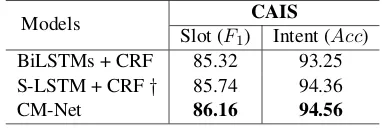
Table 6: Results on our CAIS dataset, where “†” indi-cates our implementation of the S-LSTM.
massive corpora to learn contextual representa-tions (e.g. BERT (2018) and EMLo (2018)). In-spired by the effectiveness of language model em-beddings, we conduct experiments by leveraging the BERT as an additional feature. The results emerged in Table 5 show that we establish new state-of-the-art results on both tasks of the SNIPS.
5.4 Evaluation on the CAIS
We conduct experiments on our self-collected CAIS to evaluate the generalizability in different language. We apply two baseline models for com-parison, one is the popular BiLSTMs + CRF ar-chitecture (Huang et al.,2015) for sequence label-ing task, and the other one is the more powerful sententce-state LSTM (Zhang et al.,2018b). The results listed in Table6demonstrate the generaliz-ability and effectiveness of our CM-Net when han-dling various domains and different languages.
6 Related Work
Memory Network Memory network is a gen-eral machine learning framework introduced by Weston et al. (2014), which have been shown effective in question answering (Weston et al., 2014; Sukhbaatar et al., 2015), machine transla-tion (Wang et al.,2016a;Feng et al.,2017), aspect level sentiment classification (Tang et al., 2016), etc. For spoken language understanding, Chen et al.(2016) introduce memory mechanisms to en-code historical utterances. In this paper, we pro-pose two memories to explicitly capture the
se-mantic correlations between slots and the intent in a given utterance, and devise a novel collaborative retrieval approach.
Interactions between slots and intents Consid-ering the semantic proximity between slots and in-tents, some works propose to enhance the slot fill-ing task unidirectionally with the guidance of in-tent representations via gating mechanisms (Goo et al., 2018;Li et al.,2018). Intuitively, the slot representations are also instructive to the intent de-tection task and thus bidirectional interactions be-tween slots and intents are benefical for each other. Zhang et al. (2018a) propose a hierarchical cap-sule network to perform interactions from words to slots, slots to intents and intents to words in a pipeline manner, which is relatively limited in cap-turing the complicated correlations among them. In our CM-Net, information exchanges are per-formed simultaneously with knowledge diffusions in both directions. The experiments demonstrate the superiority of our CM-Net in capturing the se-mantic correlations between slots and intents.
Sentence-State LSTM Zhang et al. 2018b pro-pose a novel graph RNN named S-LSTM, which models sentence between words simultaneously. Inspired by the new perspective of state transi-tion in the S-LSTM, we further extend it with task-specific (i.e., slots and intents) representa-tions via our collaborative memories. In addition, the global information in S-LSTM is modeled by aggregating the local features with gating mecha-nisms, which may lose sight of sequential infor-mation of the whole sentence. Therefore, We ap-ply external BiLSTMs to supap-ply global sequential features, which is shown highly necessary for both tasks in our experiments.
7 Conclusion
[image:8.595.86.277.201.265.2]Acknowledgments
Liu, Chen and Xu are supported by the National Natural Science Foundation of China (Contract 61370130, 61976015, 61473294 and 61876198), and the Beijing Municipal Natural Science Foun-dation (Contract 4172047), and the Interna-tional Science and Technology Cooperation Pro-gram of the Ministry of Science and Technology (K11F100010). We sincerely thank the anony-mous reviewers for their thorough reviewing and valuable suggestions.
References
Qian Chen, Zhu Zhuo, and Wen Wang. 2019. Bert for joint intent classification and slot filling.
Yun-Nung Chen, Dilek Hakkani-T¨ur, G¨okhan T¨ur, Jianfeng Gao, and Li Deng. 2016. End-to-end mem-ory networks with knowledge carryover for multi-turn spoken language understanding. InInterspeech, pages 3245–3249.
Ronan Collobert, Jason Weston, L´eon Bottou, Michael Karlen, Koray Kavukcuoglu, and Pavel Kuksa. 2011. Natural language processing (almost) from scratch. Journal of Machine Learning Research, 12(Aug):2493–2537.
Alice Coucke, Alaa Saade, Adrien Ball, Thodore Bluche, Alexandre Caulier, David Leroy, Clment Doumouro, Thibault Gisselbrecht, Francesco Cal-tagirone, Thibaut Lavril, Mal Primet, and Joseph Dureau. 2018. Snips voice platform: an embedded spoken language understanding system for private-by-design voice interfaces.
Jacob Devlin, Ming-Wei Chang, Kenton Lee, and Kristina Toutanova. 2018. Bert: Pre-training of deep bidirectional transformers for language understand-ing. arXiv preprint arXiv:1810.04805.
Yang Feng, Shiyue Zhang, Andi Zhang, Dong Wang, and Andrew Abel. 2017. Memory-augmented neu-ral machine translation.
G David Forney. 1973. The viterbi algorithm. Pro-ceedings of the IEEE, 61(3):268–278.
Xavier Glorot and Yoshua Bengio. 2010. Understand-ing the difficulty of trainUnderstand-ing deep feedforward neu-ral networks. In Proceedings of the thirteenth in-ternational conference on artificial intelligence and statistics, pages 249–256.
Chih-Wen Goo, Guang Gao, Yun-Kai Hsu, Chih-Li Huo, Tsung-Chieh Chen, Keng-Wei Hsu, and Yun-Nung Chen. 2018.Slot-gated modeling for joint slot filling and intent prediction. In Proceedings of the 2018 Conference of the North American Chapter of
the Association for Computational Linguistics: Hu-man Language Technologies, Volume 2 (Short Pa-pers), pages 753–757, New Orleans, Louisiana. As-sociation for Computational Linguistics.
Daniel Guo, Gokhan Tur, Wen-tau Yih, and Geoffrey Zweig. 2014a. Joint semantic utterance classifica-tion and slot filling with recursive neural networks. In 2014 IEEE Spoken Language Technology Work-shop (SLT), pages 554–559. IEEE.
Daniel Guo, Gokhan Tur, Wen-tau Yih, and Geoffrey Zweig. 2014b. Joint semantic utterance classifica-tion and slot filling with recursive neural networks. In 2014 IEEE Spoken Language Technology Work-shop (SLT), pages 554–559. IEEE.
Arshit Gupta, John Hewitt, and Katrin Kirchhoff. 2019.
Simple, fast, accurate intent classification and slot labeling.
Patrick Haffner, Gokhan Tur, and Jerry H Wright. 2003. Optimizing svms for complex call classi-fication. In 2003 IEEE International Conference on Acoustics, Speech, and Signal Processing, 2003. Proceedings.(ICASSP’03)., volume 1, pages I–I. IEEE.
Dilek Hakkani-T¨ur, G¨okhan T¨ur, Asli Celikyilmaz, Yun-Nung Chen, Jianfeng Gao, Li Deng, and Ye-Yi Wang. 2016. Multi-domain joint semantic frame parsing using bi-directional rnn-lstm. In Inter-speech, pages 715–719.
James Hammerton. 2003. Named entity recognition with long short-term memory. InProceedings of the seventh conference on Natural language learning at HLT-NAACL 2003-Volume 4, pages 172–175. Asso-ciation for Computational Linguistics.
Charles T. Hemphill, John J. Godfrey, and George R. Doddington. 1990. The ATIS spoken language sys-tems pilot corpus. InSpeech and Natural Language: Proceedings of a Workshop Held at Hidden Valley, Pennsylvania, June 24-27,1990.
Sepp Hochreiter and Jrgen Schmidhuber. 1997.
Long short-term memory. Neural Computation, 9(8):1735–1780.
Zhiheng Huang, Wei Xu, and Kai Yu. 2015. Bidi-rectional LSTM-CRF models for sequence tagging.
CoRR, abs/1508.01991.
Diederik P Kingma and Jimmy Ba. 2014. Adam: A method for stochastic optimization. arXiv preprint arXiv:1412.6980.
Gakuto Kurata, Bing Xiang, Bowen Zhou, and Mo Yu. 2016. Leveraging sentence-level information with encoder lstm for semantic slot filling.arXiv preprint arXiv:1601.01530.
Guillaume Lample, Miguel Ballesteros, Sandeep Sub-ramanian, Kazuya Kawakami, and Chris Dyer. 2016.
Neural architectures for named entity recognition. InProceedings of the 2016 Conference of the North American Chapter of the Association for Computa-tional Linguistics: Human Language Technologies, pages 260–270. Association for Computational Lin-guistics.
Changliang Li, Liang Li, and Ji Qi. 2018. A self-attentive model with gate mechanism for spoken lan-guage understanding. In Proceedings of the 2018 Conference on Empirical Methods in Natural Lan-guage Processing, pages 3824–3833, Brussels, Bel-gium. Association for Computational Linguistics.
Bing Liu and Ian Lane. 2016. Attention-based recur-rent neural network models for joint intent detection and slot filling. arXiv preprint arXiv:1609.01454.
Gr´egoire Mesnil, Yann Dauphin, Kaisheng Yao, Yoshua Bengio, Li Deng, Dilek Hakkani-Tur, Xi-aodong He, Larry Heck, Gokhan Tur, Dong Yu, et al. 2014. Using recurrent neural networks for slot fill-ing in spoken language understandfill-ing. IEEE/ACM Transactions on Audio, Speech, and Language Pro-cessing, 23(3):530–539.
Razvan Pascanu, Tomas Mikolov, and Yoshua Bengio. 2013. On the difficulty of training recurrent neural networks. In International conference on machine learning, pages 1310–1318.
Jeffrey Pennington, Richard Socher, and Christo-pher D. Manning. 2014. Glove: Global vectors for word representation. InEmpirical Methods in Nat-ural Language Processing (EMNLP), pages 1532– 1543.
Matthew Peters, Mark Neumann, Mohit Iyyer, Matt Gardner, Christopher Clark, Kenton Lee, and Luke Zettlemoyer. 2018. Deep contextualized word rep-resentations. InNAACL, pages 2227–2237. Associ-ation for ComputAssoci-ational Linguistics.
Lev Ratinov and Dan Roth. 2009. Design challenges and misconceptions in named entity recognition. In
Proceedings of the thirteenth conference on compu-tational natural language learning, pages 147–155. Association for Computational Linguistics.
Ruhi Sarikaya, Geoffrey E Hinton, and Bhuvana Ram-abhadran. 2011. Deep belief nets for natural lan-guage call-routing. In2011 IEEE International con-ference on acoustics, speech and signal processing (ICASSP), pages 5680–5683. IEEE.
Aditya Siddhant, Anuj Goyal, and Angeliki Metalli-nou. 2018. Unsupervised transfer learning for spo-ken language understanding in intelligent agents.
AAAI.
Nitish Srivastava, Geoffrey Hinton, Alex Krizhevsky, Ilya Sutskever, and Ruslan Salakhutdinov. 2014.
Dropout: A simple way to prevent neural networks from overfitting. Journal of Machine Learning Re-search, 15:1929–1958.
Sainbayar Sukhbaatar, Jason Weston, Rob Fergus, et al. 2015. End-to-end memory networks. InAdvances in neural information processing systems, pages 2440–2448.
Martin Sundermeyer, Ralf Schl¨uter, and Hermann Ney. 2012. Lstm neural networks for language modeling. InThirteenth annual conference of the international speech communication association.
Duyu Tang, Bing Qin, and Ting Liu. 2016. Aspect level sentiment classification with deep memory net-work. arXiv preprint arXiv:1605.08900.
Gokhan Tur, Dilek Hakkani-T¨ur, and Larry Heck. 2010. What is left to be understood in atis? In
2010 IEEE Spoken Language Technology Workshop, pages 19–24. IEEE.
Mingxuan Wang, Zhengdong Lu, Hang Li, and Qun Liu. 2016a. Memory-enhanced decoder for neural machine translation. In Proceedings of the 2016 Conference on Empirical Methods in Natural Lan-guage Processing, pages 278–286, Austin, Texas. Association for Computational Linguistics.
Xingyou Wang, Weijie Jiang, and Zhiyong Luo. 2016b. Combination of convolutional and recurrent neu-ral network for sentiment analysis of short texts. In Proceedings of COLING 2016, the 26th Inter-national Conference on Computational Linguistics: Technical Papers, pages 2428–2437.
Yu Wang, Yilin Shen, and Hongxia Jin. 2018. A bi-model based RNN semantic frame parsing bi-model for intent detection and slot filling. InProceedings of the 2018 Conference of the North American Chap-ter of the Association for Computational Linguistics: Human Language Technologies, Volume 2 (Short Papers), pages 309–314, New Orleans, Louisiana. Association for Computational Linguistics.
Jason Weston, Sumit Chopra, and Antoine Bordes. 2014.Memory networks.
Puyang Xu and Ruhi Sarikaya. 2013. Convolutional neural network based triangular crf for joint intent detection and slot filling. In 2013 IEEE Workshop on Automatic Speech Recognition and Understand-ing, pages 78–83. IEEE.
Chenwei Zhang, Yaliang Li, Nan Du, Wei Fan, and Philip S Yu. 2018a. Joint slot filling and intent de-tection via capsule neural networks. arXiv preprint arXiv:1812.09471.
Xiaodong Zhang and Houfeng Wang. 2016. A joint model of intent determination and slot filling for spoken language understanding. In IJCAI, pages 2993–2999.
Yue Zhang, Qi Liu, and Linfeng Song. 2018b.