A Joint Model for Unsupervised Chinese Word Segmentation
Miaohong Chen Baobao Chang Wenzhe Pei
Key Laboratory of Computational Linguistics, Ministry of Education School of Electronics Engineering and Computer Science, Peking University
Beijing, P.R.China, 100871
[email protected],{chbb,peiwenzhe}@pku.edu.cn
Abstract
In this paper, we propose a joint model for unsupervised Chinese word segmentation (CWS). Inspired by the “products of ex-perts” idea, our joint model firstly com-bines two generative models, which are word-based hierarchical Dirichlet process model and character-based hidden Markov model, by simply multiplying their proba-bilities together. Gibbs sampling is used for model inference. In order to further combine the strength of goodness-based model, we then integrated nVBE into our joint model by using it to initializing the Gibbs sampler. We conduct our experi-ments on PKU and MSRA datasets pro-vided by the second SIGHAN bakeoff. Test results on these two datasets show that the joint model achieves much bet-ter results than all of its component mod-els. Statistical significance tests also show that it is significantly better than state-of-the-art systems, achieving the highest F-scores. Finally, analysis indicates that compared with nVBE and HDP, the joint model has a stronger ability to solve both combinational and overlapping ambigui-ties in Chinese word segmentation.
1 Introduction
Unlike English and many other western languages, there are no explicit word boundaries in Chinese sentences. Therefore, word segmentation is a cru-cial first step for many Chinese language process-ing tasks such as syntactic parsprocess-ing, information re-trieval and machine translation. A great deal of su-pervised methods have been proposed for Chinese word segmentation. While successful, they re-quire manually labeled resources and often suffer from issues like poor domain adaptability. Thus,
unsupervised word segmentation methods are still attractive to researchers due to its independence on domain and manually labeled corpora.
Previous unsupervised approaches to word seg-mentation can be roughly classified into two types. The first type uses carefully designed goodness measure to identify word candidates. Popular goodness measures include description length gain (DLG) (Kit and Wilks, 1999), accessor variety (AV) (Feng et al., 2004), boundary entropy (BE) (Jin and Tanaka-Ishii, 2006) and normalized vari-ation of branching entropy (nVBE) (Magistry and Sagot, 2012) etc. Goodness measure based model is not segmentation model in a very strict mean-ing and is actually strong in generatmean-ing word list without supervision. It inherently lacks capabil-ity to deal with ambiguous string, which is one of main sources of segmentation errors and has been extensively explored in supervised Chinese word segmentation.
The second type focuses on designing sophis-ticated statistical model, usually nonparametric Bayesian models, to find the segmentation with highest posterior probability, given the observed character sequences. Typical statistical mod-els includes Hierarchical Dirichlet process (HDP) model (Goldwater et al., 2009), Nested Pitman-Yor process (NPY) model (Mochihashi et al., 2009) etc, which are actually nonparametric lan-guage models and therefor can be categorized as word-based model. Word-based model makes de-cision on wordhood of a candidate character se-quence mainly based on information outside the sequence, namely, the wordhood of character se-quences being adjacent to the concerned sequence. Inspired by the success of character-based model in supervised word segmentation, we pro-pose a Bayesian HMM model for unsupervised Chinese word segmentation. With the Bayesian HMM model, we formulate the unsupervised seg-mentation tasks as procedure of tagging positional
tags to characters. Different from word-based model, character-based model like HMM-based model as we propose make decisions on word-hood of a candidate character sequence based on information inside the sequence, namely, ability of characters to form words. Although the Bayesian HMM model alone does not produce competi-tive results, it contributes substantially to the joint model as proposed in this paper.
Our joint model takes advantage from three dif-ferent models: namely, a character-based model (HMM-based), a word-based model (HDP-based) and a goodness measure based model (nVBE model). The combination of HDP-based model and HMM-based model enables to utilize infor-mation of both word-level and character-level. We also show that using nVBE model as initialization model could further improve the performance to outperform the state-of-the-art systems and leads to improvement in both wordhood judgment and disambiguation ability.
Word segmentation systems are usually eval-uated with metrics like precision, recall and F-Score, regardless of supervised or unsupervised. Following normal practice, we evaluate our model and compare it with state-of-the-art systems us-ing F-Score. However, we argue that the ability to solve segmentation ambiguities is also impor-tant when evaluating different types of unsuper-vised word segmentation systems.
This paper is organized as follows. In Section 2, we will introduce several related systems for unsupervised word segmentation. Then our joint model is presented in Section 3. Section 4 shows our experiment results on the benchmark datasets and Section 5 concludes the paper.
2 Related Work
Unsupervised Chinese word segmentation has been explored in a number of previous works and by various methods. Most of these methods can be divided into two categories: goodness measure based methods and nonparametric Bayesian meth-ods.
There have been a plenty of work that is based on a specific goodness measure. Zhao and Kit (2008) compared several popular unsupervised models within a unified framework. They tried various types of goodness measures, such as De-scription Length Gain (DLG) proposed by Kit and Wilks (1999), Accessor Variety (AV) proposed by
Feng et al. (2004) and Boundary Entropy (Jin and Tanaka-Ishii, 2006). A notable goodness-based method is ESA: “Evaluation, Selection, Adjust-ment”, which is proposed by Wang et al. (2011) for unsupervised Mandarin Chinese word segmen-tation. ESA is an iterative model based on a new goodness algorithm that adopts a local maximum strategy and avoids threshold setting. One disad-vantage of ESA is that it needs to iterate the pro-cess several times on the corpus to get good perfor-mance. Another disadvantage is the requirement for a manually segmented training corpus to find best value for parameters (they called itproper ex-ponent). Another notable work is nVBE: Mag-istry and Sagot (2012) proposed a model based on the Variation of Branching Entropy. By adding normalization and viterbi decoding, they improve performance over Jin and Tanaka-Ishii (2006) and remove most of the parameters and thresholds from the model.
Nonparametric Bayesian models also achieved state-of-the-art performance in unsupervised word segmentation. Goldwater et al. (2009) introduced a unigram and a bigram model for unsupervised word segmentation, which are based on Dirichlet process and hierarchical Dirichlet process (Teh et al., 2006) respectively. The main drawback is that it needs almost 20,000 iterations before the Gibbs sampler converges. Mochihashi et al. (2009) ex-tended this method by introducing a nested charac-ter model and an efficient blocked Gibbs sampler. Their method is based on what they called nested Pitman-Yor language model.
One disadvantage of goodness measure based methods is that they do not have any disambigua-tion ability in theory in spite of their competitive performances. This is because once the goodness measure is given, the decoding algorithm will seg-ment any ambiguous strings into the same word sequences, no matter what their context is. In contrast, nonparametric Bayesian language mod-els aim to segment character string into a “reason-able” sentence according to the posterior probabil-ity. Thus, theoretically, this method should have better ability to solve ambiguities over goodness measure based methods.
3 Joint Model
3.1 Combining HDP and HMM
In supervised Chinese word segmentation lit-erature, word-based approaches and character-based approaches often have complementary ad-vantages (Wang et al., 2010).Since the two types of model try to solve the problem from different perspectives and by utilizing different levels of in-formation (word level and character level). In un-supervised Chinese word segmentation literature, the HDP-base model can be viewed as a typi-cal word-based method. And we can also build a character-based unsupervised model by using a hidden Markov model. We believe that the HDP-based model and the HMM-HDP-based model are also complementary with each other, and a combina-tion of them will take advantage of both and thus capture different levels of information.
Now the problem we are facing is how to com-bine these two models. To keep the joint model simple and involve as little extra parameters as possible, we combine the two baseline models by just multiplying their probabilities together and then renormalizing it. LetC = c1c2· · ·c|C| be a string of characters andW =w1w2· · ·w|W|is the corresponding segmented words sequence. Then the conditional probability of the segmentationW given the character stringC in our joint model is defined as:
PJ(W|C) = Z(1C)PD(W|C)PM(W|C) (1)
wherePD(W|C)is the probability from the HDP model as given in Equation 6 and PM(W|C) is the probability given by the Bayesian HMM model as given in Equation 2. Z(C) is a nor-malization term to make sure thatPJ(W|C) is a probability distribution. The combining method is inspired by Hinton (1999), which proved that it is possible to combine many individual expert mod-els by multiplying the probabilities and then renor-malizing it. They called it “product of experts”. We can see that combining models in this way does not involve any extra parameters and Gibbs sampling can be easily used for model inference.
3.2 Bayesian HMM
The dominant method for supervised Chinese word segmentation is character-based model which was first proposed by Xue (2003). This method treats word segmentation as a tagging problem, each tag indicates the position of a char-acter within a word. The most commonly used
tag set is{Single,Begin, Middle,End}. Specifi-cally,Smeans the character forms a single word,
B/E means the character is the begining/ending character of the word, andM means the charac-ter is in the middle of the word. Existing models are trained on manually annotated data in a super-vised way based on discriminative models such as Conditional Random Fields (Peng et al., 2004; Tseng et al., 2005). Supervised character-based methods make full use of character level informa-tion and thus have been very successful in the last decade. However, no unsupervised model has uti-lized character level information in the way as su-pervised method does.
We can also build a character-based model for Chinese word segmentation using hidden Markov model(HMM) as formulated in the following equation:
PM(W|C) =
|C|
Y
i=1
Pt(ti|ti−1)Pe(ci|ti) (2)
where C and W have the same meaning as be-fore. Pt(ti|ti−1) is the transition probability of
tagtigiven its former tagti−1andPe(ci|ti)is the
emission probability of charactercigiven its tagti. This model can be easily trained with Maximum Likelihood Estimation (MLE) on annotated data or with Expectation Maximization (EM) on raw texts. But using any of this methods will make it difficult to combine it with the HDP-based model. Instead, we propose a Bayesian HMM for unsu-pervised word segmentation. The Bayesian HMM model is defined as follows:
ti|ti−1 =t, pt∼Mult(pt)
ci|ti=t, et∼Mult(et) pt|θ∼Dirichlet(θ) et|σ∼Dirichlet(σ)
where pt and et are transition and emission dis-tributions,θ andσ are the symmetric parameters of Dirichlet distributions. Now suppose we have observed tagged texth, then the conditional prob-abilityPM(wi|wi−1 =l, h)can be obtained:
PM(wi|wi−1 =l, h)
=
|wi|
Y
j=1
Pt(tj|tj−1, h)Pe(cj|tj, h) (3)
where< wi−1, wi >is a word bigram,lis the
wi andtj is the corresponding tag.Pt(tj|tj−1, h)
and Pe(cj|tj, h) are the posterior probabilities, they are given as:
Pt(tj|tj−1, h) = n<tj−1,n<tj−1,tj>+θ
∗>+T θ (4)
Pe(cj|tj, h) = n<tj,n<tj,cj>+σ
∗>+V σ (5) where n<tj−1,tj> is the tag bigram count of < tj−1, tj >inh,n<tj,cj>denotes the number of oc-currences of tagtj and charactercj, and∗means a sum operation.T andV are the size of character tag set (we follow the commonly used {SBME}
tag set and thusT = 4in this case) and character vocabulary.
3.3 HDP Model
Goldwater et al. (2009) proposed a nonparametric Bayesian model for unsupervised word segmenta-tion which is based on HDP (Teh et al., 2006). In this model, the conditional probability of the seg-mentation W given the character string C is de-fined as:
PD(W|C) = |W|
Y
i=0
PD(wi|wi−1) (6)
where wi is the ith word in W. This is actually a nonparametric bigram language model. This bi-gram model assumes that each different word has a different distribution over words following it, but all these different distributions are linked through a HDP model:
wi|wi−1 =l∼Gl
Gl∼DP(α1, G0)
G0 ∼DP(α, H)
whereDP denotes a Dirichlet process.
Suppose we have observed segmentation re-sult h, then we can get the posterior probability PD(wi|wi−1=l, h)by integrating outGl:
PD(wi|wi−1=l, h)
= n<wi−1,wi>n +α1PD(wi|h)
<wi−1,∗>+α1 (7)
wheren<wi−1,wi>denotes the total number of oc-currences of the bigram< wi−1, wi >in the
ob-servationh. AndPD(wi|h)can be got by integrat-ing outG0:
PD(wi|h) = twi+t+αHα(wi) (8)
where twi denotes the number of tables associ-ated withwi in the Chinese Restaurant Franchise metaphor (Teh et al., 2006),tis the total number of tables andH(wi)is the base measure ofG0. In
fact,H(wi)is the prior distribution over words, so prior knowledge can be injected in this distribution to enhance the performance.
In Goldwater et al. (2009)’s work, the base measureH(wi)are defined as a character unigram model:
H(wi) = (1−ps)|wi|−1ps
Y
j
P(cij)
where, ps is the probability of generating a word boundary.P(cij)is the probability of thejth char-actercij in wordwi, this probability can be esti-mated from the training data using maximum like-lihood estimation.
3.4 Initializing with nVBE
Among various goodness measure based models, we choose nVBE (Magistry and Sagot, 2012) to initialize our Gibbs sampler with its segmentation results. nVBE achieved a relatively high perfo-mance over other goodness measure based meth-ods. And it’s very simple as well as efficient.
Theoretically, the Gibbs sampler may be initial-ized at random or using any other methods. Initial-ization does not make a difference since the Gibbs sampler will eventually converge to the posterior distribution if it iterates as much as possible. This is an essential attribute of Gibbs sampling. How-ever, we believe that initializing the Gibbs sam-pler with the result of nVBE will benefit us in two ways. On one hand, in consideration of its combination of nonparametric Bayesian method and goodness-based method, it will improve the overall performance as well as solve more seg-mentation ambiguities with the help of HDP-based model. On the other hand, it makes the conver-gence of Gibbs sampling faster. In practice, ran-dom initialization often leads to extremely slow convergence.
3.5 Inference with Gibbs Sampling
variable can only take on two possible values, cor-responding to a word boundary or not word bound-ary.
For instance, suppose we have obtained a seg-mentation resultβ|ci−2ci−1cici+1ci+2|γ, whereβ
and γ are the words sequences to the left and right and ci−2ci−1cici+1ci+2 are characters
be-tween them. Now we are sampling at location i to decide whether there is a word boundary be-tween ci and ci+1. Denote h1 as the hypothesis
that it forms a word boundary (the correspond-ing result isβw1w2γwherew1 =ci−2ci−1ci and
w2 = ci+1ci+2), and h2 as the opposite
hypoth-esis (then the corresponding result is βwγwhere w=ci−2ci−1cici+1ci+2). The posterior
probabil-ity for these two hypotheses would be:
P(h1|h−)∝PD(h1|h−)PM(h1|h−) (9)
P(h2|h−)∝PD(h2|h−)PM(h2|h−) (10)
where PD(h|h−) and PM(h|h−) are the pos-terior probabilities in HDP-based model and in HMM-based model, and h− denotes the current segmentation results for all observed data except ci−2ci−1cici+1ci+2. Note that the normalization
termZ(C)can be ignored during inference. The posterior probabilities for these two hypotheses in the HDP-based model is given as:
PD(h1|h−) =PD(w1|wl, h−)
×PD(w2|w1, h−)PD(wr|w2, h−) (11)
PD(h2|h−) =PD(w|wl, h−)
×PD(wr|w, h−) (12)
wherewl(wr) is the first word to the left (right) of w. And the posterior probabilities for the Bayesian HMM model is given as:
PM(h1|h−)
∝ iY+2
j=i−2
Pt(tj|tj−1, h−)Pe(cj|tj, h−) (13)
PM(h2|h−)
∝ iY+2
j=i−2
Pt(tj|tj−1, h−)Pe(cj|tj, h−) (14)
wherePt(tj|tj−1, h−)andPe(cj|tj, h−)are given
in Equation 4 and 5. The difference is that un-der hypothesish1, ci−2ci−1cici+1ci+2 are tagged
as “BMEBE” and under hypothesis h2 as
“BM-MME”.
Once the Gibbs sampler is converged, a natu-ral way to is to treat the result of last iteration as the final segmentation result, since each set of as-signments to the boundary variables uniquely de-termines a segmentation.
4 Experiments
In this section, we test our joint model on PKU and MSRA datesets provided by the Second Seg-mentation Bake-off (SIGHAN 2005) (Emerson, 2005). Most previous works reported their results on these two datasets, this will make it convenient to directly compare our joint model with theirs.
4.1 Setting
The second SIGHAN Bakeoff provides several large-scale labeled data for evaluating the per-formance of Chinese word segmentation systems. Two of the four datasets are used in our exper-iments. Both of the dataset contains only sim-plified Chinese. Table 1 shows the statistics of the two selected corpus. For development set, we randomly select a small subset (about 10%) of the training data. Specifically, 2000 sentences are selected for PKU corpus and 8000 sentences for MSRA corpus. The rest training data plus the test set is then combined for segmentation but only test data is used for evaluation. The development set is used to tune parameters of the HDP-based model and HMM-based model separately. Since our joint model does not involve any additional parameters, we reuse the parameters of the HDP-based model and HMM-based model in the joint model. Specif-ically, we setα1 = 1000.0, α= 10.0, ps= 0.5for
the HDP-based model and setθ = 1.0, σ = 0.01
for the HMM-based model.
For evaluation, we use standard F-Score on words for all following experiments. F-Score is the harmonic mean of the word precision and re-call. Precision is given as:
P = ##correct words in resulttotal words in result
and recall is given as:
R= ##total words in gold corpuscorrect words in result
then F-Score is calculated as:
Corpus TrainingSize (words) TestSize (words)
PKU 1.1M 104K
[image:6.595.178.420.62.106.2]MSRA 2.37M 107K
Table 1: Statistics of training and testing data
Huang and Zhao (2007) provided an empirical method to estimate the consistency between the four different segmentation standards involved in the Bakeoff-3. A lowest consistency rate 84.8%
is found among the four standards. Zhao and Kit (2008) considered this figure as the upper bound for any unsupervised Chinese word segmentation systems. We also use it as thetoplinein our com-parison.
4.2 Prior Knowledge Used
When it comes to the evaluation and compari-son for unsupervised word segmentation systems, an important issue is what kind of pre-processing steps and prior knowledge are needed. To be fully unsupervised, any prior knowledge such as punc-tuation information, encoding scheme and word length could not be used in principle. Neverthe-less, information like punctuation can be easily in-jected to most existing systems and significantly enhance the performance. The problem we are faced with is that we don’t know for sure what kind of prior information are used in other sys-tems. One may use a small punctuation set to segment a long sentence into shorter ones, while another may write simple regular expressions to identify dates and numbers. Lot of work we com-pare to don’t even mention this subject.
Fortunately, we notice that Wang et al. (2011) provided four kinds of preprocessings (they call settings). In their settings 1 and 2, punctuation and other encoding information are not used. In setting 3, punctuation is used to segment charac-ter sequences into sentences, and both punctuation and other encoding information are used in setting 4. Then the results reported in Magistry and Sagot (2012) relied on setting 3 and setting 4. In order to make the comparison as fair as possible, we use setting 3 in our experiment, i.e., only a punctua-tion set for simplified Chinese is used in all our experiments. We will compare our experiment re-sults to previous work on the same setting if they are provided .
4.3 Experiment Results
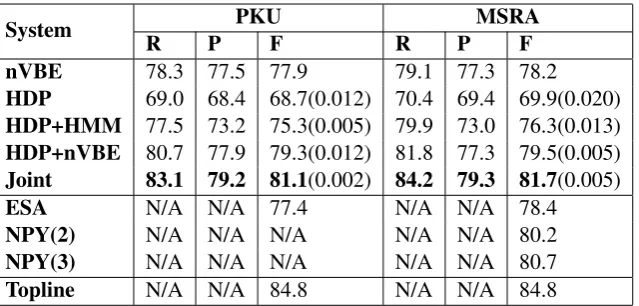
Table 2 summarizes the F-Scores obtained by dif-ferent models on PKU and MSRA corpus, as well as several state-of-the-art systems. Detailed infor-mation about the presented models are listed as follows:
• nVBE: the model based on Variation of Branching Entropy in Magistry and Sagot (2012). We re-implement their model on set-ting 31.
• HDP: the HDP-based model proposed by Goldwater et al. (2009), initialized randomly.
• HDP+HMM: the model combining HDP-based model and HMM-HDP-based model as pro-posed in Section 3, initialized randomly.
• HDP+nVBE:the HDP-based model, initial-ized with the results of nVBE model.
• Joint: the “HDP+HMM” model initialized with nVBE model.
• ESA: the model proposed in Wang et al. (2011), as mentioned above, the conducted experiments on four different settings, we re-port their results on setting 3.
• NPY(2): the 2-gram language model pre-sented by Mochihashi et al. (2009).
• NPY(3): the 3-gram language model pre-sented by Mochihashi et al. (2009).
For all of our Gibbs samplers, we run 5 times to get the averaged F-Scores. We also give the vari-ance of the F-Scores in Table 2. For each run, we find that random initialization takes around 1,000 iterations to converge, while initialing with nVBE only takes as few as 10 iterations. This makes
1The results we got with our implementation is slightly
System R P PKUF R PMSRAF
nVBE 78.3 77.5 77.9 79.1 77.3 78.2
HDP 69.0 68.4 68.7(0.012) 70.4 69.4 69.9(0.020)
HDP+HMM 77.5 73.2 75.3(0.005) 79.9 73.0 76.3(0.013)
HDP+nVBE 80.7 77.9 79.3(0.012) 81.8 77.3 79.5(0.005)
Joint 83.1 79.2 81.1(0.002) 84.2 79.3 81.7(0.005)
ESA N/A N/A 77.4 N/A N/A 78.4
NPY(2) N/A N/A N/A N/A N/A 80.2
NPY(3) N/A N/A N/A N/A N/A 80.7
[image:7.595.142.462.61.214.2]Topline N/A N/A 84.8 N/A N/A 84.8
Table 2: Experiment results and comparison to state-of-the-art systems. The figures in parentheses denote the variance the of F-Scores.
our joint model very efficient and possible to work in practical applications as well. At last, a single sample (the last one) is used for evaluation.
From Table 2, we can see that the joint model (Joint) outperforms all the presented sys-tems in F-Score on all testing corpora. Specifi-cally, comparing “HDP+HMM” with “HDP”, the former model increases the overall F-Score from 68.7% to 75.3% (+6.6%) in PKU corpora and from 69.9% to 76.3% (+6.4%) in MSRA corpora, which proves that the character information in the HMM-based model can actually enhance the performance of the HDP-based model. Compar-ing “HDP+nVBE” with “HDP”, the former model also increases the overall F-Score by 10.6%/9.6% in PKU/MSRA corpora, which demonstrates that initializing the HDP-based model with nVBE will improve the performance by a large margin. Fi-nally, the joint model “Joint” take advantage from both from the character-based HMM model and the nVBE model, it achieves a F-Score of 81.1% on PKU and 81.7% on MSRA. This result outper-forms all its component baselines such as “HDP”, “HDP+HMM” and “HDP+nVBE”.
Our joint model also shows competitive advan-tages over several state-of-the-art systems. Com-pared with nVBE,the F-Score increases by 3.2% on PKU corpora and by 3.5% on MSRA cor-pora. Compared with ESA, the F-Score increases by 3.7%/3.3% in PKU/MSRA corpora. Lastly, compared to the nonparametric Bayesian models (NPY(n)), our joint model still increases the F-Score by 1.5% (NPY(2)) and 1.0% (NPY(3)) on MSRA corpora. Moreover, compared with the empirical topline figure 84.8%, our joint model achieves a pretty close F-Score. The differences
are 3.7% on PKU corpora and 3.1% on MSRA corpora.
An phenomenon we should pay attention to is the poor performance of the HMM-based model. With our implementation of the Bayesian HMM, we achieves a 34.3% F-Score on PKU corpora and a 34.9% F-Score on MSRA corpora, just slightly better than random segmentation. The result show that the hidden Markov Model alone is not suit-able for character-based Chinese word segmenta-tion problem. However, it still substantially con-tributes to the joint model.
We find that the variance of the results are rather small, this shows the stability of our Gibbs sam-plers. From the segmentation results generated by the joint model, we also found that quite a large amount of errors it made are related to dates, numbers (both Chinese and English) and English words. This problem can be easily addressed dur-ing preprocessdur-ing by considerdur-ing encoddur-ing infor-mation as previous work, and we believe this will bring us much better performance.
4.4 Disambiguation Ability
dif-ferent systems in this section.
In general, there are mainly two kinds of ambi-guity in Chinese word segmentation problem:
• Combinational Ambiguity: Given charac-ter strings “A” and “B”, if “A”, “B”, “AB” are all in the vocabulary, and “AB” or “A-B” (here “-” denotes a space) occurred in the real text,then “AB” can be called a combinational ambiguous string.
• Overlapping Ambiguity: Given character strings “A”, “J” and “B”, if “A”, “B”, “AJ” and “JB” are all in the vocabulary, and “A-JB” or “AJ-B” occurred in the real text, then “AJB” can be called an overlapping ambigu-ous string.
We count the total number of mistakes differ-ent systems made at ambiguous strings (the vo-cabulary is obtained from the gold standard an-swer of testing set). As we have mentioned in Section 2, goodness measure based methods such as nVBE do not have any disambiguation ability in theory. Our observation is identical to this ar-gument. We find that nVBE always segments am-biguous strings into the same result. Take a combi-national string “k” as an example, “(just)”, “k (have)” and “k (only)” are all in the
vo-cabulary. In the PKU test set, this string occurs 14 times as “-k (just have)” and 18 times as
“k(only)”, 32 times in total. nVBE segments
all the 32 strings into “k (only)” (i.e. 18 of
them are correct), while the joint model segments it 22 times as “k(only)” and 10 times as “
-k(just have)” according to its context, and 24 of
them are correct.
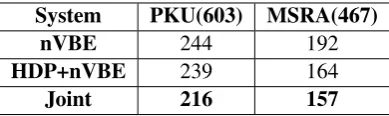
Table 3 and 4 show the statistics of combi-national ambiguity and overlapping ambiguity re-spectively. The numbers in parentheses denote the total number of ambiguous strings. From these tables, we can see that HDP+nVBE makes less mistakes than nVBE in most circumstances, ex-cept that it solves less combinational ambigui-ties on MSRA corpora. But our proposed joint model solves the most combinational and over-lapping ambiguities, on both PKU and MSRA corpora. Specifically, compared to nVBE, the joint model correctly solves 171/871 more com-binational ambiguities on PKU/MSRA corpora, which is a 0.6%/13.8% relative error reduction. It also solves 28/45 more overlapping ambiguities on PKU/MSRA corpora, which is a11.5%/23.4%
relative error reduction. This indicates that the joint model has a stronger ability of disambigua-tion over the compared systems.
System PKU(35371) MSRA(38506)
nVBE 8087 7236
HDP+nVBE 7970 7500
[image:8.595.307.527.115.172.2]Joint 7916 6305
Table 3: Statistics of combinational ambiguity. This table shows the total number of mistakes made by different systems at combinational am-biguous strings. The numbers in parentheses de-note the total number of combinational ambiguous strings.
System PKU(603) MSRA(467)
nVBE 244 192
HDP+nVBE 239 164
Joint 216 157
Table 4: Statistics of overlapping ambiguity. This table shows the total number of mistakes made by different systems at overlapping ambiguous strings. The numbers in parentheses denote the to-tal number of overlapping ambiguous strings.
4.5 Statistical Significance Test
The main results presented in Table 2 has shown that our proposed joint model outperforms the two baselines as well as state-of-the-art systems. But it is also important to know if the improve-ment is statistically significant over these sys-tems. So we conduct statistical significance tests of F-scores among these various models. Follow-ing Wang et al. (2010), we use the bootstrappFollow-ing method (Zhang et al., 2004).
Here is how it works: suppose we have a testing setT0 to test several word segmentation systems,
there areN testing examples (sentences or line of characters) inT0. We create a new testing set T1
with N examples by sampling with replacement fromT0, then repeat these processM −1 times.
And we will have a totalM+1testing sets. In our test procedures,Mis set to 2000.
[image:8.595.319.514.289.347.2]our proposed model. Then other systems can be compared with the joint model in this way: if the F-score of systemBdoesn’t fall into the95% con-fidence interval of systemA, they are considered as statistically significantly different from each other.
For all significant tests, we measure the 95%
confidence interval for the difference between two models. First, the test results show that “HDP+nVBE” and “HDP+HMM” are both sig-nificantly better than “HDP”. Second, the “Joint” model significantly outperforms all its component models, including “HDP”, “nVBE”, “HDP+nVBE” and “HDP+HMM”. Finally, the comparison also shows that the joint model signif-icantly outperforms state-of-the-art systems like ESA and NPY(n).
5 Conclusion
In this paper, we proposed a joint model for un-supervised Chinese word segmentation. Our joint model is a combination of the HDP-based model, which is a word-based model, and HMM-based model, which is a character-based model. The way we combined these two component base-lines makes it natural and simple to inference with Gibbs sampling. Then the joint model take ad-vantage of a goodness-based method (nVBE) by using it to initialize the sampler. Experiment re-sults conducted on PKU and MSRA datasets pro-vided by the second SIGHAN Bakeoff show that the proposed joint model not only outperforms the baseline systems but also achieves better perfor-mance (F-Score) over several state-of-the-art sys-tems. Significance tests showed that the improve-ment is statistically significant. Analysis also in-dicates that the joint model has a stronger abil-ity to solve ambiguities in Chinese word segmen-tation. In summary, the joint model we pro-posed combines the strengths of character-based model, nonparametric Bayesian language model and goodness-based model.
Acknowledgments
The contact author of this paper, according to the meaning given to this role by Key Labora-tory of Computational Linguistics, Ministry of Ed-ucation, School of Electronics Engineering and Computer Science, Peking University, is Baobao Chang. And this work is supported by National Natural Science Foundation of China under Grant
No. 61273318 and National Key Basic Research Program of China 2014CB340504.
References
George Casella, Edward I. George. 1992.
Explain-ing the Gibbs sampler. The American Statistician,
46(3): 167-174.
Thomas Emerson. 2005. The second international
chi-nese word segmentation bakeoff. Proceedings of
the Fourth SIGHAN Workshop on Chinese Language Processing, 133. MLA.
Haodi Feng, Kang Chen, Xiaotie Deng, et al. 2004. Accessor variety criteria for Chinese word extraction
Computational Linguistics, 30(1): 75-93.
Sharon Goldwater, Thomas L. Griffiths, Mark Johnson. 2009. A Bayesian framework for word
segmenta-tion: Exploring the effects of context. Cognition
112(1): 21-54.
Geoffrey E. Hinton. 1999. Products of experts.
Arti-ficial Neural Networks. Ninth International Confer-ence on Vol. 1.
Changning Huang, Hai Zhao. 2007. Chinese word
segmentation: A decade review. Journal of Chinese
Information Processing, 21(3): 8-20.
Zhihui Jin, Kumiko Tanaka-Ishii. 2006. Unsupervised segmentation of Chinese text by use of branching
entropy. Proceedings of the COLING/ACL on Main
conference poster sessions, page 428-435.
Chunyu Kit, Yorick Wilks. 1999. Unsupervised learning of word boundary with description length
gain. Proceedings of the CoNLL99 ACL Workshop.
Bergen, Norway: Association for Computational Linguis-tics, page 1-6.
Pierre Magistry, Benoit Sagot. 2012.
Unsuper-vized word segmentation: the case for mandarin
chinese. Proceedings of the 50th Annual Meeting
of the Association for Computational Linguistics: Short Papers-Volume 2. Association for Computa-tional Linguistics, page 383-387.
Daichi Mochihashi, Takeshi Yamada, Naonori Ueda. 2009. Bayesian unsupervised word segmentation
with nested Pitman-Yor language modeling.
Pro-ceedings of the Joint Conference of the 47th Annual Meeting of the ACL and the 4th International Joint Conference on Natural Language Processing of the AFNLP: Volume 1-Volume 1. Association for Com-putational Linguistics, page 100-108.
Wenzhe Pei, Dongxu Han, Baobao Chang. 2013. A Refined HDP-Based Model for Unsupervised
Chi-nese Word Segmentation. Chinese Computational
Yee Whye Teh, Michael I. Jordan, Matthew J. Beal, et al. 2006. Sharing Clusters among Related Groups: Hierarchical Dirichlet Processes. NIPS.
Fuchun Peng, Fangfang Feng, Andrew McCallum. 2004. Chinese segmentation and new word
detec-tion using condidetec-tional random fields. Proceedings
of COLING, page 562-568.
Huihsin Tseng, Pichuan Chang, Galen Andrew, et al. 2005. A conditional random field word segmenter
for sighan bakeoff 2005. Proceedings of the Fourth
SIGHAN Workshop on Chinese Language Process-ing, Vol. 171.
Kun Wang, Chengqing Zong, Keh-Yih Su. 2010. A character-based joint model for Chinese word
seg-mentation. Proceedings of the 23rd International
Conference on Computational Linguistics. Associa-tion for ComputaAssocia-tional Linguistics, page 1173-1181. Hanshi Wang, Jian Zhu, Shiping Tang, et al. 2011. A new unsupervised approach to word segmentation.
Computational Linguistics, 37(3): 421-454. Nianwen Xue. 2003. Chinese word segmentation as
character tagging. Computational Linguistics and
Chinese Language Processing, 8(1): 29-48. Hai Zhao, Chunyu Kit. 2008. An Empirical
Compar-ison of Goodness Measures for Unsupervised Chi-nese Word Segmentation with a Unified Framework.
IJCNLP, page 6-16.
Ying Zhang, Stephan Vogel, Alex Waibel. 2004. In-terpreting BLEU/NIST scores: How much