A Comparison of Selectional Preference Models for Automatic Verb
Classification
Will Roberts and Markus Egg
Institut für Anglistik und Amerikanistik, Humboldt University 10099 Berlin, Germany
{will.roberts,markus.egg}@anglistik.hu-berlin.de
Abstract
We present a comparison of different selec-tional preference models and evaluate them on an automatic verb classification task in German. We find that all the models we compare are effective for verb clustering; the best-performing model uses syntactic information to induce nouns classes from unlabelled data in an unsupervised man-ner. A very simple model based on lexical preferences is also found to perform well.
1 Introduction
Selectional preferences (Katz and Fodor, 1963; Wilks, 1975; Resnik, 1993) are the tendency for a word to semantically select or constrain which other words may appear in a direct syntactic re-lation with it. Selectional preferences (SPs) have been a perennial knowledge source forNLPtasks such as word sense disambiguation (Resnik, 1997; Stevenson and Wilks, 2001; McCarthy and Car-roll, 2003) and semantic role labelling (Erk, 2007); and recognising selectional violations is thought to play a role in identifying and interpreting meta-phor (Wilks, 1978; Shutova et al., 2013). We focus on theSPs of verbs, since determining which argu-ments are typical of a given verb sheds light on the semantics of that verb.
In this study, we present the first empirical com-parison of differentSPmodels from the perspective of automatic verb classification (Schulte im Walde, 2009; Sun, 2012), the task of grouping verbs to-gether based on shared syntactic and semantic prop-erties.
We cluster German verbs using features captur-ing theirvalencyorsubcategorisation, following prior work (Schulte im Walde, 2000; Esteve Ferrer, 2004; Schulte im Walde, 2006; Sun et al., 2008; Korhonen et al., 2008; Li and Brew, 2008), and investigate the effect of adding information about
verb argument preferences. SPs are represented by features capturing lexical information about the heads of arguments to the verbs; we restrict our focus here to nouns.
We operationalise a selectional preference model as a function which maps such an argument head to a concept label. We submit that the primary characteristic of such a model is itsgranularity. In our baseline condition, all nouns are mapped to the same label; this effectively captures no information about a verb’sSPs (i.e., we cluster verbs using sub-categorisation information only). On the other ex-treme, each noun is its own concept label; we term this conditionlexical preferences(LP). Between the baseline and LP lie a spectrum of models, in which multiple concepts are distinguished, and each concept label can represent multiple nouns. Our main hypothesis is that verb clustering will work best using a model of such intermediate gran-ularity. This follows the intuition that verbs would seem to select for classes of nouns; for instance, we suppose thatessen‘eat’ would tend to prefer as a direct object a noun from the abstract concept Es-sen(‘food’). We assume that these concepts can be expressed independently of particular predicates; that is, there exist selectional preference models that will work for all verbs (and all grammatical relations). Further benefits of grouping nouns into classes include combating data sparsity, as well as deriving models which can generalise to nouns unseen in training data.
Another parameter of a selectional preference model is the methodology used to induce the con-ceptual classes; put another way, the success of anSPmodel hinges on how it represents concepts. In this paper, we investigate the choice of noun categorisation method through an empirical com-parison of selectional preference models previously used in the literature.
We set out to investigate the following questions: 1. What classes of nouns are effective descriptors
of selectional preference concepts? For ex-ample, do they correspond to features such as ANIMATE?
2. What is the appropriate granularity of selec-tional preference concepts?
3. Which methods of classifying nouns into con-cepts are most effective at capturing selec-tional preferences for verb clustering?
This paper is structured as follows: In Section 2, we introduce our baseline method of clustering verbs using subcategorisation information and de-scribe evaluation; Section 3 lists the models of se-lectional preferences that we compare in this work; Section 4 presents results and discussion; Section 5 summarises related work; and Section 6 concludes with directions for future research.
2 Automatic verb classification
Verb classifications such as VerbNet (Kipper-Schuler, 2005) allow generalisations about the syn-tax and semantics of verbs and have proven useful for a range ofNLPtasks; however, creation of these resources is expensive and time-consuming. Auto-matic verb classification seeks to learn verb classes automatically from corpus data in a cheaper and faster way. This endeavour is possible due to the link between a verb’s semantics and its syntactic be-haviour (Levin, 1993). Recent research has found that even automatically-acquired classifications can be useful forNLPapplications (Shutova et al., 2010; Guo et al., 2011). In this section, we introduce the verb classification method used by our baseline model, which clusters verbs based on subcategor-isation information. Following this, Section 2.2 ex-plains the gold standard verb clustering and cluster purity metric which we use for evaluation.
2.1 Baseline model
In this work, we take subcategorisation to mean the requirement of a verb for particular types of argument or concomitant. For example, the English verbputsubcategorises for subject, direct object, and a prepositional phrase (PP) likeon the shelf:
(1) [NPAl] put [NP the book] [PPon the shelf].
A subcategorisation frame (SCF) describes a combination of arguments required by a specific verb; a description of the set ofSCFs which a verb may take is called itssubcategorisation preference.
We acquire descriptions of verbalSCFpreferences on the basis of unannotated corpus data.
Our experiments use the SdeWaC corpus (Faaß and Eckart, 2013), containing 880 million words in 45 million sentences; this is a subset of deWaC (Baroni et al., 2009), a corpus of109words
extrac-ted from Web search results. SdeWaC is filtered to include only those sentences which are max-imally parsable1. We parsed SdeWaC with the
mate-toolsdependency parser (Bohnet et al., 2013)2, which performs joint POS and morpholo-gical tagging, as well as lemmatisation. Our sub-categorisation analyses are delivered by the rule-basedSCFtagger described by Roberts et al. (2014), which operates using the dependency parses and as-signs each finite verb anSCFtype. TheSCFtags are taken from theSCFinventory proposed by Schulte im Walde (2002), which indicates combinations of nominal and verbal complement types, such as
nap:für.Acc(transitive verb, with aPPheaded byfür‘for’). Examples of complements arenfor nominative subject, andafor accusative direct ob-ject; inSCFs which includePPs (p), theSCF tag specifies the head of thePPand the case of the pre-positional argument (Accin our example indicates the accusative case of the prepositional argument). TheSCFtagger undoes passivisation and analyses verbs embedded in modal and tense constructions. We record 673SCFtypes in SdeWaC.
From SdeWaC, we extracted the first 3,000,000 verb instances assigned anSCFtag by theSCF tag-ger, where the verb lemma is one of the 168 listed in our gold standard clustering (this requires ap-proximately 270 million words of parsed text, or 25% of SdeWaC). We refer to this as ourtest set. In this set, each verb is seen on average 17,857 times; the most common isgeben(‘give’, 328,952 instances), and the least isgrinsen(‘grin’, 50).
We represent verbs as vectors, where each di-mension represents a different SCF type. Vector entries are initialised with SCF code counts over the test set, and each vector is then normalised to sum to 1, so that a vector represents a discrete prob-ability distribution over theSCFinventory. We use the Jensen-Shannon divergence as a dissimilarity measure between pairs of verb vectors. The Jensen-Shannon divergence (Lin, 1991) is an information-theoretic, symmetric measure (Equation (2))
re-1The filtering used a rule-based dependency parser to es-timate a per-token parse error rate for each sentence, and removed those sentences with very high error rates.
lated to the Kullback-Leibler divergence (Equa-tion (3)).
JS(p, q) =D(p||p+2 q) +D(q||p+2 q) (2)
D(p||q) =X
i
pilogpqi
i (3)
With this dissimilarity measure, we use hier-archical clustering with Ward’s criterion (Ward, Jr, 1963) to partition the verbs intoKdisjoint sets (i.e., hard clustering), where we matchK to the number of classes in our gold standard (described below).
2.2 Evaluation paradigm
We evaluate the automatically induced verb cluster-ings against a manually-constructed gold standard, published by Schulte im Walde (2006, page 162ff.). This Levin-style classification groups 168 high-and low-frequency verbs into 43 semantic classes; examples include Aspect (e.g.,anfangen‘begin’), Propositional Attitude (e.g.,denken‘think’), and Weather (e.g.,regnen‘rain’). Some of the classes are further sub-classified; for the purposes of our evaluation, we ignore the hierarchical structure of the classification and consider each class or sub-class to be a separate entity. In this way, we obtain classes of fairly comparable size and sufficient se-mantic consistency.3
We evaluate a given verb clustering against the gold standard using the pairwise F-score (Hatzivassiloglou and McKeown, 1993). To calcu-late this statistic, we construct a contingency table over the n2pairs of verbs, the idea being that the gold standard provides binary judgements about whether two verbs should be clustered together or not. If a clustering agrees with the gold standard as to whether a pair of verbs belong together or not, this is a “correct” answer. Using the contingency table, the standard information retrieval measures of precision (P) and recall (R) can be computed; the F-score is then the harmonic mean of these: F = 2P R/(P+R). The random baseline is 2.08 (calculated as the average score of 50 random parti-tions), and the optimal score is 95.81, calculated by evaluating the gold standard against itself. As the gold standard includes polysemous verbs, which
3In contrast, a top-level class like ‘Transfer of Possession (Obtaining)’, not only covers 25% of the gold standard, it also comprises the semantically very diverse subclasses ‘Transfer of Possession (Giving)’, ‘Manner of Motion’, and ‘Emotion’.
belong to more than one cluster, the optimal score is calculated by randomly picking one of their senses; the average is then taken over 50 such trials.
The pairwiseF-score is known to be somewhat nonlinear (Schulte im Walde, 2006), penalising early clustering “mistakes” more than later ones, but it has the advantage that we can easily determ-ine statistical significance using the contingency table and McNemar’s test.
We use only one clustering algorithm and one purity metric, because our prior work shows that the most important choices for verb clustering are the distance measure used, and how verbs are rep-resented. These factors set, we expect similar per-formance trends from different algorithms, with predictable variation (e.g., spectral tends to form hierarchical clustering, which in turn outper-formsk-means). Combining Ward’s criterion and F-score is a trade-off at this point; the criterion is deterministic, giving reproducible results without computational complexity, but disallows estimates of density over our evaluation metric and is greedy (see discussion in Section 4.3).
3 Selectional preference models
In this section, we introduce the variousSPmodels that we compare in this paper. In all cases, we hold the verb clustering procedure described in the previous section unchanged, with the exception that SCF tags for verbs are parameterised for selectional preferences. As an example, a verb instance observed in a simple transitive frame with a nominal subject and accusative object would receive theSCFtagna. Assuming that a givenSP model places the subject noun in theSPconcept animate and the object noun in the concept
concrete, the parameterisedSCF tag would be na*subj-{animate}*obj-{concrete}. This process captures argument co-occurrence information about verb instances, and has the effect of multiplying theSCFinventory size, making the verb vectors described in Section 2.1 both longer and sparser.
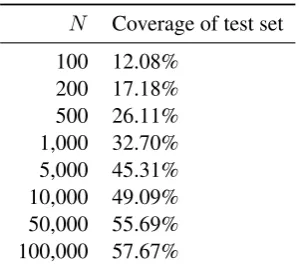
N Coverage of test set 100 12.08%
[image:4.595.107.257.61.195.2]200 17.18% 500 26.11% 1,000 32.70% 5,000 45.31% 10,000 49.09% 50,000 55.69% 100,000 57.67%
Table 1: Fraction of verb instances in the test set parameterised byLPas a function of the number of nounsN included in theLPmodel.
3.1 Lexical preferences
TheLPmodel is the simplest in our study after the baseline condition; it simply maps a noun to its own lemma. We include as a parameter of theLPmodel a maximum number of nouns N to admit as LP tags. In this way, theLPmodel parameterisesSCFs using only theN most frequent nouns in SdeWaC; nouns beyond rankN are treated as if they were unseen. Table 1 indicates what fraction of the 3 million verb instances receiveSCFtags specifying one or more LPs as a function of this parameter. Note that the coverage approaches an asymptote of around 60%. This is due to the fact that noun arguments are not observed for every verb instance; many verbs’ arguments are pronominal or verbal and are not treated by our SPmodels. SettingN allows a simple way of tuning theLPmodel: With increasingN, theLP model should capture more data about verb instances, but after a point this benefit should be cancelled out by the increasing sparsity in the verb vectors.
3.2 Sun and Korhonen model
TheSPmodel described in this section (SUN) was first used by Sun and Korhonen (2009) to de-liver state-of-the-art verb classification perform-ance for English; more recently, the technique was applied to successfully identify metaphor in free text (Shutova et al., 2010; Shutova et al., 2013). It uses co-occurrence counts that describe which nouns are found with which verbs in which gram-matical relations; this information is used to sort the nouns into classes in a procedure almost identical to our verb clustering method described in Sec-tion 2.1.
We extract all verb instances in SdeWaC which
are analysed by the SCF tagger, and count all (verb, grammatical relation, nominal argument head) triples, where the grammatical relation is subject, direct (accusative) object, indirect (dative) object, or prepositional object4, and is listed in the verb instance’sSCFtag; we undo passivisation, re-move instances of auxiliary and modal verbs, and filter out those triples seen less than 10 times in the corpus.
These observations cover 60,870 noun types and 33,748,390 tokens, co-occurring with 6,705 verb types (11,426 verb-grammatical-relation types); an example is (sprechen, obj, Wort) (‘speak’ with dir-ect objdir-ect ‘word’, occurring 1,585 times)5. We rep-resent each noun by a vector whose 11,426 dimen-sions are the different verb-grammatical-relation pairs; coordinates in the vector indicate the ob-served corpus counts. The vectors are then norm-alised to sum to 1, such that each represents some particular noun’s discrete probability distribution over the set of verb-grammatical-relation pairs. The distance between two noun vectors is defined to be the Jensen-Shannon divergence between their probability distributions, and we partition the set of nouns intoM groups using hierarchical Ward’s clustering.
TheSPmodel then maps a noun to an arbitrary label indicating which of theM disjoint sets that noun is to be found in (i.e., all nouns in the first noun class map to the concept labelconcept1); we employ the parameterM to modelSPconcept granularity. As with the LP model, we use the parameterN to indicate how many nouns are in-cluded in theSUNmodel; we search the parameter values N = {300,500,1000,5000,10000} and
N
M ={5,10,15,20,30,50}.
3.3 Word space model
Word space models (WSMs, (Sahlgren, 2006; Turney and Pantel, 2010)) use word co-occurrence counts to represent the distributional semantics of a word. This strategy makes possible a clustering of nouns that does not depend on verbal dependencies in the first place.
4We have also experimented with adding features for each noun showing nominal modification features (e.g., (schwarz, nmod, Haar), ‘hair’ modified by ‘black’), but these seem to hurt performance.
5Triples representing prepositional object relations are dis-tinguished by preposition (e.g., the triple (geben, prep-in, Auftrag), ‘give’ withPPheaded by ‘in’ with argument head ‘contract’, an idiomatic expression meaning ‘to commission’
Dagan et al. (1999) address the problem of data sparseness for the automatic determination of word co-occurrence probabilities, which includes selec-tional preferences. They introduce the idea of es-timating the probability of hitherto unseen word combinations using available information on words that are closest w.r.t. distributional word similar-ity. Following this idea, Erk (2007) and Padó et al. (2007) describe a memory-basedSPmodel, using a WSMsimilarity measure to generalise the model to unseen data.
We build aWSMof German nouns and use it to partition nouns into disjoint sets, which we then employ as with theSUNmodel. We compute word co-occurrence counts across the whole SdeWaC corpus, using as features the 50,000 most common words in SdeWaC, skipping the first 50 most com-mon words (i.e., we use words 50 through 50,050), with sentences as windows. We lemmatise the cor-pus and remove all punctuation; no other normalisa-tion is performed. Co-occurrence counts between a wordwiand a featurecj are weighted using the
t-test scheme:
ttest(wi, cj) = p(wip, cj)−p(wi)p(cj)
p(wi)p(cj)
We use a recent technique calledcontext selec-tion(Polajnar and Clark, 2014) to improve the word space model, whereby only the C most highly weighted features are kept for each word vector. We setCby optimising the correlation between the word space model’s cosine similarity and a data set of human semantic relatedness judgements for 65 word pairs (Gurevych and Niederlich, 2005); at C= 380, we obtain Spearmanρ= 0.813and Pear-sonr = 0.707(human inter-annotator agreement for this data set is given asr= 0.810).
After this, we build a similarity matrix between all pairs of nouns using the cosine similarity, and then partition the set ofN nouns intoM disjoint classes using spectral clustering with the MNCut algorithm (Meil˘a and Shi, 2001). As with theSUN model, thisSPmodel assigns labels to nouns indic-ating which noun class they belong to. We search the same parameter space forN andM as for the SUNmodel.
3.4 GermaNet
Statistical models ofSPs have often used WordNet as a convenient and well-motivated inventory of concepts (e.g., Resnik (1997), Li and Abe (1998),
Clark and Weir (2002)). Typically, such models make use of probabilistic treatments to determine an appropriate concept granularity separately for each predicate; we opt here for a simple model that allows more direct control over concept granularity. We take the set of concepts relevant to describing selectional preferences to be atarget setof synsets in GermaNet (Hamp and Feldweg, 1997), and rep-resent the target set as the set of synsets which are at somedepthdor less in the GermaNet noun hier-archy: {s|depth(s) ≤d}where depth(s)counts the number of hypernym links separatingsfrom the root of the hierarchy. We model concept gran-ularity by varyingd= 1. . .6; atd= 1, the target set is of size 5, and atd= 6, it is of size 17,125. Nouns are attributed to concepts as follows: Given a noun belonging to a synsets, eithersis in the target set, or we takes’s lowest hypernym in the target set. For polysemous nouns, each synset list-ing a sense of the noun votes for a member of the target set; the noun observation is then spread over the target set using the votes as weights.
This procedure makes our GermaNetSPmodel a
soft clusteringover nouns (i.e., a noun can belong to more than oneSPconcept); a consequence of this is that a single verb occurrence in the corpus can contribute fractional counts to multiple SCF types.
3.5 LDA
Latent Dirichlet allocation (Blei et al., 2003) is a generative model that discovers similarities in data using latent variables; it is frequently used for topic modelling.LDAmodels ofSPs have been proposed by Ó Séaghdha (2010) and Ritter et al. (2010); previous to this, Rooth et al. (1999) also described a latent variable model ofSPs.
We implement theLDAmodel of selectional pref-erences described by Ó Séaghdha (2010). Gener-atively, the model produces nominal arguments to verbs as follows: For a given (verb, grammatical re-lation) pair(v, r), (1) Sample a noun classzfrom a from a multinomial distributionΦv,rwith a
Dirich-let prior parameterised byα; (2) Sample a nounn from a multinomial distributionΘzwith a Dirichlet
prior parameterised byβ. Like Ó Séaghdha, we use an asymmetric Dirichlet prior forΦv,r(i.e.,αcan
differ for each noun class) and a symmetric prior forΘz (β is the same for eachΘz). We estimate
relation, argument head) co-occurrence statistics used for the SUN model. We train for 1,000 it-erations using the software’s default parameters, allowing theLDAhyperparametersαandβto be re-estimated every 10 iterations. We build mod-els with 50 or 100 topics as a proxy to concept granularity; models include number of nounsN of
{500,1000,5000,10000,50000,100000}. As with the GermaNet-based model, the LDA model creates a soft clustering of nouns; the abil-ity of a noun to have degrees of membership in multiple concepts might be a good way to model polysemy. We also experiment with a hard cluster-ing version of theLDAmodel; to do this, we assign each nounnits most likely class labelzusing the model’s estimate forP(z|n).
4 Results
We experimented with applying theSPmodels to different combinations of grammatical relations (e.g., only subject, only object, subject+object, etc.), but generally obtained better results by para-meterisingSCFtags for all grammatical relations. Table 2 summarises the evaluation scores and para-meter settings for the best-performingSPmodels, applied to verb arguments in all four grammatical relations (subject, direct, indirect and prepositional object)6. The table also indicates the number of
SCFtypes constructed by eachSPmodel (i.e., the number of dimensions of the vectors representing verbs).
All the SPmodels we compare help with auto-matic verb clustering. Using McNemar’s test on the contingency tables underlying theF-scores, all models score better than the baseline at at least the p < 0.01 level. LDA-hard is better than the Ger-maNet,LDA-soft,WSMandLPmodels at at least thep <0.05level;SUN is better (p ≤0.05) than all models exceptLDA-hard. All other performance differences are not statistically significant7.
We can also demonstrate the effectiveness of the SPmodels with a regression analysis on the models’ coverage of the test set. By varying the number of nounsN included in theSPmodels which use this parameter (LP, SUN, WSM,LDA), or by paramet-erisingSCFtags withSPinformation only for par-6Due to space constraints, we do not present here a de-tailed per-model study of performance as a function of para-meter settings; we feel a summary to be adequate, since the relative performances of the models reflect trends across a range of parameter settings.
7Using a significance criterion ofp <0.05.
ticular combinations of grammatical relations, dif-ferent numbers of the verb instances in the test data will end up withSPinformation in theirSCFtags (this is the “coverage” statistic in Table 1); with the exception of the GermaNet model, all of theSP models we examine here show positive correlation between the number of verb instances tagged for SP information and verb clustering performance. This effect is independent of parameter settings, indicating the performance benefit conferred by the SPmodels is robust.
4.1 Comparison ofSPmodels
The GermaNet model is the least successful in our study. It achieves its best performance with a depth of 5; after this, verb clustering performance drops off again. Verb clustering using the GermaNet SPmodel is only slightly better than the baseline condition.
SPmodel Parameters Granularity F-score Number ofSCFtypes SUN 10,000 nouns 1,000 noun classes 39.76 248,665 LDA(hard) 10,000 nouns 50 topics 39.10 78,409
LP 5,000 nouns 38.02 388,691
WSM 10,000 nouns 500 noun classes 36.95 149,797 LDA(soft) 10,000 nouns 50 topics 35.91 1,524,338 GermaNet depth = 5 8,196 synsets 34.41 851,265
[image:7.595.112.488.64.183.2]Baseline 33.47 673
Table 2: Evaluation of the bestSPmodels.
100 101 102 103 104 105
N 31
32 33 34 35 36 37 38
PairF
0.0 0.1 0.2 0.3 0.4 0.5 0.6
Co
verage
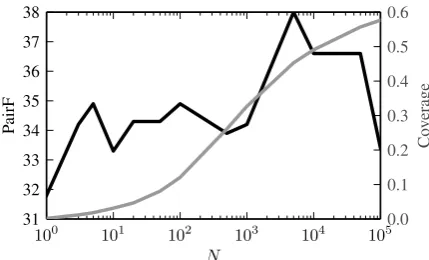
Figure 1: Verb clustering performance (black) and test set coverage (grey) of theLPmodel as a func-tion of the number of nouns N included in the model.
specific concepts; it is possible that this problem might be alleviated by careful filtering of the (verb, grammatical relation, noun) triples, but we leave this question to future research.
TheLPmodel is very effective, which is surpris-ing given its simplicity. As expected, with increas-ingN, we do observe sparsity effects which hurt verb clustering performance (see Figure 1).
Our best performing model isSUN. Our best res-ult is obtained with 10,000 nouns (the maximum value ofN that we tried) in 1,000 classes, giving relatively fine-grained classes (on average 10 nouns per class). Table 3 shows some example noun classes learned by theSUNmodel. These include: groups with synonyms or near synonyms, often in-cluding alternate spellings of the same word (such as in thetruckgrouping); and groups of closely-related co-hyponyms, such as the body part group-ing and the clothgroup-ing groupgroup-ing. In the latter, bill, joint responsibility,complicityandinscriptionare also included as things which can beborne, this is due to the fact that the SUNnoun clustering is based on triples of verbs, grammatical relations, and nouns.
LKW (truck),Lkw(truck),Lastwagen (truck), Castor(container for highly radioactive mater-ial),Laster(truck),Krankenwagen(ambulance), Transporter(van),Traktor(tractor)
Hand (hand), Kopf (head), Fuß (foot), Haar (hair),Bein(leg),Arm(arm),Zahn(tooth),Fell (fur)
Leiche (corpse), Leichnam (body), Schädel (skull),Skelett(skeleton),Wrack(wreck), Mu-mie(mummy),Trümmer(debris)
Sauna (sauna), Badezimmer (bathroom), Schwimmbad (swimming pool), Nachbildung (replica), Kamin (fireplace), Aufenthaltsraum (common room),Mensa(cafeteria)
Rechnung(bill),Kopftuch(headscarf),Uniform (uniform),Anzug(suit),Helm(helmet),Gewand (garment), Handschuh(glove), Mitverantwor-tung (joint responsibility), Bart (beard), Rüs-tung(armour), Mitschuld (complicity), Socke (sock),Jeans(jeans),Sonnenbrille(sunglasses), Aufschrift (inscription), Pullover (sweater), Weste(vest),Handschellen(handcuffs),Hörner (horns), Kennzeichen(marking),Tracht (tradi-tional costume), Korsett (corset), Schuhwerk (footwear), Kopfbedeckung (headgear), Pelz (fur),Maulkorb(muzzle)
Missionar (missionary), Weihnachtsmann (Santa Claus), Selbstmordattentäter (sui-cide bomber), Bote (messenger), Nikolaus (Nicholas), Killer (killer), Bomber (bomber), Osterhase(Easter bunny)
[image:7.595.78.293.229.359.2]Furthermore, there are thematically related groups (corpse,body, etc., andsauna,bathroom, etc.). All months are placed together in one 12-word group.
Some classes can be easily subdivided into sep-arate groups, and sometimes the source for this can be guessed: For example, sports (football,golf, ten-nis) are lumped together with musical instruments (guitar,piano,violin) and film roles (starring role, supporting role), these all being things that can beplayed. Many groups of personal roles (such as various kinds of government ministers) are dis-tinguished, as are diseases and medications; other groupings contain proper names or geographical locations, sometimes of surprising specificity (e.g., authors, Biblical names, philosophers, NGOs, East-ern European countries, foreign currencies, Ger-man male first names, newspapers, television chan-nels). The last group in Table 3 shows a grouping which appears to combine two of these semantic-ally narrow categories, in which Santa Claus and the Easter bunny are united with killers and suicide bombers.
4.2 Noun classes asSPconcepts
TheWSM SPmodel is not as successful asSUN, but, due to the methodological similarity between these two (SP concepts modelled as hard partitions of nouns), it affords us an opportunity to investigate the question of what properties might make for an effective noun partition.
The WSM model partitions nouns based on paradigmatic information (which sentence con-texts a noun appears in), rather than SUN’s use of syntagmatic information (which grammatical contexts a noun appears in). Therefore, it is per-haps not surprising that the noun classes derived by the WSM are organised thematically, and the synonym/co-hyponym structure observed in the SUN noun classes is in many cases absent (e.g., {Pferd(horse),Reiter(rider),Stall(stable),Sattel (saddle), Stute (mare)}; these classes can easily conflate semantic roles (e.g., Agent for rider and Location for stable), which is presumably unhelp-ful for representing selectional preferences.
The distribution of noun classes also differs between SUN and WSM. The largest noun class in theWSMmodel contains 1,076 high-frequency nouns which are semantically unrelated (day, ques-tion, case, part, reason, kind, form, week, person, month, . . .). We suppose that these nouns are
them-105 106 107 108
Number of verb instances 15
20 25 30 35 40 45
PairF
Baseline
LP WSM
[image:8.595.305.517.64.237.2]SUN LDA-hard
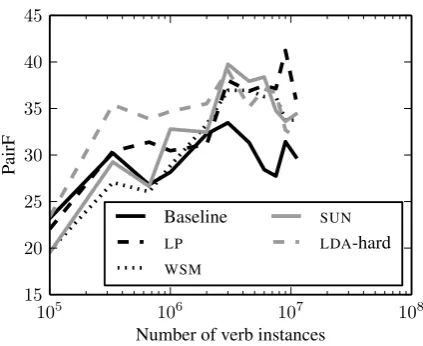
Figure 2: Verb clustering performance ofSP mod-els as a function of number of verb instances.
atically “neutral” and are classed together by virtue of their usage in a wide variety of sentences. This one noun class by itself subsumes 13.6% of all noun tokens in SdeWaC. WSM also includes 56 singleton noun classes; the variance in noun class size is 2800. For comparison, inSUN, the largest noun class has 73 words, and the smallest, 2 (there are 12 of these two-word classes); noun class size variance is 37. The 73-word class inSUNdoes in-deed appear to be a grab bag (includinggas, taboo, pioneer, mustard, spy, mafia, andskinhead), but these are uncommon words and account for only 0.1% of noun tokens in SdeWaC. The next two most common classes (with some 40 nouns each) are lists of names (politicians’ surnames, and male first names). The noun class in theSUNmodel con-taining the largest number of high-frequency nouns (28 nouns:human, child, woman, man, people, Mr., mother, father, . . .) only covers 3.6% of noun us-ages in SdeWaC and is both semantically cohesive and intuitively useful as aSPconcept.
These issues raise the question of why theWSM model is effective at all for verb classification. We think that the larger less-related noun classes neither help nor hurt verb clustering, and we find that some of the thematic classes represent abstrac-tions that should be useful for describingSPs. Ex-amples include lists of body parts, countries (separ-ate classes for Europe, Africa, Asia, etc.), diseases, human names, articles of clothing, and the group
{fruit, apple, banana, pear, strawberry}.
4.3 Effects of test set size
sparsity from becoming a problem. To pursue this question, we take the four best performingSP mod-els and run the verb clustering evaluation with the number of verb instances in the test set varying between 10,000 and the full SdeWaC corpus (11 million). The results are displayed in Figure 2. This graph indicates that below3×105verb instances,
sparsity seems to become a problem for all mod-els on this task, and the baseline delivers the best performance. Above this threshold, it seems that sparsity is not a major issue:LPperforms fairly con-sistently, and is competitive with theSUNmodel. We attribute this to our use of the Jensen-Shannon divergence as a verb dissimilarity measure, which seems relatively robust to data sparsity. TheLDA -hard model with its fewer topics seems to do quite well with fewer data; as the test set size increases, it drops off in the rankings. At the maximum number of verb instances, the best-performing models are SUN,WSMand the lexical preferences. The figure also shows that our evaluation metric is not smooth (note, e.g., the fluctuations in the baseline score). We believe that this reflects a degree of instability in the Ward’s hierarchical clustering algorithm; this clustering method is greedy, and clustering errors can be expected to propagate, which might explain the jaggedness of the plot.
4.4 Conclusions
To conclude, we summarise the results of our ana-lysis, using the questions formulated in the Intro-duction as guidelines.
First, we wanted to compare the efficiency of different classes of nouns as descriptors of selec-tional preference concepts. Our findings suggest that noun classes are most effective when they are semantically highly consistent, representing groups of strongly related nouns. It seems reasonable that SPconcepts representing collections of synonyms would be useful for generalising observations, and should represent arguments better than simpleLP. A classification of proper names (e.g., as human, corporation, country, medication) is also useful. This implies that we can expect features such as ANIMATEto be shared by all members of a noun cluster.
Second, we were interested in the appropriate granularity of selectional preference concepts. In our evaluation, we have observed a tendency for smaller, more specific noun classes to be superior; this holds because data sparsity is not a problem
in our experiment. Beyond this finding, we would have liked to present a direct juxtaposition of differ-ent models on “granularity” but this is difficult: We have not yet identified a strong abstraction of gran-ularity from the proxies we use (e.g., GermaNet depth, orSUN’sN/M).
Finally, which methods of classifying nouns into concepts are most effective at capturing selectional preferences for verb clustering? In our experiments, theSUNandLDA-hard models proved to be more effective than lexical preferences, supporting our primary hypothesis that some level ofSPconcept granularity above the lexical level is desirable for verb clustering. On the other hand, theLPmodel is only slightly worse thanSUNandLDA-hard, mak-ing it attractive because it is so simple. As we have shown, the potential data sparsity issues with LP can be alleviated by judiciously choosing the value of the N parameter that controls the number of nouns included in the model. In addition, compar-ing theSUNandWSMmodels, and observing the performance of theLDA-hard method, we conclude that inducing noun classes using syntagmatic in-formation is more effective than using paradigmatic relations.
5 Related work
SPs are described qualitatively by presenting two example cases. Sun and Korhonen (2009) study the effect of adding selectional preferences to a subcategorisation-based verb clustering in Eng-lish using theSUNmodel (see Section 3.2). They demonstrate that addingSPs to theSCFpreference data leads to the best results on their two clustering evaluations; overall, their best results come from using SP information only for the subject gram-matical relation. They employ coarseSPconcepts (20 or 30 noun clusters) which capture general se-mantic categories (Human, Building, Idea, etc.).
Selectional preferences are usually evaluated either from a word sense disambiguation stand-point using pseudo-words (Chambers and Juraf-sky, 2010), or in terms of how acceptable an ar-gument is with a verb, via regression against hu-man plausibility judgements. Several studies have compared SP methodologies from the latter per-spective. These include Brockmann and Lapata (2003), who compared three GermaNet-based mod-els ofSP, showing that different models were most effective for describing different grammatical re-lations; Ó Séaghdha (2010), who compared dif-ferentLDA-based models ofSP, showing these to be effective for a variety of grammatical relations; and Ó Séaghdha and Korhonen (2012), who show that WordNet tree cut models,LDA, and a hybrid LDA-WordNet model are effective for describing verb-object relations.
6 Future work
Our GermaNet model delivered disappointing per-formance in this study; we would be interested in seeing whether a more sophisticated implementa-tion such as the tree cut model of Li and Abe (1998) would be more competitive. We also would like to explore alternative noun clustering methods such as CBC (Pantel and Lin, 2002) and Brown clusters (Brown et al., 1992), which were not covered in this work; these would fit easily into ourSP eval-uation paradigm. More challenging would be a verb classification-based evaluation of theSP mod-els of (Rooth et al., 1999) and (Schulte im Walde et al., 2008), which use expectation maximisation to simultaneously cluster verbs into verb classes and nominal arguments into noun classes; these ap-proaches are not compatible with the evaluation framework we have used here. Finally, the SP model of Bergsma et al. (2008) has also achieved impressive results on a number of tasks, but has not
been investigated for use in verb classification. Our verb clustering evaluation in this work has matchedK, the number of clusters found by Ward’s method, to the number of classes in the gold standard. Since the number of clusters has an influence on the quality of the ensuing semantic classification (Schulte im Walde, 2006, page 180f.), we will also be running our experiments with dif-ferent settings ofK to explore whether this also influences the overall results of our evaluation.
References
Marco Baroni, Silvia Bernardini, Adriano Ferraresi, and Eros Zanchetta. 2009. The WaCky wide web: A collection of very large linguistically processed Web-crawled corpora. Language Resources and Evalu-ation, 43(3):209–226.
Shane Bergsma, Dekang Lin, and Randy Goebel. 2008. Discriminative learning of selectional preference from unlabeled text. In Proceedings of the Con-ference on Empirical Methods in Natural Language Processing, pages 59–68.
David M. Blei, Andrew Y. Ng, and Michael I. Jordan. 2003. Latent Dirichlet allocation. Journal of Ma-chine Learning Research, 3:993–1022.
Bernd Bohnet, Joakim Nivre, Igor Boguslavsky, Richárd Farkas, Filip Ginter, and Jan Hajiˇc. 2013. Joint morphological and syntactic analysis for richly inflected languages. Transactions of the Association for Computational Linguistics, 1:415–428.
Carsten Brockmann and Mirella Lapata. 2003. Evalu-ating and combining approaches to selectional pref-erence acquisition. InProceedings of the Tenth Con-ference on European Chapter of the Association for Computational Linguistics, pages 27–34.
Peter F. Brown, Peter V. Desouza, Robert L. Mer-cer, Vincent J. Della Pietra, and Jenifer C. Lai. 1992. Class-based n-gram models of natural lan-guage. Computational Linguistics, 18(4):467–479.
Nathanael Chambers and Daniel Jurafsky. 2010. Im-proving the use of pseudo-words for evaluating se-lectional preferences. InProceedings of the 48th An-nual Meeting of the Association for Computational Linguistics, pages 445–453.
Stephen Clark and David Weir. 2002. Class-based probability estimation using a semantic hierarchy. Computational Linguistics, 28(2):187–206.
Katrin Erk. 2007. A simple, similarity-based model for selectional preferences. In Proceedings of the 45th Annual Meeting of the Association for Compu-tational Linguistics, pages 216–223.
Eva Esteve Ferrer. 2004. Towards a semantic classi-fication of Spanish verbs based on subcategorisation information. InProceedings of the Student Research Workshop at the Annual Meeting of the Association for Computational Linguistics, pages 37–42. Gertrud Faaß and Kerstin Eckart. 2013. SdeWaC - A
corpus of parsable sentences from the Web. In Lan-guage processing and knowledge in the Web, pages 61–68. Springer, Berlin, Heidelberg.
Yufan Guo, Anna Korhonen, and Thierry Poibeau. 2011. A weakly-supervised approach to argumentat-ive zoning of scientific documents. InProceedings of the Conference on Empirical Methods in Natural Language Processing, pages 273–283.
Iryna Gurevych and Hendrik Niederlich. 2005. Com-puting semantic relatedness in German with revised information content metrics. InProceedings of "On-toLex 2005 - Ontologies and Lexical Resources" IJCNLP’05 Workshop, pages 28–33.
Birgit Hamp and Helmut Feldweg. 1997. GermaNet: A lexical-semantic net for German. InProceedings of ACL Workshop on Automatic Information Extrac-tion and Building of Lexical Semantic Resources for NLP Applications, pages 9–15.
Vasileios Hatzivassiloglou and Kathleen R. McKeown. 1993. Towards the automatic identification of ad-jectival scales: Clustering adjectives according to meaning. InProceedings of the 31st Annual Meet-ing on Association for Computational LMeet-inguistics, pages 172–182.
Jerrold J. Katz and Jerry A. Fodor. 1963. The structure of a semantic theory. Language, 39:170–210.
Karin Kipper-Schuler. 2005. VerbNet: A broad-coverage, comprehensive verb lexicon. Ph.D. thesis, University of Pennsylvania.
Anna Korhonen, Yuval Krymolowski, and Nigel Col-lier. 2008. The choice of features for classifica-tion of verbs in biomedical texts. In Proceedings of the 22nd International Conference on Computa-tional Linguistics, pages 449–456.
Beth Levin. 1993. English verb classes and altern-ations: A preliminary investigation. University of Chicago Press, Chicago.
Hang Li and Naoki Abe. 1998. Generalizing case frames using a thesaurus and the MDL principle. Computational Linguistics, 24(2):217–244.
Jianguo Li and Chris Brew. 2008. Which are the best features for automatic verb classification. In Pro-ceedings of ACL-08: HLT, pages 434–442.
Jianhua Lin. 1991. Divergence measures based on the Shannon entropy. IEEE Transactions on Informa-tion Theory, 37(1):145–151.
Andrew McCallum. 2002. MALLET: A machine learning for language toolkit.
Diana McCarthy and John Carroll. 2003. Disambig-uating nouns, verbs, and adjectives using automat-ically acquired selectional preferences. Computa-tional Linguistics, 29(4):639–654.
Marina Meil˘a and Jianbo Shi. 2001. A random walks view of spectral segmentation. InProceedings of the International Conference on Artificial Intelligence and Statistics (AISTATS).
Diarmuid Ó Séaghdha and Anna Korhonen. 2012. Modelling selectional preferences in a lexical hier-archy. InProceedings of the 1st Joint Conference on Lexical and Computational Semantics, pages 170– 179.
Diarmuid Ó Séaghdha. 2010. Latent variable mod-els of selectional preference. InProceedings of the 48th Annual Meeting of the Association for Compu-tational Linguistics, pages 435–444.
Sebastian Padó, Ulrike Padó, and Katrin Erk. 2007. Flexible, corpus-based modelling of human plausib-ility judgements. InProceedings of the 2007 Joint Conference on Empirical Methods in Natural guage Processing and Computational Natural Lan-guage Learning (EMNLP-CoNLL), pages 400–409. Patrick Pantel and Dekang Lin. 2002. Discovering
word senses from text. InProceedings of the Eighth ACM SIGKDD International Conference on Know-ledge Discovery and Data Mining, pages 613–619.
Tamara Polajnar and Stephen Clark. 2014. Improv-ing distributional semantic vectors through context selection and normalisation. InProceedings of the 14th Conference of the European Chapter of the As-sociation for Computational Linguistics, pages 230– 238.
Philip Resnik. 1993. Selection and information: A class-based approach to lexical relationships. Ph.D. thesis, University of Pennsylvania.
Philip Resnik. 1997. Selectional preference and sense disambiguation. InProceedings of the ACL SIGLEX Workshop on Tagging Text with Lexical Semantics: Why, What, and How, pages 52–57.
Alan Ritter, Mausam, and Oren Etzioni. 2010. A lat-ent Dirichlet allocation method for selectional pref-erences. In Proceedings of the 48th Annual Meet-ing of the Association for Computational LMeet-inguistics, pages 424–434.
14th Conference of the European Chapter of the As-sociation for Computational Linguistics, pages 298– 307.
Mats Rooth, Stefan Riezler, Detlef Prescher, Glenn Car-roll, and Franz Beil. 1999. Inducing a semantic-ally annotated lexicon via EM-based clustering. In Proceedings of the 37th Annual Meeting of the Asso-ciation for Computational Linguistics on Computa-tional Linguistics, pages 104–111.
Magnus Sahlgren. 2006. The word-space model: Us-ing distributional analysis to represent syntagmatic and paradigmatic relations between words in high-dimensional vector spaces. Ph.D. thesis, Stockholm University.
Sabine Schulte im Walde, Christian Hying, Christian Scheible, and Helmut Schmid. 2008. Combining EM training and the MDL principle for an automatic verb classification incorporating selectional prefer-ences. In Proceedings of the 46th Annual Meet-ing of the Association for Computational LMeet-inguistics, pages 496–504.
Sabine Schulte im Walde. 2000. Clustering verbs se-mantically according to their alternation behaviour. InProceedings of the 18th Conference on Computa-tional Linguistics, pages 747–753.
Sabine Schulte im Walde. 2002. A subcategorisation lexicon for German verbs induced from a lexicalised PCFG. In Proceedings of the 3rd Conference on Language Resources and Evaluation (LREC), pages 1351–1357.
Sabine Schulte im Walde. 2006. Experiments on the automatic induction of German semantic verb classes. Computational Linguistics, 32(2):159–194. Sabine Schulte im Walde. 2009. The induction of verb frames and verb classes from corpora. In Anke Lüdeling and Merja Kytö, editors, Corpus linguistics: An international handbook, volume 2, chapter 44, pages 952–971. Mouton de Gruyter, Ber-lin.
Ekaterina Shutova, Lin Sun, and Anna Korhonen. 2010. Metaphor identification using verb and noun clustering. InProceedings of the 23rd International Conference on Computational Linguistics, pages 1002–1010.
Ekaterina Shutova, Simone Teufel, and Anna Korhonen. 2013. Statistical metaphor processing. Computational Linguistics, 39(2):301–353.
Mark Stevenson and Yorick Wilks. 2001. The interac-tion of knowledge sources in word sense disambigu-ation.Computational Linguistics, 27(3):321–349. Lin Sun and Anna Korhonen. 2009. Improving verb
clustering with automatically acquired selectional preferences. In Proceedings of the 2009 Confer-ence on Empirical Methods in Natural Language Processing, pages 638–647.
Lin Sun, Anna Korhonen, and Yuval Krymolowski. 2008. Verb class discovery from rich syntactic data. In Proceedings of the Ninth International Confer-ence on Intelligent Text Processing and Computa-tional Linguistics, pages 16–27.
Lin Sun. 2012. Automatic induction of verb classes using clustering. Ph.D. thesis, University of Cam-bridge, Cambridge.
Peter D. Turney and Patrick Pantel. 2010. From frequency to meaning: Vector space models of se-mantics. Journal of Artificial Intelligence Research, 37(1):141–188.
Joe H. Ward, Jr. 1963. Hierarchical grouping to optim-ize an objective function. Journal of the American Statistical Association, 58(301):236–244.
Yorick Wilks. 1975. An intelligent analyzer and un-derstander of English. Communications of the ACM, 18(5):264–274.