Stream-based Randomised Language Models for SMT
Abby Levenberg
School of Informatics University of Edinburgh
Miles Osborne
School of Informatics University of Edinburgh
Abstract
Randomised techniques allow very big language models to be represented suc-cinctly. However, being batch-based they are unsuitable for modelling an un-bounded stream of language whilst main-taining a constant error rate. We present a novel randomised language model which uses an online perfect hash function to efficiently deal with unbounded text streams. Translation experiments over a text stream show that our online ran-domised model matches the performance of batch-based LMs without incurring the computational overhead associated with full retraining. This opens up the possibil-ity of randomised language models which continuously adapt to the massive volumes of texts published on the Web each day.
1 Introduction
Language models (LM) are an integral feature of statistical machine translation (SMT) systems. They assign probabilities to generated hypothe-ses in the target language informing lexical selec-tion. The most common form of LMs in SMT systems are smoothedn-gram models which pre-dict a word based on a contextual history ofn−1 words. For some languages (such as English) tril-lions of words are available for training purposes. This fact, along with the observation that ma-chine translation quality improves as the amount of monolingual training material increases, has lead to the introduction of randomised techniques for representing large LMs in small space (Talbot and Osborne, 2007; Talbot and Brants, 2008).
Randomised LMs (RLMs) solve the problem of representing large, static LMs but they are batch oriented and cannot incorporate new data with-out fully retraining from scratch. This property
makes current RLMs ill-suited for modelling the massive volume of textual material published daily on the Web. We present a novel RLM which is capable of incremental (re)training. We use ran-dom hash functions coupled with an online perfect hashing algorithm to represent n-grams in small space. This makes it well-suited for dealing with an unbounded stream of training material. To our knowledge this is the first stream-based RLM re-ported in the machine translation literature. As well as introducing the basic stream-based RLM, we also consider adaptation strategies. Perplex-ity and translation results show that populating the language model with material chronologically close to test points yields good results. As with previous randomised language models, our experi-ments focus on machine translation but we also ex-pect that our findings are general and should help inform the design of other stream-based models.
Section 2 introduces the incrementally retrain-able randomised LM and section 3 considers re-lated work; Section 4 then considers the question of how unbounded text streams should be mod-elled. Sections 5 and 6 show stream-based trans-lation results and properties of our novel data-structure. Section 7 concludes the paper.
2 Online Bloomier Filter LM
Our online randomised LM (O-RLM) is based on the dynamic Bloomier filter (Mortensen et al., 2005). It is a variant of the batch-based Bloomier filter LM of Talbot and Brants (2008) which we refer to as the TB-LM henceforth. As with the TB-LM, the O-RLM uses random hash functions to represent n-grams as fingerprints which is the main source of space savings for the model.
2.1 Online Perfect Hashing
The key difference in our model as compared to the TB-LM is we use an online perfect hashing
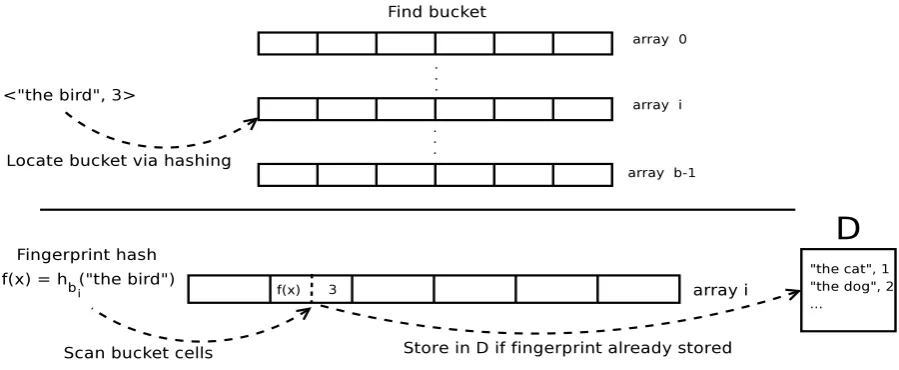
Figure 1: Inserting ann-gram into the dynamic Bloomier filter. Above: ann-gram is hashed to its target bucket. Below: then-gram is transformed into a fingerprint and the same target bucket is scanned. If a collision occurs thatn-gram is diverted to the overflow dictionary; otherwise the fingerprint is stored in the bucket.
function instead of having to precompute the per-fect hash offline prior to data insertion.
The online perfect hash function uses two data structures: A and D. Ais the main, randomised data structure and is an array of b dictionaries
A0, . . . , Ab−1.Dis a lossless data structure which handles collisions inA. Each of the dictionaries in
Ais referred to as a ‘bucket’. In our implementa-tion the buckets are equally sized arrays of w-bit cells. These cells hold the fingerprints and values ofn-grams (onen-gram-value pair per cell).
To insert an n-gram x and associated value
v(x) into the model, we select a bucket Ai by hashing x into the range i → [0, . . . , b − 1]. Each bucket has an associated random hash func-tion, hAi, drawn from a universal hash func-tion (UHF) familyh(Carter and Wegman, 1977), which is then used to generate the n-gram finger-print: f(x) =hAi(x).
If the bucketAiis not full we conduct a scan of its cells. If the fingerprint f(x)is not already en-coded in the bucketAiwe add the fingerprint and value to the first empty cell available. We allocate a preset number of the least significant bits of each
w-bit cell to holdv(x)and the remaining most sig-nificant bits forf(x)but this is arbitrary. Any en-coding scheme, such as the packed representation of Talbot and Brants (2008), is viable here.
However, iff(x)∈Ai already (there is a colli-sion) we store the n-gramxand associated value
v(x)in the lossless overflow dictionaryDinstead.
Dalso holds then-grams that were hashed to any
buckets that are already full.
To query for the value of an n-gram, we first check if the gram is in the overflow dictionaryD. If it is, we return the associated value. Otherwise we query A using the same hash functions and procedure as insertion. If we find a matching fin-gerprint in the appropriate bucket Ai we have a hit with high probability. Deletions and updates are symmetric to querying except we reset the cell to the null value or update its value respectively. As with other randomised models we construct queries with the appropriate sanity checks to lower the error rate efficiently (Talbot and Brants, 2008).
2.2 Data Insertion
Thesen-grams and counts are then considered for insertion into the online model. If we decide to insert ann-gram, we either update the count of thatn-gram if we previously inserted it or else we insert it as a new entry. Note that there is some probability we may encounter a false positive and update some othern-gram in the model.
2.3 Properties
The online perfect hash succeeds by associating each n-gram with only one cell in A rather than having it depend on cells (or bits) which may be shared by othern-grams as with the TB-LM. Since eachn-gram’s encoding in the model uses distinct bits and is independent of all other events it can not corrupt othern-grams when deleted.
Adding the overflow dictionary D means that we use more space than the TB-LM for the same support. It is shown in Mortensen et al. (2005) that the expected size ofDis a small fraction of the to-tal number of events and its space usage comprises less thanO(|S|)bits with high probability.
There is a nonzero probability for false posi-tives. Since the overflow dictionary D has no er-rors, the expected error rate for our dynamic struc-ture is the probability of a random collision in the hash range of eachhAi for each bucket cell com-pared. In our setup we have
Pr(falsepos) = 2|A|f(ix|)|
where |f(x)|is the number of bits of each w-bit cell used for the fingerprint f(x). w also primar-ily governs space used in the model. The O-RLM assumes only valid updates and deletions are per-formed (i.e. we do not remove or update entries that were never inserted prior).
The O-RLM takes time linear to the input size for training and uses worst-case constant time for querying and deletions where the constant is de-pendent on the number of cells per bucket in A. The number of bucket cells also effects the overall error rate significantly since smaller ranges reduce the probability of a collision. However, too few cells per bucket will result in many full buckets when the bucket hash function is not highly IID.
2.4 Basic RLM Comparisons
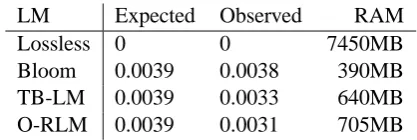
Table 1 compares expected versus observed false positive rates for the Bloom filter, TB-LM, and O-RLM obtained by querying a model of approxi-mately 280M events with 100K unseenn-grams.
LM Expected Observed RAM
Lossless 0 0 7450MB
[image:3.595.311.520.61.131.2]Bloom 0.0039 0.0038 390MB TB-LM 0.0039 0.0033 640MB O-RLM 0.0039 0.0031 705MB
Table 1: Example false postive rates and corre-sponding memory usage for all randomised LMs.
We see the bit-based Bloom filter uses signifi-cantly less memory than the cell-based alternatives and the O-RLM consumes more memory than the TB-LM for the same expected error rate.
3 Related Work
3.1 Randomised Language Models
Talbot and Osborne (2007) used a Bloom filter (Bloom, 1970) to encode a smoothed LM. A Bloom filter (BF) represents a setSfrom arbitrary domainU and supports membership queries such as“Isx∈S?”. The BF uses an array ofmbits and
kindependent UHFs each with range0, . . . , m−1. For insertion, each item is hashed through the k hash functions and the resulting target bits are set to one. During testing, an event x ∈ U is passed through the same khash functions and if any bit tested is zero thenxwas not in the supportS.
The Bloomier filter directly represents key-value pairs by using a table of cells and a family of
Deleting items from a Bloomier Filter without re-computing the perfect hash will corrupt it.
3.2 Probabilistic Counting
Concurrent work has used approximate counting schemes based on Morris (1978) to estimate in small space frequencies over a high volume in-put text stream (Van Durme and Lall, 2009; Goyal et al., 2009). The space savings are due to com-pact storage of counts and retention of only a small subset of the available n-grams in the data stream. Since the final LMs are still lossless (mod-ulo counts), the resulting LM needs significant space. It is trivial to use probabilistic counting within our framework.
3.3 Compact Exact Language Models
Randomised algorithms are not the only com-pact representation schemes. Church et al. (2007) looked at Golomb Coding and Brants et al. (2007) used tries in a distributed setting. These methods are less succinct than randomised approaches.
3.4 Adaptive Language Models
There is a large literature on adaptive LMs from the speech processing domain (Bellegarda, 2004). The primary difference between the O-RLM and other adaptive LMs is that we add and removen -grams from the model instead of adapting only the parameters of the current support set.
3.5 Domain adaptation in Machine Translation
Within MT there has been a variety of approaches dealing with domain adaption (for example (Wu et al., 2008; Koehn and Schroeder, 2007). Typi-cally LMs are interpolated with one another, yield-ing good results. These models are usually stat-ically trained, exact and unable to deal with an unbounded stream of monolingual data. Domain adaptation has similarities with streaming, in that our stream may be non-stationary. A crucial dif-ference however is that the stream is of unbounded length, whereas domain adaptation usually as-sumes some finite and fixed training set.
4 Stream-based translation
[image:4.595.307.525.76.232.2]Streaming algorithms have numerous applications in mainstream computer science (Muthukrishnan, 2003) but to date there has been very little aware-ness of this field within computational linguistics.
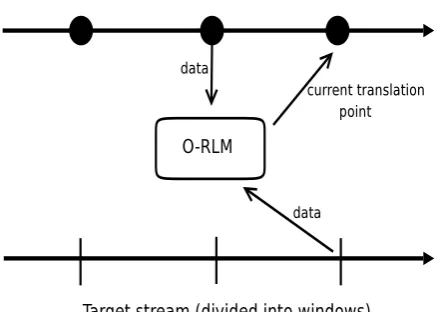
Figure 2: Stream-based translation. The online RLM uses data from the target stream and the last test point in the source stream for adaptation.
A text stream can be thought of as a unbounded sequence of documents that are time-stamped and we have access to them in strict chronological or-der. The volume of the stream is so large we can afford only a limited number of passes over the data (typically one).
Text streams naturally arise on the Web when millions of new documents are published each day in many languages. For instance, 18 thousand websites continuously publish news stories in 40 languages and there are millions of multilingual blog postings per day. There are over 30 billion e-mails sent daily and social networking sites, in-cluding services such as Twitter, generate an adun-dance of textual data in real time. Web crawlers that spidered all these new documents would pro-duce an unbounded input stream.
The stream-based translation scenario is as fol-lows: we assume that each day we see a source stream of many new newswire stories that need translation. We also assume a stream of newswire stories in the target language. Intuitively, since the concurrent streams are from the same domain, we can use the contexts provided in the target stream to help with the translation of the source stream (Figure 2). From a theoretical perspective, since we cannot represent the entirety of the stream and wish to maintain a constant error rate, we are forced to throw some information away.
180 200 220 240 260 280 300
20 25 30 35 40 45 50
perplexity
weeks Reuters 96-97 LM subsets
[image:5.595.76.283.70.241.2]51-week baseline 20-week subset test 1 20-week subset test 2
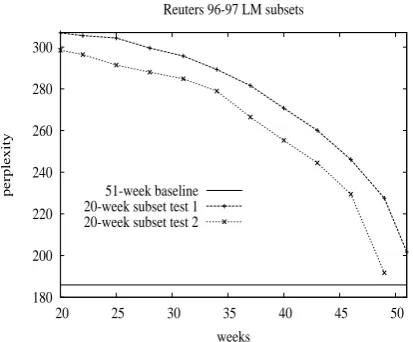
Figure 3: Perplexity results using streamed data. Perplexity decreases as we retrain LMs using data chronologically closer to the (two) test dates.
we represent in our model?
Using perplexity, we investigated this question using a text stream based on Reuter’s RCV1 text collection (Rose et al., 2002). This contains 800k time-stamped newswire stories from a full calen-der year (8.20.1996 - 8.19.1997). We used the SRILM (Stolcke, 2002) to construct an exact tri-gram model built using all the RCV1 data with the exception of the final week which we held out as test data. This served as an oracle since we store all of the stream.
We then trained multiple exact LMs of much smaller sizes, coined subset LMs, to simulate memory constraints. For a given date in the RCV1 stream, these subset LMs were trained using a fixed window of previously seen documents up to that data. Then we obtained perplexity results for each subset LM against our test set.
Figure 3 shows an example. For this experiment subset LMs were trained using a sliding window of 20 weeks with the window advancing over a period of three weeks each time. The two arcs correspond to two different test sets drawn from different days. The arcs show that recency has a clear effect: populating LMs using material closer to the test data date produces improved perplexity performance. The LM chronologically closest to a given test set has perplexity closest to the results of the significantly larger baseline LM which uses all the stream. As expected, using all of the data yields the lowest perplexity.
We note that this is a robust finding, since we also observe it in other domains. For example, we
Epoch Stream Window
1 08.20.1996 to 01.01.1997 2 01.02.1997 to 04.23.1997 3 04.24.1997 to 08.18.1997
Table 2: The stream timeline is divided into win-dowed epochs for our recency experiments.
conducted the same tests over a stream of 18 bil-lion tokens drawn from 80 milbil-lion time-stamped blog posts downloaded from the web with match-ing results. The effect of recency on perplexity has also been observed elsewhere (see, for example, Rosenfeld (1995) and Whittaker (2001)).
Our experiments show that a possible way to tackle stream-based translation is to always focus the attention of the LM on the most recent part of the stream. This means we remove data from the model that came from the receding parts of the stream and replace it with the present.
5 SMT Experiments
5.1 Experimental Setup
We used publicly available resources for all our tests: for decoding we used Moses (Koehn and Hoang, 2007) and our parallel data was taken from the Spanish-English section of Europarl. For test material, we translated 63 documents (800 sen-tences) from three randomly selected dates spaced throughout the RCV1 year (January 2nd, April 24, and August 19).1 This effectively divided the stream into three epochs between the test dates ( table 2). We held out 300 sentences for minimum error rate training (MERT) (Och, 2003) and opti-mised the parameters of the feature functions of the decoder for each experimental run.
The RCV1 is not a large corpus when compared to the entire web but it is multilingual, chronologi-cal, and large enough to enable us to test the effect of recency in a translation setting.
5.2 Adaption
We looked at a number of ways of adapting the O-RLM:
1. (Random) Randomly sample the stream and for each new n-gram encountered, insert
1As RCV1 is not a parallel corpus we translated the
Order Full Epoch 1 Epoch 3
1 1.25M 0.6M 0.7M
2 14.6 M 6.8M 7.0M
3 50.6 M 21.3M 21.7M 4 90.3 M 34.8M 35.4M 5 114.7M 41.8M 42.6M Total 271.5M 105M 107.5M
Table 3: Distinct n-grams (in millions) encoun-tered in the full stream and example epochs.
it and remove some previously inserted n -gram, irrespective of whether it was ever re-quested by the decoder or is a prefix.
2. (Conservative) For each new n-gram en-countered in the stream, insert it in the filter and remove one previously inserted n-gram which was never requested by the decoder. To preserve consistency we do not remove lower-order grams that are needed to estimate backoff probability for higher-order smooth-ing. Counts are updated forn-grams already in the model if the new count observed is larger than the current one.
3. (Severe) Differs from the conservative ap-proach only in that we delete all unused n -grams (i.e. all those not requested by the de-coder in the previous translation task) from the O-RLM before adapting with data from the stream. This means the data structure is sparsely populated for all runs.
All the TB-LMs and O-RLMs were unpruned 5-gram models and used Stupid-backoff smoothing (Brants et al., 2007) 2with the backoff parameter set to0.4as suggested. The number of distinctn -grams encountered in the stream for two epochs is shown in Table 3.
Table 6 shows translation results using these adaption strategies. In practice, the random ap-proach does not work while the conservative and severe adaption techniques produce equivalent re-sults due to the small proportion of data in the model that is queried during decoding. All the MT experiments that follow use the severe method and the overflow dictionary always holds less than1% of the total elements in the model.
2Smoothing text input data streams poses an interesting
problem we hope to investigate in the future.
[image:6.595.93.274.61.158.2]Date Lossless TB-LM O-RLM Jan 37.83 37.12 37.17 Apr 34.88 34.21 34.79 Aug 29.05 28.52 28.44 Avg 33.92 33.28 33.46
Table 4: Baseline translation results in BLEU us-ing data from the first stream epoch with a lossless LM (4.5GB RAM), the TB-LM and the O-RLM (300MB RAM). All LMs are static.
5.3 Training Regimes
We now consider stream-based translation. Our first naive approach is to continually add new data from the stream to the training set without delet-ing anythdelet-ing. Given a constant memory bound this strategy only increases the error rate over time as discussed. Our second, computationally demand-ing approach is, before each test point, to rebuild the TB-LM from scratch using the stream data from the most recent epoch as the training set. This is batch retraining. The final approach in-crementally retrains online. This utilizes the same training data as above (the stream data from the last epoch) but instead of full retraining it replaces
n-grams currently in the model with unseen n -grams and counts encountered in the data stream.
5.4 Streaming Translation Results
Each table shows translation results for the three different test times in the stream. All results re-ported use the case-sensitive BLEU score.
[image:6.595.331.504.61.129.2]For our baselines we use static LMs trained on the first epoch’s data to test all three translation points in the source stream. This is the tradi-tional approach. We trained an exact, modified Kneser-Ney smoothed LM (here we do not en-force a memory constraint) and also used the TB-LM and O-RTB-LM to verify our structures adequecy. Results are shown in table 4. The exact model gives better performance overall due to the more sophisticated smoothing used.
Table 5 shows results for a set of stream-based LMs using the TB-LM and the O-RLM with mem-ory bounds of 200MB and 300MB. As expected, the naive models performance degrades over time as we funnel more data into the TB-LM and the error rises. The batch retrained TB-LMs and O-RLMs have constant error rates of 218 and 2112 and
Naive TB-LM Batch Retrained TB-LM O-RLM Date 200MB 300MB 200MB 300MB 200MB 300MB Jan 35.94 37.12 35.94 37.12 36.44 37.17 Apr 33.55 35.79 36.01 35.99 35.87 36.10 Aug 22.44 26.07 28.97 29.38 29.00 29.18 Avg 30.64 32.99 33.64 34.16 33.77 34.15
Table 5: Translation results for stream-based LMs in BLEU. Performance degrades with time using the Naive approach. The batch retrained TB-LM and stream-based O-RLM use constant error rates of 218
and 2112.
performance from the batch retrained and online models. We also see some improvement compared to the static baselines when the LMs use the most recent data from the target language stream with respect to the current translation point.
The key difference is that each time we batch retrain the TB-LM, we must compute a perfect hashing of the new training set. This is computa-tionally demanding since the perfect hashing algo-rithm uses Monte Carlo randomisation which fails routinely and must be repeated. To make the al-gorithm tractable the training data set must be di-vided into lexically sorted subsets as well. This requires extra passes over the data which may not be trivial in a streaming environment.
In contrast, the O-RLM is incrementally re-trained online. This makes it more resource ef-ficient since we find bits in the model for the n -grams dynamically without using more memory than we intially set. Note that even though the O-RLM is theoretically less space efficient than the TB-LM, when using the same amount of memory translation performance is comparable.
6 O-RLM Properties
The previous experiments confirm that the O-RLM can be employed as a LM in an SMT setting but it is useful to get insight into the intrinsic prop-erties of the data structure. Many of the propprop-erties of the model, such as the number of bits per fin-gerprint, follow directly from the TB-LM but the relationship between the overflow dictionary and the randomised buckets is novel.
Figures 4 and 5 shows properties of the O-RLM while varying only the number of cells in each bucket and keeping all other model parameters constant. We test membership of n-grams in an unseen corpus against those stored in the table. Our tests were conducted over a larger stream of 1.25B n-grams from the Gigaword corpus(Graff,
Date Severe Random Conservative Jan 36.44 36.44 36.44 Apr 35.87 31.08 35.51 Aug 29.00 19.31 29.14 Avg 33.77 29.11 33.70
Table 6: Adaptation results measured in BLEU. Random deletions degrade performance when adapting a 200MB O-RLM.
2003). We set our space usage to match the 3.08 bytes per n-gram reported in Talbot and Brants (2008) and held out just over 1M unseenn-grams to test the error rates of our models.
In Figure 4 we see a direct correlation between model error and cells per buckets. As the num-ber of cells decreases the false positive rate drops as well since fewer cells to compare against per bucket means a lower chance of producing colli-sions. If the range is decreased too much though more data is diverted to the overflow dictionary due to many buckets reaching capacity when in-serting and adapting. Clearly this is less space ef-ficient. Figure 5 shows the relationship between the percent of data in the overflow dictionary and the total cells per bucket.
7 Conclusions
Our experiments have shown that for stream-based translation, using recent data can benefit perfor-mance but simply adding entries to a randomised representation will only reduce translation perfor-mance over time. We have presented a novel ran-domised language model based on dynamic per-fect hashing that supports online insertions and deletions. As a consequence, it is considerably faster and more efficient than batch retraining.
[image:7.595.318.514.218.287.2]0 0.001 0.002 0.003 0.004 0.005 0.006 0.007
50 100 150 200 250
false positive rates
[image:8.595.75.284.70.243.2]cells per bucket O-RLM Error rate
Figure 4: The O-RLM error rises in correlation with the number of cells per bucket.
0 0.002 0.004 0.006 0.008 0.01 0.012 0.014 0.016 0.018
50 100 150 200 250
% of data in overflow dictionary
cells per bucket Overflow Dictionary Size
Figure 5: Too few cells per bucket causes a higher percentage of the data to be stored in the overflow dictionary due to full buckets.
elling, within a bounded amount of space our re-sults show that it is better to have a low error rate and store a wisely chosen fraction of the data than having a high error rate and storing more of it. Clearly tradeoffs will vary between applications.
This is the first stream-based randomised lan-guage model and associated machine translation system reported in the literature. Clearly there are many interesting open questions for future work. For example, can we use small randomised repre-sentations called sketches to compactly represent side-information on the stream telling us which as-pects of it we should insert into our data? How can we efficiently deal with smoothing in this set-ting? Our adaptation scheme is simple and our data stream is tractable. Currently we are
con-ducting tests over much larger, higher variance text streams from crawled blog data. In the fu-ture we will also consider randomised representa-tions of other adaptive LMs in the literature using a static background LM in conjunction with our online one. We ultimately hope to deploy large-scale LMs which continuously adapt to the vast amount of material published on the Web without incurring significant computational overhead.
Acknowledgements
The authors would like to thank David Talbot, Adam Lopez and Phil Blunsom for their valu-able comments and insight. This work was sup-ported in part under the GALE program of the De-fense Advanced Research Projects Agency, Con-tract No. HR0011-06-C-0022.
References
Jerome R. Bellegarda. 2004. Statistical language model adaptation: review and perspectives. Speech
Communication, 42:93–108.
Burton H. Bloom. 1970. Space/time trade-offs in hash coding with allowable errors. Commun. ACM, 13(7):422–426.
Thorsten Brants, Ashok C. Popat, Peng Xu, Franz J. Och, and Jeffrey Dean. 2007. Large language models in machine translation. In Proceedings
of the 2007 Joint Conference on Empirical Meth-ods in Natural Language Processing and Com-putational Natural Language Learning (EMNLP-CoNLL), pages 858–867.
J. Lawrence Carter and Mark N. Wegman. 1977. Uni-versal classes of hash functions (extended abstract). In STOC ’77: Proceedings of the ninth annual ACM
symposium on Theory of computing, pages 106–112,
New York, NY, USA. ACM Press.
Bernard Chazelle, Joe Kilian, Ronitt Rubinfeld, and Ayellet Tal. 2004. The bloomier filter: an ef-ficient data structure for static support lookup ta-bles. In SODA ’04: Proceedings of the fifteenth
an-nual ACM-SIAM symposium on Discrete algorithms,
pages 30–39, Philadelphia, PA, USA. Society for In-dustrial and Applied Mathematics.
Kenneth Church, Ted Hart, and Jianfeng Gao. 2007. Compressing trigram language models with Golomb coding. In Proceedings of the 2007 Joint
Con-ference on Empirical Methods in Natural guage Processing and Computational Natural Lan-guage Learning (EMNLP-CoNLL), pages 199–207,
[image:8.595.76.285.303.473.2]Amit Goyal, Hal Daum´e III, and Suresh Venkatasub-ramanian. 2009. Streaming for large scale NLP: Language modeling. In North American
Chap-ter of the Association for Computational Linguistics (NAACL), Boulder, CO.
David Graff. 2003. English Gigaword. Linguistic Data Consortium (LDC-2003T05).
Philipp Koehn and Hieu Hoang. 2007. Factored trans-lation models. In Proceedings of the 2007 Joint
Conference on Empirical Methods in Natural guage Processing and Computational Natural Lan-guage Learning (EMNLP-CoNLL), pages 868–876.
Philipp Koehn and Josh Schroeder. 2007. Experi-ments in domain adaptation for statistical machine translation. In Proceedings of the Second Workshop
on Statistical Machine Translation, pages 224–227,
Prague, Czech Republic, June. Association for Com-putational Linguistics.
Robert Morris. 1978. Counting large numbers of events in small registers. Commun. ACM,
21(10):840–842.
Christian Worm Mortensen, Rasmus Pagh, and Mihai Pˇatrac¸cu. 2005. On dynamic range reporting in one dimension. In STOC ’05: Proceedings of the
thirty-seventh annual ACM symposium on Theory of com-puting, pages 104–111, New York, NY, USA. ACM.
S. Muthukrishnan. 2003. Data streams: algorithms and applications. In SODA ’03: Proceedings of the
fourteenth annual ACM-SIAM symposium on Dis-crete algorithms, pages 413–413, Philadelphia, PA,
USA. Society for Industrial and Applied Mathemat-ics.
Franz Josef Och. 2003. Minimum error rate train-ing in statistical machine translation. In ACL ’03:
Proceedings of the 41st Annual Meeting on Asso-ciation for Computational Linguistics, pages 160–
167, Morristown, NJ, USA. Association for Compu-tational Linguistics.
Tony Rose, Mark Stevenson, and Miles Whitehead. 2002. The reuters corpus volume 1 - from yester-days news to tomorrows language resources. In In
Proceedings of the Third International Conference on Language Resources and Evaluation, pages 29–
31.
Ronald Rosenfeld. 1995. Optimizing lexical and n-gram coverage via judicious use of linguistic data. In In Proc. European Conf. on Speech Technology, pages 1763–1766.
A. Stolcke. 2002. Srilm – an extensible language mod-eling toolkit. In Proc. Intl. Conf. on Spoken
Lan-guage Processing, 2002.
David Talbot and Thorsten Brants. 2008. Randomized language models via perfect hash functions. In
Pro-ceedings of ACL-08: HLT, pages 505–513,
Colum-bus, Ohio, June. Association for Computational Lin-guistics.
David Talbot and Miles Osborne. 2007. Smoothed Bloom filter language models: Tera-scale LMs on the cheap. In Proceedings of the 2007 Joint
Con-ference on Empirical Methods in Natural Language Processing and Computational Natural Language Learning (EMNLP-CoNLL), pages 468–476.
Benjamin Van Durme and Ashwin Lall. 2009. Prob-abilistic counting with randomized storage. In
Twenty-First International Joint Conference on Ar-tificial Intelligence (IJCAI-09), Pasadena, CA, July.
E. W. D. Whittaker. 2001. Temporal adaptation of lan-guage models. In In Adaptation Methods for Speech
Recognition, ISCA Tutorial and Research Workshop (ITRW), pages 203–206.
Hua Wu, Haifeng Wang, and Chengqing Zong. 2008. Domain adaptation for statistical machine transla-tion with domain dictransla-tionary and monolingual cor-pora. In Proceedings of the 22nd International
Conference on Computational Linguistics (Coling 2008), pages 993–1000. Coling 2008 Organizing