Proceedings of the Second Workshop on Abusive Language Online (ALW2), pages 26–32 26
Predictive Embeddings for Hate Speech Detection on Twitter
Rohan Kshirsagar1Tyrus Cukuvac1Kathleen McKeown1Susan McGregor2 1Department of Computer Science at Columbia University
2School of Journalism at Columbia University
[email protected] [email protected] [email protected] [email protected]
Abstract
We present a neural-network based approach to classifying online hate speech in general, as well as racist and sexist speech in par-ticular. Using pre-trained word embeddings and max/mean pooling from simple, fully-connected transformations of these embed-dings, we are able to predict the occurrence of hate speech on three commonly used publicly available datasets. Our models match or out-perform state of the art F1 out-performance on all three datasets using significantly fewer param-eters and minimal feature preprocessing com-pared to previous methods.
1 Introduction
The increasing popularity of social media plat-forms like Twitter for both personal and politi-cal communication (Lapowsky, 2017) has seen a well-acknowledged rise in the presence of toxic and abusive speech on these platforms (Hillard,
2018; Drum, 2017). Although the terms of ser-vices on these platforms typically forbid hate-ful and harassing speech, enforcing these rules has proved challenging, as identifying hate speech speech at scale is still a largely unsolved prob-lem in the NLP community. Waseem and Hovy
(2016), for example, identify many ambiguities in classifying abusive communications, and high-light the difficulty of clearly defining the parame-ters of such speech. This problem is compounded by the fact that identifying abusive or harassing speech is a challenge for humans as well as au-tomated systems.
Despite the lack of consensus around what con-stitutes abusive speech, some definition of hate speech must be used to build automated systems to address it. We rely onDavidson et al.(2017)’s definition of hate speech, specifically: “language that is used to express hatred towards a targeted
group or is intended to be derogatory, to humili-ate, or to insult the members of the group.”
In this paper, we present a neural classification system that uses minimal preprocessing to take ad-vantage of a modified Simple Word Embeddings-based Model (Shen et al.,2018) to predict the oc-currence of hate speech. Our classifier features:
• A simple deep learning approach with few parameters enabling quick and robust train-ing
• Significantly better performance than two other state of the art methods on publicly available datasets
• An interpretable approach facilitating analy-sis of results
In the following sections, we discuss related work on hate speech classification, followed by a description of the datasets, methods and results of our study.
2 Related Work
Many efforts have been made to classify hate speech using data scraped from online message fo-rums and popular social media sites such as Twit-ter and Facebook. Waseem and Hovy (2016) ap-plied a logistic regression model that used one- to four-character n-grams for classification of tweets labeled as racist, sexist or neither. Davidson et al.
(2017) experimented in classification of hateful as well as offensive but not hateful tweets. They ap-plied a logistic regression classifier with L2 reg-ularization using word level n-grams and various part-of-speech, sentiment, and tweet-level meta-data features.
approach with two binary classifiers: one to pre-dict the presence abusive speech more generally, and another to discern the form of abusive speech.
Zhang et al. (2018), meanwhile, used pre-trained word2vec embeddings, which were then fed into a convolutional neural network (CNN) with max pooling to produce input vectors for a Gated Recurrent Unit (GRU) neural network. Other researchers have experimented with using metadata features from tweets. Founta et al.
(2018) built a classifier composed of two sepa-rate neural networks, one for the text and the other for metadata of the Twitter user, that were trained jointly in interleaved fashion. Both networks used in combination - and especially when trained us-ing transfer learnus-ing - achieved higher F1 scores than either neural network classifier alone.
In contrast to the methods described above, our approach relies on a simple word embedding (SWEM)-based architecture (Shen et al., 2018), reducing the number of required parameters and length of training required, while still yielding im-proved performance and resilience across related classification tasks. Moreover, our network is able to learn flexible vector representations that demon-strate associations among words typically used in hateful communication. Finally, while metadata-based augmentation is intriguing, here we sought to develop an approach that would function well even in cases where such additional data was miss-ing due to the deletion, suspension, or deactivation of accounts.
3 Data
In this paper, we use three data sets from the liter-ature to train and evaluate our own classifier. Al-though all address the category of hateful speech, they used different strategies of labeling the col-lected data. Table 1 shows the characteristics of the datasets.
Data collected by Waseem and Hovy (2016), which we term the Sexist/Racist (SR)data set1, was collected using an initial Twitter search fol-lowed by analysis and filtering by the authors and their team who identified 17 common phrases, hashtags, and users that were indicative of abu-sive speech. Davidson et al.(2017) collected the HATE dataset by searching for tweets using a lexicon provided byHatebase.org. The final data
1Some Tweet IDs/users have been deleted since the cre-ation, so the total number may differ from the original
Dataset Labels and Counts Total
SR Sexist Racist Neither
3086 1924 10,898 15,908
HATE Hate Speech Not Hate Speech
1430 23,353 24,783
HAR Harassment Non Harassing
5,285 15,075 20,360
Table 1: Dataset Characteristics
set we used, which we callHAR, was collected by
Golbeck et al.(2017); we removed all retweets re-ducing the dataset to 20,000 tweets. Tweets were labeled as “Harrassing” or “Non-Harrassing”; hate speech was not explicitly labeled, but treated as an unlabeled subset of the broader “Harrassing” cat-egory(Golbeck et al.,2017).
4 Transformed Word Embedding Model (TWEM)
Our training set consists of N examples
{Xi, Yi}N
i=1 where the inputXi is a sequence of
tokens w1, w2, ..., wT, and the output Yi is the numerical class for the hate speech class. Each input instance represents a Twitter post and thus, is not limited to a single sentence.
We modify the SWEM-concat (Shen et al.,
2018) architecture to allow better handling of in-frequent and unknown words and to capture non-linear word combinations.
4.1 Word Embeddings
Each token in the input is mapped to an embed-ding. We used the 300 dimensional embeddings for all our experiments, so each wordwtis mapped toxt ∈ R300. We denote the full embedded se-quence as x1:T. We then transform each word embedding by applying 300 dimensional 1-layer Multi Layer Perceptron (MLP) Wt with a Recti-fied Liner Unit (ReLU) activation to form an up-dated embedding space z1:T. We find this bet-ter handles unseen or rare tokens in our training data by projecting the pretrained embedding into a space that the encoder can understand.
4.2 Pooling
features from our input; this representation is de-noted as m. This forces words that are highly indicative of hate speech to higher positive val-ues within the updated embedding space. We also average the embeddingsz1:T to capture the over-all meaning of the sentence, denoted asa, which provides a strong conditional factor in conjunction with the max pooling output. This also helps reg-ularize gradient updates from the max pooling op-eration.
4.3 Output
We concatenateaandmto form a document rep-resentationdand feed the representation into a 50 node 2 layer MLP followed by ReLU Activation to allow for increased nonlinear representation learn-ing. This representation forms the preterminal layer and is passed to a fully connected softmax layer whose output is the probability distribution over labels.
5 Experimental Setup
We tokenize the data using Spacy (Honnibal and Johnson,2015). We use 300 Dimensional Glove Common Crawl Embeddings (840B Token) ( Pen-nington et al., 2014) and fine tune them for the task. We experimented extensively with pre-processing variants and our results showed bet-ter performance without lemmatization and lower-casing (see supplement for details). We pad each input to 50 words. We train using RMSprop with a learning rate of .001 and a batch size of 512. We add dropout with a drop rate of 0.1 in the final layer to reduce overfitting (Srivastava et al.,2014), batch size, and input length empirically through random hyperparameter search.
All of our results are produced from 10-fold cross validation to allow comparison with previ-ous results. We trained a logistic regression base-line model (base-line 1 in Table 2) using character ngrams and word unigrams using TF*IDF weight-ing (Salton and Buckley,1987), to provide a base-line since HAR has no reported results. For the SR and HATE datasets, the authors reported their trained best logistic regression model’s2results on their respective datasets.
2
Features described in Related Works section
3SR: Sexist/Racist (Waseem and Hovy, 2016), HATE: Hate (Davidson et al., 2017) HAR: Harassment (Golbeck et al.,2017)
Method SR HATE HAR
LR(Char-gram + Unigram) 0.79 0.85 0.68
LR(Waseem and Hovy,2016) 0.74 -
-LR (Davidson et al.,2017) - 0.90
-CNN (Park and Fung,2017) 0.83 -
-GRU Text (Founta et al.,2018) 0.83 0.89 -GRU Text + Metadata 0.87 0.89
-TWEM (Ours) 0.86 0.924 0.71
Table 2: F1 Results3
6 Results and Discussion
The approach we have developed establishes a new state of the art for classifying hate speech, outperforming previous results by as much as 12 F1 points. Table2illustrates the robustness of our method, which often outperform previous results, measured by weighted F1.4
Using the Approximate Randomization (AR) Test (Riezler and Maxwell,2005), we perform sig-nificance testing using a 75/25 train and test split
to compare against (Waseem and Hovy,2016) and (Davidson et al.,2017), whose models we re-implemented. We found 0.001 significance com-pared to both methods. We also include in-depth precision and recall results for all three datasets in the supplement.
Our results indicate better performance than several more complex approaches, including
Davidson et al.(2017)’s best model (which used word and part-of-speech ngrams, sentiment, read-ability, text, and Twitter specific features), Park and Fung(2017) (which used two fold classifica-tion and a hybrid of word and character CNNs, using approximately twice the parameters we use excluding the word embeddings) and even recent work byFounta et al. (2018), (whose best model relies on GRUs, metadata including popularity, network reciprocity, and subscribed lists).
On the SR dataset, we outperformFounta et al.
(2018)’s text based model by 3 F1 points, while just falling short of the Text + Metadata Inter-leaved Training model. While we appreciate the potential added value of metadata, we believe a tweet-only classifier has merits because retriev-ing features from the social graph is not always
tractable in production settings. Excluding the em-bedding weights, our model requires 100k param-eters , whileFounta et al.(2018) requires 250k pa-rameters.
6.1 Error Analysis
False negatives5
Many of the false negatives we see are specific ref-erences to characters in the TV show “My Kitchen Rules”, rather than something about women in general. Such examples may be innocuous in iso-lation but could potentially be sexist or racist in context. While this may be a limitation of consid-ering only the content of the tweet, it could also be a mislabel.
Debra are now my most hated team on #mkr after least night’s ep. Snakes in the grass those two.
Along these lines, we also see correct predictions of innocuous speech, but find data mislabeled as hate speech:
@LoveAndLonging ...how is that exam-ple ”sexism”?
@amberhasalamb ...in what way?
Another case our classifier misses is problematic speech within a hashtag:
:D @nkrause11 Dudes who go to culi-nary school: #why #findawife #notsex-ist :)
This limitation could be potentially improved through the use of character convolutions or sub-word tokenization.
False Positives
In certain cases, our model seems to be learning user names instead of semantic content:
RT @GrantLeeStone: @MT8 9 I don’t even know what that is, or where it’s from. Was that supposed to be funny? It wasn’t.
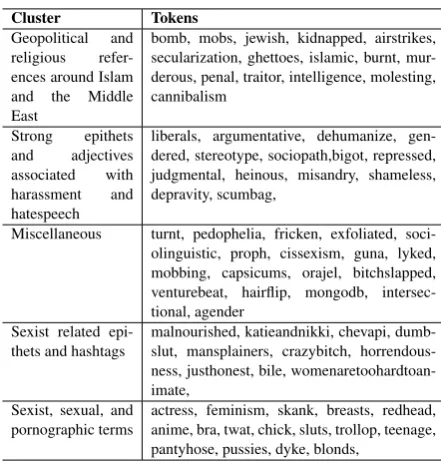
Since the bulk of our model’s weights are in the embedding and embedding-transformation matri-ces, we cluster the SR vocabulary using these transformed embeddings to clarify our intuitions about the model (8). We elaborate on our clus-tering approach in the supplement. We see that
5Focused on the SR Dataset (Waseem and Hovy,2016)
the model learned general semantic groupings of words associated with hate speech as well as spe-cific idiosyncrasies related to the dataset itself (e.g.
katieandnikki)
Cluster Tokens Geopolitical and religious refer-ences around Islam and the Middle East
bomb, mobs, jewish, kidnapped, airstrikes, secularization, ghettoes, islamic, burnt, mur-derous, penal, traitor, intelligence, molesting, cannibalism
Strong epithets and adjectives associated with harassment and hatespeech
liberals, argumentative, dehumanize, gen-dered, stereotype, sociopath,bigot, repressed, judgmental, heinous, misandry, shameless, depravity, scumbag,
Miscellaneous turnt, pedophelia, fricken, exfoliated, soci-olinguistic, proph, cissexism, guna, lyked, mobbing, capsicums, orajel, bitchslapped, venturebeat, hairflip, mongodb, intersec-tional, agender
Sexist related epi-thets and hashtags
malnourished, katieandnikki, chevapi, dumb-slut, mansplainers, crazybitch, horrendous-ness, justhonest, bile, womenaretoohardtoan-imate,
Sexist, sexual, and pornographic terms
[image:4.595.308.529.124.356.2]actress, feminism, skank, breasts, redhead, anime, bra, twat, chick, sluts, trollop, teenage, pantyhose, pussies, dyke, blonds,
Table 3: Projected Embedding Cluster Analysis from SR Dataset
7 Conclusion
Despite minimal tuning of hyper-parameters, fewer weight parameters, minimal text preprocess-ing, and no additional metadata, the model per-forms remarkably well on standard hate speech datasets. Our clustering analysis adds inter-pretability enabling inspection of results.
Our results indicate that the majority of recent deep learning models in hate speech may rely on word embeddings for the bulk of predictive power and the addition of sequence-based param-eters provide minimal utility. Sequence based ap-proaches are typically important when phenom-ena such as negation, co-reference, and context-dependent phrases are salient in the text and thus, we suspect these cases are in the minority for pub-licly available datasets. We think it would be valuable to study the occurrence of such linguistic phenomena in existing datasets and construct new datasets that have a better representation of sub-tle forms of hate speech. In the future, we plan to investigate character based representations, using character CNNs and highway layers (Kim et al.,
References
Thomas Davidson, Dana Warmsley, Michael Macy, and Ingmar Weber. 2017. Automated hate speech detection and the problem of offensive language.
arXiv preprint arXiv:1703.04009.
Kevin Drum. 2017. Twitter Is a Cesspool, But It’s Our Cesspool.Mother Jones.
Antigoni-Maria Founta, Despoina Chatzakou, Nico-las Kourtellis, Jeremy Blackburn, Athena Vakali, and Ilias Leontiadis. 2018. A unified deep learn-ing architecture for abuse detection. arXiv preprint arXiv:1802.00385.
Jennifer Golbeck, Zahra Ashktorab, Rashad O Banjo, Alexandra Berlinger, Siddharth Bhagwan, Cody Buntain, Paul Cheakalos, Alicia A Geller, Quint Gergory, Rajesh Kumar Gnanasekaran, et al. 2017. A large labeled corpus for online harassment re-search. In Proceedings of the 2017 ACM on Web Science Conference, pages 229–233. ACM.
Graham Hillard. 2018. Stop Complaining about Twit-ter — Just Leave It. National Review.
Matthew Honnibal and Mark Johnson. 2015. An im-proved non-monotonic transition system for depen-dency parsing. In Proceedings of the 2015 Con-ference on Empirical Methods in Natural Language Processing, pages 1373–1378, Lisbon, Portugal. As-sociation for Computational Linguistics.
Ian T Jolliffe. 1986. Principal component analysis and factor analysis. In Principal component analysis, pages 115–128. Springer.
Yoon Kim, Yacine Jernite, David Sontag, and Alexan-der M Rush. 2016. Character-aware neural language models. InAAAI, pages 2741–2749.
Issie Lapowsky. 2017. Trump faces lawsuit over his Twitter blocking habits. Wired.
Ji Ho Park and Pascale Fung. 2017. One-step and two-step classification for abusive language detection on twitter. CoRR, abs/1706.01206.
F. Pedregosa, G. Varoquaux, A. Gramfort, V. Michel, B. Thirion, O. Grisel, M. Blondel, P. Pretten-hofer, R. Weiss, V. Dubourg, J. Vanderplas, A. Pas-sos, D. Cournapeau, M. Brucher, M. Perrot, and E. Duchesnay. 2011. Scikit-learn: Machine learning in Python. Journal of Machine Learning Research, 12:2825–2830.
Jeffrey Pennington, Richard Socher, and Christo-pher D. Manning. 2014. Glove: Global vectors for word representation. InEmpirical Methods in Nat-ural Language Processing (EMNLP), pages 1532– 1543.
Stefan Riezler and John T Maxwell. 2005. On some pitfalls in automatic evaluation and significance test-ing for mt. InProceedings of the ACL workshop on
intrinsic and extrinsic evaluation measures for ma-chine translation and/or summarization, pages 57– 64.
Gerard Salton and Chris Buckley. 1987. Term weight-ing approaches in automatic text retrieval. Technical report, Cornell University.
Dinghan Shen, Guoyin Wang, Wenlin Wang, Mar-tin Renqiang Min, Qinliang Su, Yizhe Zhang, Ri-cardo Henao, and Lawrence Carin. 2018. On the use of word embeddings alone to represent natural language sequences.
Nitish Srivastava, Geoffrey Hinton, Alex Krizhevsky, Ilya Sutskever, and Ruslan Salakhutdinov. 2014. Dropout: A simple way to prevent neural networks from overfitting. The Journal of Machine Learning Research, 15(1):1929–1958.
Zeerak Waseem and Dirk Hovy. 2016. Hateful sym-bols or hateful people? predictive features for hate speech detection on twitter. In Proceedings of the NAACL student research workshop, pages 88–93.
A Supplemental Material
We experimented with several different prepro-cessing variants and were surprised to find that re-ducing preprocessing improved the performance on the task for all of our tasks. We go through each preprocessing variant with an example and then describe our analysis to compare and evalu-ate each of them.
A.1 Preprocessing
Original text
RT @AGuyNamed Nick Now, I’m not sexist in any way shape or form but I think women are better at gift wrapping. It’s the XX chromosome thing
Tokenize (Basic Tokenize: Keeps case and words intact with limited sanitizing)
RT @AGuyNamed Nick Now , I ’m not sexist in any way shape or form but I think women are better at gift wrapping . It ’s the XX chromosome thing
Tokenize Lowercase: Lowercase the basic tok-enize scheme
rt @aguynamed nick now , i ’m not sex-ist in any way shape or form but i think women are better at gift wrapping . it ’s the xx chromosome thing
Token Replace: Replaces entities and user names with placeholder)
ENT USER now , I ’m not sexist in any way shape or form but I think women are better at gift wrapping . It ’s the xx chromosome thing
Token Replace Lowercase: Lowercase the To-ken Replace Scheme
ENT USER now , i ’m not sexist in any way shape or form but i think women are better at gift wrapping . it ’s the xx chromosome thing
We did analysis on a validation set across mul-tiple datasets to find that the ”Tokenize” scheme was by far the best. We believe that keeping the case in tact provides useful information about the user. For example, saying something in all CAPS is a useful signal that the model can take advantage of.
Preprocessing Scheme Avg. Validation Loss Token Replace Lowercase 0.47
Token Replace 0.46
Tokenize 0.32
Tokenize Lowercase 0.40
Table 4: Average Validation Loss for each Preprocess-ing Scheme
A.2 In-Depth Results
Waseem2016 Ours
P R F1 P R F1
none 0.76 0.98 0.86 0.88 0.93 0.90 sexism 0.95 0.38 0.54 0.79 0.74 0.76 racism 0.85 0.30 0.44 0.86 0.72 0.78
0.74 0.86
Table 5: SR Results
Davidson2017 Ours
P R F1 P R F1
none 0.82 0.95 0.88 0.89 0.94 0.91 offensive 0.96 0.91 0.93 0.95 0.96 0.96 hate 0.44 0.61 0.51 0.61 0.41 0.49
0.90 0.924
Table 6: HATE Results
Method Prec Rec F1 Avg F1
Ours 0.713 0.206 0.319 0.711 LR Baseline 0.820 0.095 0.170 0.669
Table 7: HAR Results
A.3 Embedding Analysis
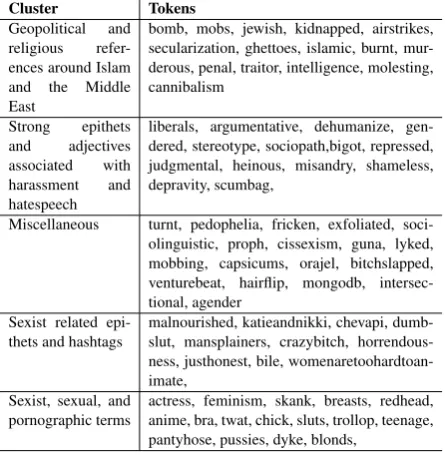
dimensions for each word and sorted by the sum in descending order to find the 1000 most salient word embeddings from our vocabulary. We then ran PCA (Jolliffe,1986) to reduce the dimension-ality of the projected embeddings from 300 dimen-sions to 75 dimendimen-sions. This captured about 60% of the variance. Finally, we ran K means cluster-ing fork= 5clusters to organize the most salient embeddings in the projected space.
The learned clusters from the SR vocabulary were very illuminating (see Table8); they gave in-sights to how hate speech surfaced in the datasets. One clear grouping we found is the misogynistic and pornographic group, which contained words likebreasts,blonds, andskank. Two other clusters had references to geopolitical and religious issues in the Middle East and disparaging and resentful epithets that could be seen as having an intellec-tual tone. This hints towards the subtle pedagogic forms of hate speech that surface.
We ran silhouette analysis (Pedregosa et al.,
2011) on the learned clusters to find that the clus-ters from the learned representations had a 35% higher silhouette coefficient using the projected embeddings compared to the clusters created from the original pre-trained embeddings. This rein-forces the claim that our training process pushed hate-speech related words together, and words from other clusters further away, thus, structuring the embedding space effectively for detecting hate speech.
Cluster Tokens Geopolitical and religious refer-ences around Islam and the Middle East
bomb, mobs, jewish, kidnapped, airstrikes, secularization, ghettoes, islamic, burnt, mur-derous, penal, traitor, intelligence, molesting, cannibalism
Strong epithets and adjectives associated with harassment and hatespeech
liberals, argumentative, dehumanize, gen-dered, stereotype, sociopath,bigot, repressed, judgmental, heinous, misandry, shameless, depravity, scumbag,
Miscellaneous turnt, pedophelia, fricken, exfoliated, soci-olinguistic, proph, cissexism, guna, lyked, mobbing, capsicums, orajel, bitchslapped, venturebeat, hairflip, mongodb, intersec-tional, agender
Sexist related epi-thets and hashtags
malnourished, katieandnikki, chevapi, dumb-slut, mansplainers, crazybitch, horrendous-ness, justhonest, bile, womenaretoohardtoan-imate,
Sexist, sexual, and pornographic terms
[image:7.595.74.297.502.730.2]actress, feminism, skank, breasts, redhead, anime, bra, twat, chick, sluts, trollop, teenage, pantyhose, pussies, dyke, blonds,