Framework of Semantic Role Assignment based on Extended Lexical
Conceptual Structure: Comparison with VerbNet and FrameNet
Yuichiroh Matsubayashi† Yusuke Miyao† Akiko Aizawa†
†, National Institute of Informatics, Japan
{y-matsu,yusuke,aizawa}@nii.ac.jp
Abstract
Widely accepted resources for semantic parsing, such as PropBank and FrameNet, are not perfect as a semantic role label-ing framework. Their semantic roles are not strictly defined; therefore, their mean-ings and semantic characteristics are un-clear. In addition, it is presupposed that a single semantic role is assigned to each syntactic argument. This is not necessarily true when we consider internal structures of verb semantics. We propose a new frame-work for semantic role annotation which solves these problems by extending the the-ory of lexical conceptual structure (LCS). By comparing our framework with that of existing resources, including VerbNet and FrameNet, we demonstrate that our ex-tended LCS framework can give a formal definition of semantic role labels, and that multiple roles of arguments can be repre-sented strictly and naturally.
1 Introduction
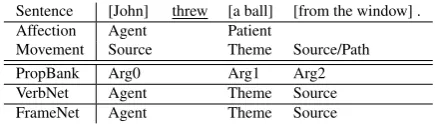
Recent developments of large semantic resources have accelerated empirical research on seman-tic processing (M`arquez et al., 2008). Specif-ically, corpora with semantic role annotations, such as PropBank (Kingsbury and Palmer, 2002) and FrameNet (Ruppenhofer et al., 2006), are in-dispensable resources for semantic role labeling. However, there are two topics we have to carefully take into consideration regarding role assignment frameworks: (1) clarity of semantic role meanings and (2) the constraint that a single semantic role is assigned to each syntactic argument.
While these resources are undoubtedly invalu-able for empirical research on semantic
process-Sentence [John] threw [a ball] [from the window] . Affection Agent Patient
[image:1.595.301.519.255.317.2]Movement Source Theme Source/Path PropBank Arg0 Arg1 Arg2 VerbNet Agent Theme Source FrameNet Agent Theme Source
Table 1: Examples of single role assignments with ex-isting resources.
ing, current usage of semantic labels for SRL sys-tems is questionable from a theoretical viewpoint. For example, most of the works on SRL have used PropBank’s numerical role labels (Arg0 to Arg5). However, the meanings of these numbers depend on each verb in principle and PropBank does not expect semantic consistency, namely on Arg2 to Arg5. Moreover, Yi et al. (2007) explic-itly showed that Arg2 to Arg5 are semantically inconsistent. The reason why such labels have been used in SRL systems is that verb-specific roles generally have a small number of instances and are not suitable for learning. However, it is necessary to avoid using inconsistent labels since those labels confuse machine learners and can be a cause of low accuracy in automatic process-ing. In addition, clarity of the definition of roles are particularly important for users to rationally know how to use each role in their applications. For this reasons, well-organized and generalized labels grounded in linguistic characteristics are needed in practice. Semantic roles of FrameNet and VerbNet (Kipper et al., 2000) are used more consistently to some extent, but the definition of the roles is not given in a formal manner and their semantic characteristics are unclear.
Another somewhat related problem of existing annotation frameworks is that it is presupposed
that a single semantic role is assigned to each syn-tactic argument.1In fact, one syntactic argument can play multiple roles in the event (or events) ex-pressed by a verb. For example, Table 1 shows a sentence containing the verb “throw” and seman-tic roles assigned to its arguments in each frame-work. The table shows that each framework as-signs a single role, such as Arg0 and Agent, to each syntactic argument. However, we can ac-quire information from this sentence that John is an agent of the throwing event (the “Affec-tion” row), as well as a source of the movement event of the ball (the “Movement” row). Existing frameworks of assigning single roles simply ig-nore such information that verbs inherently have in their semantics. We believe that giving a clear definition of multiple argument roles would be beneficial not only as a theoretical framework but also for practical applications that require detailed meanings derived from secondary roles.
This issue is also related to fragmentation and the unclear definition of semantic roles in these frameworks. As we exemplify in this paper, mul-tiple semantic characteristics are conflated in a single role label in these resources due to the man-ner of single-role assignment. This means that se-mantic roles of existing resources are not mono-lithic and inherently not mutually independent, but they share some semantic characteristics.
The aim of this paper is more on theoreti-cal discussion for role-labeling frameworks rather than introducing a new resource. We developed a framework of verb lexical semantics, which is an extension of the lexical conceptual structure (LCS) theory, and compare it with other exist-ing frameworks which are used in VerbNet and FrameNet, as an annotation scheme of SRL. LCS is a decomposition-based approach to verb se-mantics and describes a meaning by composing a set of primitive predicates. The advantage of this approach is that primitive predicates and their compositions are formally defined. As a result, we can give a strict definition of semantic roles by grounding them to lexical semantic structures of verbs. In fact, we define semantic roles as ar-gument slots in primitive predicates. With this
ap-1
To be precise, FrameNet permits multiple-role assign-ment, while it does not perform this systematically as we show in Table 1. It mostly defines a single role label for a corresponding syntactic argument, that plays multiple roles in several sub-events in a verb.
proach, we demonstrate that some sort of seman-tic characterisseman-tics that VerbNet and FrameNet in-formally/implicitly describe in their roles can be given formal definitions and that multiple argu-ment roles can be represented strictly and natu-rally by extending the LCS theory.
In the first half of this paper, we define our ex-tended LCS framework and describe how it gives a formal definition of roles and solves the problem of multiple roles. In the latter half, we discuss the analysis of the empirical data we collected for 60 Japanese verbs and also discuss theoreti-cal relationships with the frameworks of existing resources. We discuss in detail the relationships between our role labels and VerbNet’s thematic roles. We also describe the relationship between our framework and FrameNet, with regards to the definitions of the relationships between semantic frames.
2 Related works
There have been several attempts in linguistics to assign multiple semantic properties to one ar-gument. Gruber (1965) demonstrated the dis-pensability of the constraint that an argument takes only one semantic role, with some concrete examples. Rozwadowska (1988) suggested an approach of feature decomposition for semantic roles using her three features of change, cause, and sentient, and defined typical thematic roles by combining these features. This approach made it possible for us to classify semantic properties across thematic roles. However, Levin and Rap-paport Hovav (2005) argued that the number of combinations using defined features is usually larger than the actual number of possible com-binations; therefore, feature decomposition ap-proaches should predict possible feature combi-nations.
com-2 6 6
4cause(affect(i,j), go(j, 2 6 4
from(locate(in(i))) fromward(locate(at(k))) toward(locate(at(l)))
3 7 5))
3 7 7 5
Figure 1: LCS of the verbthrow.
binations of roles by taking a role from each set. Dorr (1997) created an LCS-based lexical re-source as an interlingual representation for ma-chine translation. This framework was also used for text generation (Habash et al., 2003). How-ever, the problem of multiple-role assignment was not completely solved on the resource. As a comparison of different semantic structures, Dorr (2001) and Hajiˇcov´a and Kuˇcerov´a (2002) ana-lyzed the connection between LCS and PropBank roles, and showed that the mapping between LCS and PropBank roles was many to many correspon-dence and roles can map only by comparing a whole argument structure of a verb. Habash and Dorr (2001) tried to map LCS structures into the-matic roles by using their thethe-matic hierarchy.
3 Multiple role expression using lexical
conceptual structure
Lexical conceptual structure is an approach to de-scribe a generalized structure of an event or state represented by a verb. A meaning of a verb is rep-resented as a structure composed of several prim-itive predicates. For example, the LCS structure for the verb “throw” is shown in Figure 1 and includes the predicates cause, affect, go, from,
fromward, toward, locate, in, and at. The argu-ments of primitive predicates are filled by core ar-guments of the verb. This type of decomposition approach enables us to represent a case that one syntactic argument fills multiple slots in the struc-ture. In Figure 1, the argumentiappears twice in the structure: as the first argument of affectand the argument infrom.
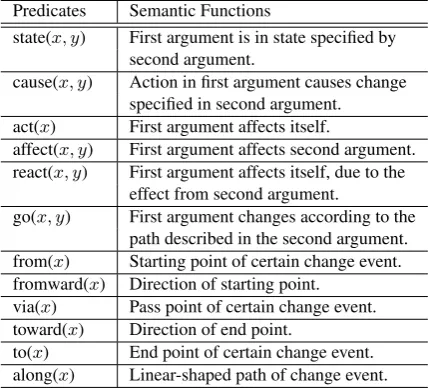
The primitives are designed to represent a full or partial action-change-state chain, which con-sists of a state, a change in or maintaining of a state, or an action that changes/maintains a state. Table 2 shows primitives that play important roles to represent that chain. Some primitives embed other primitives as their arguments and the seman-tics of the entire structure of an LCS structure is calculated according to the definition of each primitive. For instance, the LCS structure in
Fig-Predicates Semantic Functions
state(x, y) First argument is in state specified by second argument.
cause(x, y) Action in first argument causes change specified in second argument. act(x) First argument affects itself.
affect(x, y) First argument affects second argument. react(x, y) First argument affects itself, due to the
effect from second argument.
go(x, y) First argument changes according to the path described in the second argument. from(x) Starting point of certain change event. fromward(x) Direction of starting point.
via(x) Pass point of certain change event. toward(x) Direction of end point.
[image:3.595.303.519.72.267.2]to(x) End point of certain change event. along(x) Linear-shaped path of change event.
Table 2: Major primitive predicates and their semantic functions.
ure 1 represents the action changing the state ofj. The inner structure of the second argument ofgo
represents the path of the change.
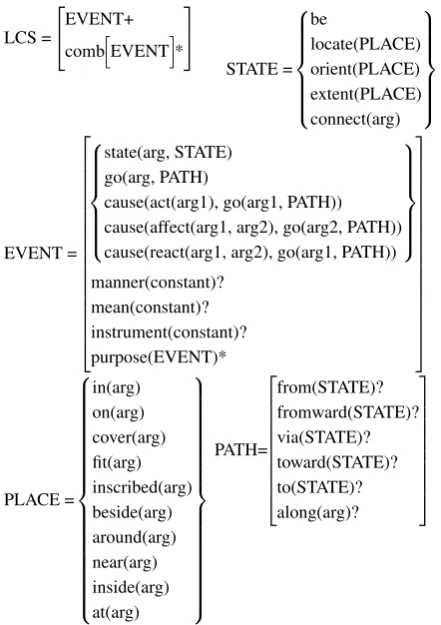
The overall definition of our extended LCS framework is shown in Figure 2.2 Basically, our definition is based on Jackendoff’s LCS frame-work (1990), but performed some simplifications and added extensions. The modification is per-formed in order to increase strictness and gen-erality of representation and also a coverage for various verbs appearing in a corpus. The main differences between the two LCS frameworks are as follows. In our extended LCS framework, (i) the possible combinations of cause, act, affect, react, and go are clearly restricted, (ii) multiple actions or changes in an event can be described by introducing acombinationfunction (comb for short), (iii)GO,STAYandINCH in Jackendoff’s theory are incorporated into one functiongo, and (iv) most of thechange-of-stateevents are repre-sented as a metaphor using a spatial transition.
The idea of acombfunction comes from a nat-ural extension of Jackendoff’s EXCH function. In our case, comb is not limited to describing a counter-transfer of the main event but can de-scribe subordinate events occurring in relation to the main event.3 We can also describe multiple
2
Here we omitted the attributes taken by each predicate, in order to simplify the explanation. We also omitted an explanation for lower level primitives, such as STATE and PLACE groups, which are not necessarily important for the topic of this paper.
3
LCS = 2 4EVENT+ comb h EVENT i * 3 5 STATE = 8 > > > > > < > > > > > : be locate(PLACE) orient(PLACE) extent(PLACE) connect(arg) 9 > > > > > = > > > > > ; EVENT = 2 6 6 6 6 6 6 6 6 6 6 6 6 6 6 6 6 4 8 > > > > > < > > > > > : state(arg, STATE) go(arg, PATH)
cause(act(arg1), go(arg1, PATH)) cause(affect(arg1, arg2), go(arg2, PATH)) cause(react(arg1, arg2), go(arg1, PATH))
9 > > > > > = > > > > > ; manner(constant)? mean(constant)? instrument(constant)? purpose(EVENT)* 3 7 7 7 7 7 7 7 7 7 7 7 7 7 7 7 7 5 PLACE = 8 > > > > > > > > > > > > > > > > > < > > > > > > > > > > > > > > > > > : in(arg) on(arg) cover(arg) fit(arg) inscribed(arg) beside(arg) around(arg) near(arg) inside(arg) at(arg) 9 > > > > > > > > > > > > > > > > > = > > > > > > > > > > > > > > > > > ; PATH= 2 6 6 6 6 6 6 6 6 4 from(STATE)? fromward(STATE)? via(STATE)? toward(STATE)? to(STATE)? along(arg)? 3 7 7 7 7 7 7 7 7 5
Figure 2: Description system of our LCS. Operators +,∗,?follow the basic regular expression syntax. {} represents a choice of the elements.
main events if the agent does more than two ac-tions simultaneously and all the acac-tions are the focus (e.g., John exchanges A with B). This ex-tension is simple, but essential for creating LCS structures of predicates appearing in actual data. In our development of 60 Japanese predicates (verb and verbal noun) frequently appearing in Kyoto University Text Corpus (KTC) (Kurohashi and Nagao, 1997) ,37.6% of the frames included multiple events. By using thecombfunction, we can express complicated events with predicate de-composition and prevent missing (multiple) roles. A key point for associating LCS framework with the existing frameworks of semantic roles is that each primitive predicate of LCS represents a fundamental function in semantics. The
func-events in the semantic structure of a verb. However, gener-ally, a verb focuses on one of those events and this makes a semantic variation among verbs such as buy, sell, and pay as well as difference of syntactic behavior of the arguments. Therefore, focused event should be distinguished from the others as lexical information. We expressed focused events as main formulae (formulae that are not surrounded by a combfunction).
Role Description
Protagonist Entity which is viewpoint of verb. Theme Entity in which its state or change of state
is mentioned.
State Current state of certain entity. Actor Entity which performs action that
changes/maintains its state. Effector Entity which performs action that
changes/maintains a state of another entity. Patient Entity which is changed/maintained its
state by another entity.
Stimulus Entity which is cause of the action. Source Starting point of certain change event. Source dir Direction of starting point.
Middle Pass point of certain change event. Goal End point of certain change event. Goal dir Direction of end point.
[image:4.595.70.291.69.382.2]Route Linear-shaped path of certain change event.
Table 3: Semantic role list for proposing extended LCS framework.
[image:4.595.303.523.72.280.2]Predicate 1st arg 2nd arg
state Theme State
act Actor –
affect Effector Patient
react Actor Stimulus
go Theme PATH
from Source –
fromward Source dir –
via Middle –
toward Goal dir –
to Goal –
[image:5.595.105.255.70.214.2]along Route –
Table 4: Correspondence between semantic roles and arguments of LCS primitives
this number is comparatively smaller than that in VerbNet. The discussion with regard to this num-ber is described in the next section.
Essentially, the semantic functions of the ar-guments in LCS primitives are similar to those of traditional, or basic, thematic roles. However, there are two important differences. Our extended LCS framework principally guarantees that the primitive predicates do not contain any informa-tion concerning (i) selecinforma-tional preference and (ii) complex structural relation of arguments. Primi-tives are designed to purely represent a function in anaction-change-statechain, thus the informa-tion of selecinforma-tional preference is annotated to a dif-ferent layer; specifically, it is directly annotated to core arguments (e.g., we can annotateiwith sel-Pref(animate∨organization) in Figure 1). Also, the semantic function is already decomposed and the structural relation among the arguments is resented as a structure of primitives in LCS rep-resentation. Therefore, each argument slot of the primitive predicates does not include compli-cated meanings and represents a primitive seman-tic property which is highly functional. These characteristics are necessary to ensure clarity of the semantic role meanings. We believe that even though there surely exists a certain type of com-plex semantic role, it is reasonable to represent that role based on decomposed properties.
In order to show an instance of our extended LCS theory, we constructed a dictionary of LCS structures for60Japanese verbs (including event nouns) using our extended LCS framework. The
60verbs were the most frequent verbs in KTC af-ter excluding 100 most frequent ones.4 We
cre-4
We omitted top 100 verbs since these most frequent ones
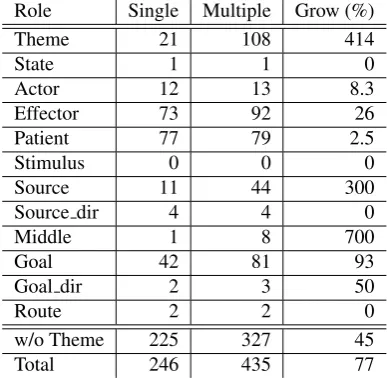
Role Single Multiple Grow (%)
Theme 21 108 414
State 1 1 0
Actor 12 13 8.3
Effector 73 92 26
Patient 77 79 2.5
Stimulus 0 0 0
Source 11 44 300
Source dir 4 4 0
Middle 1 8 700
Goal 42 81 93
Goal dir 2 3 50
Route 2 2 0
w/o Theme 225 327 45
Total 246 435 77
Table 5: Number of appearances of each role
ated the dictionary looking at the instances of the target verbs in KTC. To increase the cover-age of senses and case frames, we also consulted the online Japanese dictionary Digital Daijisen5
and Kyoto university case frames (Kawahara and Kurohashi, 2006) which is a compilation of case frames automatically acquired from a huge web corpus. There were97constructed frames in the dictionary.
Then we analyzed how many roles are addi-tionally assigned by permitting multiple role as-signment (see Table 5). The numbers of assigned roles for single role are calculated by counting roles that appear first for each target argument in the structure. Table 5 shows that the total number of assigned roles is1.77times larger than single-role assignment. The main reason is an increase in
Theme. For single-role assignment,Theme, in our sense, in action verbs is always duplicated with
Actor/Patient. On the other hand, LCS strictly divides a function for action and change; there-fore the duplicatedThemeis correctly annotated. Moreover, we obtained a45% increase even when we did not count duplicatedTheme. Most of in-crease are a result from the inin-crease in Source
andGoal. For example,Effectorsof transmission verbs are also annotated with aSource, and Effec-torsof movement verbs are sometimes annotated withSourceorGoal.
contain a phonogram form (Hiragana form) of a certain verb written with Kanji characters, and that phonogram form gen-erally has a huge ambiguity because many different verbs have same pronunciation in Japanese.
5
[image:5.595.313.507.72.261.2]Resource Frame-independent # of roles
LCS yes 13
VerbNet (v3.1) yes 30
[image:6.595.75.289.72.125.2]FrameNet (r1.4) no 8884
Table 6: Number of roles in each resource.
4 Comparison with other resources
4.1 Number of semantic roles
The number of roles is related to the number of se-mantic properties represented in a framework and to the generality of that property. Table 6 lists the number of semantic roles defined in our extended LCS framework, VerbNet and FrameNet.
There are two ways to define semantic roles. One isframe specific, where the definition of each role depends on a specific lexical entry and such a role is never used in the other frames. The other isframe independent, which is to construct roles whose semantic function is generalized across all verbs. The number of roles in FrameNet is comparatively large because it defines roles in a frame-specific way. FrameNet respects individual meanings of arguments rather than generality of roles.
Compared with VerbNet, the number of roles defined in our extended LCS framework is less than half. However, this fact does not mean that the representation ability of our framework is lower than VerbNet. We manually checked and listed a corresponding representation in our ex-tended LCS framework for each thematic role in VerbNet in Table 6. This table does not provide a perfect or complete mapping between the roles in these two frameworks because the mappings are not based on annotated data. However, we can roughly say that the VerbNet roles combine three types of information, a function of the argument in the action-change-state chain, selectional pref-erence, and structural information of arguments, which are in different layers in LCS representa-tion. VerbNet has many roles whose functions in the action-change-state chain are duplicated. For example,Destination, Recipient, andBeneficiary
have the same propertyend-state (Goalin LCS) of a changing event. The difference between such roles comes from a specific sub-type of a chang-ing event (possession), selectional preference, and structural information among the arguments. By distinguishing such roles, VerbNet roles may take
into account specific syntactic behaviors of cer-tain semantic roles. Packing such complex infor-mation to semantic roles is useful for analyzing argument realization. However, from the view-point of semantic representation, the clarity for semantic properties provided using a predicate de-composition approach is beneficial. The 13 roles for the LCS approach is sufficient for obtaining a function in the action-change-state chain. In our LCS framework, selectional preference can be assigned to arguments in an individual verb or verb class level instead of role labels themselves to maintain generality of semantic functions. In addition, our extended LCS framework can easily separate complex structural information from role labels because LCS directly represents a structure among the arguments. We can calculate the infor-mation from the LCS structure instead of coding it into role labels. As a result, our extended LCS framework maintains generality of roles and the number of roles is smaller than other frameworks.
4.2 Clarity of role meanings
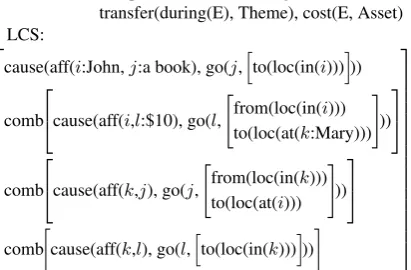
We showed that an approach of predicate decom-position used in LCS theory clarified role mean-ings assigned to syntactic arguments. Moreover, LCS achieves high generality of roles by separat-ing selectional preference or structural informa-tion from role labels. The complex meaning of one syntactic argument is represented by multi-ple appearances of the argument in an LCS struc-ture. For example, we show an LCS structure and a frame in VerbNet with regard to the verb “buy” in Figure 3. The LCS structure consists of four formulae. The first one is the main for-mula and the others are sub-forfor-mulae that rep-resent co-occurring actions. The semantic-role-like representation of the structure is given in Ta-ble 4:i={Protagonist,Effector, Source,Goal},
j ={Patient,Theme}, k ={Effector,Source,
Goal}, and l ={Patient,Theme}. Selectional preference is annotated to each argument as i: selPref(animate∨organization),j: selPref(any), k: selPref(animate ∨ organization), and l: sel-Pref(valuable entity). If we want to represent the information, such as “Sourceof what?”, then we can extend the notation asSource(j)to refer to a changing object.
VerbNet role (# of uses) Representation in LCS
Actor (9), Actor1 (9), Actor2 (9) Actor or Effector in symmetric formulas in the structure Agent (212) (Actor∨Effector)∧Protagonist
Asset (6) Theme∧Source of the change is (locate(in())∧Protagonist)∧ selPref(valuable entity)
Beneficiary (9) (peripheral role∨(Goal∧locate(in())))∧selPref(animate∨organization) ∧ ¬(Actor∨Effector)∧a transferred entity is something beneficial
Cause (21) ((Effector∧selPref(¬animate∧ ¬organization))∨Stimulus∨peripheral role)
Destination (32) Goal
Experiencer (24) Actor of react()
Instrument (25) ((Effector∧selPref(¬animate∧ ¬organization))∨peripheral role) Location (45) (Theme∨PATH roles∨peripheral role)∧selPref(location)
Material (6) Theme∨Source of a change∧The Goal of the change is locate(fit())∧ the Goal fullfills selPref(physical object)
Patient (59), Patient 1(11) Patient∨Theme
Patient2 (11) (Source∨Goal)∧connect()
Predicate (23) Theme∨(Goal∧locate(fit()))∨peripheral role Product (7) Theme∨(Goal∧locate(fit())∧selPref(physical object))
Proposition (11) Theme
Recipient (33) Goal∧locate(in())∧selPref(animate∨organization)
Source (34) Source
Theme (162) Theme
[image:7.595.83.510.73.347.2]Theme1 (13), Theme2 (13) Both of the two is Theme∨Theme1 is Theme and Theme2 is State Topic (18) Theme∧selPref(knowledge∨infromation)
Table 7: Relationship of roles between VerbNet and our LCS framework. VerbNet roles that appears more than five times in frame definition are analyzed. Each relationship shown here is only a partial and consistent part of the complete correspondence table. Note that complete table of mapping highly depends on each lexical entry (or verb class). Here, locate(in()) generally means possession or recognizing.
roles depends more on selectional preference or the structure of the arguments than a primitive function in the action-change-state chain. Such VerbNet roles are used for several different func-tions depending on verbs and their alternafunc-tions, and it is therefore difficult to capture decomposed properties from the role label without having spe-cific lexical knowledge. Moreover, some seman-tic functions, such as Mary is aGoalof the money in Figure 3, are completely discarded from the representation at the level of role labels.
There is another representation related to the argument meanings in VerbNet. This representa-tion is a type of predicate decomposirepresenta-tion using its original set of predicates, which are referred to as
semantic predicates. For example, the verb “buy” in Figure 3 has the predicates has possession,
transfer andcost for composing the meaning of its event structure. The thematic roles are fillers of the predicates’ arguments, thus the semantic predicates may implicitly provide additional func-tions to the roles and possibly represent multiple roles. Unfortunately, we cannot discover what each argument of the semantic predicates exactly means since the definition of each predicate is not
Example: “John bought a book from Mary for $10.” VerbNet: Agent V Theme{from}Source{for}Asset.
has possession(start(E), Source, Theme), has possession(end(E), Agent, Theme), transfer(during(E), Theme), cost(E, Asset) LCS:
2 6 6 6 6 6 6 6 6 6 6 6 6 6 6 6 4
cause(aff(i:John,j:a book), go(j,
h
to(loc(in(i)))
i
))
comb
2
4cause(aff(i,l:$10), go(l,
"
from(loc(in(i))) to(loc(at(k:Mary)))
#
))
3 5
comb
2
4cause(aff(k,j), go(j,
"
from(loc(in(k))) to(loc(at(i)))
#
))
3 5
comb
»
cause(aff(k,l), go(l,hto(loc(in(k)))i))
–
3 7 7 7 7 7 7 7 7 7 7 7 7 7 7 7 5
Figure 3: Comparison between the semantic predicate representation and the LCS structure of the verbbuy.
publicly available. A requirement for obtaining implicit semantic functions from these semantic predicates is clearly defining how the roles (or functions) are calculated from these complex re-lations of semantic predicates.
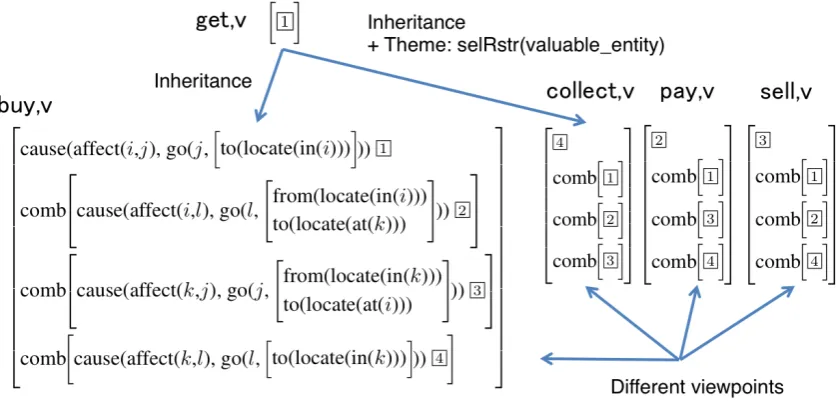
[image:7.595.305.511.479.614.2]seman-i: selPref(animate∨organization),j: selPref(any),k: selPref(animate∨organization),l: selPref(valuable entity)
Figure 4: LCS of the verbsget,buy,sell,pay, andcollectand their relationships calculated from the structures.
tic properties of roles using a predicate decom-position approach, but defines specific roles for each conceptual event/state to represent a specific background of the roles in the event/state. How-ever, at the same time, FrameNet defines several types of parent-child relations between most of the frames and between their roles; therefore, we may say FrameNet implicitly describes a sort of decomposed property using roles in highly gen-eral or abstract frames and represents the inher-itance of these semantic properties. One advan-tage of this approach is that the inheritance of a meaning between roles is controlled through the relations, which are carefully maintained by hu-man efforts, and is not restricted by the represen-tation ability of the decomposition system. On the other hand, the only way to represent generalized properties of a certain semantic role is enumerat-ing all inherited roles by tracenumerat-ing ancestors. Also, a semantic relation between arguments in a cer-tain frame, which is given by LCS structure and semantic predicates of VerbNet, is only defined by a natural language description for each frame in FrameNet. From a CL point of view, we con-sider that, at least, a certain level of formalization of semantic relation of arguments is important for utilize this information for application. LCS ap-proach, or an approach using a well-defined pred-icate decomposition, can explicitly describe se-mantic properties and relationships between
argu-Figure 5: The frame relations among the verbs get,
buy,sell,pay, andcollectin FrameNet.
ments in a lexical structure. The primitive proper-ties can be clearly defined, even though the repre-sentation ability is restricted under the generality of roles.
[image:8.595.308.511.358.437.2]they contain exactly the same formulae, and the only difference is the main formula. The rela-tion between “buy” and “get” is defined as in-heritance; a part of the child structure exactly equals the parent structure. Interestingly, the re-lations surrounding the “buy” are similar to those in FrameNet (see Figure 5). We cannot describe all types of the relations we considered due to space limitations. However, the point is that these relationships are represented as rewriting rules between the two LCS representations and thus they are automatically calculated. Moreover, the grounds for relations maintain clarity based on concrete structural relations. A semantic relation construction of frames based on structural rela-tionships is another possible application of LCS approaches that connects traditional LCS theo-ries with resources representing a lexical network such as FrameNet.
4.3 Consistency on semantic structures
Constructing a LCS dictionary is generally a dif-ficult work since LCS has a high flexibility for describing structures and different people tend to write different structures for a single verb. We maintained consistency of the dictionary by tak-ing into account a similarity of the structures be-tween the verbs that are in paraphrasing or entail-ment relations. This idea was inspired by auto-matic calculation of semantic relations of lexicon as we mentioned above. We created a LCS struc-ture for each lexical entry as we can calculate se-mantic relations between related verbs and main-tained high-level consistency among the verbs.
Using our extended LCS theory, we success-fully created97frames for60predicates without any extra modification. From this result, we be-lieve that our extended theory is stable to some extent. On the other hand, we found that an extra extension of the LCS theory is needed for some verbs to explain the different syntactic behaviors of one verb. For example, a condition for a cer-tain syntactic behavior of a verb related to re-ciprocal alteration (see class 2.5 of Levin (Levin, 1993)) such asつながる(connect) and統一 (in-tegrate) cannot be explained without considering the number of entities in some arguments. Also, some verbs need to define an order of the internal events. For example, the Japanese verb 往復す
る(shuttle) means that going is a first action and coming back is a second action. These are not
the problems that are directly related to a seman-tic role annotation on that we focus in this paper, but we plan to solve these problems with further extensions.
5 Conclusion
We discussed the two problems in current labeling approaches for argument-structure analysis: the problems in clarity of role meanings and multiple-role assignment. By focusing on the fact that an approach of predicate decomposition is suitable for solving these problems, we proposed a new framework for semantic role assignment by ex-tending Jackendoff’s LCS framework. The statis-tics of our LCS dictionary for 60 Japanese verbs showed that37.6% of the created frames included multiple events and the number of assigned roles for one syntactic argument increased 77% from that in single-role assignment.
Compared to the other resources such as Verb-Net and FrameVerb-Net, the role definitions in our ex-tended LCS framework are clearer since the prim-itive predicates limit the meaning of each role to a function in theaction-change-state chain. We also showed that LCS can separate three types of information, the functions represented by primi-tives, the selectional preference and structural re-lation of arguments, which are conflated in role la-bels in existing resources. As a potential of LCS, we demonstrated that several types of frame re-lations, which are similar to those in FrameNet, are automatically calculated using the structural relations between LCSs. We still must perform a thorough investigation for enumerating relations which can be represented in terms of rewriting rules for LCS structures. However, automatic construction of a consistent relation graph of se-mantic frames may be possible based on lexical structures.
We believe that this kind of decomposed analy-sis will accelerate both fundamental and applica-tion research on argument-structure analysis. As a future work, we plan to expand the dictionary and construct a corpus based on our LCS dictionary.
Acknowledgment
References
P.W. Culicover and W.K. Wilkins. 1984. Locality in linguistic theory. Academic Press.
Bonnie J. Dorr. 1997. Large-scale dictionary con-struction for foreign language tutoring and inter-lingual machine translation. Machine Translation, 12(4):271–322.
Bonnie J. Dorr. 2001. Lcs database. http://www. umiacs.umd.edu/˜bonnie/LCS Database Document ation.html.
Jeffrey S Gruber. 1965. Studies in lexical relations. Ph.D. thesis, MIT.
N. Habash and B. Dorr. 2001. Large scale language independent generation using thematic hierarchies. InProceedings of MT summit VIII.
N. Habash, B. Dorr, and D. Traum. 2003. Hybrid natural language generation from lexical conceptual structures. Machine Translation, 18(2):81–128. Eva Hajiˇcov´a and Ivona Kuˇcerov´a. 2002.
Argu-ment/valency structure in propbank, lcs database and prague dependency treebank: A comparative pilot study. In Proceedings of the Third Inter-national Conference on Language Resources and Evaluation (LREC 2002), pages 846–851.
Ray Jackendoff. 1990.Semantic Structures. The MIT Press.
D. Kawahara and S. Kurohashi. 2006. Case frame compilation from the web using high-performance computing. In Proceedings of LREC-2006, pages 1344–1347.
Paul Kingsbury and Martha Palmer. 2002. From Tree-bank to PropBank. InProceedings of LREC-2002, pages 1989–1993.
Karin Kipper, Hoa Trang Dang, and Martha Palmer. 2000. Class-based construction of a verb lexicon. InProceedings of the National Conference on Arti-ficial Intelligence, pages 691–696. Menlo Park, CA; Cambridge, MA; London; AAAI Press; MIT Press; 1999.
Sadao Kurohashi and Makoto Nagao. 1997. Kyoto university text corpus project. Proceedings of the Annual Conference of JSAI, 11:58–61.
Beth Levin and Malka Rappaport Hovav. 2005. Argu-ment realization. Cambridge University Press. Beth Levin. 1993. English verb classes and
alter-nations: A preliminary investigation. University of Chicago Press.
Llu´ıs M`arquez, Xavier Carreras, Kenneth C. Litkowski, and Suzanne Stevenson. 2008. Se-mantic role labeling: an introduction to the special issue.Computational linguistics, 34(2):145–159. B. Rozwadowska. 1988. Thematic restrictions on
de-rived nominals. In W Wlikins, editor, Syntax and Semantics, volume 21, pages 147–165. Academic Press.
J. Ruppenhofer, M. Ellsworth, M.R.L. Petruck, C.R. Johnson, and J. Scheffczyk. 2006. FrameNet II: Extended Theory and Practice. Berkeley FrameNet Release, 1.
Szu-ting Yi, Edward Loper, and Martha Palmer. 2007. Can semantic roles generalize across genres? In