2509
Target-oriented Opinion Words Extraction with Target-fused Neural
Sequence Labeling
Zhifang Fan, Zhen Wu, Xin-Yu Dai∗, Shujian Huang, Jiajun Chen
National Key Laboratory for Novel Software Technology, Nanjing University, Nanjing, 210023, China
{fanzf,wuz}@nlp.nju.edu.cn;{daixinyu,huangsj,chenjj}@nju.edu.cn
Abstract
Opinion target extraction and opinion words extraction are two fundamental subtasks in As-pect Based Sentiment Analysis (ABSA). Re-cently, many methods have made progress on these two tasks. However, few works aim at extracting opinion targets and opinion words as pairs. In this paper, we propose a novel sequence labeling subtask for ABSA named TOWE (Target-oriented Opinion Words Ex-traction), which aims at extracting the corre-sponding opinion words for a given opinion target. A target-fused sequence labeling neu-ral network model is designed to perform this task. The opinion target information is well encoded into context by an Inward-Outward LSTM. Then left and right contexts of the opin-ion target and the global context are combined to find the corresponding opinion words. We build four datasets for TOWE based on several popular ABSA benchmarks from laptop and restaurant reviews. The experimental results show that our proposed model outperforms the other compared methods significantly. We be-lieve that our work may not only be helpful for downstream sentiment analysis task, but can also be used for pair-wise opinion summariza-tion.
1 Introduction
Sentiment analysis, also known as opinion min-ing (Pang and Lee,2007;Liu,2012), has drawn increasing attention of researchers and industries in recent years. It can provide valuable information from user-generated reviews. However, sentiment analysis at sentence level or document level some-times cannot provide more detailed information, thus a finer-grained task, Aspect-Based Sentiment Analysis (ABSA) (Pontiki et al.,2014), is proposed to identify the opinions of a specific target or aspect
∗
Corresponding author.
Review:
“My friends and I were on vacation in NY and was referred to Chance by a friend. I found the foodto be outstanding, particularly the salmon dishI had. I also ordered the Change Mojito, which was out of this world. My friends settled for rice dishes, but we came back the following day to try the
dim sum, which was not outstanding, but good. We ate out in the back patio, which is worthit as it's cooland the musicis
hear well there. Overall, excellentrestaurant!”
The list of extracted targets and opinion words as pairs:
• food : [outstanding]
• salmon dish : [outstanding] • Change Mojito : [out of this world]
• dim sum : [not outstanding,good]
• back patio : [worth,cool]
• music : [hear well]
• restaurant : [excellent]
Figure 1: The upper part is a restaurant review and the lower part shows the pairs of extracted opinion targets (in red) and opinion words (in blue).
in reviews. ABSA consists of multiple subtasks in-cluding aspect category detection, opinion target extraction, aspect level sentiment classification etc. Opinion target extraction (OTE) and opinion words extraction (OWE) are two such fundamental sub-tasks. Opinion targets, sometimes called aspect terms, are the words or phrases in the sentence rep-resenting features or entities towards which users show attitude. Opinion words (or opinion terms) refer to those terms used to express attitude explic-itly. For example, in the sentence “The menu is limited but almost all of the dishes are excellent.”, the words “menu” and “dishes” are two opinion targets, and the words “limited” and “excellent” are opinion words. More examples can be found in the upper part of Figure1.
Li and Lam,2017). However, the extracted opin-ion targets and opinopin-ion words are not in pairs and the correspondence is not extracted. For in-stance, in the example sentence, hmenu:limitedi
andhdishes:excellentiare two opinion pairs. Ob-viously, extracting them as pairs is significant for ABSA. Additionally, in Figure1, the list of pairs ex-tracted from the example review can be considered to be an extractive pair-wise opinion summariza-tion.
Considering the significance of the pairs in re-views and promising results of targets extraction in previous works, in this paper, we propose a new subtask for ABSA namedTOWE(Target-oriented Opinion Words Extraction). Given a review and a target in the review, the objective of TOWE is to extract the corresponding opinion words describ-ing or evaluatdescrib-ing the target from the review. Then, TOWE can form pairs of the given target and its corresponding opinion words.
Motivated by the success of neural networks in natural language processing, we design a powerful sequence labeling neural network model to per-form TOWE. The task TOWE aims to extract the target-oriented opinion terms. In the same review, for different targets, the model needs to output dif-ferent results. Therefore, a core challenge is the learning of target-specific context representations. We design a neural encoder to incorporate target in-formation and generate the target-fused context. To be specific, we propose an Inward-Outward LSTM to pass target information to the left context and the right context of the target respectively. Then we combine the left, right and global context to encode the sentence and make sequence labeling. It is essential and reasonable to formulate TOWE as a sequence labeling task because some opinion terms include several words and one opinion target may correspond to multiple opinion terms. We try two different decoding strategies in the experiment. Our main contributions are summarized as fol-lows:
• We propose a sequence labeling subtask for ABSA: TOWE (Target-oriented Opinion Words Extraction), which can offer assistance and interpretability for downstream tasks in ABSA.
• We design a novel sequence labeling neural network model to perform TOWE. It can gen-erate target-specific context representations for different targets in the same review.
• We build four datasets from different domains serving as a benchmark for future works. We conduct extensive experiments on these datasets, and the results show that our model could significantly exceed a variety of base-lines.
We release the datasets and our source code at
https://github.com/NJUNLP/TOWE
2 Related works
A lot of works have been carried out for Opin-ion Targets ExtractOpin-ion. TraditOpin-ional methods can be categorized into unsupervised/semi-supervised methods (Hu and Liu,2004;Zhuang et al.,2006; Qiu et al.,2011) and supervised methods (Jakob and Gurevych,2010;Shu et al.,2017). Recently, deep learning methods have also made progress in this task.Liu et al.(2015) apply a recurrent neu-ral network with pre-trained word emebddings to solve this task.Yin et al.(2016) exploit a CRF with dependency-paths enhanced word embeddings for aspect term extraction. Poria et al.(2016) use a deep convolutional neural network (CNN) and Xu et al.(2018) propose a CNN model with double embeddings.
Some works extract the targets and opinion words jointly as a co-extraction strategy. Qiu et al. (2011) propose double propagation to ex-pand opinion targets and opinion words lists in a bootstrapping way.Liu et al.(2013) extract the tar-gets and opinion words jointly with modeling the relation from a statistical word alignment model. This co-extraction strategy can also be adopted in neural networks with multi-task learning (Wang et al.,2016,2017;Li and Lam,2017). However, in all these works, the extracted targets and opinion words are separated.
linguistic knowledge, lexicons or handcrafted tem-plates. Moreover, in these two methods, the pro-cess of detecting opinion words and the propro-cess of discovering correspondence is separated into two tasks, which suffers from error propagation. Our model for TOWE aims at detecting the corre-sponding opinion words in one step with sequence labeling.
3 Our Methods
3.1 Task Formulation
Given a sentence s = {w1, w2, . . . , wi, . . . , wn}
consisting ofnwords, and a opinion targettin the sentence, the task is to make sequence labelling on the sentence to extract the target-oriented opinion words. We use the BIO tagging scheme (Ramshaw and Marcus, 1995) on this task. For each word
wi in the sentences, it should be tagged asyi ∈
{B, I, O}(B: Beginning, I: Inside, O: Others). For example, for different opinion targets, the sentence “Waiters are very friendly and the pasta is out of this world .” is tagged inwi/yi style as
follows:
1. Waiters/O are/O very/O[friendly/B]and/O the/O pasta/O is/O out/O of/O this/O world/O ./O (Given opinion target:waiter, extract“friendly”as corresponding opinion word).
2. Waiters/O are/O very/O friendly/O and/O the/O pasta/O is/O[out/B of/I this/I world/I]./O (Given Opinion target: pasta, extract“out of this
world”as corresponding opinion words).
3.2 Framework
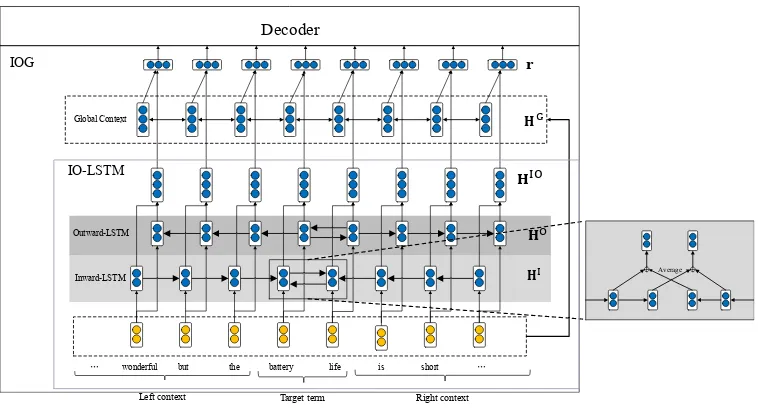
Figure 2 shows the framework of our methods, which follows an encoder-decoder architecture. We propose a target-fused encoder to incorporate the target information into context and learn target-specific context representations, then pass them to the decoder for sequence labeling. In the target-fused encoder, we first use an Inward-Outward LSTM to model the left context and right context of the target, then combine them with the global context. In the decoder, we can adopt two different decoding strategies. We present the details of each component in the following sections.
3.3 Target-Fused Encoder
We first generate the input vectors for each word by using a embedding lookup tableL ∈ Rd×|V|,
wheredis the embedding dimension and|V|is the vocabulary size. The embedding lookup table will
maps={w1, w2, . . . , wt, . . . , wn}to a sequence
of vectors{e1,e2,· · · ,ei, . . . ,en}as words
repre-sentations whereei ∈Rd.
Typically, neural sequence labeling models use recurrent neural networks, such as LSTM (Hochre-iter and Schmidhuber,1997) or BiLSTM, to model the sentence. However, merely using BiLSTM to model the whole sentence is totally target-independent. For the different target terms in the same sentence, BiLSTM outputs equal representa-tion and cannot generate target-specific results.
As mentioned before, the core challenge of TOWE is the learning of target-specific context representations. It is evident that different targets have different positions in the sentence and thus different contexts. So, we first split the sentence into three segments: left context{w1, w2,· · · , wl},
target term {wl+1,· · · , wr−1} and right context
{wr,· · ·, wn}and left and right contexts are
target-specific.We use a left LSTM to model the left con-text plus target and a right LSTM to model the target plus right context respectively. In this way the specific contexts could generate target-specific context representations. However, the di-rection of the two LSTMs is a crucial problem.
3.3.1 Inward-LSTM
We can use a simple strategy called Inward-LSTM, which follows the design of TD-LSTM (Tang et al., 2016). As Figure 2 shows, Inward-LSTM runs the two LSTMs from the two ends of the sentence to the middle target respectively. It runs the left LSTM from the first word to opinion target as a forward-LSTM and a right LSTM from the last word to the opinion target as a backward-LSTM, so we call it as Inward. This is a process of passing the context to target. We obtain left context rep-resentationsHLand right context representations HRas follows:
hLi =−LSTM−−−→(hLi−1,ei),∀i∈[1,· · · , r−1], (1)
hRi =←LSTM−−−−(hRi+1,ei),∀i∈[l+ 1,· · · , n]. (2)
It is obvious that the words of opinion target
{wl+1,· · · , wr−1}are represented twice in the left
LSTM and right LSTM. We simply average the two representations for the same word to get the representation of target words:
hLRi = (h L
i +hRi)
2 ,∀i∈[l+ 1,· · · , r−1]. (3)
Then the context representation is: HI =
wonderful but the battery life is short Inward-LSTM
Outward-LSTM IO-LSTM
Global Context IOG
Decoder
… …
r
Average
[image:4.595.114.493.64.269.2]Left context Target term Right context
Figure 2: The framework of our method. The subfigure on the right side is an illustration for averaging the hidden states of the Opinion Target.
3.3.2 Outward-LSTM
Although passing contexts to the target in Inward-LSTM is a good strategy for encoding whole sen-tence representation, only using this strategy is not enough for TOWE because the target information is not passed to the left and right context. For ex-ample, in the sentence“I found the food to be out-standing.”, the opinion target is“food”, the Inward-LSTM will first model “outstanding” and then model“food”. The representation of“outstanding” does not contain the information of“food”.
To solve this problem, we design a novel strat-egy specifically for TOWE, i.e., Outward-LSTM. The idea of the Outward-LSTM is to pass the tar-get to the context, which we believe is a better choice. As Figure2shows, the Outward-LSTM starts two LSTMs from the target in the middle and run towards the both ends of the sentence, which means the left LSTM is a backward LSTM and the right LSTM is a forward LSTM. We av-erage the duplicate target hidden states and get the target-fused context representations HO =
{hL1,· · · ,hLl,hLRl+1,· · · ,hLRr−1,hrR,· · · ,hRn}:
hLi =←LSTM−−−−(hLi+1,ei),∀i∈[1,· · · , r−1], (4)
hRi =−LSTM−−−→(hRi−1,ei),∀i∈[l+ 1,· · · , n], (5)
hLRi = (h L
i +hRi)
2 ,∀i∈[l+ 1,· · · , r−1]. (6)
This concise and reasonable strategy can solve the problems remaining in the Inward-LSTM. As
we start the LSTM from the target, the target’s in-formation is fused into each word in the sentence. Also, the Outward-LSTM ensures that for differ-ent targets each word has differdiffer-ent represdiffer-entations. Take the sentence“Its camera is wonderful but the battery life is short !” as an example. For target “camera”or“battery life”, the target-fused
represen-tations for“short”are different and can generate target-specific results.
3.3.3 IO-LSTM
We can combine the both strategy and adopt an Inward-Outward LSTM (IO-LSTM). IO-LSTM concatenates the outputs of Outward-LSTM and Inward-LSTM. The output of Outward-LSTM is crucial for incorporating target information into context, while the Inwards-LSTM is included so they can complement each other and act as a Target-specific Bidirectional LSTM. The target-fused con-text representations are denoted asHIO:
hIOi =hIi;hOi . (7)
3.3.4 IOG: IO-LSTM + Global context
global context to further improve the IO-LSTM. We use a BiLSTM to model the whole sentence embeddingse={e1,e2,· · ·,ei, . . . ,en}and
ob-tain global contextualized representation HG as follows:
hGi =
h−→
hi;
←−
hi i
, (8)
− →
hi =LSTM(
− →
hi−1,ei), (9)
←−
hi =LSTM(
←−
hi+1,ei). (10)
Then we combine left-right contexts from IO-LSTM and global context, as shown in Figure2. This enables us to obtain the final target-specific contextualized representationrfor each word:
ri=
hIOi ;hGi . (11)
The final representationris fused with both target information and global context information, which can be passed to the decoder for sequence labeling.
3.4 Decoder and Training
Given a sequential representationr, we can userto computep(y|r)wherey={y1,· · ·, yn}are
BIO-label sequence for the sentence andyi ∈ {B,I,O}.
Two different decoding policies can be adopted.
3.4.1 Greedy decoding
The first is greedy decoding, formulated as a three-class three-classification problem at each position inde-pendently. We use softmax to compute the proba-bility:
p(yi|ri) =softmax(Wsri+bs) . (12)
Greedy decoding just simply selects the tag with highest point-wise probability. It does not consider the dependencies between tags but runs faster. We use the negative log likelihood (NLL) as the loss for one sentence:
L(s) =−
n X
i=1 3 X
k=1
I(yi=k) logp(yi =k|wi).
(13)
3.4.2 CRF
The second decoding method is to use Conditional Random Field (CRF) (Lafferty et al.,2001). CRF considers the correlations between tags in neigh-borhoods and score the whole sequence of tags. Specifically, we use a linear-chain CRF and score the tag sequence as conditional probability:
p(y|r) = P exp(s(r,y)) y0∈Y exp(s(r,y0))
, (14)
where Y is the set of all possible tag sequences ands(r,y)) =Pn
i (Ayi−1,yi +Pi,yi)is the score
function. Ayi−1,yi measures the transition score
fromyi−1toyi andPi =Wsri+bs. So we use
negative log likehood as the loss of the sentence:
L(s) =−logp(y|r). (15)
When given a new sentence for decoding, we will output the tag sequence that maximizes the condi-tional probability with Viterbi algorithm.
Finally, we minimize the loss for training:
J(θ) =
|D|
X
s
L(s). (16)
4 Experiments
4.1 Datasets
We build the datasets based on the SemEval chal-lenge 2014 Task4, SemEval Chalchal-lenge 2015 task 12 and SemEval Challenge 2016 task 5 (Pontiki et al., 2014, 2015,2016). The SemEval challenge pro-vides several datasets from restaurant and laptop do-main. These datasets are very popular benchmarks for many ABSA subtasks, including Aspect cate-gory detection, Opinion Target Extraction, Opinion Words Extraction and Target-Dependent Sentiment Analysis (TDSA).
In the original datasets of SemEval challenge, the opinion targets (aspect terms) are annotated, but the opinion words and the correspondence with targets are not provided. So we annotate the corre-sponding opinion words for the annotated targets. Every sentence is annotated by two people, and the conflicts will be checked. Each instance of the datasets consists of a sentence, the position of the target and the positions of the corresponding opin-ion words. Note that we only keep the sentences that contain pairs of target and opinion words. The sentences without targets or with implicit opinion expressions are not included.
Finally, we generate four datasets: 14res and
14lapfrom SemEval 2014, 15resfrom SemEval
2015 and16resfrom SemEval 2016.14res,15res,
and16rescontain reviews from restaurant domain.
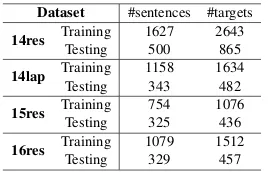
The sentences in14lapcome from laptop domain. The statistics of the four datasets is shown in Ta-ble1.
4.2 Settings
Dataset #sentences #targets
14res Training 1627 2643 Testing 500 865
14lap Training 1158 1634 Testing 343 482
15res Training 754 1076 Testing 325 436
[image:6.595.116.250.61.147.2]16res Training 1079 1512 Testing 329 457
Table 1: Statistics of datasets. The number of targets is identical to the number of pairs and instances
are pre-trained on unlabeled data of 840 billion tokens (Pennington et al., 2014). The word em-beddings are fixed and not fine-tuned during the training stage. The dimension of hidden states in all the LSTM cell is set as 200. Adam (Kingma and Ba,2015) is chosen as the optimization method with the default setting in the original paper. We randomly split 20% of the train set as dev set for tunning the hyperparameters and early stopping. Then we test the models on testing sets and the average result of five runs is reported.
4.3 Evaluation Metrics
Precision, recall and F1 score are used as the met-rics to measure the performance of models. An extracted opinion words span is regarded as a cor-rect prediction when the starting and ending offset of the predicted span are both identical to those of a golden opinion words span. We compute Precision, Recall and F1 with the span as the unit.
4.4 Compared Methods
Since we are the first to study this sequence labeling task, there is no available sequence labeling model in the literature to be compared. Although there are a number of complicated models in TDSA, the task is different. Those TDSA models focus on sentence-level representations for sentiment clas-sification, while for TOWE the representation on token-level representations is more crucial. Simply transferring the TDSA models for TOWE is not suitable.
Except for two rule-based methods, we can only design and implement the baselines for TOWE our-selves. Our final model is the IOG encoder with a greedy decoding strategy. We compare it with the following baselines:
• Distance-rule: Hu and Liu(2004) use the
dis-tance and POS tags to determine the opinion words. Following this idea, we first use the nltk toolkit to make part-of-speech tagging
on each word and select the nearest adjective from the target as the corresponding opinion word.
• Dependecy-rule: We adopt the strategies
pro-posed in (Zhuang et al., 2006) which uses dependency-tree based templates to identify opinion pairs. The POS tag of opinion targets and opinion words and the dependency path between them in the training set are recorded as rule templates.1 The high-frequency de-pendency templates are used for detecting the related opinion words in the testing set.
• LSTM/BiLSTM: This method is an
LSTM/BiLSTM network built on top of word embeddings proposed by (Liu et al., 2015). We pass the whole sentence into the LSTM/BiLSTM and each hidden state is fed to a softmax layer for three-class classification, which works as sentence-level opinion words extraction.
• Pipeline: This method combines BiLSTM
and Distance-rule method in a pipelined way. We first train a sentence-level opinion words extraction model with BiLSTM and extract all the opinion words in the test sentences; then we select the closest extracted opinion words of the target as the result.
• Target-Concatenated BiLSTM
(TC-BiLSTM): This method incorporates the
target information into sentence by concate-nation. A target vector is obtained by the average pooling of target word embeddings. The word representation at each position is the concatenation of word embedding and target vector, which is then fed into a BiLSTM for sequence labeling.
4.5 Results and Discussion
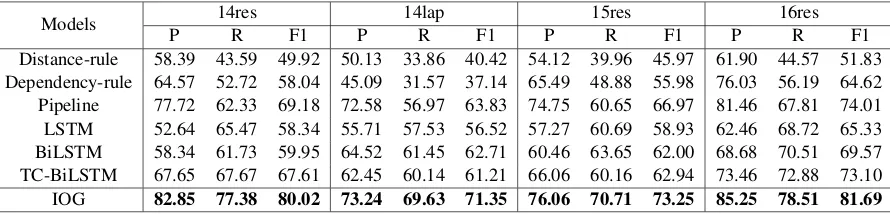
The main results can be found in Table 2. Note that all the neural models in Table 2 adopt greedy decod-ing. The performance of Distance-rule method is not satisfactory and the worst among all the meth-ods; its recall score is especially low. IOG ob-tains an F1 score with a greater-than 30% improve-ment over the Distance-rule method. Dependency-rule method obtains a general improvement than Distance-rule, but it was still lower than the below sequence-labeling based methods. This reveals the
Models 14res 14lap 15res 16res
P R F1 P R F1 P R F1 P R F1
Distance-rule 58.39 43.59 49.92 50.13 33.86 40.42 54.12 39.96 45.97 61.90 44.57 51.83
Dependency-rule 64.57 52.72 58.04 45.09 31.57 37.14 65.49 48.88 55.98 76.03 56.19 64.62
Pipeline 77.72 62.33 69.18 72.58 56.97 63.83 74.75 60.65 66.97 81.46 67.81 74.01
LSTM 52.64 65.47 58.34 55.71 57.53 56.52 57.27 60.69 58.93 62.46 68.72 65.33
BiLSTM 58.34 61.73 59.95 64.52 61.45 62.71 60.46 63.65 62.00 68.68 70.51 69.57
TC-BiLSTM 67.65 67.67 67.61 62.45 60.14 61.21 66.06 60.16 62.94 73.46 72.88 73.10
IOG 82.85 77.38 80.02 73.24 69.63 71.35 76.06 70.71 73.25 85.25 78.51 81.69
Table 2: Main Results in terms of Precsion, Recall and F1-score. Best results are in bold. IOG outperms all the baselines significantly (p <0.01).
Models 14res 14lap 15res 16res
P R F1 P R F1 P R F1 P R F1
Inward-LSTM 53.64 70.06 60.67 55.49 54.96 55.18 53.84 68.60 60.32 66.46 73.83 69.92
Outward-LSTM 81.08 73.65 77.17 70.34 64.90 67.48 74.18 65.60 69.62 81.12 77.68 79.35
IO-LSTM 82.09 75.44 78.62 72.90 66.49 69.51 74.71 67.22 70.74 83.31 78.67 80.91
IOG 82.85 77.38 80.02 73.24 69.63 71.35 76.06 70.71 73.25 85.25 78.51 81.69
[image:7.595.77.522.62.169.2]IOG + CRF 82.97 77.73 80.24 74.19 68.96 71.39 75.50 71.68 73.51 84.41 79.43 81.84
Table 3: Comparisions for different model design in terms of Precsion, Recall and F1-score.
lack of robustness in rule-based approaches. The error propagation from syntactic parsers is also a reason for poor performance.
The Pipeline model performs much better than rule-based methods, obtaining an especially high precision, showing that machine-learning methods can obtain better opinion words extraction. How-ever, pipeline model is still not ideal, and the F1-score is approximately 10% lower than our pro-posed model in several datasets. This reflects that the distance information is not sufficient for detect-ing target-oriented opinion words while IOG could better handle long distance dependency problem. Also, this strategy cannot solve the cases where one target corresponds to more than one opinion term. It also suffers from error propagation.
LSTM and BiLSTM are both target-independent leading to low precision, and their performance is even worse than pipeline method. IOG outperforms BiLSTM by about 15% averagely, which indicates the target information should be included.
TC-BiLSTM includes the target information by concatenation and obtains better general perfor-mance than LSTM and BiLSTM. However, TC-BiLSTM is still over 10% lower than IOG and is slightly inferior to Pipeline, showing that the con-catenation is not a good way to incorporate the target information for TOWE. We believe that the problem is that the concatenated target may inter-fere with the other targets in the same sentence.
IOG achieves the best performance on all
datasets from different domains compared to both the rule-based methods and neural models. We can conclude that IOG can learn target-specific repre-sentations more effectively and can better capture the correspondence between targets and opinion words.
4.6 Model Analysis
To compare the different design of our model and provide more compared models, we also report the results of the variants of our models in Table3.
• Inward-LSTM:HI computed from (1), (2),
(3) are fed to the greedy decoder for sequence labeling.
• Outward-LSTM: HO computed from (4),
(5), (6) are fed for greedy decoding
• IO-LSTM: Combining Inwards-LSTM and
Outwards-LSTM,HIOis obtained by concate-nation ofHI and HO in (7), which is then used for greedy decoding.
• IOG+CRF: Passing the representationsrin
IOG to a CRF decoder.
The performance of Inward-LSTM is inferior, similar to the target-independent BiLSTM. This demonstrates that only passing the context to target is similar to not considering the target information owing to the problems we discussed before.
Sentence Distance-rule Dependency rule Pipeline BiLSTM TC-BiLSTM IOG
Thebreadistop notchas well . top% NULL% top notch! top notch! NULL% top notch!
BEST spicy tuna roll,greatasian salad. asian% “great”, ”asian”% great! asian% “BEST”, ”great”% great! Ilovethedrinks, esp lychee martini ,
and the food is also VERY good . lyche% love! love! “love”,“good”% “love”,“good”% love!
Foodwasdecent, butnot great. decent% “decent”, “great”% decent% “decent”,
“not great” ! decent%
“decent”, “not great” ! Thefoodwas
excellent-authentic Italian cuisine made absolutely fresh . excellent! NULL% excellent! excellent! “excellent”, “fresh”% excellent! The food was excellent
-authenticItalian cuisinemade absolutelyfresh . Italian% “authentic”, “Italian ”% authentic% excellent%
“authentic”,
[image:8.595.71.526.62.150.2]“excellent ”, “fresh”% “authentic”, “fresh”!
Table 4: Examples for the extracted result, the target terms are in red and the golden corresponding opinion words are in blue.
that passing target into context is a better choice and learning the target-specific word representa-tions is crucial. In fact, Outward-LSTM has already outperformed all the previous baselines, which in-dicates that this is a really good design for TOWE. IO-LSTM which combine the Inward and Outward is slightly better than Outward-LSTM, showing that Inward-LSTM can still provide supplementary information for Outward-LSTM. Through combin-ing global context with IO-LSTM as IOG model, we roughly obtain a further 1% improvement.
We also test our model with a linear Conditional-Random-Field as the decoder. CRF considers the label dependencies. It can be observed that IOG with CRF obtains a slight improvement.
4.7 Case Study
To demonstrate the effectiveness of our model, we pick some examples in the test dataset in14resand show the extracted results of different models.
In the first sentence, since the Distance-rule can-not extract phrases, the extraction it makes is in-correct. In addition, merely selecting the nearest adjective using the Distance-rule approach does not enable coverage in all cases, as shown in the second and third sentence (e.g., the“asian”and “lyche”). Dependency-rule in some cases fails to
ex-tract any word owing to the error of parser and no template to match. Pipeline method has the prob-lem that it cannot handle the cases that one target corresponds to multiple opinion terms (e.g.,“not great”is not extracted in the fourth sentence). The drawback of BiLSTM is that it does not include target information, so it extracts both“love”and “good”in the third sentence while only“love”is the corresponding opinion word for“drinks”. Al-though TC-BiLSTM is a target-specific model, it tends to extract irrelevant opinion words because of the interference from concatenation. In the last two rows of Table 4, we show the same sentence with two different targets and only IOG does not
make mistakes for both targets. IOG outputs the correct results for all the sentences in the table.
5 Conclusion and Future Works
In this paper, we propose a novel subtask for aspect-based sentiment analysis: Target-oriented Opinion Words Extraction (TOWE) which aims at extract-ing the correspondextract-ing opinion words for a given opinion target. We design a novel neural model IOG to solve this task. IOG can effectively encode target information into left and right context respec-tively. Then we combine the left and right context of the opinion target and global context for extract-ing the correspondextract-ing opinion word in the decoder. We contribute four datasets based on several bench-marks. The experimental results demonstrate that our model achieves the best performance across all the datasets from different domains.
In future works, TOWE could be utilized to fur-ther improve the performance on downstream sen-timent analysis tasks with building a more inter-pretable model, such as enhanced-feature or multi-task learning. In addition, an end-to-end opinion extractive summary method without given golden targets is also a future work.
Acknowledgements
The authors would like to thank Fang Qian and Fei Zhao for their contribution to building the datasets, and Robert Ridley for his comments on this paper. We also express the gratitude to the anonymous reviewers for their valuable feedback. This work is supported by the National Natural Science Foun-dation of China (No. 61672277, U1836221), the Jiangsu Provincial Research Foundation for Basic Research (No. BK20170074).
References
Sepp Hochreiter and J¨urgen Schmidhuber. 1997. Long
1780.
Minqing Hu and Bing Liu. 2004. Mining and
summa-rizing customer reviews. InProceedings of the 10th ACM SIGKDD International Conference on Knowl-edge Discovery and Data Mining, pages 168–177.
Niklas Jakob and Iryna Gurevych. 2010. Extracting opinion targets in a single and cross-domain setting
with conditional random fields. InProceedings of
the 2010 Conference on Empirical Methods in Natu-ral Language Processing, pages 1035–1045.
Diederik P. Kingma and Jimmy Ba. 2015. Adam: A
method for stochastic optimization. InProceedings of the 3rd International Conference for Learning Representations.
John D. Lafferty, Andrew McCallum, and Fernando
C. N. Pereira. 2001. Conditional random fields:
Probabilistic models for segmenting and labeling
se-quence data. In Proceedings of the 18th
Interna-tional Conference on Machine Learning, pages 282– 289.
Xin Li and Wai Lam. 2017. Deep multi-task learning
for aspect term extraction with memory interaction. In Proceedings of the 2017 Conference on Empiri-cal Methods in Natural Language Processing, pages 2886–2892.
Bing Liu. 2012. Sentiment Analysis and Opinion
Min-ing. Synthesis Lectures on Human Language
Tech-nologies. Morgan & Claypool Publishers.
Kang Liu, Heng Li Xu, Yang Liu, and Jun Zhao. 2013. Opinion target extraction using partially-supervised
word alignment model. InProceedings of the 23rd
International Joint Conference on Artificial Intelli-gence, pages 2134–2140.
Pengfei Liu, Shafiq R. Joty, and Helen M. Meng. 2015. Fine-grained opinion mining with recurrent neural
networks and word embeddings. InProceedings of
the 2015 Conference on Empirical Methods in Natu-ral Language Processing, pages 1433–1443.
Bo Pang and Lillian Lee. 2007. Opinion mining and
sentiment analysis. Foundations and Trends in
In-formation Retrieval, 2(1-2):1–135.
Jeffrey Pennington, Richard Socher, and Christopher D.
Manning. 2014.Glove: Global vectors for word
rep-resentation. InProceedings of the 2014 Conference on Empirical Methods in Natural Language
Process-ing, pages 1532–1543.
Maria Pontiki, Dimitris Galanis, Haris Papageor-giou, Ion Androutsopoulos, Suresh Manandhar, Mo-hammad Al-Smadi, Mahmoud Al-Ayyoub, Yanyan Zhao, Bing Qin, Orph´ee De Clercq, V´eronique Hoste, Marianna Apidianaki, Xavier Tannier, Na-talia V. Loukachevitch, Evgeniy Kotelnikov, N´uria Bel, Salud Mar´ıa Jim´enez Zafra, and G¨ulsen Eryigit.
2016.Semeval-2016 task 5: Aspect based sentiment
analysis. InProceedings of the 10th International Workshop on Semantic Evaluation, pages 19–30.
Maria Pontiki, Dimitris Galanis, Haris Papageorgiou, Suresh Manandhar, and Ion Androutsopoulos. 2015. Semeval-2015 task 12: Aspect based sentiment anal-ysis. InProceedings of the 9th International Work-shop on Semantic Evaluation, pages 486–495.
Maria Pontiki, Dimitris Galanis, John Pavlopoulos, Harris Papageorgiou, Ion Androutsopoulos, and
Suresh Manandhar. 2014. Semeval-2014 task 4:
As-pect based sentiment analysis. InProceedings of the 8th International Workshop on Semantic Evaluation, pages 27–35.
Soujanya Poria, Erik Cambria, and Alexander F.
Gel-bukh. 2016. Aspect extraction for opinion
min-ing with a deep convolutional neural network.
Knowledge-Based Systems, 108:42–49.
Guang Qiu, Bing Liu, Jiajun Bu, and Chun Chen.
2011. Opinion word expansion and target
extrac-tion through double propagaextrac-tion. Computational
Linguistics, 37(1):9–27.
Lance Ramshaw and Mitch Marcus. 1995.Text
chunk-ing uschunk-ing transformation-based learnchunk-ing. In Third
Workshop on Very Large Corpora.
Lei Shu, Hu Xu, and Bing Liu. 2017. Lifelong learning
CRF for supervised aspect extraction. In
Proceed-ings of the 55th Annual Meeting of the Association for Computational Linguistics, pages 148–154.
Duyu Tang, Bing Qin, Xiaocheng Feng, and Ting Liu.
2016. Effective lstms for target-dependent
senti-ment classification. InProceedings of the 26th Inter-national Conference on Computational Linguistics: Technical Papers, pages 3298–3307.
Wenya Wang, Sinno Jialin Pan, Daniel Dahlmeier, and
Xiaokui Xiao. 2016. Recursive neural conditional
random fields for aspect-based sentiment analysis. In Proceedings of the 2016 Conference on Empiri-cal Methods in Natural Language Processing, pages 616–626.
Wenya Wang, Sinno Jialin Pan, Daniel Dahlmeier, and
Xiaokui Xiao. 2017. Coupled multi-layer attentions
for co-extraction of aspect and opinion terms. In
Proceedings of the 31st AAAI Conference on Arti-ficial Intelligence, pages 3316–3322.
Hu Xu, Bing Liu, Lei Shu, and Philip S. Yu. 2018.
Dou-ble embeddings and cnn-based sequence labeling for aspect extraction. InProceedings of the 56th Annual Meeting of the Association for Computational Lin-guistics, pages 592–598.
Yichun Yin, Furu Wei, Li Dong, Kaimeng Xu, Ming
Zhang, and Ming Zhou. 2016. Unsupervised word
Li Zhuang, Feng Jing, and Xiaoyan Zhu. 2006. Movie
review mining and summarization. InProceedings