3274
Continual Learning for Sentence Representations Using Conceptors
Tianlin Liu
Department of Computer Science and Electrical Engineering
Jacobs University Bremen 28759 Bremen, Germany [email protected]
Lyle Ungar and Jo˜ao Sedoc
Department of Computer and Information Science University of Pennsylvania
Philadelphia, PA 19104
{ungar, joao}@cis.upenn.edu
Abstract
Distributed representations of sentences have become ubiquitous in natural language pro-cessing tasks. In this paper, we consider a continual learning scenario for sentence rep-resentations: Given a sequence of corpora, we aim to optimize the sentence encoder with re-spect to the new corpus while maintaining its accuracy on the old corpora. To address this problem, we propose to initialize sentence en-coders with the help of corpus-independent features, and then sequentially update sentence encoders using Boolean operations of concep-tor matrices to learn corpus-dependent fea-tures. We evaluate our approach on semantic textual similarity tasks and show that our pro-posed sentence encoder can continually learn features from new corpora while retaining its competence on previously encountered cor-pora.
1 Introduction
Distributed representations of sentences are essen-tial for a wide variety of natural language pro-cessing (NLP) tasks. Although recently proposed sentence encoders have achieved remarkable re-sults (e.g., (Yin and Sch¨utze, 2015;Arora et al., 2017;Cer et al., 2018;Pagliardini et al., 2018)), most, if not all, of them are trained on a priori
fixed corpora. However, in open-domain NLP sys-tems such as conversational agents, oftentimes we are facing a dynamic environment, where train-ing data are accumulated sequentially over time and the distributions of training data vary with respect to external input (Lee, 2017;Mathur and Singh,2018). To effectively use sentence encoders in such systems, we propose to consider the fol-lowing continual sentence representation learn-ing task: Given a sequence of corpora, we aim to train sentence encoders such that they can continu-ally learn features from new corpora while
retain-ing strong performance on previously encountered corpora.
Toward addressing the continual sentence rep-resentation learning task, we propose a simple sentence encoder that is based on the summation and linear transform of a sequence of word vec-tors aided by matrix concepvec-tors. Concepvec-tors have their origin in reservoir computing (Jaeger,2014) and recently have been used to perform continual learning in deep neural networks (He and Jaeger, 2018). Here we employ Boolean operations of conceptor matrices to update sentence encoders over time to meet the following desiderata:
1. Zero-shot learning. The initialized sentence encoder (no training corpus used) can effec-tively produce sentence embeddings.
2. Resistant to catastrophic forgetting. When the sentence encoder is adapted on a new training corpus, it retains strong perfor-mances on old ones.
The rest of the paper is organized as follows. We first briefly review a family of linear sentence encoders. Then we explain how to build upon such sentence encoders for continual sentence represen-tation learning tasks, which lead to our proposed algorithm. Finally, we demonstrate the effective-ness of the proposed method using semantic tex-tual similarity tasks.1
Notation We assume each word w from a
vo-cabulary setV has a real-valued word vectorvw∈ Rn. Let p(w) be the monogram probability of
a word w. A corpus D is a collection of
sen-tences, where each sentences ∈ Dis a multiset of words (word order is ignored here). For a col-lection of vectors Y = {yi}i∈I, where yi ∈ Rl
1Our codes are available on GitHub https://
foriin an index setI with cardinality|I|, we let [yi]i∈I ∈ Rl×|I| be a matrix whose columns are
vectorsy1,· · · , y|I|. An identity matrix is denoted byI.
2 Linear sentence encoders
We briefly overview “linear sentence encoders” that are based on linear algebraic operations over a sequence of word vectors. Among different lin-ear sentence encoders, the smoothed inverse fre-quency (SIF) approach (Arora et al., 2017) is a prominent example – it outperforms many neural-network based sentence encoders on a battery of NLP tasks (Arora et al.,2017).
Derived from a generative model for sentences, the SIF encoder (presented in Algorithm1) trans-forms a sequence of word vectors into a sentence vector with three steps. First, for each sentence in the training corpus, SIF computes a weighted average of word vectors (line 1-3 of Algorithm 1); next, it estimates a “common discourse direc-tion” of the training corpus (line 4 of Algorithm 1); thirdly, for each sentence in the testing cor-pus, it calculates the weighted average of the word vectors and projects the averaged result away from the learned common discourse direction (line 5-8 of Algorithm 1). Note that this 3-step paradigm is slightly more general than the original one pre-sented in (Arora et al.,2017), where the training and the testing corpus is assumed to be the same.
Algorithm 1:SIF sentence encoder. Input :A training corpusD; a testing
corpusG; parametera, monogram
probabilities{p(w)}w∈V of words
1 forsentences∈Ddo 2 qs← |1
s|
P w∈s
a p(w)+avw
3 end
4 Letube the first singular vector of[qs]s∈D. 5 forsentences∈Gdo
6 qs← |1
s|
P w∈s
a p(w)+avw
7 fsSIF ←qs−uu>qs. 8 end
Output:{fsSIF}s∈G
Building upon SIF, recent studies have pro-posed further improved sentence encoders ( Kho-dak et al., 2018; Pagliardini et al., 2018; Yang et al.,2018). These algorithms roughly share the core procedures of SIF, albeit using more refined
methods (e.g., softly remove more than one com-mon discourse direction).
3 Continual learning for linear sentence encoders
In this section, we consider how to design a lin-ear sentence encoder for continual sentence repre-sentation learning. We observe that common dis-course directions used by SIF-like encoders are estimated from the training corpus. However, in-crementally estimating common discourse direc-tions in continual sentence representation learning tasks might not be optimal. For example, consider that we are sequentially given training corpora of tweets and news article. When the first tweetscorpus is presented, we can train a SIF sentence encoder usingtweets. When the sec-ond news article corpus is given, however, we will face a problem on how to exploit the newly given corpus for improving the trained sentence encoder. A straightforward solution is to first com-bine the tweetsand news articlecorpora and then train a new encoder from scratch using the combined corpus. However, this paradigm is not efficient or effective. It is not efficient in the sense that we will need to re-train the encoder from scratch every time a new corpus is added. Furthermore, it is not effective in the sense that the common direction estimated from scratch reflects a compromise between tweets and news articles, which might not be optimal for either of the stand-alone corpus. Indeed, it is possible that larger cor-pora will swamp smaller ones.
To make the common discourse learned from one corpus more generalizable to another, we pro-pose to use the conceptor matrix (Jaeger, 2017) to characterize and update the common discourse features in a sequence of training corpora.
3.1 Matrix conceptors
In this section, we briefly introduce matrix con-ceptors, drawing heavily on (Jaeger,2017;He and Jaeger, 2018; Liu et al., 2019). Consider a set of vectors {x1,· · · , xn}, xi ∈ RN for all i ∈
{1,· · ·, n}. A conceptor matrix is a regularized identity map that minimizes
1
n
n X
i=1
kxi−Cxik22+α−2kCk2F. (1)
thatChas a closed form solution:
C= 1
nXX
>(1
nXX
>+
α−2I)−1, (2)
where X = [xi]i∈{1,···,n} is a data collec-tion matrix whose columns are vectors from {x1,· · ·, xn}. In intuitive terms,Cis a soft
pro-jection matrix on the linear subspace where the typical components ofxi samples lie. For
conve-nience in notation, we may writeC(X, α)to stress the dependence onXandα.
Conceptors are subject to most laws of Boolean logic such as NOT¬, AND∧and OR∨. For two conceptorsCandB, we define the following
op-erations:
¬C:=I−C, (3)
C∧B :=(C−1+B−1−I)−1 (4)
C∨B :=¬(¬C∧ ¬B) (5)
Among these Boolean operations, the OR oper-ation ∨ is particularly relevant for our continual sentence representation learning task. It can be shown thatC∨Bis the conceptor computed from
the union of the two sets of sample points from which C and B are computed. Note that,
how-ever, to calculate C∨B, we only need to know
two matricesC andB and do not have to access to the two sets of sample points from whichCand Bare computed.
3.2 Using conceptors to continually learn sentence representations
We now show how to sequentially characterize and update the common discourse of corpora us-ing the Boolean operation of conceptors. Sup-pose that we are sequentially given M training
corporaD1,· · ·, DM, presented one after another.
Without using any training corpus, we first initial-ize a conceptor which characterinitial-izes the corpus-independent common discourse features. More concretely, we compute C0 := C([v
w]w∈Z, α),
where [vw]w∈Z is a matrix of column-wisely
stacked word vectors of words from a stop word list Z andα is a hyper-parameter. After
initial-ization, for each new training corpus Di (i =
1,· · · , M) coming in, we compute a new
concep-tor Ctemp := C([qs]s∈Di, α) to characterize the
common discourse features of corpus Di, where
thoseqs are defined in the SIF Algorithm 1. We
can then use Boolean operations of conceptors to
compute Ci := Ctemp∨Ci−1, which character-izes common discourse features from the new cor-pus as well as the old corpora. After allM
cor-pora are presented, we follow the SIF paradigm and useCMto remove common discourse features
from (potentially unseen) sentences. The above outlined conceptor-aided (CA) continual sentence representation learning method is presented in Al-gorithm2.
Algorithm 2:CA sentence encoder.
Input :A sequence ofM training corpora
D={D1,· · · , DM}; a testing
corpusG; hyper-parametersaandα;
word probabilities{p(w)}w∈V; stop
word listZ.
1 C0 ←C([vw]w∈Z, α).
2 forcorpus indexi= 1,· · ·, M do 3 forsentences∈Dido 4 qs← |1s| P
w∈s a p(w)+avw
5 end
6 Ctemp←C([qs]s∈Di, α)
7 Ci ←Ctemp∨Ci−1 8 end
9 fors∈Gdo 10 qs← |1s| P
w∈s a p(w)+avw
11 fsCA←qs−CMqs 12 end
Output:{fsCA}s∈G
A simple modification of Algorithm 2 yields a “zero-shot” sentence encoder that requires only pre-trained word embeddings and no training cor-pus: we can simply skip those corpus-dependent steps (line 2-8) and use C0 in place of CM in
line 11 in Algorithm2to embed sentences. This method will be referred to as “zero-shot CA.”
4 Experiment
300-1 2 3 4 5 firstntraining
corpora used 63.0
67.5 72.0
PCC
News
1 2 3 4 5 75.0
81.2
87.0 Captions
1 2 3 4 5 76.0
82.7
87.0 Wordnet
corpus-specialized SIF train-from-scratch SIF
CA
1 2 3 4 5 51.0
60.1
66.0 Forums
1 2 3 4 5 70.0
73.9
79.0 Tweets
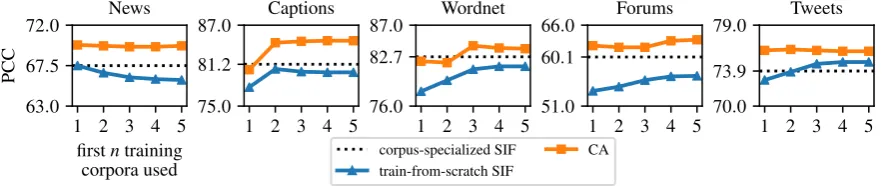
Figure 1: PCC results of STS datasets. Each panel shows the PCC results of a testing corpus (specified as a subtitle) as a function of increasing numbers of training corpora used. The setup of this experiment mimics (Zenke et al.,
2017, section 5.1).
News Captions WordNet Forums Tweets
av. train-from-scratch SIF 66.5 79.7 80.3 55.5 74.2
zero-shot CA 65.6 79.8 82.5 61.5 75.2
[image:4.595.78.525.69.162.2]av. CA 69.7 83.8 83.2 62.5 76.2
Table 1: Time-course averaged PCC of train-from-scratch SIF and conceptor-aided (CA) methods, together with the result of zero-shot CA. Best results are in boldface and the second best results are underscored.
dimensional GloVe vectors (trained on the 840 billion token Common Crawl) (Pennington et al., 2014). Additional experiments with Word2Vec (Mikolov et al.,2013), Fasttext (Bojanowski et al., 2017), Paragram-SL-999 (Wieting et al.,2015) are in the appendix.
We use a standard continual learning experi-ment setup (cf. (Zenke et al.,2017, section 5.1)) as follows. We sequentially present the five training datasets in the order2of news, captions, wordnet, forums, and tweets, to train sentence encoders. Whenever a new training corpus is presented, we train a SIF encoder from scratch3 (by combining all available training corpora which have been al-ready presented) and then test it on each corpus. At the same time, we incrementally adapt a CA en-coder4 using the newly presented corpus and test it on each corpus. The lines of each panel of Fig-ure1show the test results of SIF and CA on each testing corpus (specified as the panel subtitle) as a function of the number of training corpora used (the firstncorpora of news, captions, wordnet,
fo-rums, and tweets for this experiment). To give a concrete example, consider the blue line in the first
2The order can be arbitrary. Here we ordered the corpora
from the one with the largest size (news) to the smallest size (tweets). The results from reversely ordered corpora are re-ported in the appendix.
3We usea= 0.001as in (Arora et al.,2017). The word
frequencies are available at the GitHub repository of SIF.
4We used hyper-parameterα= 1. Other parameters are
set to be the same as SIF.
panel of Figure 1. This line shows the test PCC scores (y-axis) of SIF encoder on the news corpus
when the number of training corpora increases (x
-axis). Specifically, the left-most blue dot indicates the test result of SIF encoder on news corpus when trained on news corpus itself (that is, the first train-ing corpus is used); the second point indicates the test results of SIF encoder on news corpus when trained on news and captions corpora (i.e., the first
twotraining corpora are used); the third point in-dicates the test results of SIF encoder on news cor-pus when trained on news, captions, and wordnet corpora (that is, the firstthreetraining corpora are used), so on and so forth. The dash-lines in pan-els show the results of a corpus-specialized SIF, which is trained and tested on the same corpus, i.e., as done in (Arora et al.,2017, section 4.1). We see that the PCC results of CA are better and more “forgetting-resistant” than train-from-scratch SIF throughout the time course where more training data are incorporated. Consider, for example, the test result of news corpus (first panel) again. As more and more training corpora are used, the per-formance of train-from-scratch SIF drops with a noticeable slope; by contrast, the performance CA drops only slightly.
presented in Table1, together with the time-course averaged results of CA and train-from-scratch SIF (i.e., the averaged values of those CA or SIF scores in each panel of Figure 1). We see that the aver-aged results of our CA method performs the best among these three methods. Somewhat surpris-ingly, the results yielded by zero-shot CA are bet-ter than the averaged results of train-from-scratch SIF in most of the cases.
We defer additional experiments to the ap-pendix, where we compared CA against more baseline methods and use different word vectors other than GloVe to carry out the experiments.
5 Conclusions and future work
In this paper, we formulated a continual sentence representation learning task: Given a consecutive sequence of corpora presented in a time-course manner, how can we extract useful sentence-level features from new corpora while retaining those from previously seen corpora? We identified that the existing linear sentence encoders usually fall short at solving this task as they leverage on “com-mon discourse” statistics estimated based on a pri-ori fixed corpora. We proposed two sentence en-coders (CA encoder and zero-shot CA encoder) and demonstrate their the effectiveness at the con-tinual sentence representation learning task using STS datasets.
As the first paper considering continual sen-tence representation learning task, this work has been limited in a few ways – it remains for fu-ture work to address these limitations. First, it is worthwhile to incorporate more benchmarks such as GLUE (Wang et al.,2019) and SentEval ( Con-neau and Kiela,2018) into the continual sentence representation task. Second, this work only con-siders the case of linear sentence encoder, but fu-ture research can attempt to devise (potentially more powerful) non-linear sentence encoders to address the same task. Thirdly, the proposed CA encoder operates at a corpus level, which might be a limitation if boundaries of training corpora are ill-defined. As a future direction, we expect to lift this assumption, for example, by updating the common direction statistics at a sentence level us-ing Autoconceptors (Jaeger, 2014, section 3.14). Finally, the continual learning based sentence en-coders should be applied to downstream applica-tions in areas such as open domain NLP systems.
Acknowledgements
The authors thank anonymous reviewers for their helpful feedback. This work was partially sup-ported by Jo˜ao Sedoc’s Microsoft Research Dis-sertation Grant.
References
E. Agirre, C. Banea, C. Cardie, D. Cer, M. Diab, A. Gonzalez-Agirre, W. Guo, I. Lopez-Gazpio, M. Maritxalar, R. Mihalcea, G. Rigaua, L. Uriaa, and J. Wiebeg. 2015. Semeval-2015 task 2: Seman-tic textual similarity, English, Spanish and pilot on interpretability. InProceedings of the 9th interna-tional workshop on semantic evaluation, pages 252– 263.
E. Agirre, C. Banea, C. Cardie, D. Cer, M. Diab, A. Gonzalez-Agirre, W. Guo, R. Mihalcea, G. Rigau, and J. Wiebe. 2014. Semeval-2014 task 10: Multilingual semantic textual similarity. In Proceedings of the 8th international workshop on semantic evaluation, pages 81–91.
E. Agirre, C. Banea, D. Cer, M. Diab, A. Gonzalez-Agirre, R. Mihalcea, G. Rigau, and J. Wiebe. 2016.
Semeval-2016 task 1: Semantic textual similarity, monolingual and cross-lingual evaluation. In Pro-ceedings of the 10th International Workshop on Se-mantic Evaluation (SemEval-2016), pages 497–511, San Diego, California.
E. Agirre, D. Cer, M. Diab, A. Gonzalez-Agirre, and W. Guo. 2013. Sem 2013 shared task: Semantic tex-tual similarity. InSecond Joint Conference on Lexi-cal and Computational Semantics, volume 1, pages 32–43.
E. Agirre, M. Diab, D. Cer, and A. Gonzalez-Agirre. 2012. Semeval-2012 task 6: A pilot on semantic textual similarity. InProceedings of the First Joint Conference on Lexical and Computational Seman-tics, SemEval ’12, pages 385–393, Stroudsburg, PA, USA. Association for Computational Linguistics. S. Arora, Y. Liang, and T. Ma. 2017. A simple but
tough-to-beat baseline for sentence embeddings. In International Conference on Learning Representa-tions.
P. Bojanowski, E. Grave, A. Joulin, and T. Mikolov. 2017. Enriching word vectors with subword infor-mation. Transactions of the Association for Compu-tational Linguistics, 5:135–146.
D. Cer, Y. Yang, S. Kong, N. Hua, N. Limti-aco, R. John, N. Constant, M. Guajardo-Cespedes, S. Yuan, C. Tar, et al. 2018. Universal sentence en-coder. arXiv preprint arXiv:1803.11175.
X. He and H. Jaeger. 2018. Overcoming catas-trophic interference using conceptor-aided back-propagation. InInternational Conference on Learn-ing Representations.
H. Jaeger. 2014. Controlling recurrent neural networks by conceptors. Technical report, Jacobs University Bremen.
H. Jaeger. 2017. Using conceptors to manage neural long-term memories for temporal patterns. Journal of Machine Learning Research, 18(13):1–43.
M. Khodak, N. Saunshi, Y. Liang, T. Ma, B. Stewart, and S. Arora. 2018. A la carte embedding: Cheap but effective induction of semantic feature vectors. In the Proceedings of ACL.
S. Lee. 2017. Toward continual learning for conversa-tional agents. Technical report, Microsoft Research AI - Redmond.
T. Liu, L. Ungar, and J. Sedoc. 2019. Unsupervised post-processing of word vectors via conceptor nega-tion. InProceedings of the Thirty-Third AAAI Con-ference on Artificial Intelligence (AAAI-2019), Hon-olulu.
V. Mathur and A. Singh. 2018. The rapidly changing landscape of conversational agents.
T. Mikolov, I. Sutskever, K. Chen, G. S. Corrado, and J. Dean. 2013. Distributed representations of words and phrases and their compositionality. In C. J. C. Burges, L. Bottou, M. Welling, Z. Ghahramani, and K. Q. Weinberger, editors, Advances in Neural In-formation Processing Systems 26, pages 3111–3119. Curran Associates, Inc.
M. Pagliardini, P. Gupta, and M. Jaggi. 2018. Unsuper-vised Learning of Sentence Embeddings using Com-positional n-Gram Features. InProceedings of the NAACL 2018.
J. Pennington, R. Socher, and C. D. Manning. 2014. Glove: Global vectors for word representation. In Proceedings of EMNLP, pages 1532–1543.
A. Wang, A. Singh, J. Michael, F. Hill, O. Levy, and S. R. Bowman. 2019. GLUE: A multi-task bench-mark and analysis platform for natural language un-derstanding. InInternational Conference on Learn-ing Representations.
J. Wieting, M. Bansal, K. Gimpel, K. Livescu, and D. Roth. 2015. From paraphrase database to com-positional paraphrase model and back.Transactions of the Association for Computational Linguistics, 3:345–358.
Z. Yang, C. Zhu, and W. Chen. 2018. Zero-training sentence embedding via orthogonal basis.
W. Yin and H. Sch¨utze. 2015. Convolutional neural network for paraphrase identification. In Proceed-ings of the NAACL HLT 2015, pages 901–911.