Proceedings of NAACL-HLT 2019, pages 4052–4059 4052
Pre-trained Language Model Representations for Language Generation
Sergey Edunov∗, Alexei Baevski∗, Michael Auli
Facebook AI Research Menlo Park, CA
{edunov,abaevski,michaelauli}@fb.com
Abstract
Pre-trained language model representations have been successful in a wide range of lan-guage understanding tasks. In this paper, we examine different strategies to integrate pre-trained representations into sequence to se-quence models and apply it to neural ma-chine translation and abstractive summariza-tion. We find that pre-trained representa-tions are most effective when added to the en-coder network which slows inference by only 14%. Our experiments in machine translation show gains of up to 5.3 BLEU in a simulated resource-poor setup. While returns diminish with more labeled data, we still observe im-provements when millions of sentence-pairs are available. Finally, on abstractive summa-rization we achieve a new state of the art on the full text version of CNN-DailyMail.1
1 Introduction
Pre-training of language models has been shown to provide large improvements for a range of lan-guage understanding tasks (Peters et al., 2018; Radford et al., 2018; Phang et al., 2018; Devlin et al.,2018). The key idea is to train a large gen-erative model on vast corpora and use the result-ing representations on tasks for which only limited amounts of labeled data is available. Pre-training of sequence to sequence models has been previ-ously investigated for text classification (Dai and Le,2015) but not for text generation. In neural ma-chine translation, there has been work on transfer-ring representations from high-resource language pairs to low-resource settings (Zoph et al.,2016).
In this paper, we apply pre-trained representa-tions from language models to language
genera-∗
Equal contribution.
1Code and pre-trained models are available at
https://github.com/pytorch/fairseq/tree/ bi_trans_lm/examples/pretraining
tion tasks that can be modeled by sequence to se-quence architectures. Previous work on integrat-ing language models with sequence to sequence models focused on the decoder network and added language model representations right before the output of the decoder (Gulcehre et al.,2015). We extend their study by investigating several other strategies such as inputting ELMo-style represen-tations (Peters et al.,2018) or fine-tuning the lan-guage model (§2).
Our experiments rely on strong transformer-based language models trained on up to six bil-lion tokens (§3). We present a detailed study of various strategies in different simulated labeled training data scenarios and observe the largest im-provements in low-resource settings but gains of over 1 BLEU are still possible when five million sentence-pairs are available. The most successful strategy to integrate pre-trained representations is as input to the encoder network (§4).
2 Strategies to add representations
We consider augmenting a standard sequence to sequence model with pre-trained representations following an ELMo-style regime (§2.1) as well as by fine-tuning the language model (§2.2).
2.1 ELMo augmentation
The ELMo approach ofPeters et al.(2018) forms contextualized word embeddings based on lan-guage model representations without adjusting the actual language model parameters. Specifi-cally, the ELMo module contains a set of parame-ters λ1. . . λL, γ to form a linear combination of
the L layers of the language model: ELMo =
γPL
i=0 1
Zexp(λi)hk whereγ is a learned scalar, Z is a constant to normalize theexp(λi) to sum
to one and hk is the output of thek-th language
apply layer normalization (Ba et al.,2016) to each
hkbefore computing ELMo vectors.
We experiment with an ELMo module to input contextualized embeddings either to the encoder (SRC-ELMO) or the decoder (TGT-ELMO). This provides word representations specific to the cur-rent input sentence and these representations have been trained on much more data than is available for the text generation task.
2.2 Fine-tuning approach
Fine-tuning the pre-trained representations adjusts the language model parameters by the learning signal of the end-task (Radford et al., 2018; De-vlin et al., 2018). We replace learned input word embeddings in the encoder network with the out-put of the language model (SRC-FT). Specifically, we use the language model representation of the layer before the softmax and feed it to the encoder. We also add dropout to the language model out-put. Tuning separate learning rates for the lan-guage model and the sequence to sequence model may lead to better performance but we leave this to future work. However, we do tune the number of encoder blocksN as we found this important to obtain good accuracy for this setting. We apply the same strategy to the decoder: we input language model representations to the decoder network and fine-tune the language model when training the se-quence to sese-quence model (TGT-FT).
3 Experimental setup
3.1 Datasets
Pre-training. We train language models on two languages: One model is estimated on the Ger-man newscrawl distributed by WMT’18 compris-ing 260M sentences or 6B tokens. Another model is trained on the English newscrawl data compris-ing 193M sentences or 5B tokens. We learn a joint Byte-Pair-Encoding (BPE; Sennrich et al., 2016) vocabulary of 37K types on the German and En-glish newscrawl and train the language models with this vocabulary.
Machine translation. We consider two bench-marks: Most experiments are run on the WMT’18 English-German (en-de) news translation task and we validate our findings on the WMT’18 Turkish (en-tr) news task. For WMT’18 English-German, the training corpus consists of all avail-able bitext excluding the ParaCrawl corpus and we
remove sentences longer than 250 tokens as well as sentence-pairs with a source/target length ra-tio exceeding 1.5. This results in 5.18M sentence pairs. We tokenize all data with the Moses tok-enizer (Koehn et al.,2007) and apply the BPE vo-cabulary learned on the monolingual corpora.
For WMT’18 English-Turkish, we use all of the available bitext comprising 208K sentence-pairs without any filtering. We develop on newstest2017 and test on newstest2018. For en-tr we only exper-iment with adding representations to the encoder and therefore apply the language model vocabu-lary to the source side. For the target vocabuvocabu-lary we learn a BPE code with 32K merge operations on the Turkish side of the bitext. Both datasets are evaluated in terms of case-sensitive de-tokenized BLEU (Papineni et al.,2002;Post,2018).2
Summarization. We consider the CNN-DailyMail abstractive document summarization task comprising over 280K news articles paired with multi-sentence summaries. CNN-DailyMail is a widely used dataset for abstractive text sum-marization. Following (See et al.,2017), we report results on the non-anonymized version of CNN-DailyMail rather than the entity-anonymized version (Hermann et al., 2015; Nallapati et al., 2016) because the language model was trained on full text. Articles are truncated to 400 tokens (See et al.,2017) and we use a BPE vocabulary of 32K types (Fan et al.,2017). We evaluate in terms of F1-Rouge, that is Rouge-1, Rouge-2 and Rouge-L (Lin,2004).3
3.2 Language model pre-training
We consider two types of architectures: a bi-directional language model to augment the se-quence to sese-quence encoder and a uni-directional model to augment the decoder. Both use self-attention (Vaswani et al., 2017) and the uni-directional model contains N = 12 transformer blocks, followed by a word classifier to predict the next word on the right. The bi-directional model solves a cloze-style token prediction task at train-ing time (Baevski et al.,2019). The model consists of two towers, theforwardtower operates left-to-right and the tower operating left-to-right-to-left as back-ward tower; each tower containsN = 12
trans-2sacreBLEU signatures:
BLEU+case.mixed+lang.en-{de,tr}+numrefs.1+smooth.exp+test.wmt18+tok.13a +version.1.2.1
3We use the following parameters for
160K 320K 640K 1280K 2560K 5186K −1
0 1 2 3 4 5 6
Bitext tokens
BLEU
delta
wrt
baseline
[image:3.595.77.518.61.276.2]SHARED SRC-ELMO SRC-FT TGT-ELMO TGT-FT SRC-ELMO+SHDEMB
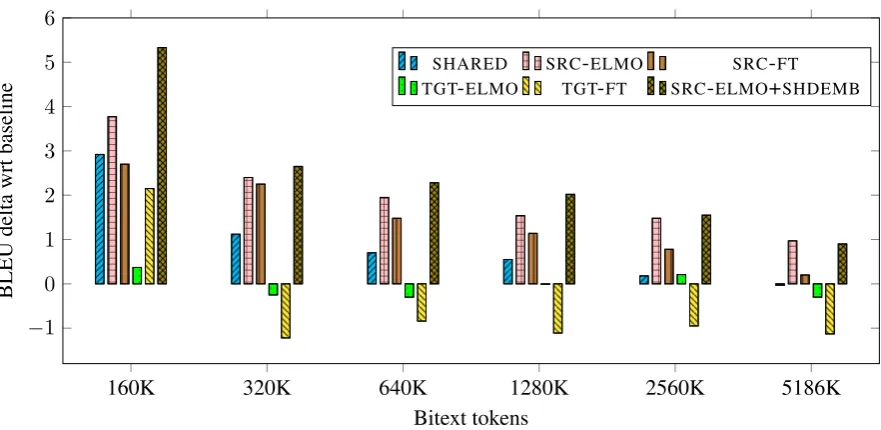
Figure 1: BLEU difference to a bitext-only baseline when adding pre-trained language model representations to a neural machine translation model in different simulated bitext settings. Results are based on averaging newstest2012-2017 of WMT English-German translation.
former blocks. The forward and backward repre-sentations are combined via a self-attention mod-ule and the output of this modmod-ule is used to predict the token at positioni. The model has access to the entire input surrounding the current target token. Models use the standard settings for the Big Trans-former (Vaswani et al.,2017). The bi-directional model contains 353M parameters and the uni-directional model 190M parameters. Both models were trained for 1M steps using Nesterov’s accel-erated gradient (Sutskever et al., 2013) with mo-mentum0.99followingBaevski and Auli(2018). The learning rate is linearly warmed up from10−7
to1for 16K steps and then annealed using a co-sine learning rate schedule with a single phase to 0.0001 (Loshchilov and Hutter,2016). We train on 32 Nvidia V100 SXM2 GPUs and use the NCCL2 library as well as the torch distributed package for inter-GPU communication. Training relies on 16-bit floating point operations (Ott et al.,2018) and it took six days for the bi-directional model and four days for the uni-directional model.
3.3 Sequence to sequence model
We use the transformer implementation of the fairseq toolkit (Ott et al.,2019). The WMT en-de and en-tr experiments are based on the Big Trans-former sequence to sequence architecture with 6 blocks in the encoder and decoder. For abstractive summarization we use a base transformer model (Vaswani et al.,2017). We tune dropout values of
between 0.1 and 0.4 on the validation set. Models are optimized with Adam (Kingma and Ba,2015) usingβ1 = 0.9,β2 = 0.98, and = 1e−8 and we use the same learning rate schedule asVaswani et al. (2017); we perform 10K-200K depending on bitext size. All models use label smoothing with a uniform prior distribution over the vocab-ulary= 0.1(Szegedy et al.,2015;Pereyra et al., 2017). We run experiments on 8 GPUs and gener-ate translations with a beam of size 5.
4 Results
4.1 Machine translation
We first present a comparison of the various strate-gies in different simulated parallel corpus size set-tings. For each experiment, we tune the dropout applied to the language model representations, and we reduce the number of optimizer steps for smaller bitext setups as models converge faster; all other hyper-parameters are equal between se-tups. Our baseline is a Big Transformer model and we also consider a variant where we share to-ken embeddings between the encoder and decoder (SHARED; Inan et al., 2016; Press & Wolf, 2016).
160K 640K 5186K
baseline 21.4 33.1 40.1
SRC-ELMO 26.6 35.6 41.8
SRC-FT 24.3 34.9 40.8
TGT-ELMO 21.3 31.9 40.5
TGT-FT 24.2 31.4 38.8
[image:4.595.308.530.65.171.2]SRC-ELMO+SHDEMB 29.0 36.2 41.8
Table 1: BLEU on newstest2018 of WMT English-German in three simulated bitext size scenarios.
news2017 news2018
baseline 9.8 9.5
SRC-ELMO 12.0 11.3
SRC-ELMO+SHDEMB 12.9 11.8
Table 2: WMT English-Turkish translation results in terms of BLEU on newstest2017 (valid) and new-stest2018 (test) with ELMo inputs to the encoder.
language model representations are most effective in low bitext setups. The best performing strategy is ELMo embeddings input to the encoder (SRC -ELMO). This improves the baseline by 3.8 BLEU in the 160K bitext setting and it still improves the 5.2M setting by over 1 BLEU.
We further improve SRC-ELMO by sharing learned word representations in the decoder by tying input and output embeddings (SRC -ELMO+SHDEMB). This configuration performs even better than SRC-ELMO with a gain of 5.3 BLEU in the 160K setup. Sharing decoder embed-dings is equally applicable to SRC-FT. Language model representations are much less effective in the decoder: TGT-FT improves the 160K bitext setup but yields no improvements thereafter and TGT-ELMO performs even worse. We conjecture that pre-trained representations give much easier wins in the encoder. Table1shows additional re-sults on newstest2018.
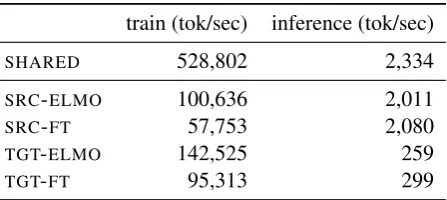
Pre-trained representations mostly impacts the training time of the sequence to sequence model (see Appendix B): SRC-ELMO slows throughput during training by about 5.3x and SRC-FT is even slower because of the need to backpropa-gate through the LM for fine-tuning (9.2x). How-ever, inference is only 12-14% slower than the baseline when adding pre-trained embeddings to the encoder (SRC-ELMO, SRC-FT). This is be-cause the LM computation can be paralelized for
ROUGE
1 2 L
Lead-3 40.34 17.70 36.57
See et al.(2017) 39.53 17.28 36.38 Gehrmann et al.(2018) 41.22 18.68 38.34
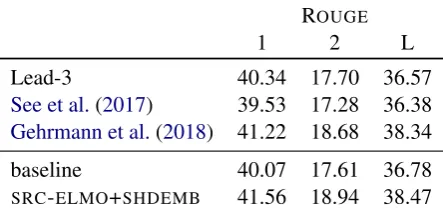
baseline 40.07 17.61 36.78 SRC-ELMO+SHDEMB 41.56 18.94 38.47
Table 3: Abstractive summarization results on CNN-DailyMail. ELMo inputs achieve a new state of the art.
all input tokens. Inference is much slower when adding representations to the decoder because the LM needs to be invoked repeatedly. Our current implementation does not cache LM operations for the previous state and can be made much faster.
The baseline uses a BPE vocabulary estimated on the language model corpora (§3). AppendixA shows that this vocabulary actually leads to sligtly better performance than a joint BPE code learned on the bitext as is usual.
Next, we validate our findings on the WMT’18 English-Turkish task for which the bitext is truly limited (208K sentence-pairs). We use the lan-guage model vocab for the the English side of the bitext and a BPE vocabulary learned on the Turk-ish side. Table2shows that ELMo embeddings for the encoder improve English-Turkish translation.
4.2 Abstractive summarization
Following See et al. (2017), we experiment on the non-anonymized version of CNN-DailyMail. When generating summaries, we follow standard practice of tuning the maximum output length and disallow repeating the same trigram (Paulus et al., 2017; Fan et al., 2017). For this task we train language model representations on the combina-tion of newscrawl and the CNN-DailyMail train-ing data. Table 3 shows that pre-trained em-beddings can significantly improve on top of a strong baseline transformer. We also compare to Gehrmann et al. (2018) who use a task-specific architecture compared to our generic sequence to sequence baseline. Pre-trained representations are complementary to their method.
5 Conclusion
[image:4.595.71.293.65.173.2]translation and abstractive document summariza-tion. Adding pre-trained representations is very effective for the encoder network and while re-turns diminish when more labeled data becomes available, we still observe improvements when millions of examples are available. In future re-search we will investigate ways to improve the de-coder with pre-trained representations.
References
Jimmy Lei Ba, Jamie Ryan Kiros, and Geoffrey E Hinton. 2016. Layer normalization. arXiv, abs/1607.06450.
Alexei Baevski and Michael Auli. 2018. Adaptive in-put representations for neural language modeling.
arXiv, abs/1809.10853.
Alexei Baevski, Sergey Edunov, Yinhan Liu, Luke Zettlemoyer, and Michael Auli. 2019. Cloze-driven pretraining of self-attention networks. arXiv.
Andrew M. Dai and Quoc V. Le. 2015. Semi-supervised sequence learning. arXiv, abs/1511.01432.
Jacob Devlin, Ming-Wei Chang, Kenton Lee, and Kristina Toutanova. 2018. Bert: Pre-training of deep bidirectional transformers for language understand-ing. CoRR, abs/1810.04805.
Angela Fan, David Grangier, and Michael Auli. 2017. Controllable abstractive summarization. arXiv, abs/1711.05217.
Sebastian Gehrmann, Yuntian Deng, and Alexander M Rush. 2018. Bottom-up abstractive summarization.
arXiv, abs/1808.10792.
Caglar Gulcehre, Orhan Firat, Kelvin Xu, Kyunghyun Cho, Loic Barrault, Huei-Chi Lin, Fethi Bougares, Holger Schwenk, and Yoshua Bengio. 2015. On us-ing monolus-ingual corpora in neural machine transla-tion. arXiv, abs/1503.03535.
Karl Moritz Hermann, Tom´aˇs Koˇcisk´y, Edward Grefenstette, Lasse Espeholt, Will Kay, Mustafa Su-leyman, and Phil Blunsom. 2015. Teaching ma-chines to read and comprehend. InProc. of NIPS.
Hakan Inan, Khashayar Khosravi, and Richard Socher. 2016. Tying word vectors and word classifiers: A loss framework for language modeling. arXiv, abs/1611.01462.
Diederik P. Kingma and Jimmy Ba. 2015. Adam: A Method for Stochastic Optimization. In Proc. of ICLR.
Philipp Koehn, Hieu Hoang, Alexandra Birch, Chris Callison-Burch, Marcello Federico, Nicola Bertoldi, Brooke Cowan, Wade Shen, Christine Moran,
Richard Zens, Chris Dyer, Ondrej Bojar, Alexandra Constantin, and Evan Herbst. 2007. Moses: Open source toolkit for statistical machine translation. In
Proc. of ACL Demo Session.
Chin-Yew Lin. 2004. Rouge: A package for automatic evaluation of summaries. InWorkshop on Text Sum-marization Branches Out.
Ilya Loshchilov and Frank Hutter. 2016. SGDR: stochastic gradient descent with restarts. arXiv, abs/1608.03983.
Ramesh Nallapati, Bowen Zhou, Caglar Gulcehre, Bing Xiang, et al. 2016. Abstractive text summa-rization using sequence-to-sequence rnns and be-yond. InProc. of CONLL.
Myle Ott, Sergey Edunov, Alexei Baevski, Angela Fan, Sam Gross, Nathan Ng, David Grangier, and Michael Auli. 2019. fairseq: A fast, extensible toolkit for sequence modeling. InProc. of NAACL System Demonstrations.
Myle Ott, Sergey Edunov, David Grangier, and Michael Auli. 2018. Scaling neural machine trans-lation. InProc. of WMT.
Kishore Papineni, Salim Roukos, Todd Ward, and Wei-Jing Zhu. 2002. BLEU: a method for automatic evaluation of machine translation. InProc. of ACL.
Romain Paulus, Caiming Xiong, and Richard Socher. 2017. A deep reinforced model for abstractive sum-marization.arXiv, abs/1705.04304.
Gabriel Pereyra, George Tucker, Jan Chorowski, Lukasz Kaiser, and Geoffrey E. Hinton. 2017. Reg-ularizing neural networks by penalizing confident output distributions. InInternational Conference on Learning Representations (ICLR) Workshop.
Matthew E Peters, Mark Neumann, Mohit Iyyer, Matt Gardner, Christopher Clark, Kenton Lee, and Luke Zettlemoyer. 2018. Deep contextualized word rep-resentations. InProc. of ACL.
Jason Phang, Thibault Fevry, and Samuel R. Bowman. 2018. Sentence encoders on stilts: Supplementary training on intermediate labeled-data tasks. arXiv, abs/1811.01088.
Matt Post. 2018. A call for clarity in reporting bleu scores. arXiv, abs/1804.08771.
Ofir Press and Lior Wolf. 2017. Using the output em-bedding to improve language models. In Proc. of EACL.
Alec Radford, Karthik Narasimhan, Tim Sali-mans, and Ilya Sutskever. 2018. Improving language understanding by generative pre-training.
Abigail See, Peter J Liu, and Christopher D Manning. 2017. Get to the point: Summarization with pointer-generator networks. InProc. of ACL.
Rico Sennrich, Barry Haddow, and Alexandra Birch. 2016. Neural machine translation of rare words with subword units. InProc. of ACL.
Ilya Sutskever, James Martens, George E. Dahl, and Geoffrey E. Hinton. 2013. On the importance of ini-tialization and momentum in deep learning. InProc. of ICML.
Christian Szegedy, Vincent Vanhoucke, Sergey Ioffe, Jonathon Shlens, and Zbigniew Wojna. 2015. Re-thinking the Inception Architecture for Computer Vision.arXiv preprint arXiv:1512.00567.
Ashish Vaswani, Noam Shazeer, Niki Parmar, Jakob Uszkoreit, Llion Jones, Aidan N. Gomez, Lukasz Kaiser, and Illia Polosukhin. 2017. Attention Is All You Need. InProc. of NIPS.
A Detailed WMT English-German Results
bitext method 2012 2013 2014 2015 2016 2017 2018 Avg
160K
baseline 13.2 15.7 13.5 15.7 18.6 14.8 21.4 16.1 SHARED 15.3 18.2 16.7 19.0 21.6 18.2 24.9 19.1 SHARED+bitext-BPE 15.1 17.9 16.2 18.9 22.0 18.0 25.2 19.0 SRC-ELMO 16.0 19.4 17.1 19.9 23.0 18.7 26.6 20.1 SRC-FT 15.3 18.5 16.6 18.9 20.8 17.6 24.3 18.9 TGT-ELMO 13.3 16.4 14.1 16.2 18.8 14.9 21.3 16.4 TGT-FT 14.7 17.2 15.8 18.4 21.4 16.9 24.2 18.4 SRC-ELMO+SHDEMB 17.4 20.8 18.6 21.5 24.9 20.3 29.0 21.8
320K
baseline 17.2 20.4 18.1 21.2 25.0 19.6 28.9 21.5 SHARED 18.1 21.1 19.1 22.4 26.3 21.2 30.6 22.7 SHARED+bitext-BPE 17.6 20.6 19.1 22.3 26.1 20.8 29.9 22.3 src-elmo 18.8 22.3 21.1 24.0 27.5 22.2 32.5 24.1 SRC-FT 19.0 22.5 20.9 23.5 26.9 22.2 32.1 23.9 TGT-ELMO 16.7 20.7 18.2 20.9 24.1 19.4 28.0 21.1 TGT-FT 16.1 19.4 17.1 20.0 23.1 18.5 26.3 20.1 SRC-ELMO+SHDEMB 19.5 22.9 21.2 24.0 27.4 22.4 32.3 24.2
640K
baseline 19.2 22.9 21.2 24.5 27.9 22.4 33.1 24.5 SHARED 19.9 23.4 22.1 25.1 28.8 23.0 34.1 25.2 SHARED+bitext-BPE 19.4 22.8 21.7 24.9 28.4 22.9 33.6 24.8 src-elmo 21.0 24.3 23.4 26.5 30.0 24.6 35.6 26.5 SRC-FT 20.5 24.0 22.9 26.1 29.1 24.4 34.9 26.0 TGT-ELMO 18.9 22.6 20.8 24.2 27.5 22.3 31.9 24.0 TGT-FT 18.2 21.8 20.6 23.7 27.0 21.8 31.4 23.5 SRC-ELMO+SHDEMB 21.2 25.1 23.9 26.7 30.2 24.7 36.2 26.9
1280K
baseline 20.9 24.6 23.6 26.5 30.5 24.7 36.2 26.7 SHARED 21.1 24.6 24.6 27.6 31.0 25.2 37.3 27.3 SHARED+bitext-BPE 20.5 24.0 23.9 26.2 30.6 24.8 36.2 26.6 src-elmo 22.1 25.7 25.7 28.5 31.7 26.3 38.2 28.3 SRC-FT 21.3 25.2 25.3 28.5 31.1 26.2 37.4 27.9 TGT-ELMO 20.9 24.4 23.6 26.6 30.3 24.9 36.1 26.7 TGT-FT 20.1 23.7 22.4 25.2 29.1 23.6 34.4 25.5 SRC-ELMO+SHDEMB 22.3 26.0 26.3 28.9 32.6 26.8 38.6 28.8
2560K
baseline 21.7 25.6 25.4 28.2 32.3 26.2 39.1 28.4 SHARED 22.2 25.9 25.7 28.3 32.1 26.3 38.9 28.5 SHARED+bitext-BPE 21.8 25.5 25.5 27.9 32.1 26.0 38.6 28.2 src-elmo 22.9 27.0 27.0 30.0 33.4 28.0 40.0 29.8
SRC-FT 22.2 26.4 26.3 29.5 32.4 27.3 39.3 29.1 TGT-ELMO 21.8 25.7 25.8 28.5 32.3 26.6 39.3 28.6 TGT-FT 21.5 25.3 24.5 27.0 30.2 25.2 36.8 27.2 SRC-ELMO+SHDEMB 23.1 27.2 27.1 29.7 33.7 27.9 40.0 29.8
5186K
baseline 23.1 26.8 27.7 30.1 33.6 27.9 40.1 29.9 SHARED 22.6 26.6 27.7 30.5 33.4 28.2 40.2 29.9 SHARED+bitext-BPE 22.5 26.0 27.0 29.7 33.4 27.7 40.6 29.6 src-elmo 23.7 27.8 28.7 31.1 34.5 29.2 41.8 31.0
[image:7.595.112.487.95.617.2]SRC-FT 23.1 27.0 27.8 30.5 33.7 28.3 40.8 30.2 TGT-ELMO 22.9 26.6 26.9 29.5 33.8 27.7 40.5 29.7 TGT-FT 22.3 26.1 26.1 28.9 32.5 26.5 38.8 28.7 SRC-ELMO+SHDEMB 23.4 28.0 28.8 31.2 34.5 28.7 41.8 30.9
B Training and inference speed
train (tok/sec) inference (tok/sec)
SHARED 528,802 2,334
SRC-ELMO 100,636 2,011
SRC-FT 57,753 2,080
TGT-ELMO 142,525 259
[image:8.595.189.413.94.194.2]TGT-FT 95,313 299