Original Article
Factors affecting patient survival and technical survival
in patients undergoing peritoneal dialysis
Erim Gulcan1, Veysel Kıdır1, Mustafa Keles2, Erdem Cankaya2, Abdullah Uyanik2, Fatma Saatci2 1Department of Nephrology, Dumlupinar University Faculty of Medicine, Kutahya, Turkey; 2Department of
Nephrology, Ataturk University Medical Faculty, Erzurum, Turkey
Received March 31, 2016; Accepted October 11, 2016; Epub January 15, 2017; Published January 30, 2017
Abstract: Background: This study was aretrospective investigation aimed at determining the factors affecting the termination of peritoneal dialysis (PD) in patients with end stage renal failure (ESRF). Methods: Patients monitored in our PD Unit between 2000 and 2012 were included in the study. Demographic, clinical, and laboratory data were recorded for each patient. Treatment outcomes (technical survival and patient survival) were obtained for the patients who dropped out of the PD treatment. These patients were separated into sub-groups according to ESRF etiologies, sociodemographic characteristics, working conditions, and properties related to PD. The survival data were analyzed by the Kaplan-Meierand Cox regression methods. Results: Of the 322 patients treated by PD, 249 dropped out of PD for reasons including exitus, peritonitis, renal transplantation, own request, dialysis, and ultrafiltration (UF) failure. Technical survival was significantly higher in patients who underwent PD under their own initiative, in patients with glomerulonephritis, and in patients whose first renal replacement treatment (RRT) was PD (P < 0.05). The key factor for technical survival was the albuminlevel at the end visit (P = 0.040). Low albumin levels at the last visit (P = 0.001, HR = 1.695) and patient age of 65 or over (P = 0.01, HR = 5.555) negatively affected patient survival, whereas active employment had a positive effect (P = 0.01, HR = 0.272). Conclusion: Technical survival and patient survival were affected by end visit albumin levels. Patient survival was also affected by patient age and employment status.
Keywords: Peritoneal dialysis, dropout, patient survival, technical survival
Introduction
Peritoneal dialysis (PD) is a treatment that should be preferred over hemodialysis (HD), considering its advantages in terms of good protection of remaining kidney function and superior patient survival time compared to HD in the early stages [1]. However, the number of patients undergoing PD treatment has decre- ased in recent years [2].
The use of PD as a treatment could be increas- ed by providing sufficient dialysis durations and ultrafiltration targets, encouraging patients to undergo the treatment, and minimizing some of the technical problems. Examination of patients who have undergone PD treatment initially and then HD treatment for any reason can be ben-eficial in determining the reasons for dropping out of PD treatment. In addition, determination of other reasons for termination of PD and
eval-uation of the maintenance time of peritoneal dialysis (PD technique or patient survival) may provide additional reasons.
Many factors could play a role in the declining use of PD, including the growth of large-scale organizations for dialysis, recurrent peritonitis, the HD transition of increasing numbers of patients who have undergone transplantation, PD catheter-related technical problems and the patient’s social and economic status [3]. The aim of the present study was to examine the factors that affect patient’s survival and techni-cal survival and the reasons for termination of PD in patients undergoing PD treatment. Methods
Subjects
versity Faculty of Medicine to investigate patients with chronic renal disease whose PD treatment was terminated for any reason. Patients who were still receiving treatment were also included. Patients who had initiated PD while under the age of 18, who had trans-ferred to other centers, or whose treatment was less than 3 months in duration were excluded from the study. Patient data were ret-rospectively obtained from registered follow-up files.
Data collection
The ageat initiation/termination of treatment, gender, marital status, occupation, educational status, and place of residence were determined for each patient from the records. The date of termination of treatment for each patient was used to determine monthly PD administration. The causes of end-stage renal failure in pa- tients, concomitant conditions (including com- orbid conditions), history of abdominal surgery, and lifestyle habits (such as smoking) were also determined.
Early and late complications related to PD cath-eters (leaks, camphor emergence, omental wrapping, and adhesions) and any infections (catheter exit site infections, peritonitis) or mechanical complications were scanned from the files. The reasons for termination of PD were then identified and recorded. For this pur -pose, the reasons for discontinuance of PD were identified (death, transition to hemodialy -sis, transplantation, etc.). The causes of death were also identified when possible.
Patients were divided into three groups: patients who were still undergoing PD ment, patients who had been lost to PD treat-ment, and patients who had transferred to hemodialysis. At the first visit and the end visit, several parameters, such as weight, height, body mass index (BMI), systolic blood pressure (SBP), diastolic blood pressure (DBP), complete blood count, biochemical parameters, and parathyroid hormone and ferritin levels, were measured and recorded for each patient. The initial method of renal replacement therapy and the reasons for choosing peritoneal dialy-sis were recorded for each group. Residual renal function (creatinine clearance) was ass- essed by collecting 24-hour urine after
initia-tion of PD treatment, one month later, and at the time of termination of PD (three months before the date of drop-out). Peritoneal clear-ance was calculated and determined on a weekly basis. Data from peritoneal equalization tests (PETs), Kt/Vurea, weekly creatinine clear-ance (CrCl), and nPNA tests were obtained from the record so fall patients at the initiation and termination of treatment [4-6].
The PD treatment etiology of the patients was used to plot survival curves by the Kaplan-Meier method and significant differences were determined by the log rank statistical method. Patients were further divided into subgroups based on gender (male or female), marital sta-tus (married or single, including widowed), edu-cational level (primary six and over), obesity (body mass index (BMI) ≥ 30 kg/m2) and non-obese (BMI < 30 kg/m2), age ≥ 65 years and age < 65 years, PD catheter insertion with per-cutaneous and surgical techniques, abdominal surgery, presence or absence of comorbid dis-eases or conditions (diabetes, cardiovascular disease, cerebrovascular disease, peripheral arterial disease, cancer, congestive heart fail-ure, chronic obstructive pulmonary disease, cir-rhosis, systemic collagen vascular disease, hands or feet, disability state), the initial renal replacement therapy (RRT) type (hemodialysis (HD) or PD), previous history of HD, treatment preference (mandatory or self-chosen), the per-son implementing dialysis (i.e., the patients themselves or another), place of residence (rural or city), professional groups, and physical activity (active or inactive) and PD treatment survival analysis. Factors affecting both patient survival and PD treatment survival were also investigated. The equilibration of the effects was provided by using Cox regression analysis lamination techniques when necessary for pair-wise comparisons that were significant for the effect of age and gender. The PD technique sur-vival was defined as the time to transitioning to HD, while PD treatment survival was defined as the time to death and the time to transitioning to HD.
Statistical analysis
Patient survival and technical survival indica-tors were determined with the Cox regression proportional hazards method. It was compared by logrank tests to determine differences between the survival curves. A P value of < 0.05 was considered to be statistically significant.
Results
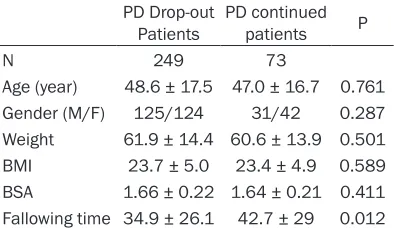
By the end of 2012, 355 patients received PD in our center. Patients who were under the age of 18 (n = 5), or had undergone PD treatment for less than 3 months (n = 8), or who had been transferred to another center (n = 20) were excluded from the study. The PD treatment of 249 in the remaining 322 patients (77.3%) was terminated during follow-up (Table 1).
The reasons for discontinuance of PD treat-ment are shown in Table 2. The most important reasons for this discontinuance were death (54.2%), peritonitis (16.9%); transplantation
(11.2%), the patient’s own request (6%), dialy-sis failure (4.4%), and ultrafiltration failure (2.0%). Rare causes were as follows, in order of frequency: improvement of renal function, peri-toneal adhesions, drainage problems, leaks, catheter malfunction, abdominal surgery, om- ental wrapping, sepsis, noncompliance with the treatment, and umbilical hernia.
The 5-year patient survival was 62% and the 1-, 3-, and 5-year technical survival rates were 91%, 67%, and 57%, respectively. These data did not include patients who underwent trans-plantation. Exclusion of deceased patients revealed the main reasons for transition to HD as peritonitis (48.8%), dialysis UF insufficiency (18.6%), and own request of the patient (17.4%). Increased duration of PD also changed the dis-tribution of dropout reasons.
Determinants of technical survival
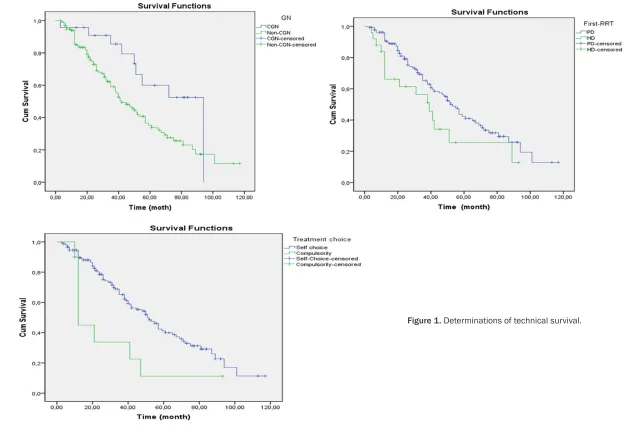
Patients with chronic glomerulonephritis (CGN) had a better survival (CGN 94 months, non-CGN 42 months; P = 0.020). The survival of patients who received PD as the initial RRT was better (PD 53 months, HD 39 months; P = 0.040). Survival was also better in patients who chose PD under their own initiative (own choice 51 months, mandatory 12 months; P = 0.015, Figure 1).
The results of baseline clinical and laboratory findings and residual renal function and perito -neal characteristics (taken in the first 1-3 months) prior to the end of the PD treatment (in the last 3 months) are shown in Table 3. Significant differences, indicated in red font in the Table, were found between patients with respect to age, albumin at the last visit, hemo-globin, and ALP levels (P < 0.05). Cox regres-sion analysis indicated that only the albumin level at the end visit had a significant effect on technical survival (Table 4).
Determinants of mortality
[image:3.612.91.288.86.200.2]No significant effect of gender on patient sur -vival was determined (men 30 months, women 49 months; P = 0.147). Although not statisti-cally significant, married patients had better survival compared to single patients (married 41 months, single 33 months; P = 0.498). Patients with high school and higher education level had better survival, although it was not statistically significant (primary education 36 Table 1. PD patients characteristic features
PD Drop-out
Patients PD continued patients P
N 249 73
Age (year) 48.6 ± 17.5 47.0 ± 16.7 0.761 Gender (M/F) 125/124 31/42 0.287 Weight 61.9 ± 14.4 60.6 ± 13.9 0.501 BMI 23.7 ± 5.0 23.4 ± 4.9 0.589 BSA 1.66 ± 0.22 1.64 ± 0.21 0.411 Fallowing time 34.9 ± 26.1 42.7 ± 29 0.012
[image:3.612.92.291.260.379.2]BMI: Body mass index, BSA: Body surface area.
Table 2. PD drop-out causes of patients un-dergoing PD treatment
Cause n %
Death 135 54.2
Peritonitis 42 16.9 Transplantation 28 11.2 Own request 15 6.0 Inadequate dialysis 11 4.4 Ultrafiltration failure 5 2.0 Catheter related other problems* 4 1.6
Others** 9 3.6
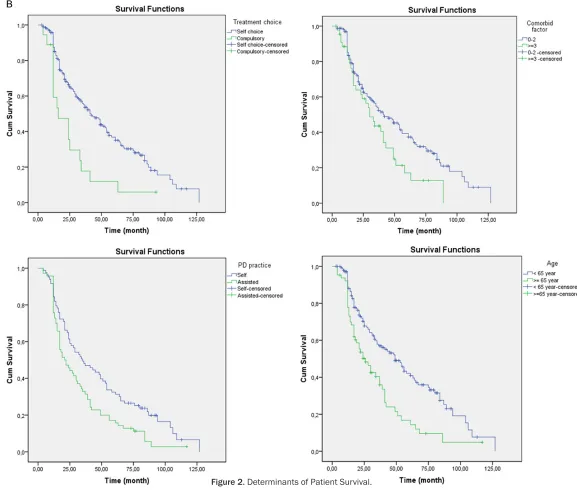
months, high school and over 58 months; P = 0.220). Employed patients had a significantly better survival than unemployed patients (employed 65 months, unemployed 25 months; P = 0.0001). Although not significant, the sur -vival of patients living closer to the dialysis cen-ter was betcen-ter (urban areas 39 months, rural areas 37 months; P = 0.529). Patient survival was worse in diabetes (DM) patients (DM 25 months, non-DM 45 months; P = 0.016). Patients with CGN had a better survival com-pared to patients without CGN (CGN 65 months, non-CGN 34 months; P = 0.004). Survival for
[image:5.612.96.521.97.413.2]patients with amyloidosis was worse, although not statistically significant (amyloidosis 24 months, non-amyloidosis 41 months, P = 0.083). Survival was better for patients who ini-tiated their RRT with PD (PD42 months, HD 24 months; P = 0.036). The survival was worse for patients who were mandatorily assigned PD (own choice 41 months, mandatory 16 months; P = 0.001). Patient survival was worse in patients with 3 or more comorbid conditions (≥ 2 conditions, 41 months, ≥ 3 conditions, 30 months; P = 0.022). Patient survival was better in patients who could conduct dialysis them-selves (self 35 months, assisted 21 months; P = 0.007). Patients aged 65 years and over had a poorer survival compared to younger patients (elderly 26 months, young 49 months; P = 0.0001, Figure 2A and 2B). Cox regression analysis revealed that age, employment, and albumin levels at the final visit were important determinants of patient survival (Table 5). Table 3. Clinical, laboratory and peritoneal dialysis and adequacy measures and residual renal func-tion indicators PD dropout (death or transfer of hemodialysis) and PD continued patients
PD continued Death P PD continued Transfer to HD P Gender (M/F) 31/42 71/64 0.147 31/42 40/46 0.363 Age 48 ± 16 56 ± 15 0.001 48 ± 16 41 ± 16 0.013 BMI 23 ± 5 25 ± 5 0.018 23 ± 5 22 ± 4 0.162 Alb-first visit 3.1 ± 0.7 3.2 ± 0.6 0.665 3.1 ± 0.7 3.2 ± 0.7 0.406 Alb-last visit 3.5 ± 0.5 2.8 ± 0.6 0.0001 3.5 ± 0.5 3.0 ± 0.6 0.006 Hb-first visit 8.4 ± 2.0 9.7 ± 1.9 0.01 8.4 ± 2.0 9.1 ± 2.2 0.244 Hb-last visit 10.9 ± 1.5 10.7 ± 2.3 0.700 10.9 ± 1.5 9.6 ± 2.0 0.016 PTH-first visit 455 ± 175 360 ± 346 0.255 455 ± 175 430 ± 435 0.807 Pth-last visit 366 ± 246 262 ± 337 0.213 366 ± 246 391 ± 417 0.806 Ferri-first visit 404 ± 311 444 ± 458 0.711 404 ± 311 520 ± 459 0.311 Ferri-last visit 365 ± 270 480 ± 417 0.259 365 ± 270 616 ± 594 0.083 ALP-first visit 188 ± 83 169 ± 124 0.623 188 ± 83 184 ± 119 0.918 ALP-last visit 243 ± 179 159 ± 104 0.017 243 ± 179 147 ± 118 0.019 Ca-first visit 7.7 ± 1.0 8.0 ± 1.0 0.288 7.7 ± 1.0 8.1 ± 1.0 0.226 Ca-last visit 8.6 ± 0.9 8.4 ± 1.0 0.614 8.6 ± 0.9 8.7 ± 0.8 0.504 P-first visit 5.2 ± 2.0 5.4 ± 1.9 0.748 5.2 ± 2.0 5.2 ± 1.4 0.996 P-last visit 4.7 ± 1.0 4.3 ± 1.6 0.371 4.7 ± 1.0 4.6 ± 1.5 0.849 nPNA-first visit 1.7 ± 1.1 0.9 ± 0.3 0.0001 1.7 ± 1.1 1.3 ± 1.0 0.329 nPNA-last visit 1.2 ± 0.5 0.7 ± 0.3 0.002 1.2 ± 0.5 1.0 ± 0.5 0.394 GFR-first visit 5.7 ± 4.3 4.6 ± 5.7 0.626 5.7 ± 4.3 4.0 ± 4.8 0.369 GFR-last visit 5.1 ± 5.4 1.8 ± 5.3 0.045 5.1 ± 5.4 3.8 ± 10.1 0.657 KT/V-first visit 2.3 ± 0.7 2.3 ± 1.0 0.883 2.3 ± 0.7 2.4 ± 0.7 0.801 KT/V-last visit 2.2 ± 0.6 2.0 ± 0.6 0.253 2.2 ± 0.6 2.1 ± 0.5 0.446
Abbreviations: PTH: Parathyroid hormone, UF: ultrafiltration, RRF: residual renal function, rGFH: residual glomerular filtration
rate, CrCl: creatinine clearance, nPNA: normalized protein equivalent, D/P creatinine: dialysate/plasma creatinine ratio.
Table 4. Factors, affecting technical survival according to Cox regression analysis
[image:5.612.91.287.481.537.2]Discussion
According to our findings, the most important reasons for termination of PD were death, peri-tonitis, and transplantation. These reasons were followed by transition to HD at the patient’s own request, insufficiency of dialysis, and insuf -ficiency of ultrafiltration. The factors affecting the duration of the PD treatment term were pri-marily ESRF (DM, CHN, and amyloidosis), the activity level of the patient, whether the patient had been mandatorily assigned the treatment, the presence of HD history, the ability of the patient to conduct self-treatment, and patient age. The ESRF etiologies significantly affected PD treatment durations. The lowest median PD treatment term was observed in patients with DM and amyloidosis, while the longest was observed in patients with CGN. Patient survi- val and technical survival rates were very good during the first year of PD treatment. At year 5, the decrease was somewhat greater than that reported at other centers. Sociodemographic characteristics, such as gender, marital status, education level, and proximity to the dialysis center, did not have statistically significant effects on the term of administration of PD. In physically active patients, the term of treat-ment was statistically significantly longer when compared to inactive patients. In patients who had received HD as the initial RRT, the PD term was shorter; it was longer in patients whose ini-tial RRT was PD. The duration was shortened in cases where the patient was mandatorily assigned PD. The PD survival decreased with an increase in comorbid conditions. PD survival was shorter in patients aged 65 years and over. Low albumin levels at the last visit negatively affected patient survival.
PD is an inexpensive ESRF treatment that provides patients with the ability to move freely. It has no differences in terms of survival when compared with HD and has similar end points [7, 8]. Consequently, the reduction in PD pa- tients in recent yearsis noteworthy [9].
The 5-year technical survival rate varies bet- ween countries. This rate has been reported as 83% in Japan, [10], 72% in Italy [11], 61% in Canada [12], and 55.7% in China [13]. In Turkey, Sipahioğlu et al. have reported a 5-year survival rate of 66.7% [14]. In our study, the 5-year tech-nical survival rate was 57%. This relatively lower result may be due to regional differences (poor hygiene, low educational level, and low socio-economic level).
In Japan, the primary cause of technical failure was reported as a loss of UF [10, 15, 16]. Nakamoto et al., in a study conducted in Japan on 139 PD patients, reported that three prima-ry reasons for transition to HD were UF insuffi -ciency or non-compliance with salt-water res- triction (34.1%), peritonitis (30.1%), and choice of physician or family (6.5%) [16]. Ke et al. con-ducted an observational study in China on 130 PD patients and reported the most important reasons for technical insufficiency were dialysis insufficiency (28.5%) and peritonitis (21.4%) [17]. A multi-center study conducted in Italy found the most frequent causes of technical insufficiency were peritonitis (36.7%) and insuf -ficient dialysis (16.7%) [18]. The results of our study are similar to the study in Italy. The high rates of peritonitis in our country, compared to Japan and China, may be related to poor sanita-tion and failure to provide adequate training. Hypoalbuminemia has previously been report-ed to have a negative effect on technical sur-vival [19]. A similar finding was observed in the present study, where low albumin level, particu-larly at the last visit, negatively affected the technical survival. A lower technical survival has also been reported for diabetic patients [20]. In our study, technical insufficiency was more prevalent in patients with diabetes mellitus.
[image:8.612.91.287.96.151.2]Several studies have reported that technical survival was affected by treatment preference. Koç et al. demonstrated that patients who were mandatorily assigned PD treatment, rather than choosing it on their own initiative, had poorer PD treatment survival. This poorer sur-vival in these patients could be due to comor-bid conditions [21]. In the patients who had previously received HD treatment, most of the transitions (70%) could be due to vascular prob-lems and this could adversely affect patient and technical survival [14]. If the choice of Table 5. Factors affecting patient survival
ac-cording to Cox regression analysis
treatment is a person’s own decision, then the compliance with the treatment may increase [22]. In our study, mandatory assignment of PD treatment had a negative effect on technical survival. Therefore, mandatory assignment of PD can be said to accompany bad endpoints. The various studies report differences in death as the most important reason for drop-out of PD. Kawaguchi et al. examined 282 patients who had discontinued peritoneal dialysis and reported a mortality rate of 32.3% [23]. In other studies, the mortality rates have been reported as 27.4% [24], 39.7% [25], and 40.3% [26]. Sanchez et al. reported a mortality rate of 57% in patients whose PD treatment was terminat-ed and who were treatterminat-ed with CAPD [27]. In our patient group, death was the most important reason for PD treatment termination and approximately half the patients discontinued treatment for this reason. These results were similar to recent studies. Comparison of our findings to the first study gave a mortality rate half of that reported, while comparison to the second study gave a higher rate. The reason for these discrepancies can be geographic, socio-cultural, and genetic factors of the patients, as well as an impact of the treatment center. Many studies have reported hypoalbuminemia as one of the important determinants of patient survival, in particular in CKD patients [28-31]. In our study, similar to previous studies, low albumin level had a negative effect on patient survival. Studies have also reported that the survival was dramatically decreased in patients over 65 years of age [32, 33]. Our study showed similar results, as Cox regression analysis indi-cated that the most important factor negatively affecting patient survival was the increase in age.
In our study, the PD patients who were actively working (physically) had a significantly higher patient survival rate when compared to the inactive (non-employed) patients. A previous study reported that PD patients who decreased their physical activity were more likely to experi-ence depression and insomnia [34]. Our results can be explained by taking this earlier study into account: our patients who were inactive, older, or bedridden may have had a tendency toward depression and chronic fatigue syn-drome. Consideration of age status in our study indicated that the average age of inactive
patients was statistically higher when com-pared to the active patients. The PD technical survival difference was thought to be related to this. However, even after accounting for patient age, physical activity was found to have a significant effect on survival. According to these results, physical activity (employment) status has a protective effect on PD technical survival.
Consequently, the reasons for termination of PD were death, peritonitis, and transplantation. Peritonitis was the most important reason for leaving PD, although this may change since the rate of transplantation is increasing. The albu-min levels affected both technical and patient survival, while the treatment choice had a near-significant effect on technical survival. Adv-nced age negatively affected patient survival, whereas the employment status of patients positively and significantly affected their survival.
Disclosure of conflict of interest
None.
Address correspondence to: Dr. Erim Gulcan, De- partment of Nephrology, Dumlupinar University Faculty of Medicine, Kutahya, Turkey. Tel: +90 5056887688; Fax: +90 2742652286; E-mail: [email protected]
References
[1] Tokgoz B. Clinical advantages of peritoneal di-alysis. Perit Dial Int 2009; 29 Suppl 2: 59-61. [2] Chiu YW, Mehrotra R. The utilization and
out-come of peritoneal dialysis. In: Himmelfarb J, Sayegh MH, editors. Chronic kidney disease, dialysis, and transplantation companion to Brenner & Rector’s the kidney. Philadelphia: Saunders; 2010. pp. 405-416.
[3] Chaudhary K. Peritoneal dialysis drop-out: ca- uses and prevention strategies. Int J Nephrol 2011; 2011: 434608.
[4] Rotter RC, Manzano AC, Khanna R. Peritoneal Dialysis. In: Tall MV, Cherlow GM, Marsden FA, Skoecki K, Yu ASL, Brenner BM, editors. Brenner the kidney. Philadelphia: Saunders; 2011. pp. 2347-2370.
[6] Blake PG, Bargman JM, Brimble KS, Davison SN, Hirsch D, McCormick BB, Suri RS, Taylor P, Zalunardo N, Tonelli M; Canadian Society of Nephrology Work Group on Adequacy of Peritoneal Dialysis. Clinical practice guidelines and recommendations on peritoneal dialysis adequacy 2011. Perit Dial Int 2011; 31: 218-239.
[7] Mehrotra R, Chiu YW, Kalantar-Zadeh K, Bargman J, Vonesh E. Similar outcomes with hemodialysis and peritoneal dialysis in pa-tients with end-stage renal disease. Arch Intern Med 2011; 171: 110-118.
[8] Yeates K, Zhu N, Vonesh E, Trpeski L, Blake P, Fenton S. Hemodialysis and peritoneal dialysis are associated with similar outcomes for end-stage renal disease treatment in Canada. Nephrol Dial Transplant 2012; 27: 3568-3575. [9] Blake P. Proliferation of hemodialysis units and
declining peritoneal dialysis use: an interna-tional trend. Am J Kidney Dis 2009; 54: 194-196.
[10] Honda M. The 1997 reports of the Japanese national registry data on pediatric peritoneal dialysis patients. Perit Dial Int 1999; 19 Suppl 2: S473-478.
[11] Maiorca R, Cancarini GC, Zubani R, Camerini C, Manili L, Brunori G, Movilli E. CAPD viability: a long-term comparison with hemodialysis. Perit Dial Int 1996; 16: 276-287.
[12] Marcelli D, Spotti D, Conte F, Tagliaferro A, Limido A, Lonati F, Malberti F, Locatelli F. Survival of diabetic patients on peritoneal di-alysis or hemodidi-alysis. Perit Dial Int 1996; 16 Suppl 1: S283-287.
[13] Zhang F, Liu H, Gong X, Liu F, Peng Y, Cheng M, Zhang H, Liu Y, Liu Y, Guo C. Risk factors for mortality in Chinese patients on continuous ambulatory peritoneal dialysis. Perit Dial Int 2015; 35: 199-205.
[14] Sipahioglu MH, Aybal A, Unal A, Tokgoz B, Oymak O, Utas C. Patient and technique sur-vival and factors affecting mortality on perito-neal dialysis in Turkey: 12 years’ experience in a single center. Perit Dial Int 2008; 28: 238-245.
[15] Kawaguchi Y. National comparisons: optimal peritoneal dialysis outcomes among Japanese patients. Perit Dial Int 1999; 19 Suppl 3: S9-16.
[16] Nakamoto H, Kawaguchi Y, Suzuki H. Is tech-nique survival on peritoneal dialysis better in Japan? Perit Dial Int 2006; 26: 136-143. [17] Ke CL, Hsieh YP, Yang Y. Mortality and
tech-nique failure in peri-toneal dialysis patients using different dialysate characteristics. Acta Nephrologica 2013; 27: 90-98.
[18] Marinangeli G, Cabiddu G, Neri L, Viglino G, Russo R, Teatini U; Italian Society of Nephrology
Peritoneal Dialysis Study Group. Old and new perspectives on peritoneal dialysis in Italy emerging from the peritoneal dialysis study group census. Perit Dial Int 2012; 32: 558-565.
[19] Isla RA, Mapiye D, Swanepoel CR, Rozumyk N, Hubahib JE, Okpechi IG. Continuous ambula-tory peritoneal dialysis in Limpopo province, South Africa: predictors of patient and tech-nique survival. Perit Dial Int 2014; 34: 518-525.
[20] Guo A, Mujais S. Patient and technique surviv-al on peritonesurviv-al disurviv-alysis in the United States: evaluation in large incident cohorts. Kidney Int Suppl 2003; S3-12.
[21] Zhang X, Han F, He Q, Huang H, Yin X, Ge J, Chen J. Outcomes and risk factors for mortality after transfer from hemodialysis to peritoneal dialysis in uremic patients. Perit Dial Int 2008; 28: 313-314.
[22] Koc Y, Unsal A, Basturk T, Sakaci T, Ahbap-Dal E, Sinangil-Arar A, Kose-Budak S, Kayabasi H. Is there impact of mortality prior hemodialy-sis therapy in peritoneal dialyhemodialy-sis patients? Nefrologia 2012; 32: 335-342.
[23] Kawaguchi Y, Ishizaki T, Imada A, Oohira S, Kuriyama S, Nakamoto H, Nakamoto M, Hiramatu M, Maeda K, Ota K. Study group for withdrawal from PD in Japan. Searching for the reasons for drop-out from peritoneal dialy-sis: a nationwide survey in Japan. Perit Dial Int 2003; 23 Suppl 2: 175-177.
[24] Sarı F, Sarıkaya M, Güneş AJ, Eren M, Korkmaz A, Çetinkaya R. The evaluation of the causes of discontinuation in patients undergoing contin-uous ambulotory peritoneal dialysis. Turk Klin J Med Sci 2011; 3: 805-808.
[25] Mizuno M, Ito Y, Tanaka A, Suzuki Y, Hiramatsu H, Watanabe M, Tsuruta Y, Matsuoka T, Ito I, Tamai H, Kasuga H, Shimizu H, Kurata H, Inaguma D, Hiramatsu T, Horie M, Naruse T, Maruyama S, Imai E, Yuzawa Y, Matsuo S. Peritonitis is still an important factor for with-drawal from peritoneal dialysis therapy in the Tokai area of Japan. Clin Exp Nephrol 2011; 15: 727-737.
[26] Dervişoğlu E, Selek A, Özcan U, Kalender B. Reasons for dropping-out of peritoneal dialysıs in chronic renal failure patients undergoing continuous ambulatory peritoneal dialysis. Turk Klin J Med Sci 2007; 27: 184-188. [27] Sanchez AR, Madonia C, Rascon-Pacheco RA.
[28] Kalantar-Zadeh K, Kilpatrick RD, Kuwae N, McAllister CJ, Alcorn H, Kopple JD, Greenland S. Revisiting mortality predictability of serum albumin in the dialysis population: time depen-dency, longitudinal changes and population-attributable fraction. Nephrol Dial Transplant 2005; 14: 1880.
[29] Honda H, Qureshi AR, Heimbürger O, Barany P, Wang K, Pecoits-Filho R, Stenvinkel P, Lindholm B. Serum albumin, C-reactive protein, interleu-kin 6, and fetuin a as predictors of malnutri-tion, cardiovascular disease, and mortality in patients with ESRD. Am J Kidney Dis 2006; 14: 139-148.
[30] Yang X, Yi C, Liu X, Guo Q, Yang R, Cao P, Lin J, Mao H, Yu X. Clinical outcome and risk factors for mortality in Chinese patients with diabetes on peritoneal dialysis: a 5-year clinical cohort study. Diabetes Res Clin Pract 2013; 100: 354-361.
[31] Guan JC, Bian W, Zhang XH, Shou ZF, Chen JH. Influence of peritoneal transport characteris-tics on nutritional status and clinical outcome in Chinese diabetic nephropathy patients on peritoneal dialysis. Chin Med J (Engl) 2015; 128: 859-864.
[32] Fried LF, Shlipak MG, Crump C, Bleyer AJ, Gottdiener JS, Kronmal RA, Kuller LH, Newman AB. Renal insufficiency as a predictor of cardio-vascular outcomes and mortality in elderly in-dividuals. J Am Coll Cardiol 2003; 41: 1364-1372.
[33] Manjunath G, Tighiouart H, Coresh J, Macleod B, Salem DN, Griffith JL, Levey AS, Sarnak MJ. Level of kidney function as a risk factor for car-diovascular outcomes in the elderly. Kidney Int 2003; 63: 1121-1129.