Traversing Knowledge Graphs in Vector Space
Kelvin Guu Stanford University
John Miller Stanford University
Percy Liang Stanford University
Abstract
Path queries on a knowledge graph can be used to answer compositional ques-tions such as “What languages are spoken by people living in Lisbon?”. However, knowledge graphs often have missing facts (edges) which disrupts path queries. Re-cent models for knowledge base comple-tion impute missing facts by embedding knowledge graphs in vector spaces. We show that these models can be recursively applied to answer path queries, but that they suffer from cascading errors. This motivates a new “compositional” training objective, which dramatically improves all models’ ability to answer path queries, in some cases more than doubling accuracy. On a standard knowledge base comple-tion task, we also demonstrate that com-positional training acts as a novel form of structural regularization, reliably improv-ing performance across all base models (reducing errors by up to 43%) and achiev-ing new state-of-the-art results.
1 Introduction
[image:1.595.344.488.209.341.2]Broad-coverage knowledge bases such as Free-base (Bollacker et al., 2008) support a rich array of reasoning and question answering applications, but they are known to suffer from incomplete cov-erage (Min et al., 2013). For example, as of May 2015, Freebase has an entity Tad Lincoln (Abra-ham Lincoln’s son), but does not have his ethnic-ity. An elegant solution to incompleteness is using vector space representations: Controlling the di-mensionality of the vector space forces generaliza-tion to new facts (Nickel et al., 2011; Nickel et al., 2012; Socher et al., 2013; Riedel et al., 2013; Nee-lakantan et al., 2015). In the example, we would hope to infer Tad’s ethnicity from the ethnicity of his parents.
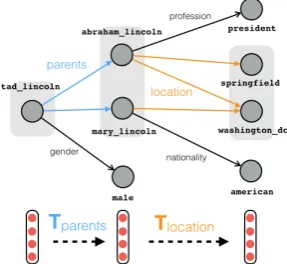
Figure 1: We propose performing path queries such as tad lincoln/parents/location (“Where
are Tad Lincoln’s parents located?”) in a parallel low-dimensional vector space. Here, entity sets (boxed) are represented as real vectors, and edge traversal is driven by vector-to-vector transforma-tions (e.g., matrix multiplication).
However, what is missing from these vector space models is the original strength of knowledge bases: the ability to support compositional queries (Ullman, 1985). For example, we might ask what the ethnicity of Abraham Lincoln’s daugh-ter would be. This can be formulated as a path query on the knowledge graph, and we would like a method that can answer this efficiently, while generalizing over missing facts and even missing or hypothetical entities (Abraham Lincoln did not in fact have a daughter).
In this paper, we present a scheme to answer path queries on knowledge bases by “composi-tionalizing” a broad class of vector space mod-els that have been used for knowledge base com-pletion (see Figure 1). At a high level, we inter-pret the base vector space model as implementing a soft edge traversal operator. This operator can then be recursively applied to predict paths. Our interpretation suggests a newcompositional train-ing objective that encourages better modeling of
paths. Our technique is applicable to a broad class of composable models that includes the bilinear model (Nickel et al., 2011) and TransE (Bordes et al., 2013).
We have two key empirical findings: First, we show that compositional training enables us to answer path queries up to at least length 5 by substantially reducing cascading errors present in the base vector space model. Second, we find that somewhat surprisingly, compositional train-ing also improves upon state-of-the-art perfor-mance for knowledge base completion, which is a special case of answering unit length path queries. Therefore, compositional training can also be seen as a new form of structural regularization for ex-isting models.
2 Task
We now give a formal definition of the task of an-swering path queries on a knowledge base. Let E be a set of entities and R be a set of binary relations. A knowledge graph G is defined as a set of triples of the form (s, r, t) where s, t ∈ E andr ∈ R. An example of a triple in Freebase is (tad lincoln,parents,abraham lincoln).
A path queryqconsists of an initialanchor en-tity, s, followed by a sequence of relations to be traversed,p = (r1, . . . , rk). The answer or
deno-tation of the query,JqK, is the set of all entities that can be reached fromsby traversing p. Formally, this can be defined recursively:
JsKdef= {s}, (1)
Jq/rKdef= {t:∃s∈JqK,(s, r, t)∈ G}. (2)
For example, tad lincoln/parents/location is a
queryq that asks: “Where did Tad Lincoln’s par-ents live?”.
For evaluation (see Section 5 for details), we de-fine the set of candidate answers to a queryC(q) as the set of all entities that “type match”, namely those that participate in the final relation of q at least once; and letN(q)be the incorrect answers:
C(s/r1/· · ·/rk)def= {t| ∃e,(e, rk, t)∈ G} (3)
N (q)def= C(q)\JqK. (4) Knowledge base completion. Knowledge base completion (KBC) is the task of predicting whether a given edge(s, r, t)belongs in the graph or not. This can be formulated as a path query
q=s/rwith candidate answert.
3 Compositionalization
In this section, we show how to compositional-ize existing KBC models to answer path queries. We start with a motivating example in Section 3.1, then present the general technique in Section 3.2. This suggests a new compositional training objec-tive, described in Section 3.3. Finally, we illus-trate the technique for several more models in Sec-tion 3.4, which we use in our experiments. 3.1 Example
A common vector space model for knowledge base completion is the bilinear model (Nickel et al., 2011). In this model, we learn a vectorxe ∈
Rdfor each entitye∈ E and a matrixWr∈Rd×d
for each relationr ∈ R. Given a querys/r (ask-ing for the set of entities connected tosvia relation
r), the bilinear model scores how likelyt∈Js/rK
holds using
score(s/r, t) =x>
sWrxt. (5)
To motivate our compositionalization tech-nique, take d = |E| and suppose Wr is the
ad-jacency matrix for relationr and entity vectorxe
is the indicator vector with a 1 in the entry corre-sponding to entitye. Then, to answer a path query
q=s/r1/ . . . /rk, we would then compute
score(q, t) =x>
sWr1. . . Wrkxt. (6)
It is easy to verify that the score counts the number of unique paths between s and t following rela-tionsr1/ . . . /rk. Hence, anytwith positive score
is a correct answer (JqK={t:score(q, t)>0}). Let us interpret (6) recursively. The model be-gins with an entity vector xs, and sequentially
applies traversal operatorsTri(v) = v>Wri for
each ri. Each traversal operation results in a
new “set vector” representing the entities reached at that point in traversal (corresponding to the nonzero entries of the set vector). Finally, it ap-plies themembership operator M(v, xt) = v>xt
to check if t ∈ Js/r1/ . . . /rkK. Writing graph
traversal in this way immediately suggests a useful generalization: takedmuch smaller than|E| and learn the parametersWrandxe.
3.2 General technique
has a scoring function of the form:
score(s/r, t) =M(Tr(xs), xt) (7)
for some choice of membership operatorM:Rd×
Rd→Rand traversal operatorTr:Rd→Rd.
We can now define the vector denotation of a query JqKV analogous to the definition of JqK in (1) and (2):
JsKVdef= xs, (8)
Jq/rKVdef= Tr(JqKV). (9)
The score function for a compositionalized model is then
score(q, t) =M(JqKV,JtKV). (10)
We would like JqKV to approximately represent the set JqK in the sense that for every e ∈ JqK, M(JqKV,JeKV) is larger than the values for e 6∈
JqK. Of course it is not possible to represent all sets perfectly, but in the next section, we present a training objective that explicitly optimizesT and Mto preserve path information.
3.3 Compositional training
The score function in (10) naturally suggests a new compositional training objective. Let{(qi, ti)}Ni=1
denote a set of path query training examples with path lengths ranging from 1 to L. We minimize the following max-margin objective:
J(Θ) =XN
i=1
X
t0∈N(qi)
1−margin(qi, ti, t0)+,
margin(q, t, t0) =score(q, t)−score(q, t0),
where the parameters are the membership opera-tor, the traversal operators, and the entity vectors:
Θ ={M} ∪ {Tr:r∈ R} ∪
n
xe ∈Rd:e∈ E
o
.
This objective encourages the construction of “set vectors”: because there are path queries of different lengths and types, the model must learn to produce an accurate set vector JqKV after any sequence of traversals. Another perspective is that each traversal operator is trained such that its transformation preserves information in the set vector which might be needed in subsequent traversal steps.
In contrast, previously proposed training objec-tives for knowledge base completion only train on
queries of path length 1. We will refer to this spe-cial case assingle-edge training.
In Section 5, we show that compositional train-ing leads to substantially better results for both path query answering and knowledge base com-pletion. In Section 6, we provide insight into why.
3.4 Other composable models
There are many possible candidates forTandM. For example,Tcould be one’s favorite neural net-work mapping fromRdtoRd. Here, we focus on
two composable models that were both recently shown to achieve state-of-the-art performance on knowledge base completion.
TransE. The TransE model of Bordes et al. (2013) uses the scoring function
score(s/r, t) =−kxs+wr−xtk22. (11)
wherexs,wrandxtare alld-dimensional vectors.
In this case, the model can be expressed using membership operator
M(v, xt) =−kv−xtk22 (12)
and traversal operator Tr(xs) = xs + wr.
Hence, TransE can handle a path query q =
s/r1/r2/· · ·/rkusing
score(q, t) =−kxs+wr1 +· · ·+wrk−xtk22.
We visualize the compositional TransE model in Figure 2.
Bilinear-Diag. The Bilinear-Diag model of Yang et al. (2015) is a special case of the bilinear model with the relation matrices constrained to be diagonal. Alternatively, the model can be viewed as a variant of TransE with multiplicative interac-tions between entity and relation vectors.
Not all models can be compositionalized. It is important to point out that some models are not naturally composable—for example, the latent feature model of Riedel et al. (2013) and the neu-ral tensor network of Socher et al. (2013). These approaches have scoring functions which combine
WordNet Freebase
Relations 11 13
Entities 38,696 75,043 Base TrainTest 112,58110,544 316,23223,733
[image:4.595.88.275.63.157.2]Paths Train 2,129,539 6,266,058Test 46,577 109,557
Table 1: WordNet and Freebase statistics for base and path query datasets.
3.5 Implementation
We use AdaGrad (Duchi et al., 2010) to optimize
J(Θ), which is in general non-convex. Initial-ization scale, mini-batch size and step size were cross-validated for all models. We initialize all parameters with i.i.d. Gaussians of variance 0.1 in every entry, use a mini-batch size of 300 examples, and a step size in [0.001,0.1] (chosen via cross-validation) for all of the models. For each exam-pleq, we sample 10 negative entitiest0 ∈ N(q). During training, all of the entity vectors are con-strained to lie on the unit ball, and we clipped the gradients to the median of the observed gradients if the update exceeded 3 times the median.
We first train on path queries of length 1 until convergence and then train on all path queries until convergence. This guarantees that the model mas-ters basic edges before composing them to form paths. When training on path queries, we explic-itly parameterize inverse relations. For the bilinear model, we initializeWr−1 withWr>. For TransE, we initializewr−1 with −wr. For Bilinear-Diag, we found initializing wr−1 with the exact inverse 1/wr is numerically unstable, so we instead
ran-domly initializewr−1 with i.i.d Gaussians of vari-ance 0.1 in every entry. Additionally, for the bi-linear model, we replaced the sum overN(qi) in
the objective with a max since it yielded slightly higher accuracy. Our models are implemented us-ing Theano (Bastien et al., 2012; Bergstra et al., 2010).
4 Datasets
In Section 4.1, we describe two standard knowl-edge base completion datasets. These consist of single-edge queries, so we call thembase datasets. In Section 4.2, we generate path query datasets from these base datasets.
4.1 Base datasets
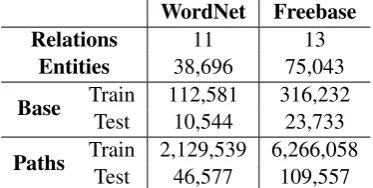
Our experiments are conducted using the sub-sets of WordNet and Freebase from Socher et al. (2013). The statistics of these datasets and their splits are given in Table 1.
The WordNet and Freebase subsets exhibit sub-stantial differences that can influence model per-formance. The Freebase subset is almost bipartite with most of the edges taking the form(s, r, t)for somepersons, relationrand propertyt. In Word-Net, both the source and target entities are arbi-trary words.
Both the raw WordNet and Freebase contain many relations that are almost perfectly correlated with an inverse relation. For example, WordNet contains bothhas partandpart of, and Freebase
contains bothparentsandchildren. At test time,
a query on an edge(s, r, t)is easy to answer if the inverse triple(t, r−1, s)was observed in the
train-ing set. Followtrain-ing Socher et al. (2013), we ac-count for this by excluding such “trivial” queries from the test set.
4.2 Path query datasets
Given a base knowledge graph, we generate path queries by performing random walks on the graph. If we view compositional training as a form of reg-ularization, this approach allows us to generate ex-tremely large amounts of auxiliary training data. The procedure is given below.
LetGtrain be the training graph, which consists
only of the edges in the training set of the base dataset. We then repeatedly generate training ex-amples with the following procedure:
1. Uniformly sample a path length L ∈ {1, . . . , Lmax}, and uniformly sample a
start-ing entitys∈ E.
2. Perform a random walk beginning at entitys
and continuingLsteps.
(a) At stepiof the walk, choose a relation
riuniformly from the set of relations in-cident on the current entitye.
(b) Choose the next entity uniformly from the set of entities reachable viari.
3. Output a query-answer pair,(q, t), whereq =
s/r1/· · ·/rL and t is the final entity of the
In practice, we do not sample paths of length 1 and instead directly add all of the edges fromGtrainto
the path query dataset.
To generate a path query test set, we repeat the above procedure except using the graphGfull,
which isGtrainplus all of the test edges from the
base dataset. Then we remove any queries from the test set that also appeared in the training set. The statistics for the path query datasets are pre-sented in Table 1.
5 Main results
We evaluate the models derived in Section 3 on two tasks: path query answering and knowledge base completion. On both tasks, we show that the compositional training strategy proposed in Sec-tion 3.3 leads to substantial performance gains over standard single-edge training. We also com-pare directly against the KBC results of Socher et al. (2013), demonstrating that previously inferior models now match or outperform state-of-the-art models after compositional training.
Evaluation metric. Numerous metrics have been used to evaluate knowledge base queries, in-cluding hits at 10 (percentage of correct answers ranked in the top 10) and mean rank. We evaluate on hits at 10, as well as a normalized version of mean rank,mean quantile, which better accounts for the total number of candidates. For a queryq, the quantile of a correct answertis the fraction of incorrect answers ranked aftert:
|{t0 ∈ N(q) :score(q, t0)<score(q, t)}| |N(q)| (13)
The quantile ranges from 0 to 1, with 1 being opti-mal. Mean quantile is then defined to be the aver-age quantile score over all examples in the dataset. To illustrate why normalization is important, con-sider a set of queries on the relation gender. A
model that predicts the incorrect gender on ev-ery quev-ery would receive a mean rank of 2 (since there are only 2 candidate answers), which is fairly good in absolute terms, whereas the mean quantile would be 0, rightfully penalizing the model.
As a final note, several of the queries in the Freebase path dataset are “type-match trivial” in the sense that all of the type matching candidates C(q)are correct answers to the query. In this case, mean quantile is undefined and we exclude such queries from evaluation.
Overview. The upper half of Table 2 shows that compositional training improves path query-ing performance across all models and metrics on both datasets, reducing error by up to76.2%.
The lower half of Table 2 shows that surpris-ingly, compositional training also improves per-formance on knowledge base completion across almost all models, metrics and datasets. On Word-Net, TransE benefits the most, with a43.3% re-duction in error. On Freebase, Bilinear benefits the most, with a38.8%reduction in error.
In terms of mean quantile, the best overall model is TransE (COMP). In terms of hits at 10, the
best model on WordNet is Bilinear (COMP), while
the best model on Freebase is TransE (COMP).
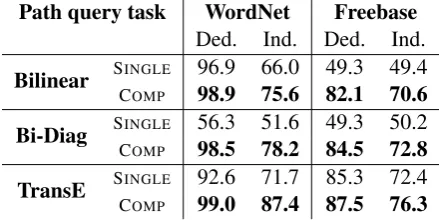
Deduction and Induction. Table 3 takes a deeper look at performance on path query answer-ing. We divided path queries into two subsets: de-ductionandinduction. Thedeductionsubset con-sists of queriesq =s/pwhere the source and tar-get entitiesJqKare connected via relationspin the training graphGtrain, but the specific queryqwas
never seen during training. Such queries can be answered by performing explicit traversal on the training graph, so this subset tests a model’s abil-ity to approximate the underlying training graph and predict the existence of a path from a collec-tion of single edges. Theinductionsubset consists of all other queries. This means that at least one edge was missing on all paths following p from source to target in the training graph. Hence, this subset tests a model’s generalization ability and its robustness to missing edges.
Performance on the deduction subset of the dataset is disappointingly low for models trained with single-edge training: they struggle to answer path queries even whenall edges in the path query have been seen at training time. Compositional training dramatically reduces these errors, some-times doubling mean quantile. In Section 6, we analyze how this might be possible. After com-positional training, performance on the harder in-ductionsubset is also much stronger. Even when edges are missing along a path, the models are able to infer them.
Bilinear Bilinear-Diag TransE
Path query task SINGLE COMP (%red) SINGLE COMP (%red) SINGLE COMP (%red)
WordNet H@10MQ 84.743.6 89.454.3 30.719.0 59.77.9 90.431.1 76.225.4 13.883.7 43.593.3 58.934.5
Freebase H@10MQ 58.025.9 83.542.1 60.721.9 23.157.9 84.838.6 63.920.2 45.486.2 50.588 13.09.3 KBC task SINGLE COMP (%red) SINGLE COMP (%red) SINGLE COMP (%red)
WordNet H@10MQ 76.119.2 82.027.3 24.710.0 76.512.9 14.484.3 33.21.72 75.54.6 16.586.1 43.312.5
[image:6.595.73.523.61.213.2]Freebase H@10MQ 85.370.2 91.076.4 38.820.8 63.284.6 89.167.0 29.210.3 78.892.7 78.692.8 1.37-0.9
Table 2: Path query answering and knowledge base completion. We compare the performance of single-edge training (SINGLE) vs compositional training (COMP). MQ: mean quantile, H@10: hits at 10,
%red: percentage reduction in error.
Interpretable Queries BilinearSINGLE BilinearCOMP X/institution/institution−1/profession 50.0 93.6
X/parents/religion 81.9 97.1
X/nationality/nationality−1/ethnicity−1 68.0 87.0
X/has part/has instance−1 92.6 95.1
[image:6.595.120.479.276.356.2]X/type of/type of/type of 72.8 79.4
Table 4: Path query performance (mean quantile) on a selection of interpretable queries. We compare BilinearSINGLEand BilinearCOMP. Meanings of each query (descending): “What professions are there
at X’s institution?”; “What is the religion of X’s parents?”; “What are the ethnicities of people from the same country as X?”; “What types of parts does X have?”; and the transitive “What is X a type of?”. (Note that a relationrand its inverser−1do not necessarily cancel out ifris not a one-to-one mapping.
For example, X/institution/institution−1 denotes the set of all people who work at the institution X works at, which is not just X.)
Path query task WordNet Freebase Ded. Ind. Ded. Ind. Bilinear SCINGLE 96.9 66.0 49.3 49.4
OMP 98.9 75.6 82.1 70.6
Bi-Diag SCINGLE 56.3 51.6 49.3 50.2
OMP 98.5 78.2 84.5 72.8
TransE SCINGLE 92.6 71.7 85.3 72.4
OMP 99.0 87.4 87.5 76.3
Table 3: Deduction and induction. We compare mean quantile performance of single-edge training (SINGLE) vs compositional training (COMP). Length
1 queries are excluded.
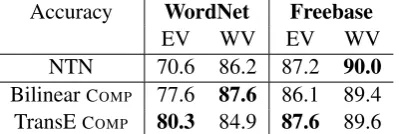
Comparison with Socher et al. (2013). Here, we measure performance on the KBC task in terms of the accuracy metric of Socher et al. (2013). This evaluation involves sampled negatives, and is hence noisier than mean quantile, but makes our results directly comparable to Socher et al. (2013). Our results show that previously inferior models
such as the bilinear model can outperform state-of-the-art models after compositional training.
Socher et al. (2013) proposed parametrizing each entity vector as the average of vectors of words in the entity (wtad lincoln = 12(wtad + wlincoln), and pretraining these word vectors
us-ing the method of Turian et al. (2010). Table 5 reports results when using this approach in con-junction with compositional training. We initial-ized all models with word vectors from Penning-ton et al. (2014). We found that composition-ally trained models outperform the neural tensor network (NTN) on WordNet, while being only slightly behind on Freebase. (We did not use word vectors in any of our other experiments.)
[image:6.595.71.291.477.587.2]Accuracy WordNet Freebase
EV WV EV WV
NTN 70.6 86.2 87.2 90.0 BilinearCOMP 77.6 87.6 86.1 89.4
[image:7.595.83.283.63.130.2]TransECOMP 80.3 84.9 87.6 89.6
Table 5: Model performance in terms of accu-racy. EV: entity vectors are separate (initialized randomly); WV: entity vectors are average of word vectors (initialized with pretrained word vectors).
always meaningful. 6 Analysis
In this section, we try to understand why com-positional training is effective. For concrete-ness, everything is described in terms of the bi-linear model. We will refer to the compositionally trained model asCOMP, and the model trained with
single-edge training asSINGLE.
6.1 Why does compositional training improve path query answering?
It is tempting to think that ifSINGLEhas accurately
modeled individual edges in a graph, it should ac-curately model the paths that result from those edges. This intuition turns out to be incorrect, as revealed bySINGLE’s relatively weak performance
on the path query dataset. We hypothesize that this is due to cascading errors along the path. For a given edge(s, r, t)on the path, single-edge train-ing encouragesxtto be closer tox>sWr than any
other incorrectxt0. However, once this is achieved
by a margin of1, it does not pushxtany closer to
x>
sWr. The remaining discrepancy is noise which
gets added at each step of path traversal. This is illustrated schematically in Figure 2.
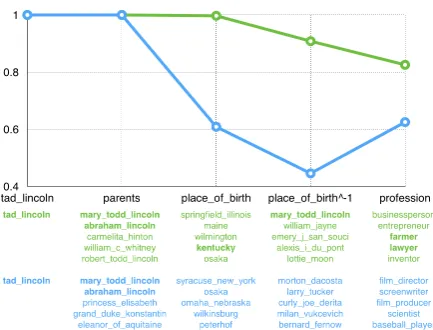
To observe this phenomenon empirically, we examine how well a model handles each interme-diate step of a path query. We can do this by measuring the reconstruction quality(RQ) of the set vector produced after each traversal operation. Since each intermediate stage is itself a valid path query, we define RQ to be the average quantile over all entities that belong inJqK:
RQ(q) = |JqK1 | X
t∈JqK
quantile(q, t) (14)
When all entities in JqKare ranked above all in-correct entities, RQ is 1. In Figure 3, we illustrate how RQ changes over the course of a query.
Figure 2: Cascading errors visualized for TransE.Each node represents the position of an entity in vector space. The relation parent is
ideally a simple horizontal translation, but each traversal introduces noise. The red circle is where we expect Tad’s parent to be. The red square is where we expect Tad’s grandparent to be. Dotted red lines show that error grows larger as we tra-verse farther away from Tad. Compositional train-ing pulls the entity vectors closer to the ideal ar-rangement.
Given the nature of cascading errors, it might seem reasonable to address the problem by adding a term to our objective which explicitly encour-agesx>
sWr to be as close as possible toxt. With
this motivation, we tried addingλkx>
sWr−xtk22
term to the objective of the bilinear model and a
λkxs+wr−xtk22term to the objective of TransE.
We experimented with different settings ofλover the range [0.001,100]. In no case did this addi-tional `2 term improve SINGLE’s performance on
the path query or single edge dataset. These re-sults suggest that compositional training is a more effective way to combat cascading errors.
[image:7.595.320.509.70.145.2]6.2 Why does compositional training improve knowledge base completion? Table 2 reveals thatCOMPalso performs better on
the single-edge task of knowledge base comple-tion. This is somewhat surprising, since SINGLE
is trained on a training set which distributionally matches the test set, whereas COMPis not.
How-ever, COMP’s better performance on path queries
suggests that there must be another factor at play. At a high level, training on paths must be provid-ing some form of structural regularization which reduces cascading errors. Indeed, paths in a knowledge graph have proven to be important fea-tures for predicting the existence of single edges (Lao et al., 2011; Neelakantan et al., 2015). For example, consider the following Horn clause:
Figure 3: Reconstruction quality (RQ) at each step of the querytad lincoln/parents/place of birth/ place of birth−1/profession. COMP experiences significantly less degradation in RQ as path length increases. Correspondingly, the set of 5 highest scoring entities computed at each step usingCOMP
(green) is significiantly more accurate than the set given bySINGLE(blue). Correct entities are bolded.
which states that if x has a parent with location
z, then x has place of birth z. The body of the Horn clause expresses a path fromxtoz. IfCOMP
models the path better, then it should be better able to use that knowledge to infer the head of the Horn clause.
More generally, consider Horn clauses of the formp ⇒ r, wherep=r1/ . . . /rkis a path type
andris the relation being predicted. Let us focus on Horn clauses with high precision as defined by:
prec(p) = |JpK|JpK∩JrK| |, (15)
whereJpKis the set of entity pairs connected byp, and similarly forJrK.
Intuitively, one way for the model to implicitly learn and exploit such a Horn clause would be to satisfy the following two criteria:
1. The model should ensure a consistent spa-tial relationship between entity pairs that are related by the path type p; that is, keeping
x>
sWr1. . . Wrkclose toxtforallvalid(s, t)
pairs.
2. The model’s representation of the path typep
and relationr should capture that spatial re-lationship; that is, x>
sWr1. . . Wrk ≈ xt
im-pliesx>
sWr ≈xt, or simplyWr1. . . Wrk ≈
Wr.
We have already seen empirically thatSINGLEdoes
not meet criterion 1, because cascading errors cause it to put incorrect entity vectors xt0 closer
to x>
sWr1. . . Wrk than the correct entity. COMP
mitigates these errors.
To empirically verify thatCOMPalso does a
bet-ter job of meeting cribet-terion 2, we perform the following: for a path type p and relation r, de-fine dist(p, r)to be the angle between their corre-sponding matrices (treated as vectors inRd2
). This is a natural measure because x>
sWrxt computes
the matrix inner product between Wr andxsx>
t.
Hence, any matrix with small distance from Wr
will produce nearly the same scores asWrfor the
same entity pairs.
IfCOMPis better at capturing the correlation
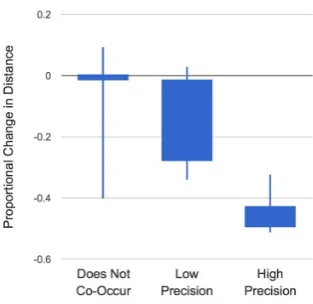
be-tween p and r, then we would expect that when prec(p) is high, compositional training should shrink dist(p, r) more. To confirm this hypothe-sis, we enumerated over all 676 possible paths of length 2 (including inverted relations), and exam-ined the proportional reduction in dist(p, r)caused by compositional training,
∆dist(p, r) =distCOMP(p, r)−distSINGLE(p, r)
distSINGLE(p, r) .
(16) Figure 4 shows that higher precision paths indeed correspond to larger reductions in dist(p, r). 7 Related work
Knowledge base completion with vector space models. Many models have been proposed for knowledge base completion, including those re-viewed in Section 3.4 (Nickel et al., 2011; Bor-des et al., 2013; Yang et al., 2015; Socher et al., 2013). Dong et al. (2014) demonstrated that KBC models can improve the quality of relation extrac-tion by serving as graph-based priors. Riedel et al. (2013) showed that such models can be also be directly used for open-domain relation extraction. Our compositional training technique is an orthog-onal improvement that could help any composable model.
ex-Figure 4: We divide paths of length 2 into high precision (>0.3), low precision (≤0.3), and not co-occuring withr. Herer = nationality. Each
box plot shows the min, max, and first and third quartiles of ∆dist(p, r). As hypothesized, com-positional training results in large decreases in dist(p, r) for high precision paths p, modest creases for low precision paths, and little to no de-creases for irrelevant paths.
plored the ability of tensors to simulate logical cal-culi. Bowman et al. (2014) showed that recursive neural networks can learn to distinguish impor-tant semantic relations. Socher et al. (2014) found that compositional models were powerful enough to describe and retrieve images.
We demonstrate that compositional representa-tions are also useful in the context of knowledge base querying and completion. In the aforemen-tioned work, compositional models produce vec-tors which represent truth values, sentiment or im-age features. In our approach, vectors represent sets of entities constituting the denotation of a knowledge base query.
Path modeling. Numerous methods have been proposed to leverage path information for knowl-edge base completion and question answering. Nickel et al. (2014) proposed combining low-rank models with sparse path features. Lao and Cohen (2010) used random walks as features and Gard-ner et al. (2014) extended this approach by us-ing vector space similarity to govern random walk probabilities. Neelakantan et al. (2015) addressed the problem of path sparsity by embedding paths using a recurrent neural network. Perozzi et al. (2014) sampled random walks on social networks as training examples, with a different goal to
clas-sify nodes in the network. Bordes et al. (2014) em-bed paths as a sum of relation vectors for question answering. Our approach is unique in modeling the denotation of each intermediate step of a path query, and using this information to regularize the spatial arrangement of entity vectors.
8 Discussion
We introduced the task of answering path queries on an incomplete knowledge base, and presented a general technique for compositionalizing a broad class of vector space models. Our experiments show that compositional training leads to state-of-the-art performance on both path query answering and knowledge base completion.
There are several key ideas from this paper: reg-ularization by augmenting the dataset with paths, representing sets as low-dimensional vectors in a context-sensitive way, and performing function composition using vectors. We believe these three could all have greater applicability in the develop-ment of vector space models for knowledge repre-sentation and inference.
Reproducibility Our code, data, and exper-iments are available on the CodaLab platform at https://www.codalab.org/worksheets/ 0xfcace41fdeec45f3bc6ddf31107b829f. Acknowledgments We would like to thank Ga-bor Angeli for fruitful discussions and the anony-mous reviewers for their valuable feedback. We gratefully acknowledge the support of the Google Natural Language Understanding Focused Pro-gram and the National Science Foundation Grad-uate Research Fellowship under Grant No. DGE-114747.
References
F. Bastien, P. Lamblin, R. Pascanu, J. Bergstra, I. J. Goodfellow, A. Bergeron, N. Bouchard, and Y. Ben-gio. 2012. Theano: new features and speed im-provements. Deep Learning and Unsupervised Fea-ture Learning NIPS 2012 Workshop.
J. Bergstra, O. Breuleux, F. Bastien, P. Lamblin, R. Pas-canu, G. Desjardins, J. Turian, D. Warde-Farley, and Y. Bengio. 2010. Theano: a CPU and GPU math expression compiler. InProceedings of the Python for Scientific Computing Conference (SciPy). K. Bollacker, C. Evans, P. Paritosh, T. Sturge, and
[image:9.595.93.250.70.222.2]International Conference on Management of Data (SIGMOD), pages 1247–1250.
A. Bordes, N. Usunier, A. Garcia-Duran, J. Weston, and O. Yakhnenko. 2013. Translating embeddings for modeling multi-relational data. In Advances in Neural Information Processing Systems (NIPS), pages 2787–2795.
A. Bordes, S. Chopra, and J. Weston. 2014. Ques-tion answering with subgraph embeddings. In Em-pirical Methods in Natural Language Processing (EMNLP).
S. R. Bowman, C. Potts, and C. D. Manning. 2014. Can recursive neural tensor networks learn logical reasoning? InInternational Conference on Learn-ing Representations (ICLR).
X. Dong, E. Gabrilovich, G. Heitz, W. Horn, N. Lao, K. Murphy, T. Strohmann, S. Sun, and W. Zhang. 2014. Knowledge vault: A web-scale approach to probabilistic knowledge fusion. In International Conference on Knowledge Discovery and Data Min-ing (KDD), pages 601–610.
J. Duchi, E. Hazan, and Y. Singer. 2010. Adaptive sub-gradient methods for online learning and stochastic optimization. In Conference on Learning Theory (COLT).
M. Gardner, P. Talukdar, J. Krishnamurthy, and T. Mitchell. 2014. Incorporating vector space sim-ilarity in random walk inference over knowledge bases. InEmpirical Methods in Natural Language Processing (EMNLP).
E. Grefenstette. 2013. Towards a formal distributional semantics: Simulating logical calculi with tensors. arXiv preprint arXiv:1304.5823.
N. Lao and W. W. Cohen. 2010. Relational re-trieval using a combination of path-constrained ran-dom walks. Machine learning, 81(1):53–67. N. Lao, T. Mitchell, and W. W. Cohen. 2011. Random
walk inference and learning in a large scale knowl-edge base. In Empirical Methods in Natural Lan-guage Processing (EMNLP), pages 529–539. B. Min, R. Grishman, L. Wan, C. Wang, and
D. Gondek. 2013. Distant supervision for relation extraction with an incomplete knowledge base. In North American Association for Computational Lin-guistics (NAACL), pages 777–782.
A. Neelakantan, B. Roth, and A. McCallum. 2015. Compositional vector space models for knowledge base completion. InAssociation for Computational Linguistics (ACL).
M. Nickel, V. Tresp, and H. Kriegel. 2011. A three-way model for collective learning on multi-relational data. InInternational Conference on Ma-chine Learning (ICML), pages 809–816.
M. Nickel, V. Tresp, and H. Kriegel. 2012. Factorizing YAGO. InWorld Wide Web (WWW).
M. Nickel, X. Jiang, and V. Tresp. 2014. Reducing the rank in relational factorization models by including observable patterns. InAdvances in Neural Informa-tion Processing Systems (NIPS), pages 1179–1187. J. Pennington, R. Socher, and C. D. Manning. 2014.
Glove: Global vectors for word representation. In Empirical Methods in Natural Language Processing (EMNLP).
B. Perozzi, R. Al-Rfou, and S. Skiena. 2014. Deep-walk: Online learning of social representations. In International Conference on Knowledge Discovery and Data Mining (KDD), pages 701–710.
S. Riedel, L. Yao, and A. McCallum. 2013. Re-lation extraction with matrix factorization and uni-versal schemas. InNorth American Association for Computational Linguistics (NAACL).
R. Socher, B. Huval, C. D. Manning, and A. Y. Ng. 2012. Semantic compositionality through recursive matrix-vector spaces. InEmpirical Methods in ural Language Processing and Computational Nat-ural Language Learning (EMNLP/CoNLL), pages 1201–1211.
R. Socher, D. Chen, C. D. Manning, and A. Ng. 2013. Reasoning with neural tensor networks for knowl-edge base completion. InAdvances in Neural Infor-mation Processing Systems (NIPS), pages 926–934. R. Socher, A. Karpathy, Q. V. Le, C. D. Manning, and A. Y. Ng. 2014. Grounded compositional semantics for finding and describing images with sentences. Transactions of the Association for Computational Linguistics (TACL), 2:207–218.
J. Turian, L. Ratinov, and Y. Bengio. 2010. Word rep-resentations: a simple and general method for semi-supervised learning. InProceedings of the 48th an-nual meeting of the association for computational linguistics, pages 384–394.
J. D. Ullman. 1985. Implementation of logical query languages for databases. ACM Transactions on Database Systems (TODS), 10(3):289–321.