Alignment-Based Compositional Semantics for Instruction Following
Jacob Andreas and Dan Klein
Computer Science Division University of California, Berkeley
{jda,klein}@cs.berkeley.edu
Abstract
This paper describes an alignment-based model for interpreting natural language structions in context. We approach in-struction following as a search over plans, scoring sequences of actions conditioned on structured observations of text and the environment. By explicitly modeling both the low-level compositional structure of individual actions and the high-level struc-ture of full plans, we are able to learn both grounded representations of sentence meaning and pragmatic constraints on in-terpretation. To demonstrate the model’s flexibility, we apply it to a diverse set of benchmark tasks. On every task, we outperform strong task-specific baselines, and achieve several new state-of-the-art results.
1 Introduction
In instruction-following tasks, an agent executes a sequence of actions in a real or simulated envi-ronment, in response to a sequence of natural lan-guage commands. Examples include giving nav-igational directions to robots and providing hints to automated game-playing agents. Plans speci-fied with natural language exhibit compositional-ity both at the level of individual actions and at the overall sequence level. This paper describes a framework for learning to follow instructions by leveraging structure at both levels.
Our primary contribution is a new, alignment-based approach to grounded compositional se-mantics. Building on related logical approaches (Reddy et al., 2014; Pourdamghani et al., 2014), we recast instruction following as a pair of nested, structured alignment problems. Given instructions and a candidate plan, the model infers a sequence-to-sequence alignment between sentences and
atomic actions. Within each sentence–action pair, the model infers astructure-to-structurealignment between the syntax of the sentence and a graph-based representation of the action.
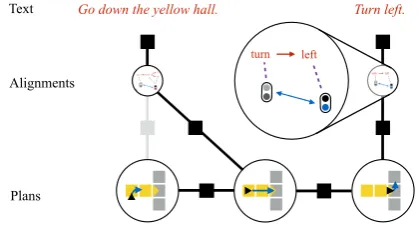
At a high level, our agent is a block-structured, graph-valued conditional random field, with align-ment potentials to relate instructions to actions and transition potentials to encode the environment model (Figure 3). Explicitly modeling sequence-to-sequence alignments between text and actions allows flexible reasoning about action sequences, enabling the agent to determine which actions are specified (perhaps redundantly) by text, and which actions must be performed automatically (in or-der to satisfy pragmatic constraints on interpreta-tion). Treating instruction following as a sequence prediction problem, rather than a series of inde-pendent decisions (Branavan et al., 2009; Artzi and Zettlemoyer, 2013), makes it possible to use general-purpose planning machinery, greatly in-creasing inferential power.
The fragment of semantics necessary to com-plete most instruction-following tasks is essen-tially predicate–argument structure, with limited influence from quantification and scoping. Thus the problem of sentence interpretation can reason-ably be modeled as one of finding an alignment be-tween language and the environment it describes. We allow this structure-to-structure alignment— an “overlay” of language onto the world—to be mediated by linguistic structure (in the form of dependency parses) and structured perception (in what we term grounding graphs). Our model thereby reasons directly about the relationship be-tween language and observations of the environ-ment, without the need for an intermediate logi-cal representation of sentence meaning. This, in turn, makes it possible to incorporate flexible fea-ture representations that have been difficult to in-tegrate with previous work in semantic parsing.
We apply our approach to three established
2
1
3
2
1
3
2
1
3
. . . right round the white water but stay quite close ’cause you don’t otherwise you’re going to be in that stone creek . . .
Go down the yellow hall. Turn left at the intersection of the yellow and the gray.
Clear the right column. Then the other column. Then the row.
(a) Map reading (b) Maze navigation (c) Puzzle solving
Figure 1: Example tasks handled by our framework. The tasks feature noisy text, over- and under-specification of plans, and challenging search problems.
instruction-following benchmarks: the map read-ing task of Vogel and Jurafsky (2010), the maze navigation task of MacMahon et al. (2006), and the puzzle solving task of Branavan et al. (2009). An example from each is shown in Figure 1. These benchmarks exhibit a range of qualitative properties—both in the length and complexity of their plans, and in the quantity and quality of ac-companying language. Each task has been stud-ied in isolation, but we are unaware of any pub-lished approaches capable of robustly handling all three. Our general model outperforms strong, task-specific baselines in each case, achieving relative error reductions of 15–20% over sev-eral state-of-the-art results. Experiments demon-strate the importance of our contributions in both compositional semantics and search over plans. We have released all code for this project at github.com/jacobandreas/instructions.
2 Related work
Existing work on instruction following can be roughly divided into two families: semantic parsers and linear policy estimators.
Semantic parsers Parser-based approaches (Chen and Mooney, 2011; Artzi and Zettlemoyer, 2013; Kim and Mooney, 2013) map from text into a formal language representing commands. These take familiar structured prediction models for semantic parsing (Zettlemoyer and Collins, 2005; Wong and Mooney, 2006), and train them with task-provided supervision. Instead of attempting to match the structure of a manually-annotated semantic parse, semantic parsers for instruction following are trained to maximize a reward signal
provided by black-box execution of the predicted command in the environment. (It is possible to think of response-based learning for question answering (Liang et al., 2013) as a special case.)
This approach uses a well-studied mechanism for compositional interpretation of language, but is subject to certain limitations. Because the environ-ment is manipulated only through black-box exe-cution of the completed semantic parse, there is no way to incorporate current or future environment state into the scoring function. It is also in general necessary to hand-engineer a task-specific formal language for describing agent behavior. Thus it is extremely difficult to work with environments that cannot be modeled with a fixed inventory of pred-icates (e.g. those involving novel strings or arbi-trary real quantities).
Much of contemporary work in this family is evaluated on the maze navigation task introduced by MacMahon et al. (2006). Dukes (2013) also in-troduced a “blocks world” task for situated parsing of spatial robot commands.
Linear policy estimators An alternative fam-ily of approaches is based on learning a pol-icy over primitive actions directly (Branavan et al., 2009; Vogel and Jurafsky, 2010).1
Policy-based approaches instantiate a Markov decision process representing the action domain, and ap-ply standard supervised or reinforcement-learning approaches to learn a function for greedily select-ing among actions. In linear policy approximators, natural language instructions are incorporated di-rectly into state observations, and reading order 1This is distinct from semantic parsers in which greedy
becomes part of the action selection process. Almost all existing policy-learning approaches make use of an unstructured parameterization, with a single (flat) feature vector representing all text and observations. Such approaches are thus restricted to problems that are simple enough (and have small enough action spaces) to be effectively characterized in this fashion. While there is a great deal of flexibility in the choice of feature func-tion (which is free to inspect the current and fu-ture state of the environment, the whole instruc-tion sequence, etc.), standard linear policy estima-tors have no way to model compositionality in lan-guage or actions.
Agents in this family have been evaluated on a variety of tasks, including map reading (Anderson et al., 1991) and gameplay (Branavan et al., 2009). Though both families address the same class of instruction-following problems, they have been applied to a totally disjoint set of tasks. It should be emphasized that there is nothing inherent to policy learning that prevents the use of composi-tional structure, and nothing inherent to general compositional models that prevents more compli-cated dependence on environment state. Indeed, previous work (Branavan et al., 2011; Narasimhan et al., 2015) uses aspects of both to solve a differ-ent class of gameplay problems. In some sense, our goal in this paper is simply to combine the strengths of semantic parsers and linear policy es-timators for fully general instruction following. As we shall see, however, this requires changes to many aspects of representation, learning and in-ference.
3 Representations
We wish to train a model capable of following commands in a simulated environment. We do so by presenting the model with a sequence of train-ing pairs(x,y), where eachxis a sequence of nat-ural language instructions(x1, x2, . . . , xm), e.g.:
(Go down the yellow hall., Turn left., . . .)
and each y is a demonstrated action sequence
(y1, y2, . . . , yn), e.g.:
(rotate(90), move(2), . . .)
Given a start state, y can equivalently be char-acterized by a sequence of (state, action, state)
Go down the yellow hall
go down hall the
(a) Text
(b) Syntax
(c) Alignment
(d) Perception
(e) Environment
* go down the yellow hall
yellow
[image:3.595.311.526.71.367.2]move(2)
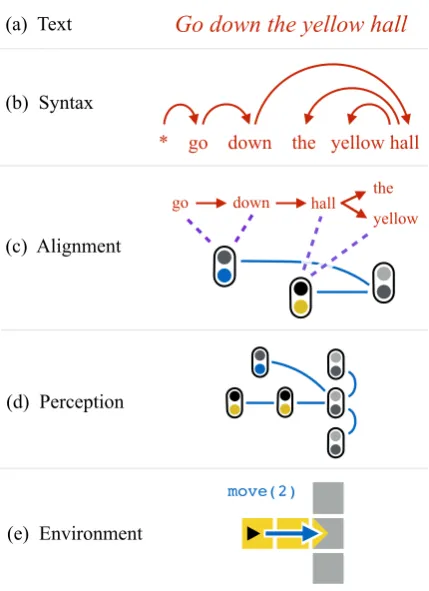
Figure 2: Structure-to-structure alignment connecting a sin-gle sentence (via its syntactic analysis) to the environment state (via its grounding graph). The connecting alignments take the place of a traditional semantic parse and allow flexi-ble, feature-driven linking between lexical primitives and per-ceptual factors.
triples resulting from execution of the environ-ment model. An example instruction is shown in Figure 2a. An example action, situated in the en-vironment where it occurs, is shown in Figure 2e.
Our model performs compositional interpreta-tion of instrucinterpreta-tions by leveraging existing struc-ture inherent in both text and actions. Thus we interpretxiandyjnot as raw strings and primitive
actions, but rather as structured objects.
Linguistic structure We assume access to a pre-trained parser, and in particular that each of the instructionsxi is represented by a tree-structured
dependency parse. An example is shown in Fig-ure 2b.
shown in Figure 2d. The example contains a node corresponding to the primitive action move(2)
(in the upper left), and several nodes correspond-ing to locations in the environment that are visible after the action is performed.
Each node in the graph (and, though not de-picted, each edge) is decorated with a list of fea-tures. These features might be simple indica-tors (e.g. whether the primitive action performed
wasmove orrotate), real values (the distance
traveled) or even string-valued (English-language names of visible landmarks, if available in the environment description). Formally, a grounding graph consists of a tuple(V, E,L, fV, fE), with
– V a set of vertices
– E∈V ×V a set of (directed) edges – La space of labels (numbers, strings, etc.) – fV :V →2La vertex feature function
– fE :E →2Lan edge feature function
In this paper we have tried to remain agnostic to details of graph construction. Our goal with the grounding graph framework is simply to accom-modate a wider range of modeling decisions than allowed by existing formalisms. Graphs might be constructed directly, given access to a struc-tured virtual environment (as in all experiments in this paper), or alternatively from outputs of a perceptual system. For our experiments, we have remained as close as possible to task representa-tions described in the existing literature. Details for each task can be found in the accompanying software package.
Graph-based representations are extremely common in formal semantics (Jones et al., 2012; Reddy et al., 2014), and the version presented here corresponds to a simple generalization of famil-iar formal methods. Indeed, ifL is the set of all atomic entities and relations,fV returns a unique
label for every v ∈ V, and fE always returns
a vector with one active feature, we recover the existentially-quantified portion of first order logic exactly, and in this form can implement large parts of classical neo-Davidsonian semantics (Parsons, 1990) using grounding graphs.
Crucially, with an appropriate choice ofL this formalism also makes it possible to go beyond set-theoretic relations, and incorporate string-valued features (like names of entities and landmarks) and real-valued features (like colors and positions) as well.
Turn left. Go down the yellow hall.
turn left
Text
Alignments
[image:4.595.308.518.70.186.2]Plans
Figure 3: Our model is a conditional random field that de-scribes distributions over state-action sequences conditioned on input text. Each variable’s domain is a structured value. Sentences align to a subset of the state–action sequences, with the rest of the states filled in by pragmatic (planning) implication. State-to-state structure represents planning con-straints (environment model) while state-to-text structure rep-resents compositional alignment. All potentials are log-linear and feature-driven.
Lexical semantics We must eventually combine features provided by parse trees with features pro-vided by the environment. Examples here might include simple conjunctions (word=yellow ∧
rgb=(0.5, 0.5, 0.0)) or more
compli-cated computations like edit distance between landmark names and lexical items. Features of the latter kind make it possible to behave correctly in environments containing novel strings or other features unseen during training.
This aspect of the syntax–semantics inter-face has been troublesome for some logic-based approaches: while past work has used related machinery for selecting lexicon entries (Berant and Liang, 2014) or for rewriting logical forms (Kwiatkowski et al., 2013), the relationship be-tween text and the environment has ultimately been mediated by a discrete (and indeed finite) in-ventory of predicates. Several recent papers have investigated simple grounded models with real-valued output spaces (Andreas and Klein, 2014; McMahan and Stone, 2015), but we are unaware of any fully compositional system in recent lit-erature that can incorporate observations of these kinds.
Formally, we assume access to a joining feature functionφ: (2L×2L) →Rd. As with grounding
4 Model
As noted in the introduction, we approach instruc-tion following as a sequence predicinstruc-tion problem. Thus we must place a distribution over sequences of actions conditioned on instructions. We decom-pose the problem into two components, describing interlocking models of “path structure” and “ac-tion structure”. Path structure captures how se-quences of instructions give rise to sese-quences of actions, while action structure captures the com-positional relationship between individual utter-ances and the actions they specify.
Path structure: aligning utterances to actions
The high-level path structure in the model is de-picted in Figure 3. Our goal here is to permit both under- and over-specification of plans, and to ex-pose a planning framework which allows plans to be computed with lookahead (i.e. non-greedily).
[image:5.595.317.528.79.157.2]These goals are achieved by introducing a se-quence of latent alignments between instructions and actions. Consider the multi-step example in Figure 1b. If the first instructiongo down the yel-low hallwere interpreted immediately, we would have a presupposition failure—the agent is facing a wall, and cannot move forward at all. Thus an implicitrotateaction, unspecified by text, must be performed before any explicit instructions can be followed.
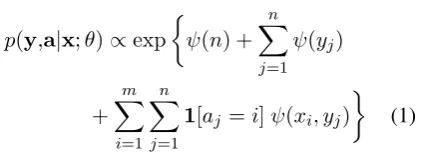
To model this, we take the probability of a (text, plan, alignment) triple to be log-proportional to the sum of two quantities:
1. a path-only scoreψ(n;θ) +Pjψ(yj;θ)
2. a path-and-text score, itself the sum of all pair scoresψ(xi, yj;θ)licensed by the alignment
(1) captures our desire for pragmatic constraints on interpretation, and provides a means of encod-ing the inherent plausibility of paths. We take
ψ(n;θ) and ψ(y;θ) to be linear functions of θ. (2) provides context-dependent interpretation of text by means of the structured scoring function
ψ(x, y;θ), described in the next section.
Formally, we associate with each instructionxi
a sequence-to-sequence alignment variable ai ∈
1. . . n(recalling thatnis the number of actions).
Then we have2
p(y,a|x;θ)∝exp
ψ(n) +Xn
j=1 ψ(yj)
+
m
X
i=1 n
X
j=1
1[aj =i]ψ(xi, yj)
(1)
We additionally place a monotonicity constraint on the alignment variables. This model is globally normalized, and for a fixed alignment is equiva-lent to a linear-chain CRF. In this sense it is analo-gous to IBM Model I (Brown et al., 1993), with the structured potentialsψ(xi, yj)taking the place of
lexical translation probabilities. While alignment models from machine translation have previously been used to align words to fragments of semantic parses (Wong and Mooney, 2006; Pourdamghani et al., 2014), we are unaware of such models be-ing used to align entire instruction sequences to demonstrations.
Action structure: aligning words to percepts
Intuitively, this scoring function ψ(x, y) should capture how well a given utterance describes an action. If neither the utterances nor the actions had structure (i.e. both could be represented with sim-ple bags of features), we would recover something analogous to the conventional policy-learning ap-proach. As structure is essential for some of our tasks,ψ(x, y)must instead fill the role of a seman-tic parser in a conventional compositional model.
Our choice ofψ(x, y)is driven by the following fundamental assumptions: Syntactic relations ap-proximately represent semantic relations. Syntac-tic proximity implies relational proximity. In this view, there is an additional hidden structure-to-structure alignment between the grounding graph and the parsed text describing it. 3 Words line up
with nodes, and dependencies line up with rela-tions. Visualizations are shown in Figure 2c and the zoomed-in portion of Figure 3.
As with the top-level alignment variables, this approach can viewed as a simple relaxation of a familiar model. CCG-based parsers assume that syntactic type strictly determines semantic type, 2Here and the remainder of this paper, we suppress the
dependence of the various potentials onθ in the interest of readability.
3It is formally possible to regard the
and that each lexical item is associated with a small set of functional forms. Here we simply allow all words to license all predicates, multi-ple words to specify the same predicate, and some edges to be skipped. We instead rely on a scoring function to impose soft versions of the hard con-straints typically provided by a grammar. Related models have previously been used for question an-swering (Reddy et al., 2014; Pasupat and Liang, 2015).
For the moment let us introduce variables b
to denote these structure-to-structure alignments. (As will be seen in the following section, it is straightforward to marginalize over all choices of
b. Thus the structure-to-structure alignments are never explicitly instantiated during inference, and do not appear in the final form of ψ(x, y).) For a fixed alignment, we defineψ(x, y, b) according to a recurrence relation. Letxibe theith word of
the sentence, and letyj be thejth node in the
ac-tion graph (under some topological ordering). Let
c(i)andc(j)give the indices of the dependents of
xi and children ofyj respectively. Finally, letxik
andyjldenote the associated dependency type or
relation. Define a “descendant” function:
d(i, j) =(k, l) : k∈c(i), l ∈c(j), (k, l)∈b
Then,
ψ(xi, yj, b) = exp
θ>φ(xi, yj)
+ X
(k,l)∈d(x,y)
h
θ>φ xik, yjl· ψ(xk, yl, b)i
This is just an unnormalized synchronous deriva-tion betweenxandy—at any aligned (node, word) pair, the score for the entire derivation is the score produced by combining that word and node, times the scores at all the aligned descendants. Observe that as long as there are no cycles in the depen-dency parse, it is perfectly acceptable for the rela-tion graph to contain cycles and even self-loops— the recurrence still bottoms out appropriately.
5 Learning and inference
Given a sequence of training pairs (x,y), we wish to find a parameter setting that maximizes
p(y|x;θ). If there were no latent alignments a
or b, this would simply involve minimization of a convex objective. The presence of latent vari-ables complicates things. Ideally, we would like
Algorithm 1 Computing structure-to-structure alignments
xiare words in reverse topological order yj are grounding graph nodes (root last) chartis anm×narray
fori= 1to|x|do forj = 1to|y|do
score←expθ>φ(xi, yj)
for(k, l)∈d(i, j)do
s←Pl∈c(j)hexpθ>φ(xik, yjl) ·chart[k, l]i
score←score·s
end for
chart[i, j]←score
end for end for
returnchart[n, m]
to sum over the latent variables, but that sum is in-tractable. Instead we make a series of variational approximations: first we replace the sum with a maximization, then perform iterated conditional modes, alternating between maximization of the conditional probability of a andθ. We begin by initializingθrandomly.
As noted in the preceding section, the vari-able b does not appear in these equations. Con-ditioned ona, the sum over structure-to-structure
ψ(x, y) = Pbψ(x, y, b) can be performed ex-actly using a simple dynamic program which runs in time O(|x||y|) (assuming out-degree bounded by a constant, and with|x|and|y|the number of words and graph nodes respectively). This is Al-gorithm 1.
In our experiments, θ is optimized using L-BFGS (Liu and Nocedal, 1989). Calculation of the gradient with respect to θ requires computa-tion of a normalizing constant involving the sum overp(x,y0,a) forally0. While in principle the
normalizing constant can be computed using the forward algorithm, in practice the state spaces un-der consiun-deration are so large that even this is in-tractable. Thus we make an additional approxima-tion, constructing a setY˜of alternative actions and taking
p(y,a|x)≈
n
X
j=1
expψ(yj)+Pmi=11[ai=j]ψ(xi,yi)
P
˜ y∈Y˜exp
ψ(˜y)+Pm
˜
Y is constructed by sampling alternative actions from the environment model. Meanwhile, maxi-mization ofacan be performed exactly using the Viterbi algorithm, without computation of normal-izers.
Inference at test time involves a slightly differ-ent pair of optimization problems. We again per-form iterated conditional modes, here on the align-ments a and the unknown output path y. Max-imization of a is accomplished with the Viterbi algorithm, exactly as before; maximization of y also uses the Viterbi algorithm, or a beam search when this is computationally infeasible. If bounds on path length are known, it is straightforward to adapt these dynamic programs to efficiently con-sider paths of all lengths.
6 Evaluation
As one of the main advantages of this approach is its generality, we evaluate on several different benchmark tasks for instruction following. These exhibit great diversity in both environment struc-ture and language use. We compare our full system to recent state-of-the-art approaches to each task. In the introduction, we highlighted two core aspects of our approach to semantics: compositionality (by way of grounding graphs and structure-to-structure alignments) and plan-ning (by way of inference with lookahead and sequence-to-sequence alignments). To evaluate these, we additionally present a pair of ablation ex-periments:no grounding graphs(an agent with an unstructured representation of environment state), and no planning (a reflex agent with no looka-head).
Map reading Our first application is the map navigation task established by Vogel and Jurafsky (2010), based on data collected for a psychological experiment by Anderson et al. (1991) (Figure 1a). Each training datum consists of a map with a des-ignated starting position, and a collection of land-marks, each labeled with a spatial coordinate and a string name. Names are not always unique, and landmarks in the test set are never observed dur-ing traindur-ing. This map is accompanied by a set of instructions specifying a path from the start-ing position to some (unlabeled) destination point. These instruction sets are informal and redundant, involving as many as a hundred utterances. They are transcribed from spoken text, so grammatical errors, disfluencies, etc. are common. This is a
P R F1
Vogel and Jurafsky (2010) 0.46 0.51 0.48 Andreas and Klein (2014) 0.43 0.51 0.45 Model [no planning] 0.44 0.46 0.45 Model [no grounding graphs] 0.52 0.52 0.52
[image:7.595.315.519.63.140.2]Model [full] 0.51 0.60 0.55
Table 1: Evaluation results for the map-reading task. P is pre-cision, R is recall and F1is F-measure. Scores are calculated with respect to transitions between landmarks appearing in the reference path (for details see Vogel and Jurafsky (2010)). We use the same train / test split. Some variant of our model achieves the best published results on all three metrics.
Feature Weight
word=top ∧ side=North 1.31 word=top ∧ side=South 0.61 word=top ∧ side=East −0.93
dist=0 4.51
dist=1 2.78
dist=4 1.54
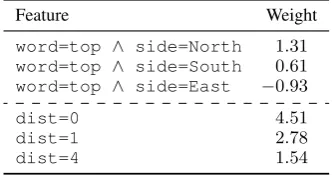
Table 2: Learned feature values. The model learns that the wordtopoften instructs the navigator to position itself above a landmark, occasionally to position itself below a landmark, but rarely to the side. The bottom portion of the table shows learnedtext-independent constraints: given a choice, near destinations are preferred to far ones (so shorter paths are pre-ferred overall).
prime example of a domain that does not lend it-self to logical representation—grammars may be too rigid, and previously-unseen landmarks and real-valued positions are handled more easily with feature machinery than predicate logic.
The map task was previously studied by Vo-gel and Jurafsky (2010), who implementedSARSA
with a simple set of features. By combining these features with our alignment model and search pro-cedure, we achieve state-of-the-art results on this task by a substantial margin (Table 1).
Some learned feature values are shown in Ta-ble 2. The model correctly infers cardinal direc-tions (the example shows the preferred side of a destination landmark modified by the word top). Like Vogel et al., we see support for both allocen-tric references (you are on top of the hill) and ego-centric references (the hill is on top of you). We can also see pragmatics at work: the model learns useful text-independent constraints—in this case, that near destinations should be preferred to far ones.
[image:7.595.333.500.225.313.2]sit-Success (%)
Kim and Mooney (2012) 57.2
Chen (2012) 57.3
Model [no planning] 58.9
Model [no grounding graphs] 51.7
Model [full] 59.6
Kim and Mooney (2013) [reranked] 62.8
[image:8.595.319.513.62.131.2]Artzi et al. (2014) [semi-supervised] 65.3
Table 3: Evaluation results for the maze navigation task. “Success” shows the percentage of actions resulting in a cor-rect position and orientation after observing a single instruc-tion. We use the leave-one-map-out evaluation employed by previous work.4 All systems are trained on full action
se-quences. Our model outperforms several task-specific base-lines, as well as a baseline with path structure but no action structure.
uated in a maze (whose hallways are distinguished with various wallpapers, carpets, and the presence of a small set of standard objects), and again given instructions for getting from one point to another. This task has been the subject of focused attention in semantic parsing for several years, resulting in a variety of sophisticated approaches.
Despite superficial similarity to the previous navigation task, the language and plans required for this task are quite different. The proportion of instructions to actions is much higher (so redun-dancy much lower), and the interpretation of lan-guage is highly compositional.
As can be seen in Table 3, we outperform a number of systems purpose-built for this naviga-tion task. We also outperform both variants of our system, most conspicuously the variant with-out grounding graphs. This highlights the impor-tance of compositional structure. Recent work by Kim and Mooney (2013) and Artzi et al. (2014) has achieved better results; these systems make use of techniques and resources (respectively, dis-criminative reranking and a seed lexicon of hand-annotated logical forms) that are largely orthogo-nal to the ones used here, and might be applied to improve our own results as well.
Puzzle solving The last task we consider is the Crossblock task studied by Branavan et al. (2009) (Figure 1c). Here, again, natural language is used to specify a sequence of actions, in this case the solution to a simple game. The environment is simple enough to be captured with a flat feature
4We specifically targeted the single-sentence version of
this evaluation, as an alternative full-sequence evaluation does not align precisely with our data condition.
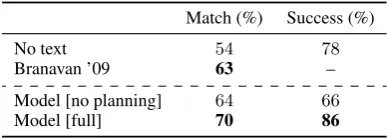
Match (%) Success (%)
No text 54 78
Branavan ’09 63 –
Model [no planning] 64 66
Model [full] 70 86
Table 4: Results for the puzzle solving task. “Match” shows the percentage of predicted action sequences that exactly match the annotation. “Success” shows the percentage of predicted action sequences that result in a winning game con-figuration, regardless of the action sequence performed. Fol-lowing Branavan et al. (2009), we average across five random train / test folds. Our model achieves state-of-the-art results on this task.
representation, so there is no distinction between the full model and the variant without grounding graphs.
Unlike the other tasks we consider, Crossblock is distinguished by a challenging associated search problem. Here it is nontrivial to findanysequence that eliminates all the blocks (the goal of the puz-zle). Thus this example allows us measure the ef-fectiveness of our search procedure.
Results are shown in Table 4. As can be seen, our model achieves state-of-the-art performance on this task when attempting to match the human-specified plan exactly. If we are purely concerned with task completion (i.e. solving the puzzle, per-haps not with the exact set of moves specified in the instructions) we can measure this directly. Here, too, we substantially outperform a no-text baseline. Thus it can be seen that text induces a useful heuristic, allowing the model to solve a con-siderable fraction of problem instances not solved by na¨ıve beam search.
The problem of inducing planning heuristics from side information like text is an important one in its own right, and future work might focus specifically on coupling our system with a more sophisticated planner. Even at present, the re-sults in this section demonstrate the importance of lookahead and high-level reasoning in instruction following.
7 Conclusion
[image:8.595.81.283.64.166.2]here provides modular interfaces for the study of a number of fundamental linguistic issues from a machine learning perspective. These include:
Pragmatics How do we respond to presup-position failures, and choose among possible interpretations of an instruction disambiguated only by context? The mechanism provided by the sequence-prediction architecture we have de-scribed provides a simple answer to this ques-tion, and our experimental results demonstrate that the learned pragmatics aid interpretation of in-structions in a number of concrete ways: am-biguous references are resolved by proximity in the map reading task, missing steps are inferred from an environment model in the maze naviga-tion task, and vague hints are turned into real plans by knowledge of the rules in Crossblock. A more comprehensive solution might explicitly describe the process by which instruction-givers’ own be-liefs (expressed as distributions over sequences) give rise to instructions.
Compositional semantics The graph alignment model of semantics presented here is an expres-sive and computationally efficient generalization of classical logical techniques to accommodate en-vironments like the map task, or those explored in our previous work (Andreas and Klein, 2014). More broadly, our model provides a compositional approach to semantics that does not require an explicit formal language for encoding sentence meaning. Future work might extend this approach to tasks like question answering, where logic-based approaches have been successful.
Our primary goal in this paper has been to ex-plore methods for integrating compositional mantics and the pragmatic context provided by se-quential structures. While there is a great deal of work left to do, we find it encouraging that this general approach results in substantial gains across multiple tasks and contexts.
Acknowledgments
The authors would like to thank S.R.K. Brana-van for assistance with the Crossblock evaluation. The first author is supported by a National Science Foundation Graduate Fellowship.
References
Anne H. Anderson, Miles Bader, Ellen Gurman Bard, Elizabeth Boyle, Gwyneth Doherty, Simon Garrod, Stephen Isard, Jacqueline Kowtko, Jan McAllister, Jim Miller, et al. 1991. The HCRC map task corpus.
Language and speech, 34(4):351–366.
Jacob Andreas and Dan Klein. 2014. Grounding lan-guage with points and paths in continuous spaces. In
Proceedings of the Conference on Natural Language Learning.
Yoav Artzi and Luke Zettlemoyer. 2013. Weakly su-pervised learning of semantic parsers for mapping instructions to actions. Transactions of the Associa-tion for ComputaAssocia-tional Linguistics, 1(1):49–62.
Yoav Artzi, Dipanjan Das, and Slav Petrov. 2014. Learning compact lexicons for CCG semantic pars-ing. InProceedings of the Conference on Empiri-cal Methods in Natural Language Processing, pages 1273–1283, Doha, Qatar, October. Association for Computational Linguistics.
Jonathan Berant and Percy Liang. 2014. Semantic parsing via paraphrasing. InProceedings of the An-nual Meeting of the Association for Computational Linguistics, page 92.
S.R.K. Branavan, Harr Chen, Luke S. Zettlemoyer, and Regina Barzilay. 2009. Reinforcement learning for mapping instructions to actions. InProceedings of the Annual Meeting of the Association for Compu-tational Linguistics, pages 82–90. Association for Computational Linguistics.
S.R.K. Branavan, David Silver, and Regina Barzilay. 2011. Learning to win by reading manuals in a Monte-Carlo framework. InProceedings of the Hu-man Language Technology Conference of the Asso-ciation for Computational Linguistics, pages 268– 277.
Peter Brown, Vincent Della Pietra, Stephen Della Pietra, and Robert Mercer. 1993. The mathemat-ics of statistical machine translation: Parameter esti-mation. Computational Linguistics, 19(2):263–311, June.
David L. Chen and Raymond J. Mooney. 2011. Learn-ing to interpret natural language navigation instruc-tions from observainstruc-tions. InProceedings of the Meet-ing of the Association for the Advancement of Artifi-cial Intelligence, volume 2, pages 1–2.
David L Chen. 2012. Fast online lexicon learning for grounded language acquisition. In Proceedings of the Annual Meeting of the Association for Computa-tional Linguistics, pages 430–439.
Bevan Jones, Jacob Andreas, Daniel Bauer, Karl Moritz Hermann, and Kevin Knight. 2012. Semantics-based machine translation with hyper-edge replacement grammars. In Proceedings of the International Conference on Computational Linguistics, pages 1359–1376.
Joohyun Kim and Raymond J. Mooney. 2012. Un-supervised PCFG induction for grounded language learning with highly ambiguous supervision. In Pro-ceedings of the Conference on Empirical Methods in Natural Language Processing, pages 433–444. Joohyun Kim and Raymond J. Mooney. 2013.
Adapt-ing discriminative rerankAdapt-ing to grounded language learning. InProceedings of the Annual Meeting of the Association for Computational Linguistics. Tom Kwiatkowski, Eunsol Choi, Yoav Artzi, and Luke
Zettlemoyer. 2013. Scaling semantic parsers with on-the-fly ontology matching. InProceedings of the Conference on Empirical Methods in Natural Lan-guage Processing.
Percy Liang, Michael I. Jordan, and Dan Klein. 2013. Learning dependency-based compositional seman-tics. Computational Linguistics, 39(2):389–446. Dong Liu and Jorge Nocedal. 1989. On the limited
memory BFGS method for large scale optimization.
Mathematical Programming, 45(1-3):503–528. Matt MacMahon, Brian Stankiewicz, and Benjamin
Kuipers. 2006. Walk the talk: Connecting language, knowledge, and action in route instructions. Pro-ceedings of the Meeting of the Association for the Advancement of Artificial Intelligence, 2(6):4. Brian McMahan and Matthew Stone. 2015. A
Bayesian model of grounded color semantics.
Transactions of the Association for Computational Linguistics, 3:103–115.
Karthik Narasimhan, Tejas Kulkarni, and Regina Barzilay. 2015. Language understanding for text-based games using deep reinforcement learning. In
Proceedings of the Conference on Empirical Meth-ods in Natural Language Processing.
Terence Parsons. 1990. Events in the semantics of En-glish. MIT Press.
Panupong Pasupat and Percy Liang. 2015. Composi-tional semantic parsing on semi-structured tables. In
Proceedings of the Annual Meeting of the Associa-tion for ComputaAssocia-tional Linguistics.
Nima Pourdamghani, Yang Gao, Ulf Hermjakob, and Kevin Knight. 2014. Aligning english strings with abstract meaning representation graphs. In Proceed-ings of the Conference on Empirical Methods in Nat-ural Language Processing.
Siva Reddy, Mirella Lapata, and Mark Steedman. 2014. Large-scale semantic parsing without question-answer pairs. Transactions of the Associ-ation for ComputAssoci-ational Linguistics, 2:377–392.
Andreas Vlachos and Stephen Clark. 2014. A new cor-pus and imitation learning framework for context-dependent semantic parsing. Transactions of the As-sociation for Computational Linguistics, 2:547–559. Adam Vogel and Dan Jurafsky. 2010. Learning to follow navigational directions. In Proceedings of the Annual Meeting of the Association for Compu-tational Linguistics, pages 806–814. Association for Computational Linguistics.
Yuk Wah Wong and Raymond Mooney. 2006. Learn-ing for semantic parsLearn-ing with statistical machine translation. In Proceedings of the Human Lan-guage Technology Conference of the North Ameri-can Chapter of the Association for Computational Linguistics, pages 439–446, New York, New York. Luke S. Zettlemoyer and Michael Collins. 2005.