Adapting Coreference Resolution for Narrative Processing
Quynh Ngoc Thi Do1, Steven Bethard2, Marie-Francine Moens11Katholieke Universiteit Leuven, Belgium 2University of Alabama at Birmingham, United States
[email protected] [email protected]
Abstract
Domain adaptation is a challenge for super-vised NLP systems because of expensive and time-consuming manual annotated re-sources. We present a novel method to adapt a supervised coreference resolution system trained on newswire to short narra-tive stories without retraining the system. The idea is to perform inference via an In-teger Linear Programming (ILP) formula-tion with the features of narratives adopted as soft constraints. When testing on the UMIREC1and N22corpora with the-state-of-the-art Berkeley coreference resolution system trained on OntoNotes3, our infer-ence substantially outperforms the original inference on the CoNLL 2011 metric.
1 Introduction
Coreference resolution is the task of partitioning the set of mentions of discourse referents in a text into classes (or ‘chains’) corresponding to those referents (Stede, 2011). To solve the problem, con-textual and grammatical clues, as well as semantic information and world knowledge are necessary for either learning-based (Bengtson and Roth, 2008; Stoyanov et al., 2010; Haghighi and Klein, 2010) or rule-based (Haghighi and Klein, 2009; Lee et al., 2011) coreference systems. These systems draw on diverse information sources and complex heuristics to resolve pronouns, model discourse, determine anaphoricity, and identify semantically compati-ble mentions. However, this leads to systems with many hetorogenous parts that can be difficult to interpret or modify.
Durrett and Klein (2013) propose a learning-based, mention-synchronous coreference system to
1http://dspace.mit.edu/handle/1721.1/57507 2http://dspace.mit.edu/handle/1721.1/85893 3https://catalog.ldc.upenn.edu/LDC2011T03
tackle the various aspects of coreference by using the simplest possible set of features. Its advantage is that the system can both implicitly model impor-tant linguistic effects and capture other patterns in the data that are not easily teased out by hand. With a simple set of features including head/first/last words, preceding/following words, length, exact string match, head match, sentence/mention dis-tance, gender, number etc. and an efficient training using conditional log-likelihood augmented with a parameterized loss function optimization they report state-of-the-art results on CoNLL 2011 data. But while CoNLL 2011 training data (OntoNotes) includes a few different source domains (newswire, weblogs, etc.), we witness significant drops in performance when systems trained on CoNLL 2011 are applied to new target domains such as narratives. Some linguistic effects and patterns that are very important for the target domain were never seen in the source domain on which the model was trained. In such cases, when adapting a coreference system to a new domain, it is necessary to incorporate these more complex linguistic features and patterns into the model.
We propose a novel method to adopt the tar-get domain’s features to a supervised coreference system without retraining the model. We present a case of transferring the system of (Durrett and Klein, 2013), which is trained on OntoNotes, to short narrative stories. The idea is to perform infer-ence via a linear programming formulation with the features of narratives adopted as soft constraints. Since the new features are incorporated only into the linear program, there is no need to retrain the original model. Our formulation models three phe-nomena that are important for short narrative sto-ries: local discourse coherence, which we model via centering theory constraints, speaker-listener relations, which we model via direct speech act con-straints, and character-naming, which we model via definite noun phrase and exact match constraints.
We also suggest a method to compute back pointers (as defined in Durrett and Klein (2013)) globally.
2 Berkeley coreference system
GivenN mentionsm1, ..., mN from a document x, eachmi has an associated random variable ai taking values in the set of {1, ..., i−1, NEW}. This variable specifiesmi’s selected antecedent or indicates that it begins a new coreference chain. We callai the back pointer ofmi. A setting of all the back pointers, denoted bya= (a1, ..., an), implies an unique set of coreference chains that serve as the system output.
A log-linear model of the conditional distribu-tionP(a|x)∝expPni=1f(i, ai, x)is used, where
f(i, ai, x) is a feature function that examines the coreference decisionaiformiwith document con-textx. Ifai = NEW, the features indicate the suitability of the given mention to be anaphoric or not; whenai =jfor somej, the features express aspects of the pairwise linkage, and examine rele-vant attributes of the anaphorior the antecedent j. During training, the model is optimized with a parameterized loss function. The inference is sim-ple and efficient: becauselogP(a|x)decomposes linearly over mentions, ai = arg maxaiP(ai|x)
(Durrett and Klein, 2013).
3 Computing back pointers globally
A drawback of computing eachailocally is that the system does not take into account constraints from mentions outside of the (mention, antecedent) pairs. For example, given three mentionsm1, m2, m3, if the system predicts thata2 = 1anda3 = 2(i.e., thatm2’s antecedent is m1 andm3’s antecedent ism2), thenm3will be automatically inferred as coreferent withm1. But if there is a clear clue that m1 andm3 are not coreferent, leveraging this clue could help avoid the error of linkingm3tom2.
In this work, we perform inference via an ILP formulation which allows new linguistic features and patterns over mentions – not only (mention, antecedent) pairs – that were not part of training the original model to be adopted as constraints of the ILP problem.
Let U be the set of binary indicator variables corresponding to the values assigned to the back pointers. Specifically, uij = 1 iff ai = j and uii= 1iffai=NEW.
Cis the set ofKbinary constraint indicator vari-ables indicating if linguistic constraints are violated.
Specifically,ck,i,j = 1iff the linguistic constraint Ckis violated for the back pointeruij. EachCkis associated with a penalty scoreρk.
We aim to maximize the objective function:
N X
i=1 i X
j=1
uijP(ai =j|x)− K X
k=1
ρkck,i,j (1)
Subject to:
∀i:Xi
j=1
uij = 1
To incorporate coreference constraints, we intro-duceV, a set of binary variables indicating if two mentions are in the same coreference chain. For each pair ofj < i, a variablevij is added to the ILP model, wherevij = 1iffmiandmjare in the same chain. The definition ofvij in terms ofuij is encoded as the following ILP constraints:
∀j < i:uii+vij ≤1
∀j < i:uij −vij ≤0
∀k < j < i:uij+vjk−vik≤1
∀k < j < i:uij−vjk+vik≤1
∀j < k < i:uij+vkj−vik≤1
∀j < k < i:uij−vkj+vik≤1
For long texts, to reduce the complexity of the ILP problem, we set a threshold,windowsv, so thatvij is only available ifi−windowsv ≤j.
The framework of Vvariables allows corefer-ence constraints to be adopted easily by any coref-erence resolution system that provides scores for each possible back pointer value. For example, con-sider the Stanford exact string match sieve, which “requires an exact string match between a mention and its antecedent” (Lee et al., 2011). If we want to encourage such matches, for each pairj < iwhere the two nominal mentionsmiandmj have an ex-act string match, we would introduce a constraint indicator variablecexact,i,j and add the constraint vij +cexact,i,j = 1to the ILP model. The result would be that when the exact match constraint is violated and somevij = 0, ILP would force the cor-respondingcexact,i,j = 1and the objective function would be reduced byρexact.
coreference resolution, and are not directly appli-cable to the back pointer approach of (Durrett and Klein, 2013). But the back pointer approach allows features to be expressed more naturally using local context, rather than requiring, for example, judg-ments of whether two pronouns separated by many paragraphs are coreferent. Moreover, our ILP for-mulation is the only one to consider the problem of adapting to another domain and incorporating new features without retraining the original model.
4 Centering theory constraints
Pronouns, in particular, have a huge effect on in-formation flow across sentences. Since they are almost void of meaning (only signal gender and number of the antecedent), the discourse referent to be picked up must be particularly salient, so that it can be readily identified by the reader (Stede, 2011). The discourse center hypothesis (Hudson-D’Zmura, 1988) states that at any point in discourse understanding, there is one single entity that is the most salient discourse referent at that point. This referent is called the center. Centering theory is a key element of the discourse center hypothesis used in anaphora resolution (Grosz et al., 1995). Beaver (2004) reformulates the centering theory in terms of Optimality Theory (Prince and Smolensky, 2004). Six ranked constraints – Agree, Disjoint, ProTop, FamDef, Cohere and Align – are used to make anaphora decisions. We adopt four of these constraints in our ILP model as follows:
Disjoint “Co-arguments of a predicate4are
dis-joint.” For eachj < i such thatmi and mj are subject and object arguments of a non-reflexive predicate, we introduce a constraint indicator vari-ablecdisjoint,i,j, and add the ILP constraintvij − cdisjoint,i,j = 0.
ProTop “Thetopicof a sentence which is the
en-tity referred to in both the current and the previous sentence, is pronominalized.” If a sentence con-tains pronouns then at least one of its pronouns is coreferent with a mention in the previous sentence. For each sentencet containing pronouns, we in-troduce a constraint indicator variablecprotop,t,t−1, and add the ILP constraints:
∀i∈Pt,∀j∈Mt−1:vij +cprotop,t,t−1 ≤1 cprotop,t,t−1+
X
i∈Pt
X
j∈Mt−1
vij ≥1
4A word that evokes a semantic frame (event) in a sentence.
Ptis the set of all pronouns in sentencet.Mt−1is the set of all mentions in sentencet−15.
FamDef “No new information about the
refer-ent is provided by the definite.” We consider only pronouns here, though the original FamDef also includes definite descriptions and proper names (Beaver, 2004). For each pronoun mi, we intro-duce a constraint indicator variablecfamdef,i,iand add the ILP constraintuii−cfamdef,i,i= 0.
Align “The topic is in subject position.” More
specifically, the topic of a sentence is pronominal-ized and prefers the subject position over other positions. For each sentence containing only one pronounmi, if the previous sentence has only one verbal semantic frame andmj is its subject, we introduce a constraint indicator variablecalign,i,j, and add the ILP constraintvij+calign,i,j= 1. Note: The ProTop, FamDef and Align constraints are not applied to sentences containing quotations.
5 Direct speech constraints
Direct speech acts (with quotation marks) are de-tected and attached to the closest verbal commu-nication semantic frames. For each direct speech actqt, we call the mentionsmst, motthe speaker and listener ofqtif they play the subject and ob-ject roles respectively in the semantic frame of qt. We detect the set of subject pronouns6inside the quote marks of qt and name it St. The set of all mentions that refer to the speaker of qt is SPEAKERt = {mst} ∪St. For each (mi, mj) ∈ SPEAKERt×SPEAKERtwithi > j, we introduce a constraint indicator variablecsubject,i,j, and add the ILP constraintvij +csubject,i,j = 1.
Similarly,Otis the set of object pronouns7 in-side the quote marks of qt. The set of all men-tions that refer to the listener ofqtis LISTENERt=
{mot}∪Ot. For each pair of mentions(mi, mj)∈ LISTENERt×LISTENERtwithi > j, we introduce a constraint indicator variablecobject,i,j, and add the constraintvij+cobject,i,j= 1.
If a conversation is detected (a sequence of “question” and “answer” semantic frames), the
sub-ject of the “question” is coreferent with the obsub-ject
5We can relax the constraint by replacing M t−1 with
Mt−1∪Mt−2∪Mt−3
6(“I”, “me”, “my”, “mine”, “myself”) ifm
stis singular or
Method MUC BCUB CEAFE AVG MUC BCUB CEAFE AVGUMIREC (Tales) N2 (Hadith)
ILPI with gold mentions 84.16 65.65 50.47 66.76 80.47 65.53 54.06 66.69
BER with gold mentions 80.58 60.96 42.48 61.34 76.28 62.66 45.48 61.47 ILPI with predicted mentions 73.32 59.18 37.54 56.68 66.13 62.55 40.51 56.40
[image:4.595.80.522.61.146.2]BER with predicted mentions 72.71 58.12 35.76 55.53 64.87 59.60 37.96 54.14
Table 1: ILPI and BER inference results on UMIREC (Tales) and N2 (Hadith) data.
of the “answer” and vice versa. For each pair of di-rect speech acts (qt,qt+1) that is a (“question”, “an-swer”) pair, for each pair of mentions(mi, mj)∈
{LISTENERt+1×SPEAKERt} ∪ {SPEAKERt+1× LISTENERt}, we introduce a constraint indicator variablecconversation,i,jand add the ILP constraint vij+cconversation,i,j = 1.
6 Definite noun phrase and exact match constraints
In short narrative stories, characters are frequently named via proper names, pronouns or definite noun phrases (Toolan, 2009). Character names are re-peated regularly over the whole stories. A character is often first presented as an indefinite noun phrase (such as “a woman”), then later as a definite noun phrase (such as “the woman”). In this work we introduce the definite noun phrase constraint: For each pairj < i, ifmjis the indefinite form andmi is the definite form of the same noun phrase, to en-force thatmiandmj are coreferent, we introduce a constraint indicator variablecname,i,j, and add the ILP constraintvij+cname,i,j = 1. To boost the identification of characters in the stories, the def-inite noun phrase constraint is used together with the exact match constraint (See Section 3) applied to noun phrases and proper nouns.
7 Experiment
We test our model on 30 English folktales from the UCM/MIT Indications, Referring Expressions, and Coreference (UMIREC) Corpus v1.1 (Finlayson and Hervs, 2010), and 64 text stories from the Ha-dith section of the Narrative Networks (N2) Cor-pus (Finlayson et al., 2014). The texts are prepro-cessed using the Stanford sentence splitter (Man-ning et al., 2014)8 and the Berkeley coreference system’s preprocessor. The Berkeley coreference system is trained on OntoNotes (newswire,
broad-8If two direct speech acts enclosed in quotation marks are adjacent and one is placed at the end of a sentence, we separate them into two different sentences.
cast news/conversation, and web texts). We use Gurobi9 to solve our ILP problem, and the Lund semantic role labeler (Bj¨orkelund et al., 2009) to detect semantic frames. Note that in our imple-mentation, “subject” and “object” used in Sec-tion 4 and SecSec-tion 5 refer to “subject role” and “object role” of the semantic frames respectively. We use a separate section of the N2 corpus, the Inspire story texts, as the held-out validation set used for parameter tuning, resulting inwindowv=
40, ρsubject=ρobject=ρconversation=ρdefinite= ρexact=ρdisjoint=1, ρprotop=0.2, ρfamdef=0.2, ρalign=0.1.
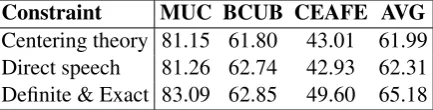
We compare our ILP inference (ILPI) to the standard Berkeley coreference system (BER) with both gold and predicted mentions. Table 1 shows that our inference improves the MUC, BCUB and CEAFE scores on both datasets, especially when using gold mentions10. The average ILP running times are 42.37s per UMIREC document and 22.7s per N2 document on a Core I7 2.3 GHz quad-core computer. Table 2 shows the effects of each con-straint type when used alone. Surprisingly, the sim-plest constraint type (definite & exact match con-straints) gives us the best improvement especially in terms of CEAFE score. This may be because definite & exact match constraint links mentions in the whole document, while the centering theory and direct speech act constraints are more local. And since short narrative stories often have a small set of characters (usually represented by definite noun phrases or proper nouns), when these charac-ters are linked correctly, the coreference resolution result is improved considerably.
8 Discussion
Our method provides a promising solution when retraining a system is impossible or difficult. How-ever, it may raise a question of the computing cost
9http://www.gurobi.com/
Constraint MUC BCUB CEAFE AVG
[image:5.595.74.291.63.118.2]Centering theory 81.15 61.80 43.01 61.99 Direct speech 81.26 62.74 42.93 62.31 Definite & Exact 83.09 62.85 49.60 65.18 Table 2: Effects of different constraints on ILP inference on UMIREC (Tales) with gold mentions.
for tuning penalty scores especially with the large number of constraints. In such these cases, dividing the constraints into different groups where all con-straints in the same group have the same penalty score may help to limit the number of scores that need to be tuned. In our case study, the system is not very sensitive to the values of the penalty parameters. If we set all the penalty scores to 1, the final AVG results on UMIREC and N2 corpus are 66.05 and 66.68 respectively11. Those scores are a bit less than the scores obtained after tuning parameters but still higher than the results obtained without ILP. Regardless, it’s true that the proposed ILP approach is not necessarily less costly in some settings, but it can be applied to any coreference system that provides back pointers, not just the Berkeley one.
Instead of adopting features of the target domain as soft constraints as in our method, one may con-sider to use them as linguistic features and retrain the model. A simple domain adaptation approach by augmenting the feature space (Daum´e et al., 2010) based on a limited set of annotated data in the target domain might be an alternative solution. But note that our approach does not use any anno-tated data of the target domain. Also, an unsuper-vised system as (Lee et al., 2011) might encode the target domain features (exact match noun phrases, direct speech act) as sieves (hard), but with the
softconstraints, our system is more flexible when making global decisions.
Our approach can be applied to another target do-main, such as bio-medical domain where we have entities and a list of acronyms in texts. Constrain-ing the entities with their acronyms might help to improve the coreference resolution for bio-medical texts.
9 Conclusion
We have proposed a novel approach to adapt a su-pervised coreference resolution system trained on newswire domain to short narrative stories without
11with gold mentions
retraining the system by modeling the inference as an ILP problem with the features of narratives adopted as soft constraints. Three phenomena that are important for short narrative stories: local dis-course coherence, speaker-listener relations, and character-naming are modeled via centering theory, direct speech act and definite noun phrase & ex-act match constraints. We obtain promising results when transferring the Berkeley coreference resolu-tion trained on OntoNotes to UMIREC (Tales) and N2 (Hadith). We find that the simplest constraints, definite noun phrase & exact match constraints, are the most effective in our case study assuming the gold mentions. We also suggest an approach to compute back pointers in coreference resolution globally.
Acknowledgment
This work acknowledges the financial support of the Future and Emerging Technologies (FET) programme within the Seventh Framework Pro-gramme for Research of the European Com-mission, under FET-Open grant number 295703 (FET project “Machine Understanding for in-teractive StorytElling” (MUSE) http://www. muse-project.eu/).
References
Regina Barzilay and Mirella Lapata. 2006. Aggrega-tion via set partiAggrega-tioning for natural language genera-tion. InProceedings of the Main Conference on Hu-man Language Technology Conference of the North American Chapter of the Association of Computa-tional Linguistics, HLT-NAACL ’06, pages 359– 366, Stroudsburg, PA, USA. Association for Com-putational Linguistics.
David I. Beaver. 2004. The optimization of discourse anaphora.Linguistics and Philosophy, 27(1):3–56. Eric Bengtson and Dan Roth. 2008. Understanding
the value of features for coreference resolution. In Proceedings of the Conference on Empirical Meth-ods in Natural Language Processing, EMNLP ’08, pages 294–303, Stroudsburg, PA, USA. Association for Computational Linguistics.
Anders Bj¨orkelund, Love Hafdell, and Pierre Nugues. 2009. Multilingual semantic role labeling. In Pro-ceedings of the Thirteenth Conference on Compu-tational Natural Language Learning: Shared Task, CoNLL ’09, pages 43–48, Stroudsburg, PA, USA. ACL.
adaptation. InProceedings of the 2010 Workshop on Domain Adaptation for Natural Language Process-ing, DANLP 2010, pages 53–59, Stroudsburg, PA, USA. Association for Computational Linguistics. Pascal Denis and Jason Baldridge. 2007. Joint
deter-mination of anaphoricity and coreference resolution using integer programming. In Human Language Technologies 2007: The Conference of the North American Chapter of the Association for Computa-tional Linguistics; Proceedings of the Main Confer-ence, pages 236–243, Rochester, New York, April. Association for Computational Linguistics.
Greg Durrett and Dan Klein. 2013. Easy victories and uphill battles in coreference resolution. In Proceed-ings of the Conference on Empirical Methods in Nat-ural Language Processing, Seattle, Washington, Oc-tober. Association for Computational Linguistics. Jenny Rose Finkel and Christopher D. Manning. 2008.
Enforcing transitivity in coreference resolution. In Proceedings of the 46th Annual Meeting of the Asso-ciation for Computational Linguistics, Short Papers, pages 45–48.
M.A. Finlayson and R Hervs. 2010. Ucm/mit indica-tions, referring expressions, and co-reference corpus v1.1 (umirec corpus). MIT CSAIL Work Product. Mark A. Finlayson, Jeffry R. Halverson, and Steven R.
Corman. 2014. The n2 corpus: A semantically an-notated collection of islamist extremist stories. The 9th Language Resources and Evaluation Conference (LREC), Reykjavik, Iceland.
B. J. Grosz, A. K. Joshi, and S. Weinstein. 1995. Centering: A framework for modelling the local co-herence of discourse. Computational Linguistics, 21(2):203–226.
Aria Haghighi and Dan Klein. 2009. Simple coref-erence resolution with rich syntactic and semantic features. In Proceedings of the 2009 Conference on Empirical Methods in Natural Language Process-ing: Volume 3 - Volume 3, EMNLP ’09, pages 1152– 1161, Stroudsburg, PA, USA. Association for Com-putational Linguistics.
Aria Haghighi and Dan Klein. 2010. Coreference res-olution in a modular, entity-centered model. In Hu-man Language Technologies: The 2010 Annual Con-ference of the North American Chapter of the As-sociation for Computational Linguistics, HLT ’10, pages 385–393, Stroudsburg, PA, USA. Association for Computational Linguistics.
Hudson-D’Zmura. 1988. The structure of discourse and anaphore resolution: The discourse center and the roles of nouns and pronouns. Unpublished doc-toral dissertation.
Heeyoung Lee, Yves Peirsman, Angel Chang, Nathanael Chambers, Mihai Surdeanu, and Dan Jurafsky. 2011. Stanford’s multi-pass sieve coref-erence resolution system at the conll-2011 shared
task. In Proceedings of the Fifteenth Conference on Computational Natural Language Learning: Shared Task, CONLL Shared Task ’11, pages 28–34, Stroudsburg, PA, USA. Association for Computational Linguistics.
Christopher D. Manning, Mihai Surdeanu, John Bauer, Jenny Finkel, Steven J. Bethard, and David Mc-Closky. 2014. The Stanford CoreNLP natural lan-guage processing toolkit. In Proceedings of 52nd Annual Meeting of the Association for Computa-tional Linguistics: System Demonstrations, pages 55–60.
Alan Prince and Paul Smolensky. 2004. Optimality theory: Constraint interaction in generative gram-mar. Wiley-Blackwell.
Manfred Stede. 2011. Discourse processing. Morgan & Claypool Publishers.
Veselin Stoyanov, Claire Cardie, Nathan Gilbert, Ellen Riloff, David Buttler, and David Hysom. 2010. Coreference resolution with reconcile. In Proceed-ings of the ACL 2010 Conference Short Papers, pages 156–161, Uppsala, Sweden, July. Association for Computational Linguistics.