Answering Elementary Science Questions by Constructing Coherent
Scenes using Background Knowledge
Yang Li∗ UC Santa Barbara Santa Barbara, CA, USA [email protected]
Peter Clark
Allen Institute for Artificial Intelligence Seattle, WA, USA
Abstract
Much of what we understand from text is not explicitly stated. Rather, the reader uses his/her knowledge to fill in gaps and create a coherent, mental picture or “scene” depicting what text appears to convey. The scene constitutes an under-standing of the text, and can be used to an-swer questions that go beyond the text. Our goal is to answer elementary science questions, where this requirement is per-vasive; A question will often give a partial description of a scene and ask the student about implicit information. We show that by using a simple “knowledge graph” rep-resentation of the question, we can lever-age several large-scale linguistic resources to provide missing background knowl-edge, somewhat alleviating the knowledge bottleneck in previous approaches. The coherence of the best resulting scene, built from a question/answer-candidate pair, re-flects the confidence that the answer can-didate is correct, and thus can be used to answer multiple choice questions. Our ex-periments show that this approach outper-forms competitive algorithms on several datasets tested. The significance of this work is thus to show that a simple “knowl-edge graph” representation allows a ver-sion of “interpretation as scene construc-tion” to be made viable.
1 Introduction
Elementary grade science tests are challenging as they test a wide variety of commonsense knowl-edge that human beings largely take for granted, yet are very difficult for machines (Clark, 2015). For example, consider a question from a NY Re-gents 4th Grade science test:
∗
Work was done while the author was an intern at Allen Institute for Artificial Intelligence.
Question 1 “When a baby shakes a rattle, it makes a noise. Which form of energy was changed to sound energy?” [Answer: mechanical energy] Science questions are typically quite different from the entity-centric factoid questions exten-sively studied in the question answering (QA) community, e.g., “In which year was Bill Clinton born?” (Ferrucci et al., 2010; Yao and Van Durme, 2014). While factoid questions are usually an-swerable from text search or fact databases, sci-ence questions typically require deeper analysis. A full understanding of the above question in-volves not just parsing and semantic interpreta-tion; it involves adding implicit information to cre-ate an overall picture of the “scene” that the text is intended to convey, including facts such as: noise is a kind of sound, the baby is holding the rattle, shaking involves movement, the rattle is making the noise, movement involves mechanical energy, etc. This mental ability to create a scene from par-tial information is at the heart of natural language understanding (NLU), which is essential for an-swering these kinds of question. It is also very dif-ficult for a machine because it requires substantial world knowledge, and there are often many ways a scene can be elaborated.
We present a method for answering multiple-choice questions that implements a simple ver-sion of this. A scene is represented as a “knowl-edge graph” of nodes (words) and relations, and the scene is elaborated with (node,relation,node) tuples drawn from three large-scale linguistic knowledge resources: WordNet (Miller, 1995), DART (Clark and Harrison, 2009), and the Free-Association database (Nelson et al., 2004). These elaborations reflect the mental process of “filling in the gaps”, and multiple choice questions can then be answered by finding which answer option creates the most coherent scene.
The notion of NLU as constructing a most co-herent scene is not new, and has has been stud-ied in several contexts including work on scripts (Schank and Abelson, 1977), interpretation as
duction (Hobbs et al., 1988; Hobbs, 1979; Ovchin-nikova et al., 2014), bridging anaphora (Asher and Lascarides, 1998; Fan et al., 2005), and para-graph understanding (Zadrozny and Jensen, 1991; Harabagiu and Moldovan, 1997). These meth-ods are inspiring, but have previously been limited by the lack of background knowledge to supply implicit information, and with the complexity of their representations. To make progress, we have chosen to work with a simple “knowledge graph” representation of nodes (words) and edges (rela-tions). Although we lose some subtlety of expres-sion, we gain the ability to leverage several vast resources of world knowledge to supply implicit information. The significance of this work is thus to show that, by working with a simple “knowl-edge graph” representation, we can make a viable version of “interpretation as scene construction”. Although the approach makes several simplifying assumptions, our experiments show that it outper-forms competitive algorithms on several datasets of (real) elementary science questions.
2 Approach
The input to our question-answering system is a multiple choice question Q, a set of an-swer options ak, and one or more background knowledge base(s) each containing a set of (wordi, relation, wordj) tuples, each denoting that word1 is plausibly related to wordj by
relation. The output is a ranked list of theK an-swer options.
We define a scene S as a “knowledge graph” of nodes (words) and edges (relations between words), where all(wordi, relation, wordj)edges are sanctioned by (contained in) at least one of the background knowledge bases. Each scene node has an associated measure ofcoherence (de-scribed shortly), denoting how well-connected it is. The question-answering objective is, for each answer optionak, to find the most coherent scene containing (at least) the question keywordskwi∈
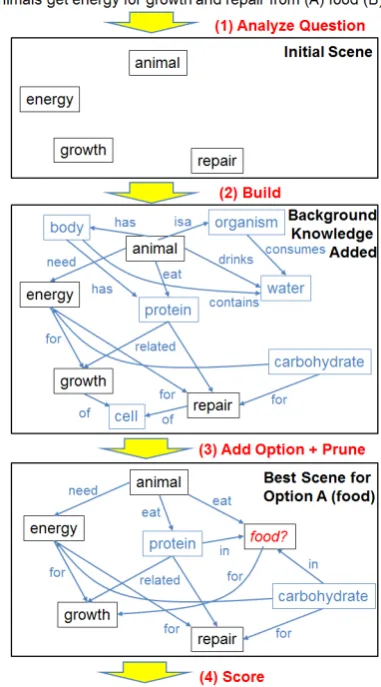
Q and answer optionak, and then return the an-swer option with the overall highest coherence score. Our implementation approximates this ob-jective using a simple elaborate-and-prune algo-rithm, illustrated in Figure 11and now described.
1The system constructs 4 alternative graphs, each contains only one answer option plus some additional related nodes. Figure 1 shows just one of these 4 graphs, namely the graph containing answer option ”food”.
Figure 1: (1) Question keywords are extracted to form the initial scene. (2) The scene is elaborated with background knowledge to add plausible rela-tionships. (3) For each answer option, it is added into the scene and connected with additional rela-tionships. Then the scene is pruned. (4) A score is derived from the final scene, reflecting confidence that the answer option is correct.
2.1 Question Analyzer
The initial scene is simply the keywords (non-stop words) KW = {kwi} in the question Q, along with a measure of importance IS(kwi) for each word kwi. For our purposes we compute impor-tance by sending the question to Google, grouping the top 20 result snippets into a documentd, and computing:
IS(kw) = dftfd(kw)
[image:2.595.321.512.71.415.2]Size
KB (# tuples) Examples
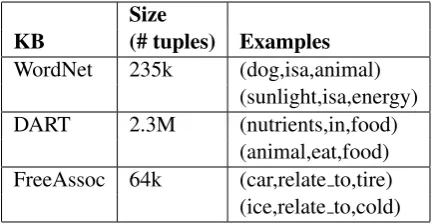
WordNet 235k (dog,isa,animal) (sunlight,isa,energy) DART 2.3M (nutrients,in,food)
[image:3.595.73.291.62.174.2](animal,eat,food) FreeAssoc 64k (car,relate to,tire) (ice,relate to,cold) Table 1: Knowledge Bases Used
that the words frequently mentioned in variations of the question should be important (reflected by ”tf”), while the descriptive words (e.g. ”follow-ing”, ”example”) which are widely used in many questions should be penalized (reflected by ”idf”). Other methods could equally be used to compute importance.
2.2 Builder
In this step our goal is to inject implicit knowl-edge from the background KBs to form an elab-orated knowledge graph. To do this, we first fetch all the triples (kw, relation, w) that are directly connected with any keyword kw ∈ KW from the background KBs, as well as all (kwi, relation, kwj) triples between keywords. In our experiments we use three background knowledge bases to supply implicit knowledge, al-though in principle any triple store could be used: WordNet (Miller, 1995), DART (Clark and Har-rison, 2009), and the FreeAssociation database (Nelson et al., 2004). Table 1 shows examples of each2.
These triples introduce new nodes w into the graph. As we may get a large number of such nodes, we score them and retain only the top scor-ing ones (and all edges connectscor-ing to it). Infor-mally, a new wordwis preferred if it is connected to many important keywordskwwith strong rela-tionships. Formally, the scoring function is:
score(w) = X kw∈K
IS(kw)∗rel(kw, w) (2)
whereIS(kw)is the importance score of keyword
kw and rel(kw, w) is the relatedness score be-tween kw and w. In this work we use the co-sine similarity between word2vec (Mikolov et al., 2013) word vectors to measure two words’ ness, as a rough proxy for the strength of
related-2WordNet: all relationships types are used. DART: The NVN and NPN databases with frequency counts>10 are used. FreeAssoc: The top 3 associations per word were used.
ness in the KBs (the KBs themselves do not pro-vide meaningful strengths of relationship). After the ranking, the topN ×|KW|neighbor wordsw
are retained3, along with their edges to keywords
kwand each other.
Note that at this point the elaboration process is independent of any answer option; rather, the graph depicts the question scenario.
2.3 Elaborate and Prune
To score theK different answer options, the sys-tem now buildsK alternative elaborations of the scene so far, each one with answer option ak added, and assesses the coherence of the addition. The answer option ak that fits “most coherently” with the scene is returned as the answer to the question.
To do this for a given option ak, we addak to the graph along with all triples(wi, relation, ak) in the KBs that relate any node wi in the graph to ak. Now that the focus ak of the question is known, some of the earlier added nodeswin the graph may be only weakly relevant to the question and answer, and so we add a pruning step to re-move these nodes. The goal of this pruning is to find a dense subgraph (i.e. the coherent scene) that would ideally contain all the question keywords
kw, the answer optionak, and extra wordswkthat are highly connected with them.
Inspired by Sozio et al’s work (Sozio and Gio-nis, 2010) on finding strongly interconnected sub-groups in social networks, we have developed an iterative node removal algorithm for extracting this subgraph. We define the coherence of a node as the summed weight of its incident edges:
coherence(w) = X w0∈{(w,r,w0)}
rel(w, w0) (3)
whererel(w, w0)is the weight of edge (w, r, w0) in the graph, again computed using cosine similar-ity betweenwandw0. We then iteratively remove the non-keyword node (and attached edges) with least coherence until the answer optionakis about to removed. The resulting graph is thus maximally pruned, subject to the constraint it must still de-scribe the question plus answer option.
Finally, we use the coherence of the answer op-tion ak in this final scene as the confidence that
akis the correct answer. The system repeats this
for allK answer options and selects theak with highest confidence.
3 Evaluation
The system was developed using a dataset of natu-ral (unedited) elementary science exam questions, and then tested on three similar, unseen (hidden) datasets. Its performance was compared with two other state-of-the-art systems for this task. As our system only fields questions where the answer op-tions are all single words, we evaluate it, and the other systems, only on these subsets. These sub-sets are in general easier than other questions, but this advantage is the same for all systems being compared so it is still a fair test.
3.1 Evaluation Datasets
The datasets used are the non-diagram, multiple-choice questions with single-word answer options drawn from the following exams:
• Dev (System Development):New York Re-gents 4th Grade Science4(47 questions in 6
years)
• Test1:New York Regents 4th Grade Science (23 questions in 3 years)
• Test2: Additional 4th Grade Science (from multiple States) (26 questions)
• Test3: 5th Grade Science (from multiple States) (197 questions)
Although these datasets are small (real exam ques-tions of this type are in limited supply), the num-bers are large enough to draw conclusions.
3.2 Experiments
We compared our system (calledSceneQA) with two other state-of-the-art systems for this task:
• LSModel (Lexical semantics model): SVM combination of several language models (likeli-hood of answer given question) and information retrieval scores (score of top retrieved sentence matching question plus answer), trained on a set of questions plus answers. (An expanded ver-sion of Section 4.3 of (Jansen et al., 2014))
• A*Rules: “Prove” the answer option from the question by applying lexical inference rules au-tomatically extracted from science texts. Select the option with the strongest “proof”. (Clark et al., 2014)
4http://www.nysedregents.org/Grade4/Science/home.html
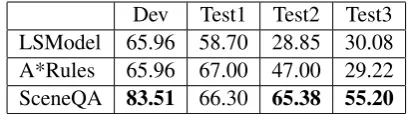
Dev Test1 Test2 Test3 LSModel 65.96 58.70 28.85 30.08 A*Rules 65.96 67.00 47.00 29.22 SceneQA 83.51 66.30 65.38 55.20
Table 2: SceneQA outperforms two competitive systems on two of the three test sets. The high-lighted improvements are statistically significant.
The results (% scores, Table 2) show SceneQA significantly outperforms the two other systems on two of the three test sets, including the largest (Test3, 197 questions), suggesting the approach has merit.
We also performed some case studies to identify what kinds of questions SceneQA does well on, relative to the baselines. In general, SceneQA per-forms well when the question words and the (cor-rect) answer can be tightly related by background knowledge, including through intermediate nodes (words). For example, in Question 2 below:
Question 2 Which type of energy does a person use to pedal a bicycle? (A) light (B) sound (C) mechanical (D) electrical
the KB relates the correct answer ”mechanical” to the question words ”energy”, ”pedal”, ”bicycle”, and the intermediate node ”power” forming a tight graph. In contrast, the other algorithms select the wrong answer ”light” due to frequent mentions of ”bicycle lights” in their supporting text corpora that confuses their algorithms.
3.3 Ablations
We also performed ablations to assess which parts of our method are contributing the most:
• -NewNodes: Only add edges but no new nodes
wduring the Build step.
• -Prune: Do not prune nodes during the Elabo-rate and Prune step.
• -Both: No new nodes, no pruning
Dev Test1 Test2 Test3 SceneQA 83.51 66.30 65.38 55.20
[image:4.595.313.518.62.119.2]-NewNodes 65.96 69.57 42.31 51.78 -Prune 70.74 57.61 47.12 50.13 -Both 59.57 65.22 42.31 50.25 Table 3: SceneQA outperforms all the ablations on two of the three test sets. The highlighted im-provements are statistically significant.
concepts implied but not explicitly stated in the text (NewNodes), and later removing implied in-formation that is of low relevance to the answer (Prune) - are important for answering the ques-tions correctly. (The small gain without adding NewNodes on Test1 is not statistically significant).
3.4 Error Analysis
We also examined cases where SceneQA gave the wrong answer. Two problems were particularly common:
(1) There were two answer options with oppo-site meanings, and one of them was correct. For example:
Question 3 An animal that has a backbone is called a(n) (A) invertebrate (B) vertebrate (C) ex-oskeleton (D) sponge
Since the relatedness measure we use (i.e. word2vec) cannot distinguish words with similar distributional semantics (a common property of antonyms), our method cannot confidently iden-tify which of the opposites (e.g., here, vertebrate vs. invertebrate) is correct.
(2) The word ordering in the question is particu-larly important, e.g., questions about processes or sequences. For example:
Question 4 The process that changes a gas to liq-uid is called (A) condensation (B) melting (C) evaporation (D) vaporization
Because our method ignores word order (the knowledge graph is initially populated with key-words in the question), the representation is inher-ently incapable of capturing sequential informa-tion (e.g., here, gas to liquid vs. liquid to gas). As a result, it struggles with such questions.
4 Discussion and Conclusion
Our goal is to answer simple science questions. Unlike entity-centric factoid QA tasks, science questions typically involve general concepts, and answering them requires identifying implicit re-lationships in the question. Our approach is to view question-answering as constructing a coher-ent scene. While the notion of scene construction is not new, our insight is that this can be done with a simple “knowledge graph” representation, allowing several massive background KBs to be applied, somewhat alleviating the knowledge bot-tleneck. Our contribution is to show this works well in the elementary science domain.
Despite this, there are clearly many limitations with our approach: we are largely ignoring syn-tactic structure in the questions; the KBs are noisy, contributing errors to the scenes; the graph representation has limited expressivity (e.g., no quantification or negation); the word2vec measure of relationship strength does not account for the question context; and contradictions are not de-tected within the scene. These all contributed to QA failures in the tests. However, the approach is appealing as it takes a step towards a richer picture of language understanding, the empirical results are encouraging, and there are many ways these initial limitations can be addressed going forward. We are confident that this is a rich and exciting space, worthy of further exploration.
Acknowledgments
The research was supported by the Allen Insti-tute for Artificial Intelligence (AI2). We thank the Aristo team at AI2 for invaluable discussions, and the anonymous reviewers for helpful comments.
References
Nicholas Asher and Alex Lascarides. 1998. Bridging. Journal of Semantics, 15(1):83–113.
Peter Clark and Phil Harrison. 2009. Large-scale extraction and use of knowledge from text. In Proceedings of the fifth international conference on Knowledge capture, pages 153–160.
Peter Clark, Niranjan Balasubramanian, Sum-ithra Bhakthavatsalam, Kevin Humphreys, Jesse Kinkead, Ashish Sabharwal, and Oyvind Tafjord. 2014. Automatic construction of inference-supporting knowledge bases. In Proceedings of AKBC.
Peter Clark. 2015. Elementary school science and math tests as a driver for ai: Take the aristo chal-lenge! InTwenty-Seventh IAAI Conference. James Fan, Ken Barker, and Bruce Porter. 2005.
Indi-rect anaphora resolution as semantic path search. In Proceedings of the 3rd international conference on Knowledge capture, pages 153–160. ACM.
David Ferrucci, Eric Brown, Jennifer Chu-Carroll, James Fan, David Gondek, Aditya A Kalyanpur, Adam Lally, J William Murdock, Eric Nyberg, John Prager, et al. 2010. Building watson: An overview of the deepqa project. AI magazine, 31(3):59–79. Sanda M Harabagiu and Dan I Moldovan. 1997.
Jerry R Hobbs, Mark Stickel, Paul Martin, and Dou-glas Edwards. 1988. Interpretation as abduction. In Proceedings of the 26th annual meeting on Associ-ation for ComputAssoci-ational Linguistics, pages 95–103. Association for Computational Linguistics.
Jerry R Hobbs. 1979. Coherence and coreference. Cognitive science, 3(1):67–90.
Peter Jansen, Mihai Surdeanu, and Peter Clark. 2014. Discourse complements lexical semantics for non-factoid answer reranking. InProceedings of ACL, pages 977–986.
Tomas Mikolov, Kai Chen, Greg Corrado, and Jeffrey Dean. 2013. Efficient estimation of word represen-tations in vector space. InProceedings of ICLR. George A Miller. 1995. Wordnet: a lexical
database for english. Communications of the ACM, 38(11):39–41.
Douglas L Nelson, Cathy L McEvoy, and Thomas A Schreiber. 2004. The university of south florida free association, rhyme, and word fragment norms. Be-havior Research Methods, Instruments, & Comput-ers, 36(3):402–407.
Ekaterina Ovchinnikova, Niloofar Montazeri, Theodore Alexandrov, Jerry R Hobbs, Michael C McCord, and Rutu Mulkar-Mehta. 2014. Abductive reasoning with a large knowledge base for dis-course processing. In Computing Meaning, pages 107–127. Springer.
Roger C Schank and Robert P Abelson. 1977.Scripts, Plans, Goals and Understanding. Erlbaum, Hills-dale, NJ.
Mauro Sozio and Aristides Gionis. 2010. The community-search problem and how to plan a suc-cessful cocktail party. InProceedings of SIGKDD, pages 939–948.
Xuchen Yao and Benjamin Van Durme. 2014. Infor-mation extraction over structured data: Question an-swering with freebase. InProceedings of ACL. Wlodek Zadrozny and Karen Jensen. 1991.