JPSG Parser on Constraint Logic Programming
TUDA, Hirosi *
Department of information science
Faculty of science
University of Tokyo 7-3-1 Hongo, Bunkyo-ku Tokyo, 113 Japan
e-maih a30728%tansei.cc.u-tokyo.junet @relay.cs.net
HASIDA, Kbiti
Institute for New Generation Computer Technology (ICOT)
1-4-28 Mita, Minato-ku Tokyo, 108 Japan
e-mail: [email protected]@relay.cs.net
SIRAI, Hidetosi
Tamagawa University
6-1-1 Tamagawa gakuen, Machida-shi Tokyo, 194 Japan
e-mail: a88868%[email protected]
Abstract
This paper presents a constraint logic programming language cu-Prolog and introduces a simple Japanese parser based on Japanese Phrase Structure Grammar (JPSG) as a suitable application of cu-Prolog.
cu-Prolog adopts constraint unification instead of the normal Prolog unification. In cu-Prolog, con- straints in terms of user defined predicates can be directly added to the program clauses. Such a clause is called Constraint Added Horn Clause (CAHC}. Unlike conventional CLP systems, cu-Prolog deals with constraints about symbolic or combinatorial ob- jects. For natural language processing, such con- straints are more important than those on numeri- cal or boolean objects. In comparison with normal Prolog, cu-Prolog has more descriptive power, and is more declarative. It enables a natural implementa- tion of JPSG and other unification based grammar formalisms.
*From this April, Fujitsu Corporation
1 Introduction
Prolog is frequently used in implementing natural language parsers or generators based on unification based grammars. This is because Prolog is also based on unification, and therefore has a declarative feature. O n e important characteristic of unification based grammar is also a declarative grammar formal- ization [11].
However, Prolog does not have sufficient power of expressing constraints because it executes every parts of its programs as procedures and because every vari- able of Prolog can be instantiated with any objects. Hence, the constraints in unification based grammar are forced to be implemented not declaratively but procedurally.
W e developed a new constraint logic programming language
cu-Prolog
which is free from this defect of traditional Prolog [13]. In cu-Prolog, user defined constraints can be directly added to a program clause (constraint added Horn clause), and the constraint unification [12, 8] 1 is adopted instead of the nor-1 I n t h e s e earlier papers, "constraint unification" was called "conditioned unification."
mal unification. This paper discusses the outline of the cu-Prolog system, and presents a Japanese parser based on :IPSG (Japanese Phrase Structure Gram- mar) [7] as a suitable application of cu-Prolog.
2
C o n s t r a i n t
A d d e d
H o r n
C l a u s e ( C A H C )
Most of the constraint logic programming language systems (CAL [2], PrologIII [5], etc.) deal with con- straints about algebraic equations, i.e., constraints about numerical domains, such as that of real num- bers etc.
However, in the problems arising in Artificial In- telligence, constraints on symbolic or combinatorial objects are far more important than those on nu- merical objects, cu-Prolog handles constraints de- scribed in terms of sequence of atomic formulas of Prolog. The program clauses of cu-Prolog are fol- lowing type, which we call Constraint Added Horn
Clauses (CAHCs):
1. H : - B t , B 2 , . . . , B n ; C 1 , C 2 , . . . , C m .
(H is called the head, B1, B2,... ,Bn is the body, C1, C 2 , . . . , Cm is the constraint. The body and the constraint can be empty.)
C 1 , C 2 , . . . , C m comprise a set of constraints on the variables occurring in the rest of the clause. C1, C 2 , . . . , Crn must be, in the current implementa- tion, modular in the sense that it has the following canonical form.
[Def.] 1 ( m o d u l a r ) A sequence of atomic formulas C1, C 2 , . . . , Cm is modular when
1. every arguments of Ci is variable, and
~. no variable occurs in two distinct places, and
3. the predicate of Ci is modularly defined (1 < i < m).
[Def.] 2 ( m o d u l a r l y defined) Predicate p is mod- ularly defined, when in every definition clause of p, PI : --D.,
D is empty,
o r
1. every argument of D is variable,
~. no variable occurs in two distinct space, and
3. every predicate occurring in D is p or modularly defined.
For example,
member(X, Y), member(U, V) is modular, member(X, Y), member(Y, Z) is not modu- lar, and
append(X, Y, [a, b, e, a~) is not modular.
Seen from the declarative semantics, the program clause of cu-Prolog is equivalent to the following pro- gram clause of Prolog:
1. H : - B 1 , B 2 , . . . , B ~ , C 1 , C 2 , . . . , C m .
3
c u - P r o l o g
3 . 1 C o n s t r a i n t U n i f i c a t i o n
cu-Prolog employs Constraint Unification [12, 8] which is the usual Prolog unification plus constraint transformation (normalization).
Using constraint unification, the inference rule of cu-Prolog is as follows:
Q, R; C. , Q' : - S ; D.,
0 = mgu(Q, Q'), B = m y ( c o , DO) $0, R6; B
(Q is an atomic formula. R, C, S, D, and B are sequences of atomic formulas. mgu(Q,Q I) is a most general unifier be- tween Q and Q'.)
For
example,mr(member(X, [a, b,
d),
member(X, [b, c, d]) )
returns a new constraint
cO(X),
where the definition of cO iscO(b).
c0(c).
and
mr(member(X,
[a, b, 4),
member(X,
[k, l, m]))
is not undefined.
This transformation is done by repeating un- fold/fold transformations as described later.
3 . 2 C o m p a r i s o n w i t h c o n v e n t i o n a l a p - p r o a c h e s
In normal Prolog, constraints are inserted in a goal and processed as procedures. It is not desirable for a declarative programming language, and the execution can be ineffective when constraints are inserted in a insufficient place.
As constraints are rewritten at every unification, cu-Prolog has more powerful descriptive ability than the bind-hook technique. For example,
freeze
in Pro- log II[4] can impose constraints on one variable, so that when the variable is instantiated, the constraints are executed as a procedure. Freeze has, however, two disadvantages. First,freeze
cannot impose a con- straint on plural variables at one time. For example, it cannot express the following CAHC.f(X), g(Y,
Z);append(X, Y, Z).
Second, since the contradiction between constraints is not detected until the variable is instantiated, there is a possibility of executing useless computation in constraints deadlocking. For example, X and Y are unifiable even after executing
and
freeze(X, member(X, [a, hi))
freeze(Y, member(Y, [u,
v]))In cu-Prolog,
and
f(x); member(X, [a, hi). 2
I(Y); member(Y, [u, ,]).
are not unifiable.
3 . 3 C o n s t r a i n t T r a n s f o r m a t i o n
This subsection explains the mechanism of constraint transformation in cu-Prolog.
Let 7" be definition clauses of modularly defined constraints, ~ be a set of constraints {C1,...,
Cn}
that contains variables zl, ... ,zm, and p be a new m-ary predicate.
Let D be definition clauses of new predicates, and
~o
= T U ~ )is initially
{ p ( x l , . . . , xm): - C 1 , . . . , C,.}
and other new predicates are included through the constraint normalization.
Then,
mf(~)
returnsp(zl,..., zm),
if there exists a sequence of program clauses:P0,
Pl,... ,~',
and :Pn is modularly defined, where Pi+1 is derived from Pi (0 < i < n) by one of the following three types of transformations.
1.
unfold transformation
Select one clause C from Pi and one atomic for- mulaA from the body of C. Let C1, . . . ,
Cn
be all the clauses whose heads unify with A, and C~ be the result of applying Cj toA of C (j = 1,..., n).
7~+x is obtained by replacing C in :Pi with
q , . . . , c - .
:~rnember(X,[a,b D
is not modular, but is equivalent topI(X), where
pl(~).
p2(b).
2. fold transformation
Let
C(A : -K&L.)
be a clause in Pi, andD(B :
- K ' . ) be a clause in :D, and 0 be
mgu(K,
K') that meets the following conditions.(a) No variables occur in both K and L, and (b) C is not contained in 7).
Then, 7~i+t is obtained by replacing C in :Pi with
AO :-BO&L.
.
integration
Let C (H :
-B&R.)
be a clause in :Pi, where B is not modular and contains variables z l , . . . , zm and there are no common variables between B and R. Let p be a new m-ary predicate and the following clause E:p ( z l , . . . , z ~ ) : - B .
be the definition ofp. Then, :Pi+l is obtained by replacing C in :Pi with
H
: - p ( X l . . . . , z m ) ~ R .and adding E. E is also added to :D.
The third transformation can be seen as a special case of fold transformation. Hence, these three trans- formations preserve the semantics of programs be- cause unfold/fold transformation has been proved as valid [6]. '
The following example shows a transformation of
member(A, Z), append(X, Y, Z).
Here, T is { T1,T2,T3,T4 }, where
T1 = member(X,[X[Y]).
T2 = member(X,[Y[Z]):-member(X,Z). T3 = append([],X,X).
T4 = append([AIX],Y,[AIZ]):-append(X,Y,Z).
and E is
{member(A, Z), append(X, Y,
Z)}. The n e w predicate pl is defined asDI: p1(A,X,Y,Z):-member(A,Z),append(X,Y,Z).
and
P0 = { T I , T 2 , Z 3 , T 4 , D 1 } , ~ = {D1}
Unfolding the first formula of Dl's body, we get T5 = pI(A,X,Y, [AIZ]) :-append(X,Y, [AIZ]). T6 = pI(A,X,Y, [BJZ]) :-member,(A,Z), append (X, Y, [B J Z/).
So
~Pl -- {T1,T2,T3,T4,TS,T6} By integration,
T6' = pI(A,X,Y,[AJZ3):-p2(X,Y,A,Z). T6' = pI(A.X,Y,[BIZ3):-p3(A,Z,X,Y,B). D2 = p2(X,Y,A,Z):-append(X,Y, [AIZ]).
D3 = p3(A,Z,X,Y,B):-
member (A, Z), append (X, Y, [B [ Z/). and
~)2 -- {TI, T2, T3, T4, TS', T6', D2, D3}
~) = {D1,D2,D3} B y unfolding D2,
T7 = p2([],[AIZ],A,Z).
T8 = p2([BIX] ,Y,A,Z) :-append(X,Y,Z).
These clauses comprise the modular definition of p2. T h u s
"P3 = {T1, T2, T3, T4, T5', T6', TT, T8, D3}.
Unfold the second definition of D3, and we have T9 = p3(A,Z, [ ] , [B[Z] ,B) :-member(k,Z). TIO = p3(A,Z, [BIX],Y,B):-
member (A, Z) ,append(X,Y,Z).
~9 4 = {T1, T2, T3, T4, T5 I, T6', TT, T8, Tg, TIO}.
Folding TIO by D1 will generate
TIO' = p3(A,Z,EBIX3,Y,B):-pI(A,X,Y,Z). Accordingly
As a result,
member(A, Z), append(X, Y, Z)
has been transformed to
pl(A,X,Y,Z)
preserving equivalefice, and the following new clauses have been defined.{T4, T5 I, T6 I, T7, T8, T9, TlOI}.
3 . 4 I m p l e m e n t a t i o n
The source code of cu-Prolog is, at present (Vet 2.0), composed o f 4,500 lines of language C on UNIX sys- tem. Its precise computation speed is under evalua- tion, but is sufficient for practical use.
Implementation of the effective constraint trans- formation shown in above subsection requires some heuristics in the application of three transformation. Especially, in unfold transformation, one atomic for- mula A is selected in the following heuristic rules
1. The atomic formula of the finite predicate.
2. The atomic formula that has constants or [ ] in its arguments.
3. The atomic formula that has lists in its argu- ment.
4. The atomic formula that has plural dependen- cies.
Here,
[Def.] 3 (finite p r e d i c a t e )
A predicate p is
finite,when the body of every definition clause of p is
.
Figure
nil,
orexpressed by finite predicates
1 demonstrates constraint transformation.
4 A J P S G p a r s e r
As an application of cu-Prolog, a natural language parser based on unification based grammar has been considered first of all. Since constraints can be added
directly to the program clause representing a lexi- cal entry or a phrase structure rule, the grammar is implemented more naturally and declaratively than with ordinary Prolog. Here we describe a simple Japanese parser of JPSG in cu-Prolog. CAHC plays an important role in two respects.
First, CAHC is used in the lexicon of homonyms or polysemic words. For example, a Japanese noun "hasi" is 3-way ambiguous, it means a bridge, chop- sticks, or an edge. This polysemic word can be sub- sumed in the following single lexical entry.
lezieon([hasilX], X, [... semS EM]);
hasi_sem( S E M ).
where
hasi_sem
is defined as follows.hasi.sem( bridge ).
hasi.sem( ehopst icks ).
hasi.sem(edge).
The value of the semantic feature is a vari-
able
(SEM),
and the constraint onSEM
ishasi_sem(SEM).
Note that predicatehasi_sem
ismodularly defined. According to
CAHC,
such ambi- guity may be considered at one time, instead of being divided in separate lexical entries. Japanese has such an ambiguity is also shown in conjugation, post po- sitions, etc. They can be treated in this manner.Second, a phrase structure rule is written naturally in a CAHC. In JPSG [7], F F P ( F O O T Feature Prin- ciple) is:
The value of a FOOT feature of the mother unifies with the union of those of her daugh- ters.
This principle is embedded in a phrase structure rule as follows:
psr([slashM S], [slashLDb~, [slashRDS]);
union( L D S, RD S, MS).
However, this cannot be described in this manner in traditional Prolog.
.member(I,[IIY]).
.member(I,[YlZ]):-member(I,Z). . a p p e n d ( [ ] , I , I ) .
.append([lll],Y,[AIZ]):-append(X,Y,Z). .@ member(I,[ga,eo,nt]),member(X,[no,eo,nt]).
s o l u t i o n = cO(I)
c l ( . o ) . c l ( n i ) .
cO(lO):-cl(IO).
.@ member(A,l),append(I,Y,l).
s o l u t i o n = cT(&, Z, I , Y)
¢8(12, I 2 , IO, Yl, Y3):-append(IO, YI, Y3). c8(I2, Y3, IO, Y1, Z4):-c7(I2, Z4, XO, YI).
cT(AO, Xl, D , II):-member(AO, I1).
cT(Ao, [A%lz4], [A%lx2], Y3):-cB(AO, A1, I2, Y3, Z4).
The first four lines are definitions of member and append. The lines that begin with "(~" are user's input atomic formulas (constraints). The system returns the constraint (cO(X)) that is equivalent to the input constraint, and its definitions.
Figure 1: Demonstration of the constraint transformation routine
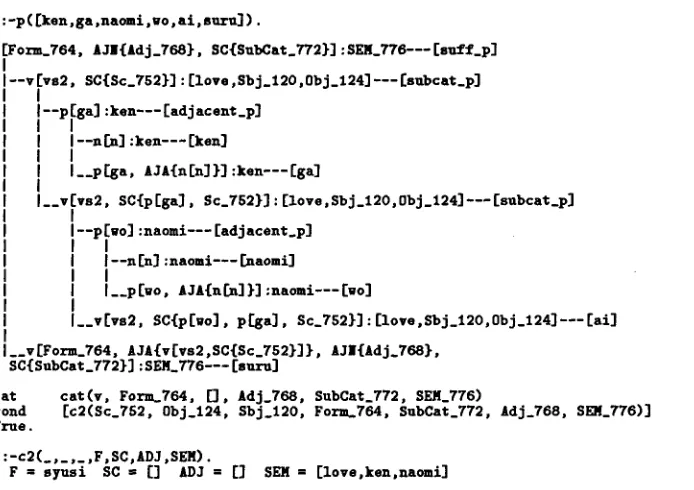
Figure 2 shows a simple demonstration of our JPSG parser, and Figure 3 shows an example of treating ambiguity as constraint. The current parser treats a few feature and has little lexicon. However, the expansion is easy. It parses about ten to twenty words sentences within a second on VAX8600. Since JPSG is a declarative grammar formalism and cu- Prolog describes JPSG also declaratively, the parser needs parsing algorithms independently. In the cur- rent implementation, we adopt the left corner parsing algorithm [1]. Furthermore, we would even be able to abandon parsing algorithm altogether [10].
5
F i n a l R e m a r k s
ular. So the most difficult problem one must tackle concerns itself with heuristics about how to control computation.
A c k n o w l e d g m e n t s
This study owes much to our colleagues in the JPSG Working group at ICOT. The implementation of cu-Prolog is supported by ICOT and the Ministry of International Trade and Industry in Japan.
R e f e r e n c e s
[i]
The further study of cu-Prolog has many prospects. [2] For example, to expand descriptive ability of con- straints, the negative operator or the universal quan- tifier can be added. The constraint-based, alias par- tial, aspects of Situation Semantics[3] are naturally [3] implemented in terms of an extended version of cu- Prolog [9]. For practical applications in Artificial In-
[4]
telligence in general and natural language process- ing in particular, one needs a mechanism for carrying out computation partially, instead of totally as de- scribed above, where constraint transformation halts only when the constraint in question is entirely mod-A. V. Aho and J. D. Ullman. The Theory of Parsing, Translation, and Compiling, Volume i: Parsing. Prentice-Hall, 1972.
A. AIBA. Seiyaku Ronri Programming (Con- straint Logic Programming). bit, 20(1):89-97, 1988. (in Japanese).
J. Barwise and J. Perry. Situation and Attitudes. MIT Press, Cambridge, Mass, 1983.
A. Colmerauer. Prolog H Reference Manual
and Theoretical Model. Technical Report, ER- ACRANS 363, Groupe d'-Intelligenee Artifielle, Universite Aix-Marseille II, October 1982.
_ : - p ( [ k e n , ga , n a o m i , wo, a l , e u r u ] ) .
v [Form_764, A J | { A d j _ 7 6 8 } , SC{SubCat.772}] : SEN_776--- [ s u f f _ p ]
I
[ - - v [ v s 2 , SC{Sc_752}] : [ l o v e , S b j . 1 2 0 , Obj_1241 - - - [ s u b c a t _p]
I
l--pFga]
:ken---[adjao.nt_p]I [ --n[n] :ken--- [ken]
I I
I I__p[ga, AJA{n[n]}] :ken---[ga] I
l __v [ v s 2 , SC{p [ g a ] , $c_752}] : [ l o v e , S b j _ 1 2 0 , 0 b j _ 1 2 4 ] - - - [ s u b c a t _ p ]
I
[ - - p [ w o ] : n a o m i - - - [ a d j a c e n t . p ]
I I
[ l - - n [hi : n a o m i - - - [naomi]
I I
[ I__p[wo, AJA{n[n]}] : n a o m i - - - [ w o ]
I
[__V[VS2, $C{p[wo], p[gal, Sc_752}] : [lovo,Sbj_120,Obj_124]---[ni]
[__v[For=_764, AJA{v[vs2,SC{Sc_752}]}, AJII{Adj_768},
SC{SubCat _772}1 : SEN.776--- [suru]
c a t c a t ( v , Form_764, [ ] , A d j . 7 6 8 , SubCat_772, SEH_776)
cond [c2(Sc_752, 0bj_124, S b j . 1 2 0 , Form_764, SubCat_772, Adj_768, SEM_776)]
True.
. : - c 2 ( . , _ , _ , F, SC, AD3 ,SEM).
F = s y u s i SC = [] ADJ ffi [] SEN = [ l o v e , k e n , n a o m i ]
The first line is a user's input. "Ken-ga Naomi-wo ai-suru" means "Ken loves Naomi."
Then, the parser returns the parse tree and the category and constraint
(c2())
of the top node. User solves the constraintto get the actual value of the variables.
F i g u r e 2: D e m o n s t r a t i o n o f o u r 3 P S G parser
_ : - p ( [ a i , s u r u , h i t o] ) .
n In] : Semant i c s . 8 2 4 - - - [ a d j u n c t _ p ]
I
[--v[Form_796, AJ|{n[h]}, $C{_820}]:Semmtics_824---[su~.pl
I I
I I - - v i v a 2 , SC{Sc.376}1 : [ l o v e , S b j _ l E 2 , 0 b j . l S 6 ] - - - [ a i ] I I
I I_.v[For=_796, AJA{v[vs2,$C{$¢_376}]}, AJl{n[n]}, $(:{_820}1 :Semmtics.824---[surul
I
[ __n In] : inst (ObJ .932, [people, 0bj_932] ) - - - [ h i t o]
cat cat(n, n, [ ] , [ ] , [ ] , Semantics.824)
cond [c6($c_376, 0bj.156, $bj_152, Foz~.796, _820, 0bj.932, Semantics_824)1
Title.
. : - c 6 ( . , . . . ,me=).
Se~ inst(ObJO.136, [and, [people,ObJO_136], [love,SbJ1.140,ObjO_136]])
Sam : I n s t ( S b j 0 . 1 3 6 , [and, Lpeople,SbJO_136], [ l o v a , S b j O . t 3 6 , 0 b j 1 . 1 4 0 ] ] )
This is a parse tree of "ai-suru hito" that has two meaning: "people whom someone loves" or "people who loves someone". These ambiguity is shown in two solution of the constraint.
F i g u r e 3: E x a m p l e o f a m b i g u i t y
[image:7.596.52.399.115.360.2][6]
K. FURUKAWA and F. MIZOGUTI, editors. Program Henkan (Program Transformation). Tisiki Johoshori Series No.7, Kyoritu, Tokyo, 1987. (in Japanese).[7] T. GUNJI. Japanese Phrase Structure Gram- mar. Reidel, Dordrecht, 1986.
[8] K. HASIDA. Conditioned Unification for Natu- ral Language Processing. In Proceedings of the 11th COLING, pages 85-87, 1986.
[9] K. HASIDA. A Constraint-Based View of Lan- guage. In Proceedings of Workshop on Situation Theory and its AppliCation, 1989. (to appear).
[10] K. HASIDA and S. ISIZAKI. Dependency Prop- agation: A Unified Theory of Sentence Cmpri- hension and Generation. In Proceedings of IJ-
CAI, 1987.
[11] S. M. Shieber. An Introduction to Unification- Based Approach to Grammar. CSLI Lecture Notes Series No.4, Stanford:CSLI, 1986.
[12] H. SIRAI and K. HASIDA. Zyookentuki Tanitu- ka (Conditioned Unification). Computer Soft- ware, 3(4):28-38, 1986. (in Japanese).