A. L i n e a r O b s e r v e d T i m e S t a t i s t i c a l P a r s e r B a s e d o n M a x i m u m
E n t r o p y M o d e l s
Adwait Ratnaparkhi*
Dept. of Computer and Information Science
University of Pennsylvania
200 South 33rd Street
Philadelphia, PA 19104-6389
adwait~unagi, cis. upenn, edu
Abstract
This paper presents a statistical parser for natural language that obtains a parsing accuracy--roughly 87% precision and 86% recall--which surpasses the best previously published results on the Wall St. Journal domain. The parser itself requires very lit- tle human intervention, since the informa- tion it uses to make parsing decisions is specified in a concise and simple manner, and is combined in a fully automatic way under the maximum entropy framework. The observed running time of the parser on a test sentence is linear with respect to the sentence length. Furthermore, the parser returns several scored parses for a sentence, and this paper shows that a scheme to pick the best parse from the 20 highest scoring parses could yield a dramatically higher ac- curacy of 93% precision and recall.
1 Introduction
This paper presents a statistical parser for natural language that finds one or more scored syntactic parse trees for a given input sentence. The parsing accuracy--roughly 87% precision and 86% recall-- surpasses the best previously published results on the Wall St. Journal domain. The parser consists of the following three conceptually distinct parts:
1. h set of procedures that use certain actions to incrementally construct parse trees.
2. A set of maximum entropy models that com- pute probabilities of the above actions, and ef- fectively "score" parse trees.
* The author acknowledges the support of AI:tPA grant N66001-94C-6043.
3. A search heuristic which attempts to find the highest scoring parse tree for a given input sen- tence.
The maximum entropy models used here are simi- lar in form to those in (Ratnaparkhi, 1996; Berger, Della Pietra, and Della Pietra, 1996; Lau, Rosen- feld, and Roukos, 1993). The models compute the probabilities of actions based on certain syntactic characteristics, or features, of the current context. The features used here are defined in a concise and simple manner, and their relative importance is de- termined automatically by applying a training pro- cedure on a corpus of syntactically annotated sen- tences, such as the Penn Treebank (Marcus, San- torini, and Marcinkiewicz, 1994). Although creat- ing the annotated corpus requires much linguistic expertise, creating the feature set for the parser it- self requires very little linguistic effort.
Also, the search heuristic is very simple, and its observed running time on a test sentence is linear with respect to the sentence length. Furthermore, the search heuristic returns several scored parses for -a sentence, and this paper shows that a scheme to pick the best parse from the 20 highest scoring parses
could yield a dramatically higher accuracy of 93% precision and recall.
Sections 2, 3, and 4 describe the tree-building procedures, the maximum entropy models, and the search heuristic, respectively. Section 5 describes experiments with the Penn Treebank and section 6 compares this paper with previously published works.
Pass Procedure Actions Description
First Pass TAG A P O S t a g in tag set Assign P O S Tag to word
Second Pass C H U N K S t a r t X, J o i n X, O t h e r Assign Chunk t a g to P O S t a g and word
T h i r d Pass B U I L D S t a r t X, J o i n X, where X is a Assign current tree to s t a r t a new constituent label in label set constituent, or to join the previ-
ous one
CHECK Yes, No Decide if current constituent is
complete
Table 1: Tree-Building Procedures of Parser
CHECK. T h e passes, the procedures they apply, and the actions of the procedures are summarized in ta- ble 1 and described below.
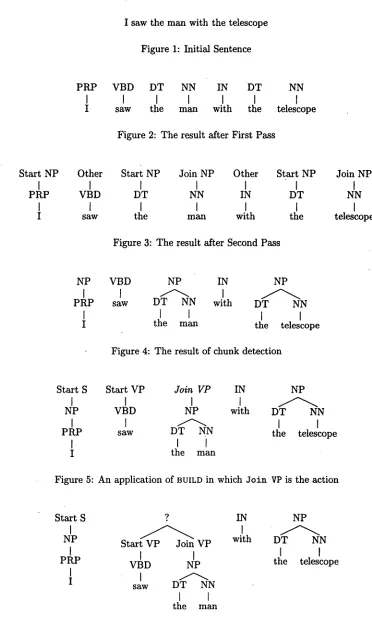
T h e actions of the procedures are designed so t h a t any possible complete parse tree T for the input sen- tence corresponds to exactly one sequence of actions; call this sequence the derivation of T. Each proce- dure, when given a derivation d = { a l . . . an}, pre- dicts some action a , + l to create a new derivation d' = {al . . . a , + l }. Typically, the procedures postu- late m a n y different values for a , + l , which cause the parser to explore m a n y different derivations when parsing an input sentence. B u t for demonstration purposes, figures 1-7 trace one possible derivation for the sentence "I saw the m a n with the telescope", using the part-of-speech (POS) t a g set and con- stituent label set of the Penn treebank.
2.1 First Pass
T h e first pass takes an input sentence, shown in fig- ure 1, and uses TAG to assign each word a P O S tag. T h e result of applying T A G to each word is shown in figure 2.
2.2 Second Pass
T h e second pass takes the output of the first pass
and uses C H U N K to determine the "flat" phrase chunks of the sentence, where a phrase is "flat" if and only if it is a constituent whose children consist solely of P O S tags. Starting from the left, C H U N K assigns each (word,POS tag) pair a "chunk" tag, ei- ther Start X, Join X, or Other. Figure 3 shows the
result after the second pass. T h e chunk tags are then
used for chunk detection, in which any consecutive sequence of words win.., w , ( m _< n) are grouped
into a "flat" chunk X if wm has been assigned S t a r t
X and W m + l . . . w , have all been assigned J o i n X. T h e result of chunk detection, shown in figure 4, is a forest of trees and serves as the input to the third pass.
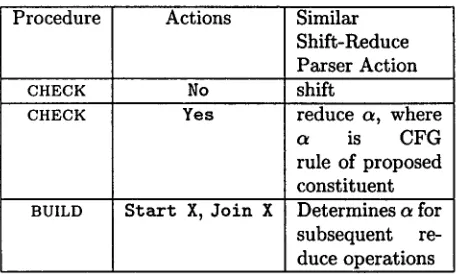
Procedure Actions Similar Shift-Reduce P a r s e r Action
CHECK No shift
CHECK Yes reduce c~, where
a is C F G rule of proposed constituent BUILD S t a r t X, J o i n X D e t e r m i n e s a for
subsequent re- duce operations
Table 2: Comparison of BUILD and CHECK to oper- ations of a shift-reduce parser
2.3 T h i r d P a s s
[image:2.612.94.526.74.190.2] [image:2.612.318.547.234.371.2]I saw the man with the telescope
Figure 1: Initial Sentence
P R P VBD DT NN IN DT NN
I
I
i
i
I
i
I
I saw the man with the telescope
Figure 2: The result after First Pass
Start NP Other Start NP Join NP Other Start NP Join NP
i
i
I
I
i
i
I
P R P VBD DT NN IN DT NN
i
I
I
i
i
i
i
I saw the man with the telescope
Figure 3: The result after Second Pass
NP VBD NP IN
P R P saw DT NN with
I
I
I
I the man
NP
DT NN
i
i
the telescope
Figure 4: The result of chunk detection
Start S Start VP Join VP IN NP
I
I
I
I
NP VBD NP with DT NN
I
f
~
i
i
P R P saw DT NN the telescope
I
I
i
I the man
Figure 5: An application of BUILD in which Join VP is the action
Start S ? IN NP
NP Start VP Join VP with DT NN
I
I
I
I
I
P R P VBD NP the telescope
I saw DT NN
I
I
the man
[image:3.612.107.479.70.687.2]Start S Start VP Join VP ?
I
I
i
I
NP VBD NP IN
P R P saw D T NN with
I
I
I
I the man
NP
D T NN
I
I
the telescope
Figure 7: An application of CHECK in which No is the action, indicating t h a t the proposed constituent in figure 6 is
not
complete. BUILD will now process the tree marked with ?proposed constituent is a "fiat" chunk, since such constituents must be formed in the second pass. Fig- ure 7 shows the result when CHECK looks at the pro- posed constituent in figure 6 and decides No. T h e third pass terminates when CHECK is presented a constituent t h a t spans the entire sentence.
Table 2 compares the actions of BUILD and CHECK to the operations of a standard shift-reduce parser. T h e No and Yea actions of CHECK correspond to the shift and reduce actions, respectively. The impor- t a n t difference is t h a t while a shift-reduce parser creates a constituent in one step (reduce a), the pro- cedures BUILD and CHECK create it over several steps in smaller increments.
3 P r o b a b i l i t y M o d e l
This paper takes a "history-based" approach (Black et al., 1993) where each tree-building procedure uses a probability model
p(alb),
derived fromp(a, b),
to weight any action a based on the available context, or history, b. First, we present a few simple cate- gories of contextual predicates t h a t capture any in- formation in b t h a t is useful for predicting a. Next, the predicates are used to extract a set of features from a corpus of manually parsed sentences. Finally, those features are combined under the maximum en- t r o p y framework, yieldingp(a, b).
3.1 C o n t e x t u a l P r e d i c a t e s
Contextual predicates are functions that check for the presence or absence of useful information in a context b and return true or false accordingly. T h e comprehensive guidelines, or templates, for the con- textual predicates of each tree building procedure are given in table 3. T h e templates use indices relative to the tree t h a t is currently being modi- fied. For example, if the current tree is the 5th tree, c o n s ( - 2 ) looks at the constituent label, head word, and s t a r t / j o i n annotation of the 3rd tree in the forest. T h e actual contextual predicates are gen- erated automatically by scanning the derivations of the trees in the manually parsed corpus with the
templates. For example, an actual contextual pred- icate based on the template cons(0) might be "Does cons(0) = { NP, he } ?" Constituent head words are found, when necessary, with the algorithm in (Magerman, 1995).
Contextual predicates which look at head words, or especially pairs of head words, m a y not be re- liable predictors for the procedure actions due to their sparseness in the training sample. Therefore, for each lexically based contextual predicate, there also exist one or more corresponding less specific, or "backed-off", contextual predicates which look at the same context, but
omit
one or more words. For example, the contexts cons(0, 1"), cons(0*, 1), cons(0*, 1") are the same as cons(0,1) b u t omit ref- erences to the head word of the 1st tree, the 0th tree, and b o t h the 0th and 1st tree, respectively. T h e backed-off contextual predicates should allow the model to provide reliable probability estimates when the words in the history are rare. Backed-off predicates are not enumerated in table 3, b u t their existence is indicated with a * and t.3.2 M a x i m u m E n t r o p y F r a m e w o r k
T h e contextual predicates derived from the tem- plates of table 3 are used to create the features nec- essary for the maximum entropy models. T h e pred- icates for TAG, CHUNK, BUILD, and CHECK are used to scan the derivations of the trees in the corpus to form the training samples "~^c, TcMusK, '~U~LD, and TCMECK, respectively. Each training sample has the form T = ( ( a l , 51), (a2, b 2 ) , . . . ,
CaN, bN)},
where ai is an action of the corresponding procedure and bi is the list of contextual predicates t h a t were t r u e in the context in which al was decided.The training samples are respectively used to cre- ate the models PT^G, PCHUNK, PBUILD, and PCMECK, all of which have the form:
k
p(a, b) =
I I _ij(o,b
~j (1)j----1
[image:4.612.167.455.63.155.2]Model Categories Description Templates Used
TAG See (Ratnaparkhi, 1996)
CHUNK chunkandpostag(n)*
BUILD
CHECK
chunkandpostag(m, n)*
cons(n)
cons(re, n)*
cons(m,
n,p) Tpunctuation
checkcons(n)*
checkcons(m,n)*
production
surround(n)*
The word, POS tag, and chunk tag of n t h leaf. Chunk tag omitted if n > 0.
chunkandpostag(m) & chunkandpostag(n)
The head word, constituent (or POS) la- bel, and start/join annotation of the n t h tree. Start/join annotation omitted if n > 0 .
cons(m) & cons(n)
cons(m), cons(n), & cons(p).
The constituent we could join (1) contains a "[" and the current tree is a "]"; (2) contains a "," and the current tree is a ","; (3) spans the entire sentence and current
tree is "."
The head word, constituent (or POS) la- bel of the nth tree, and the label of pro- posed constituent, begin and last are first and last child (resp.) of proposed constituent.
checkcons(m) & checkcons(n)
Constituent label of parent (X), and constituent or P 0 S labels of children (Xz . . . Xn) of proposed constituent POS tag and word of the n t h leaf to the left of the constituent, if n < 0, or to the right of the constituent, if n > 0
chunkandpostag(O),
chunkandpostag(-1),
chunkandpostag(-2)
chunkandpostag(1),
chunkandpostag(2)
chunkandpostag(-1, 0),
chunkandpostag(O, 1)
cons(O), cons(-1), cons(-2),
cons(l), cons(2)
cons(-1,
0),cons(O,
1)cons(O, -1, -2), cons(O, 1, 2),
cons(-1, O, 1)
bracketsmatch,
iscomma,
endofsentence
checkcons( last) , checkcons(begin)
checkcons(i, last),
begin <i < last
production=X --} X1 ... Xn
surround(I),
surround(2),
surround(-1), surround(-2)
[image:5.612.72.555.168.579.2]malization constant, a j are the model parameters, 0 < a j < oo, and
fj(a, b) E
{0, 1} are calledfeatures,
j = { 1 . . . k}. Features encode an action a' as well as some contextual predicate cp t h a t a tree-building procedure would find useful for predicting the action a'. Any contextual predicate cp derived from table 3 which occurs 5 or more times in a training sample with a particular action a' is used to construct a feature f j :
1 if cp(b) = t r u e
&& a = a'
f j ( a , b ) =
0 otherwisefor use in the corresponding model. Each feature f j corresponds to a parameter a j , which can be viewed as a "weight" t h a t reflects the importance of the feature.
The parameters { a l . . . a n } are found automat- ically with
Generalized Iterative Scaling
(Darroch and Ratcliff, 1972), or GIS. T h e GIS procedure, as well as the maximum entropy and maximum likeli- hood properties of the distribution of form (1), are described in detail in (Ratnaparkhi, 1997). In gen- eral, the maximum entropy framework puts no lim- itations on the kinds of features in the model; no special estimation technique is required to combine features t h a t encode different kinds of contextual predicates, like punctuation and cons(0, 1, 2). As a result, experimenters need only worry aboutwhat
features to use, and not
how
to use them.We then use the models Pr^a, PeHusK, PBUILD, and Pongee to define a function score, which the search procedure uses to rank derivations of incomplete and complete parse trees. For each model, the corre- sponding conditional probability is defined as usual:
p(a, b)
P(alb) = Ea'eA p(a', b)
For notational convenience, define q as follows
[ PrAa(a]b) if a is an action from TAG
pCStmK(a[b) if a is an action from CHUNK
q(alb)
=PBUILD(al
b)
if a is an action from BUILDPcnEcK(alb )
if a is an action fromCHECK
Let deriv(T) = { a l , . . .
,an}
be the derivation of a parse T, where T is not necessarily complete, and where each al is an action of some tree-building procedure. By design, the tree-building procedures guarantee t h a t { a l , . . . , an} is the only derivation for the parse T. T h e n the score of T is merely the prod- uct of the conditional probabilities of the individual actions in its derivation:score(T) = H
q(adbi)
a~ Ederiv(T)
where bi is the context in which ai was decided.
4
S e a r c h
The search heuristic a t t e m p t s to find the best parse T*, defined as:
T* = a r g m a x
score(T)
T G t r e e s ( S )where trees(S) are all the complete parses for an input sentence S.
T h e heuristic employs a breadth-first search (BFS) which does not explore the entire frontier, but rather, explores only at most the top g scor- ing incomplete parses in the frontier, and terminates when it has found M complete parses, or when all the hypotheses have been exhausted. Furthermore, if { a l . . . a n } are the possible actions for a given procedure on a derivation with context b, and they are sorted in decreasing order according to
q(ailb),
we only consider exploring those actions {al . . .
am}
t h a t hold most of the probability mass, where m is defined as follows:
m
m = m a x E q(a, lb) < Q
i = 1and where Q is a threshold less t h a n 1. T h e search also uses a
Tag Dictionary
constructed from train- ing data, described in (Ratnaparkhi, 1996), t h a t re- duces the number of actions explored by the tag- ging model. Thus there are three parameters for the search heuristic, namelyK , M ,
and Q and all exper- iments reported in this paper use K = 20, M = 20, and Q = .951 Table 4 describes the top K BFS and the semantics of the supporting functions.It should be emphasized t h a t if K > 1, the parser does not commit to a single POS or chunk assign- ment for the input sentence before building con- stituent structure. All three of the passes described in section 2 are integrated in the search, i.e., when parsing a test sentence, the input to the second pass consists of K of the best distinct P O S tag assign- ments for the input sentence. Likewise, the input to the third pass consists of K of the best distinct chunk and POS tag assignments for the input sen- tence.
T h e top K BFS described above exploits the ob- served property t h a t the individual steps of correct derivations tend to have high probabilities, and thus avoids searching a large fraction of the search space. Since, in practice, it only does a constant a m o u n t of work to advance each step in a derivation, and since derivation lengths are roughly proportional to the
1The parameters
K,M, and Q
were optimized o na d v a n c e : d x V
i n s e r t : d x h e x t r a c t : h ) d
c o m p l e t e d : d
> d l . . . d m
> void
) {true,false}
M = 2 0 K = 2 0
Q = .95
C = <empty heap>
h0 =<input sentence>
w h i l e ( I C l < M )
i f ( Vi, hi i s empty ) t h e n b r e a k
/ * Applies relevant tree building procedure to d and returns list of new derivations whose action probabilities pass the threshold Q */
/* inserts d in heap h */
/* removes and returns derivation in h with highest score */
/* returns true if and only if d is a complete derivation */
/* Heap of completed parses */
/* hi contains derivations of length i */
i = max{i I hi i s n o n - e m p t y }
sz = m i n ( g , ihii) f o r j = l t o sz
d l . . . d p = a d v a n c e ( e x t r a c t ( h l ) , V ) f o r q = l t o p
if (completed (dq))
then insert (dq, C )
else insert(dq, hi+l)
Table 4: Top K BFS Search Heuristic
Seconds
I I I I I
, li!
,ll!ill,
0
::it
:ii i
,i!.,:
...:i
,!lili
!)))I,
)!i'
• ° • o •
:'i:!"."
: . : ' , I - ","
• i . , i I :o:
!!II,
| l i : ' . "
I|I: i i ~ ' :
I • o •
i ' l " I I f I I
10 20 30 40 50 60 70
Sentence Length
[image:7.612.65.529.70.674.2] [image:7.612.115.491.373.654.2]sentence length, we would expect it to run in lin- ear observed time with respect to sentence length. Figure 8 confirms our assumptions about the linear observed running time.
5 E x p e r i m e n t s
The maximum entropy parser was trained on sec- tions 2 through 21 (roughly 40000 sentences) of the Penn Treebank Wall St. Journal corpus, release 2 (Marcus, Santorini, and Marcinkiewicz, 1994), and tested on section 23 (2416 sentences) for compar- ison with other work. All trees were stripped of their semantic tags (e.g., -LOC, -BNF, etc.), coref- erence information(e.g., *-1), and quotation marks ( " and ' ' ) for both training and testing. The PAR- SEVAL (Black and others, 1991) measures compare a proposed parse P with the corresponding correct treebank parse T as follows:
# correct constituents in P Recall =
# constituents in T # correct constituents in P Precision =
# constituents in P
A constituent in P is "correct" if there exists a con- stituent in T of the same label that spans the same words. Table 5 shows results using the PARSEVAL measures, as well as results using the slightly more forgiving measures of (Collins, 1996) and (Mager- man, 1995). Table 5 shows that the maximum en- tropy parser performs better than the parsers pre- sented in (Collins, 1996) and (Magerman, 1995) ~, which have the best previously published parsing ac- curacies on the Wall St. Journal domain.
It is often advantageous to produce the top N parses instead of just the top 1, since additional in- formation can be used in a secondary model that re- orders the top N and hopefully improves the quality of the top ranked parse. Suppose there exists a "per- fect" reranking scheme that, for each sentence, magi- cally picks the best parse from the top N parses pro- duced by the maximum entropy parser, where the
best parse has the highest average precision and re- call when compared to the treebank parse. The per- formance of this "perfect" scheme is then an upper bound on the performance of any reranking scheme that might be used to reorder the top N parses. Fig- ure 9 shows that the "perfect" scheme would achieve roughly 93% precision and recall, which is a dra- matic increase over the top 1 accuracy of 87% preci- sion and 86% recall. Figure 10 shows that the "Ex- act Match", which counts the percentage of times
2Results for SPATTER on section 23 are reported in (Collins, 1996)
Parser Precision Maximum Entropy ° 86.8% Maximum Entropy* 87.5% (Collins, 1996)* 85.7% (Magerman, 1995)* 84.3%
Recall 85.6% 86.3% 85.3% 84.0%
Table 5: Results on 2416 sentences of section 23 (0 to 100 words in length) of the WSJ Treebank. Evaluations marked with ~ ignore quotation marks. Evaluations marked with * collapse the distinction between ADVP and PRT, and ignore all punctuation.
the proposed parse P is identical (excluding POS tags) to the treebank parse T, rises substantially to about 53% from 30% when the "perfect" scheme is applied. For this reason, research into reranking schemes appears to be a promising step towards the goal of improving parsing accuracy.
6 C o m p a r i s o n W i t h P r e v i o u s W o r k
The two parsers which have previously reported the best accuracies on the Penn Treebank Wall St. Jour- nal are the bigram parser described in (Collins, 1996) and the SPATTER parser described in (Jelinek et al., 1994; Magerman, 1995). The parser presented here outperforms both the bigram parser and the SPATTER parser, and uses different modelling tech- nology and different information to drive its deci- sions.
The bigram parser is a statistical CKY-style chart parser, which uses cooccurrence statistics of head- modifier pairs to find the best parse. The max- imum entropy parser is a statistical shift-reduce style parser that cannot always access head-modifier pairs. For example, the checkcons(m,n) predicate of the maximum entropy parser may use two words such that neither is the intended head of the pro- posed consituent that the CHECK procedure must judge. And unlike the bigram parser, the maximum entropy parser cannot use head word information besides "flat" chunks in the right context.
[image:8.612.332.526.75.139.2]95
94
93
92
91
%Accuracy90
89
88
87
0
0 +
+
0 +
0 +
+ +
I I I
Precision O Recall +
o O o O O O O O O O O O O O O + + + + + + + + + + +
+ +
85 L - - - ~ - - - . . - - - . . . - -
0 5 10 15 20
N
Figure 9: Precision & recall of a "perfect" reranking scheme for the top N parses of section 23 of the WSJ Treebank, as a function of N. Evaluation ignores quotation marks.
55 53 51 49 47 45 43
% A c c u r a c y ~
37 35 33 31< 29 27 25
0 O
O O
O O O
O O
I
O O O O O O O O O O O
I
I I
5 10 15 20
N
[image:9.612.105.478.78.325.2] [image:9.612.108.471.385.655.2]bustly integrates any kind of information, obviating the need to screen it first.
The SPATTER parser is a history-based parser that uses decision tree models to guide the opera- tions of a few tree building procedures. It differs from the maximum entropy parser in how it builds trees and more critically, in how its decision trees use information. The SPATTER decision trees use predicates on word classes created with a statistical clustering technique, whereas the maximum entropy parser uses predicates that contain merely the words themselves, and thus lacks the need for a (typically expensive) word clustering procedure. Furthermore, the top K BFS search heuristic appears to be much simpler than the stack decoder algorithm outlined in (Magerman, 1995).
77
C o n c l u s i o n
The maximum entropy parser presented here achieves a parsing accuracy which exceeds the best previously published results, and parses a test sen- tence in linear observed time, with respect to the sentence length. It uses simple and concisely speci- • fled predicates which can added or modified quickly with little human effort under the maximum entropy framework. Lastly, this paper clearly demonstrates that schemes for reranking the top 20 parses deserve research effort since they could yield vastly better accuracy results.
8
Acknowledgements
Many thanks to Mike Collins and Professor Mitch Marcus from the University of Pennsylvania for their helpful comments on this work.
R e f e r e n c e s
Berger, Adam, Stephen A. Della Pietra, and Vin- cent J. Della Pietra. 1996. A Maximum Entropy
Approach to Natural Language Processing. Com-
putational Linguistics, 22(1):39-71.
Black, Ezra et al. 1991. A Procedure for Quan- titatively Comparing the Syntactic Coverage of
English Grammars. In Proceedings of the Febru-
ary 1991 DARPA Speech and Natural Language Workshop, pages 306-311.
Black, Ezra, Fred Jelinek, John Lafferty, David M. Magerman, Robert Mercer, and Salim Roukos. 1993. Towards History-based Grammars: Using
Richer Models for Probabilistic Parsing. In Pro-
ceedings of the 31st Annual Meeting of the ACL,
Columbus, Ohio.
Collins, Michael John. 1996. A New Statistical
Parser Based on Bigram Lexical Dependencies. In Proceedings of the 34th Annual Meeting of the ACL.
Darroch, J. N. and D. Ratcliff. 1972. Generalized
Iterative Scaling for Log-Linear Models. The An-
nals of Mathematical Statistics, 43(5):1470-1480. Jelinek, Fred, John Lafferty, David M. Magerman, Robert Mercer, Adwait Ratnaparkhi, and Salim Roukos. 1994. Decision Tree Parsing using a Hid-
den Derivational Model. In Proceedings of the Hu-
man Language Technology Workshop, pages 272- 277. ARPA.
Lau, Ray, Ronald Rosenfeld, and Salim Roukos. 1993. Adaptive Language Modeling Using The
Maximum Entropy Principle. In Proceedings of
the Human Language Technology Workshop, pages 108-113. ARPA.
Magerman, David M. 1995. Statistical Decision-
Tree Models for Parsing. In Proceedings of the
33rd Annual Meeting of the ACL.
Marcus, Mitchell P., Beatrice Santorini, and
Mary Ann Marcinkiewicz. 1994. Building a large annotated corpus of English: the Penn Treebank.
Computational Linguistics, 19(2):313-330. Ratnaparkhi, Adwait. 1996. A Maximum Entropy
Part of Speech Tagger. In Conference on Em-
pirical Methods in Natural Language Processing,
University of Pennsylvania, May 17-18.