1460
Using Similarity Measures to Select Pretraining Data for NER
Xiang Dai1,2 Sarvnaz Karimi1 Ben Hachey2,3 Cecile Paris1 1CSIRO Data61, Sydney, Australia
2University of Sydney, Sydney, Australia 3Digital Health CRC, Sydney, Australia
{dai.dai,sarvnaz.karimi,cecile.paris}@csiro.au [email protected]
Abstract
Word vectors and Language Models (LMs) pretrained on a large amount of unlabelled data can dramatically improve various Natural Lan-guage Processing (NLP) tasks. However, the measure and impact of similarity between pre-training data and target task data are left to in-tuition. We propose three cost-effective mea-sures to quantify different aspects of similar-ity between source pretraining and target task data. We demonstrate that these measures are good predictors of the usefulness of pretrained models for Named Entity Recognition (NER) over 30 data pairs. Results also suggest that pretrained LMs are more effective and more predictable than pretrained word vectors, but pretrained word vectors are better when pre-training data is dissimilar.
1 Introduction
Modern neural architectures for NLP are highly effective when provided a large amount of labelled
training data (Zhang et al.,2015;Conneau et al.,
2017;Bowman et al.,2015). However, a large la-belled data set is not always readily accessible due to the high cost of expertise needed for labelling or even due to legal barriers. Researchers working on such tasks usually spend a considerable amount of effort and resources on collecting useful
exter-nal datasourcesand investigating how to transfer
knowledge to their target tasks (Qi et al., 2009;
Kim et al.,2017). Recent transfer learning tech-niques make the most of limited labelled data by incorporating word vectors or LMs pretrained on a large amount of unlabelled data. This produces dramatic improvements over a range of NLP tasks
where appropriate unlabelled data is available (
Pe-ters et al.,2017,2018;Akbik et al.,2018;Devlin et al.,2019).
However, there is still a lack of systematic study on how to select appropriate data to pretrain word
vectors or LMs. We observe a range of heuristic strategies in the literature: (1) collecting a large
amount of generic data, e.g., web crawl (
Penning-ton et al.,2014;Mikolov et al.,2018); (2) selecting
data from a similarfield(the subject matter of the
content being discussed), e.g., biology (Chiu et al.,
2016;Karimi et al.,2017); and, (3) selecting data
from a similar tenor (the participants in the
dis-course, their relationships to each other, and their
purposes), e.g., Twitter, or online forums (Li et al.,
2017;Chronopoulou et al.,2019). In all these set-tings, the decision is based on heuristics and varies according to the individual’s experience. We also conducted a pilot study that suggests that the prac-titioner’s intuition is to prioritise field over tenor
(see Section3).
Our overarching goal is to develop a cost-effective approach that, given a NER data set, nominates the most suitable source data to pretrain word vectors or LMs from several options. Our approach builds on the hypothesis that the more similar the source data is to the target data, the better the pretrained models are, all other aspects (such as source data size) being equal. We pro-pose using target vocabulary covered rate and lan-guage model perplexity to select pretraining data. We also introduce a new measure based on the change from word vectors pretrained on source data to word vectors initialized from source data and then trained on target data. Experiments lever-age 30 data pairs from five source and six target NER data sets, each selected to provide a range of fields (i.e., biology, computer science, medica-tions, local business) and tenors (i.e., encyclope-dia articles, journal articles, experimental proto-cols, online reviews).
Our contributions can be summarized as below:
• We propose methods to quantitatively
source and target data sets and find that these measures are predictive of the impact of pre-training data on final accuracy. To the best of our knowledge, this is the first systematic study to investigate LMs pretrained on
vari-ous data sources.1
• We find that it is important to consider tenor
as well as field when selecting pretraining data, contrary to human intuitions.
• We show that models pretrained on a
mod-est amount of similar data outperform pre-trained models that take weeks to train over very large generic data.
2 Related Work
Text Similarity Word similarity following the hypothesis that similar words tend to occur in
sim-ilar contexts (Harris, 1954) is well studied and
forms the foundation of neural word embedding
architectures. Hill et al. (2015) and Budanitsky
and Hirst(2006) evaluate functional similarity (as inschool versuscollege) and associative
similar-ity (as in school versus teacher) captured by
se-mantic models, respectively. Pavlick et al.(2015)
study sentence-level similarity, using entailment relation, vector embedding and stylistic variation
measures. Kusner et al. (2015) propose Word
Mover’s Distance to measure the similarity be-tween documents and evaluate on document clas-sification tasks. We extend the study of similarity to corpus-level, and focus on its implication on un-supervised pretraining.
Pretrained Word Vectors The effectiveness of pretrained word vectors mainly depends on three factors: source data, training algorithm, and its
hyper-parameters. Turian et al. (2010) andLevy
et al. (2015) systematically compare count-based distributional models and distributed neural em-bedding models. They find that both models can improve the performance of downstream tasks.
Chiu et al. (2016) identify the most influential hyper-parameters of neural embedding methods. They also investigate the impact of the source data size and find that larger pretraining data do not necessarily produce better word vectors for biomedical NER. Our work regarding pretrained word vectors is conducted using skip-gram model
with default hyper-parameter setting (Mikolov
et al., 2013), and our focus is on the impact of
1Our pretrained word vectors and LMs are publicly
avail-able:https://bit.ly/2O0mOOG.
similarity between source data and target task data on the effectiveness of pretrained word vectors for NER tasks. Our observations are a useful supple-ment to the literature as a practitioners’ guide.
Pretrained Language Models Dai and Le
(2015) investigate different methods to transfer
knowledge to supervised recurrent neural net-works. They establish that a pretrained recurrent LM can improve the generalization ability of the supervised models. They use unlabelled data from Amazon reviews to pretrain the LM and find that it can improve classification accuracy on the
Rot-ten Tomatoes data set. Joshi et al.(2018)
empiri-cally showed that, for their vaccination behaviour detection task on twitter data, LMs pretrained on a small amount of movie reviews outperform the ones pretrained on large size of Wikipedia data.
Peters et al. (2017) successfully inject the infor-mation captured by a bidirectional LM into a se-quence tagger, and extend this approach to other
NLP tasks (Peters et al.,2018). Our work is based
on (Peters et al., 2018) and investigates the im-pact of pretraining data on the effectiveness of pre-trained LMs for downstream NER tasks.
Transfer Learning While our study falls into the paradigm of semi-supervised learning, we dis-tinguish ourselves from other studies in transfer learning. One sub-area of transfer learning is do-main adaptation, which aims to learn transferable representation from a source domain and apply it
to a target domain (Blitzer et al.,2006;Yang and
Eisenstein,2015). The question in domain adapta-tion is usually framed as ‘Given a source and a tar-get, how to transfer?’. In contrast, the question we address is ‘Given a specific target, which source to choose from?’. The other sub-area of transfer
learning is transferring from multiple sources (Yin
and Sch¨utze,2015;Li et al.,2018). Our work fo-cuses, instead, on the selection of a single external data source. Our work is inspired by the
methodol-ogy proposed byJohnson et al.(2018) where they
predict a system’s accuracy using larger training data from its performance on much smaller pilot data. However, we aim to predict the usefulness of pretrained models for target tasks from the sim-ilarity between the source pretraining data and the target task data.
Figure 1: Likert scale ratings from NLP and ML practitioners (N= 30) for the statement ‘Unsupervised pretrain-ing on S would be useful for supervised named entity recognition learnpretrain-ing on T.’ Target data T is described as ‘Online forum posts about medications,’ source data S1 as ‘Research papers about biology and health,’ and source data S2 as ‘Online reviews about restaurants, hotels, barbers, mechanics, etc.’
different combinations of convolutional and recur-rent neural networks have achieved state-of-the-art results on many NER tasks. A detailed review and comparison of these methods can be found in (Yang et al.,2018). Our experiments on the use-fulness of pretrained word vectors and pretrained LMs for NER tasks are based on one variant
pro-posed byLample et al.(2016).
3 What Human Intuition Indicates
Results of a survey capturing intuition regarding selection of pretraining data across 30 NLP or
ma-chine learning practitioners is shown in Figure1.
Participants were provided short descriptions of the target data set T, and two possible source data sets S1 and S2 as
• T: Online forum posts about medications;
• S1: Research papers about biology and
health;
• S2: Online reviews about restaurants, hotels,
barbers, mechanics, etc.
We constructed each of these descriptions as
‘t about f’ where t is intended to describe the
tenor andf the field. Each participant rated both
sources on a five-point Likert, indicating agree-ment with the stateagree-ment “Unsupervised pretrain-ing on S would be useful for supervised named entity recognition learning on T”. 73% of partici-pants agreed or strongly agreed that S1 would be useful, while only 27% agreed that S2 would be useful. A Wilcoxon signed-rank test indicates that scores are significantly higher for S1 than for S2 (Z = 43.0, p <0.001).
Although small in scale, these results show that intuition varies across practitioners, motivating our work on identifying quantitative measures that
are predictive of performance. These results also suggest that practitioners favour field over tenor when selecting pretraining data, which would be detrimental to accuracy of the target NER tasks in
later experiments (Section7.2).
4 Similarity Measures
To measure the similarity between source and tar-get data, we start from identifying linguistic con-cepts behind these human intuitions. Then, we propose several measures to quantify these at-tributes which lead to the perception that two data sets are similar.
Researchers who select pretraining data from a similar field believe that, if the source data has a similar field to the target data, they tend to share similar vocabulary. Conversely, vocabularies are different from each other if source and target are
from different fields. Imagine data sets about
medications and restaurants. Those who select
pretraining data from a similar tenor believe that tenor may impact the writing style of text. Imag-ine the participants in onlImag-ine reviews and scien-tific papers, their relationships to each other, their purposes and how these affect text style, includ-ing punctuation, lexical normalization, politeness,
emotiveness and so on (Lee,2001;Solano-Flores,
2006;Pavlick and Tetreault,2016).
Below, we detail different measures based on these intuitions to quantify different aspects of similarity between two data sets.
4.1 Target Vocabulary Covered
they are written in a similar style and talking about
the same subject2. We proposeTarget Vocabulary
Covered (TVC)as a measure of field, calculated as
T V C(DS, DT) =
|VDS ∩VDT| |VDT|
,
whereVDS andVDT are sets of unique tokens in
source and target data sets respectively. We also investigate a variant where only content words (nouns, verbs, adjectives) are used to calculate
VDS andVDT. We denote this variant asVCcR.
4.2 Language Model Perplexity
A language model can assign a probability to any
sequence of words< w1,· · ·, wN >using chain
rule of probability:
p(w1, w2,· · ·, wN) = N Y
i=1
p(wi|w1w−1),
where N is the length of the sequence and wi1−1
are all words before word wi. In practice, this
equation can be simplified by n-gram models based on Markov Assumption:
p(w1, w2,· · ·, wN) = N Y
i=1
p(wi|wii−−1n+1),
wherewii−−n1+1 represents onlynpreceding words
of wi. To make the model generalize
bet-ter, smoothing techniques can be used to assign non-zero probabilities to unseen events. In this study, we use Kneser-Ney smoothed 5-gram
mod-els (Heafield,2011). To measure the similarity
be-tween two data sets using language modeling, we first train the language model on the source data, then evaluate it on the target data using perplex-ity to represent the degree of similarperplex-ity. The in-tuition is that, if the model finds a sentence very unlikely (dissimilar from the data where this lan-guage model is trained on), it will assign a low
probability and therefore high perplexity. The
summed upperplexity (PPL)is then:
P P L(DS, DT) = m X
i=1
P(DTi)−
1 Ni,
wherem is the number of sentences in the target
data set, andP(DTi)is the probability assigned by
2Our focus is on transferring through pretrained models
using one single source and we do not consider multilingual similarity.
the language model trained on the source data to
the i-th sentence from the target data set, whose
sentence length isNi.
PPL is token-based, similar to TVC, but also captures surface structure. We therefore propose PPL as a proxy to measure tenor as well as field.
4.3 Word Vector Variance
Pretrained word vectors capture semantic and
syn-tactic regularities of words (Artetxe et al.,2018).
The variance of a word vector that is first trained on the source data and then on the target data can reflect the difference of linguistic regularities be-tween the two data sets.
Intuitively, if the context words around a given word are very different in the source and target data, then the word vector of this word learned from the source will be updated more than those words whose context words are similar between
source and target. Therefore, we useWord Vector
Variance (WVV)as another combined measure of tenor and field.
To calculate word vector variance, we first train word vectors on the source data set using
skip-gram model (Mikolov et al., 2013). The trained
word vectors are denoted as W S ∈ R|VS|×d,
where |VS| is the vocabulary size of the source
data set and d is the vector dimension. Then,
we useW Sas initial weights of a new skip-gram
model, and train this new model on the target data.
We denote the final word vectors as W T. The
WVV can be calculated as:
W V V(DS, DT) =
1
|VS|
1
d |VS| X
i d X
j
(W Sij−W Tij)2.
The smaller the word vector variance, the more similar context surrounds the same words from the two data sets, and therefore the more similar the two data sets are.
5 Data Sets
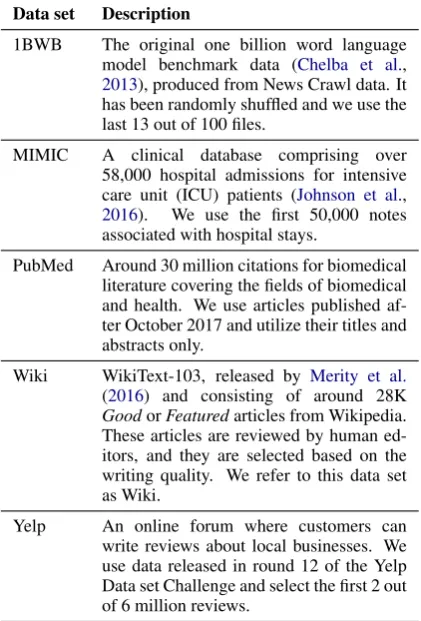
Source data sets We use five data sets as source data, covering a range of fields (i.e., clinical, biomedical, local business and Wiki with diverse fields) and tenors (i.e., popular reporting, notes, scholarly publications, online reviews and ency-clopedia). To isolate the impact of source size, we sample all source data to approximately 100 mil-lion tokens. We also analyze the impact of source
data size separately in Section7.3. The
Data set Description
1BWB The original one billion word language model benchmark data (Chelba et al., 2013), produced from News Crawl data. It has been randomly shuffled and we use the last 13 out of 100 files.
MIMIC A clinical database comprising over 58,000 hospital admissions for intensive care unit (ICU) patients (Johnson et al., 2016). We use the first 50,000 notes associated with hospital stays.
PubMed Around 30 million citations for biomedical literature covering the fields of biomedical and health. We use articles published af-ter October 2017 and utilize their titles and abstracts only.
Wiki WikiText-103, released by Merity et al. (2016) and consisting of around 28K GoodorFeaturedarticles from Wikipedia. These articles are reviewed by human ed-itors, and they are selected based on the writing quality. We refer to this data set as Wiki.
[image:5.595.76.287.64.375.2]Yelp An online forum where customers can write reviews about local businesses. We use data released in round 12 of the Yelp Data set Challenge and select the first 2 out of 6 million reviews.
Table 1: List of the source data sets.
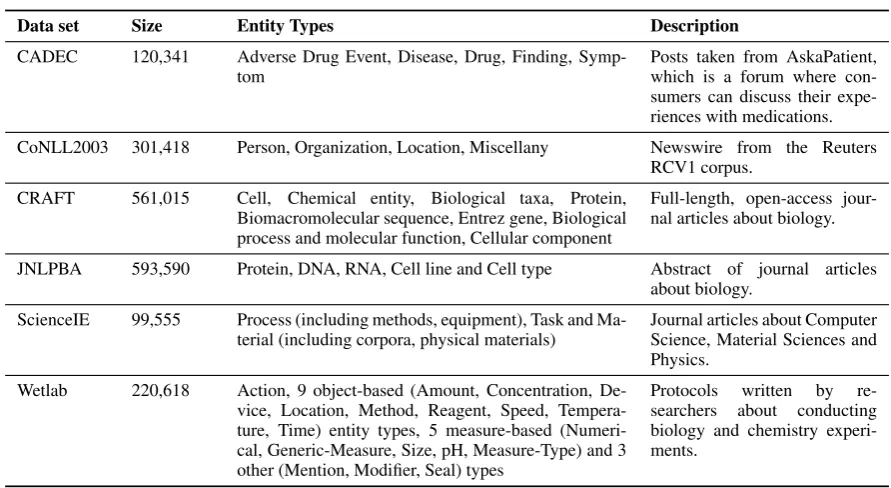
Target data sets Six NER data sets are
used as target data: CADEC (Karimi et al.,
2015), CoNLL2003 (Sang and Meulder, 2003),
CRAFT (Bada et al.,2012), JNLPBA (Collier and
Kim, 2004), ScienceIE (Augenstein et al., 2017)
and WetLab (Kulkarni et al., 2018). Details of
these target data are listed in Table2. We choose
these data sets based on two considerations:
1. NER is a popular structured NLP task. Using NER, we want to observe how the similar-ity between source and target data may affect the effectiveness of different pretrained word vectors and LMs on downstream tasks.
2. NER is highly sensitive to word representa-tions, because the model needs to make token level decisions. That is, each token needs to be assigned a proper label. Past studies have shown that removing pretrained word vectors from a tagging system results in a large drop
in performance (Huang et al.,2015;Lample
et al.,2016).
6 Experimental Setup
To investigate the impact of source data on pre-trained word vectors and LMs, we pretrain word vectors and LMs on different sources separately, then observe how the effectiveness of these pre-trained models varies in different NER data sets.
We use the BiLSTM-CRF model, a state-of-the-art model for sequence tagging tasks, as a super-vised model for the target NER task. We follow
the architecture proposed in (Lample et al.,2016),
except that we use two BiLSTM-layers and em-ploy a CNN network to learn character-level
rep-resentations (Ma and Hovy,2016). Micro average
F1score is used to evaluate the performance of the
tagger (Sang and Meulder,2003).
Word vectors are pretrained using word2vec
with its default hyper-parameter setting (Mikolov
et al.,2013). In different experiments, we only re-place the word embedding weights initialized by word vectors pretrained on different source data, then make these weights trained jointly with other
model parameters. The baseline is denoted as
Nonein Table3, where word embedding weights
are randomly initialized.
LMs are pretrained using the architecture
pro-posed by Jozefowicz et al. (2016) with
hyper-parameters in (Peters et al.,2018). The supervised
model used for NER is the same BiLSTM-CRF model mentioned above, and we follow the
ap-proach proposed byPeters et al.(2018) to
incorpo-rate the pretrained LMs. Note that these pretrained LMs are character-based. Therefore, words in the target data set are first converted into a sequence of characters, and then fed into the LMs. The contex-tualized representation of each word is generated using the outputs of all layers of the pretrained LMs, then injected to the input of the second BiL-STM layer of the supervised model.
7 Experimental Results
Using proposed similarity measures, we first quantify the similarity between all source-target
pairs (Section 7.1), then investigate how these
measures can be used to predict the usefulness of
pretraining data (Section7.2). Finally, we take the
source data size into consideration, and observe its impact on the effectiveness of pretrained model on both similar and dissimilar source-target settings
Data set Size Entity Types Description
CADEC 120,341 Adverse Drug Event, Disease, Drug, Finding, Symp-tom
Posts taken from AskaPatient, which is a forum where con-sumers can discuss their expe-riences with medications.
CoNLL2003 301,418 Person, Organization, Location, Miscellany Newswire from the Reuters RCV1 corpus.
CRAFT 561,015 Cell, Chemical entity, Biological taxa, Protein, Biomacromolecular sequence, Entrez gene, Biological process and molecular function, Cellular component
Full-length, open-access jour-nal articles about biology.
JNLPBA 593,590 Protein, DNA, RNA, Cell line and Cell type Abstract of journal articles about biology.
ScienceIE 99,555 Process (including methods, equipment), Task and Ma-terial (including corpora, physical maMa-terials)
Journal articles about Computer Science, Material Sciences and Physics.
Wetlab 220,618 Action, 9 object-based (Amount, Concentration, De-vice, Location, Method, Reagent, Speed, Tempera-ture, Time) entity types, 5 measure-based (Numeri-cal, Generic-Measure, Size, pH, Measure-Type) and 3 other (Mention, Modifier, Seal) types
[image:6.595.75.521.58.302.2]Protocols written by re-searchers about conducting biology and chemistry experi-ments.
Table 2: List of the target NER data sets and their specifications. Size is shown in number of tokens.
7.1 Similarity Between Source and Target Data Sets
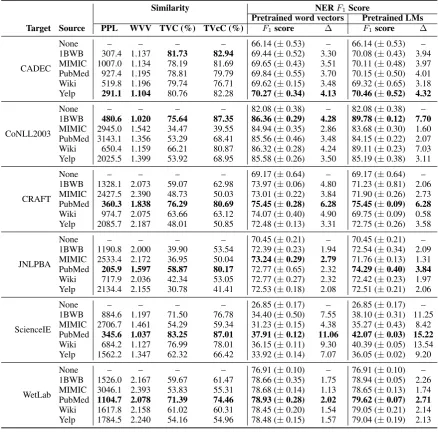
Different aspects of similarity measured between five source and six target data sets are shown in the
left side of Table3. The language model trained
on PubMed achieves lower perplexity when eval-uated on CRAFT, JNLPBA and ScienceIE com-pared to other sources. On one hand, it is expected that PubMed is similar to CRAFT and JNLPBA, since they are all sampled journal articles about biology and health, thus being similar in terms of both field and tenor. On the other hand, although ScienceIE does not have the same field as PubMed (computer science, material and physics versus bi-ology and health), they are similar because they share a similar tenor (scholarly publications).
The measures calculated on CADEC also show that tenor is reflected more than field by PPL and WVV. Source data set Yelp is more similar to CADEC than PubMed and MIMIC from both PPL
and WVV perspectives. CADEC is a data set
focusing on recognizing drugs, diseases and ad-verse drug events. The field of CADEC is there-fore more similar to PubMed which includes jour-nal articles in health discipline and MIMIC which contains clinical notes. However, CADEC is writ-ten by patients, and can be considered as ‘drug re-views’. The tenor is therefore closer to the one in Yelp, where customers use informal language to describe their experiences.
All sources are measured against WetLab with relatively high PPL and WVV values. This reflects the fact that the tenor of WetLab (experimental protocols) is different from the tenor of all sources, although WetLab has a similar field (biology) with PubMed which is therefore more similar than other sources. For CoNLL2003, 1BWB which is News Crawl data is the most similar source, while PubMed is the most dissimilar source from PPL perspective, and MIMIC is the most dissimilar one using WVV measure.
Although WVV does not distinguish between different sources as PPL does, it still reflects the same trend as PPL regarding which source is the most similar to a given target data set.
Can these different similarity measures reach a consensus? Similarity results in Table3 indi-cate that using different measures can lead to al-most the same answer regarding which source is the most similar one to a given target. To further investigate the level of agreement between differ-ent similarity measures, we employ inter-method agreement that we ask a fine-grained question on
the results in Table 3: given a target and two
simi-Similarity NERF1Score
Pretrained word vectors Pretrained LMs
Target Source PPL WVV TVC (%) TVcC (%) F1score ∆ F1score ∆
CADEC
None – – – – 66.14 (±0.53) – 66.14 (±0.53) – 1BWB 307.4 1.137 81.73 82.94 69.44 (±0.52) 3.30 70.08 (±0.43) 3.94 MIMIC 1007.0 1.134 78.19 81.69 69.65 (±0.43) 3.51 70.11 (±0.48) 3.97 PubMed 927.4 1.195 78.81 79.79 69.84 (±0.55) 3.70 70.15 (±0.50) 4.01 Wiki 519.8 1.196 79.74 76.71 69.62 (±0.15) 3.48 69.32 (±0.65) 3.18
Yelp 291.1 1.104 80.76 82.28 70.27 (±0.34) 4.13 70.46 (±0.52) 4.32
CoNLL2003
None – – – – 82.08 (±0.38) – 82.08 (±0.38) –
1BWB 480.6 1.020 75.64 87.35 86.36 (±0.29) 4.28 89.78 (±0.12) 7.70
MIMIC 2945.0 1.542 34.47 39.55 84.94 (±0.35) 2.86 83.68 (±0.30) 1.60 PubMed 3143.1 1.356 53.29 68.41 85.56 (±0.46) 3.48 84.15 (±0.22) 2.07 Wiki 650.4 1.159 66.21 80.87 86.32 (±0.28) 4.24 89.11 (±0.23) 7.03 Yelp 2025.5 1.399 53.92 68.95 85.58 (±0.26) 3.50 85.19 (±0.38) 3.11
CRAFT
None – – – – 69.17 (±0.64) – 69.17 (±0.64) – 1BWB 1328.1 2.073 59.07 62.98 73.97 (±0.06) 4.80 71.23 (±0.81) 2.06 MIMIC 2427.5 2.390 48.73 50.03 73.01 (±0.22) 3.84 71.90 (±0.26) 2.73 PubMed 360.3 1.838 76.29 80.69 75.45 (±0.28) 6.28 75.45 (±0.09) 6.28 Wiki 974.7 2.075 63.66 63.12 74.07 (±0.40) 4.90 69.75 (±0.09) 0.58 Yelp 2085.7 2.187 48.01 50.85 72.48 (±0.13) 3.31 72.75 (±0.26) 3.58
JNLPBA
None – – – – 70.45 (±0.21) – 70.45 (±0.21) – 1BWB 1190.8 2.000 39.90 53.54 72.39 (±0.23) 1.94 72.54 (±0.34) 2.09 MIMIC 2533.4 2.172 36.95 50.04 73.24 (±0.29) 2.79 71.76 (±0.13) 1.31 PubMed 205.9 1.597 58.87 80.17 72.77 (±0.65) 2.32 74.29 (±0.40) 3.84 Wiki 717.9 2.036 42.34 53.05 72.77 (±0.27) 2.32 72.42 (±0.23) 1.97 Yelp 2134.4 2.155 30.78 41.41 72.53 (±0.18) 2.08 72.51 (±0.21) 2.06
ScienceIE
None – – – – 26.85 (±0.17) – 26.85 (±0.17) – 1BWB 884.6 1.197 71.50 76.78 34.40 (±0.50) 7.55 38.10 (±0.31) 11.25 MIMIC 2706.7 1.461 54.29 59.34 31.23 (±0.15) 4.38 35.27 (±0.43) 8.42 PubMed 345.6 1.037 83.25 87.01 37.91 (±0.12) 11.06 42.07 (±0.03) 15.22 Wiki 684.2 1.127 76.99 78.01 36.15 (±0.11) 9.30 40.39 (±0.05) 13.54 Yelp 1562.2 1.347 62.32 66.42 33.92 (±0.14) 7.07 36.05 (±0.02) 9.20
WetLab
None – – – – 76.91 (±0.10) – 76.91 (±0.10) – 1BWB 1526.0 2.167 59.67 61.47 78.66 (±0.35) 1.75 78.94 (±0.05) 2.26 MIMIC 3046.1 2.393 53.83 55.31 78.68 (±0.14) 1.13 78.65 (±0.13) 1.74 PubMed 1104.7 2.078 71.39 74.46 78.93 (±0.28) 2.02 79.62 (±0.07) 2.71 Wiki 1617.8 2.158 61.02 60.31 78.45 (±0.20) 1.54 79.05 (±0.21) 2.14 Yelp 1784.5 2.240 54.16 54.96 78.48 (±0.15) 1.57 79.04 (±0.19) 2.13
Table 3: Similarity between source and target data sets (left), and the effectiveness of word vectors and LMs pretrained using different sources for NER (right). Lower PPL or WVV values indicate higher similarity between source and target, while higher TVC and TVcC values indicate higher similarity. Nonerows refer to the models that word embedding weights are randomly initialized with no pretrained LMs. ∆shows absolute improvement. We repeat every NER experiment 5 times, and report mean and standard deviation of testF1scores.
lar, while WVV gives an opposite answer. Fleiss’s
kappa (Fleiss, 1971) (a variant of Cohen’s kappa
for more than two raters) is a robust metric used to measures inter-rater agreement, since it takes random chance into consideration. We use it to measure the inter-method agreement between the 60 binary comparisons inferred using PPL, WVV and TVC. Our results achieve a Fleiss’s kappa of 0.733, which shows a high agreement between conclusions inferred using different measures.
Overall, we find that these similarity measures can reach high level of consensus. To simplify our
following discussion, from here onsimilarmeans
low PPL (because of its clear distinction between different sources), unless otherwise stated.
7.2 Impact of Pretraining Data
After we quantify the similarity between source and target data sets, the next question is how these similarity measures can be used to predict the ef-fectiveness of pretrained models for NER tasks.
Results in Table3 show that, although all
[image:7.595.79.518.63.495.2]Word vectors LMs
[image:8.595.320.513.63.154.2]TVC 0.454 0.666 TVcC 0.469 0.739 PPL -0.398 -0.618 WVV -0.406 -0.747
Table 4: Correlation coefficients between similarity measures and the effectiveness of pretrained models. The coefficients vary between -1 (negative correlation) and 1 (positive correlation). Zero means no correlation.
sets. Word vectors and LMs pretrained on a source similar to the target outperform the ones pretrained on other sources (except pretrained word vectors for JNLPBA data set).
We also observe that pretrained LMs provide more benefits than pretrained word vectors if source data is similar to the target (see 1BWB-CoNLL2003 and PubMed-JNLPBA data pairs). However, if the source is dissimilar to the tar-get, pretrained word vectors outperform pretrained
LMs (see these pairs: MIMIC-CoNLL2003,
PubMed-CoNLL2003, MIMIC-CRAFT).
Predictiveness of similarity measures To ana-lyze how proposed similarity measures correlate to the effectiveness of pretrained word vectors and LMs for the target NER tasks, we employ the Pearson correlation analysis to find out the rela-tionships between improvement due to pretrained models and TVC, TVcC, PPL and WVV. The
re-sults in Table4show that our proposed similarity
measures are predictive of the effectiveness of the pretraining data. In terms of pretrained word vec-tors, VCcR is the most informative factor in pre-dicting the effectiveness of pretrained word vec-tors given a target data set. It implies that find-ing a source data set which has large vocabulary intersection with the target data set is a promising first step to generate effective pretrained word vec-tors. The results regarding the LM performance show that it has a stronger correlation with simi-larity measures than the one of word vectors, thus more predictable using our proposed measures.
Comparison to publicly available pretrained models Recent literature shows substantial im-provements are sometimes possible when
pretrain-ing on very large generic corpora. Given that
pretrained models are freely available, is it even necessary to pretrain on similar data as proposed above? We compare to publicly available (1) word vectors trained on 6 billion tokens of
encyclopae-Word vectors LMs
GloVe Ours ELMo Ours
[image:8.595.114.249.63.123.2]CADEC 70.30 70.27 71.91 70.46 CoNLL2003 90.25 86.36 91.34 89.78 CRAFT 74.22 75.45 75.77 75.45 JNLPBA 73.19 73.24 73.65 74.29 ScienceIE 37.10 37.91 41.15 42.07 WetLab 79.15 78.93 79.57 79.62
Table 5: Comparison between our best performance pretrained models and the publicly available ones, which are pretrained on much larger corpora.
ScienceIE WetLab
Def Opt Def Opt
1BWB 34.40 34.57 78.66 79.12 MIMIC 31.23 34.14 78.68 78.65 PubMed 37.91 38.86 78.93 79.28 Wiki 36.15 35.63 78.45 78.99 Yelp 33.92 34.25 78.48 78.78
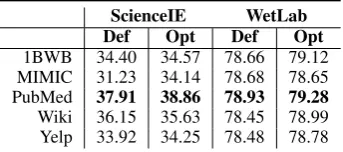
Table 6: Impact of hyper-parameter setting on the effectiveness of pretrained word vectors. ‘Opt’ is hyper-parameter setting proposed in (Chiu et al.,2016), whereas ‘Def’ is the default setting in word2vec.
dia articles and news stories about various fields3
and (2) LMs trained on 5.5 billion tokens of en-cyclopaedia articles and news stories about
vari-ous fields4. We use the same experimental setup
described in Section 6, that pretrained word
vec-tors are used to initialize the weights of word em-bedding layer, whereas outputs of pretrained LMs are used as input features of the supervised model. We find that word vectors and LMs pretrained on small similar sources can achieve competitive or even better performance than the ones pretrained
on larger sources (Table5). On JNLPBA,
Scien-ceIE and Wetlab, LMs pretrained on the small sim-ilar source perform better, while word vectors pre-trained on the small similar source perform better on CRAFT, JNLPBA, and ScienceIE.
These results indicate that a small similar source reduces the computational cost without sacrificing the performance. This is especially important in practice, because collecting data and pretraining models are expensive. For example, a LM pre-trained on 1 billion tokens takes three weeks to
train on 32 GPUs (Jozefowicz et al.,2016).
Comparison to other hyper-parameter settings
Chiu et al.(2016) propose a hyper-parameter com-bination of skip-gram model that is empirically
3
https://nlp.stanford.edu/projects/glove/
[image:8.595.331.503.214.290.2]identified on NER tasks. They find that a narrow context window size can boost the performance since it can capture better word function rather
than domain similarity. We use their proposed
hyper-parameter setting to train word vectors on different source data, and evaluate these pretrained word vectors on the ScienceIE and WetLab data sets. The reason for hand-picking these two is that benefits of pretrained word vectors on these two sets vary with a large margin. Our results suggest that this hyper-parameter setting can over-all (except Wiki-ScienceIE and MIMIC-WetLab pairs) produce better performance compare to the
default setting (Table 6). Most importantly we
observe that our observation that similar sources generate better pretrained models can still holds with these hyper-parameters: PubMed, which is the most similar source to both target data sets, still outperforms other sources.
7.3 Controlling for source data size
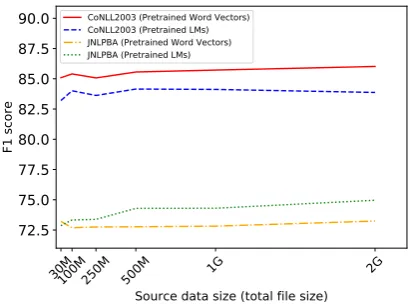
To further investigate how source data size af-fects pretrained word vectors and LMs for NER tasks, we sample six PubMed subsets of different size. For target data sets, we use CoNLL2003, to which PubMed is the most dissimilar source, and JNLPBA, to which PubMed is the most sim-ilar source. We observe that 500 MB of pretrain-ing data appears to be sufficient to calculate sim-ilarity, and capping factors out the impact of size
(Figure2). As discussed, VCcR is the most
influ-ential factor affecting the usefulness of pretrained word vectors for NER task. Increasing source data size may provide a larger vocabulary intersection with the target data set, but the resulting absolute
F1score increase is less than 0.5, after the source
data has been large enough. We also observe that if source and target data are dissimilar (PubMed-CoNLL2003 pair), pretrained word vectors is a better option than pretrained LMs, no matter how large source data is. However, pretrained LMs out-perform pretrained word vectors, if source is sim-ilar to target (PubMed-JNLPBA pair).
We leave exploration of the combined effect of size and similarity to future work, but believe size should be considered separately, noting that results here suggest that similarity is more important.
8 Conclusions
We studied whether there are cost-effective meth-ods to identify data sets to pretrain word vectors
30M100M250M 500M 1G 2G
Source data size (total file size)
72.5 75.0 77.5 80.0 82.5 85.0 87.5 90.0
F1 score
[image:9.595.313.520.68.220.2]CoNLL2003 (Pretrained Word Vectors) CoNLL2003 (Pretrained LMs) JNLPBA (Pretrained Word Vectors) JNLPBA (Pretrained LMs)
Figure 2: Impact of source data size on the effective-ness of pretrained models for NER.
and LMs that are building blocks of NER models. We proposed using three measures, Target Vocab-ulary Covered, Language Model Perplexity, and Word Vector Variance, to measure different as-pects of similarity between source and target data. We investigated how these measures correlate with the effectiveness of pretrained word vectors and LMs for NER tasks. We found that the effective-ness of pretrained word vectors strongly depends on whether the source data have a high vocabu-lary intersection with target data, while pretrained LMs can gain more benefits from a similar source. While different NLP tasks may rely on different aspects of language, our study is a step towards systematically guiding researchers on their choice
of data for pretraining. As a future study, we
will explore how these similarity measures predict performance of pretrained models in other NLP tasks.
Acknowledgments
We would like to thank Massimo Piccardi and Mark Dras for their constructive
feed-back. The authors also thank the members of
CSIRO Data61’s Language and Social Comput-ing (LASC) team for helpful discussions, as well as anonymous reviewers for their insightful com-ments.
References
Mikel Artetxe, Gorka Labaka, Inigo Lopez-Gazpio, and Eneko Agirre. 2018. Uncovering divergent linguistic information in word embeddings with lessons for intrinsic and extrinsic evaluation. In
CoNLL, pages 282–291, Brussels, Belgium.
Isabelle Augenstein, Mrinal Das, Sebastian Riedel, Lakshmi Vikraman, and Andrew McCallum. 2017.
SemEval 2017 task 10: ScienceIE - extracting keyphrases and relations from scientific publica-tions. In SemEval, pages 546–555, Vancouver, Canada.
Michael Bada, Miriam Eckert, Donald Evans, Kristin Garcia, Krista Shipley, Dmitry Sitnikov, William A Baumgartner, K Bretonnel Cohen, Karin Verspoor, Judith A Blake, and Lawrence E Hunter. 2012. Con-cept annotation in the CRAFT corpus. BMC bioin-formatics, 13:161.
John Blitzer, Ryan McDonald, and Fernando Pereira. 2006.Domain adaptation with structural correspon-dence learning. InEMNLP, pages 120–128, Sydney, Australia.
Samuel R. Bowman, Gabor Angeli, Christopher Potts, and Christopher D. Manning. 2015. A large anno-tated corpus for learning natural language inference. InEMNLP, pages 632–642, Lisbon, Portugal.
Alexander Budanitsky and Graeme Hirst. 2006. Eval-uating wordnet-based measures of lexical semantic relatedness.Comput. Linguist., 32(1).
Ciprian Chelba, Tomas Mikolov, Mike Schuster, Qi Ge, Thorsten Brants, Phillipp Koehn, and Tony Robin-son. 2013.One billion word benchmark for measur-ing progress in statistical language modelmeasur-ing.CoRR abs/1312.3005.
Billy Chiu, Gamal Crichton, Anna Korhonen, and Sampo Pyysalo. 2016. How to train good word embeddings for biomedical nlp. In BioNLP, pages 166–174, Berlin, Germany.
Alexandra Chronopoulou, Christos Baziotis, and Alexandros Potamianos. 2019. An embarrassingly simple approach for transfer learning from pre-trained language models. In NAACL, Minneapolis, Minnesota.
Nigel Collier and Jin-Dong Kim. 2004. Introduction to the bio-entity recognition task at JNLPBA. In
BioNLP.
Alexis Conneau, Holger Schwenk, Lo¨ıc Barrault, and Yann Lecun. 2017. Very deep convolutional net-works for text classification. InEACL, pages 1107– 1116, Valencia, Spain.
Andrew M Dai and Quoc V Le. 2015. Semi-supervised sequence learning. InNIPS, pages 3079–3087.
Jacob Devlin, Ming-Wei Chang, Kenton Lee, and Kristina Toutanova. 2019. BERT: Pre-training of deep bidirectional transformers for language under-standing. InNAACL, Minneapolis, Minnesota.
Joseph Fleiss. 1971. Measuring nominal scale agree-ment among many raters.Psychol. Bull., 76(5):378.
Zellig S Harris. 1954. Distributional structure. Word, 10(2-3):146–162.
Kenneth Heafield. 2011. Kenlm: Faster and smaller language model queries. In WMT, pages 187–197, Edinburgh, Scotland.
Felix Hill, Roi Reichart, and Anna Korhonen. 2015.
Simlex-999: Evaluating semantic models with (gen-uine) similarity estimation. Comput. Linguist., 41(4):665–695.
Zhiheng Huang, Wei Xu, and Kai Yu. 2015. Bidirec-tional lstm-crf models for sequence tagging. CoRR abs/1508.01991.
Alistair EW Johnson, Tom J Pollard, Lu Shen, H Lehman Li-wei, Mengling Feng, Moham-mad Ghassemi, Benjamin Moody, Peter Szolovits, Leo Anthony Celi, and Roger G Mark. 2016.
MIMIC-III, a freely accessible critical care database.
Sci. Data, 3:160035.
Mark Johnson, Peter Anderson, Mark Dras, and Mark Steedman. 2018. Predicting accuracy on large datasets from smaller pilot data. InACL, pages 450– 455, Melbourne, Australia.
Aditya Joshi, Xiang Dai, Sarvnaz Karimi, Ross Sparks, Cecile Paris, and C Raina MacIntyre. 2018. Shot or not: Comparison of NLP approaches for vacci-nation behaviour detection. In EMNLP-SMM4H, pages 43–47.
Rafal Jozefowicz, Oriol Vinyals, Mike Schuster, Noam Shazeer, and Yonghui Wu. 2016. Exploring the lim-its of language modeling. CoRR abs/1602.02410.
Sarvnaz Karimi, Xiang Dai, Hamedh Hassanzadeh, and Anthony Nguyen. 2017. Automatic diagnosis coding of radiology reports: A comparison of deep learning and conventional classification methods. In
BioNLP, pages 328–332, Vancouver, Canada,.
Sarvnaz Karimi, Alejandro Metke-Jimenez, Madonna Kemp, and Chen Wang. 2015. CADEC: A corpus of adverse drug event annotations.J Biomed Inform, 55:73–81.
Youngjun Kim, Ellen Riloff, and St´ephane M Meystre. 2017. Exploiting unlabeled texts with clustering-based instance selection for medical relation classi-fication. InAMIA, pages 1060–1069.
Chaitanya Kulkarni, Wei Xu, Alan Ritter, and Raghu Machiraju. 2018. An annotated corpus for machine reading of instructions in wet lab protocols. In
NAACL, pages 97–106, New Orleans, Louisiana.
Guillaume Lample, Miguel Ballesteros, Sandeep Sub-ramanian, Kazuya Kawakami, and Chris Dyer. 2016.
Neural architectures for named entity recognition. InNAACL, pages 260–270, San Diego, California.
David YW Lee. 2001. Genres, registers, text types, domains and styles: Clarifying the concepts and nevigating a path through the BNC jungle. LLT, 5(3):37–72.
Omer Levy, Yoav Goldberg, and Ido Dagan. 2015. Im-proving distributional similarity with lessons learned from word embeddings.TACL, 3:211–225.
Quanzhi Li, Sameena Shah, Xiaomo Liu, and Armineh Nourbakhsh. 2017. Data sets: Word embeddings learned from tweets and general data. InICWSM, pages 428–436, Montreal, Canada.
Yitong Li, Timothy Baldwin, and Trevor Cohn. 2018.
What’s in a domain? learning domain-robust text representations using adversarial training. In
NAACL, pages 474–479, New Orleans, Louisiana.
Xuezhe Ma and Eduard Hovy. 2016. End-to-end se-quence labeling via bi-directional lstm-cnns-crf. In
ACL, pages 1064–1074, Berlin, Germany.
Stephen Merity, Caiming Xiong, James Bradbury, and Richard Socher. 2016. Pointer sentinel mixture models.CoRR abs/1609.07843.
Tomas Mikolov, Kai Chen, Greg Corrado, and Jeffrey Dean. 2013. Efficient estimation of word represen-tations in vector space.CoRR abs/1301.3781.
Tomas Mikolov, Edouard Grave, Piotr Bojanowski, Christian Puhrsch, and Armand Joulin. 2018. Ad-vances in pre-training distributed word representa-tions. InLREC.
Ellie Pavlick, Pushpendre Rastogi, Juri Ganitkevitch, Benjamin Van Durme, and Chris Callison-Burch. 2015. PPDB 2.0: Better paraphrase ranking, fine-grained entailment relations, word embeddings, and style classification. InACL and IJCNLP, pages 425– 430, Beijing, China.
Ellie Pavlick and Joel Tetreault. 2016. An empiri-cal analysis of formality in online communication.
TACL, 4:61–74.
Jeffrey Pennington, Richard Socher, and Christopher Manning. 2014. GloVe: Global vectors for word representation. In EMNLP, pages 1532–1543, Doha, Qatar.
Matthew Peters, Waleed Ammar, Chandra Bhagavat-ula, and Russell Power. 2017. Semi-supervised se-quence tagging with bidirectional language models. InACL, pages 1756–1765, Vancouver, Canada.
Matthew Peters, Mark Neumann, Mohit Iyyer, Matt Gardner, Christopher Clark, Kenton Lee, and Luke Zettlemoyer. 2018. Deep contextualized word repre-sentations. InNAACL, pages 2227–2237, New Or-leans, Louisiana.
Yanjun Qi, Ronan Collobert, Pavel Kuksa, Koray Kavukcuoglu, and Jason Weston. 2009. Combining labeled and unlabeled data with word-class distribu-tion learning. In CIKM, pages 1737–1740, Hong Kong, China.
Erik F. Tjong Kim Sang and Fien De Meulder. 2003. Introduction to the CoNLL-2003 shared task: Language-independent named entity recognition. In
CoNLL.
Guillermo Solano-Flores. 2006. Language, dialect, and register: Sociolinguistics and the estimation of measurement error in the testing of english language learners. Teach. Coll. Rec., 108(11):2354.
Joseph Turian, Lev-Arie Ratinov, and Yoshua Bengio. 2010. Word representations: A simple and general method for semi-supervised learning. InACL, pages 384–394, Uppsala, Sweden.
Jie Yang, Shuailong Liang, and Yue Zhang. 2018. De-sign challenges and misconceptions in neural se-quence labeling. In COLING, pages 3879–3889, Santa Fe, New Mexico.
Yi Yang and Jacob Eisenstein. 2015. Unsupervised multi-domain adaptation with feature embeddings. InNAACL, pages 672–682, Denver, Colorado.
Wenpeng Yin and Hinrich Sch¨utze. 2015. Multichan-nel variable-size convolution for sentence classifica-tion. InCoNLL, pages 204–214, Beijing, China.
Xiang Zhang, Junbo Zhao, and Yann LeCun. 2015.