773
Imposing Label-Relational Inductive Bias
for Extremely Fine-Grained Entity Typing
Wenhan Xiong†, Jiawei Wu†, Deren Lei†, Mo Yu∗, Shiyu Chang∗, Xiaoxiao Guo∗, William Yang Wang†
†University of California, Santa Barbara ∗IBM Research
{xwhan, william}@cs.ucsb.edu, [email protected],{shiyu.chang, xiaoxiao.guo}@ibm.com
Abstract
Existing entity typing systems usually ex-ploit the type hierarchy provided by knowl-edge base (KB) schema to model label cor-relations and thus improve the overall perfor-mance. Such techniques, however, are not di-rectly applicable to more open and practical scenarios where the type set is not restricted by KB schema and includes a vast number of free-form types. To model the underly-ing label correlations without access to man-ually annotated label structures, we introduce a novel label-relational inductive bias, repre-sented by a graph propagation layer that effec-tively encodes both global label co-occurrence statistics and word-level similarities. On a large dataset with over 10,000 free-form types, the graph-enhanced model equipped with an attention-based matching module is able to achieve a much higher recall score while main-taining a high-level precision. Specifically, it achieves a15.3%relative F1 improvement and also less inconsistency in the outputs. We fur-ther show that a simple modification of our proposed graph layer can also improve the per-formance on a conventional and widely-tested dataset that only includes KB-schema types.1
1 Introduction
Fine-grained entity typing is the task of identifying specific semantic types of entity mentions in given contexts. In contrast to general entity types (e.g., organization, event), fine-grained types (e.g., po-litical party, natural disaster) are often more infor-mative and can provide valuable prior knowledge for a wide range of NLP tasks, such as coreference resolution (Durrett and Klein, 2014), relation ex-traction (Yaghoobzadeh et al.,2016) and question answering (Lee et al.,2006;Yavuz et al.,2016).
1https://github.com/xwhan/
Extremely-Fine-Grained-Entity-Typing
Context Types
Big Showthen appeared at One Night Stand, attacking Tajiri, Super Crazy, and the Full Blooded Italians after their tag team match
person†, televi-sion program?
person, athlete, wrestler, entertainer
The womens pole vault at the 2010 IAAF World Indoor Championships was held at the ASPIRE Dome on 12 and 14March.
month†,event?
[image:1.595.308.528.223.374.2]date, month
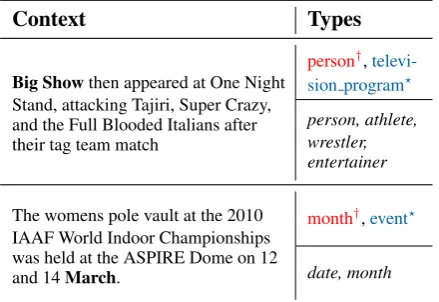
Table 1: Examples of inconsistent predictions pro-duced by existing entity typing system that does not model label correlations. We use different subscript symbols to indicate contradictory type pairs and show the ground-truth types initalics.
In practical scenarios, a key challenge of entity typing is to correctly predictmultipleground-truth type labels from a large candidate set that covers a wide range of types in different granularities. In this sense, it is essential for models to effectively capture the inter-label correlations. For instance, if an entity is identified as a “criminal”, then the en-tity must also be a “person”, but it is less likely for this entity to be a “police officer” at the same time. When ignoring such correlations and considering each type separately, models are often inferior in performance and prone to inconsistent predictions. As shown in Table 1, an existing model that in-dependently predicts different types fails to reject predictions that include apparent contradictions.
assump-tion that the underlying type structures are prede-fined in entity typing datasets. For benchmarks annotated with the knowledge base (KB) guided distant supervision, this assumption is often valid since all types are from KB ontologies and natu-rally follow tree-like structures. However, since knowledge bases are inherently incomplete (Min et al.,2013), existing KBs only include a limited set of entity types. Thus, models trained on these datasets fail to generalize to lots of unseen types. In this work, we investigate entity typing in a more open scenario where the type set is not restricted by KB schema and includes over 10,000 free-form types (Choi et al.,2018). As most of the types do not follow any predefined structures, methods that explicitly incorporate type hierarchies cannot be straightforwardly applied here.
To effectively capture the underlying label cor-relations without access to known type struc-tures, we propose a novel label-relational induc-tive bias, represented by a graph propagation layer that operates in the latent label space. Specifi-cally, this layer learns to incorporate a label affin-ity matrix derived from global type co-occurrence statistics and word-level type similarities. It can be seamlessly coupled with existing models and jointly updated with other model parameters. Em-pirically, on the Ultra-Fine dataset (Choi et al., 2018), the graph layer alone can provide a signif-icant11.9% relative F1 improvement over previ-ous models. Additionally, we show that the re-sults can be further improved (11.9%→ 15.3%) with an attention-based mention-context matching module that better handles pronouns entity men-tions. With a simple modification, we demonstrate that the proposed graph layer is also beneficial to the widely used OntoNotes dataset, despite the fact that samples in OntoNotes have lower label multiplicity (i.e., average number of ground-truth types for each sample) and thus require less label-dependency modeling than the Ultra-Fine dataset. To summarize, our major contribution includes:
• We impose an effective label-relational bias on entity typing models with an easy-to-implement graph propagation layer, which al-lows the model to implicitly capture type de-pendencies;
• We augment our graph-enhanced model with an attention-based matching module, which constructs stronger interactions between the mention and context representations;
• Empirically, our model is able to offer sig-nificant improvements over previous models on the Ultra-Fine dataset and also reduces the cases of inconsistent type predictions.
2 Related Work
Fine-Grained Entity Typing The task of fine-grained entity typing was first thoroughly inves-tigated in (Ling and Weld, 2012), which utilized Freebase-guided distant supervision (DS) (Mintz et al., 2009) for entity typing and created one of the early large-scale datasets. Although DS pro-vides an efficient way to annotate training data, later work (Gillick et al.,2014) pointed out that en-tity type labels induced by DS ignore entities’ lo-cal context and may have limited usage in context-aware applications. Most of the following research has since focused on testing in context-dependent scenarios. While early methods (Gillick et al., 2014;Yogatama et al.,2015) on this task rely on well-designed loss functions and a suite of hand-craft features that represent both context and enti-ties,Shimaoka et al.(2016) proposed the first at-tentive neural model which outperformed feature-based methods with a simple cross-entropy loss.
Modeling Entity Type Correlations To bet-ter capture the underlying label correlations, Shi-maoka et al.(2017) employed a hierarchical label encoding method and AFET (Ren et al., 2016a) used the predefined label hierarchy to identify noisy annotations and proposed a partial-label loss to reduce such noise. A recent work (Xu and Barbosa, 2018) proposed hierarchical loss nor-malization which alleviated the noise of too spe-cific types. Our work differs from these works in that we do not rely on known label structures and aim to learn the underlying correlations from data. Rabinovich and Klein (2017) recently pro-posed a structure-prediction approach which used type correlation features. The inference on their learned factor graph is approximated by a greedy decoding algorithm, which outperformed unstruc-tured methods on their own dataset. Instead of us-ing an explicit graphical model, we enforce a re-lational bias on model parameters, which does not introduce extra burden on label decoding.
3 Task Definition
politician
person
author
athlete leader
official
Hehas been trying to win international support for the Palestinian cause GloVe + Position Embedding
Entity Mention
Bi-LSTM Attention Interaction
Context
Type Co-occurrence Graph Linear Transform
Graph Convolution
Neighbors of person Dot Product
P(person|x) !
Information Propagation Flow on Graph
[image:3.595.81.525.68.246.2]a) Mention-Context Encoding b) GCN over Type Vectors Self-Attentive
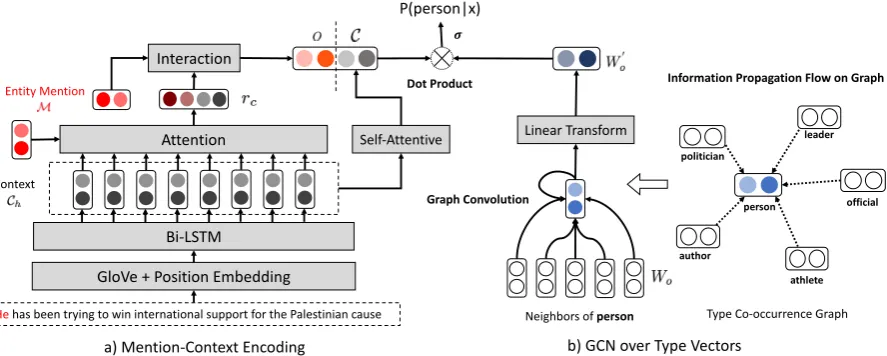
Figure 1: Overview of the process to make predictions on the type“person”.a)Modules used to extract mention and context aware representations.b)An illustration of the graph layer operating over the type vector of“person”.
Cas inputs, and aims to predict the correct type la-belsTmofM from a candidate type setT, which
includes more than 10,000 free-form types. The entity span M here can be named entities, nom-inals and also pronouns. The ground-truth type setTm here usually includes more than one types
(approximately five types on average), making this task a multi-label classification problem.
4 Methodology
In this section, we first briefly introduce the neural architecture to encode raw text inputs. Then we describe the matching module we use to enhance the interaction between the mention span and the context sentence. Finally, we move to the label decoder, on which we impose the label-relational bias with a graph propagation layer that encodes type co-occurrence statistics and word-level simi-larities. Figure1provides a graphical overview of our model, with1a) illustrating both the text en-coders and the matching module, and1b) showing an example of graph propagation.
4.1 Representation Model
Our base model to encode the context and the mention span follows existing neural ap-proaches (Shimaoka et al.,2016;Xu and Barbosa, 2018;Choi et al.,2018). To encode the context, we first apply a standard Bi-LSTM, which takes GloVe (Pennington et al., 2014) embeddings and position embeddings (three vectors representing positions before, inside or after the mention span) as inputs and outputs the hidden states at each time step t ∈ [1, lc]. With the derived hidden states
Ch ∈ Rlc×hc, we then apply a self-attentive
en-coder (McCann et al.,2017) on the top to get the final context representationC. For the entity men-tion span, we concatenate the features derived by a character-level CNN and a similar self-attentive encoder. We denote the final mention representa-tion asM.2
4.2 Mention-Context Interaction
Since most previous datasets only considernamed entities, a simple concatenation of the two features
[C;M] followed by a linear output layer ( Shi-maoka et al., 2016, 2017) usually works reason-ably well when making predictions. This sug-gests that M itself provides important informa-tion for recognizing entity types. However, as in our target dataset, a large portion of entity men-tions are actually pronouns, such as “he” or “it”, this kind of mentions alone provide only limited clues about general entity types (e.g., “he” is a “person”) but little information about fine-grained types. In this case, directly appending represen-tation of pronouns does not provide extra useful information for making fine-grained predictions. Thus, instead of using the concatenation operator, we propose to construct a stronger interaction be-tween the mention and context with an attention-based matching module, which has shown its ef-fectiveness in recent natural language inference models (Mou et al.,2016;Chen et al.,2017).
Formally consider the mention representation M ∈ Rhm and context’s hidden feature C
h ∈
2Please refer to (Shimaoka et al.,2017) and (Choi et al.,
Rlc×hc, wherelcindicates the number of tokens in
the context sentence andhm, hcdenote feature
di-mensions. We first project the mention featureM into the same dimension space asCh with a linear layer (W1∈Rhm×hc) and atanhfunction3:
mproj =tanh(W1TM), (1)
then we perform bilinear attention matching be-tweenmprojandCh, resulting in an affinity matrix
Awith dimensionA ∈R1×lc:
A=mproj×Wa× Ch, (2)
whereWa ∈ Rhc×hc is a learnable matrix. If we
consider the mention feature as query and the con-text as memory, we can use the affinity matrix to retrieve the relevant parts in the context:
¯
A=sof tmax(A) (3)
rc= ¯A × Ch. (4)
With the projected mention representation mproj
and the retrieved context featurerc, we define the
following interaction operators:
r =ρ(Wr[rc;mproj;rc−mproj]) (5)
g=σ(Wg[rc;mproj;rc−mproj]) (6)
o=g∗r+ (1−g)∗mproj, (7)
where ρ(·) is a gaussian error linear unit (Hendrycks and Gimpel, 2016) and r is the fused context-mention feature; σ(·) indicates a sigmoid function and g is the resulting gating function, which controls how much information in mention span itself should be passed down. We expect the model to focus less on the mention representation when it is not informative. The concatenation [rc;mproj;rc − mproj] here is
supposed to capture different aspects of the inter-actions. To emphasize the context’s impact, we finally concatenate the extracted context feature (C) with the output (o) of the matching module (f = [o;C]) for prediction.
4.3 Imposing Label-Relational Inductive Bias
For approaches that ignore the underlying label correlations, the type predictions are considered asN independent binary classification problems, withN being the number of types. If we denote the feature extracted by any arbitrary neural model
3tanhhere is used to makem
proj in the same scale as
Ch, which was the output of atanhfunction inside LSTM.
as f ∈ Rdf, then the probability of being any
given type is calculated by:
p=σ(Wof), Wo∈RN×df. (8)
We can see that every row vector ofWois
respon-sible for predicting the probability of one partic-ular type. We will refer the row vectors as type vectors for the rest of this paper. As these type vectors are independent, the label correlations are only implicitly captured by sharing the model pa-rameters that are used to extractf. We argue that the paradigm of parameter sharing is not enough to impose strong label dependencies and the val-ues of type vectors should be better constrained.
A straightforward way to impose the desired constraints is to add extra regularization terms on Wo. We first tested several auxiliary loss
func-tions based on the heuristics from GloVe ( Pen-nington et al.,2014), which operates on the type co-occurrence matrix. However, the auxiliary losses only offer trivial improvements in our ex-periments. Instead, we find that directly impos-ing a model-level inductive bias on the type vec-tors turns out to be a more principled solution. This is done by adding a graph propagation layer over randomly initializedWo and generating the
updated type vectors Wo0, which is used for final prediction. Both Wo and the graph convolution
layer are learned together with other model param-eters. We view this layer as the key component of our model and use the rest of this section to de-scribe how we create the label graph and compute the propagation over the graph edges.
depen-Person
[image:5.595.99.268.66.119.2]Engineer Politician Musician
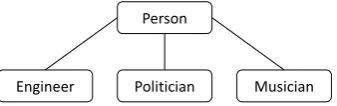
Figure 2: A snippet of the underlying type co-occurrence graph. Multiple edges between nodes are omitted here for clarity.
dencies and the corresponding type vectors should be more similar in the vector space. In this sense, we expect each type vector to effectively capture the local neighbor structure on the graph.
Correlation Encoding via Graph Convolution
To encode the neighbor information into each node’s representation, we follow the propaga-tion rule defined in Graph Convolupropaga-tion Network (GCN) (Kipf and Welling, 2016). In particular, with the adjacent or co-occurrence matrix A, we define the following propagation rule onWo:
Wo0 = ˜D−12A˜D˜− 1
2WoT (9)
˜
A=A+IN. (10)
Here T ∈ Rdf×df is the transformation matrix
and IN is an identity matrix used to add
self-connected edges. D˜ is a diagonal degree matrix with D˜ii = PjA˜ij, which is used to normalize
the feature vectors such that the number of neigh-bors does not affect the scale of transformed fea-ture vectors. In our experiments, we find that an alternative propagation rule
Wo0 = ˜D−1AW˜ oT (11)
works similarly well and is more efficient as it involves less matrix multiplications. If we look closely and take each node out, the propagation can be written as
Wo0[i,:] = P1 jA˜ij
(X
j ˜
AijWo[j,:]T). (12)
From this formula, we can see that the propaga-tion is essentially gathering features from the first-order neighbors. In this way, the prediction on typetiis dependent on its neighbor types.
Compared to original GCNs that often use multi-hop propagations (i.e., multiple graph lay-ers connected by nonlinear functions) to capture higher-order neighbor structures. We only apply one-hop propagation and argue that high-order la-bel dependency is not necessarily beneficial in our
scenario and might introduce false bias. A sim-ple illustration is shown in Figure2. We can see that propagating 2-hop information introduces un-desired inductive bias, since types that are more than 1-hop away (e.g., “Engineer” and “Politi-cian”) usually do not have any dependencies. In fact, some of the 2-hop type pairs can be contra-dictory types (e.g., “police” and “prisoner”). This hypothesis is consistent with our experiment re-sults: adding more than one graph layer leads to worse results. Additionally, we also omit GCN’s nonlinear activation which introduces unnecessary constraints on the scale ofWo0, with which we cal-culate the unscaled scores before calculating the probability via a sigmoid function.
4.4 Leveraging Label Word Embeddings
As the type labels are all written as text phrases, an interesting question is whether we can exploit the semantics provided by pre-trained word em-beddings to improve entity typing. We explore this possibility by using the cosine similarity of word embeddings. We first calculate type embeddings by simply summing the embeddings of all tokens in the type name. Then we build a label affinity matrixAwordby calculating pair-wise cosine
ilarities. With the assumption that word-level sim-ilarity measures some degree of label dependency, we propose to integrateAwordinto the graph
con-volution layer following
A0word = (Aword+ 1)/2 (13)
Wo0 = ˜D−1( ˜A+λA0word)WoT. (14)
Here Equation 13scales the similarity value into
(0,1]to avoid negative edge weights, which might introduce numerical issues when calculatingD˜−1. λis a trainable parameter used to weight the im-pact of word-level similarities. As will be shown in Section 5, this simple augmentation provides further improvement over our original model.
5 Experiments
5.1 Experiment Setup
0 5 10 15 20
Number of Labels
0.0 0.1 0.2 0.3 0.4 0.5 0.6 0.7
Ratio
[image:6.595.78.282.67.200.2]OntoNotes Ultra-Fine
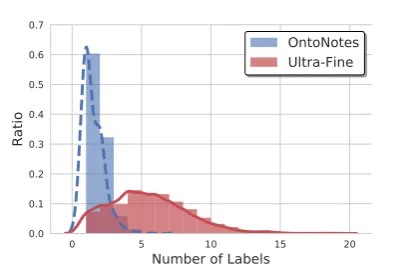
Figure 3: Label multiplicity distribution of the datasets.
resulting in about 25.2M4 training samples. This dataset also includes around 6,000 crowdsourced samples. Each of these samples has five ground-truth labels on average. For a fair comparison, we use the original test split of the crowdsourced data for evaluation. To better understand the capabil-ity of our model, we also test our model on the commonly-used OntoNotes (Gillick et al., 2014) benchmark. It is worth noting that this dataset is much smaller and has lower label multiplicity than the Ultra-Fine dataset,i.e., each sample only has around 1.5 labels on average. Figure 3 shows a comparison of these two datasets.
Baselines For the Ultra-Fine dataset, we com-pare our model with AttentiveNER (Shimaoka et al., 2016) and the multi-task model proposed with the Ultra-Fine dataset. Note thatother mod-els that require pre-defined type hierarchy are not applicable to this dataset. For experiments on OntoNotes, in addition to the two neural baselines for Ultra-Fine, we compare with several existing methods that explicitly utilize the pre-defined type structures in loss functions. Namely, these meth-ods are AFET (Ren et al.,2016a), LNR (Ren et al., 2016b) and NFETC (Xu and Barbosa,2018).
Evaluation Metrics On Ultra-Fine, we first evaluate the mean reciprocal rank (MRR), macro precision(P), recall (R) and F1 following existing research. As P, R and F1 all depend on a cho-sen threshold on probabilities, we also consider a more transparent comparison using precision-recall curves. On OntoNotes, we use the standard metrics used by baseline models: accuracy, macro, and micro F1 scores.
4Choi et al.(2018) use the licensed Gigaword to build
part of the dataset, while in our experiments we only use the open-sourced training set which has approximately 6M train-ing samples.
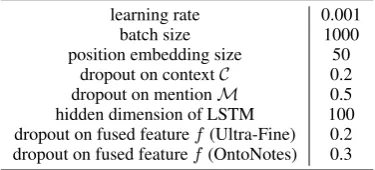
Implementation Details Most of the model hy-perparameters, such as embedding dimensions, learning rate, batch size, dropout ratios on con-text and mention representations are consistent with existing models. Since the mention-context matching module brings more parameters, we ap-ply a dropout layer over the extracted feature f to avoid overfitting. We list all the hyperparam-eters in the appendix. Models for OntoNotes are trained with standard binary cross-entropy (BCE) losses defined on all candidate labels. When train-ing on Ultra-Fine, we adopt the multi-task loss proposed in Choi et al.(2018) which divides the cross-entropy loss into three separate losses over different type granularities. The multi-task objec-tive avoids penalizing false negaobjec-tive types and can achieve higher recalls.
5.2 Evaluation on the Ultra-Fine Dataset
We report the results on Ultra-Fine in Table2. It is worth mentioning that our model, denoted as LA
-BELGCN, is trained using the unlicensed training set which is smaller than the one used by com-pared baselines. Even though our model signifi-cantly outperforms the baselines, for a fair com-parison, we first test our model using the same de-cision threshold (0.5) used by previous models. In terms of F1, our best model (LABELGCN)
outper-forms existing methods by a large margin. Com-pared to Choi et al. (2018), our model improves on both precision and recall significantly. Com-pared to the AttentiveNER trained with standard BCE loss, our model achieves much higher re-call but performs worse in precision. This is due to the fact that when trained with BCE loss, the model usually retrieves only one label per sample and these types are mostly general types5 which are easier to predict. With higher recalls or more retrieved types, achieving high precision requires being accurate on fine-grained types, which are of-ten harder to predict.
As the precision and recall scores both rely on the decision threshold, different models or differ-ent metrics can have differdiffer-ent optimal thresholds. As shown by the “LABELGCN + thresh tuning” entry in Table2, with threshold tuning, our model beats baselines in all metrics. We also see that recall is usually lagging behind precision on this dataset, indicating that F1 score is mainly affected
5According to the results of our own implementation of
Dev Test
Model MRR P R F1 MRR P R F1
AttentiveNER 0.221 53.7 15.0 23.5 0.223 54.2 15.2 23.7
Choi et al.(2018) 0.229 48.1 23.2 31.3 0.234 47.1 24.2 32.0
LABELGCN 0.250 50.5 28.7 36.6 0.253 50.3 29.2 36.9
[image:7.595.116.484.63.175.2]- w/o word embedding 0.245 49.4 27.8 35.6 0.249 48.7 28.3 35.8 - w/o gcn propagation 0.231 47.8 25.7 33.5 0.239 45.4 25.8 32.9 - w/o mention-context interaction 0.249 53.2 25.0 34.0 0.253 54.3 25.8 35.0 LABELGCN +threshold-tuning 0.250 55.6 25.4 35.0 0.253 54.8 25.9 35.1
Table 2: Comparison with baseline models on the Ultra-Fine dataset. Threshold-tuninggives better performance on all metrics compared to both baselines.
0.20 0.25 0.30 0.35 0.40 0.45 0.50 0.55 0.60 Precision
0.15 0.20 0.25 0.30 0.35 0.40 0.45 0.50
Recall
[image:7.595.78.271.229.355.2]Choi el al. LabelGCN LabelGCN w/o inter LabelGCN w/o gcn LabelGCN w/o word
Figure 4: Precision-recall curves on Ultra-Fine. The trivial point derived by threshold 0 is omitted here.
Model F1-pronouns F1-else
Choi et al.(2018) 35.8 32.0 Choi et al.(2018) + inter 38.2 (↑2.4) 32.8
LABELGCN w/o inter 38.6 36.8
LABELGCN 39.3 (↑0.7) 36.5
Table 3: Decomposed validation performance on pro-nouns and the other entities. Each entry is obtained using the best threshold among the 50 equal-interval thresholds. The corresponding PR curves can be found in the appendix (Figure5).
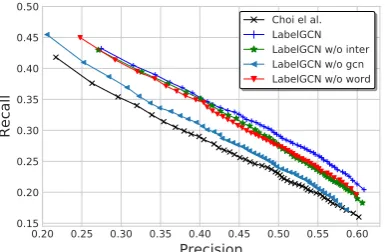
by the recall and tuning towards recall can usu-ally lead to higher F1 scores. For more transparent comparisons, we show the precision-recall curves in Figure 4. These data points are based on the validation performance given by 50 equal-interval thresholds between 0 and 1. We can see there is a clear margin between our model and the multi-task baseline method (LabelGCN vs Choi et al.).
5.3 Ablation Studies
To quantify the effect of different model compo-nents, we report the performance of model vari-ants in Table2and Figure4. We can clearly see that the graph convolution layer is the most es-sential component. The information provided by word embedding is useful and can further improve
both precision and recall. Although Table2seems to indicate the interaction module decreases the precision, we can see from Figure 4 that with a proper threshold, the enhanced interaction actu-ally improves both precision and recall. In term of this, we recommend future research to use PR curves for more accurate model analysis.
5.4 Fine-Grained Performance for Pronouns
As discussed in Section 4.2, the mention repre-sentation of pronouns provide limited information about fine-grained types. We investigate the ef-fect of the enhanced mention-context interaction by analyzing the decomposed performance on pro-nouns and other kinds of entities. From the re-sults in Table3, we can see that the enhanced in-teraction offers consistent improvements over pro-nouns entities and also maintains the performance on other kinds of entities.
5.5 Qualitative Analysis
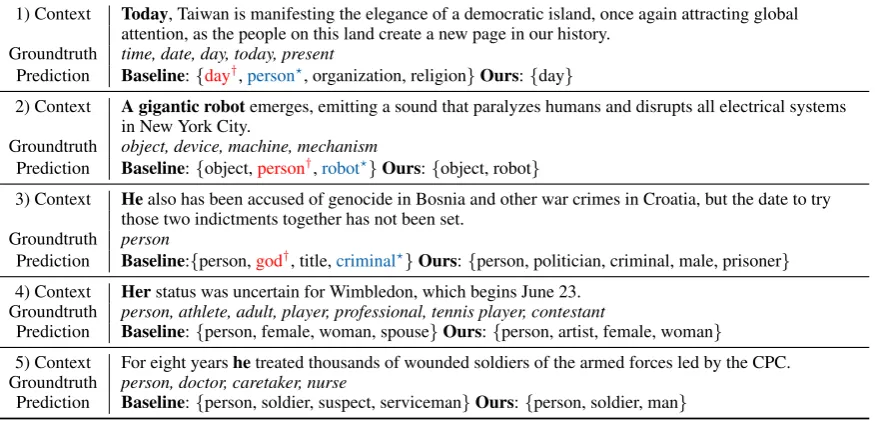
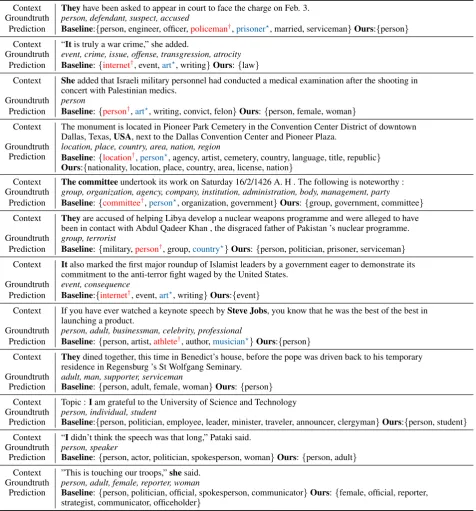
To gain insights on the improvements provided by our model, we manually analyze 100 error cases6 of the baseline model (Choi et al. (2018) with threshold 0.5) and see if our model can gener-ate high-quality predictions. We first observe that many errors actually results from incomplete an-notations. This suggests models’ precision scores are often underestimated in this dataset. We dis-cuss several typical error cases shown in Table4 and list more samples in the appendix (Table7).
A key observation is that while the baseline model tends to make inconsistent predictions (see examples 1, 2, 3), our model can avoid predicting such inconsistent type pairs. This indeed validates our model’s ability to encode label correlations. We also notice that our model is more sensitive to gender information indicated by pronouns, while
6The baseline model achieves the lowest precision on
[image:7.595.79.282.406.467.2]1) Context Today, Taiwan is manifesting the elegance of a democratic island, once again attracting global attention, as the people on this land create a new page in our history.
Groundtruth time, date, day, today, present
Prediction Baseline:{day†,person?, organization, religion}Ours:{day}
2) Context A gigantic robotemerges, emitting a sound that paralyzes humans and disrupts all electrical systems in New York City.
Groundtruth object, device, machine, mechanism
Prediction Baseline:{object,person†,robot?}Ours:{object, robot}
3) Context Healso has been accused of genocide in Bosnia and other war crimes in Croatia, but the date to try those two indictments together has not been set.
Groundtruth person
Prediction Baseline:{person,god†, title,criminal?}Ours:{person, politician, criminal, male, prisoner}
4) Context Herstatus was uncertain for Wimbledon, which begins June 23. Groundtruth person, athlete, adult, player, professional, tennis player, contestant
Prediction Baseline:{person, female, woman, spouse}Ours:{person, artist, female, woman}
5) Context For eight yearshetreated thousands of wounded soldiers of the armed forces led by the CPC. Groundtruth person, doctor, caretaker, nurse
[image:8.595.82.520.64.275.2]Prediction Baseline:{person, soldier, suspect, serviceman}Ours:{person, soldier, man}
Table 4: Qualitative analysis of validation samples. We use different colors and subscript symbols to mark incon-sistencies. The bottom two rows show error cases for both models.
Model Accuracy Macro-F1 Micro-F1
AttentiveNER 51.7 71.0 64.9
AFET 55.1 71.1 64.7
LNR 57.2 71.5 66.1
NFETC 60.2 76.4 70.2
Choi et al.(2018) 59.5 76.8 71.8
[image:8.595.80.518.65.277.2]LABELGCN 59.6 77.8 72.2
Table 5: Results on OntoNotes. Upper rows show the results of baselines that explicitly use the hierarchical type structures.
the baseline model sometimes holds the gender-indicating predictions and predict other types, our model predicts the gender-indicating types more often (examples 3, 4, 5). We conjecture that our model learns this easy way to maintain precision.
For cases that both models fail, some of them actually require background knowledge (example 4) to make accurate predictions. Another typical case is that both models predict some other enti-ties in the context (example 5). We think this po-tentially results from the data bias introduced by the head-word supervision.
5.6 Evaluation on OntoNotes
To better understand the requirements for applying our model, we further evaluate on the OntoNotes dataset. Here we do not apply the proposed mention-context matching module as this dataset does not include any pronoun entities. To obtain more reliable co-occurrence statistics, we use the augmented training data released by Choi et al.
(2018). However, since the training set is still much smaller than that of the Ultra-Fine dataset, the derived co-occurrence statistics are relatively noisy and might introduce undesired bias. We thus add an additional residual connection to our graph convolution layer, which allows the model to se-lectively use co-occurrence statistics. This indeed gives us improvements over previous state-of-the-arts, as shown in Table 5. However, compared to Ultra-Fine, the margin of the improvement is smaller. In view of the key differences of these two datasets, we highlight two key requirements for our proposed model to offer substantial improve-ments. First, there should be a large-scale train-ing set so that the derived co-occurrence statistics can reasonably reflect the true label correlations. Second, the samples themselves should also have higher label multiplicity. In fact, most of the sam-ples in OntoNotes only have 1 or 2 labels. This property actually alleviates the need for models to capture label dependencies.
6 Conclusion
previous methods on a large-scale dataset. As our method does not require external knowledge about the label structures, we believe our method is gen-eral enough and has the potential to be applied to other multi-label tasks with plain-text labels.
Acknowledgement
This research was supported in part by DARPA Grant D18AP00044 funded under the DARPA YFA program. The authors are solely responsi-ble for the contents of the paper, and the opinions expressed in this publication do not reflect those of the funding agencies.
References
Qian Chen, Xiaodan Zhu, Zhen-Hua Ling, Si Wei, Hui Jiang, and Diana Inkpen. 2017. Enhanced lstm for natural language inference. In Proceedings of the 55th Annual Meeting of the Association for Compu-tational Linguistics (Volume 1: Long Papers), pages 1657–1668. Association for Computational Linguis-tics.
Eunsol Choi, Omer Levy, Yejin Choi, and Luke Zettle-moyer. 2018. Ultra-fine entity typing. arXiv preprint arXiv:1807.04905.
Greg Durrett and Dan Klein. 2014. A joint model for entity analysis: Coreference, typing, and linking. Transactions of the Association for Computational Linguistics, 2:477–490.
Dan Gillick, Nevena Lazic, Kuzman Ganchev, Jesse Kirchner, and David Huynh. 2014. Context-dependent fine-grained entity type tagging. arXiv preprint arXiv:1412.1820.
Dan Hendrycks and Kevin Gimpel. 2016. Bridg-ing nonlinearities and stochastic regularizers with gaussian error linear units. arXiv preprint arXiv:1606.08415.
Thomas N Kipf and Max Welling. 2016. Semi-supervised classification with graph convolutional networks. arXiv preprint arXiv:1609.02907.
Changki Lee, Yi-Gyu Hwang, Hyo-Jung Oh, Soo-jong Lim, Jeong Heo, Chung-Hee Lee, Hyeon-Jin Kim, Ji-Hyun Wang, and Myung-Gil Jang. 2006. Fine-grained named entity recognition using condi-tional random fields for question answering. InAsia Information Retrieval Symposium, pages 581–587. Springer.
Xiao Ling and Daniel S Weld. 2012. Fine-grained en-tity recognition. InAAAI, volume 12, pages 94–100.
Bryan McCann, James Bradbury, Caiming Xiong, and Richard Socher. 2017. Learned in translation: Con-textualized word vectors. InAdvances in Neural In-formation Processing Systems, pages 6294–6305.
Bonan Min, Ralph Grishman, Li Wan, Chang Wang, and David Gondek. 2013. Distant supervision for relation extraction with an incomplete knowledge base. In Proceedings of the 2013 Conference of the North American Chapter of the Association for Computational Linguistics: Human Language Tech-nologies, pages 777–782.
Mike Mintz, Steven Bills, Rion Snow, and Dan Juraf-sky. 2009. Distant supervision for relation extrac-tion without labeled data. In Proceedings of the Joint Conference of the 47th Annual Meeting of the ACL and the 4th International Joint Conference on Natural Language Processing of the AFNLP: Vol-ume 2-VolVol-ume 2, pages 1003–1011. Association for Computational Linguistics.
Lili Mou, Rui Men, Ge Li, Yan Xu, Lu Zhang, Rui Yan, and Zhi Jin. 2016. Natural language inference by tree-based convolution and heuristic matching. In Proceedings of the 54th Annual Meeting of the Association for Computational Linguistics (Volume 2: Short Papers), pages 130–136. Association for Computational Linguistics.
Jeffrey Pennington, Richard Socher, and Christopher Manning. 2014. Glove: Global vectors for word representation. InProceedings of the 2014 confer-ence on empirical methods in natural language pro-cessing (EMNLP), pages 1532–1543.
Maxim Rabinovich and Dan Klein. 2017. Fine-grained entity typing with high-multiplicity assignments. arXiv preprint arXiv:1704.07751.
Xiang Ren, Wenqi He, Meng Qu, Lifu Huang, Heng Ji, and Jiawei Han. 2016a. Afet: Automatic fine-grained entity typing by hierarchical partial-label embedding. InProceedings of the 2016 Conference on Empirical Methods in Natural Language Pro-cessing, pages 1369–1378.
Xiang Ren, Wenqi He, Meng Qu, Clare R Voss, Heng Ji, and Jiawei Han. 2016b. Label noise reduction in entity typing by heterogeneous partial-label embed-ding. InProceedings of the 22nd ACM SIGKDD in-ternational conference on Knowledge discovery and data mining, pages 1825–1834. ACM.
Sonse Shimaoka, Pontus Stenetorp, Kentaro Inui, and Sebastian Riedel. 2016. An attentive neural ar-chitecture for fine-grained entity type classification. In Proceedings of the 5th Workshop on Automated Knowledge Base Construction, pages 69–74. Asso-ciation for Computational Linguistics.
Peng Xu and Denilson Barbosa. 2018. Neural fine-grained entity type classification with hierarchy-aware loss. arXiv preprint arXiv:1803.03378.
Yadollah Yaghoobzadeh, Heike Adel, and Hinrich Sch¨utze. 2016. Noise mitigation for neural en-tity typing and relation extraction. arXiv preprint arXiv:1612.07495.
Semih Yavuz, Izzeddin Gur, Yu Su, Mudhakar Srivatsa, and Xifeng Yan. 2016. Improving semantic pars-ing via answer type inference. InProceedings of the 2016 Conference on Empirical Methods in Natural Language Processing, pages 149–159.
A Appendix
[image:11.595.88.508.122.259.2]a) PR curves of pronoun entities a) PR curves of non-pronoun entities
Figure 5: Precision-recall curves showing the decomposed results on pronoun and non-pronoun entity mentions. The enhanced mention-context interaction can consistently offer improvements for pronoun entity mentions while maintaining the performance for non-pronoun entity mentions.
learning rate 0.001
batch size 1000
position embedding size 50 dropout on contextC 0.2 dropout on mentionM 0.5 hidden dimension of LSTM 100 dropout on fused featuref(Ultra-Fine) 0.2 dropout on fused featuref(OntoNotes) 0.3
[image:11.595.205.393.355.440.2]Context Theyhave been asked to appear in court to face the charge on Feb. 3. Groundtruth person, defendant, suspect, accused
Prediction Baseline:{person, engineer, officer,policeman†,prisoner?, married, serviceman}Ours:{person} Context “Itis truly a war crime,” she added.
Groundtruth event, crime, issue, offense, transgression, atrocity Prediction Baseline:{internet†, event,art?, writing}Ours:{law}
Context Sheadded that Israeli military personnel had conducted a medical examination after the shooting in concert with Palestinian medics.
Groundtruth person
Prediction Baseline:{person†,art?, writing, convict, felon}Ours:{person, female, woman}
Context The monument is located in Pioneer Park Cemetery in the Convention Center District of downtown Dallas, Texas,USA, next to the Dallas Convention Center and Pioneer Plaza.
Groundtruth location, place, country, area, nation, region
Prediction Baseline:{location†,person?, agency, artist, cemetery, country, language, title, republic}
Ours:{nationality, location, place, country, area, license, nation}
Context The committeeundertook its work on Saturday 16/2/1426 A. H . The following is noteworthy : Groundtruth group, organization, agency, company, institution, administration, body, management, party
Prediction Baseline:{committee†,person?, organization, government}Ours:{group, government, committee}
Context Theyare accused of helping Libya develop a nuclear weapons programme and were alleged to have been in contact with Abdul Qadeer Khan , the disgraced father of Pakistan ’s nuclear programme. Groundtruth group, terrorist
Prediction Baseline:{military,person†, group,country?}Ours:{person, politician, prisoner, serviceman}
Context Italso marked the first major roundup of Islamist leaders by a government eager to demonstrate its commitment to the anti-terror fight waged by the United States.
Groundtruth event, consequence
Prediction Baseline:{internet†, event,art?, writing}Ours:{event}
Context If you have ever watched a keynote speech bySteve Jobs, you know that he was the best of the best in launching a product.
Groundtruth person, adult, businessman, celebrity, professional
Prediction Baseline:{person, artist,athlete†, author,musician?}Ours:{person}
Context Theydined together, this time in Benedict’s house, before the pope was driven back to his temporary residence in Regensburg ’s St Wolfgang Seminary.
Groundtruth adult, man, supporter, serviceman
Prediction Baseline:{person, adult, female, woman}Ours:{person}
Context Topic :Iam grateful to the University of Science and Technology Groundtruth person, individual, student
Prediction Baseline:{person, politician, employee, leader, minister, traveler, announcer, clergyman}Ours:{person, student}
Context “Ididn’t think the speech was that long,” Pataki said. Groundtruth person, speaker
Prediction Baseline:{person, actor, politician, spokesperson, woman}Ours:{person, adult}
Context ”This is touching our troops,”shesaid. Groundtruth person, adult, female, reporter, woman
[image:12.595.73.550.140.652.2]Prediction Baseline:{person, politician, official, spokesperson, communicator}Ours:{female, official, reporter, strategist, communicator, officeholder}