Multilingual robust anaphora resolution
Ruslan Mitkov
School of Languages and European Studies University of Wolverhampton
Stafford Street
Wolverhampton WVJ ISB, United Kingdom
Email [email protected]
Lamia Belguith LARIS -FSEG University of Sfax
B.P. 1088 3018 Sfax, Tunisia
Email [email protected]
Malgorzata Stys Computer Laboratory University of Cambridge New Museums Site, Pembroke Street
Cambridge CB2 3QG United Kingdom
Email [email protected]
Abstract
Most traditional approaches to anaphora resolution rely heavily on linguistic and domain knowledge. One of the disadvantages of developing a knowledge-based system, however, is that it is a very labour-intensive and timehconsuming task. This paper presents a ro-bust, knowledge-poor approach to resolving pronouns in technical manuals. This approach is a modification of the practical approach (Mitkov 1998a) and operates on texts pre-processed by a part-of-speech taggcr. In-put is checked against agreement and a nlonhber of an-tecedent indicators. Candidates are assigried scores by each indicator and the candidate with the highest ag~ gregate score is returned as the antecedent. We pro~ pose this approach as a platform for multilingual pro-noun resolution. The robust approach was initially de~ veloped and tested for English, but we have also adapted and tested it for Polish and Arabic. For both languages, we found that adaptation required mini-mum modification and that further, even if used un~ modified, the approach delivers acceptable success rates. Preliminary evaluation reports high success rates in the range of and over 90%
1. Introduction: robust, knowledge poor anaphora resolution and multilingual NLP For the most part, anaphora resolution has focused on traditional linguistic methods (Carbonell & Brown 1988; Carter 1987; Hobbs 1978; Ingria & Stallard 1989; Lappin & McCord 1990; Lappin & Leass 1994; Mitkov 1994; Rich & LuperFoy 1988; Sidner 1979; Webber 1979). However, to represent and manipulate the various types of linguistic and domain
knowledge involved requires considerable human input and computational expense.
While various alternatives have been proposed, making use of e.g. neural networks, a situation se-mantics framework, or the principles of reasoning with uncertainty (e.g. Connoly et a!. 1994; Mitkov 1995; Tin & Akman 1995), there is still a strong need for the development of robust and effective strategies to meet the demands of practical NLP systems, and to enhance further the automatic processing of growing language resources.
, Several proposals have already addressed the anaphora resolution problem by deliberately limiting the extent to which they rely on domain and/or lin-guistic knowledge (Baldwin 1997; Dagan & llai 1990; Kennedy & Boguraev 1996; Mitkov 1998; Nasukawa 1994; Williams eta!. 1996). Our work is a continuation of these latest trends
in
the search for inexpensive, rapid and reliable procedures for anaph~ ora resolution. It shows how pronouns ina
specific genre can be resolved quite successfully without any sophisticated linguistic knowledge or even without parsing, benefiting instead from corpus-based NLP techniques such as sentence splitting and part-of-speech tagging.While anaphora resolution projects have been re-ported for French (Popescu-Belis & Robba 1997, Rolbert 1989), German (Dunker & Umbach 1993; Fischer eta!. 1996; Leass & Schwa!l1991; Stuckardt 1996; Stuckardt 1997), Japanese (Mori eta!. 1997; Nakaiwa & Ikehara 1992; Nakaiwa & Ikehara 1995; Nakaiwa et a!. 1995; Nakaiwa et a!. 1996; Wakao 1994 ), Portuguese (Abra9os & Lopes 1994 ), Swedish (Fraurud, 1988) and Turkish (Tin & Akman, 1994), the research on languages other than English consti-tutes only a small part of all the work in this field.
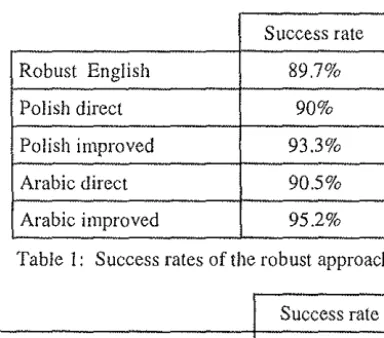
In contrast to previous work in the field, our proj-ect has a tmly multilingual character. We have de-veloped a knowledge-poor, robust approach which we propose as a platform for multilingual pronoun resolution in technical manuals. The approach was initially developed and tested for English, but we have also adapted and tested it for Polish and Arabic. We found that the approach could be adapted with minimum modifications for both languages and fur-ther, even if used without any modification, it deliv-ers acceptable success rates. Evaluation shows a success rate of 89.7% for English, 93.3% for Polish and 95.2% for Arabic.1
2. The approach: general overview
With a view to avoiding complex syntactic, semantic and discourse analysis, we developed a robust, knowledge-poor approach to pronoun resolution which does not make use of parsing, syntactic and semantic constraints or any other form of linguistic or non-linguistic knowledge. Instead, we rely on the efficiency of sentence segmentation, part-of-speech tagging, noun phrase identification and the high per-formance of the antecedent indicators (knowledge is limited to a small noun phrase grammar, a list of terms, a list of (indicating) verbs, a list of genre-specific synonyms, and a set of antecedent indica~ tors).
The core of the approach lies in activating a list of multilingual' "antecedent indicators" after filtering candidates (from the current and two preceding sen-tences) on the basis of gender and number agreement. Before that, the text is pre-processed by a sentence splitter which determines the sentence boundaries, a part-of-speech tagger which identifies the parts of the speech and a simple phrasal grammar which detects the noun phrases (In addition, in the case of complex
1
Given that the evaluation of the English version was more extensive, the figures for English are expected to be statis-tically more representative.
2
We term the antecedent indicators "multilingual" because they work well not only for English, but also for other languages (in this case Arabic and Polish).
sentences, heuristic "clause identification" rules track the clause boundaries). Non~anaphoric occurrences of "it" in constructions such as "It is important", "It is necessary" etc., are eliminated by a "referential fil-ter11.
After passing the "agreement filter", the genspecific antecedent indicators are applied to the re-maining candidates (see section 2.2). The noun phrase with the highest aggregate score is proposed as antecedent; in the rare event of a tie, priority is given to the candidate with the higher score for im-mediate reference. If imim-mediate reference has not been identified, then priority is given to the candidate with the best collocation pattern score. If this does not help, the candidate with the higher score for indi-cating verbs is preferred. If still no choice is possible, the most recent from the remaining candidates is selected as the antecedent.
2.1 Agreement filter
The detected noun phrases (from the sentence where the anaphor is situated and the two preceding sen-tences, if available) are passed on to a gender and number agreement test. In English, however, there are certain collective nouns which do not agree in number with their antecedents (e.g. ''government", "team", "parliament" etc. can be referred to by "they"; equally some plural nouns such as "data" can be referred to by "it") and are exempted from the agreement test. For this purpose we have drawn up a comprehensive list of all such cases; to our knowl-edge, no other computational treatment of pronomi-nal anaphora resolution has addressed the problem of "agreement exceptions".
The gender and number agreement of an anaphor and its antecedent in Polish is compulsory. Polish gender distinctions are much more diverse than in English (e.g. feminine and masculine do not apply to a restricted number of nouns). Moreover, one pro-nominal form can potentially refer to nouns of differ-ent gender. For instance, the singular genitive form "jego" can equally well refer to either masculine or neuter nouns. In addition, certain pronouns such as the accusative form 'je" can refer to either singular neuter or plural feminine nouns. Finally, unlike Eng-lish, zero anaphors (in subject position) are typical in Polish in declarative sentences.
objects, while "ha" refers to singular feminine ones. There
are
three plural anaphoric pronouns: "homa" which refers to a dual number (a set of two elements) of both masculine and feminine nouns, "hom" which refers to a plural number (a set of more than two elements) of masculine nouns and 11honna" which refers to a plural number of feminine
2.2 Antecedent indicators
Antecedent indicators (preferences) play a decisive role in tracking down the antecedent from
a
set of possible candidates. Candidates could be given pref-erential treatment, or not, from the point of view of each indicator and assigned a score (-1, 0, I or 2) accordingly; the candidate with the highest aggregate score is proposed as the antecedent. The antecedent indicators have been identified on the basis of em~ pirical studies of numerous hand~annotated technical manuals (referential links had been marked by human experts). These indicators can be related to salience (definiteness, givenness, indicating verbs, indicating noun phrases, lexical reiteration, section heading preference, "non-prepositional" noun phrases, rela~ tive pronoun), to structural matches (collocation, immediate reference, sequential instructions), to referential distance or to preference of terms. Whilst some of the indicators are more genre-specific (term preference) and others are less genre-specific ("im-mediate reference", "sequential instructions" and to a much lesser extent "indicating noun phrases"), the majority of them appear to be genre-independent. In the following we shall outline the indicatop used and shall illustrate some of them by examples (the indi-cators are used in the same way for English, Polish and Arabic unless otherwise specified).Definiteness
Definite noun phrases in previous sentences are more likely antecedents of pronominal anaphors than in~ definite ones (definite noun phrases score 0 and
in-definite ones are penalised by -1). In English we regard a noun phrase as definiteif
the head noun is modified by a definite article, or by demonstrative or possessive pronouns. This rule is ignoredif
there areno
definite articles, possessive or demonstrative pro~ nouns in the paragraph (this exception is taken into account because some English user's guides tend to omit articles).Since in Polish there are no definite articles, definiteness is signalled by word order, demonstra-tive pronouns or repetition.
In
Arabic, definiteness occurs in a richer variety of forms (Galaini 1992). In addition to the definiteness triggered by the definite article "a!" (the),demonstra-tive and possessive pronouns, a noun phrase in Ara~ bic
is
also regarded as definite if it is followed bya
definite noun/noun phrase3. For example, the noun phrase "kitabu al-rajuli" (lit. book the man) which means "the book of the man", is considered definite since the non-definite noun "kitabu" (book) is fol-lowed by the definite noun "al-rajoli" (the man). This form of definiteness is called in Arabic "AI-ta'rif bi-al-idhafa" (definiteness by addition).Give1mess
Noun phrases in previous sentences representing the "given information" (theme)4 are deemed good can-didates for antecedents and score 1 (candidates not representing the theme score 0). In a coherent text (Firbas 1992), the given or known information, or theme, usually appears first, and thus forms a co~ referential link with the preceding text. The new information,
or
rheme, provides some informationIndicating verbs
If a verb is a member of the Verb_set
=
{discuss, present, illustrate, identify, summarise, examine, describe, define, show, check, develop, review, re-port, outline, consider, investigate, explore, assess, analyse, synthesise, study, survey, deal, cover}, we consider the first NP following it as the preferred antecedent (scores 1 and 0). Empirical evidence sug-gests that because of the salience of the noun phrases which follow them, the verbs listed above arc par-ticularly good indicators.The Verb_set in Polish contains the Polish equiva-lents of the above verbs and their synonyms.
Indicating noun phrases
If
the head of theNP
preceding the verb is the noun "chapter'\ "section", "table" then consider the NP following the verb as the preferred antecedent (scoresI and 0)
The last two preferences can be illustrated by the example:
This table shows a minimal configurationi; iti docs not leave much room for additional applications or other soflware for which you may require additional swap space.
3There are other forms of definiteness in Arabic which we
shall not discuss in this paper since they are not typical of technical manuals.
4
Lexical reiteration
Lexically reiterated items are likely candidates for antecedent (a NP scores 2 if is repeated within the same paragraph twice or more, 1 if repeated once and 0 if not). Lexically reiterated items include repeated synonymous noun phrases which may often be pre-ceded by definite articles or demonstratives. Also, a sequence of noun phrases with the same head counts as lexical reiteration (e.g. "toner bottle", "bottle of
toner", "the bottle").
Section heading preference
If a noun phrase occurs in the heading of the section, part of which is the current sentence, then we con-sider it as the preferred candidate (l, 0).
"Non-prepositional" noun phrases
A "pure", "non-prepositional" noun phrase is given a
higher preference than a noun phrase which is part of a prepositional phrase (0, -1)Insert the cassettei into the VCR making sure iti
is
suitable for the length of recording.
Here "the VCR" is penalised (-1) for being part of the prepositional phrase "into the VCR".
This preference can be explained in terms of sali-ence from the point of view of the centering theory. The latter proposes the ranking "subject, direct ob-ject, indirect object" (Brennan et a!. 1987) and noun
phrases which are parts of prepositional phrases are usually indirect objects.
This criterion was extended in Polish to frequently
occurring genitive constructions (e.g. liczba
kom-puterow
=number of computers). Nouns which are
part of such genitive constructions and which are not
in genitive form are penalised by"-!".In Arabic the antecedent and the anaphor can be-long to the same prepositional phrase (see next sec-tion). Therefore, we have modified this indicator for the "Arabic version" accordingly:
if
an NP belongs to a prepositional phrase which doesn't contain the anaphor, we penalise it by-!; otherwise we do not assign any score to it (0).Relative pronoun indicator
This indicator is used only in the Arabic version and is based on the fact that the first anaphor following a
relative pronoun refers exclusively to the most recent
NP preceding it which is considered as the most
likely antecedent (2,0).Example:
Al-tahakkok min tahyiat al-moakkit
Yornkino~ka a'rdh tahyiat rnoakldtoka li~at-lahakkok
mina al~bararniji al~lati targhabo fi tasjili-hai. (Literal translation)
Checking the Timer Settings
You can display your timer settings to confirm the programmesi that you wish to recording it1. Checking the Timer Settings
You can display your timer settings to confirm the programmes you wish to record.
In this example the pronoun "ha" (it) is the first pro-nominal anaphor which follows the relative pronoun "al-lati" (that) and refers to the non-animate feminine plural "al-baramij" (the programmes; for agreement rules in Arabic see section 2.1) which is the most recent NP preceding "al-lati".
Collocation pattern preference
This preference
isgiven to candidates which have an
identical collocation pattern with a pronoun (2,0). The collocation preference here is restricted to thepattern
"noun/pronoun,
verb"
or
"verb,
noun/pronoun" (owing to lack of syntacticinforma-tion, this preference is somewhat weaker than the
collocation preference described in (Dagan & Itai1990).
Press the keyi down and tum the volume up ... Press it1 again.
The collocation pattern preference in Arabic has been
extended to patterns "(un)V-NP/anaphor", i.e. verbswith a "undoing action" meaning are considered for
the purpose of our approach to fall into collocationpatterns along with their "doing action" counterparts.
This extended new rule would help in cases such as"Loading a cassette or unloading it". This rule is soon
to be integrated into the English and Polish versions.lrnmediate reference
In technical manuals the "immediate reference" clue
can often be useful in identifying the antecedent. Theheuristics used is that in constructions of the form
" ... (You) V1 NP ... con (you) V2 it (con (you) V3 it)", where con E {and/or/before/after ... }, the noun phrase immediately after V 1 is a very likely candidate for antecedent of the pronoun "it" immediately following V 2 and is therefore given preference (scores 2 and 0).This preference can be viewed as a modification of
the collocation preference. It is also quite frequentwith imperative constructions.
To turn on the printer, press the Power buttoni and hold iti down for a moment.
~nwrap the paperi, form iti and align iti, then load iti
mto the drawer.
Sequential instructions
This new antecedent indicator has recently been incorporated for Arabic but it works equally well for English and is to be implemented in the English version soon as well. It states than
in
sequential in-structions of the form "To V 1 NP1, V2 NP2.(Sen-tence). To V 3 it, V 4 NP 4" the noun phrase NP 1 is
the likely antecedent of the anaphor "it" (NP1 is as-signed a score of 2).
Example:
To turn on the video recorder, press the red button. To programme it, press the "Programme" key.
To turn the TV set ON, press the mains ON/OFF switch. The power indicator illuminates to show that the power is on. To turn the TV set off, press it again.
Referential distance
In English complex sentences, noun phrases in the previous clause· are the best candidate for the an-tecedent of an anaphor
in
the subsequent clause, followed by noun phrases in the previous sentence, then by nouns situated 2 sentences further back and finally nouns 3 sentences fmther back (2, I, 0, -1). For anaphors in simple sentences, noun phrases in the previous sentence are the best candidate for antece-dent, followed by noun phrases situatedf2
sentences further back and finally nouns 3 sentences further back (I, 0, -I)Since we found out that in Arabic the anaphor is more likely to refer to the most recent NP, the scor-ing system for Arabic gives a bonus to such candi-dates: the most recent NP is assigned a score of 2, the one that precedes it immediately I and the rest 0.
Term preference
NPs representing terms in the field are more likely to be the antecedent than NPs which are not terms (score I if the NP is a term and 0 if not).
As already mentioned, each of the antecedent indi-cators assigns a score with a value e { -1, 0, 1, 2}. These scores have been determined experimentally on an empirical basis and are constantly being up-dated. Top symptoms like "lexical reiteration" assign score "2" whereas "non-prepositional~~ noun phrases
5
Identification of clauses in complex sentences is done heuristically,
are given a negative score of "-1 ".We should point out that the antecedent indicators are preferences and not absolute factors. There might be cases where one or more of the antecedent indicators do not "point" to the correct antecedent. For instance, in the sentence "Insert the cassette into the VCR making sure it· is I I turned on", the indicator "non-prepositional noun phrases" would penalise the correct antecedent. When all preferences (antecedent indicators) arc taken into account, however, the right antecedent is still very likely to be tracked down - in the above example, the "non-prepositional noun phrases" heu-ristics (penalty) would be overturned by the "collo-cational preference" heuristics.
The antecedent indicators have proved to be rea-sonably efficient in assigning the right antecedent and our results show that for the genre of technical manuals they may be no less accurate than syntax-and centering-based methods (see Mitkov 1998b). The approach described is not dependent on any theories or assumptions; in particular, it docs not operate on the assumption that the subject of the previous utterance is the highest-ranking candidate for the backward-looking center - an approach which can sometimes lead to incorrect results. For instance, most centering-orientated methods would propose "the utility" incorrectly as the antecedent of "it" in the . sentence "The utility (CDVU) shows you a LIST4250, LIST38PP, or LIST3820 file on your terminal for a format similar to that in which it will be printed" because of the preferential treatment of the subject as the most salient candidate (e.g. RAP, see Dagan et al. 1995). The "indicating verbs" prefer-et}Ce of our approach, however, would give prefer~ cnce to the correct antecedent "LIST4250, LIST38PP, or LIST3820 file".
3. Evaluation
even better than syntax-based methods (Lappin & Leass 1994). The evaluation results also show supe-riority over other knowledge-poor methods (Baldwin 1997; see also below)6. We believe that the good success rate is due to the fact that a number of
ante-cedent indicators are taken into account and no factor
is given absolute preference. In particular, this strat-egy can often override incorrect decisions linked with strong centering preference (see 2.2) or syntactic and semantic parallelism preferences (Mitkov 1998b).We have carried out evaluations on sample texts from technical user's guides both for English and Arabic and the results show comparable success rates. The success rate for Arabic is slightly higher and we should mention that in addition to tuning the approach for Arabic, the "Arabic improved" version
uses
2new indicators recently introduced which have
not been included in the "Robust English" version yet.3.1 English
The first evaluation exercise for English (Mitkov & Stys 1997) was based on a random sample text from a technical manual (Minolta 1994 ). There were 71 pronouns in the 140 page technical manual; 7 of the pronouns were non-anaphoric and 16 exophoric. The
resolution of anaphors was carried out with a
suc-cess rate of 95.8%. The approach being robust (an attempt is made to resolve each anaphor and a pro-posed antecedent is returned), this figure representsboth "precision" and "recall"
if we use the MUC
terminology. To avoid any terminological confusion,
we shall therefore use the more neutral term "success
rate" while discussing the evaluation.
We conducted a second evaluation 7 of the robust
approach on a different set of English sample texts from the genre of technical manuals (47-page Port-able Style-Writer User's Guide (Stylewriter 1994). Out of 223 pronouns in the text, 167 were non-anaphoric (deictic and non-non-anaphoric "it"). The
evaluation carried out was manual to ensure that no
added error was generated (e.g. due to possible wrong sentence/clause detection or POS tagging).Another reason for doing it by hand is to ensure a fair
comparison with other knowledge-poor methods (Baldwin 1997), which not being available to us, had to be hand-simulated.The second evaluation indicated an 83.6% success
rate for our robust approach. Baldwin's CogNIAC6
This applies to the genre of technical manuals; for other genres results may be different
7
We are indebted to Lowenna Ansell for carrying out the second evaluation
scored 75% on the same data, while J. Hobb's algo-rithm achieved 71% (Mitkov 1998b).
On the basis of both evaluation experiments a suc-cess rate of 89.7% could be regarded as a statistically more representative figure for the performance of "English version" of the robust approach8• In
addi-tion, our evaluation results indicate 82% "critical
success rate", which we consider quite a satisfactory
score (for definition of the concept "critical success rate" which is limited to the evaluation of the so-called "critical cases" - the resolution of "tough" anaphors which have already passed the agreement filter, see Mitkov 1998b). Finally, in order to evalu-ate the effectiveness of the approach and to explore whether or by how much it is superior to the baseline models for anaphora resolution, we also tested the sample texts on (i) a Baseline Model which checksagreement in number and gender and, where more
than one candidate remains, picks as antecedent the
most recent subject matching the gender and number
of the anaphor and (ii) a Baseline Model which picksas antecedent the most recent noun phrase that
matches the gender and number of the anaphor. Theevaluation results suggest a success rate of 48.55%
for the first baseline model and a success rate 65.95% for the second (Mitkov 1998b).If we regard as "discriminative power" of each
an-tecedent indicator the ratio "number of successfulantecedent identifications when this indicator was
applied"/"number of applications of this indicator" (for the non-prepositional noun phrase anddefiniteness being penal ising indicators, this f-igure is
calculated as the ratio "number of unsuccessful
ante-cedent idcntifications"/"number of applications"), theimmediate reference emerges as the most
discrimi-native indicator (100%), followed by non-prepositional noun phrase (92.2%), collocation (90.9%), section heading (61.9%), lexical reiteration (58.5%), givenness (49.3%), term preference (35.7%) and referential distance (34.4%). The relatively low figures for the majority of indicators should not be regarded as a surprise: firstly, we should bear in mindthat in most cases a candidate was picked (or
re-jected) as an antecedent on the basis of applying a number of different indicators and secondly, that most anaphors had a relatively high number of can-didates for antecedent.In terms of frequency of usc ("number of non-zero applications"/"number of anaphors"), the most fre-quently used indicator proved to be referential dis-tance used in 98.9% of the cases, followed by term preference (97.8%), givenness (83.3%), lexical
reit-8
eration (64.4%), definiteness (40%), section heading (37.8%), immediate reference (31.1%) and colloca-tion (11.1 %). As expected, the most frequent indica-tors were not the most discriminative ones.
3.2 Arabic
We evaluated the robust approach for Arabic operat-ing in two modes: the !irst mode consisted of usoperat-ing the robust approach directly, without any adapta-tion/modification for Arabic, whereas the second mode used an adapted/enhanced version which in-cluded modified rules (see section 2.2) designed to capture some of the specific aspects of Arabic plus a few new indicators.
The evaluation was based on 63 examples from a technical manual (Sony 1992). The first mode (i.e. using the robust approach without any adaptation for Arabic- this version is referred to as "Arabic direct" in the table below) reported a success rate of 90.5% (57 out of 63 anaphors were correctly resolved). Typical failures were examples in which the antece-dent and the anaphor belonged to the same preposi-tional phrase:
Tathhar al-surah fi awal kanati ta-stakbilo-hai fi mintakati-ka.
Appears the-picture on first channeli you-rcceivc-iti in area-your. (Literal tnmslation)
The picture appears when the first channel received in your area is detected.
Such failure cases were not detected in the improved version for Arabic in which the "non-ptjepositional phrase" rule was changed (see section 2.2).
Another typical problem which was rectified by changing the referential distance in Arabic was the case in which the anaphor appeared as part of a PP modifying the antecedent-NP:
Kom bi-taghtiat thokb al-lisan bi-sharit plastic aw ista'mil kasit akhari bi-hii lisan al-aman.
Cover slot the-tab wit!Hape plastic or use cassette anotheri in iti tab the-safety.
Cover the safety tab slot with plastic tape, or use
an-other cassette with a safety tab.
The candidates for antecedent in this example are the noun phrases "safety tab slot'', "plastic tape" and "another cassette". If we use the robust approach without any modification, each candidate gets 2 for referential distance; the aggregate score for "safety tab slot" is 3, for "plastic tape" it is 2 and for "another cassette" is 2 as well (they all get an additional 1 score for "term preference"). Using the new referen-tial distance scores, however, the correct candidate "another cassette" scores an aggregate of 2 as
op-posed to the other two candidates which are assigned an aggregate score of 1.
The second evaluation mode (evaluating the ver-sion adapted and improved for Arabic which is re-ferred to as "Arabic improved" in the table below) reported a success rate of 95.2% (60 out of 63 ana-phors were correctly resolved).
The evaluation for Arabic also showed a very high "critical success rate" as well. The robust approach used without any modification scored a "critical success rate" of 78.6%, whereas the improved Arabic version scored 89.3%.
The most discriminative indicators for Arabic proved to be immediate reference, collocation and sequential instructions with 100% discriminative power, followed by non-prepositional noun phrase (89.2%), term preference (82.1 %), de!initeness (78.6%), referential distance_seore_2 (67.9%) and section heading (63.6%). The higher contribution of referential distance for Arabic is in tune with our empirical finding that referential distance is a more important indicator for Arabic than for English and that in particular, the most recent NPs in Arabic are more likely to be antecedents than in English (see section 2.2, indicator "referential distance").
The most frequently used indicators for Arabic were referential distance ( 100%, of which 34.6% with score 2 and 34.6% with score 1) and term pref-, erence (87.7%). Againpref-, the most discriminative indi-cators could not be frequently used: collocation was applied in only 2.5% of the cases, whereas immediate reference and sequential instructions could be acti-vated in 1.2% of the cases only.
3.3
PolishThe evaluation for Polish was based technical manu-als available on the Internet (Internet Manual, 1994; Java Manual 1998). The sample texts contained 180 pronouns among which were 120 instances of exo-phoric reference (most being zero pronouns). The robust approach adapted for Polish demonstrated a high success rate of 93.3% in resolving anaphors.
Similarly to the evaluation for English, we com-pared the approach for Polish with (i) a Baseline Model which discounts candidates on the basis of agreement in number and gender and, if there were still competing candidates, selects as the antecedent the most recent subject matching the anaphor in gen-der and number (ii) a Baseline Model which checks agreement in number and gender and, if there were still more than one candidate left, picks up as the antecedent the most recent noun phrase that agrees with the anaphor.
The first Baseline Model (Baseline Subject) was successful in only 23.7% of the cases, whereas the second (Baseline Most Recent) had a success rate of 68.4%. These results demonstrate the dramatic in-crease in precision, which is due to the use of antece-dent tracking indicators.
The Polish version also showed a very high "criti-cal success rate" of 86.2%. Used without any modifi-cation ("Polish direct"), the approach scored a 90% success rate.
The most discriminative antecedent indicators for Polish appear to be the sequential instructions, im-mediate reference and indicating verbs (100%), fol-lowed by referential distance (84.1 %) and givenness (80 %).
The most frequently used indicators for Polish were definiteness (97.2% of the cases), referential distance (94.4%), givenness (61.1 %) and non-prepositional noun phrase (52.8%). The least fre-quently used indicators proved to be indicating verbs (16.7%), lexical reiteration (13.9%) and immediate reference (2.8%).
The success rates obtained can be summarised as follows:
Success rate
Robust English 89.7%
Polish direct 90%
Polish improved 93.3%
Arabic direct 90.5%
Arabic improved 95.2%
Table 1: Success rates of the robust approach
Success rate
Baseline subject English 31.6% I 48.6% Baseline most recent English 65.9% Baseline subject Polish 23.7% Baseline most recent Polish 68.4%
Table 2: Success rates of the baseline models Since the approach is robust, the success rates equal both recall and precision except for "Baseline subject English": since there are cases in which "Baseline subject" may not be able to pick up an antecedent (e.g. paragraphs with zero subjects), this version can be measured in terms of both precision (the higher figure in table 2) and recall (the lower figure).
4. Future work
Future work includes adapting the approach for French, Spanish and Bulgarian as well as testing it on (and if necessary, modifying it to cover) a wider variety of genres. In addition, we plan to use the statistically-based multicriteria approach (Pomerol & Barbara-Romero, 1992) to fine-tune scoring.
5. Conclusion
We have described a genre-specific modification of the practical approach to pronoun resolution (Mitkov 1998a) and have shown its multilingual nature: we have adapted and tested the approach for Polish and Arabic. The evaluation reports success rates which are comparable to (and even better than) syntax~ based methods and show superiority over other methods with limited knowledge.
References
Abra,os, Jose & Jose G. Lopes. 1994. "Extending DRT with a focusing mechanism for pronominal anaphora and ellipsis resolution". Proceedings of the 15th International Conference on Complt!ational Linguistics (COL/NG'94),
1128-1132, Kyoto, Japan.
Baldwin, Breck. 1997. "CogNIAC: high precision corefer-encc with limited knowledge and linguistic resources".
Proceedings of the ACL'97/EACL'97 workshop on Op-erational factors in practical, robust arzaphora
resolu-tion, 38-45, Madrid, Spain.
Brennan, S., M. Fridman and C. Pollard. 1987. A centering approach to pronouns. Proceedings of the 25th Annual
Meeting of the ACL (ACL'87), 155-162. Stanford, CA,
USA.
Carbonell, James G. & Ralf D. Brown. 1988. "Anaphora resolution·. a multi-strategy approach". Proceedings of the 12. International Conference on Computational
Lin-guistics (COLING'88), Vol.!, 96-101, Budapest,
Hun-gary.
Carter, David M. 1987. Interpreting anaphora in natural
language texts. Chichester: Ellis Horwood
Connoly, Dennis, John D. Burger & David S. Day. 1994. "A Machine learning approach to anaphoric reference".
Proceedings of the International Conference "New
Meth-ods in Language Processing", 255-261, Manchester,
United Kingdom.
Dagan, Ida & Alan ltai. 1990. "Automatic processing of large corpora for the resolution of anaphora references".
Proceedings of the 13thelnternational Conference on ComputationaL Linguistics (COLING'90), Vol. III, I-3,
Helsinki, Finland.
Dagan, Ida, John Justeson, Shalom Lappin, Herbert Leass & Amnon Ribak. 1995. Syntax and lexical statistics in anaphora resolution. Applied Artificial Intelligence, 9. Dunker, Guido & Carla Umbach. 1993. Ve1jahren zur
Anaphernresolll!ion in KIT-fAST. Internal Report KIT~
[image:8.611.117.309.344.513.2] [image:8.611.113.312.474.572.2]Firbas, Jan. 1992. Functional sentence perspective in
writ-ten and spoken communication. Cambridge: Cambridge
University Press.
Fischer, Ingrid, Bernd Gcistert & GUnter GOrz 1996. "In-cremental anaphora resolution in a chart-based semantics construction framework using 1-DRT". Proceedings of the International Colloquium on Discourse Anaphora
and Anaphora Resolution. Lancaster (DAARC), 235-244,
Lancaster, UK.
Fraurud, Kari. 1988. "Pronoun Resolution in unrestricted text". Nordic Journal of Linguistics II, 47-68
Galaini, Chikh Mustafa. 1992. Jami'u al-durus al-arabiah
(Arabic lessons collection). Beirut: Manshurat al-maktabah al-asriyah (Modern library).
Hasan, Abbes. 1975. Al-nahw al-wafi ma'a rabtihi
bi-al-asalib al-rafiah wa al-hayah al-loghawiah
al-mutajadidah (Complete grammar referring to good styles
and the changing language). Egypt: Dar al-ma'arif (Knowledge bookstore).
Hobbs, Jerry R. 1978 "Resolving pronoun references".
Lingua, 44, 339-352.
Ingria, Robert J.P. & David Stallard. 1989. "A computa-tional mechanism for pronominal reference".
Proceed-ings of the 27th Annual Meeting of the ACL, 262-271,
Vancouver, British Columbia.
Internet ManuaL 1994. Translation of Internet Manual
Internet i okolice: Przewodnik po swiatowych sieciach
komputerowych. Tracy LaQuey, Jeanne C. Ryer
Trans-lated by Monika Zielinska, BIZNET Poland. Java Manual. 1998. Jezyk Java. Clico, Krakow.
Kennedy, Christopher & Branimir Boguraev, 1996. "Anaphora for everyone: pronominal anaphora resolution without a parser". Proceedings of the 16th Intemational Conference on Computational Linguistics (COL!NG'96),
1 13Hl18. Copenhagen, Denmark.
Lappin, Shalom & Michael McCord. 1990. "Anaphora resolution in slot grammar". Computationd Linguistics,
16:4, 197-212.
Lappin, Shalom & Herbert Leass. 1994. "11-n algorithm for pronominal anaphora resolution". Computational
Lin-guistics, 20(4), 535-56!.
Leass Herbert & Ulrike Schwall. 1991. An anaphora
reso-lution procedure for machine translation. IBM Germany
Science Center. Institute for Knowledge Based Systems, Report 172.
Minolta. 1994. Minolta Operator's Manual for Photocopier
EP5325. Technical Manual Minolta Camera Co., Ltd.,
Business Equipment Division 3-13, 2-Chome, Azuchi,-Machi, Chuo-Ku, Osaka 541, Japan.
Mitkov, Ruslan. 1994. "An integrated model for anaphora resolution". Proceedings of the 15th International Con-ference on Computational Linguistics (COL!NG'94),
1170-1176, Kyoto, Japan.
Mitkov, H.uslan. 1995. "Un uncertainty reasoning approach for anaphora resolution". Proceedings of the Natural
Language Processing Pacific Rim Symposium
(NLPRS'95), 149-154, Seoul, Korea.
Mitkov, Ruslan. I998a. "Pronoun resolution: the practicai alternative". In T. McEnery, S. Botlcy(Eds) Discourse
Anaphora and Anaphor Resolution. Jo!m Benjamins.
Mitkov, Ruslan. 1998b. "Evaluating anaphora resolution approaches" (forthcoming).
Mitkov, Ruslan & Malgorzata Stys. 1997. "Robust refer-ence resolution with limited knowledge: high precision genre-specific approach for English and Polish". Pro-ceedings of the international Conference "Recent Ad-vances in Natural Language Proceeding" (RANLP'97),
74-8!. Tzigov Chark, Bulgaria.
Mori, Tatsunori, Mamoru Matsuo, Hiroshi Nakagawa. 1997. Constraints and defaults of zero pronouns in Japa-nese instruction manuals. Proceedings of the ACL'97/EACL'97 workshop on Operational factors in
practical, robust anaphora resolution, 7-13. Madrid,
Spain.
Nakaiwa, Hiromi & Satoru, Ikehara. 1992. " Zero pronoun resolution in a Japanese-to-English Machine Translation system by using verbal semantic attributes". Proceedings of 3rd Conference on Applied Natural Language
Proc-essing (ANLP'92), Trento, Italy.
Nakaiwa, Hiromi & Satoru, Ikehara. 1995. "lntrasentential resolution of Japanese zero pronouns in a Machine Translation system using semantic and pragmatic con-straints". Proceeedings of the International Conference on Theoretical and Merhodological Issues in Machine
Translation (TM!'95), 96-105, Leuven, Belgium.
Nakaiwa, Hiromi, S. Shirai, Satoru Ikehara & T. Kawaoka. 1995. "Extrasentential resolution of Japanese zero pro-nouns using semantic and pragmatic constraints". Pro-ceedings of the AAAI I995 Spring Symposium Series: Empirical methods in discourse intetpretation and gen-eration.
Nakaiwa, Hiromi & Francis Bond, Takahiro Uekado & Yayoi Nozawa. 1996. "Resolving zero pronouns in texts using textual structure". Proceedings of the International Conference "New Methods in Language Processing"
(NeMLaP-2), Ankara, Turkey.
Nasukawa, Tetsuya. 1994. "Robust method of pronoun resolution using full-text information". Proceedings of the 15th International Conference on Computational
,Linguistics (COLJNG'94), 1157-1163, Kyoto, Japan.
Pomerol, Jean-Charles & Sergio Barbara-Romero. 1992.
Choix multicritere dans l'entreprise: principes et
pratique. Paris: HERMES.
Popescu-Belis, Andrei & Isabelle Robba. 1997. "Coopera-tion between pronoun and reference resolu"Coopera-tion for unre-stricted texts". Proceedings of rhe ACL'97/EACL'97 workshop on Operational factors in practical, robust
anaphora resolution, 30-37. Madrid, Spain.
Rich, Elaine & Susann LuperFoy. 1988. "An architecture for anaphora resolution". Proceedings of the Second Conference on Applied Natural Language Processing
(ANLP-2), 18-24, Texas, U.S.A.
Rolbert, Moniquc. 1989. Resolution de formes pronomina-les dans l'intetjace d'interogation d'une base de donnees.
ThCse de doctorat. Facult6 des sciences de Luminy. Sidner, Candy L. 1979. Towards a computational themy of
definite anaphora comprehension in English discourse.
Technical Report No. 537. M.I.T., Artificial Intelligence Laboratory.
Sony. 1992. Video cassette recorder. Operating Instruc-tions. Sony Corporation.
Anaphora Resolution. Lancaster (DMRC), 400AI3. Lancaster, UK.
Stuckardt, Roland. 1997. "Resolving anaphoric references on deficient syntactic descriptions". Proceedings of the
ACL'97!EAC~'97 workshop on Operational factors in
practical, robust anaphora resolution, 30fi37. Madrid,
Spain.
Stylewriter 1994. Portable Style Writer. User's guide. Apple Computers.
Tin, Erkan & Varol, Akman. 1994. "Situated processing of pronominal anaphora". Proceedings of the KONVENS"94
Conference, 369fi378, Vienna, Austria.
Wakao, Takahiro. 1994. "Reference resolution using se-mantic patterns in Japanese newspaper articles". Pro-ceedings of the 15th International Conference on
Com-putational Linguistics (COLJNG'94), 1133-1137. Kyoto,
Japan.
Webber, Bonnie L. 1979. A formal approach to discourse
anaphora. London: Garland Publishing.
Williams, Sandra, Mark Harvey & Keith Preston. 1996. "Rule-based reference resolution for unrestricted text using part-of-speech tagging and noun phrase parsing".
Proceedings of the International Colloquium on Dis· course Anaphora and Anaphora Resolution (DAARC),