Limiting Disclosure of Sensitive Attribute
Values: An Active Approach
Junping Sun, Member IAENG
∗Abstract—As computer and other technologies ad-vance and various data and information are perva-sively available, preservation of private information embedded in volume data are facing more and more challenges than ever before. Although there are available mechanisms in database management sys-tems limiting access to some sensitive and private information, some inference techniques might still be able to bypass the access control mechanisms to acquire these unauthorized information inappropri-ately. This paper will propose an active approach to limiting disclosure of sensitive and private infor-mation.
Keywords: Preservation of Private and Sensitive In-formation, Limiting Disclosure of Sensitive Data
1
Introduction
As both the size and the number of databases are grow-ing exponentially, it is not only important to manage access control of sensitive and private data [4] [5], but also critical to protect the privacy from data inference by obscure database queries [2] [6] [7]. Next the gener-alized disclosure scenery with respect to inference rules will be given, and its related problem statement will be defined correspondingly. Section 2 will discuss various types of inference rules leading to possible disclosure of sensitive and private information. Section 3 will give the algorithms that detect these rules as well as set of private attributes whose values might be disclosed. Sec-tion 4 will present an active model based trigger mech-anism that will take appropriate actions when a query might access to some private attribute values. Section 5 is the conclusion.
∗Nova Southeastern University, Graduate School of Computer
and Information Sciences, Fort Lauderdale, Florida USA 33314 Tel/Fax: 954-262-2082/3915 Email: [email protected]
1.1
Disclosure Scenery
Given a universal database schema S(A1, A2, ..., An) with a set of attributes Ai ∈A =AP U ∪AP R where
AP U is a set of publicly accessible attributes, andAP R
set of private attributes accessible to an authorized group of users, assuming that there is a set of publicly known rules such asRi∈R:
Pi−→Aj
wherePi∈PP U, 1≤i≤nandAj∈AP R, 1≤j≤m, if ∃Pi ∈ PP U can be satisfied by the query predicates Pk ∈PP U, 1≤i=k≤nfrom a given a queryQ∈Q, then ∃Aj ∈ AP R V(Aj) (the value of attribute Aj ∈
AP R) will be disclosed.
Although a given database queryQ is only allowed to access Ai ∈AP U, 1≤i = j ≤n, the values V(Aj) of private attributes might be inferred from some publicly known rules by any unauthorized individuals,
Ri∈R:Pi−→Aj,
that is,
Q={Ai|Pk} ∪R|=Aj
where Ai ∈AP U, Pk ∈ PP U, Aj ∈ AP R, and 1 ≤i = j≤n,1≤j≤m.
In order to address the issues from the inference queries, the following model is proposed.
1.2
Problem Statement
Given a database query Q ∈ Q, an active model is proposed to analyze Q and to discover if there exist potential inferences on sensitive data in databaser(S).
The active model is a 4-tuple and defined as:
• E = {Q,I,D,U} where Q is a set of queries, D set of deletions, I set of insertions, and U set of updates. Without loss of generality, all of D,I,U are treated asQin this paper.
• Cis a set of conditions that triggers corresponding actions, which will be discussed in the later part of this paper.
• KB={R,IC}is the knowledge base including a set of inference rulesRand set of integrity constraints
IC.
• AC is a set of actions and defined as:
E × C × KB −→ AC
where AC = {ACb,ACp}, ACb is the set of prior actions before an event Q ∈ Q can proceed, and
ACp set of post actions afterQ∈Qis processed.
In order to take appropriate actions on the inference queries, the following will discuss various types of in-ference rules possible to be used to access sensitive and private attribute values.
2
Inference Rules
2.1
Functional Dependency as Inference
Rule
Definition 2.1 Let r(S) be a relation on the schema S(A1, ..., An), ∃i Ai ∈ X ⊆ S, Ai ∈Y ⊆ S, 1 ≤i ≤ n, r(S) satisfies the functional dependency X −→ Y, denoted r(S)X −→Y,if
∀t, t∈r(S)t[X] =t[X]⇒t[Y] =t[Y],
i.e., ∀x∈D(X), |πY(σX=x(r(S))| ≤ 1 where D(X) is the domain of attribute X, π is the project operator, andσthe select operation in relational model.
The functional dependency X −→ Y claims that for each unique value of X, there exists at most one value ofY.
Definition 2.2 Let r(S)H be a relation in a historical database H accessible to public.
For givenr(S) and r(S)H, there exists two tuples such ast∈r(S) andt ∈r(S)H. For a given database query
Q, assumingQ is allowed to access only the set of at-tributes Ai ∈ AP U, 1 ≤i ≤n, if there exists a func-tional dependency X −→ Y where X ⊆ ∪Ai ⊆ AP U and Y ⊆ AP R, then the value of Y can be inferred and will be disclosed because if t[X] = t[X], then t[Y] = t[Y], and the fact t[X], t[Y] ∈r(S)H. In the following discussion, the knowledge ofr(S)His assumed publicly available.
That is, for a given query:
Q={A1, ..., Ai|Pk}
Q∪X−→Y |=A1, ..., Ai, ..., Aj
whereAi ∈X ⊆AP U, Pk ∈PP U,Aj∈Y ⊆AP R, and 1≤i=j≤n.
Given Armstrong Inference Axioms (IA) as follows [3],
IA1: Reflexive Rule
ifY ⊆X, thenX −→Y.
IA2: Augmentation Rule
ifX −→Y, thenXZ −→Y Z.
IA3: Transitive Rule
ifX −→Y andY −→Z, thenX −→Z.
Some attribute values V(AP R) might be further in-ferred and disclosed by using some of IA, for example,
IA3. The following will discuss the inference chain of the functional dependencies based on the closure and Armstrong Inference Axioms.
Definition 2.3 A functional dependencyf : X−→Y is trivial if Y ⊆ X. If Y ⊆X, then functional depen-dencyf : X−→Y is non-trivial.
In the rest part, this paper refers to only set of non-trivial functional dependencies.
Definition 2.4 Let F be a set of functional dependen-cies, and letf ∈F with respect to a set of attributes in f, (f)∈S,
F+={f |(f)⊆ ∪
f∈F(f)∧F |={Armsrules}f}
Definition 2.5 ForX ⊆S(A1, ..., An) and a set ofF of functional dependencies overS(A1, ..., An),
closureF(X) ={Y ∈S|X −→Y ∈F+}
is calledclosureof X.
For a given set of functional dependencies F Ds,
F={fi:Xi−→Yi|1≤i≤n},
ifXi−→YiandYi −→Yi+1,then we haveXi −→Yi+1, denoted as fi ⇒ fi+1, by the transitivity property of Armstrong’s rule[3].
Without loss of generality, if
f1 ⇒f2, ..., fi⇒fi+1, ..., fn−1⇒fn,
denoted as,
f1=∗⇒fn, thenXi−→Yj,1≤i < j≤n.
For a given database queryQ, althoughQis allowed to access only the set of attributes Xi∈AP U, 1≤i≤m, iff1 =∗⇒fn, then Xi −→Yj,1≤i < j ≤n,the value of Yj ⊆ AP R can be inferred, and will be disclosed. That is, for a given query:
Q={X1, ..., Xi|Pk} Q∪f1=∗⇒fn|=X1, ..., Xi, ..., Yj
where Xi ⊆AP U, Pk ∈PP U, Yj ⊆AP R, and 1≤i= j≤n.
GivenIA2 andIA3, the pseudo transitive rule can be achieved:
IA4: Pseudotransitive Rule
ifX−→Y andY Z−→W, thenXZ−→W.
The proof of IA4 can be done by following IA2 and
IA3[3].
For a given database query Q ∈ Q and access to at-tributes X, Y, Z, the value of W can be inferred and will be disclosed with the fact:
X −→Y &Y Z −→W |=XZ −→W
That is, for given query:
Q={X, Y, Z|Pk} Q∪(X −→Y&Y Z −→W)|=W whereX, Y, Z ⊆AP U,Pk∈PP U,W ⊆AP R.
2.2
General Inference Rules
For given set of various rules such as: R⊆ KB, if there exists a rule R : Pi −→ Pj, where Ai ⊆ AP U is a set of attributes with respect to Pi and Aj ∈ AP R is the attribute with respect to Pj. If Ai ⊆ AP U can be satisfied by a given queryQ, then the value of Aj ∈ AP R with respect toPj can be inferred and will be disclosed.
That is, for a given query:
Q={Ai|Pk}
Q∪(R:Pi−→Pj)|=Aj
where Ai ⊆AP U, Pk ∈ PP U, R : Pi −→ Pj ∈ KB, andAj ⊆AP R.
The type of each predicatePiinRior a matched query condition inQcan be:
1. either a simple query predicate or constraintSQP such as:
Ai θ C or Ai θ Aj,i=j,
whereθ∈ {=, <,≤, >,≥,=}.
2. or a compound query predicate or constraintCQP that consists of a set ofSQPs and logical operators such as: AND, OR, NOT.
For a given set of rulesR⊆ KBsuch that:
R={Ri:Pi−→Pj |1≤i=j+ 1≤n},
ifPi−→Pj andPj+1−→Pk,then we havePi−→Pk, denoted asRi=⇒Ri+1,by the modus ponens law and hypothetical syllogism.
Without loss of generality, if
P1−→P2, ..., Pi−→Pi+1, ..., Pn−→Pn+1,
denoted as,P1−→∗ Pn, then
Ri−→∗ Rj,1≤i=j+ 1≤n,orR1=∗⇒Rn.
So for a given query:
Q∪(R:Ri=∗⇒Rj)|=Aj
where Ai ⊆AP U, Pk ∈PP U, R:Ri =∗⇒Rj ⊆ KB, andAj⊆AP R.
Definition 2.6 Given predicates Pi, Pj, ifRi :Pi −→ Pj and Rj : Pj −→ Pi, denoted as: Pi ←→ Pj, or
Pj ←→Pi, then Pi ←→Pj is a mutual (circular)
im-plication betweenPi andPj, or Ri⇐⇒Rj.
Definition 2.7 Given Ri : Pi −→ Pi+1 and Rj : Pj −→ Pj+1, Ri, Rj ∈ R, 1 ≤ i = j + 1 ≤ n, if
Pi −→∗ Pj and Pi ←−∗ Pj, denoted as Pi ←→∗ Pj, or Pi −→∗ Pj and Pi ←−∗ Pj, denoted as Pi ←→∗ Pj, then
Ri⇐⇒∗ Rj,1≤i=j+1≤n.We denote it as a mutual implication ring, or simply a ring.
For given set of various rules R⊆ KB such that:
Ri⇐⇒∗ Rj,1≤i=j+ 1≤n.
if there exists a ruleR:Pi←→∗ Pj, whereAi⊆AP U is a set of attributes with respect toPi andAj ∈AP R is the attribute with respect toPj, and ifAi⊆AP U can be satisfied by a given query Q, then the value of Aj ∈AP R with respect to Pj can be inferred and will
be disclosed.
So for a given query:
Q={Ai|Pk}
Q∪(R:Ri⇐⇒∗ Rj)|=Aj
where Ai ⊆ AP U, Pk ∈ PP U, Aj ⊆ AP R, and R : Ri⇐⇒∗ Rj⊆R⊆ KB.
3
Discovering
Inference
Chains
and
Rings
Theorem 3.1 For a given set of rules R⊆ KB:
R={Ri:Pi→Pj |1≤i < j≤n}
with respect to a given schema S(A1, ..., An), let LHSR={Pi|Pi∈Ri,1≤i≤n}
be the set of predicates on the left hand side of each Ri∈R, and
RHSR={Pj|Pj∈Ri,1≤i < j≤n} be the set of attributes on the right hand,
a given set of rules R:={Pi −→Pj, 1 ≤i < j ≤n} forms a mutual implication ring (MIR) for a given R set, if and only ifclosure(Pi)⊆(LHSR∩RHSR).
Proof:
Proof of the if-part:
Assume the conditionclosure(Pi)⊆(LHSR∩RHSR) is true, but R : Pi ←→∗ Pj is not an MIR. For a given circular rule R : Pi ←→∗ Pj, both Pi → Pj and Pi → Pj must hold. Removal of either Pi −→ Pj or Pj −→ Pi will make R : Pi ←→∗ Pj non-circular and contradict with the given conditionclosure(Pi)⊆ (LHSR∩RHSR).
Proof of the only-if part: AssumeR: Pi ←→∗ Pi is an MIR, but the conditionclosure(Pi)⊆(LHSR∩RHSR) is not true. For a given circular ruleR:Pi←→∗ Pj, we have bothPi −→Pj and Pj −→Pi. In order to make Pi ⊆ LHSR true, but Pi ⊆ RHSR, removal of Pi on
RHS implies the removal ofPj→Pi, and it contradicts with the fact thatR: Pi←→Pj is an MIR as well as
R:Pi←→∗ Pj.
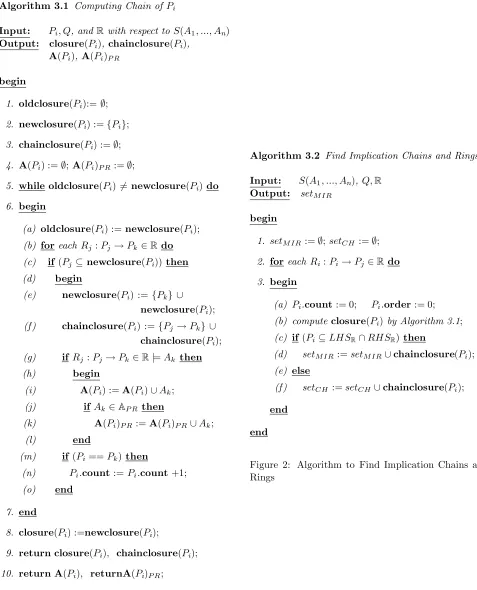
Algorithm 3.1 takes as the input: a given queryQ, a given query predicatePi, and a set of rulesRwith re-spect to schemaS(A1, A2, ..., An). The algorithm com-putes an inference chainPi−→∗ Pj, 1≤i=j+ 1≤m, for a givenPiwith respect to a given queryQ. The com-putation of an inference chain at Step 6c is based on the Armstrong Inference Axiom IA3, the transitive rule. Step 6g to 6l compute both the attributesAk ∈ AP R andAk∈Aimplied by the predicatesPj∈Rj. Step 6m will test if the derived inference chain forms a ring Pi ←→∗ Pj, 1 ≤i = j+ 1 ≤m. If a ring Pi ←→∗ Pj,
1≤i=j+ 1≤m, is found, then the access to all the attributes in A(Pi), 1 ≤ i ≤ m, will be restricted in order to prevent any attribute values in the ring from disclosure. If a chain Pi −→∗ Pj, 1 ≤ i = j+ 1 ≤ m is found, then the attribute Aj−1 ∈ AP U will be re-stricted for the attributeAj ∈AP Rwith respect to the inference chainPi−→∗ Pj, 1≤i=j+ 1≤m.
Algorithm 3.1 Computing Chain ofPi
Input: Pi, Q, and Rwith respect toS(A1, ..., An)
Output: closure(Pi),chainclosure(Pi),
A(Pi),A(Pi)P R
begin
1. oldclosure(Pi):=∅;
2. newclosure(Pi) :={Pi};
3. chainclosure(Pi) :=∅;
4. A(Pi) :=∅;A(Pi)P R:=∅;
5. while oldclosure(Pi) =newclosure(Pi) do
6. begin
(a) oldclosure(Pi) :=newclosure(Pi);
(b) foreach Rj :Pj→Pk∈R do
(c) if(Pj⊆newclosure(Pi))then
(d) begin
(e) newclosure(Pi) := {Pk} ∪
newclosure(Pi);
(f ) chainclosure(Pi) :={Pj→Pk} ∪
chainclosure(Pi);
(g) ifRj:Pj→Pk ∈R|=Ak then
(h) begin
(i) A(Pi) :=A(Pi)∪Ak;
(j) ifAk∈AP R then
(k) A(Pi)P R:=A(Pi)P R∪Ak;
(l) end
(m) if(Pi==Pk)then
(n) Pi.count:=Pi.count+1;
(o) end
7. end
8. closure(Pi) :=newclosure(Pi);
9. return closure(Pi), chainclosure(Pi);
10. return A(Pi), returnA(Pi)P R;
end
Figure 1: Algorithm to Computing Chain ofPi
Algorithm 3.2 Find Implication Chains and Rings
Input: S(A1, ..., An),Q,R
Output: setMIR
begin
1. setMIR:=∅; setCH :=∅;
2. foreach Ri:Pi→Pj∈Rdo
3. begin
(a) Pi.count:= 0; Pi.order:= 0;
(b) computeclosure(Pi)by Algorithm 3.1;
(c) if(Pi⊆LHSR∩RHSR)then
(d) setMIR:=setMIR∪chainclosure(Pi);
(e) else
(f ) setCH :=setCH∪chainclosure(Pi);
end
[image:5.612.66.543.70.660.2]end
results achieved from Algorithm 3.2 will be used for the corresponding prevention actions inTrigger4.1 to be presented in Section 4.
4
The Active Approach
For a given active model based system such as:
T ={E,C,KB,AC}
AC is a set of actions and defined as:
Q× C × KB −→ AC
whereAC={ACb,ACp},ACbis the set of prior actions before an event Q∈Q⊆ E can proceed, andACp set of post actions afterQ∈Q⊆ E is processed.
4.1
The Before Action
AC
bWhen a queryQis issued, the active modelT will take a proactive action AC ∈ ACb before query Q can be processed. AC ∈ ACb will invoke Algorithm Algo-rithm3.2 to detect the inference mutual inference rings and chains. If a chain of inference rules is found such as:
P1−→∗ Pn|=Aj ∈AP R,
where 1≤i=j−1≤n,
then the access to Ai ∈ A, Ai Pi ∈ Ri will be re-stricted in order to preserve the privacy ofAP R.
If a ring of inference is found such as:
P1←→∗ Pn |=Aj ∈AP R,
where 1≤i < j≤n,
then the access to all the attributes Ai ∈ A, Ai Pi will be restricted.
The active triggerTrigger4.1 inFigure3 will take the initial action to check the given queryQat Step 3a, and process query Q correspondingly at Step 3b, Step 3c, and Step 3d.
Trigger 4.1 Checking Possible Disclosure
Input: S(A1, ..., An),Q,R
Output: setMIR
begin
1. EVENT: Qon databaser(S)
2. CONDITION:if ∃Ai∈AP R⊆S(A1, ..., An), 1≤i≤n
3. ACTION:
(a) invoke Algorithm 3.2 to detectPi−→∗ Pj and Pi←→∗ Pj,1≤i < j≤n;
(b) ifPi−→∗ Pj &|=Aj∈AP R then
restrict the access toAi∈A,AiPi;
(wherei=j−1)
(c) ifPi←→∗ Pj &|=Aj ∈AP R then
restrict the access toAi∈APi,∀1≤i≤n;
(d) if∀Ai Qare resstricted,thenrejectQ;
4. processQwith restriction on Ai in 3a and 3b;
end
4.2
The Post Action
AC
pThere are many actions inACpthat can be taken after a query passes the testing inACb.One of majorACp is to keep track of query patterns by various data mining approaches. It is important to discover the association and correlations between AP U and AP R in the set of observed queries [1]. The higher ratio of association and correlations betweenAP U andAP Rshould trigger great attention and further actions. Mining query patterns is a broad subject area and will be considered for the future research.
5
Conclusions and Discussions
This paper has demonstrated an active model to detect possible disclosure of sensitive and private attribute val-ues. The active approach mainly addresses a single rule inference, a chain type rule inference, and a ring type rule inference with respect to the type of functional de-pendency rules and generalized rules from different per-spectives. The proposed algorithms detects the chains and rings, and the corresponding actions taken will limit the access to the private attribute values. Fur-ther, the post process will use data mining approach to find the patterns of query access for the future access control policy making.
6
Acknowledgments
The author would like to express sincere thanks to Dean and Dr. Edward Lieblein, faculty, and staff of Gradu-ate School of Computer and Information Sciences, Nova Southeastern University.
References
[1] R. Agrawal, A. Evfimievski, J. Keirnan, and R. Velu, “Auditing Disclosure by Relevance Rank-ing,” in Proceedings of 2007 ACM SIGMOD In-ternational Conference on Management of Data, pp. 79-90, 2007.
[2] R. Agrawal, J. Keirnan, R. Srikant, and Y. R. Xu, “Hippocratic Databases,” in Proceedings of 28th International Conference on Very Large Data Bases, Hong Kong, China, pp. 143-154, 2002.
[3] W. W. Armstrong, “Dependency Structures of Data Base Relationships,” inProceedings of IFIP Congress, pp. 580-583, 1974.
[4] E. Bertino and R. Sandhu, “Database Security -Concepts, Approaches, and Chanllenges,” inIEEE Transactions on Dependable and Secure Comput-ing, Vol. 2, No. 1, pp. 2-19, 2005.
[5] S. Castano, M. Fugini, G. Martella, and P. Sama-rati.Database Security(Eds), ACM Press, 1994.
[6] K. LeFevre, R. Agrawal, V. Ercegovac, R. Ramakr-ishnan, Y. R. Xu, D. DeWitt, “Limiting Disclo-sure in Hippocratic Databases,” inProceedings of 30thInternational Conference on Very Large Data Bases, Toronto, Canada, pp. 108-119, 2004.