Index Terms—Web information retrieval, software agent. Abstract—This paper presents an enhanced holistic information retrieval (IR) system that aims to automate the entire process of Web-based IR. The system consists of three types of agents: 1) ontology-enhanced Web browsing agents (WBAs) that are used to autonomously browse and scan multiple Websites to determine and rate the relevance of Websites, 2) Web monitoring agents (WMAs) that are used for tracking and reporting changes in selected Websites, and 3) price watcher agents (PWAs) that monitor product prices from competing suppliers’ Websites. WBAs perform information filtering by considering three relevance metrics: ontological relations, frequency, and nearness of keywords. The general idea of Website monitoring is that each WMA is programmed to download a new copy of a Website and compare it with the old copy. WMAs allow users to specify monitoring rules, and provide user interface for specifying patterns and data to be monitored. PWAs invoke the functionalities of WBAs and WMAs for browsing and monitoring multiple Websites displaying different prices of a product. Whereas empirical results show that WBAs are likely to rate the relevance of Website with a small degree of error, proof-of-concept examples demonstrate the major functionalities of WMAs and PWAs.
I. INTRODUCTION
Web users searching for information are often overwhelmed with very large numbers of URLs returned from search engines. Whereas many of the URLs are often quite relevant, it is not uncommon that irrelevant Websites containing query keywords are among the suggested URLs because words can have several meanings (senses). For example, a typical user using Google search to search for Websites about “mountain chain” may find the
URL
Manuscript received November 27, 2008. This work was supported by the DASAN Project (GIST International Faculty Start-up Fund) from the Gwangju Institute of Science and Technology, South Korea.
Kwang Mong Sim is with the Gwangju Institute of Science and Technology, South Korea (phone: 82-62-970-2235; fax: 82-62-970-2204; e-mail: kmsim@ gist.ac.kr).
Paul C. K. Kwok is with the School of Science and Technology, Open University of Hong Kong (e-mail: [email protected]).
1 This query was executed on Google on November 18, 2008. This may
change due to changes in the Website or Google.
, which contains words such as “chain” (as in bicycle chain). Consulting WORDNET [1], “chain” has several senses (meanings). One of the senses of chain refers to “a series of (usually metal) rings or links fitted into one another to make a flexible ligament” and another refers to “a series of hills or mountains”. In such situation, one
possible solution is to program a software agent to distinguish between relevant and irrelevant URLs by searching for evidence phrases by consulting an ontology [2]. Evidence phrases may include ontologically related words such as synonym, hyponym, hypernym, meronym, and holonym. For example, Websites containing words such as “Adirondack Mountains” and “Alaska Range ” (a hyponym of mountain chain) are more likely to contain relevant information about mountain chain than a Website with words like “anchor chain ” and “tire chain” (a hyponym of “iron chain ”).
Furthermore, even though users can use search engines to locate URLs and program software agents to autonomously browse selected Website(s), they still need to repeatedly and regularly visit the Websites to retrieve up-to-date information. Due to the ever-changing content of Webpages, tracking the changing contents of Websites may be tedious and time-consuming. Examples of Websites with ever-changing contents include financial Websites that display stock prices and Websites of retail companies that display prices of computer products and accessories. It is not uncommon that investors constantly visit multiple financial Websites and continuously monitor stock prices, and analyze stock trends. One way of assisting such users is to build software tools that visit selected Websites to monitor and track changes in the contents of these Websites. Additionally, software agents for bolstering price comparisons among multiple Websites selling the same product may also be useful tools for retailers and e-shoppers.
The objective of this project is to develop a holistic information retrieval (IR) system (section II) that augments the functionalities of existing search engines by supporting the following:
1. Autonomous filtering of contents in Websites,
2. Regularly monitoring and reporting (selected) changes in Websites, and
3. Regularly comparing and reporting product prices from competing suppliers.
This project is designed to support the information gathering activities in Ellis’ model [3] that are not supported by existing search engines. Ellis’ model [3] of information gathering includes 1) activities that form initial search for information by following and linking to other information sources, 2) browsing (scanning information source), 3) differentiating (filtering and selecting among the sources), 4) monitoring (regularly following a particular source) and 5) extracting (identifying materials of interest from some sources). Whereas activity (1) is supported by existing search engines, the enhanced holistic IR system in this project is designed to bolster activities (2) through (5). To this end, this project complements and augments the functionalities of existing search engines. In particular, it is reminded here that
An Enhanced Holistic
Information Retrieval System
this project does not compete with existing search engines and is certainly not designed to replace existing search engines, but rather to supplement their functionalities.
II. AHOLISTIC IR SYSTEM
This section presents the prototype of an enhanced holistic IR system consisting of three types of agents: 1) Web Browsing Agents (WBAs), 2) Web Monitoring Agents (WMAs), and 3) Price Watcher Agents (PWAs).
Web Browsing Agent: A WBA supports a user by
bolstering activities (2) and (3) of Ellis’ model of information gathering (section I). That is, it performs the following tasks: i) browsing and scanning the information contents of a Website and ii) determining the relevance of and rating the contents in a Website. Based on Sim’s previous works [4-6], details of the functionalities of a WBA are given in section III.
Web Monitoring Agent: A WMA supports a user by
bolstering activities (4) and (5) of Ellis’ model of information gathering (section I). It carries out the following tasks: 1) regularly monitoring a selected Website and tracking changes in the Website, and 2) identifying and reporting selected changes in the contents of the Website that it is monitoring.
Price Watcher Agent: A PWA supports a user by invoking
a search engine to search for Websites containing the prices of a product, 2) deploying multiple WBAs for determining and rating the relevance of a list of Websites displaying that product, 3) deploying multiple WMAs for monitoring changes in product prices in multiple Websites, and 4) displaying in ascending order the prices of that product from different Websites.
Stages of Information Gathering: The stages of the
information gathering process are listed and described as follows:
1. Locating Information Resources. This is typically the first step that a user would do when searching for information through the Web – compose a query using a set of keywords, then enter the query to a search engine.
2. Browsing and Evaluating Selected Websites. When a search engine returns a set of URLs, multiple WBAs are deployed to simultaneously visit and browse the contents of the set of URLs and verify if the contents are relevant to a query. This corresponds to the second step that a user would typically do – visiting, browsing, and deciding if the contents of the URLs are relevant.
3. Monitoring Changes in Selected Websites. In this stage, a set of WMAs is activated to monitor and track changes in selected relevant URLs. This stage corresponds to a user bookmarking a set of favorite URLs and perhaps repeatedly visiting the URL to retrieve updated and ever-changing information (e.g., stock prices).
III. WEB BROWSING AGENT
A WBA carries out two functions : 1) information filtering and 2) information rating.
Information Filtering : In this stage, a WBA adopts WORDNET’s ontology [1] for determining the relevance of a Website. This is achieved by constructing a set of evidence phrases for a user query by considering ontological relations from WORDNET such as meronym and holonym. Meronym and holonym refer to the part-whole relations of words [7].
Whereas a meronym is the name of a constituent part of a concept, a holonym is the name of the whole of which the meronym is a part (i.e., P1 is a meronym of Q1 if P1 is a part of
Q1, and Q2 is a holonym of P2 if P2 is a part of Q2) [1]. Furthermore, in WORDNET, some of the categories of meronym relations include :
1) part mernonym : P1 is a part meronym of Q1 if P1 is a
component part of Q1. Example Query Word: battery
Part Meronym(s) : electrode, pole (terminal). 2) member meronym : P1 is a member meronym of Q1 if P1 is
a member of Q1
Example Query Word : Forest Member Meronym(s) : tree
3) substance meronym: P1 is a substance meronym of Q1 if P1 is the stuff thatQ1 is made of.
Example Query Word : chalk
Substance Meronym(s) : calcium carbonate
When filtering relevant URLs, a WBA examines the content of a URL for meronyms of a query word by consulting WORDNET. Given that each word can have different senses, an irrelevant URL is identified by searching for meronyms of query keywords of other senses. For instance, to identify an irrelevant Webpage for the query “battery” (in the sense of “electric battery”), the WBA filters out Webpages with meronyms such as “gun” and “missile launcher” which are meronyms of battery in the sense of gunnery. An example of an irrelevant Webpage containing the keyword “battery” for the query “battery” (in the sense of “electric battery”) is shown in Fig.1. Fig. 1 shows a Webpage of “battery” in sense of gunnery. Such an irrelevant Webpage can be identified when a WBA searches for phrases such as “missile launcher” and “gun”. To verify that a Webpage is relevant to the query “battery” in the sense of “electric battery”, a WBA should search for evidence phrases such as “electrode” and “pole” (meronyms of electric battery). If a Webpage is determined to be relevant, a WBA proceeds to rate the Webpage.
Information Rating : A WBA rates the information contents in a Website by considering 3 heuristic factors: 1) ontologically related words, 2) frequency of occurrence, and 3) nearness of keywords.
(1) By searching for ontologically related words in a Webpage, a WBA is more likely to detect information related to a query. To ensure high precision, the heuristic in [5, p. 96] is used to guide a WBA in identifying relevant information of different degrees.
Fig. 1. An Irrelevant Webpage for a Query Search IV. WEB MONITORING AGENT
A WMA carries out two functions : 1) monitors changes in a Webpage, and 2) extracts specific information from a Webpage periodically. The general idea of information monitoring is to download a new copy of a Website and compare it with the old copy. An algorithm for monitoring changes in a table within a Website is given in algorithm 1 [4,6].
Algorithm 1:
1. Retrieve the Webpage from the given URL at time t as a string of characters S(t).
2. Extract all tables from S(t) as {T1,T2, …, Tn}. For each Tx in S(t), Tx contains a set of cells {c1,1,c1,2,…, cr,c}
3. Let Value(cx,y,t) return the value of cx,y at time t and Type(cx,y, t) be the data type of the cx,y at time t that can either be a string or numeric type. If Value(cx,y, t) only contains digits , period(“.”) and comma(“,”), it is assumed that Value(cx,y , t) is numeric. All other values are considered as string.
4. Select a cell, cx,y ,from {c1,1,c1,2,c1,3,…} to monitor changes.
5. If the Type(cx,y , t) is string, report changes if Value (cx,y ,
tn+1) is different from Value (cx,y , tn). This is accomplished by comparing the strings at tn and tn+1.
6. If the Type(cx,y , t) is numeric, report changes if
%
)
t
,
(c
Value
)
t
,
(c
Value
)
t
,
(c
Value
n y x,
n y x, 1
n y x,
n
>
+
where n is a user defined threshold
Monitoring rules : In a WMA, each monitoring task can be represented by a task script using monitoring rules. Some of the monitoring rules in a WMA are given as follows :
R1 : If (modified()) notify(); R2 : If (modified()) download(); R3 : If (new(2)>2.0) notify(); R4 : If (new(2)-old(2)>=0.1) notify()
R1 (respectively, R2) simply specifies that the WBA should notify a user (e.g., by sending email) (respectively, download the Webpage to local disk instead of notifying the user) if there is any changes in a Webpage. Used in conjunction with a pattern, the functions old() and new() in R3 and R4 refer to the old and new values of the data associated to a pattern. For instance, if a user instructs a WMA to monitor the value of a stock called “tom.com” (see section VI) then in R3 and R4, “2” inside the functions old() and new() is a marker that points to a data value associated to the pattern “tom.com”, i.e., “2” refers to the stock price of “tom.com” displayed in the Webpage that the WMA is monitoring.
[image:3.595.310.554.366.544.2]Whereas regular expression is used for specifying the instructions for a WMA to extract specific information from a Website, a user interface is developed to allow a user to specify : 1) the pattern that a WMA should monitor and the message it should display (Fig. 2), 2) the interval for monitoring the Webpage (Fig. 3), and 3) the position of the data that is associated with a pattern (Fig. 4).
[image:3.595.226.539.579.765.2]Fig. 2. WMA User Interface : Pattern to Monitor
Fig. 4. WMA Pattern Builder Interface.
V. EXPERIMENTATION AND EVALUATION
[image:4.595.46.291.385.752.2]Evaluation of the WBA consisted of 1) user study, and 2) a series of experiments using the WBA for rating the same set of URLs rated by human users. For user study, two human users were asked to rate the relevance of the top 5 URLs returned by Google for 100 queries. Using a WBA to rate the relevance of contents in URLs, two series of experiments were conducted [4-6]. For the first series of experiments, the WBA was programmed to incrementally recognize exact words, synonyms, hyponyms, and hypernyms (see Table I). The second series of experiments examined the effect of using five different combinations of weightings of the three heuristics in section III: 1) ontological related words (OR), 2) frequency of occurrence (FO), and 3) nearness of keywords (NK) (see Table II).
Table I. WBA Combination of Related Terms Simulation Word relations
WBA1 {Exact words}
WBA2 {Exact words} + {synonyms}
WBA3 {Exact words, synonyms} + {hyponyms} WBA4 {Exact words, synonyms, hyponyms} +
{hypernyms}
Table II. Weightings of the 3 Heuristic Weight
combination
s OR FO NK Difference between
users and WBA ratings 1 0.6 0.2 0.2 29% 2 0.34 0.33 0.33 16% 3 0.5 0.25 0.25 21% 4 0.6 0.3 0.1 29% 5 0.4 0.4 0.3 18%
Fig. 5. Differences in User and WBA Ratings
Empirical results : Empirical results obtained show that in the first series of experiments, a WBA adopting WBA4 (i.e., scanning a Webpage for exact words, synonyms, hyponyms and hypernyms) achieved the minimum mean square error (MSE) relative to human users’ rating when rating the relevance of Websites. Whereas space limitations preclude all results from being included here, the results showing the MSE between users and the WBA in the experiments when the WBA searched for related words using exact words, synonyms, hyponyms and hypernyms (i.e., WBA4) and when the WBA only searched for exact words (i.e., WBA1) is shown in Fig. 5. The results showing that WBA4 attained lower MSEs than WBA1 suggest that a WBA is more likely to reduce its error in rating URLs if it is programmed to recognize related words including exact words, synonyms, hyponyms and hypernyms. For the five combinations of weightings shown in Table II, empirical results in the second series of experiments show that the WBA achieved the minimum MSE when it adopted combination 2 in Table II. This generally suggests that a WBA is more likely to reduce its error in rating URLs if it is programmed to place almost equal emphasis on all the three heuristics (OR, FO and NK).
VI. PROOF-OF-CONCEPT EXAMPLES
Two examples are provided in this section to illustrate the major functionalities of WMAs and PWAs.
Example 1: A WMA was deployed to monitor the changing value of the data value associated with “stock.com” in a Webpage shown in Fig. 6.
Fig. 6. A Website to be monitored
Step 1: In this example, the stock value of tom.com will be monitored, and the user enters the pattern to be monitored
(i.e., “tom.com”) and the
URL
using the interface screen shown in Fig. 7.
Last trading price Stock to be
[image:4.595.310.554.422.679.2]Step 2: Subsequently, the user uses the pattern builder interface of the WMA to specify the location of the data value associated with “tom.com”. In Fig. 6, it can be seen that the data value (i.e., “2.10”) of “tom.com” and the pattern “tom.com” is separated by 1) some whitespaces (this is represented in regular expression in Fig. 8 as “\s*”, i.e., zero or more whitespace(s)), and 2) a sequence of characters followed by at least one space character (this is represented in regular expression in Fig. 8 as “\S+\s+”). In Fig. 8, “(\S+\s+)” represents the data value to be monitored.
Step 3: The user specifies the monitoring rule using a WMA’s script builder shown in Fig. 9. The instruction in Fig. 9 indicates that the WMA should notify the user if the stock value of tom.com is above 2.
Step 4: The user specifies the monitoring interval using a WMA’s schedule interface shown in Fig. 3.
[image:5.595.304.543.49.236.2]Step 5: When the stock value of tom.com is above 2, the WMA notifies the user as shown in Fig. 10.
[image:5.595.304.544.481.734.2]Fig. 7. WMA Task Specification Interface.
Fig. 8. WMA Pattern Builder Interface
Fig. 9. WMA Script Builder Interface
Fig. 10. WMA Notifies User
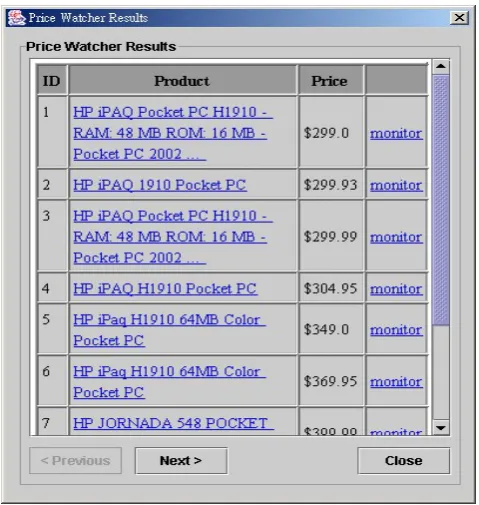
Example 2: A PWA supports a user by invoking a search engine to search for the price of a HP Pocket PC, deploying WBAs to browse and determine the relevance of a list of Websites displaying HP Pocket PC, deploying WMAs to monitor changes in the prices of HP Pocket PC in selected Websites then displaying in ascending order the prices of HP Pocket PC from different suppliers’ Websites (Fig. 11).
[image:5.595.45.285.501.637.2]VII. DISCUSSION AND CONCLUSION
This paper has presented an enhanced holistic IR system. It serves the emphasis to mention that the system in this project is not designed to replace or compete with existing search engines. Rather, it is designed to augment and complement the functionalities of existing search engines.
The novel features of this project are as follows. Multiple WBAs can be deployed in parallel to simultaneously visit, browse, and scan the information contents of multiple Websites and autonomously determine and rate the relevance of the contents in multiple Websites. Multiple WMAs can be deployed in parallel to simultaneously monitor, track, and report changes in multiple Websites. Whereas preliminary ideas of holistic IR were reported in [4,6], this work extends the work in [4,6] as follows. Whereas the information filtering agents in [4,6] only rate the relevance of Webpages by considering exact words, hyponyms, and hypernyms, WBAs in this work 1) consider meronyms and holonyms when determining the relevance of Webpages and 2) consider exact words, hyponyms, and hypernyms when scanning and rating the relevance of Webpages. Whereas only the general algorithm of Webpage monitoring was presented in [4,6], WMAs in this work are built with user interfaces for specifying information monitoring rules, pattern and data value to be monitored and schedule for monitoring. Additionally, PWAs were not considered in [4-6]. PWAs in this work can be viewed as “meta-software- agents” invoking on the functionalities of WBAs and WMAs for browsing and monitoring multiple Websites containing prices of a product.
ACKNOWLEDGMENT
Thanks to Chan Siu Man and Cheung Ting Yee for carrying out the implementations.
REFERENCES
[1] G.A. Miller. WORDNET: An On-line Lexical Database. International Journal of Lexicography 3-4, pages 235-312.
[2] N. Fridman and C. Hafner. The State of the Art in Ontology Design. AI Magazine, Fall 1997, pp. 53-74.
[3] D. Ellis. “A Behavioral Model for Information Retrieval System Design”. J. of Documentation, vol. 49, no. 4, pp. 356-369, 1989. [4] K. M. Sim and P.T. Wong. Towards Agency and Ontology for
Web-based Information Retrieval. IEEE Transactions on Systems, Man and Cybernetics, Part C: Applications and Reviews, Vol. 34, No. 3, 2004, pp. 1-13.
[5] K. M. Sim. Toward an Ontology-enhanced Information Filtering Agent. ACM SIGMOD Record, Vol 33, No. 1, March 2004, pp. 95-100.
[6] K. M. Sim. “Towards Holistic Web-based Information Retrieval: An Agent-based Approach”. In Proc. of the 2003 IEEE/WIC Int. Conf. Of Web Intelligence, pp. 39-46.
[7] Winston P. and Chaffin R. A Taxonomy of Part-Whole Relations. Cognitive Science, No. 11, pp. 417-44, 1987.
[8] G. Salton. Automatic Text Processing. Addison Wesley, 1989. [9] D. L. McGuinness. Ontological Issues for Knowledge-Enhanced