Unsupervised Multilingual Learning for POS Tagging
Benjamin Snyder and Tahira Naseem and Jacob Eisenstein and Regina Barzilay Computer Science and Artificial Intelligence Laboratory
Massachusetts Institute of Technology 77 Massachusetts Ave., Cambridge MA 02139
{bsnyder, tahira, jacobe, regina}@csail.mit.edu
Abstract
We demonstrate the effectiveness of multilin-gual learning for unsupervised part-of-speech tagging. The key hypothesis of multilin-gual learning is that by combining cues from multiple languages, the structure of each be-comes more apparent. We formulate a hier-archical Bayesian model for jointly predicting bilingual streams of part-of-speech tags. The model learns language-specific features while capturing cross-lingual patterns in tag distri-bution for aligned words. Once the parame-ters of our model have been learned on bilin-gual parallel data, we evaluate its performance on a held-out monolingual test set. Our evalu-ation on six pairs of languages shows consis-tent and significant performance gains over a state-of-the-art monolingual baseline. For one language pair, we observe a relative reduction in error of 53%.
1 Introduction
In this paper, we explore the application of multilin-gual learning to part-of-speech tagging when no an-notation is available. This core task has been studied in an unsupervised monolingual framework for over a decade and is still an active area of research. In this paper, we demonstrate the effectiveness of multilin-gual learning when applied to both closely related and distantly related language pairs. We further ana-lyze the language features which lead to robust bilin-gual performance.
The fundamental idea upon which our work is based is that the patterns of ambiguity inherent in
part-of-speech tag assignments differ across lan-guages. At the lexical level, a word with part-of-speech tag ambiguity in one language may corre-spond to an unambiguous word in the other lan-guage. For example, the word “can” in English may function as an auxiliary verb, a noun, or a regular verb. However, each of the corresponding functions in Serbian is expressed with a distinct lexical item. Languages also differ in their patterns of structural ambiguity. For example, the presence of an article in English greatly reduces the ambiguity of the suc-ceeding tag. In Serbian, a language without articles, this constraint is obviously absent. The key idea of multilingual learning is that by combining cues from multiple languages, the structure of each becomes more apparent.
While multilingual learning can address ambigu-ities in each language, it must be flexible enough to accommodate cross-lingual variations such as tag inventory and syntactic structure. As a result of such variations, two languages often select and order their tags differently even when expressing the same meaning. A key challenge of multilingual learning is to model language-specific structure while allow-ing information to flow between languages.
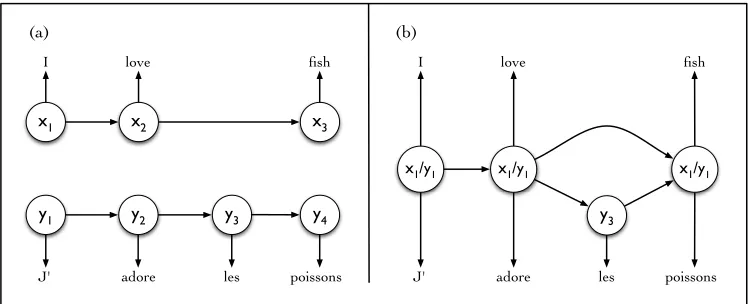
We jointly model bilingual part-of-speech tag se-quences in a hierarchical Bayesian framework. For each word, we posit a hidden tag state which gen-erates the word as well as the succeeding tag. In addition, the tags of words with common seman-tic or syntacseman-tic function in parallel sentences are combined into bilingual nodes representing the tag pair. These joined nodes serve as anchors that cre-ate probabilistic dependencies between the tag
quences in each language. We use standard tools from machine translation to discover aligned word-pairs, and thereafter our model treats the alignments as observed data.
Our model structure allows language-specific tag inventories. Additionally, it assumes only that the tags at joined nodes are correlated; they need not be identical. We factor the conditional probabilities of joined nodes into two individual transition probabil-ities as well as a coupling probability. We define priors over the transition, emission, and coupling parameters and perform Bayesian inference using Gibbs sampling and the Metropolis-Hastings algo-rithm.
We evaluate our model on a parallel corpus of four languages: English, Bulgarian, Serbian, and Slovene. For each of the six language pairs, we train a bilingual model on this corpus, and evaluate it on held-out monolingual test sets. Our results show consistent improvement over a monolingual baseline for all languages and all pairings. In fact, for one language pair – Serbian and Slovene – the error is reduced by over 53%. Moreover, the multilingual model significantly reduces the gap between unsu-pervised and suunsu-pervised performance. For instance, in the case of Slovene this gap is reduced by 71%. We also observe significant variation in the level of improvement across language pairs. We show that a cross-lingual entropy measure corresponds with the observed differentials in performance.
2 Related Work
Multilingual Learning A number of approaches
for multilingual learning have focused on induc-ing cross-linduc-ingual structures, with applications to machine translation. Examples of such efforts include work on the induction of synchronous grammars (Wu and Wong, 1998; Chiang, 2005) and learning multilingual lexical resources (Genzel, 2005).
Another thread of work using cross-lingual links has been in word-sense disambiguation, where senses of words can be defined based on their trans-lations (Brown et al., 1991; Dagan et al., 1991; Resnik and Yarowsky, 1997; Ng et al., 2003).
When annotations for a task of interest are avail-able in a source language but are missing in the
target language, the annotations can be projected across a parallel corpus (Yarowsky et al., 2000; Diab and Resnik, 2002; Pad´o and Lapata, 2006; Xi and Hwa, 2005). In fact, projection methods have been used to train highly accurate part-of-speech taggers (Yarowsky and Ngai, 2001; Feldman et al., 2006). In contrast, our own work assumes that an-notations exist for neither language.
Finally, there has been recent work on applying unsupervised multilingual learning to morphologi-cal segmentation (Snyder and Barzilay, 2008). In this paper, we demonstrate that unsupervised mul-tilingual learning can be successfully applied to the sentence-level task of part-of-speech tagging.
Unsupervised Part-of-Speech Tagging Since
the work of Merialdo (1994), the HMM has been the model of choice for unsupervised tagging (Banko
and Moore, 2004). Recent advances in these
approaches include the use of a fully Bayesian HMM (Johnson, 2007; Goldwater and Griffiths, 2007). In very recent work, Toutanova and John-son (2008) depart from this framework and propose an LDA-based generative model that groups words through a latent layer of ambiguity classes thereby leveraging morphological features. In addition, a number of approaches have focused on develop-ing discriminative approaches for unsupervised and semi-supervised tagging (Smith and Eisner, 2005; Haghighi and Klein, 2006).
Our focus is on developing a simple model that effectively incorporates multilingual evidence. We view this direction as orthogonal to refining mono-lingual tagging models for any particular language.
3 Model
We propose a bilingual model for unsupervised part-of-speech tagging that jointly tags parallel streams of text in two languages. Once the parameters have been learned using an untagged bilingual parallel text, the model is applied to a held-out monolingual test set.
I love fish
J' adore les poissons
x1
y1
x2
y2 y3 y4
x3
I love fish
J' adore les poissons
x1/y1 x1/y1 x1/y1
y3
(a) (b)
Figure 1: (a) Graphical structure of two standard monolingual HMM’s. (b) Graphical structure of our bilingual model based on word alignments.
language barrier, while respecting language-specific idiosyncrasies such as tag inventory, selection, and order. We assume that for pairs of words that share similar semantic or syntactic function, the associ-ated tags will be statistically correlassoci-ated, though not necessarily identical. We use such word pairs as the bilingual anchors of our model, allowing cross-lingual information to be shared via joint tagging de-cisions. We use standard tools from machine trans-lation to identify these aligned words, and thereafter our model treats them as fixed and observed data. To avoid cycles, we remove crossing edges from the alignments.
For unaligned parts of the sentence, the tag and word selections are identical to standard monolin-gual HMM’s. Figure 1 shows an example of the bilingual graphical structure we use, in comparison to two independent monolingual HMM’s.
We formulate a hierarchical Bayesian model that exploits both language-specific and cross-lingual patterns to explain the observed bilingual sentences. We present a generative story in which the observed words are produced by the hidden tags and model parameters. In Section 4, we describe how to in-fer the posterior distribution over these hidden vari-ables, given the observations.
3.1 Generative Model
Our generative model assumes the existence of two tagsets,T andT′
, and two vocabulariesW andW′
, one of each for each language. For ease of exposi-tion, we formulate our model with bigram tag
de-pendencies. However, in our experiments we used a trigram model, which is a trivial extension of the model discussed here and in the next section.
1. For each tag t ∈ T, draw a transition distri-bution φt over tags T, and an emission distri-butionθtover wordsW, both from symmetric Dirichlet priors.1
2. For each tagt ∈ T′, draw a transition
distri-butionφ′
tover tagsT′, and an emission distri-butionθ′
tover wordsW′, both from symmetric Dirichlet priors.
3. Draw a bilingual coupling distribution ω over tag pairs T ×T′ from a symmetric Dirichlet
prior.
4. For each bilingual parallel sentence:
(a) Draw an alignmenta from an alignment distribution A (see the following para-graph for formal definitions ofaandA), (b) Draw a bilingual sequence of
part-of-speech tags (x1, ..., xm), (y1, ..., yn) ac-cording to:
P(x1, ..., xm, y1, ..., yn|a, φ, φ′, ω). 2 This joint distribution is given in equa-tion 1.
1The Dirichlet is a probability distribution over the simplex,
and is conjugate to the multinomial (Gelman et al., 2004). 2
Note that we use a special end state rather than explicitly modeling sentence length. Thus the values ofmandndepend
[image:3.612.119.494.57.209.2](c) For each part-of-speech tagxi in the first language, emit a word fromW:ei∼θxi, (d) For each part-of-speech tagyj in the
sec-ond language, emit a word fromW′:f
j ∼ θ′
yj.
We define an alignment a to be a set of one-to-one integer pairs with no crossing edges. Intuitively, each pair (i, j) ∈ aindicates that the wordsei and fj share some common role in the bilingual paral-lel sentences. In our experiments, we assume that alignments are directly observed and we hold them fixed. From the perspective of our generative model, we treat alignments as drawn from a distributionA, about which we remain largely agnostic. We only require thatAassign zero probability to alignments which either: (i) align a single index in one language to multiple indices in the other language or (ii) con-tain crossing edges. The resulting alignments are thus one-to-one, contain no crossing edges, and may be sparse or even possibly empty. Our technique for obtaining alignments that display these properties is described in Section 5.
Given an alignmentaand sets of transition param-etersφandφ′
, we factor the conditional probability of a bilingual tag sequence (x1, ...xm), (y1, ..., yn) into transition probabilities for unaligned tags, and joint probabilities over aligned tag pairs:
P(x1, ..., xm, y1, ..., yn|a, φ, φ′, ω) =
Y
unalignedi
φxi−1(xi) ·
Y
unalignedj φ′
yj−1(yj)·
Y
(i,j)∈a
P(xi, yj|xi−1, yj−1, φ, φ′, ω)
(1)
Because the alignment contains no crossing edges, we can model the tags as generated sequen-tially by a stochastic process. We define the dis-tribution over aligned tag pairs to be a product of each language’s transition probability and the cou-pling probability:
P(xi, yj|xi−1, yj−1, φ, φ ′
, ω) =
φxi−1(xi)φ ′
yj−1(yj)ω(xi, yj)
Z (2)
The normalization constant here is defined as:
Z =X
x,y
φxi−1(x)φ ′
yj−1(y)ω(x, y)
This factorization allows the language-specific tran-sition probabilities to be shared across aligned and unaligned tags. In the latter case, the addition of the coupling parameterωgives the tag pair an addi-tional role: that of multilingual anchor. In essence, the probability of the aligned tag pair is a product of three experts: the two transition parameters and the coupling parameter. Thus, the combination of a high probability transition in one language and a high probability coupling can resolve cases of inher-ent transition uncertainty in the other language. In addition, any one of the three parameters can “veto” a tag pair to which it assigns low probability.
To perform inference in this model, we predict the bilingual tag sequences with maximal probabil-ity given the observed words and alignments, while integrating over the transition, emission, and cou-pling parameters. To do so, we use a combination of sampling-based techniques.
4 Inference
The core element of our inference procedure is Gibbs sampling (Geman and Geman, 1984). Gibbs sampling begins by randomly initializing all unob-served random variables; at each iteration, each ran-dom variableziis sampled from the conditional dis-tributionP(zi|z−i), wherez−irefers to all variables other thanzi. Eventually, the distribution over sam-ples drawn from this process will converge to the unconditional joint distribution P(z) of the unob-served variables. When possible, we avoid explic-itly sampling variables which are not of direct inter-est, but rather integrate over them—this technique is known as “collapsed sampling,” and can reduce variance (Liu, 1994).
We sample: (i) the bilingual tag sequences(x,y), (ii) the two sets of transition parameters φand φ′
, and (iii) the coupling parameterω. We integrate over the emission parametersθ andθ′
, whose priors are Dirichlet distributions with hyperparametersθ0 and
θ′
0. The resulting emission distribution over words
and the emission priorθ0, can easily be derived as:
P(ei|x,e−i, θ0) = Z
θxi
θxi(ei)P(θxi|θ0)dθxi
= n(xi, ei) +θ0 n(xi) +Wxiθ0
(3)
Here, n(xi) is the number of occurrences of the tagxiinx−i,n(xi, ei)is the number of occurrences of the tag-word pair(xi, ei)in(x−i,e−i), andWxi is the number of word types in the vocabulary W
that can take tag xi. The integral is tractable due to Dirichlet-multinomial conjugacy (Gelman et al., 2004).
We will now discuss, in turn, each of the variables that we sample. Note that in all cases we condi-tion on the other sampled variables as well as the observed words and alignments, e, f and a, which are kept fixed throughout.
4.1 Sampling Part-of-speech Tags
This section presents the conditional distributions that we sample from to obtain the part-of-speech tags. Depending on the alignment, there are several scenarios. In the simplest case, both the tag to be sampled and its succeeding tag are not aligned to any tag in the other language. If so, the sampling distribution is identical to the monolingual case, in-cluding only terms for the emission (defined in equa-tion 3), and the preceding and succeeding transi-tions:
P(xi|x−i,y,e,f, a, φ, φ′, ω, θ0, θ0′)∝
P(ei|x,e−i, θ0)φxi−1(xi)φxi(xi+1).
For an aligned tag pair (xi, yj), we sample the identity of the tags jointly. By applying the chain rule we obtain terms for the emissions in both lan-guages and a joint term for the transition probabili-ties:
P(xi, yj|x−i,y−j,e,f, a, φ, φ
′
, ω, θ0, θ0′)∝
P(ei|x,e−i, θ0)P(fj|y,f−j, θ′0)
P(xi, yj|x−i,y−j, a, φ, φ
′, ω )
The expansion of the joint term depends on the alignment of the succeeding tags. In the case that
the successors are not aligned, we have a product of the bilingual coupling probability and four transition probabilities (preceding and succeeding transitions in each language):
P(xi, yj|x−i,y−j, a, φ, φ′, ω)∝
ω(xi, yj)φxi−1(xi)φ ′
yj−1(yj)φxi(xi+1)φ ′ yj(yj+1)
Whenever one or more of the succeeding tags is aligned, the sampling formulas must account for the effect of the sampled tag on the joint probability of the succeeding tags, which is no longer a sim-ple multinomial transition probability. We give the formula for one such case—when we are sampling an aligned tag pair(xi, yj), whose succeeding tags
(xi+1, yj+1)are also aligned to one another:
P(xi, yj|x−i,y−j, a, φ, φ′, ω)∝ω(xi, yj)
·φxi−1(xi)φ ′ yj−1(yj)
"
φxi(xi+1)φ′yj(yj+1) P
x,yφxi(x)φy′j(y)ω(x, y) #
Similar equations can be derived for cases where the succeeding tags are not aligned to each other, but to other tags.
4.2 Sampling Transition Parameters and the Coupling Parameter
When computing the joint probability of an aligned tag pair (Equation 2), we employ the transition pa-rametersφ,φ′and the coupling parameterωin a
nor-malized product. Because of this, we can no longer regard these parameters as simple multinomials, and thus can no longer sample them using the standard closed formulas.
Instead, to resample these parameters, we re-sort to the Metropolis-Hastings algorithm as a sub-routine within Gibbs sampling (Hastings, 1970). Metropolis-Hastings is a Markov chain sampling technique that can be used when it is impossible to directly sample from the posterior. Instead, sam-ples are drawn from a proposal distribution and then stochastically accepted or rejected on the basis of: their likelihood, their probability under the proposal distribution, and the likelihood and proposal proba-bility of the previous sample.
does depend on the previous model likelihood. More formally, if we denote the proposal distribution as
Q(z), the target distribution asP(z), and the previ-ous sample asz, then the probability of accepting a new samplez∗∼Qis set at:
min
1,P(z
∗)Q(z)
P(z)Q(z∗)
Theoretically any non-degenerate proposal distri-bution may be used. However, a higher acceptance rate and faster convergence is achieved when the proposalQis a close approximation ofP. For a par-ticular transition parameter φx, we define our pro-posal distributionQto be Dirichlet with parameters set to the bigram counts of the tags following xin the sampled tag data. Thus, the proposal distribu-tion forφxhas a mean proportional to these counts, and is thus likely to be a good approximation to the target distribution.
Likewise for the coupling parameter ω, we de-fine a Dirichlet proposal distribution. This Dirichlet is parameterized by the counts of aligned tag pairs
(x, y) in the current set of tag samples. Since this sets the mean of the proposal to be proportional to these counts, this too is likely to be a good approxi-mation to the target distribution.
4.3 Hyperparameter Re-estimation
After every iteration of Gibbs sampling the hyper-parametersθ0andθ0′ are re-estimated using a single Metropolis-Hastings move. The proposal distribu-tion is set to a Gaussian with mean at the current value and variance equal to one tenth of the mean.
5 Experimental Set-Up
Our evaluation framework follows the standard pro-cedures established for unsupervised part-of-speech tagging. Given a tag dictionary (i.e., a set of possi-ble tags for each word type), the model has to select the appropriate tag for each token occurring in a text. We also evaluate tagger performance when only in-complete dictionaries are available (Smith and Eis-ner, 2005; Goldwater and Griffiths, 2007). In both scenarios, the model is trained only using untagged text.
In this section, we first describe the parallel data and part-of-speech annotations used for system eval-uation. Next we describe a monolingual base-line and our procedures for initialization and hyper-parameter setting.
Data As a source of parallel data, we use Orwell’s
novel “Nineteen Eighty Four” in the original English as well as translations to three Slavic languages — Bulgarian, Serbian and Slovene. This data is dis-tributed as part of the Multext-East corpus which is publicly available. The corpus provides detailed morphological annotation at the world level, includ-ing part-of-speech tags. In addition a lexicon for each language is provided.
We obtain six parallel corpora by considering all pairings of the four languages. We compute word level alignments for each language pair using Giza++. To generate one-to-one alignments at the word level, we intersect the one-to-many alignments going in each direction and automatically remove crossing edges in the order in which they appear left to right. This process results in alignment of about half the tokens in each bilingual parallel corpus. We treat the alignments as fixed and observed variables throughout the training procedure.
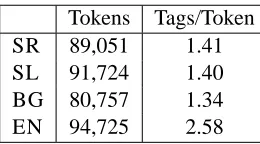
The corpus consists of 94,725 English words (see Table 2). For every language, a random three quar-ters of the data are used for learning the model while the remaining quarter is used for testing. In the test set, only monolingual information is made available to the model, in order to simulate future performance on non-parallel data.
Tokens Tags/Token
SR 89,051 1.41
SL 91,724 1.40
BG 80,757 1.34
EN 94,725 2.58
Table 2: Corpus statistics: SR=Serbian, SL=Slovene, EN=English, BG=Bulgarian
Tagset The Multext-East corpus is manually
[image:6.612.360.490.505.577.2]Random Monolingual Unsupervised Monolingual Supervised Trigram Entropy
EN 56.24 90.71 96.97 1.558
BG 82.68 88.88 96.96 1.708
SL 84.70 87.41 97.31 1.703
[image:7.612.95.516.58.127.2]SR 83.41 85.05 96.72 1.789
Table 1: Monolingual tagging accuracy for English, Bulgarian, Slovene, and Serbian for two unsupervised baselines (random tag selection and a Bayesian HMM (Goldwater and Griffiths, 2007)) as well as a supervised HMM. In addition, the trigram part-of-speech tag entropy is given for each language.
in our experiments.3
In the Multext-East corpus, punctuation marks are not annotated. We expand the tag repository by defining a separate tag for all punctuation marks. This allows the model to make use of any transition or coupling patterns involving punctuation marks. We do not consider punctuation tokens when com-puting model accuracy.
Table 2 shows the tag/token ratio for these lan-guages. For Slavic languages, we use the tag dic-tionaries provided with the corpus. For English, we use a different process for dictionary construc-tion. Using the original dictionary would result in the tag/token ratio of 1.5, in comparison to the ra-tio of 2.3 observed in the Wall Street Journal (WSJ) corpus. To make our results on English tagging more comparable to previous benchmarks, we expand the original dictionary of English tags by merging it with the tags from the WSJ dictionary. This process results in a tag/token ratio of 2.58, yielding a slightly more ambiguous dictionary than the one used in pre-vious tagging work.4
Monolingual Baseline As our monolingual
base-line we use the unsupervised Bayesian HMM model of Goldwater and Griffiths (2007) (BHMM1). This model modifies the standard HMM by adding pri-ors and by performing Bayesian inference. Its is in line with state-of-the-art unsupervised models. This model is a particulary informative baseline, since our model reduces to this baseline model when there are no alignments in the data. This implies that any performance gain over the baseline can only be
at-3
The remaining two tags are Particle and Determiner; The English tagset does not include Particle while the other three languages Serbian, Slovene and Bulgarian do not have
Deter-miner in their tagset.
4
We couldn’t perform the same dictionary expansion for the Slavic languages due to a lack of additional annotated resources.
tributed to the multilingual aspect of our model. We used our own implementation after verifying that its performance on WSJ was identical to that reported in (Goldwater and Griffiths, 2007).
Supervised Performance In order to provide a
point of comparison, we also provide supervised re-sults when an annotated corpus is provided. We use the standard supervised HMM with Viterbi decod-ing.
Training and Testing Framework Initially, all
words are assigned tags randomly from their tag dictionaries. During each iteration of the pler, aligned tag pairs and unaligned tags are sam-pled from their respective distributions given in Sec-tion 4.1 above. The hyperparametersθ0 andθ′0 are initialized with the values learned during monolin-gual training. They are re-estimated after every iter-ation of the sampler using the Metropolis Hastings algorithm. The parameters φ and φ′
are initially set to trigram counts and theω parameter is set to tag pair counts of aligned pairs. After every 40 it-erations of the sampler, a Metropolis Hastings sub-routine is invoked that re-estimates these parameters based on the current counts. Overall, the algorithm is run for 1000 iterations of tag sampling, by which time the resulting log-likelihood converges to stable values. Each Metropolis Hastings subroutine sam-ples 20 values, with an acceptance ratio of around 1/6, in line with the standard recommended values.
6 Results
Complete Tag Dictionary In our first experiment,
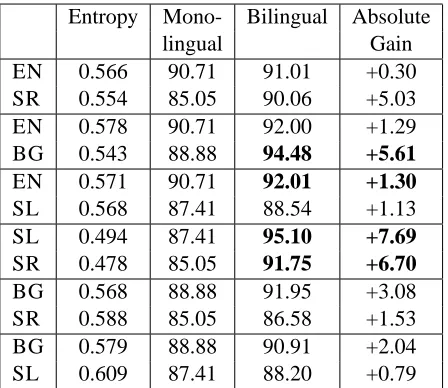
we assume that a complete dictionary listing the pos-sible tags for every word is provided in each lan-guage. Table 1 shows the monolingual results of a random baseline, an unsupervised Bayesian HMM and a supervised HMM. Table 3 show the results of our bilingual models for different language pair-ings while repeating the monolingual unsupervised results from Table 1 for easy comparison. The final column indicates the absolute gain in performance over this monolingual baseline.
Across all language pairs, the bilingual model consistently outperforms the monolingual baseline. All the improvements are statistically significant by a Fisher sign test at p < 0.05. For some lan-guage pairs, the gains are quite high. For instance, the pairing of Serbian and Slovene (two closely re-lated languages) yields absolute improvements of 6.7 and 7.7 percentage points, corresponding to rel-ative reductions in error of 51.4% and 53.2%. Pair-ing Bulgarian and English (two distantly related lan-guages) also yields large gains: 5.6 and 1.3 percent-age points, corresponding to relative reductions in error of 50% and 14%, respectively.5
When we compare the best bilingual result for each language (Table 3, in bold) to the monolin-gual supervised results (Table 1), we find that for all languages the gap between supervised and un-supervised learning is reduced significantly. For En-glish, this gap is reduced by 21%. For the Slavic lan-guages, the supervised-unsupervised gap is reduced by even larger amounts: 57%, 69%, and 78% for Serbian, Bulgarian, and Slovene respectively.
While all the languages benefit from the bilin-gual learning framework, some language combina-tions are more effective than others. Slovene, for in-stance, achieves a large improvement when paired with Serbian (+7.7), a closely related Slavic lan-guage, but only a minor improvement when coupled
5The accuracy of the monolingual English tagger is
rela-tively high compared to the 87% reported by (Goldwater and Griffiths, 2007) on the WSJ corpus. We attribute this discrep-ancy to the slight differences in tag inventory used in our data-set. For example, when Particles and Prepositions are merged in the WSJ corpus (as they happen to be in our tag inventory and corpus), the performance of Goldwater’s model on WSJ is similar to what we report here.
Entropy Mono- Bilingual Absolute
lingual Gain
EN 0.566 90.71 91.01 +0.30
SR 0.554 85.05 90.06 +5.03
EN 0.578 90.71 92.00 +1.29
BG 0.543 88.88 94.48 +5.61
EN 0.571 90.71 92.01 +1.30
SL 0.568 87.41 88.54 +1.13
SL 0.494 87.41 95.10 +7.69
SR 0.478 85.05 91.75 +6.70
BG 0.568 88.88 91.95 +3.08
SR 0.588 85.05 86.58 +1.53
BG 0.579 88.88 90.91 +2.04
[image:8.612.316.540.56.250.2]SL 0.609 87.41 88.20 +0.79
Table 3: The tagging accuracy of our bilingual models on different language pairs, when a full tag dictionary is provided. The Monolingual Unsupervised results from Table 1 are repeated for easy comparison. The first col-umn shows the cross-lingual entropy of a tag when the tag of the aligned word in the other language is known. The final column shows the absolute improvement over the monolingual Bayesian HMM. The best result for each language is shown in boldface.
anal-Mono- Bilingual Absolute
lingual Gain
EN 63.57 68.22 +4.66
SR 41.14 54.73 +13.59
EN 63.57 71.34 +7.78
BG 53.19 62.55 +9.37
EN 63.57 66.48 +2.91
SL 49.90 53.77 +3.88
SL 49.90 59.68 +9.78
SR 41.14 54.08 +12.94
BG 53.19 54.22 +1.04
SR 41.14 56.91 +15.77
BG 53.19 55.88 +2.70
[image:9.612.99.274.54.252.2]SL 49.90 58.50 +8.60
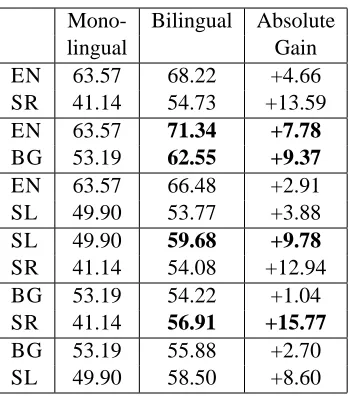
Table 4: Tagging accuracy for Bilingual models with re-duced dictionary: Lexicon entries are available for only the 100 most frequent words, while all other words be-come fully ambiguous. The improvement over the mono-lingual Bayesian HMM trained under similar circum-stances is shown. The best result for each language is shown in boldface.
ysis are given in the first column of Table 3. We ob-serve that the cross-lingual entropy is lowest for the Serbian and Slovene pair, corresponding with their large gain in performance. Bulgarian, on the other hand, has lowest cross-lingual entropy when paired with English. This corresponds with the fact that English provides Bulgarian with its largest perfor-mance gain. In general, we find that the largest per-formance gain for any language is achieved when minimizing its cross-lingual entropy.
Reduced Tag Dictionary We also conducted
ex-periments to investigate the impact of the dictio-nary size on the performance of the bilingual model. Here, we provide results for the realistic scenario where only a very small dictionary is present. Ta-ble 4 shows the performance when a tag dictionary for the 100 most frequent words is present in each language. The bilingual model’s results are consis-tently and significantly better than the monolingual baseline for all language pairs.
7 Conclusion
We have demonstrated the effectiveness of multilin-gual learning for unsupervised part-of-speech tag-ging. The key hypothesis of multilingual
learn-ing is that by combinlearn-ing cues from multiple lan-guages, the structure of each becomes more appar-ent. We formulated a hierarchical Bayesian model for jointly predicting bilingual streams of tags. The model learns language-specific features while cap-turing cross-lingual patterns in tag distribution. Our evaluation shows significant performance gains over a state-of-the-art monolingual baseline.
Acknowledgments
The authors acknowledge the support of the National Science Foundation (CAREER grant IIS-0448168 and grant IIS-0835445) and the Microsoft Research Faculty Fellowship. Thanks to Michael Collins, Amir Glober-son, Lillian Lee, Yoong Keok Lee, Maria Polinsky and the anonymous reviewers for helpful comments and sug-gestions. Any opinions, findings, and conclusions or rec-ommendations expressed above are those of the authors and do not necessarily reflect the views of the NSF.
References
Michele Banko and Robert C. Moore. 2004. Part-of-speech tagging in context. In Proceedings of the
COL-ING, pages 556–561.
Peter F. Brown, Stephen A. Della Pietra, Vincent J. Della Pietra, and Robert L. Mercer. 1991. Word-sense dis-ambiguation using statistical methods. In Proceedings
of the ACL, pages 264–270.
David Chiang. 2005. A hierarchical phrase-based model for statistical machine translation. In Proceedings of
the ACL, pages 263–270.
Ido Dagan, Alon Itai, and Ulrike Schwall. 1991. Two languages are more informative than one. In
Proceed-ings of the ACL, pages 130–137.
Mona Diab and Philip Resnik. 2002. An unsupervised method for word sense tagging using parallel corpora. In Proceedings of the ACL, pages 255–262.
Anna Feldman, Jirka Hana, and Chris Brew. 2006. A cross-language approach to rapid creation of new morpho-syntactically annotated resources. In
Pro-ceedings of LREC, pages 549–554.
Andrew Gelman, John B. Carlin, Hal .S. Stern, and Don-ald .B. Rubin. 2004. Bayesian data analysis. Chap-man and Hall/CRC.
S. Geman and D. Geman. 1984. Stochastic relaxation, Gibbs distributions, and the Bayesian restoration of images. IEEE Transactions on Pattern Analysis and
Dmitriy Genzel. 2005. Inducing a multilingual dictio-nary from a parallel multitext in related languages. In
Proceedings of HLT/EMNLP, pages 875–882.
Sharon Goldwater and Thomas L. Griffiths. 2007. A fully Bayesian approach to unsupervised part-of-speech tagging. In Proceedings of the ACL, pages 744–751.
Aria Haghighi and Dan Klein. 2006. Prototype-driven learning for sequence models. Proceedings of
HLT-NAACL, pages 320–327.
W. K. Hastings. 1970. Monte carlo sampling meth-ods using Markov chains and their applications.
Biometrika, 57:97–109.
Mark Johnson. 2007. Why doesn’t EM find good HMM POS-taggers? In Proceedings of EMNLP/CoNLL, pages 296–305.
Jun S. Liu. 1994. The collapsed Gibbs sampler in Bayesian computations with applications to a gene regulation problem. Journal of the American
Statis-tical Association, 89(427):958–966.
Bernard Merialdo. 1994. Tagging english text with a probabilistic model. Computational Linguistics,
20(2):155–171.
Hwee Tou Ng, Bin Wang, and Yee Seng Chan. 2003. Ex-ploiting parallel texts for word sense disambiguation: an empirical study. In Proceedings of the ACL, pages 455–462.
Sebastian Pad´o and Mirella Lapata. 2006. Optimal con-stituent alignment with edge covers for semantic pro-jection. In Proceedings of ACL, pages 1161 – 1168. Philip Resnik and David Yarowsky. 1997. A perspective
on word sense disambiguation methods and their eval-uation. In Proceedings of the ACL SIGLEX Workshop
on Tagging Text with Lexical Semantics: Why, What, and How?, pages 79–86.
Noah A. Smith and Jason Eisner. 2005. Contrastive esti-mation: Training log-linear models on unlabeled data. In Proceedings of the ACL, pages 354–362.
Benjamin Snyder and Regina Barzilay. 2008. Unsuper-vised multilingual learning for morphological segmen-tation. In Proceedings of the ACL/HLT, pages 737– 745.
Kristina Toutanova and Mark Johnson. 2008. A Bayesian lda-based model for semi-supervised part-of-speech tagging. In Advances in Neural Information
Processing Systems 20, pages 1521–1528. MIT Press.
Dekai Wu and Hongsing Wong. 1998. Machine trans-lation with a stochastic grammatical channel. In
Pro-ceedings of the ACL/COLING, pages 1408–1415.
Chenhai Xi and Rebecca Hwa. 2005. A backoff model for bootstrapping resources for non-english languages. In Proceedings of EMNLP, pages 851 – 858.
David Yarowsky and Grace Ngai. 2001. Inducing mul-tilingual pos taggers and np bracketers via robust pro-jection across aligned corpora. In Proceedings of the
NAACL, pages 1–8.
David Yarowsky, Grace Ngai, and Richard Wicentowski. 2000. Inducing multilingual text analysis tools via ro-bust projection across aligned corpora. In Proceedings